|
시장보고서
상품코드
2125697
테이블 램프 및 플로어 램프 시장 : 시장 점유율 분석, 업계 동향 및 통계, 성장 예측(2026-2031년)Table And Floor Lamps - Market Share Analysis, Industry Trends & Statistics, Growth Forecasts (2026 - 2031) |
||||||
 Mordor Intelligence
Mordor Intelligence에 의하면, 2026년 테이블 램프 및 플로어 램프 시장 규모는 264억 1,000만 달러로 추정되고, 2025년 252억 4,000만 달러에서 성장하여 2031년에는 330억 8,000만 달러에 이를 것으로 예측됩니다.
2026-2031년 연평균 성장률(CAGR)은 4.62%를 나타낼 전망입니다.
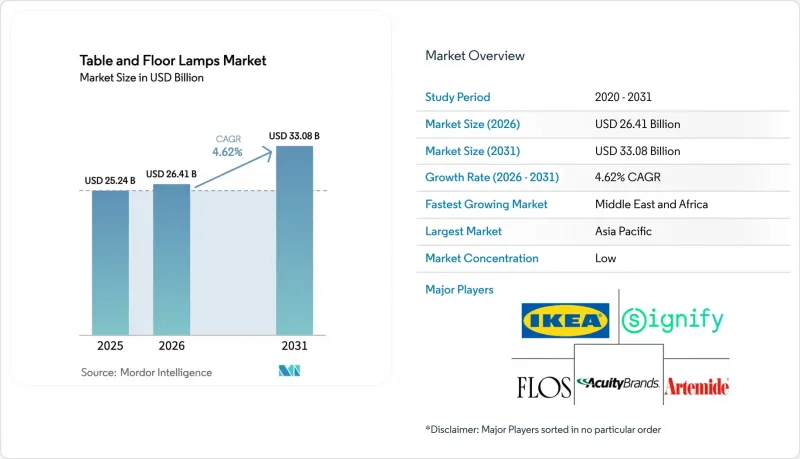
본 보고서는 제품 유형별(테이블 램프, 플로어 램프, 기타), 소재별(금속, 목재, 기타), 최종 사용자별(주거용, 상업용, 기타), 유통 채널별(오프라인, 온라인), 지역별(북미, 남미, 아시아태평양, 유럽, 중동 및 아프리카)로 분류되어 있습니다. 시장 전망은 금액(달러) 기준으로 제시되어 있습니다.
세계의 테이블 램프 및 플로어 램프 시장 동향 및 인사이트
스마트 홈 생태계의 보급에 따른 커넥티드 램프 수요 증가
조명과 IoT가 융합되는 최전선에 서 있는 커넥티드 조명 기구는 테이블 램프 및 플로어 램프 시장을 단순한 장식용 제품에서 음성, 재실 여부, 보안 신호에 반응하는 상호작용형 노드로 변화시키고 있습니다. 소비자들은 음성 비서나 모바일 대시보드와의 원활한 연동을 기대하고 있으며, 상호 운용성은 더 이상 사치품이 아닌 기본 요건이 되었습니다. 그 가치는 단순히 켜고 끄거나 밝기 조절에 그치지 않고, 일주기 리듬에 동기화된 색온도 조정, 주변 센서 정보를 기반으로 한 적응형 조도 제어, 에너지 절약으로 이어지는 예측적 사용 현황 분석에도 있습니다. 이러한 기능 덕분에 클라우드 기반 장면 라이브러리 및 원격 진단에 대한 높은 평균 판매 가격과 구독 수익이 정당화되어, 이익률을 향상시키는 동시에 고객을 브랜드 생태계에 충실하게 만들 수 있습니다. 데스크 램프 카테고리는 지식 근로자들이 눈의 피로를 줄이고 생산적인 집중 시간을 연장하기 위해 세밀한 제어를 요구하고 있기 때문에 특히 큰 혜택을 받고 있습니다. 각 브랜드는 현재 미래를 내다보며 업그레이드 가능한 무선 칩과 개방형 API를 통합하고 있어, 램프를 일회용 가전제품이 아닌 수명이 긴 플랫폼으로 변화시키고 있습니다.
LED 내장 장식용 램프의 보급 확대
LED 기술의 성숙으로 인해 기존에 존재하던 ‘효율과 가격의 상충 관계’가 해소되면서, 테이블 램프와 플로어 램프 시장은 예외 없이 LED가 표준이 되는 방향으로 나아가고 있습니다. LED는 전 세계 램프 판매의 70%를 차지하고 있으며, 2024년에 58억 대에 달할 것으로 예상되는 임박한 2차 교체 수요의 물결로 인해 제품 수명이 연장되고 있음에도 불구하고 판매량은 유지되고 있습니다. 발광 소자의 소형화로 인해 참신한 형태와 초슬림 디자인이 가능해졌으며, 개별 제어 가능한 RGB 어레이를 통해 화면을 스와이프하기만 하면 하나의 램프로 작업용 조명과 휴식용 조명을 전환할 수 있습니다. 제조 비용의 하락으로 인해 현재는 주류 가격대에서 제품을 제공할 수 있게 되었으며, 장식용 LED 제품은 대형 마트나 호텔 및 레스토랑 업계에서도 널리 활용되고 있습니다. 디자이너에게는 유기 소재나 반투명 기판에 내장된 LED 기판이 참신한 표현을 가능하게 하고, 소비자에게는 최고 수준의 색 재현성과 5만 시간의 수명이 만족감을 오래 지속시켜 유지보수 비용 절감으로 이어집니다.
DIY 가구점의 자체 브랜드가 미치는 이익률 압박
대형 소매업체들은 통합된 공급망을 활용하여 허용 가능한 제조 품질을 유지하면서도, 브랜드 제품보다 두 자릿수%나 저렴한 자사 브랜드 램프를 시장에 출시하고 있습니다. IKEA가 시장 점유율 상위 5위권에 위치하고 있다는 사실은 가구 세트를 한꺼번에 판매하는 전략이 전문 브랜드로부터 쇼핑객을 멀어지게 하고 있음을 여실히 보여줍니다. 중견 제조업체들은 압박감을 느끼고 있으며, 제품 포트폴리오 합리화, 지역 철수 전략, 혹은 사모펀드를 통한 자금 조달을 동반한 하류 기업과의 합병을 단행하고 있습니다. Kingswood Capital의 2억 5,600만 달러 규모 투자를 통해 Kichler와 Progress Lighting을 Coleto Brands로 통합한 사례는 규모 확대를 통한 통합이 우선시되는 방어 전략임을 보여줍니다. 유서 깊은 브랜드들은 현재 독자적인 앱 생태계와 디자이너와의 협업을 결합하여 가격 프리미엄을 정당화하고, 이익률 유지를 도모하고 있습니다.
부문 분석
2025년, 책상·작업용 램프는 테이블 램프 및 플로어 램프 시장에서 가장 큰 점유율을 차지하며 매출의 48.62%를 기록했습니다. 이는 고용주와 재택근무자들이 일주기 리듬을 고려한 조명을 중요시하게 되었기 때문입니다. 이 부문의 매출액은 2025년에 122억 7,000만 달러에 달한 것으로 평가되었으며, 분석가들은 하이브리드 근무 방식이 정착됨에 따라 2031년까지 연평균 성장률(CAGR) 3.82%로 꾸준히 성장할 것으로 전망하고 있습니다. 플로어 램프는 여전히 급성장하는 부문으로, 연평균 성장률(CAGR) 14.02%가 예상됩니다. 이는 호텔 및 레스토랑 업계 종사자나 단기 임대 주택 소유주들이 인테리어의 포인트가 되는 조각적인 디자인을 겸비한 조명 기구를 강력히 요구하고 있기 때문입니다. 기존 테이블 램프도, 특히 Wi-Fi 드라이버나 음성 제어 모듈을 추가 장착하여 자동화 기능을 구현할 수 있는 경우 여전히 수요가 있습니다. 액센트 램프, 토치 램프, 틈새 시장인 독서등과 같은 형태는 판매량은 적지만, 노화에 따른 시력 저하나 독창적인 디자인 수요에 대응한 특수한 광학 시스템과 소재 덕분에 건전한 이익률을 유지하고 있습니다. 경쟁 환경의 변화로 인해 다목적 하이브리드형(앰비언트 타워에 작업용 램프 헤드를 장착한 형태)이 촉진되고 있으며, 하나의 SKU로 거실의 공간 연출과 작업 책상에서의 집중 작업이라는 두 가지 요구를 모두 충족할 수 있게 되었습니다. 이러한 범용성 덕분에 미니멀리즘 트렌드가 가구 설치 면적에 영향을 미치는 상황에서도 업셀링 가능성이 유지되고 있습니다.
2세대 스마트 태스크 램프에는 재실 센서, 눈부심 제어 루버, USB-C 충전 도크가 통합되어 있어 책상 위의 어수선함을 해소합니다. 고용주는 웰니스 감사를 통해 조명의 효과를 정량화하고, 스펙트럼의 변화와 웨어러블 기기에서 제공하는 생체 데이터 피드백을 연계함으로써 램프를 참여형 웰빙 자산으로 전환하고 있습니다. 이 부문의 프리미엄 계층은 가격 탄력성이 낮으며, 기업의 구매 담당자는 단가가 아닌 생산성 향상을 기준으로 예산을 배분하고 있습니다. 한편, 대규모 전자상거래 사이트를 통해 판매되는 보급형 책상용 조명 기구는 범용 LED와 플라스틱 하우징에 의존하고 있어, 이익률은 낮지만 판매 대수 측면에서의 잠재력은 매우 큽니다. 책상·작업용 램프, 테이블 램프, 플로어 램프 시장 규모는 2031년까지 153억 6,000만 달러에 육박할 것으로 예상되며, 새로운 카테고리가 부상하는 가운데서도 이 부문의 확고한 우위가 부각되고 있습니다.
2025년에도 금속은 여전히 주요 소재로, 매출의 35.78%를 차지했습니다. 이는 주로 내구성과 LED 열 관리, 폭넓은 미적 선택지를 제공하는 강철 및 알루미늄 구조 덕분입니다. 견고한 공급망과 CNC 가공의 다용도성 덕분에 설계 반복 과정이 효율화되었으며, 브랜드는 브러시 마감과 분체 도장 색상을 조합하여 트렌드에 신속하게 대응할 수 있게 되었습니다. 그럼에도 불구하고, 목재는 지속가능성에 대한 매력 외에도 자연스러운 나뭇결을 돋보이게 하면서 부드러운 잔광을 발산하는 투명하고 야광성을 지닌 목재 패널에 대한 새로운 연구가 주목받고 있어 14.28%라는 가장 높은 연평균 성장률(CAGR)을 보일 것으로 예측됩니다. 이러한 복합 소재는 환경 친화성과 기능적인 발광을 겸비하고 있어, FSC 인증을 통한 조달을 통해 간결하게 전달되는 탄소 발자국 스토리를 중시하는 환경 의식이 높은 밀레니얼 세대에게 매력적입니다.
유리는 조각적인 존재감을 발산하는 램프의 프리미엄 소재로서의 위상을 유지하고 있으며, 그 광학적 투명감과 수작업으로 불어 만든 장인의 기술을 활용해 고급 가격대를 개척하고 있습니다. 또한 유리는 LED의 저발열성이라는 이점도 누리고 있어, 열로 인한 균열을 걱정할 필요 없이 더 얇은 형태를 구현할 수 있습니다. 세라믹은 촉감이 좋은 유약이 개성 있는 마감을 만들어내는 부티크 스튜디오에서 다시 주목받고 있습니다. 소량 생산되는 세라믹 제품은 지역 점토의 전통을 살려, 급성장 중인 ‘슬로우 데코’ 운동과도 조화를 이룹니다. 재활용 플라스틱 합금이나 삼 섬유 유래의 바이오 폴리머는 합리적인 가격대의 제품 라인에 널리 채택되고 있으며, 그 높은 색상 자유도가 계절별 컬러 팔레트에 부응하고 있습니다. 범용 금속 가격이 불안정해지는 가운데, 디자인 팀은 비용 헤지와 장인 정신을 통한 부가가치 향상을 도모하기 위해 금속 프레임에 목재 팔걸이나 등나무 쉐이드를 조합하는 등 복합 소재 전략을 채택하고 있습니다. 업계 선도 기업들은 현재 생애주기 평가(LCA) 결과를 공개하고 있으며, 투명성을 높임으로써 ESG 지표를 중시하는 법인 구매자의 조달 결정에 큰 영향을 미치고 있습니다.
지역별 분석
아시아태평양은 제조 거점의 집중, 경쟁력 있는 인건비, 확대되는 도시 중산층의 소비를 배경으로 2025년에는 매출의 34.11%를 차지하며 테이블 램프 및 플로어 램프 시장을 주도했습니다. 중국이 2024년 1월에 8가지 조명 기준을 도입한 것은 품질과 안전성을 향상시키면서 국내 혁신을 촉진하려는 규제 당국의 노력을 뒷받침합니다. 일본과 한국에서는 음성 비서 지원 조명 시나리오와 좁은 주거 공간에 적합한 초소형 책상 램프에 대한 얼리 어답터층 수요가 두드러집니다. 인도에서는 ‘스마트 시티 미션’ 추진과 가처분 소득 증가로 프리미엄 제품에 대한 수요가 높아지고 있지만, 유통 네트워크가 세분화되어 있어 1급 대도시권 이외 지역으로의 진출에는 과제가 남아 있습니다. 베트남과 인도네시아를 포함한 동남아시아 국가들에서는 호텔·리조트 산업 및 주거용 고층 빌딩 분야의 프로젝트가 가속화되고 있어, 국내외 브랜드 모두에 계약 기회를 제공합니다.
중동 및 아프리카는 걸프 국가들의 메가 프로젝트, 에너지 다각화 전략, 관광 다각화를 목표로 한 견조한 호스피탈리티 부문의 프로젝트 파이프라인에 힘입어, 2031년까지 연평균 성장률(CAGR)이 9.21%로 가장 높은 성장세를 보일 것으로 예측됩니다. 3억 3,600만 달러 규모 시장을 자랑하는 아랍에미리트(UAE)의 조명 부문은 두바이의 솔라 파크 구상이 스마트 LED 조명 도입을 필수 요건으로 하는 건축적 걸작과 시너지 효과를 발휘함으로써 15%의 성장을 목표로 하고 있습니다. 사우디아라비아의 ‘비전 2030’은 문화 허브, 엔터테인먼트 지구, 고급 리조트에 자금을 지원하고 있으며, 이러한 시설에서는 객실 및 공용 라운지용으로 고성능 조명 기구가 요구되고 있습니다. 나이로비에서 라고스에 이르는 아프리카 주요 도시에서는 호텔 시설과 고급 주택의 현대화가 진행되고 있지만, 불안정한 전력 공급으로 인해 LED의 에너지 효율성과 통합형 배터리 백업에 대한 수요가 높아지고 있습니다.
북미에서는 커넥티드 솔루션 도입이 계속해서 활발합니다. 2024년 7월부터 시행되는 미국 에너지부의 조명 기구 에너지 효율 규제 강화에 따라 일체형 LED 조명 기구로의 전환이 가속화되고 있습니다. 소비자들은 스마트 스피커 생태계 전반에 걸친 음성 연동을 적극적으로 수용하고 있으며, 기업의 구매 담당자들은 데이터 중심의 웰니스 시범 사업을 확대되고 있습니다. 유럽 시장은 성숙도 면에서 북미와 유사하지만, 순환 경제 기준이 더욱 엄격해지면서 수리 가능한 모듈이나 인증된 재활용 소재를 제공하는 브랜드가 높이 평가받고 있습니다. 독일과 북유럽 국가에서는 공공 조달 체계 내에서 사용 후 재활용 가능성에 대해 가산점이 부여되면서, 입찰이 모듈식 설계로 유도되고 있습니다. 판매 대수 증가세는 완만하지만, 두 지역 모두 평균 판매 가격이 높으며, Matter와 같은 신흥 제어 프로토콜의 조기 도입이 진행되면서 세계 표준에 대한 영향력을 강화하고 있습니다.
기타 혜택
- 엑셀 형식 시장 예측(ME) 시트
- 3개월간의 애널리스트 지원
목차
제1장 서론
제2장 조사 방법
제3장 주요 요약
제4장 시장 구도
제5장 시장 규모 및 성장 예측
제6장 경쟁 구도
제7장 시장 기회 및 향후 전망
AJYAccording to Mordor Intelligence, the table and floor lamps market size in 2026 is estimated at USD 26.41 billion, growing from 2025 value of USD 25.24 billion with 2031 projections showing USD 33.08 billion, growing at 4.62% CAGR over 2026-2031.
This report is Segmented by Product Type (Table Lamps, Floor Lamps and More), by Material (Metal, Wood, and More), by End-User (Residential, Commercial, and More), by Distribution Channel (Offline and Online) and by Geography (North America, Europe, Asia-Pacific, Latin America, and Middle-East and Africa). The Market Forecasts are Provided in Terms of Value (USD).
Global Table And Floor Lamps Market Trends and Insights
Proliferation of Smart-Home Ecosystems Boosting Connected Lamps
Connected fixtures stand at the forefront where illumination converges with IoT, transforming the table and floor lamps market from commodity decor pieces into interactive nodes that respond to voice, occupancy, and security cues. Consumers expect seamless pairing with voice assistants and mobile dashboards, making interoperability a baseline rather than a luxury. The value comes not just from switching or dimming but from color-temperature tuning that syncs to circadian rhythms, adaptive light levels informed by ambient sensors, and predictive usage analytics that conserve energy. These functions justify higher average selling prices and subscription revenues for cloud-based scene libraries and remote diagnostics, lifting margins while binding customers to brand ecosystems. The desk-lamp category benefits disproportionately, as knowledge workers demand granular control to reduce eye strain and extend productive focus windows. Brands now embed upgradeable wireless chips and open APIs to future-proof purchases, turning lamps into long-life platforms rather than disposable appliances.
Growing Penetration of LED-Integrated Decorative Lamps
LED maturity has erased the historical efficiency-price trade-off, pushing the table and floor lamps market toward unqualified LED standardization. LEDs cover 70% of global lamp sales, and the looming secondary replacement wave-5.8 billion units in 2024-sustains volume even as lifetimes lengthen. Miniaturized emitter footprints unleash daring shapes and ultra-thin profiles, while addressable RGB arrays let one lamp toggle between task brightness and lounge mood at the swipe of a screen. Manufacturing cost curves now allow mainstream price points, making decorative LED pieces accessible in mass retail and hospitality alike. For designers, LED boards embedded in organic or translucent substrates enable fresh narratives; for consumers, top-tier color rendering and 50,000-hour lifespans translate to longer satisfaction cycles and reduced maintenance costs.
Margin Pressure from DIY Furniture-Store Private Labels
Mega-retailers exploit integrated supply chains to debut private-label lamps that undercut branded rivals by double-digit percentages while offering acceptable build quality. IKEA's top-five market status exemplifies how bundled home-furnishing assortments steer shoppers away from specialist brands. Mid-tier producers feel the squeeze, prompting portfolio rationalization, regional exit strategies, or downstream mergers financed by private equity. Kingswood Capital's USD 256 million sweep of Kichler and Progress Lighting into Coleto Brands illustrates that scale consolidation is a preferred defense. Legacy names now couple proprietary app ecosystems and designer collaborations to justify price premiums and shield margin integrity.
Other drivers and restraints analyzed in the detailed report include:
- Rapid Hotel-Room Refurb Cycles in Lifestyle and Boutique Segments
- Workplace Wellness Programs Embracing Circadian-Lighting Task Lamps
- Safety-Code Tightening on Portable Luminaires
For complete list of drivers and restraints, kindly check the Table Of Contents.
Segment Analysis
Desk/task lamps generated the largest slice of the table and floor lamps market in 2025, seizing 48.62% revenue as employers and home workers converge on circadian-aligned illumination. Segment revenue reached USD 12.27 billion in 2025, and analysts project a steady 3.82% CAGR through 2031 as hybrid workflows persist. Floor lamps remain the breakout star, poised for a 14.02% CAGR, because hospitality operators and short-term landlords crave sculptural pieces that double as statement art. Traditional table lamps stay relevant, particularly when retrofitted with Wi-Fi drivers or voice-control modules that enable automation scenes. Accent, torchiere, and niche reading formats maintain modest volume, yet achieve healthy margins thanks to specialized optics and materials that address aging eyesight and design eccentricities. Competitive dynamics encourage multipurpose hybrids-task heads mounted on ambient towers-allowing a single SKU to satisfy living-room ambiance and focused worktop duties. Such versatility sustains upselling potential even as minimalism trends influence furniture footprints.
Second-generation smart task lamps integrate occupancy sensors, glare-control louvers, and USB-C charging docks, streamlining desktop clutter. Employers quantify lighting efficacy via wellness audits, correlating spectrum shifts with biometric feedback from wearables, thereby turning lamps into participatory wellbeing assets. The segment's premium tier enjoys lower price elasticity: corporate buyers allocate budget based on productivity gains rather than unit cost. Conversely, entry-level desk fixtures sold through mass e-commerce lean on commodity LEDs and plastic housings, showing thin margins yet vast unit potential. The table and floor lamps market size for desk/task lamps is set to approach USD 15.36 billion by 2031, underscoring persistent dominance even as newer categories accelerate.
Metal remained the material of choice in 2025, holding 35.78% revenue, primarily through steel and aluminum constructions that grant durability, thermal management for LEDs, and broad aesthetic range. Robust supply chains and CNC versatility streamline design iterations, letting brands combine brushed finishes with powder-coat colors for rapid trend response. Nonetheless, wood posts the highest 14.28% CAGR outlook thanks to sustainability appeal and emerging research on transparent, phosphorescent wood panels that emit soft afterglow while showcasing natural grain. Such composites ally eco-credentials with functional luminosity, attractive to eco-conscious millennials who value carbon narratives simplified through FSC-certified sourcing.
Glass persists as the premium medium for sculptural statement lamps, leveraging optical clarity and hand-blown craftsmanship to tap luxury price bands. Glass also benefits from LED's low heat output, allowing thinner profiles without thermal cracks. Ceramic resurges in boutique studios where tactile glazes produce individualistic finishes; small-batch ceramic runs exploit local clay traditions and align with the burgeoning "slow decor" movement. Recycled plastic alloys and hemp-fiber biopolymers populate budget-friendly lines, their color flexibility supporting seasonal palettes. As commodity metals face price unpredictability, design teams adopt mixed-material strategies-metal frames with wooden arms or rattan shades-to hedge costs and lift perceived artisanal value. Segment leaders now disclose life-cycle assessments, reinforcing transparency and tipping procurement decisions among contract buyers weighing ESG metrics.
Complete Report Scope:
- By Product Type
- Table Lamps
- Floor Lamps
- Desk/Task Lamps
- Accent and Decorative Lamps
- Torchieres and Uplights
- Others
- By Material
- Metal
- Wood
- Glass
- Ceramic
- Plastic and Others
- By End-user
- Residential
- Commercial
- Hospitality
- Offices and Co-working Spaces
- Retail and Restaurants
- Healthcare Facilities
- Educational Institutions
- Others (Commercial)
- Institutional
- Industrial and Others
- By Distribution Channel
- Offline
- Specialty Lighting Stores
- Furniture and Home-center Chains
- Hypermarkets / Department Stores
- Online
- Brand-owned Webstores
- Marketplaces (Amazon, Wayfair, etc.)
- Offline
- By Geography
- North America
- Canada
- United States
- Mexico
- South America
- Brazil
- Peru
- Chile
- Argentina
- Rest of South America
- Asia-Pacific
- India
- China
- Japan
- Australia
- South Korea
- South East Asia (Singapore, Malaysia, Thailand, Indonesia, Vietnam, and Philippines)
- Rest of Asia Pacific
- Europe
- United Kingdom
- Germany
- France
- Spain
- Italy
- BENELUX (Belgium, Netherlands, and Luxembourg)
- NORDICS (Denmark, Finland, Iceland, Norway, and Sweden)
- Rest of Europe
- Middle East and Africa
- United Arab of Emirates
- Saudi Arabia
- South Africa
- Nigeria
- Rest of Middle East And Africa
- North America
Geography Analysis
Asia-Pacific led the table and floor lamps market with 34.11% revenue in 2025 on the back of concentrated manufacturing clusters, competitive labor costs, and expanding urban middle-class consumption. China's introduction of eight lighting standards in January 2024 underscores regulatory drive to elevate quality and safety while encouraging domestic innovation. Japan and South Korea showcase early-adopter appetite for voice-assistant lighting scenes and ultra-compact desk lamps suited to dense living spaces. India's Smart Cities Mission and rising disposable incomes spur premium demand, although fragmented distribution networks pose reach challenges beyond tier-one metros. Southeast Asian economies, including Vietnam and Indonesia, see accelerating project pipelines in hospitality and residential high-rises, generating contract volumes for both domestic and foreign brands.
Middle East & Africa posts the fastest 9.21% CAGR forecast to 2031, propelled by mega-projects in Gulf states, energy diversification strategies, and robust hospitality pipelines targeting tourism diversification. The UAE lighting sector, valued at USD 336 million, targets 15% growth as Dubai's solar-park initiatives dovetail with architectural showpieces that specify smart LED installations. Saudi Arabia's Vision 2030 funds cultural hubs, entertainment districts, and luxury resorts that demand high-spec lamps for guest rooms and public lounges. African metros from Nairobi to Lagos modernize hotel stock and upscale residences, though erratic power supply pushes appetite for LED efficiency and integrated battery backup.
North America continues to display strong adoption of connected solutions; the U.S. Department of Energy's tightened lamp efficiency rules effective July 2024 accelerate the shift toward integrated LED fixtures. Consumers embrace voice synchronization across smart-speaker ecosystems, and corporate buyers scale datacentric wellness pilots. European markets mirror North America in maturity but intensify circular-economy criteria, rewarding brands that offer repairable modules and certified recycled content. In Germany and the Nordics, public procurement frameworks now award points for end-of-life recyclability, steering tenders toward modular designs. Despite slower unit growth, both regions offer high average selling prices and early adoption for emerging control protocols such as Matter, reinforcing their influence on global standards.
- Signify (Philips Lighting)
- IKEA Group
- Acuity Brands Lighting
- FLOS
- Artemide
- Hudson Valley Lighting
- Generation Lighting (Visual Comfort)
- Kichler Lighting
- Eglo Leuchten
- Foscarini
- Lutron Electronics
- Ralph Lauren Home
- Quoizel
- House of Troy
- Adesso Inc.
- Zumtobel Group
- NVC Lighting
- Osram GmbH
- Zaozuo
- Targetti Sankey*
Additional Benefits:
- The market estimate (ME) sheet in Excel format
- 3 months of analyst support
TABLE OF CONTENTS
1 Introduction
- 1.1 Study Assumptions and Market Definition
- 1.2 Scope of the Study
2 Research Methodology
3 Executive Summary
4 Market Landscape
- 4.1 Market Overview
- 4.2 Market Drivers
- 4.2.1 Proliferation of smart-home ecosystems boosting connected lamps
- 4.2.2 Growing penetration of LED-integrated decorative lamps
- 4.2.3 Rapid hotel-room refurb cycles in lifestyle and boutique segments
- 4.2.4 Workplace wellness programs embracing circadian-lighting task lamps
- 4.2.5 Surge in short-term rental hosts demanding statement lighting
- 4.2.6 AI-driven design-to-manufacture platforms enabling micro-brands
- 4.3 Market Restraints
- 4.3.1 Margin pressure from DIY furniture-store private labels
- 4.3.2 Safety-code tightening on portable luminaires (fire and tip-over)
- 4.3.3 Volatility in metal and glass commodity prices
- 4.3.4 Lengthening replacement cycles due to ultra-long-life LEDs
- 4.4 Value / Supply-Chain Analysis
- 4.5 Regulatory Landscape
- 4.6 Technological Outlook
- 4.7 Porter's Five Forces
- 4.7.1 Threat of New Entrants
- 4.7.2 Bargaining Power of Buyers
- 4.7.3 Bargaining Power of Suppliers
- 4.7.4 Threat of Substitutes
- 4.7.5 Competitive Rivalry
5 Market Size and Growth Forecasts
- 5.1 By Product Type
- 5.1.1 Table Lamps
- 5.1.2 Floor Lamps
- 5.1.3 Desk/Task Lamps
- 5.1.4 Accent and Decorative Lamps
- 5.1.5 Torchieres and Uplights
- 5.1.6 Others
- 5.2 By Material
- 5.2.1 Metal
- 5.2.2 Wood
- 5.2.3 Glass
- 5.2.4 Ceramic
- 5.2.5 Plastic and Others
- 5.3 By End-user
- 5.3.1 Residential
- 5.3.2 Commercial
- 5.3.2.1 Hospitality
- 5.3.2.2 Offices and Co-working Spaces
- 5.3.2.3 Retail and Restaurants
- 5.3.2.4 Healthcare Facilities
- 5.3.2.5 Educational Institutions
- 5.3.2.6 Others (Commercial)
- 5.3.3 Institutional
- 5.3.4 Industrial and Others
- 5.4 By Distribution Channel
- 5.4.1 Offline
- 5.4.1.1 Specialty Lighting Stores
- 5.4.1.2 Furniture and Home-center Chains
- 5.4.1.3 Hypermarkets / Department Stores
- 5.4.2 Online
- 5.4.2.1 Brand-owned Webstores
- 5.4.2.2 Marketplaces (Amazon, Wayfair, etc.)
- 5.4.1 Offline
- 5.5 By Geography
- 5.5.1 North America
- 5.5.1.1 Canada
- 5.5.1.2 United States
- 5.5.1.3 Mexico
- 5.5.2 South America
- 5.5.2.1 Brazil
- 5.5.2.2 Peru
- 5.5.2.3 Chile
- 5.5.2.4 Argentina
- 5.5.2.5 Rest of South America
- 5.5.3 Asia-Pacific
- 5.5.3.1 India
- 5.5.3.2 China
- 5.5.3.3 Japan
- 5.5.3.4 Australia
- 5.5.3.5 South Korea
- 5.5.3.6 South East Asia (Singapore, Malaysia, Thailand, Indonesia, Vietnam, and Philippines)
- 5.5.3.7 Rest of Asia Pacific
- 5.5.4 Europe
- 5.5.4.1 United Kingdom
- 5.5.4.2 Germany
- 5.5.4.3 France
- 5.5.4.4 Spain
- 5.5.4.5 Italy
- 5.5.4.6 BENELUX (Belgium, Netherlands, and Luxembourg)
- 5.5.4.7 NORDICS (Denmark, Finland, Iceland, Norway, and Sweden)
- 5.5.4.8 Rest of Europe
- 5.5.5 Middle East and Africa
- 5.5.5.1 United Arab of Emirates
- 5.5.5.2 Saudi Arabia
- 5.5.5.3 South Africa
- 5.5.5.4 Nigeria
- 5.5.5.5 Rest of Middle East And Africa
- 5.5.1 North America
6 Competitive Landscape
- 6.1 Market Concentration
- 6.2 Strategic Moves
- 6.3 Market Share Analysis
- 6.4 Company Profiles (includes Global level Overview, Market level overview, Core Segments, Financials as available, Strategic Information, Market Rank/Share, Products and Services, Recent Developments)
- 6.4.1 Signify (Philips Lighting)
- 6.4.2 IKEA Group
- 6.4.3 Acuity Brands Lighting
- 6.4.4 FLOS
- 6.4.5 Artemide
- 6.4.6 Hudson Valley Lighting
- 6.4.7 Generation Lighting (Visual Comfort)
- 6.4.8 Kichler Lighting
- 6.4.9 Eglo Leuchten
- 6.4.10 Foscarini
- 6.4.11 Lutron Electronics
- 6.4.12 Ralph Lauren Home
- 6.4.13 Quoizel
- 6.4.14 House of Troy
- 6.4.15 Adesso Inc.
- 6.4.16 Zumtobel Group
- 6.4.17 NVC Lighting
- 6.4.18 Osram GmbH
- 6.4.19 Zaozuo
- 6.4.20 Targetti Sankey*
7 Market Opportunities & Future Outlook
- 7.1 White-space & Unmet-need Assessment