

|
시장보고서
상품코드
2125708
저분자 CDMO 시장 : 시장 점유율 분석, 업계 동향 및 통계, 성장 예측(2026-2031년)Small Molecules Contract Development And Manufacturing Organization - Market Share Analysis, Industry Trends & Statistics, Growth Forecasts (2026 - 2031) |
||||||
 Mordor Intelligence
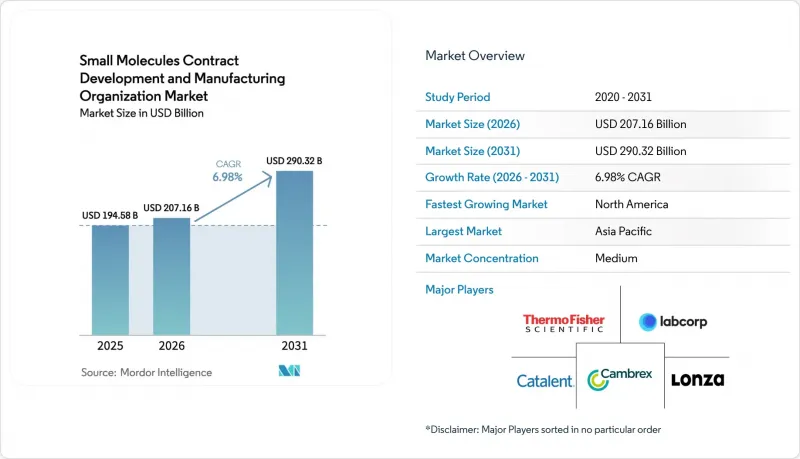
Mordor Intelligence에 의하면, 저분자 CDMO 시장 규모는 2025년 1,945억 8,000만 달러로 평가되었고, 2026년에는 2,071억 6,000만 달러로 추정되고, 2031년까지 2,903억 2,000만 달러에 이를 것으로 예측되며, 2026-2031년 CAGR 6.98%로 성장할 전망입니다.
본 보고서는 서비스 유형별(API 개발, API 제조, 제제 개발, 제제 제조, 제제·분석 서비스), 사업 규모별(전임상, 임상 1-3상, 상용), 치료 분야별(종양학, 심혈관 질환, 기타), 고객 유형별(대형 제약사, 기타), 지역별로 분류되어 있습니다. 시장 예측은 금액(달러) 기준으로 제시되어 있습니다.
세계의 저분자 CDMO 시장 동향 및 인사이트
증가하는 저분자 의약품 연구개발 파이프라인의 아웃소싱
스폰서 기업들은 현재 API 개발의 73%, 제제 제조의 65%를 외부에 위탁하고 있으며, 이는 2023년의 68%와 60%에서 증가한 수치입니다. 이는 사내 체제가 15-20% 축소되었기 때문입니다. 벤처 캐피탈의 지원을 받는 바이오테크 기업들은 자금 유출을 규제상 마일스톤과 연계하는 성과 기반 보상 모델로 몰리고 있으며, 전임상 및 1상 임상시험 자원을 둘러싼 경쟁이 격화되고 있습니다. 2025년 시점에서 2-3상 자산의 40%를 보유한 가상 제약 기업은 실제 제조 시설을 보유하고 있지 않기 때문에 리드타임이 CDMO의 가용 여부에 전적으로 좌우됩니다. 3상에서는 가동률이 이미 85%를 넘어섰기 때문에 스폰서는 수년에 걸친 다각적인 서비스 계약을 체결해야만 하는 조기 예약에 내몰리고 있습니다. 합성, 제제, 시험을 동일한 캠퍼스 내에 집약한 통합형 시설은 분석 데이터 인계에 따른 지연을 없앨 수 있기 때문에 이러한 입찰에서 수주하는 사례가 늘고 있습니다.
제약 산업의 비용 절감을 통한 CDMO 도입 가속화
제조 비용은 제약 기업의 매출액의 평균 25%를 차지하지만, 수율 최적화와 공급망 합리화를 통해 수익원가를 최대 25%까지 절감할 수 있습니다. 2024-2026년 초, 선발 의약품 제조업체들은 18개의 제조 거점을 매각하여 자본을 바이오의약품 사업에 재분배하는 한편, 고정 비용이 낮은 외부 파트너에게 저분자 의약품 제조를 위탁했습니다. 엘리퀴스(Eliquis)와 키트루다(Keytruda)의 특허 만료가 임박함에 따라 그 시급성은 더욱 높아지고 있으며, 판매 수량 약정에 연동된 단계적 가격 책정 계약이 촉진되고 있습니다. 통합형 CDMO-CRO 모델을 통해 개발 기간이 30-40% 단축되어, 자금 조달에 어려움을 겪는 바이오테크 기업의 순현재가치(NPV)가 향상되고 있습니다. 에너지 집약적인 합성 공정은 인도로 이전되고 있으며, 인도의 산업용 전기 요금은 1kWh당 평균 0.07달러인 반면 서유럽은 0.13달러이므로, 저분자 CDMO 시장의 세계적 분산이 더욱 진행되고 있습니다.
생산 능력 부족과 CDMO의 긴 리드타임
2025년 말 기준으로 임상 제조 설비의 가동률은 85%에 달했으며, 리드타임은 최장 24개월까지 늘어났습니다. 코로나19 유행 기간 동안 백신 생산으로 자원이 재분배됨에 따라 저분자 의약품 제조 설비에 구조적인 부족 현상이 발생하고 있으며, 신규 건설을 통해 이러한 부족 현상이 완전히 해소되는 것은 2027년 이후가 될 전망입니다. 듀얼 소싱은 일정상의 위험을 완화하지만, 기술 이전 비용을 최대 50%까지 끌어올리고, 비교 가능성에 관한 신청 절차를 복잡하게 만듭니다. 조립식 플랜트는 리드타임을 12-18개월로 단축하지만, 연간 생산 능력 500kg당 5,000만-8,000만 달러의 비용이 소요되므로, 저분자 CDMO 시장에 신규로 진입하는 기업들에게는 진입 장벽이 되고 있습니다.
부문 분석
제제 및 분석 서비스는 2031년까지 연평균 성장률(CAGR) 7.29%로 확대되어, API 제조의 6.5% 상승률을 상회했습니다. 2025년에도 API 관련 업무는 저분자 CDMO 시장의 41.02%를 차지하고 있으며, 저비용 아시아 공장에 의한 상품화 압력에도 불구하고 핵심인 합성 업무가 여전히 중심적인 위치를 차지하고 있음이 부각되고 있습니다. 현재 부가가치는 원활한 인계로 이동하고 있습니다. 합성, 제제, 품질 관리(QC)를 동일한 거점에서 수행함으로써 개발 일정을 30-40% 단축할 수 있어 조기 수익 창출이 가능해집니다. 연속 흐름 방식의 도입으로 경계가 더욱 모호해지고 있습니다. API 생산 라인에서 직접 실시간으로 과립화가 이루어지기 때문에 고가의 중간 저장 공간이 필요하지 않기 때문입니다.
통합형 캠퍼스는 스폰서가 검증 주기를 단축하는 데 도움이 되며, 이를 통해 지연이 저분자 CDMO 시장 전체에 미치는 악영향을 억제합니다. 분무 건조 분산액, 핫멜트 압출 또는 지질 기반 시스템을 전문으로 하는 CDMO는 본래라면 보류되었을 화합물의 용해성을 향상시킴으로써 25-40%의 가격 인상을 실현하고 있습니다. 한편, 제제 제조는 라이프사이클 관리에 따른 배합 재검토에 힘입어 연평균 성장률(CAGR) 6.8%로 성장을 이어가고 있습니다.
2025년에는 상업적 생산이 매출의 34.27%를 차지하며 가장 큰 비중을 차지했습니다. 그러나 임상 3상 시험 활동은 9.93%라는 가장 높은 연평균 성장률(CAGR)을 기록하고 있으며, 이는 신규 설비 투자(CapEx)를 피하고자 하는 성숙한 생명공학 기업의 동향을 반영하고 있습니다. 2025년에는 3상 임상시험 가동률이 85%를 넘어섰으며, 후원사들은 2년 후까지 슬롯을 예약하고 보증금 요건을 상향 조정함으로써 저분자 CDMO 시장의 파이프라인을 더욱 핍박시키고 있습니다. 론자(Lonza)가 12억 달러를 투자한 바카빌 캠퍼스는 연간 500kg의 후기 단계 생산 능력을 추가하지만, 산업 전반공급 부족은 여전히 총 200-300톤에 달할 전망입니다.
자동화 업그레이드를 통해 상용 생산 라인의 전환 시간이 최대 50% 단축되어, 새로운 시설 건설 없이도 처리 능력이 향상되고 있습니다. 신약 개발 보조금의 회복으로 전임상 및 1상 임상시험 업무도 확대되고 있으나, 여전히 자본 집약도는 낮은 수준입니다.
지역별 분석
북미는 2025년 시장 규모의 39.63%를 차지했으며, BIOSECURE법에 따른 5억 달러 규모의 신규 온쇼어링 프로젝트와 공급망 재편에 힘입어 2031년까지 연평균 성장률(CAGR) 6.4%로 확대될 것으로 전망됩니다. ACG의 애틀랜타 캡슐 공장 및 Cambrex의 아이오와주 API 생산 능력 확대는 국내에서의 회복력 강화로 전환하는 것을 상징하는 사례입니다. 한편, 캐나다와 멕시코는 USMCA(미국·멕시코·캐나다 협정)에 따른 신청 절차 간소화를 통해 임상 수요의 파급 효과를 흡수하고 있습니다. FDA의 모니터링 강화로 인해 2025년에는 국내외 시설에 대해 총 15건의 경고장이 발부되었으며, 규정 준수 기준과 한계 비용이 상향 조정되었습니다.
독일, 스위스, 이탈리아가 생산 능력을 주도하고 있으며, 론자, 지크프리트, 오론은 2024-2025년에 걸쳐 HPAPI 및 연속 흐름 제조 설비 업그레이드에 총 4억 달러를 투자했습니다. 브렉시트와 관련된 이중 신청으로 인해 일부 프로젝트는 아일랜드나 네덜란드로 이동하고 있지만, 동유럽에서는 인건비를 30-40% 절감할 수 있는 반면 인력 부족에 직면해 있습니다. 2025년 EMA가 아시아에서 실시한 42건의 GMP 감사에 따라 품질 심사가 엄격해지면서, 스폰서 기업들은 다시 지역 공급업체로 회귀하는 경향을 보이고 있습니다.
아시아태평양은 성장의 원동력이 되어 연평균 성장률(CAGR) 11.63%로 급성장하고 있으며, 인도가 중국의 대체지로 부상하는 가운데 저분자 CDMO 시장을 확대되고 있습니다. Syngene, Laurus Labs, Neuland 등 3개사는 2024-2025년 미국에서 3억 달러 규모의 신규 계약을 수주한 반면, WuXi AppTec의 수출 성장세는 둔화되어 연평균 성장률(CAGR)이 8.5%에 그쳤습니다. 일본과 한국은 수익성이 높고 기술 주도형 API(원료의약품) 라인에 투자하고 있으며, 삼성바이오로직스는 2027년까지 저분자 부문에 진출할 것으로 예측됩니다. 호주는 연구개발(R&D) 인센티브에 힘입어 초기 단계의 임상 업무를 수주하고 있습니다.
기타 혜택
- 엑셀 형식 시장 예측(ME) 시트
- 3개월간의 애널리스트 지원
자주 묻는 질문
목차
제1장 서론
제2장 조사 방법
제3장 주요 요약
제4장 시장 구도
제5장 시장 규모 및 성장 예측
제6장 경쟁 구도
제7장 시장 기회 및 향후 전망
AJY 26.09.15According to Mordor Intelligence, the small molecules contract development and manufacturing organization market size is expected to increase from USD 194.58 billion in 2025 to USD 207.16 billion in 2026 and reach USD 290.32 billion by 2031, growing at a CAGR of 6.98% over 2026-2031.
This report is Segmented by Service Type (API Development, API Manufacturing, Finished Dose Development, Finished Dose Manufacturing, Formulation & Analytical Services), Scale of Operation (Preclinical, Clinical Phase I-III, Commercial), Therapeutic Area (Oncology, Cardiovascular, and More), Client Type (Big Pharma, and More), and Geography. The Market Forecasts are Provided in Terms of Value (USD).
Global Small Molecules Contract Development And Manufacturing Organization Market Trends and Insights
Rising Small-Molecule R&D Pipeline Outsourcing
Sponsors now outsource 73% of API development and 65% of dose manufacturing, up from 68% and 60% in 2023, as in-house footprints shrink by 15-20%. Venture-backed biotechs flock to contingent payment models that tie cash outflow to regulatory milestones, intensifying competition for preclinical and Phase I slots. Virtual pharma firms, which own 40% of Phase II-III assets as of 2025, have no physical plants, so lead times hinge entirely on CDMO availability. Capacity utilization already exceeds 85% in Phase III, forcing early reservations that lock sponsors into multi-year, multi-service agreements. Integrated campuses that co-locate synthesis, formulation, and testing increasingly win these tenders by eliminating analytical transfer delays.
Pharma Cost-Containment Accelerating CDMO Adoption
Manufacturing consumes 25% of pharma revenue on average, yet yield optimization and supply chain rationalization can reduce COGS by up to 25%. Between 2024 and early 2026, originators divested 18 plants, redeploying capital toward biologics while routing small molecules to external partners with leaner fixed costs. Upcoming patent cliffs for Eliquis and Keytruda amplify urgency, prompting tiered-pricing contracts pegged to volume commitments. Integrated CDMO-CRO models now shave 30-40% off development time, improving asset NPV for cash-constrained biotechs. Energy-intensive syntheses are migrating to India, where industrial power averages USD 0.07 per kWh versus USD 0.13 in Western Europe, reinforcing the small-molecule CDMO market's global dispersion.
Capacity Crunch & Long CDMO Lead Times
Clinical manufacturing slots operated at 85% utilization in late 2025, inflating lead times to as long as 24 months. COVID-19-era redeployments toward vaccines left a structural deficit in small-molecule suites that new builds will not fully close until 2027. Dual-sourcing mitigates schedule risk but lifts tech-transfer costs by up to 50% and complicates comparability filings. Prefabricated plants shorten timelines to 12-18 months, yet demand USD 50-80 million per 500-kg annual capacity, a barrier for smaller entrants in the small-molecule CDMO market.
Other drivers and restraints analyzed in the detailed report include:
- Surge in High-Potency API (HPAPI) Demand
- AI-Driven Process Intensification for Micro-Batch APIs
- Regulatory Non-Compliance / FDA Warning Letters
For complete list of drivers and restraints, kindly check the Table Of Contents.
Segment Analysis
Formulation & analytical services accelerated at a 7.29% CAGR to 2031, outpacing API manufacturing's 6.5% climb. In 2025, API work still accounted for 41.02% of the small-molecule CDMO market, underscoring how core synthesis remains central despite commoditization pressure from low-cost Asian plants. The premium now pivots to seamless hand-offs: co-located synthesis, formulation, and QC can chop 30-40% from development calendars, lifting early-revenue capture. Continuous-flow setups further blur boundaries, as real-time granulation feeds directly from the API output, eliminating the need for expensive intermediate storage.
Integrated campuses help sponsors trim validation cycles, thereby curbing the overall drag on the small-molecule CDMO market from delays. CDMOs specializing in spray-dried dispersions, hot-melt extrusion, or lipid-based systems capture 25-40% pricing mark-ups because they unlock solubility for otherwise shelved compounds. Meanwhile, finished-dose manufacturing continues to grow at a 6.8% CAGR, buoyed by lifecycle-management reformulations.
Commercial operations led revenue with a 34.27% stake in 2025; yet clinical Phase III activities clock the fastest 9.93% CAGR, reflecting a maturing biotech cohort eager to avoid greenfield CapEx. Phase III utilization exceeded 85% in 2025, with sponsors reserving slots 2 years out, inflating deposit requirements, and further tightening the small-molecule CDMO market pipeline. Lonza's USD 1.2 billion Vacaville campus adds 500 kg of late-stage capacity annually, but the industrywide shortfall still totals 200-300 metric tons.
Automation upgrades shrink changeovers by up to 50% for commercial suites, boosting throughput without new bricks-and-mortar. Preclinical and Phase I work also expands, thanks to a rebound in discovery grants, yet remains less capital-intensive.
Complete Report Scope:
- By Service Type
- API Development
- API Manufacturing
- Finished Dose Development
- Finished Dose Manufacturing
- Formulation & Analytical Services
- By Scale of Operation
- Preclinical
- Clinical - Phase I
- Clinical - Phase II
- Clinical - Phase III
- Commercial
- By Therapeutic Area
- Oncology
- Cardiovascular
- Infectious Diseases
- Central Nervous System
- Metabolic Disorders
- Others
- By Client Type
- Big Pharma
- Small & Mid-size Pharma
- Biotech Firms
- Generic Drug Companies
- By Geography
- North America
- United States
- Canada
- Mexico
- Europe
- Germany
- United Kingdom
- France
- Italy
- Spain
- Rest of Europe
- Asia-Pacific
- China
- Japan
- India
- Australia
- South Korea
- Rest of Asia-Pacific
- Middle East & Africa
- GCC
- South Africa
- Rest of Middle East & Africa
- South America
- Brazil
- Argentina
- Rest of South America
- North America
Geography Analysis
North America accounted for 39.63% of the 2025 value and should expand at a 6.4% CAGR through 2031, driven by USD 500 million in new onshoring projects and supply re-routing induced by the BIOSECURE Act. ACG's Atlanta capsule plant and Cambrex's Iowa API expansion exemplify the tilt toward domestic resilience, while Canada and Mexico absorb spillover clinical demand under streamlined USMCA filings. Heightened FDA vigilance translated to 15 warning letters across domestic and foreign sites in 2025, raising compliance thresholds and marginal costs.
Germany, Switzerland, and Italy dominate capacity; Lonza, Siegfried, and Olon collectively funneled USD 400 million into HPAPI and continuous-flow upgrades during 2024-2025. Brexit-related dual filings push certain projects toward Ireland and the Netherlands, while Eastern Europe offers 30-40% labor savings but faces talent shortages. EMA's 42 GMP inspections in Asia during 2025 intensify quality scrutiny, nudging sponsors back to regional suppliers.
Asia-Pacific is the growth engine, sprinting at an 11.63% CAGR and expanding its small-molecule CDMO market amid India's emergence as a China alternative. Syngene, Laurus Labs, and Neuland locked USD 300 million in new U.S. contracts across 2024-2025, even as WuXi AppTec's export momentum cooled to 8.5% CAGR. Japan and South Korea invest in higher-margin, tech-driven API lines, with Samsung Biologics expected to branch into small molecules by 2027. Australia captures early-phase clinical work supported by R&D incentives.
- Ajinomoto Bio-Pharma Services
- Alcami
- Cambrex
- Catalent
- Corden Pharma International
- Delpharm
- Dottikon ES Holdings AG
- Eurofins CDMO
- Evonik Industries
- Fareva
- Jubilant Pharmova Ltd.
- Lonza Group
- LabCorp
- Olon S.p.A
- Piramal Group
- Recipharm
- Siegfried Holding AG
- Sterling Pharma Solutions
- Thermo Fisher Scientific
- WuXi STA
Additional Benefits:
- The market estimate (ME) sheet in Excel format
- 3 months of analyst support
TABLE OF CONTENTS
1 Introduction
- 1.1 Study Assumptions & Market Definition
- 1.2 Scope of the Study
2 Research Methodology
3 Executive Summary
4 Market Landscape
- 4.1 Market Overview
- 4.2 Market Drivers
- 4.2.1 Rising Small-Molecule R&D Pipeline Outsourcing
- 4.2.2 Pharma Cost-Containment Accelerating CDMO Adoption
- 4.2.3 Surge In High-Potency API (HPAPI) Demand
- 4.2.4 Post-Patent-Cliff Generic Volume Expansion
- 4.2.5 AI-Driven Process-Intensification for Micro-Batch Apis
- 4.2.6 ESG-Led Reshoring of Critical API Capacity
- 4.3 Market Restraints
- 4.3.1 Capacity Crunch & Long CDMO Lead Times
- 4.3.2 Regulatory Non-Compliance / FDA Warning Letters
- 4.3.3 Over-Reliance on Chinese Advanced Intermediates
- 4.3.4 Energy-Price Volatility Squeezing Margins
- 4.4 Regulatory Landscape
- 4.5 Technological Outlook
- 4.6 Porter's Five Forces Analysis
- 4.6.1 Threat of New Entrants
- 4.6.2 Bargaining Power of Buyers
- 4.6.3 Bargaining Power of Suppliers
- 4.6.4 Threat of Substitute Products
- 4.6.5 Intensity of Competitive Rivalry
5 Market Size & Growth Forecasts
- 5.1 By Service Type
- 5.1.1 API Development
- 5.1.2 API Manufacturing
- 5.1.3 Finished Dose Development
- 5.1.4 Finished Dose Manufacturing
- 5.1.5 Formulation & Analytical Services
- 5.2 By Scale of Operation
- 5.2.1 Preclinical
- 5.2.2 Clinical - Phase I
- 5.2.3 Clinical - Phase II
- 5.2.4 Clinical - Phase III
- 5.2.5 Commercial
- 5.3 By Therapeutic Area
- 5.3.1 Oncology
- 5.3.2 Cardiovascular
- 5.3.3 Infectious Diseases
- 5.3.4 Central Nervous System
- 5.3.5 Metabolic Disorders
- 5.3.6 Others
- 5.4 By Client Type
- 5.4.1 Big Pharma
- 5.4.2 Small & Mid-size Pharma
- 5.4.3 Biotech Firms
- 5.4.4 Generic Drug Companies
- 5.5 By Geography
- 5.5.1 North America
- 5.5.1.1 United States
- 5.5.1.2 Canada
- 5.5.1.3 Mexico
- 5.5.2 Europe
- 5.5.2.1 Germany
- 5.5.2.2 United Kingdom
- 5.5.2.3 France
- 5.5.2.4 Italy
- 5.5.2.5 Spain
- 5.5.2.6 Rest of Europe
- 5.5.3 Asia-Pacific
- 5.5.3.1 China
- 5.5.3.2 Japan
- 5.5.3.3 India
- 5.5.3.4 Australia
- 5.5.3.5 South Korea
- 5.5.3.6 Rest of Asia-Pacific
- 5.5.4 Middle East & Africa
- 5.5.4.1 GCC
- 5.5.4.2 South Africa
- 5.5.4.3 Rest of Middle East & Africa
- 5.5.5 South America
- 5.5.5.1 Brazil
- 5.5.5.2 Argentina
- 5.5.5.3 Rest of South America
- 5.5.1 North America
6 Competitive Landscape
- 6.1 Market Concentration
- 6.2 Market Share Analysis
- 6.3 Company Profiles (includes Global Level Overview, Market Level Overview, Core Segments, Financials as Available, Strategic Information, Market Rank/Share for Key Companies, Products & Services, and Recent Developments)
- 6.3.1 Ajinomoto Bio-Pharma Services
- 6.3.2 Alcami Corporation
- 6.3.3 Cambrex Corporation
- 6.3.4 Catalent Inc.
- 6.3.5 CordenPharma International
- 6.3.6 Delpharm
- 6.3.7 Dottikon ES Holdings AG
- 6.3.8 Eurofins CDMO
- 6.3.9 Evonik Industries AG
- 6.3.10 Fareva
- 6.3.11 Jubilant Pharmova Ltd.
- 6.3.12 Lonza Group AG
- 6.3.13 Labcorp Drug Development
- 6.3.14 Olon S.p.A
- 6.3.15 Piramal Pharma Solutions
- 6.3.16 Recipharm AB
- 6.3.17 Siegfried Holding AG
- 6.3.18 Sterling Pharma Solutions
- 6.3.19 Thermo Fisher Scientific, Inc
- 6.3.20 WuXi STA
7 Market Opportunities & Future Outlook
- 7.1 White-space & Unmet-Need Assessment


