

|
시장보고서
상품코드
2125716
인도의 IT 하드웨어 시장 : 시장 점유율 분석, 업계 동향 및 통계, 성장 예측(2026-2031년)India IT Hardware - Market Share Analysis, Industry Trends & Statistics, Growth Forecasts (2026 - 2031) |
||||||
 Mordor Intelligence
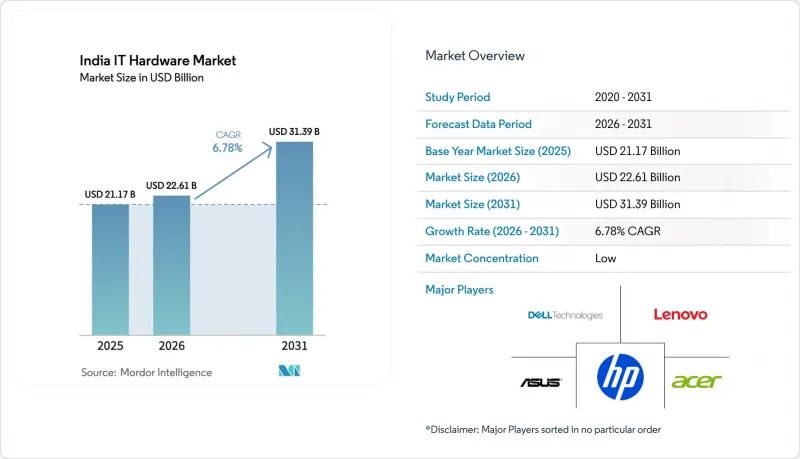
Mordor Intelligence에 의하면, 2026년 인도의 IT 하드웨어 시장 규모는 226억 1,000만 달러로 추정되고, 2025년 211억 7,000만 달러에서 확대될 전망입니다.
또한, 2031년 시장 규모는 313억 9,000만 달러에 달할 것으로 예측되며, 2026-2031년 연평균 성장률(CAGR) 6.78%를 나타낼 것으로 전망됩니다.
본 보고서는 제품 유형별(PC 및 워크스테이션, 엔터프라이즈용 네트워크 하드웨어, 엔터프라이즈용 스토리지 장치, 기타), 용도별(일반 소비자, 기업), 최종 사용자 산업별(은행, 금융서비스 및 보험(BFSI), 소매, IT 및 통신, 기타), 지역별(북인도, 동인도, 서·중부 인도, 남인도)로 분류되어 있습니다. 시장 전망은 금액(달러) 기준으로 제시되어 있습니다.
인도의 IT 하드웨어 시장 동향 및 인사이트
AI 워크로드에서 고성능 컴퓨팅에 대한 수요 증가
기업의 AI 프로젝트에는 기존 용도에 비해 3-5배의 연산 능력이 필요하기 때문에 기업은 미드레인지 랙의 경우에도 가속기, 고성능 메모리, 수냉식 시스템의 도입을 피할 수 없게 되었습니다. Dell Technologies는 2025 회계연도의 AI 서버 매출이 전년도 100억 달러에서 150억 달러로 증가할 것으로 예측했습니다. Ola가 Lenovo와 제휴하여 7,000억 파라미터 규모의 모델 ‘Krutrim 3’을 구축함에 따라, 인도 최대 규모의 슈퍼컴퓨터와 초기 단계에서 200억 루피(2억 4,000만 달러) 규모의 하드웨어 투자가 필요하게 됩니다. 이러한 플래그십급 도입은 조달 기준을 확립하고, 이것이 Tier 2 기업들로까지 파급됨에 따라 인도 IT 하드웨어 시장의 평균 판매 가격을 끌어올리며, 벤더들의 로드맵을 전용 설계 AI 노드로 전환시키고 있습니다.
국내 PC·서버 제조를 위한 ‘메이크 인 인디아’ 우대 조치(PLI 2.0)
PLI 프레임워크는 현지에서 제조된 PC와 서버의 순증 매출액에 대해 4-6%의 추가 인센티브를 제공하며, 세계 OEM 기업들이 고부가가치 조립 라인을 이전하도록 장려하고 있습니다. 딕슨 테크놀로지스는 타밀나두주에 1억 1,500만 달러를 투자하여 HP 노트북 생산을 시작했으며, 연간 200만 대를 생산할 예정입니다. 레노버는 PC 생산의 100% 현지화를 목표로 하고 있으며, AI 서버의 국내 조립도 계획하고 있습니다. 이를 통해 그동안 외환 보유고를 압박해 왔던 101억 달러 규모의 노트북 수입 대금을 절감하게 될 것입니다. 조기 현지화는 관련 부품 생태계 구축의 기반이 되기도 합니다. 폭스콘은 타밀나두주에서 디스플레이 모듈 조립에 10억 달러를 투자하겠다고 약속했으며, 이는 동아시아로부터의 수입 의존도를 낮추는 결과를 가져올 것입니다.
반도체 공급망의 변동성
인도는 여전히 반도체의 65-70%를 수입에 의존하고 있으며, 제조업체들은 2024-2025년 15-20% 상승한 DRAM 및 NAND 가격 변동의 영향을 받기 쉬운 상황에 놓여 있습니다. 타타 PSMC의 구자라트주 공장이 2025년 후반에 가동을 시작할 때까지 국내 제조 시설에서는 상용 웨이퍼가 출하되지 않기 때문에 각 OEM 업체들은 부품 조달 시 더 많은 안전 재고를 확보하고 환율 헤지를 실시해야 하는 상황에 처해 있습니다. 고성능 GPU는 여전히 공급이 가장 부족한 부문으로, 리드타임이 52-60주로 길어지면서 AI 서버 도입이 정체되고 있습니다. 이러한 병목 현상으로 인해 운전 자본 수요가 증가하고 이익률이 압박받으며, 인도 IT 하드웨어 시장의 예상 연평균 성장률(CAGR)을 90베이시스포인트 하향 조정하고 있습니다.
부문 분석
기업들이 AI 최적화 어레이와 NVMe-over-Fabrics 아키텍처를 도입함에 따라, 엔터프라이즈 스토리지 시장은 2031년까지 8.08%라는 가장 높은 연평균 성장률(CAGR)을 기록했습니다. NetApp의 하이브리드 클라우드 매출은 2024 회계연도에 56억 6,000만 달러에 달했으며, 이 회사의 AIPod 레퍼런스 디자인은 국내 데이터센터 업그레이드를 위한 청사진이 되었습니다. 서버는 엣지 배포 및 공공 부문 수요에 힘입어 7.18%의 연평균 복합 성장률(CAGR)로 그 뒤를 이었습니다. PC와 워크스테이션은 하이브리드 근무에 따른 기기 교체로 인해 6.94%의 연평균 성장률(CAGR)을 유지했습니다. 인도 IT 하드웨어 시장에서 엔터프라이즈 스토리지가 큰 점유율을 차지했지만, PC는 해당 시장의 42.08% 점유율을 유지했습니다. 프린터와 복사기는 디지털 문서 워크플로우 및 클라우드 폼의 도입을 반영하여 성장세가 둔화되었습니다. 각 벤더들은 평균 판매 가격(ASP)을 유지하기 위해 노트북에 AI 추론 가속기를 탑재함으로써 클라이언트와 서버 설계 철학의 융합을 보여주었습니다.
이러한 진화는 밸류체인의 재구축으로도 이어졌습니다. PCIe 5.0 컨트롤러와 CXL 지원 DIMM에 주력하는 부품 공급업체들은 하이퍼스케일러들이 결정론적 지연 시간을 요구함에 따라 장기적인 수주를 확보했습니다. 네트워크 하드웨어는 소프트웨어 정의 오버레이로 중심을 옮기면서 기존 섀시형 스위치의 수익을 잠식하는 한편, 지사 에지용으로 최적화된 보안 SD-WAN 어플라이언스에 새로운 기회를 가져다주었습니다. 이러한 변화로 인해 소비 형태가 자본 지출(CapEx)을 통한 구매에서 기기와 구독을 결합한 하이브리드형 번들로 전환되면서, 인도의 IT 하드웨어 시장은 확대되었습니다.
기타 혜택
- 엑셀 형식 시장 예측(ME) 시트
- 3개월간의 애널리스트 지원
자주 묻는 질문
목차
제1장 서론
제2장 조사 방법
제3장 주요 요약
제4장 시장 구도
제5장 시장 규모 및 성장 예측
제6장 경쟁 구도
제7장 시장 기회 및 향후 전망
AJY 26.09.15According to Mordor Intelligence, India IT hardware market size in 2026 is estimated at USD 22.61 billion, growing from 2025 value of USD 21.17 billion with 2031 projections showing USD 31.39 billion, growing at 6.78% CAGR over 2026-2031.
This report is Segmented by Product Type (PCs and Workstations, Enterprise Networking Hardware, Enterprise Storage Devices, and More), End-User Industry (Consumer, and Enterprise), Industry (BFSI, Retail, IT and Telecom, and Other End-User Industries), and Geography (North India, East India, West and Central India, and South India). The Market Forecasts are Provided in Terms of Value (USD).
India IT Hardware Market Trends and Insights
Elevated Need for High-Performance Computing in AI Workloads
Enterprise AI projects require 3-5 times more compute capacity than traditional applications, pushing firms to specify accelerators, advanced memory, and liquid cooling even for mid-range racks. Dell Technologies projects USD 15 billion in AI server revenue in fiscal 2025, up from USD 10 billion a year earlier. Ola's partnership with Lenovo to build Krutrim 3, a 700-billion-parameter model, necessitates India's largest supercomputer and an initial INR 2,000 crore (USD 240 million) hardware outlay. Such flagship deployments set procurement baselines that ripple into Tier-2 enterprises, increasing the India IT Hardware market's average selling price and shifting vendor roadmaps toward purpose-built AI nodes.
Make-in-India Incentives for Local PC/Server Manufacturing (PLI 2.0)
The PLI framework offers 4-6% incremental incentive on net incremental sales of locally manufactured PCs and servers, encouraging global OEMs to relocate higher-value assembly lines. Dixon Technologies invested USD 115 million in Tamil Nadu to manufacture HP notebooks, with output slated at 2 million laptops annually. Lenovo targets 100% local PC production and plans to assemble AI servers domestically, cutting a USD 10.1 billion laptop import bill that previously constrained foreign-exchange reserves. Early localization also seeds ancillary component ecosystems. Foxconn has committed USD 1 billion for display module assembly in Tamil Nadu, reducing dependence on East Asian imports.
Semiconductor Supply-Chain Volatility
India still imports 65-70% of its semiconductors, exposing manufacturers to volatile DRAM and NAND pricing that rose 15-20% over 2024-25. Local fabrication will not ship commercial wafers until Tata-PSMC's Gujarat fab comes online in late 2025, prompting OEMs to hold larger safety stocks and hedge currency in component sourcing. High-performance GPUs remain the tightest node, stretching lead times to 52-60 weeks and stalling AI server rollouts. The bottleneck inflates working capital needs and dampens margin profiles, carving 90 basis points off the projected India IT Hardware market CAGR.
Other drivers and restraints analyzed in the detailed report include:
- Public-Sector Digitization Push via Digital India and NIC Projects
- Rising Demand for Edge Data-Center Servers in Tier-2 Cities
- Escalating E-Waste Compliance Costs
For complete list of drivers and restraints, kindly check the Table Of Contents.
Segment Analysis
Enterprise storage accounted for the fastest 8.08% CAGR through 2031 as enterprises deployed AI-optimized arrays and NVMe-over-Fabrics architectures. NetApp's hybrid-cloud revenue reached USD 5.66 billion in fiscal 2024, and its AIPod reference design became a blueprint for domestic data-center upgrades. Servers followed at 7.18% CAGR, fueled by edge deployments and public-sector demand. PCs and workstations maintained a 6.94% CAGR, buttressed by hybrid-work refreshes. The India IT Hardware market size for enterprise storage represented a significant share, while PCs retained 42.08% of the India IT Hardware market share. Printers and copiers trailed, reflecting digital document workflows and cloud forms adoption. Vendors integrated AI-inference accelerators inside notebooks to protect ASPs, signaling the convergence of client and server design philosophies.
The evolution also reshaped value chains. Component suppliers focusing on PCIe 5.0 controllers and CXL-ready DIMMs secured longer-term orders as hyperscalers demanded deterministic latency. Networking hardware pivoted toward software-defined overlays, cannibalizing traditional chassis switch revenues but opening opportunities in secure SD-WAN appliances tuned for branch edge. The shift enlarged the India IT Hardware market as consumption moved from capex purchases to hybrid device-plus-subscription bundles.
Complete Report Scope:
- By Product Type
- PCs and Workstations
- Enterprise Networking Hardware
- Enterprise Storage Devices
- Servers
- Other Hardware (Printers and Copiers)
- By Application
- Consumer
- Enterprise
- SMEs
- Large Enterprises
- By End-user Industry
- BFSI
- Retail
- IT and Telecom
- Other End-user Industries
- By Region
- North India
- East India
- West and Central India
- South India
List of Companies Covered in this Report:
- Dell Inc.
- Lenovo Group Ltd
- ASUS Tek Computer Inc.
- HP Inc.
- Acer Inc.
- IBM Corporation
- Apple Inc.
- Samsung Electronics Co. Ltd.
- NetApp Inc.
- Hitachi Ltd.
- Cisco Systems Inc.
- Juniper Networks Inc.
- Arista Networks Inc.
- Hewlett Packard Enterprise (HPE) Inc.
- Wistron India Inc.
- Foxconn India Inc.
- Super Micro Computer Inc.
- Dell EMC Indian Ops
- Supertron Electronics Inc.
- RP Tech India
Additional Benefits:
- The market estimate (ME) sheet in Excel format
- 3 months of analyst support
TABLE OF CONTENTS
1 INTRODUCTION
- 1.1 Study Assumptions and Market Definition
- 1.2 Scope of the Study
2 RESEARCH METHODOLOGY
3 EXECUTIVE SUMMARY
4 MARKET LANDSCAPE
- 4.1 Market Overview
- 4.2 Market Drivers
- 4.2.1 Rapid growth in laptop demand under hybrid-work policies
- 4.2.2 Elevated need for high-performance computing in AI workloads
- 4.2.3 Public-sector digitization push via Digital India and NIC projects
- 4.2.4 Make-in-India incentives for local PC/server manufacturing (PLI 2.0)
- 4.2.5 Rising demand for edge data-centre servers in Tier-2 cities (under-reported)
- 4.2.6 Corporate ESG mandates favour energy-efficient hardware (under-reported)
- 4.3 Market Restraints
- 4.3.1 Escalating e-waste compliance costs
- 4.3.2 Semiconductor supply-chain volatility
- 4.3.3 Persistent grey-market imports in peripherals (under-reported)
- 4.3.4 Slow enterprise refresh cycles in public-sector tenders (under-reported)
- 4.4 Industry Value Chain Analysis
- 4.5 Regulatory Landscape
- 4.6 Technological Outlook
- 4.7 Porter's Five Forces Analysis
- 4.7.1 Bargaining Power of Suppliers
- 4.7.2 Bargaining Power of Buyers
- 4.7.3 Threat of New Entrants
- 4.7.4 Threat of Substitutes
- 4.7.5 Intensity of Competitive Rivalry
- 4.8 Assessment of Macro-economic Trends on the Market
5 MARKET SIZE AND GROWTH FORECASTS (VALUE)
- 5.1 By Product Type
- 5.1.1 PCs and Workstations
- 5.1.2 Enterprise Networking Hardware
- 5.1.3 Enterprise Storage Devices
- 5.1.4 Servers
- 5.1.5 Other Hardware (Printers and Copiers)
- 5.2 By Application
- 5.2.1 Consumer
- 5.2.2 Enterprise
- 5.2.2.1 SMEs
- 5.2.2.2 Large Enterprises
- 5.3 By End-user Industry
- 5.3.1 BFSI
- 5.3.2 Retail
- 5.3.3 IT and Telecom
- 5.3.4 Other End-user Industries
- 5.4 By Region
- 5.4.1 North India
- 5.4.2 East India
- 5.4.3 West and Central India
- 5.4.4 South India
6 COMPETITIVE LANDSCAPE
- 6.1 Market Concentration
- 6.2 Strategic Moves
- 6.3 Market Share Analysis
- 6.4 Company Profiles (includes Global level Overview, Market level overview, Core Segments, Financials as available, Strategic Information, Market Rank/Share for key companies, Products and Services, and Recent Developments)
- 6.4.1 Dell Inc.
- 6.4.2 Lenovo Group Ltd
- 6.4.3 ASUS Tek Computer Inc.
- 6.4.4 HP Inc.
- 6.4.5 Acer Inc.
- 6.4.6 IBM Corporation
- 6.4.7 Apple Inc.
- 6.4.8 Samsung Electronics Co. Ltd.
- 6.4.9 NetApp Inc.
- 6.4.10 Hitachi Ltd.
- 6.4.11 Cisco Systems Inc.
- 6.4.12 Juniper Networks Inc.
- 6.4.13 Arista Networks Inc.
- 6.4.14 Hewlett Packard Enterprise (HPE) Inc.
- 6.4.15 Wistron India Inc.
- 6.4.16 Foxconn India Inc.
- 6.4.17 Super Micro Computer Inc.
- 6.4.18 Dell EMC Indian Ops
- 6.4.19 Supertron Electronics Inc.
- 6.4.20 RP Tech India
7 MARKET OPPORTUNITIES AND FUTURE OUTLOOK
- 7.1 White-Space and Unmet-Need Assessment


