

|
시장보고서
상품코드
2125717
애드테크 시장 : 시장 점유율 분석, 업계 동향 및 통계, 성장 예측(2026-2031년)Ad Tech - Market Share Analysis, Industry Trends & Statistics, Growth Forecasts (2026 - 2031) |
||||||
 Mordor Intelligence
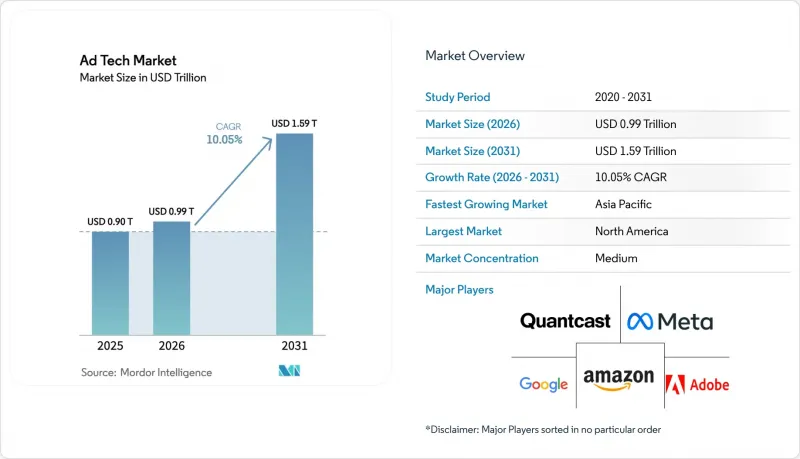
Mordor Intelligence에 의하면, 애드테크 시장 규모는 2025년에 8,980억 달러로 평가되었고, 2026년 9,900억 달러에서 2031년까지 1조 5,900억 달러에 이를 것으로 예측되며, 예측 기간(2026-2031년) CAGR은 10.05%를 나타낼 전망입니다.
본 보고서는 플랫폼별(DSP, SSP, 애드 익스체인지, DMP, 기타), 광고 형식별(검색 광고, 디스플레이 배너, 동영상 광고, 소셜 미디어, 이메일, 기타), 기기 플랫폼별(모바일 기기·스마트폰, 데스크톱·노트북, 커넥티드 TV·OTT 기기, 기타), 최종 사용자 산업별(소매 및 전자상거래, 은행, 금융서비스 및 보험(BFSI), 의료 및 제약, 미디어 및 엔터테인먼트, IT 및 통신, 자동차, 교육, 기타), 지역별(북미, 기타)로 분류되어 있습니다. 시장 예측은 금액(달러) 기준으로 제시되어 있습니다.
세계의 애드테크 시장 동향 및 인사이트
CTV 주도형 프로그래매틱 광고의 급증
스트리밍 퍼블리셔들은 인벤토리를 직접 인서트 오더에서 오픈 옥션으로 전환하고 있으며, 현재 프로그래매틱 CTV는 브랜드 총 예산의 17%를 차지하고 있습니다. The Trade Desk의 운영 시스템 ‘Ventura’는 구매자의 빈도 제한(frequency capping)과 오디언스 도달률을 향상시키는 동시에 퍼블리셔의 기술 관련 비용을 절감합니다. 리테일 미디어 데이터 세트와의 통합을 통해 시청 행동과 구매를 연결하는 결정론적 어트리뷰션이 실현됩니다. 조사 대상 광고주의 95% 이상이 CTV에 대한 예산 배분을 현 수준 유지하거나 확대할 계획이며, 이는 경제 변동 속에서도 수요가 견조함을 보여줍니다. 통합 ID 프레임워크를 갖춘 플랫폼은 프리미엄 동영상 광고 슬롯에 대한 우선 접근권을 확보하고 있으며, 이는 애드테크 시장 전체공급 경로 최적화를 가속화하고 있습니다.
써드파티 쿠키의 폐지
Chrome의 쿠키 단계적 폐지 및 EU의 동의 문자열 관련 판결로 인해 퍼스트파티 식별자로의 전환이 가속화되고 있습니다. 구글의 ‘프라이버시 샌드박스’는 초기 테스트 단계에서 퍼블리셔에게 최대 33%의 수익 격차를 초래하고 있습니다. 이에 따라 마케터들은 컨텍스트 타겟팅 예산을 증액하고, 개인 식별자를 사용하지 않으면서도 타겟팅 기능을 유지할 수 있는 클린룸 통합을 도입하고 있습니다. 인증된 거래 데이터를 보유한 소매업체는 광고주들의 높은 관심으로 혜택을 보고 있는 반면, 소규모 퍼블리셔는 CPM을 유지하기 위해 시맨틱 신호 모델을 활용하고 있습니다. 미래 지향적인 활성화 워크플로우 구축을 목표로 하는 옴니채널 브랜드에게 고객 데이터 플랫폼(CDP) 도입은 표준 관행이 되었습니다.
크로스 디바이스 아이덴티티 그래프를 제한하는 전 세계 각국의 개인정보 보호법
2024년 3월 유럽사법재판소의 판결에 따라 동의 문자열은 개인 데이터로 분류되었으며, IAB Europe은 공동 관리자가 되어 공급망 전반에 걸쳐 규정 준수 부담이 증가하고 있습니다. 디지털 시장법(Digital Markets Act)에 따른 새로운 의무로 인해 모든 데이터 이용에 대해 명확한 옵트인이 요구되면서, 크로스 디바이스 식별자의 성능이 저하되고 있습니다. 게이트키퍼 플랫폼은 클릭 수준의 투명성을 제공해야 하며, 경쟁 우위는 프라이버시 네이티브 컨텍스트 솔루션으로 이동하고 있습니다. 많은 주요 광고주들은 EU 내 리타게팅 광고 예산에 상한선을 설정하고, 추가 자금을 엄선된 시장에 재할당하고 있어, 이로 인해 애드테크 시장의 단기 성장 가능성은 낮아지고 있습니다.
부문 분석
애드 익스체인지(Ad Exchange)는 2025년 광고비의 63.62%를 차지했으며, 전체 오픈 옥션의 유동성을 뒷받침하고 있습니다. 수요 측 플랫폼(DSP)은 규모는 작지만, 구매자들이 운영 비용을 절감할 수 있는 자동 최적화를 선호함에 따라 연평균 12.08%의 성장률을 기록하고 있습니다. 기업 광고주들이 예산의 상당 부분을 셀프 서비스형 워크플로로 전환함에 따라, DSP가 차지하는 애드테크 시장 규모는 2031년까지 크게 확대될 것으로 예측됩니다. 아마존의 DSP는 이미 해당 기업의 광고 매출의 거의 3분의 1을 차지하고 있으며, 커머스 데이터와 프로그래매틱 입찰의 시너지 효과를 여실히 보여주고 있습니다.
이에 대응하여 공급측 플랫폼(SSP)은 공급 경로의 최적화를 한층 더 심화시키고 있으며, PubMatic은 거래되는 노출의 절반 이상을 수수료율이 인하된 우선 파이프라인을 통해 처리하고 있습니다. 써드파티 쿠키가 사라지면 소규모 데이터 관리 플랫폼(DMP) 벤더는 존재 의의를 잃게 되어, 사업을 폐쇄하거나 더 큰 규모의 플랫폼에 흡수될 것입니다. 마이크로소프트가 독립형 DSP 사업에서 철수할 계획을 세우고 있다는 사실은 머신러닝 혁신을 따라잡기 위해 필요한 자본 집약도가 매우 높음을 보여줍니다. 경쟁 장벽이 높아짐에 따라 플랫폼 통합이 진행되고, 애드테크 시장 내 롱테일 제공업체 기반이 축소될 것으로 예측됩니다.
검색은 2025년에 매출의 38.15%를 차지했으며, AI를 활용한 다중 모드 쿼리 해석을 통해 상거래와 관련된 검색 결과를 표시함으로써 여전히 연평균 성장률(CAGR) 11.92%로 성장을 이어가고 있습니다. CTV 및 모바일 앱에 힘입은 동영상 형식은 정적 디스플레이 광고로부터 브랜드 광고 예산을 서서히 빼앗고 있습니다. 소셜 미디어의 성장은 특히 건강이나 금융과 같은 민감한 카테고리에서의 컨텐츠 정책 강화로 인해 정체 국면에 접어들고 있습니다.
게임 내 및 증강현실(AR) 광고는 아직 초기 단계이지만 높은 참여도를 보이고 있어 가전 브랜드로부터 시험적인 예산 투자를 유치하고 있습니다. 이메일 광고는 식별자 제한을 우회하는 인증된 데이터 세트 덕분에 여전히 견조한 모습을 보이고 있습니다. 구글의 제미니(Gemini) 플랫폼은 대화형 응답에 네이티브 검색 광고를 통합할 것으로 기대되며, 사용자의 의도를 방해하지 않으면서 새로운 광고 슬롯 풀을 창출할 것으로 보입니다. 애드테크 시장은 배너 노출에서 벗어나, 몰입형 환경 전반에 걸쳐 측정 가능한 성과를 약속하는 경험 중심의 형식으로 계속 진화하고 있습니다.
지역별 분석
북미는 성숙한 인프라, 광고주의 심도 있는 인사이트, 스트리밍 지출을 301억 달러로 끌어올린 CTV의 견고한 보급에 힘입어 2025년 매출의 40.12%를 차지했습니다. 대규모 소매 미디어 네트워크와 첨단 신원 확인 프레임워크가 이 지역의 우위를 공고히 하고 있지만, 한편으로는 각 주에서 제정되고 있는 개인정보 보호 관련 법규로 인해 규정 준수 측면에서 마찰이 발생하고 있습니다. 미국에 본사를 둔 기술 벤더들은 지적 재산권 출원 건수의 대부분을 차지하고 있으며, 벤처 자금의 상당 부분도 유치하고 있어 애드테크 시장에서의 리더십을 더욱 공고히 하고 있습니다.
아시아태평양은 모바일 우선 소비자 행동, 5G 커버리지 확대, 전자상거래 활동의 급증에 힘입어 연평균 성장률(CAGR) 12.16%로 가장 빠르게 성장하고 있는 지역입니다. GSMA의 추정에 따르면, 모바일 기술은 2023년에 이 지역의 GDP에 8,800억 달러를 기여했으며, 2030년에는 1조 달러에 달할 것으로 예측됩니다. 중국의 슈퍼앱 생태계는 결제, 소셜, 컨텐츠를 통합하고 있으며, 인도, 인도네시아, 베트남의 광고주들이 현재 채택하고 있는 모델이 되고 있습니다. 규제에 대한 접근 방식은 여전히 다양하지만, 대부분의 관할 구역에서는 디지털 미디어에 대한 외국인 투자를 계속 장려하고 있어 애드테크 시장의 장기적인 성장세를 유지하고 있습니다.
유럽에서는 종합적인 개인정보 보호법으로 인해 크로스 디바이스 타겟팅이 제한되는 한편, 컨텍스트형 및 코호트 기반 모델에서의 혁신이 촉진되며 완만한 성장세를 보이고 있습니다. 측정 프로토콜의 표준화를 배경으로, 리테일 미디어에 대한 지출은 2026년까지 250억 유로에 달할 것으로 예측됩니다. 남미와 중동 및 아프리카는 광대역 보급률 향상과 현지 컨텐츠 제작 증가를 특징으로 하는 도입 초기 단계의 성장 곡선을 보이고 있습니다. 남미의 프로그래매틱 광고비는 2017년 52억 달러에서 2023년에는 168억 달러로 증가했습니다. 한편, MENA(중동·북아프리카) 지역의 디지털 광고비는 2022-2025년 5배로 확대될 전망입니다. 이러한 동향은 애드테크 시장의 세계 확장이 가속화되고 있음을 뒷받침합니다.
기타 혜택
- 엑셀 형식 시장 예측(ME) 시트
- 3개월간의 애널리스트 지원
자주 묻는 질문
목차
제1장 서론
제2장 조사 방법
제3장 주요 요약
제4장 시장 구도
제5장 시장 규모 및 성장 예측
제6장 경쟁 구도
제7장 시장 기회 및 향후 전망
AJY 26.09.15According to Mordor Intelligence, the advertising tech market size was valued at USD 0.898 trillion in 2025 and estimated to grow from USD 0.99 trillion in 2026 to reach USD 1.59 trillion by 2031, at a CAGR of 10.05% during the forecast period (2026-2031).
This report is Segmented by Platform (DSP, SSP, Ad Exchanges, DMP, and More), Ad Format (Search, Display, Video, Social Media, Email, and More), Device Platform (Mobile, Desktop, CTV and OTT, and More), End-User Industry (Retail, BFSI, Healthcare, Media, IT, Automotive, Education, and More), and Geography (North America, and More). The Market Forecasts are Provided in Terms of Value (USD).
Global Ad Tech Market Trends and Insights
CTV-led programmatic surge
Streaming publishers are shifting inventory from direct insertion orders to open auctions, and programmatic CTV now attracts 17% of total brand budgets. The Trade Desk's Ventura operating system improves frequency capping and audience reach for buyers while lowering publisher tech spend. Convergence with retail-media datasets delivers deterministic attribution that ties viewership to purchases. Over 95% of surveyed advertisers plan to maintain or expand CTV allocations, highlighting resilient demand even amid economic volatility. Platforms with unified ID frameworks gain priority access to premium video placements, which in turn accelerates supply-path optimisation across the advertising tech market.
Third-party-cookie deprecation
Chrome's phased withdrawal of cookies and the EU's consent string ruling are accelerating migration to first-party identifiers. Google's Privacy Sandbox faces yield gaps of up to 33% for publishers during early testing phases. Marketers are therefore increasing contextual targeting budgets and adopting clean-room integrations that retain addressability without personal identifiers. Retailers with authenticated transaction data benefit from surging advertiser interest, while smaller publishers exploit semantic-signal models to preserve CPMs. Customer-data-platform deployments have become standard practice for omni-channel brands aiming to future-proof activation workflows.
Global privacy laws limiting cross-device graphs
The March 2024 Court of Justice ruling classifies consent strings as personal data, making IAB Europe a joint controller and raising compliance burdens across the supply chain. New obligations under the Digital Markets Act demand clear opt-ins for every data use, eroding performance of cross-device identifiers. Gatekeeper platforms must provide click-level transparency, shifting competitive advantage toward privacy-native contextual solutions. Many large advertisers have capped EU retargeting spend and diverted incremental funds to curated marketplaces, diminishing short-term growth potential in the advertising tech market.
Other drivers and restraints analyzed in the detailed report include:
- AI-driven dynamic creative optimisation
- Retail-media monetisation of first-party data
- Rising sophistication of ad-fraud
For complete list of drivers and restraints, kindly check the Table Of Contents.
Segment Analysis
Ad Exchanges delivered 63.62% of 2025 spend, anchoring liquidity across open auctions. Demand-Side Platforms, while smaller, are growing at 12.08% annually as buyers prefer automated optimisations that cut operational overheads. The advertising tech market size captured by DSPs is projected to widen materially through 2031 as enterprise advertisers migrate bulk budgets into self-serve workflows. Amazon's DSP already accounts for almost one-third of the retailer's ad turnovers, underscoring the synergies of commerce data with programmatic bidding.
Supply-Side Platforms respond by deepening supply-path optimisation, with PubMatic funnelling more than half of traded impressions through preferential pipes that carry reduced take-rates. Smaller data-management-platform vendors lose relevance when third-party cookies vanish and are either shuttered or absorbed by larger stacks. Microsoft's planned exit from stand-alone DSP operations illustrates the capital intensity required to keep pace with machine-learning innovation. As competitive barriers climb, platform consolidation is expected, compressing the long-tail provider base inside the advertising tech market.
Search captured 38.15% of revenue in 2025 and is still expanding at a 11.92% CAGR, leveraging AI-driven multimodal query interpretation to surface commerce-adjacent results. Video formats, buoyed by CTV and mobile apps, siphon incremental brand dollars away from static display. Social media growth is flattening due to tighter content policies, particularly within sensitive health and financial categories.
In-game and augmented-reality placements are embryonic yet show high engagement, attracting exploratory budgets from consumer-electronics brands. Email remains resilient thanks to authenticated data sets that circumvent identifier restrictions. Google's Gemini platform is expected to embed native search ads into conversational responses, creating fresh inventory pools without disrupting user intent. The advertising tech market continues to evolve from banner impressions toward experience-centric formats that promise measurable outcomes across immersive environments.
Complete Report Scope:
- By Platform
- Demand-Side Platforms (DSP)
- Supply-Side Platforms (SSP)
- Ad Exchanges
- Data Management Platforms (DMP)
- Others
- By Ad Format
- Search Advertising
- Display/Banner
- Video Advertising
- Social Media
- Others
- By Device Platform
- Mobile Devices and Smartphones
- Desktop and Laptop
- Connected TV and OTT Devices
- Other Devices (Smart Speakers, Wearables)
- By End-user Industry
- Retail and E-commerce
- BFSI
- Healthcare and Pharmaceuticals
- Media and Entertainment
- IT and Telecommunications
- Services
- Automotive
- Education
- Others
- By Geography
- North America
- United States
- Canada
- Mexico
- South America
- Brazil
- Argentina
- Rest of South America
- Europe
- Germany
- United Kingdom
- France
- Italy
- Spain
- Rest of Europe
- Asia-Pacific
- China
- Japan
- South Korea
- India
- Australia
- Rest of Asia-Pacific
- Middle East
- United Arab Emirates
- Saudi Arabia
- Rest of Middle East
- Africa
- South Africa
- Rest of Africa
- North America
Geography Analysis
North America retained 40.12% of 2025 turnover, supported by mature infrastructure, deep advertiser sophistication, and robust CTV adoption that lifted streaming spend to USD 30.1 billion. Large retail-media networks and advanced identity frameworks reinforce the region's primacy, even as emerging state privacy statutes add compliance friction. Technology vendors headquartered in the United States account for the majority of intellectual-property filings and attract the bulk of venture funding, further entrenching leadership within the advertising tech market.
Asia-Pacific is the fastest-growing territory at a 12.16% CAGR, propelled by mobile-first consumer behaviour, accelerated 5G coverage, and surging e-commerce activity. GSMA estimates mobile technology contributed USD 880 billion to regional GDP in 2023, with a USD 1 trillion forecast for 2030. China's super-app ecosystems integrate payments, social, and content, creating blueprints that advertisers in India, Indonesia, and Vietnam are now adopting. Regulatory approaches remain heterogeneous, but most jurisdictions continue to encourage foreign investment in digital media, sustaining long-term momentum for the advertising tech market.
Europe shows moderate growth as comprehensive privacy laws squeeze cross-device targeting but encourage innovation in contextual and cohort-based models. Retail-media spending is projected to reach EUR 25 billion by 2026 on the back of harmonised measurement protocols. South America and the Middle East and Africa represent early-stage adoption curves characterised by improving broadband penetration and rising local content production. Programmatic spend in South America climbed from USD 5.2 billion in 2017 to USD 16.8 billion in 2023, while the MENA region's digital advertising outlay is on track to quintuple between 2022 and 2025. These trends confirm a broadening global footprint for the advertising tech market.
- Alphabet Inc.
- Meta Platforms, Inc.
- Amazon.com, Inc.
- The Trade Desk, Inc.
- Microsoft Corporation
- Adobe Inc.
- Yahoo Inc. (Owned by Apollo Global Management)
- Magnite, Inc.
- PubMatic, Inc.
- Criteo S.A.
- Oracle Corporation
- Index Exchange Inc.
- MediaMath Inc.
- InMobi Pte. Ltd.
- AppLovin Corporation
- Zeta Global Holdings Corp.
- Adform A/S
- Quantcast Corporation
- Rakuten Group, Inc.
- IronSource Ltd. (Merged with Unity Software Inc.)
- StackAdapt Inc.
- Xandr Inc. (Acquired by Microsoft)
- Mediaocean LLC
- OpenX
Additional Benefits:
- The market estimate (ME) sheet in Excel format
- 3 months of analyst support
TABLE OF CONTENTS
1 Introduction
- 1.1 Study Assumptions and Market Definition
- 1.2 Scope of the Study
2 Research Methodology
3 Executive Summary
4 Market Landscape
- 4.1 Market Overview
- 4.2 Market Drivers
- 4.2.1 CTV-Led Programmatic Surge in North America
- 4.2.2 Deprecation of Third-Party Cookies Accelerating First-Party Data Solutions
- 4.2.3 AI-Driven Dynamic Creative Optimisation Uplifting ROAS
- 4.2.4 Retail Media Networks Monetising First-Party Shopper Data
- 4.2.5 GDPR-Style Regulations Fueling Contextual Targeting in Europe
- 4.2.6 5G Roll-outs Enabling Rich Mobile Video Ads Across Asia
- 4.3 Market Restraints
- 4.3.1 Global Privacy Laws Constraining Cross-Device Identity Graphs
- 4.3.2 Rising Sophistication of Ad-Fraud in Emerging Markets
- 4.3.3 Supply-Path Complexity Elevating Transparency Costs
- 4.3.4 Acute Data-Engineering Talent Shortages
- 4.4 Technological Outlook
- 4.4.1 Digital Transformation in Advertising Platforms
- 4.4.2 Location-Based and Contextual Advertising Advances
- 4.5 Regulatory Outlook
- 4.6 Porter's Five Forces Analysis
- 4.6.1 Threat of New Entrants
- 4.6.2 Bargaining Power of Buyers
- 4.6.3 Bargaining Power of Suppliers
- 4.6.4 Threat of Substitutes
- 4.6.5 Competitive Rivalry
- 4.7 Impact of Macroeconomic Headwinds on Digital Ad Spend
5 Market Size and Growth Forecasts (Value)
- 5.1 By Platform
- 5.1.1 Demand-Side Platforms (DSP)
- 5.1.2 Supply-Side Platforms (SSP)
- 5.1.3 Ad Exchanges
- 5.1.4 Data Management Platforms (DMP)
- 5.1.5 Others
- 5.2 By Ad Format
- 5.2.1 Search Advertising
- 5.2.2 Display/Banner
- 5.2.3 Video Advertising
- 5.2.4 Social Media
- 5.2.5 Email
- 5.2.6 Others
- 5.3 By Device Platform
- 5.3.1 Mobile Devices and Smartphones
- 5.3.2 Desktop and Laptop
- 5.3.3 Connected TV and OTT Devices
- 5.3.4 Other Devices (Smart Speakers, Wearables)
- 5.4 By End-user Industry
- 5.4.1 Retail and E-commerce
- 5.4.2 BFSI
- 5.4.3 Healthcare and Pharmaceuticals
- 5.4.4 Media and Entertainment
- 5.4.5 IT and Telecommunications
- 5.4.6 Services
- 5.4.7 Automotive
- 5.4.8 Education
- 5.4.9 Others
- 5.5 By Geography
- 5.5.1 North America
- 5.5.1.1 United States
- 5.5.1.2 Canada
- 5.5.1.3 Mexico
- 5.5.2 South America
- 5.5.2.1 Brazil
- 5.5.2.2 Argentina
- 5.5.2.3 Rest of South America
- 5.5.3 Europe
- 5.5.3.1 Germany
- 5.5.3.2 United Kingdom
- 5.5.3.3 France
- 5.5.3.4 Italy
- 5.5.3.5 Spain
- 5.5.3.6 Rest of Europe
- 5.5.4 Asia-Pacific
- 5.5.4.1 China
- 5.5.4.2 Japan
- 5.5.4.3 South Korea
- 5.5.4.4 India
- 5.5.4.5 Australia
- 5.5.4.6 Rest of Asia-Pacific
- 5.5.5 Middle East
- 5.5.5.1 United Arab Emirates
- 5.5.5.2 Saudi Arabia
- 5.5.5.3 Rest of Middle East
- 5.5.6 Africa
- 5.5.6.1 South Africa
- 5.5.6.2 Rest of Africa
- 5.5.1 North America
6 Competitive Landscape
- 6.1 Strategic Moves (M&A, Partnerships, Funding)
- 6.2 Market Share Analysis
- 6.3 Company Profiles (includes Global-level Overview, Market-level Overview, Core Segments, Financials, Strategic Information, Products and Services, Recent Developments)
- 6.3.1 Alphabet Inc.
- 6.3.2 Meta Platforms, Inc.
- 6.3.3 Amazon.com, Inc.
- 6.3.4 The Trade Desk, Inc.
- 6.3.5 Microsoft Corporation
- 6.3.6 Adobe Inc.
- 6.3.7 Yahoo Inc. (Owned by Apollo Global Management)
- 6.3.8 Magnite, Inc.
- 6.3.9 PubMatic, Inc.
- 6.3.10 Criteo S.A.
- 6.3.11 Oracle Corporation
- 6.3.12 Index Exchange Inc.
- 6.3.13 MediaMath Inc.
- 6.3.14 InMobi Pte. Ltd.
- 6.3.15 AppLovin Corporation
- 6.3.16 Zeta Global Holdings Corp.
- 6.3.17 Adform A/S
- 6.3.18 Quantcast Corporation
- 6.3.19 Rakuten Group, Inc.
- 6.3.20 IronSource Ltd. (Merged with Unity Software Inc.)
- 6.3.21 StackAdapt Inc.
- 6.3.22 Xandr Inc. (Acquired by Microsoft)
- 6.3.23 Mediaocean LLC
- 6.3.24 OpenX
7 Market Opportunities and Future Outlook
- 7.1 White-Space and Unmet-Need Assessment


