

|
시장보고서
상품코드
2125735
경영진 코칭 및 리더십 개발 시장 : 시장 점유율 분석, 업계 동향 통계, 성장 예측(2026-2031년)Executive Coaching And Leadership Development - Market Share Analysis, Industry Trends & Statistics, Growth Forecasts (2026 - 2031) |
||||||
 Mordor Intelligence
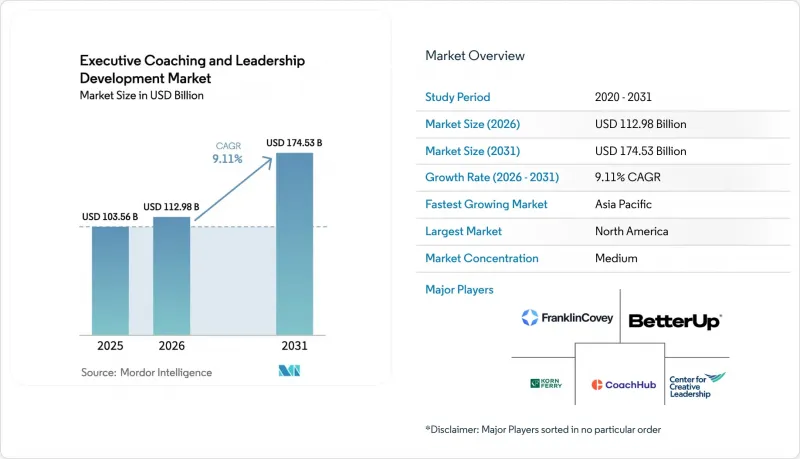
Mordor Intelligence에 의하면, 2026년 경영진 코칭 및 리더십 개발 시장 규모는 1,129억 8,000만 달러로 추정되고, 2025년 1,035억 6,000만 달러에서 확대해, 2031년에는 1,745억 3,000만 달러에 이를 것으로 예측됩니다.
2026-2031년 연평균 성장률(CAGR)은 9.11%를 나타낼 전망입니다.
본 보고서에서는 산업을 제품 유형별(온라인 학습, 대면 학습), 최종 사용자별(경영·리더십, 재무 및 회계, 기타), 조직 규모별(대기업, 중소기업(SME)), 지역별(북미, 아시아태평양, 남미, 유럽, 중동 및 아프리카)로 분류하고 있습니다.
세계의 임원 코칭 및 리더십 개발 시장 동향과 인사이트
전문 학습 생태계의 급속한 디지털화
기업 교육은 일회성 대면 행사에서 AI를 통한 개인화와 인간의 전문 지식을 융합한 클라우드 기반 플랫폼으로 전환되고 있습니다. FranklinCovey는 2025년 3월, 독자적인 컨텐츠와 고급 언어 모델을 활용하여 조기 도입 기업의 기술 습득 효율을 높이는 ‘AI 코치’를 발표했습니다. 전문 학습 분야의 AI 도입률은 연평균 40%씩 증가하고 있으며, 경영진 코칭 및 리더십 개발 시장 전체에서 ‘디지털 퍼스트’ 수요를 가속화하는 네트워크 효과가 발생하고 있습니다. 통합된 분석 기능을 통해 코칭에 대한 투자와 매출, 혁신, 직원 유지율과 같은 KPI 간의 상관관계가 밝혀졌으며, 기존 워크숍에서는 얻을 수 없었던 효과를 입증할 수 있게 되었습니다. 이러한 발전으로 출장비나 일정 조정의 부담은 줄어들겠지만, 새로운 도구를 일상적인 워크플로우에 통합하기 위해서는 변화 관리에 대한 투자가 필요합니다. HRIS 플랫폼과 원활하게 통합할 수 있는 공급업체는 단독 솔루션보다 조달 시 우선적으로 고려됩니다.
리더십 프로그램에서 측정 가능한 ROI에 대한 수요 증가
최고재무책임자(CFO)는 현재 리더십 예산이 정량화 가능한 수익을 창출할 것을 강력히 요구하고 있습니다. 2025년 벤치마크 조사에 따르면, 체계적인 코칭을 도입한 조직은 동종 업계 경쟁사 대비 25% 더 우수한 비즈니스 성과를 거두고 있습니다. 이에 대응하여 각 플랫폼은 코칭 상황과 생산성, 참여도, 프로젝트 주기 지표를 연결하는 대시보드를 통합하여 후원자에 대한 투명성을 높이고 있습니다. 북미와 아시아태평양의 고객은 엄격한 예산 관리와 기술적 준비가 갖춰져 있음을 반영하여 이러한 분석 기능을 가장 빠르게 도입하고 있습니다. 이러한 성과에 대한 증거는 더 대규모의 다년 계약을 촉진하고 있으며, 데이터에 기반한 풍부한 인사이트력을 제공할 수 있는 공급업체에게 임원 코칭 및 리더십 개발 시장을 확대되고 있습니다. 디지털 기반의 실증 데이터를 보유하지 않은 기존 컨설팅 기업들은 구매자들이 분석 기능을 갖춘 플랫폼으로 전환함에 따라 계약 갱신률이 하락할 위험에 직면해 있습니다.
인증 및 품질 보증 기준의 세분화
12개 이상의 인증 기관이 통일된 기준 없이 중복되어 존재하고 있어 조달 팀에 혼란을 야기하고 있습니다. 국제코치연맹(ICF)이 2025년 4월에 실시한 윤리 규정 개정에서는 적용 범위가 AI 플랫폼까지 확대되었지만, 세계적인 ‘골드 스탠다드’를 확립하기에는 이르지 못했습니다. 다국적 기업들은 사례별로 코치의 자격을 철저히 평가해야 합니다. 이러한 치밀한 심사 과정은 계약 체결까지의 기간을 길게 만드는 요인이 되고 있으며, 임원 코칭 및 리더십 개발 시장의 예상 연평균 성장률(CAGR)에 미미한 영향을 미치고 있습니다. 조직이 리더십 개발 이니셔티브에서 품질과 전략적 목표 간의 일관성을 우선시함에 따라, 이러한 상세한 평가는 점점 더 중요해지고 있습니다. 여러 자격을 갖춘 코치진을 보유한 대형 벤더는 신뢰도를 높이는 반면, 중소규모의 신규 진출기업들은 규정 준수 비용 증가에 직면하고 있습니다. 성과 기반 지표가 시간 기반 인증을 대체할 때까지는 이러한 분할 현상이 지속될 가능성이 높습니다.
부문 분석
온라인 학습은 연평균 성장률(CAGR) 11.64%를 나타낼 것으로 예측되며, 2025년에는 임원 코칭 및 리더십 개발 시장 점유율의 56.62%를 차지했던 대면 방식과의 격차를 좁힐 전망입니다. 클라우드를 통한 제공은 출장비와 일정 조정 비용을 대폭 절감하며, AI를 활용한 매칭 기능을 통해 리더에게 최적의 코치를 배정하고 있습니다. 내장형 VR 시뮬레이션은 미묘한 뉘앙스가 담긴 시나리오를 재현하고, 대시보드는 ROI에 대한 증거를 투명하게 제시함으로써 예산 배분을 뒷받침합니다. 그러나 이사회 수준의 코칭에서는 신뢰가 최우선시되기 때문에 여전히 대면 소통에 의존하고 있습니다. 각 제공업체들은 가상 진단과 정기적인 임원 리트릿을 순차적으로 융합하고 있으며, 이 부문의 향후 방향성을 결정지을 하이브리드형 융합이 나타나고 있습니다.
몰입형 경험, 비언어적 의사소통, 관계 심화라는 측면에서는 대면 프로그램이 여전히 필수적입니다. 임원 오프사이트에서는 전략적 계획 수립과 리더십 코칭을 결합하여, 조직의 중요한 국면에서 행동 변화를 지원합니다. 그러나 지속가능성에 대한 요구와 예산의 엄격한 검토로 인해, 기업들은 대면 진행 기간을 단축하고 사전 준비 및 후속 조치를 디지털 도구로 대체하도록 유도받고 있습니다. 이러한 하이브리드화로 인해 대면 방식의 비중은 여전히 큰 비율을 차지하고 있지만, 온라인 채널이 임원 코칭 및 리더십 개발 시장 전체에서 점진적인 성장을 거두고 있습니다.
지역별 분석
아시아태평양은 임원 코칭 및 리더십 개발 시장에서 가장 빠른 성장을 기록하고 있으며, 2031년까지 연평균 성장률(CAGR) 11.12%라는 견조한 성장세를 보이고 있습니다. 이러한 급속한 확장은 주로 해당 지역의 디지털 경제 급성장과 기업 리더십 구조의 세대교체에 의해 주도되고 있습니다. 신흥 시장과 선진 시장을 막론하고, 젊은 경영진은 적응력과 소프트 스킬 향상을 중시하는 지속적인 피드백 문화를 점점 더 적극적으로 도입하고 있습니다. 동시에 다국적 기업들은 세계 코칭 프레임워크와 기준을 각 지역의 사업 거점에 적용하고 있으며, 이를 통해 산업의 전문성이 더욱 높아지고 있습니다. 또한 각국의 기술 대기업과 복합 기업들도 혁신, 회복탄력성, 장기적인 경쟁력의 중요한 원동력으로서 리더십 개발에 막대한 투자를 하고 있습니다.
아시아태평양의 임원 코칭 생태계에서 ‘현지화’가 성공의 결정적 요인으로 부상하고 있으며, 이는 고객의 도입률과 지속률 모두에 영향을 미치고 있습니다. 조직이 더욱 관련성 높고 공감할 수 있는 리더십 인사이트를 추구하는 가운데, 문화적 뉘앙스를 매개할 수 있는 이중언어 코치에 대한 수요가 증가하고 있습니다. 시장에 진출한 기업들은 지역 특유의 비즈니스 환경을 반영한 사례 연구와 시뮬레이션을 맞춤화하여 코칭 결과의 현실감을 높이고 있습니다. 또한, 신뢰를 유지하고 데이터 개인정보 보호에 대한 기대에 부응하기 위해서는 현지 데이터 호스팅 및 지역 규제를 준수하는 플랫폼의 활용이 필수적입니다. 이러한 적응 전략이 결합됨에 따라, 임원 코칭 프로그램은 세계적 수준의 우수성 기준을 유지하면서도 지역 경영 문화와 깊이 공감할 수 있는 형태로 발전하고 있습니다.
북미는 계속해서 가장 큰 수익 점유율을 차지하고 있으며, 2025년에는 전 세계 임원 코칭 및 리더십 개발 시장의 40.88%를 차지한 것으로 평가되었습니다. 이 지역은 성숙한 기업 지배 구조, 견조한 벤처 캐피탈 유입, 측정 가능하고 데이터 기반의 코칭 성과에 대한 광범위한 노력의 혜택을 받고 있습니다. 유럽이 그 뒤를 잇고 있으며, GDPR(EU 개인정보보호규정)과 같은 엄격한 개인정보 보호 규제가 도입 장벽을 높이는 한편, 투명성이 높고 알고리즘 기반의 코칭 플랫폼을 제공하는 기업에게는 호기를 제공합니다. 한편, 중동에서는 증가하는 코칭 수요를 각국의 경제 다각화 및 인적 자본 개발 과제와 조화시키려 하고 있습니다. 아프리카에서는 급속한 도시화가 진행 중인 주요 도시에서 특히 통신 및 핀테크 부문의 성장을 견인력으로 삼아 시장이 초기 단계임에도 불구하고 탄력을 얻으며 전 세계 시장의 성장세를 뒷받침하고 있습니다.
기타 혜택
- 엑셀 형식 시장 예측(ME) 시트
- 3개월간의 애널리스트 지원
자주 묻는 질문
목차
제1장 서론
제2장 조사 방법
제3장 주요 요약
제4장 시장 구도
제5장 시장 규모 및 성장 예측
제6장 경쟁 구도
제7장 시장 기회 및 향후 전망
AJY 26.09.15According to Mordor Intelligence, executive coaching and Leadership Development market size in 2026 is estimated at USD 112.98 billion, growing from 2025 value of USD 103.56 billion with 2031 projections showing USD 174.53 billion, growing at 9.11% CAGR over 2026-2031.
This report Segments the Industry Into by Product Type (Online Learning, In-Person Learning), by End User (Management and Leadership, Finance and Accounting, and Other), by Organization Size ( Large Enterprises and Small & Medium-Sized Enterprises (SMEs) )and by Geography (North America, Asia-Pacific, South America, Europe, Middle East & Africa).
Global Executive Coaching And Leadership Development Market Trends and Insights
Rapid Digitization of Professional Learning Ecosystems
Corporate learning is migrating from one-off classroom events to cloud-based platforms that blend AI personalization with human expertise. FranklinCovey introduced its AI Coach in March 2025, utilizing proprietary content and sophisticated language models to enhance skill-acquisition efficiency among early adopters. Annual AI adoption in professional learning is climbing 40%, creating a network effect that accelerates digital-first demand across the Executive Coaching and Leadership Development market. Integrated analytics now correlate coaching inputs with revenue, innovation, and retention KPIs, providing proof of impact that traditional workshops lacked. These advances reduce travel costs and scheduling friction yet require investment in change management to weave new tools into everyday workflows. Vendors able to integrate seamlessly with HRIS platforms gain procurement preference over point solutions.
Growing Demand for Measurable ROI in Leadership Programs
Chief financial officers now insist that leadership budgets deliver quantifiable returns. Organizations that embed systematic coaching record 25% stronger business outcomes than peers, according to 2025 benchmarking research. Platforms have responded by embedding dashboards that link coaching moments to productivity, engagement, and project-cycle metrics, increasing transparency for sponsors. North American and Asia-Pacific clients adopt these analytics fastest, reflecting tight budget oversight and tech readiness. Outcome evidence supports larger multiyear contracts, expanding the Executive Coaching and Leadership Development market for providers able to deliver data-rich insights. Traditional consultancies without digital proof points risk renewal erosion as buyers migrate to analytics-enabled platforms.
Fragmented Certification & Quality-Assurance Standards
More than a dozen accreditation bodies overlap without a unified benchmark, sowing confusion for procurement teams. The International Coach Federation's April 2025 ethics update expands coverage to AI platforms yet stops short of creating one global gold standard. Multinational corporations are required to conduct a thorough evaluation of coach credentials on a case-by-case basis. This meticulous vetting process contributes to prolonged deal cycles and marginally impacts the projected CAGR of the Executive Coaching and Leadership Development market. Such detailed assessments are becoming increasingly critical as organizations prioritize quality and alignment with strategic objectives in their leadership development initiatives. Large vendors accumulating multi-credentialed coach pools gain credibility, while smaller players face higher compliance costs. Until outcome-based metrics supplant hours-based certification, fragmentation is likely to persist.
Other drivers and restraints analyzed in the detailed report include:
- Shortened Corporate-Strategy Cycles Driving Continuous Upskilling
- Escalating C-Suite Succession Gaps in Ageing Economies
- Cultural Stigma Toward Coaching in Certain Emerging Markets
For complete list of drivers and restraints, kindly check the Table Of Contents.
Segment Analysis
Online learning is expected to log an 11.64% CAGR, narrowing the gap with in-person formats that accounted for 56.62 of % Executive Coaching and Leadership Development market share in 2025. Cloud delivery slashes travel and scheduling costs, while AI-driven matchmaking pairs leaders with best-fit coaches. Embedded VR simulations replicate nuanced scenarios, and dashboards provide transparent ROI evidence, reinforcing budget allocation. Yet board-level coaching still leans on face-to-face interaction where trust is paramount. Providers successively blend virtual diagnostics with periodic executive retreats, illustrating hybrid convergence that defines the segment's future trajectory.
In-person programs remain indispensable for immersive experiences, non-verbal communication, and relationship depth. Executive offsites combine strategic planning with leadership coaching, supporting behaviour change at pivotal organizational moments. Sustainability mandates and budget scrutiny, however, encourage companies to shorten onsite durations and replace pre-work and follow-up with digital tools. This hybridization keeps the in-person share substantial while enabling online channels to capture incremental growth across the Executive Coaching and Leadership Development market.
Complete Report Scope:
- By Product Type
- Online Learning
- In-Person Learning
- By End User
- Management and Leadership
- Finance and Accounting
- Strategic Leadership and Innovation
- Marketing and Sales
- Business Operations and Entrepreneurship
- By Organization Size
- Large Enterprises
- Small & Medium-sized Enterprises (SMEs)
- By Geography
- North America
- Canada
- United States
- Mexico
- South America
- Brazil
- Peru
- Chile
- Argentina
- Rest of South America
- Europe
- United Kingdom
- Germany
- France
- Spain
- Italy
- BENELUX
- NORDICS
- Rest of Europe
- Asia-Pacific
- India
- China
- Japan
- Australia
- South Korea
- South-East Asia
- Rest of Asia-Pacific
- Middle East and Africa
- United Arab Emirates
- Saudi Arabia
- South Africa
- Nigeria
- Rest of Middle East and Africa
- North America
Geography Analysis
The Asia-Pacific region is witnessing the fastest growth in the Executive Coaching and Leadership Development market, advancing at a strong CAGR of 11.12% through 2031. This rapid expansion is primarily fueled by the region's booming digital economy and a generational transition in corporate leadership structures. Younger executives across emerging and developed markets are increasingly embracing continuous feedback cultures that prioritize adaptability and soft-skill enhancement. At the same time, multinational corporations are cascading global coaching frameworks and standards into their regional operations, further professionalizing the industry. Domestic technology giants and conglomerates are also investing heavily in leadership development as a critical driver of innovation, resilience, and long-term competitiveness.
Localization has emerged as a defining success factor across Asia-Pacific's executive coaching ecosystem, influencing both adoption and retention rates among clients. Bilingual coaches who can bridge cultural nuances are increasingly in demand, as organizations seek more relevant and relatable leadership insights. Market players are customizing casework and simulations that reflect region-specific business environments, enhancing the authenticity of coaching outcomes. Additionally, the use of local data hosting and regionally compliant platforms has become essential to maintaining trust and meeting data privacy expectations. These adaptive strategies collectively ensure that executive coaching programs resonate deeply with regional management cultures while maintaining global standards of excellence.
North America continues to hold the largest revenue share, commanding 40.88% of the global Executive Coaching and Leadership Development market in 2025. The region benefits from mature corporate governance systems, robust venture capital inflows, and a widespread commitment to measurable, data-driven coaching outcomes. Europe follows closely, where stringent privacy regulations such as GDPR elevate procurement barriers but reward firms offering transparent, algorithm-driven coaching platforms. Meanwhile, the Middle East is aligning its growing coaching demand with national diversification and human capital development agendas. In Africa, early-stage market traction is emerging within rapidly urbanizing hubs, particularly driven by growth in telecommunications and fintech sectors, sustaining overall global market momentum.
- Korn Ferry
- FranklinCovey
- BetterUp
- CoachHub
- Center for Creative Leadership (CCL)
- DDI (Development Dimensions International)
- BTS Group AB
- Gallup Inc.
- PwC (Strategy&)
- Heidrick & Struggles
- Right Management
- Vistage Worldwide Inc.
- Dale Carnegie & Associates
- SHL
- Randstad RiseSmart
- Lee Hecht Harrison (LHH)
- Blanchard
- NeuroLeadership Institute
- GiANT
Additional Benefits:
- The market estimate (ME) sheet in Excel format
- 3 months of analyst support
TABLE OF CONTENTS
1 Introduction
- 1.1 Study Assumptions & Market Definition
- 1.2 Scope of the Study
2 Research Methodology
3 Executive Summary
4 Market Landscape
- 4.1 Market Overview
- 4.2 Market Drivers
- 4.2.1 Rapid digitisation of professional learning ecosystems
- 4.2.2 Growing demand for measurable ROI in leadership programs
- 4.2.3 Shortened corporate-strategy cycles driving continuous upskilling
- 4.2.4 Escalating C-suite succession gaps in ageing economies
- 4.2.5 AI-assisted coaching analytics unlocking hyper-personalised content
- 4.2.6 Venture-capital funnel into coaching marketplaces
- 4.3 Market Restraints
- 4.3.1 Fragmented certification & quality-assurance standards
- 4.3.2 High average cost per coachee limits SMB adoption
- 4.3.3 Data-privacy anxieties around session recordings
- 4.3.4 Cultural stigma toward coaching in certain emerging markets
- 4.4 Value / Supply-Chain Analysis
- 4.5 Regulatory Landscape
- 4.6 Technological Outlook
- 4.7 Porter's Five Forces
- 4.7.1 Competitive Rivalry
- 4.7.1.1 Threat of New Entrants
- 4.7.1.2 Bargaining Power of Suppliers
- 4.7.1.3 Bargaining Power of Buyers
- 4.7.1.4 Threat of Substitutes
- 4.7.1 Competitive Rivalry
5 Market Size & Growth Forecasts
- 5.1 By Product Type
- 5.1.1 Online Learning
- 5.1.2 In-Person Learning
- 5.2 By End User
- 5.2.1 Management and Leadership
- 5.2.2 Finance and Accounting
- 5.2.3 Strategic Leadership and Innovation
- 5.2.4 Marketing and Sales
- 5.2.5 Business Operations and Entrepreneurship
- 5.3 By Organization Size
- 5.3.1 Large Enterprises
- 5.3.2 Small & Medium-sized Enterprises (SMEs)
- 5.4 By Geography
- 5.4.1 North America
- 5.4.1.1 Canada
- 5.4.1.2 United States
- 5.4.1.3 Mexico
- 5.4.2 South America
- 5.4.2.1 Brazil
- 5.4.2.2 Peru
- 5.4.2.3 Chile
- 5.4.2.4 Argentina
- 5.4.2.5 Rest of South America
- 5.4.3 Europe
- 5.4.3.1 United Kingdom
- 5.4.3.2 Germany
- 5.4.3.3 France
- 5.4.3.4 Spain
- 5.4.3.5 Italy
- 5.4.3.6 BENELUX
- 5.4.3.7 NORDICS
- 5.4.3.8 Rest of Europe
- 5.4.4 Asia-Pacific
- 5.4.4.1 India
- 5.4.4.2 China
- 5.4.4.3 Japan
- 5.4.4.4 Australia
- 5.4.4.5 South Korea
- 5.4.4.6 South-East Asia
- 5.4.4.7 Rest of Asia-Pacific
- 5.4.5 Middle East and Africa
- 5.4.5.1 United Arab Emirates
- 5.4.5.2 Saudi Arabia
- 5.4.5.3 South Africa
- 5.4.5.4 Nigeria
- 5.4.5.5 Rest of Middle East and Africa
- 5.4.1 North America
6 Competitive Landscape
- 6.1 Market Concentration
- 6.2 Strategic Moves
- 6.3 Market Share Analysis
- 6.4 Company Profiles (includes Global level Overview, Market level Overview, Core Segments, Financials as available, Strategic Information, Market Rank/Share for key companies, Products & Services, and Recent Developments)
- 6.4.1 Korn Ferry
- 6.4.2 FranklinCovey
- 6.4.3 BetterUp
- 6.4.4 CoachHub
- 6.4.5 Center for Creative Leadership (CCL)
- 6.4.6 DDI (Development Dimensions International)
- 6.4.7 BTS Group AB
- 6.4.8 Gallup Inc.
- 6.4.9 PwC (Strategy&)
- 6.4.10 Heidrick & Struggles
- 6.4.11 Right Management
- 6.4.12 Vistage Worldwide Inc.
- 6.4.13 Dale Carnegie & Associates
- 6.4.14 SHL
- 6.4.15 Randstad RiseSmart
- 6.4.16 Lee Hecht Harrison (LHH)
- 6.4.17 Blanchard
- 6.4.18 NeuroLeadership Institute
- 6.4.19 GiANT
7 Market Opportunities & Future Outlook
- 7.1 AI-powered personalised coaching at scale
- 7.2 Hybrid-work leadership programs in emerging markets


