

|
시장보고서
상품코드
2125749
전기자동차 배터리 음극 시장 : 시장 점유율 분석, 업계 동향 및 통계, 성장 예측(2026-2031년)Electric Vehicle Battery Anode - Market Share Analysis, Industry Trends & Statistics, Growth Forecasts (2026 - 2031) |
||||||
 Mordor Intelligence
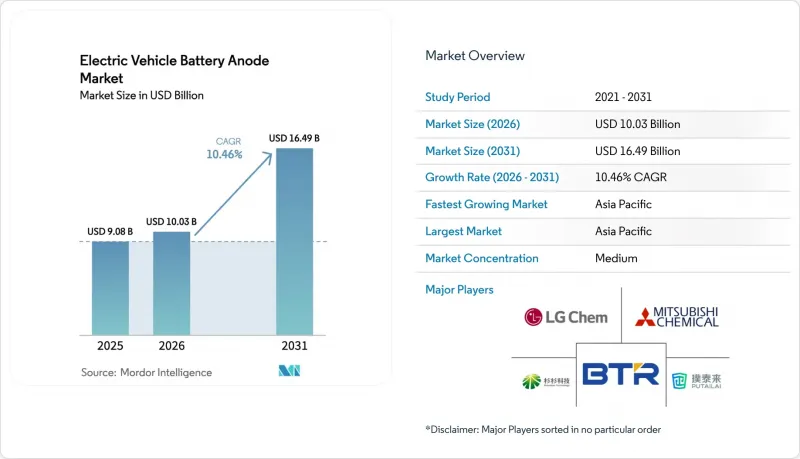
Mordor Intelligence에 의하면, 2026년 전기자동차 배터리 음극 시장 규모는 100억 3,000만 달러로 추정되고, 2025년 90억 8,000만 달러에서 확대해, 2031년에는 164억 9,000만 달러에 이를 것으로 예측됩니다.
2026-2031년 연평균 성장률(CAGR)은 10.46%를 나타낼 전망입니다.
본 보고서는 배터리 재료 유형별(흑연, 실리콘 강화 흑연, 고실리콘, 기타), 셀 형태별(원통형, 각형, 파우치형), 차종별(승용차, 소형 상용차, 중형·대형 트럭, 버스·장거리 버스, 이륜차·삼륜차, 기타), 지역별(북미, 유럽, 아시아태평양, 남미, 중동 및 아프리카)로 분류되어 있습니다.
세계의 전기자동차 배터리 음극 시장 동향 및 인사이트
전 세계 전기차 생산 대수의 급증
2024년 전 세계 경형 전기차 생산 대수는 1,400만 대에 달하여 전년 대비 25% 증가했습니다. 이를 위해 약 420GWh의 배터리와 46만 2,000톤의 음극재가 필요했습니다. 중국의 EV 승용차 생산 대수는 950만 대였던 반면, 유럽과 북미를 합친 생산 대수는 320만 대였습니다. 배터리 팩의 평균 용량은 2020년 60kWh에서 2024년 80kWh로 증가했으며, 차량 1대당 음극재 사용량은 33% 증가했습니다. 상용차의 전기화가 수요를 더욱 확대시키고 있습니다. Daimler Truck과 Volvo는 클래스 8 모델용으로 540kWh 배터리 팩을 규정하고 있으며, 각 팩에는 600kg의 음극재가 포함되어 있습니다. 동남아시아의 이륜차 판매 대수는 2024년에 2,000만 대에 달하며, 이미 8만 톤의 흑연을 소비하고 있으며, 이 수치는 2027년까지 두 배로 증가할 전망입니다.
배터리 재료에 대한 정부의 인센티브와 현지 조달 규정
‘인플레이션 억제법(Inflation Reduction Act)’에서는 배터리 부품이 북미 또는 FTA(자유무역협정) 체결국에서 생산된 것이어야 한다고 규정하고 있으며, 이에 따라 LG 에너지 솔루션은 2026년 가동을 예정하고 있는 미시간주의 음극재 복합 시설에 56억 달러를 투자하게 되었습니다. 유럽의 ‘중요 원자재법(Critical Raw Materials Act)’은 2030년까지 국내 가공 비율을 40%로 높이는 것을 목표로 하고 있으며, Syrah Resources사의 루이지애나주 합성 흑연 공장은 유럽투자은행(EIB)의 2억 유로 대출 보증을 받아 건설이 진행되고 있습니다. 한국의 ‘K-Battery’ 계획에서는 음극재 현지화에 20조 5,000억 원을 배정하고 있는 반면, 인도의 PLI 프로그램에서는 20%의 자본 보조금이 제공되고 있어, 이는 엡실론 어드밴스드 머티리얼스(Epsilon Advanced Materials)사의 구자라트주 1만 톤 규모 프로젝트를 뒷받침하고 있습니다.
실리콘의 부피 팽창 및 사이클 수명에 관한 과제
순수 실리콘은 리튬화 과정에서 3배로 팽창하여 SEI(고체 전해질 계면)에 균열을 일으키기 때문에 1세대 복합재료의 사이클 수명은 500사이클에 그쳐 자동차 제조업체가 보장하는 1,500사이클보다 훨씬 낮습니다. 나노 구조화나 카본 쉘을 통해 응력은 완화되지만, 재료 비용은 흑연의 15달러/kg에서 실리콘 나노와이어의 45달러/kg으로 상승합니다. 실리콘을 5%-10% 배합하면 에너지 밀도는 8% 향상되지만, 400Wh/kg 팩으로의 전환은 지연되고 있습니다. 고체 전해질은 팽창을 억제할 가능성이 있지만, 상업적 규모의 양산화에는 아직 5-7년이 걸릴 것으로 예측됩니다.
부문 분석
2025년에도 흑연은 매출 점유율 92.95%를 유지하는 한편, 고실리콘 음극재는 연평균 성장률(CAGR) 33.2%로 성장하여 전체 소재 중 가장 높은 성장률을 보일 전망입니다. 천연 흑연은 비용을 중시하는 이륜차용인 반면, 합성 흑연은 고사이클 용도에서 30%의 프리미엄 가격을 자랑합니다. 고실리콘 배합 전기자동차 배터리 음극재 시장 규모는 2031년까지 27억 6,000만 달러에 달할 것으로 예측되며, 이는 부문 매출의 16.74%에 해당합니다. 나트륨 이온 배터리용 하드 카본 음극이나 급속 충전이 가능한 차량용 티타네이트 리튬 음극은 여전히 3% 미만의 틈새 시장에 머물러 있지만, 연평균 성장률(CAGR)은 18%-22%로 성장을 지속하고, 있습니다. 유럽의 탄소국경조정메커니즘(CBAM)은 배출량이 많은 합성 흑연에 벌금을 부과하게 되어, 공급업체들은 재생에너지를 이용한 용광로로 전환해야 할 압박을 받게 될 것입니다.
자동차 제조업체의 조달 전략은 양극화되고 있습니다. 양산 모델용 플랫폼에서는 비용 최적화된 흑연을 채택하는 한편, 프리미엄 모델에서는 주행 거리 우위를 확보하기 위해 실리콘의 높은 단가를 감수하고 있습니다. Westwater Resources사의 앨라배마 광산과 Epsilon사의 구자라트 공장은 미국과 인도의 정책 체계 하에서 원자재를 현지 조달하는 사례를 보여주고 있습니다.
지역별 분석
2025년에는 아시아태평양이 매출의 63.10%를 차지했으며, 연평균 성장률(CAGR) 11.65%를 나타낼 것으로 예측됩니다. 중국 후난성과 장시성에서만 연간 40만 톤의 천연 흑연을 가공하는 반면, 한국은 합성 흑연 생산 능력 확대에 154억 달러를 투자하고 있습니다. 일본은 기술 개발에 주력하고 있으며, 미쓰비시 화학의 연간 1만 5,000톤 생산 라인이 파나소닉에 공급하고 있습니다. 인도에서는 타타 모터스가 생산량을 확대함에 따라 2030년까지 소비량이 3배인 4만 5,000톤에 달할 것으로 예측됩니다. 북미는 2025년에 18.35%의 점유율을 차지한 것으로 평가되었으며, 섹션 45X에 따른 1kg당 10달러의 크레딧과 캐나다 락데일(Lac de l’Ile) 광산에서의 원료 공급에 힘입어 연평균 성장률(CAGR) 12.98%를 기록할 전망입니다. 북미의 전기차 배터리 음극재 시장 규모는 2031년까지 41억 2,000만 달러에 달할 것으로 예측됩니다. 멕시코는 계속해서 조립 거점으로서의 지위를 유지하고 있으며, USMCA(미국·멕시코·캐나다 협정) 규정을 충족하기 위해 미국에서 음극재를 수입하고 있습니다. 유럽은 2025년에 15.25%의 점유율을 차지할 것으로 보이며, 중요 원자재법(Critical Raw Materials Act) 및 CBAM(탄소국경조정메커니즘)으로 인해 아시아산 수입품에 규정 준수 비용이 추가됨에 따라 12.55%의 성장률을 유지할 것으로 전망됩니다. 실러(Schiller)사의 루이지애나 공장과 노스볼트(Northvolt)사의 재활용 루프는 총 88,000t을 처리하고 있지만, 여전히 수요를 따라가지 못하고 있습니다. 남미와 아프리카는 원자재를 수출하고 있으며, 모잠비크의 바라마 광산만으로도 전 세계 천연 흑연 무역의 8%를 차지하고 있습니다.
아시아는 여전히 가장 큰 점유율을 유지하고 있지만, 코팅 생산 능력에 대한 중국의 실질적인 거부권으로 인해 2027년 이후 대체 생산 라인이 가동될 때까지는 세계 공급의 취약성이 지속될 것이 확실합니다.
기타 혜택
- 엑셀 형식 시장 예측(ME) 시트
- 3개월간의 애널리스트 지원
자주 묻는 질문
목차
제1장 서론
제2장 조사 방법
제3장 주요 요약
제4장 시장 구도
제5장 시장 규모 및 성장 예측
제6장 경쟁 구도
제7장 시장 기회 및 향후 전망
AJY 26.09.15According to Mordor Intelligence, electric vehicle battery anode market size in 2026 is estimated at USD 10.03 billion, growing from 2025 value of USD 9.08 billion with 2031 projections showing USD 16.49 billion, growing at 10.46% CAGR over 2026-2031.
This report is Segmented by Battery Material Type (Graphite, Silicon-Enhanced Graphite, High-Silicon, and More), Cell Format (Cylindrical, Prismatic, and Pouch), Vehicle Type (Passenger Cars, Light Commercial Vehicles, Medium and Heavy Trucks, Buses and Coaches, Two and Three-Wheelers, and More), and Geography (North America, Europe, Asia-Pacific, South America, and Middle East and Africa).
Global Electric Vehicle Battery Anode Market Trends and Insights
Surging EV Production Volumes Worldwide
Global light-duty EV output hit 14 million units in 2024, a 25% year-on-year rise that required roughly 420 GWh of batteries and 462,000 metric tons of anode material. China produced 9.5 million passenger EVs, whereas Europe and North America combined for 3.2 million. Average pack capacities climbed from 60 kWh in 2020 to 80 kWh in 2024, lifting anode intensity per vehicle by 33%. Commercial-vehicle electrification amplifies demand: Daimler Truck and Volvo specify 540 kWh packs for Class 8 models, each containing 600 kg of anode material. Two-wheeler sales in Southeast Asia reached 20 million electric units in 2024 and already consume 80,000 t of graphite, a figure set to double by 2027.
Government Incentives & Local-Content Rules for Battery Materials
The Inflation Reduction Act requires that battery components originate from North America or FTA partners, prompting LG Energy Solution to invest USD 5.6 billion in a Michigan anode complex scheduled for 2026. Europe's Critical Raw Materials Act targets 40% domestic processing by 2030; Syrah's Louisiana synthetic-graphite plant advanced under a EUR 200 million EIB loan guarantee. South Korea's K-Battery scheme allocates KRW 20.5 trillion to localize anodes, while India's PLI program offers 20% capital subsidies, catalyzing Epsilon Advanced Materials' 10,000 t Gujarat project.
Silicon's Volumetric-Expansion & Cycle-Life Challenges
Pure silicon expands threefold during lithiation, fracturing the SEI and limiting first-generation composites to 500 cycles, well below automaker warranties of 1,500 cycles. Nano-structuring and carbon shells mitigate stress but raise material costs from USD 15/kg for graphite to USD 45/kg for silicon nanowires. Silicon blends of 5%-10% uplift energy density 8% yet delay the jump to 400 Wh/kg packs. Solid-state electrolytes could restrain swelling, but commercial volumes remain five to seven years away.
Other drivers and restraints analyzed in the detailed report include:
- China's Graphite Export Controls Triggering Supply-Chain Diversification
- OEM Shift to High-Si Composite Anodes for 4680 Cells
- Anode-Coating Stage Still 97% China-Centric
For complete list of drivers and restraints, kindly check the Table Of Contents.
Segment Analysis
Graphite retained a 92.95% revenue share in 2025, while high-silicon anodes will grow at a 33.2% CAGR, the fastest of all materials. Natural graphite addresses cost-sensitive two-wheelers, whereas synthetic graphite commands a 30% premium in high-cycle applications. The electric vehicle battery anode market size for high-silicon formulations is forecast to reach USD 2.76 billion by 2031, equal to 16.74% of the segment revenue. Hard-carbon anodes for sodium-ion cells and lithium-titanate anodes for fast-charging fleets remain sub-3% niches but post 18%-22% CAGRs. Europe's Carbon Border Adjustment Mechanism will penalize high-emission synthetic graphite, pushing suppliers toward renewable-powered furnaces.
Automakers split sourcing strategies: mass-market platforms pursue cost-optimized graphite, while premium models absorb silicon premiums for range advantages. Westwater's Alabama mine and Epsilon's Gujarat plant illustrate feedstock localization under U.S. and Indian policy umbrellas.
Complete Report Scope:
- By Battery Material Type
- Graphite
- Silicon-Enhanced Graphite (Up to 10 % Si)
- High-Silicon (Above 10 % Si) and SiOx
- Lithium Titanate (LTO)
- Other Advanced (Hard-Carbon, CNT-Doped, Graphene)
- By Cell Format
- Cylindrical
- Prismatic
- Pouch
- By Vehicle Type
- Passenger Cars
- Light Commercial Vehicles
- Medium and Heavy Trucks
- Buses and Coaches
- Two and Three-wheelers
- Off-Highway and Specialty EVs
- By Geography
- North America
- United States
- Canada
- Mexico
- Europe
- Germany
- United Kingdom
- France
- Italy
- Spain
- NORDIC Countries
- Russia
- Rest of Europe
- Asia-Pacific
- China
- India
- Japan
- South Korea
- ASEAN Countries
- Australia and New Zealand
- Rest of Asia Pacific
- South America
- Brazil
- Argentina
- Rest of South America
- Middle East and Africa
- Saudi Arabia
- South Africa
- Rest of Middle East and Africa
- North America
Geography Analysis
Asia-Pacific accounted for 63.10% of revenue in 2025 and is projected to grow at a 11.65% CAGR. China's Hunan and Jiangxi provinces alone process 400,000 t/yr of natural graphite, while South Korea spends USD 15.4 billion to add synthetic capacity. Japan focuses on technology, with Mitsubishi Chemical's 15,000 t line feeding Panasonic. India's consumption triples to 45,000 t by 2030 as Tata Motors scales output. North America held 18.35% in 2025 and will post a 12.98% CAGR, driven by Section 45X's USD 10/kg credits and feedstock from Canada's Lac des Iles mine. The electric vehicle battery anode market size in North America is projected to reach USD 4.12 billion by 2031. Mexico remains an assembly hub, importing U.S. anodes to meet USMCA rules. Europe captured 15.25% in 2025 and grows at 12.55% as the Critical Raw Materials Act and CBAM add compliance costs to Asian imports. Syrah's Louisiana plant and Northvolt's recycling loop cover 88,000 t, still short of demand. South America and Africa export feedstock; Mozambique's Balama mine alone fills 8% of global natural graphite trade.
Asia retains the largest share, yet China's effective veto over coating capacity ensures global supply vulnerability until alternative lines are commission after 2027.
- Mitsubishi Chemical Group
- BTR New Material Group
- Shanshan Corporation
- Putailai New Energy (PTL)
- LG Chem Ltd / LG Energy Solution
- Tokai Carbon Co. Ltd
- Nippon Carbon Co. Ltd
- Resonac Holdings (Showa Denko)
- Targray Industries Inc.
- NEI Corporation
- Nexeon Ltd
- Sionic Energy
- Sila Nanotechnologies
- Group14 Technologies
- POSCO Future M
- Syrah Resources Ltd
- NOVONIX Ltd
- Amprius Technologies
- JFE Chemical Corporation
- Hunan Zeto New Energy
Additional Benefits:
- The market estimate (ME) sheet in Excel format
- 3 months of analyst support
TABLE OF CONTENTS
1 Introduction
- 1.1 Study Assumptions & Market Definition
- 1.2 Scope of the Study
2 Research Methodology
3 Executive Summary
4 Market Landscape
- 4.1 Market Overview
- 4.2 Market Drivers
- 4.2.1 Surging EV production volumes worldwide
- 4.2.2 Government incentives & local-content rules for battery materials
- 4.2.3 Synthetic-graphite capacity build-out lowering cost curves
- 4.2.4 China's graphite export controls triggering supply-chain diversification
- 4.2.5 OEM shift to high-Si composite anodes for 4680/"Gen 4" cylindrical cells
- 4.2.6 Cell-format migration (prismatic to large-cylindrical) altering anode design specs
- 4.3 Market Restraints
- 4.3.1 Silicon's volumetric-expansion & cycle-life challenges
- 4.3.2 ESG & carbon-footprint scrutiny on synthetic graphite
- 4.3.3 Impending recycling over-capacity curbing virgin-material demand
- 4.3.4 Anode-coating stage still 97 % China-centri; Heightened geopolitical risk
- 4.4 Supply-Chain Analysis
- 4.5 Regulatory Landscape
- 4.6 Technological Outlook
- 4.7 Porter's Five Forces
- 4.7.1 Bargaining Power of Suppliers
- 4.7.2 Bargaining Power of Buyers
- 4.7.3 Threat of New Entrants
- 4.7.4 Threat of Substitutes
- 4.7.5 Intensity of Rivalry
- 4.8 Investment and Funding Analysis
- 4.9 Patent Landscape (Si, Graphite, LTO)
5 Market Size & Growth Forecasts
- 5.1 By Battery Material Type
- 5.1.1 Graphite
- 5.1.2 Silicon-Enhanced Graphite (Up to 10 % Si)
- 5.1.3 High-Silicon (Above 10 % Si) and SiOx
- 5.1.4 Lithium Titanate (LTO)
- 5.1.5 Other Advanced (Hard-Carbon, CNT-Doped, Graphene)
- 5.2 By Cell Format
- 5.2.1 Cylindrical
- 5.2.2 Prismatic
- 5.2.3 Pouch
- 5.3 By Vehicle Type
- 5.3.1 Passenger Cars
- 5.3.2 Light Commercial Vehicles
- 5.3.3 Medium and Heavy Trucks
- 5.3.4 Buses and Coaches
- 5.3.5 Two and Three-wheelers
- 5.3.6 Off-Highway and Specialty EVs
- 5.4 By Geography
- 5.4.1 North America
- 5.4.1.1 United States
- 5.4.1.2 Canada
- 5.4.1.3 Mexico
- 5.4.2 Europe
- 5.4.2.1 Germany
- 5.4.2.2 United Kingdom
- 5.4.2.3 France
- 5.4.2.4 Italy
- 5.4.2.5 Spain
- 5.4.2.6 NORDIC Countries
- 5.4.2.7 Russia
- 5.4.2.8 Rest of Europe
- 5.4.3 Asia-Pacific
- 5.4.3.1 China
- 5.4.3.2 India
- 5.4.3.3 Japan
- 5.4.3.4 South Korea
- 5.4.3.5 ASEAN Countries
- 5.4.3.6 Australia and New Zealand
- 5.4.3.7 Rest of Asia Pacific
- 5.4.4 South America
- 5.4.4.1 Brazil
- 5.4.4.2 Argentina
- 5.4.4.3 Rest of South America
- 5.4.5 Middle East and Africa
- 5.4.5.1 Saudi Arabia
- 5.4.5.2 South Africa
- 5.4.5.3 Rest of Middle East and Africa
- 5.4.1 North America
6 Competitive Landscape
- 6.1 Market Concentration
- 6.2 Strategic Moves (M&A, Partnerships, PPAs)
- 6.3 Market Share Analysis (Market Rank/Share for key companies)
- 6.4 Company Profiles (includes Global level Overview, Market level overview, Core Segments, Financials as available, Strategic Information, Products & Services, and Recent Developments)
- 6.4.1 Mitsubishi Chemical Group
- 6.4.2 BTR New Material Group
- 6.4.3 Shanshan Corporation
- 6.4.4 Putailai New Energy (PTL)
- 6.4.5 LG Chem Ltd / LG Energy Solution
- 6.4.6 Tokai Carbon Co. Ltd
- 6.4.7 Nippon Carbon Co. Ltd
- 6.4.8 Resonac Holdings (Showa Denko)
- 6.4.9 Targray Industries Inc.
- 6.4.10 NEI Corporation
- 6.4.11 Nexeon Ltd
- 6.4.12 Sionic Energy
- 6.4.13 Sila Nanotechnologies
- 6.4.14 Group14 Technologies
- 6.4.15 POSCO Future M
- 6.4.16 Syrah Resources Ltd
- 6.4.17 NOVONIX Ltd
- 6.4.18 Amprius Technologies
- 6.4.19 JFE Chemical Corporation
- 6.4.20 Hunan Zeto New Energy
7 Market Opportunities & Future Outlook
- 7.1 White-Space & Unmet-Need Assessment


