

|
시장보고서
상품코드
2125752
재해 복구 서비스 시장 : 점유율 분석, 업계 동향과 통계, 성장 예측(2026-2031년)Disaster Restoration Services - Market Share Analysis, Industry Trends & Statistics, Growth Forecasts (2026 - 2031) |
||||||
 Mordor Intelligence
Mordor Intelligence에 의하면, 재해 복구 서비스 시장 규모는 2025년에 444억 3,000만 달러, 2026년에 465억 5,000만 달러가 되어, 2031년까지 604억 3,000만 달러에 이를 것으로 예측되며, 2026년부터 2031년까지 CAGR 5.36%로 성장할 전망입니다.
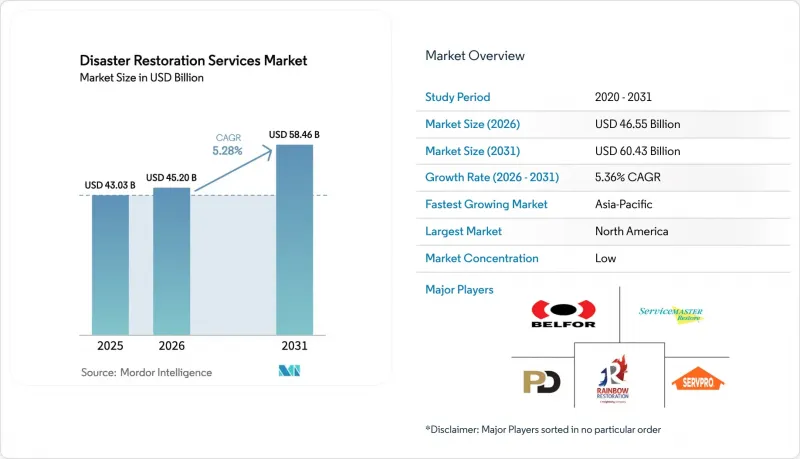
본 보고서는 서비스 유형별(수해 복구, 화재·연기 피해 복구, 곰팡이 제거 등), 용도별(주거·상업시설, 산업·인프라), 지역별(북미, 남미, 유럽, 아시아태평양, 중동 및 아프리카)로 분류되어 있습니다. 본 보고서에서는 상기 모든 부문에 대해 시장 규모 및 예측치를 금액(달러) 단위로 제시하고 있습니다.
전 세계 재해 복구 서비스 시장 동향 및 인사이트
기후 변화로 인한 이상 기후 증가
대규모 기상 현상의 발생 빈도와 피해액 증가로 인해 재해 복구 서비스에 대한 기초적인 수요가 높아지고 있습니다. 미국에서는 2025년에 피해액이 최소 10억 달러에 달하는 기상·기후 재해 23건이 발생했으며, 총 피해액은 1,150억 달러에 달했습니다. 이 중 91%는 격렬한 폭풍우로 인한 것이었으며, 2025년 1월 로스앤젤레스에서 발생한 산불로 인한 피해액은 612억 달러에 달했습니다. 2020년부터 2024년까지의 연간 평균 발생 건수는 23건이었으나, 1980년 이후의 장기 평균은 9건이었습니다. FEMA(연방재난관리청) 보고서에 따르면, 2024년 허리케인 ‘헬렌’과 ‘밀턴’ 이후 홍수 보험금 및 이재민 지원금으로 143억 달러가 지급되었습니다. 이러한 손실을 배경으로, 보험사들은 사전에 구축된 복구 네트워크를 활용하고, 다년간의 우선 공급업체 계약을 통해 재해 복구 서비스 시장을 지원하고 있습니다.
예측형 IoT 센서가 예방적 계약을 뒷받침
누수 감지 및 환경 모니터링 시스템은 대규모 피해가 발생하기 전에 재해 복구 서비스 시장을 뒷받침하는 서비스 계약을 구축할 수 있게 해줍니다. Brickeye사는 2026년, 자사 플랫폼이 20개국 이상에서 4,500건 이상의 진행 중인 프로젝트를 모니터링하고 있다고 보고했습니다. 이 회사는 자동 밸브 차단 및 실시간 습도 모니터링을 통해 고객이 수해로 인한 자기부담금을 최대 50%까지 절감할 수 있었습니다고 밝혔습니다. Brickeye와 Shepherd는 2026년, 미국 건설업체를 대상으로 한 위험 보험 계약에서 IoT 위험 데이터를 자율적인 인수 워크플로우에 통합했습니다. ANSI/IICRC S500 수해 복구 기준은 센서 기반의 신속한 대응에 부합하는 조기 감지 및 사전 청소 절차를 지지하고 있습니다. 재해 복구 서비스 시장은 치명적인 피해가 발생하지 않은 기간에도 지속적인 모니터링 및 대응 업무를 더욱 확대할 수 있습니다.
숙련된 인력 부족으로 대응 시간이 길어지고 있다.
훈련을 받은 기술자 확보는 복구 업체들에게 여전히 큰 운영상의 제약으로 작용하고 있습니다. 노동통계국 기록에 따르면, 2025년 12월 기준 건설 및 침수 제거 직종에서 29만 2,000건의 미충원 일자리가 있었으며, 이는 업계 전체 고용의 3.4%에 해당합니다. 이는 2024년 12월 시점보다 8만 7,000건 더 많은 수치입니다. 전미주택건설업협회(NAHB)의 추산에 따르면, 광범위한 숙련 노동자 부족으로 인해 주택 건설 업계는 연간 108억 달러의 손실을 입고 있습니다. 인력 부족은 현장 투입 지연을 초래하며, 보험사의 보상 지급 속도가 이를 따라가지 못할 경우 인건비 증가로 이어집니다. IICRC의 인증 요건에 따라 신규 채용자는 특정 복구 작업을 수행하기 전에 전문 교육을 받아야 하므로, 인력 풀은 더욱 좁아지고 있습니다. 이러한 인력 부족은 대규모 재해 발생 시 특히 두드러집니다. 재해 시에는 동시에 발생하는 보험금 청구로 인해 피해 지역 전체에서 자격을 갖춘 복구 인력을 둘러싼 치열한 경쟁이 벌어지기 때문입니다. 인력 부족 문제에 대처하기 위해 주요 서비스 제공 기업들은 기술자 교육, 견습 제도, 채용 인센티브, 그리고 노동 생산성과 자원 배분을 개선하는 디지털 현장 관리 도구에 대한 투자를 확대되고 있습니다.
부문 분석
2025년, 수해 복구는 매출의 32.6%를 차지하며 재해 복구 서비스 시장에서 가장 큰 서비스 카테고리가 되었습니다. 배관 고장, 폭풍우로 인한 침수, 홍수는 화재나 생물학적 위험 사고보다 더 빈번하게 주택 및 상업시설에 영향을 미칩니다. ANSI/IICRC S500 규격은 보험 보상 대상이 되는 전문적인 수해 복구 작업에 대한 서비스 기준을 규정하고 있습니다. 인증 사업자는 이 프레임워크를 활용하여 규정 준수를 입증하고 작업 범위를 정의하고 있습니다. 연중무휴 24시간 긴급 출동 체계와 첨단 수분 감지 장비를 포함한 신속한 대응 능력은 이 분야에서 중요한 경쟁 차별화 요소로 작용하며, 2차적 재산 피해 및 보험금 청구액 감축에 기여하고 있습니다. 2025년 1월 로스앤젤레스에서 발생한 산불이 612억 달러의 피해를 입힌 것을 계기로, 화재·연기 피해 복구 서비스에 대한 관심이 높아지고 있습니다.
‘기타’ 부문은 2026년부터 2031년까지 연평균 성장률(CAGR) 6.9%를 나타낼 것으로 예측되며, 서비스 부문 중 가장 높은 성장률을 보이고 있습니다. 이 그룹에는 가재 복구, 포장·반출 서비스, 청소, 보관 등이 포함됩니다. 이러한 서비스는 재고 관리나 전문적인 프로세스를 수반하기 때문에 더 높은 요금을 책정할 수 있습니다. 또한, 보험사나 상업용 부동산 소유주들이 재해 발생 후 고가의 가재도구 회수나 사업 중단을 최소화하는 것을 더욱 중요시하게 되면서 수요도 증가하고 있습니다. 폭풍우나 대규모 재해와 관련된 업무는 수요가 간헐적이지만, 대규모 피해를 수반하는 사건 증가가 장기적인 수요를 뒷받침하고 있습니다. 곰팡이 제거, 생물학적 위험물 청소 및 전문 서비스는 여전히 규모가 작은 편이지만, 그 절차와 기법에 따라 높은 가격 책정이 가능합니다.
지역별 분석
2025년, 북미는 매출의 45.2%를 차지하며 재해 복구 서비스 시장에서 가장 규모가 큰 지역 점유율을 기록했습니다. 미국은 프랜차이즈 네트워크가 밀집되어 있고, 손해보험 이용이 활발하며, 연방 정부가 재해 선언을 내리는 사례도 다수 있습니다. FEMA(연방재난관리청)는 2024년 허리케인 ‘헬렌’ 및 ‘밀턴’ 이후, 홍수 보험금 지급 및 피해자 지원금으로 143억 달러를 지원했습니다. 이러한 자금 지원은 대규모 재난 선포와 복구 활동을 연계하는 역할을 수행하고 있습니다. 또한 이 지역은 복구 도급업체, 보험사, 장비 공급업체, 인증 교육 기관으로 구성된 성숙한 생태계의 혜택을 받고 있어 신속한 대응과 표준화된 서비스 제공이 가능합니다. 캐나다에서는 2025년 11월 퍼스트 온사이트(First Onsite)가 브리티시컬럼비아주 켈로나에 위치한 RBT Restoration by Trades를 인수하는 등, 인수를 통해 시장이 확대되고 있습니다.
유럽에서는 공공 지출이 수요를 끌어올리고 있지만, 공식적인 복구 서비스의 발전은 여전히 초기 단계에 있습니다. 독일은 2026년 5월, 2029년까지 100억 유로(113억 달러) 규모의 시민 보호 투자 패키지를 발표했습니다. 이 패키지에는 2026년 BBK 및 THW에 대한 13억 3,000만 유로(15억 달러)의 예산이 포함되어 있습니다. 영국, 독일, 프랑스가 유럽의 핵심 시장으로 자리 잡고 있습니다. 독일에서는 노후된 주택 재고와 홍수 위험으로 인해 북미와 유사한 상황이 발생하고 있습니다. 건축물의 지속가능성에 관한 기준 강화 및 기후 변화 적응 정책으로 인해, 해당 지역 전체에서 회복력 있는 재건과 전문적인 복구 서비스에 대한 투자가 촉진되고 있습니다.
아시아태평양은 2031년까지 연평균 성장률(CAGR) 6.3%를 나타낼 것으로 예측되며, 재해 복구 서비스 시장에서 지역별 가장 높은 성장률을 보이고 있습니다. 보험 보급률, 중산층의 부동산 소유율, 그리고 회복탄력성에 대한 투자는 성숙한 지역보다 낮은 수준에서 증가하고 있습니다. 일본의 ‘국가 회복탄력성 추진 계획’은 전문적인 복구·부흥 역량에 대한 수요를 뒷받침하고 있습니다. 중국과 인도에서는 도시 지역의 부동산 밀도가 높아짐에 따라 장기적인 잠재력이 기대됩니다. 호주에서는 반복되는 산불, 사이클론, 홍수로 인해 상업 기반이 확립되어 있습니다. 인도네시아, 필리핀, 베트남에서는 현지 대응 능력이 따라잡지 못할 정도로 빠른 속도로 부동산 가치가 상승하고 있습니다. 재해 회복력, 스마트 인프라, 긴급 대응 능력에 대한 공공 및 민간 투자 증가로 인해 아시아태평양의 신흥 시장 전반에서 전문적인 복구 서비스 도입이 가속화될 것으로 예측됩니다. 남미는 여전히 발전 단계에 있지만, 중동 및 아프리카에서는 아랍에미리트, 사우디아라비아, 남아프리카공화국, 튀르키예에 수요가 집중되고 있습니다.
기타 혜택:
- 엑셀 형식 시장 예측(ME) 시트
- 3개월간의 애널리스트 지원
자주 묻는 질문
목차
제1장 서론
제2장 조사 방법
제3장 주요 요약
제4장 시장 구도
제5장 시장 규모와 성장 예측
제6장 경쟁 구도
제7장 시장 기회와 향후 전망
JHS 26.09.11According to Mordor Intelligence, the disaster restoration services market size is projected to be USD 44.43 billion in 2025, USD 46.55 billion in 2026, and reach USD 60.43 billion by 2031, growing at a CAGR of 5.36% from 2026 to 2031.
This report is Segmented by Service Type (Water Damage Restoration, Fire and Smoke Damage Restoration, Mold Remediation, and More), by Application (Residential and Commercial, Industrial & Infrastructure ), by Region (North America, South America, Europe, Asia-Pacific, and Middle East and Africa). The Report Offers Market Size and Forecast in Terms of Value (USD) for all the Above Segments.
Global Disaster Restoration Services Market Trends and Insights
Climate-Driven Increase in Extreme Weather Events
The rising frequency and cost of major weather events have raised the baseline demand for disaster restoration services. The United States recorded 23 weather and climate disasters costing at least USD 1 billion in 2025, totaling USD 115 billion in combined costs. Severe storms accounted for 91% of the events, and the January 2025 Los Angeles wildfires caused USD 61.2 billion in damage. The 2020 to 2024 annual average was 23 events, compared with a long-term average of 9 events since 1980. FEMA reported USD 14.3 billion in flood insurance payments and survivor grants after Hurricanes Helene and Milton in 2024. These losses encourage insurers to use pre-positioned restoration networks and support the disaster restoration services market through multi-year preferred-vendor arrangements.
Predictive IoT Sensors Support Proactive Contracts
Leak detection and environmental monitoring systems are creating service agreements that support the disaster restoration services market before a major loss occurs. Brickeye reported in 2026 that its platform monitored more than 4,500 active projects in more than 20 countries. The company stated that automated valve shutoff and real-time moisture monitoring helped clients reduce water-loss deductibles by up to 50%. Brickeye and Shepherd integrated IoT risk data into autonomous underwriting workflows for United States builder's risk policies in 2026. The ANSI/IICRC S500 water damage restoration standard supports early detection and pre-cleaning procedures that align with faster sensor-led response. The disaster restoration services market can gain more recurring monitoring and response work during periods without catastrophic losses.
Skilled Labor Shortages Lengthen Response Times
The availability of trained technicians remains a major operating constraint for restoration firms. The Bureau of Labor Statistics recorded 292,000 unfilled construction and extraction positions in December 2025, equal to 3.4% of industry jobs. This was 87,000 more openings than in December 2024. The National Association of Home Builders estimated that the broader skilled labor shortage costs residential construction USD 10.8 billion annually. Short staffing delays mobilization and raises wage costs when insurer reimbursement schedules do not keep pace. IICRC certification requirements further narrow the pool, as new hires need specialized training before they can perform certain restoration work. The shortage is particularly pronounced during large-scale catastrophe events, when simultaneous claims create intense competition for qualified restoration crews across affected regions. To address workforce constraints, leading providers are increasing investments in technician training, apprenticeship programs, recruitment incentives, and digital field-management tools that improve labor productivity and resource allocation.
Other drivers and restraints analyzed in the detailed report include:
- Insurance Platform Digitization Accelerates Lead Flow
- Franchise Expansion Reaches Underserved Secondary Cities
- Volatile Materials and Fuel Costs Compress Margins
For complete list of drivers and restraints, kindly check the Table Of Contents.
Segment Analysis
Water damage restoration accounted for 32.6% of revenue in 2025 and was the largest service category in the disaster restoration services market. Plumbing failures, storm intrusion, and flooding affect both homes and commercial facilities more frequently than fire or biohazard incidents. The ANSI/IICRC S500 standard sets service expectations for professional, insurance-reimbursed water damage work. Certified providers use this framework to demonstrate compliance and define job scopes. Rapid-response capabilities, including 24/7 emergency dispatch and advanced moisture detection equipment, have become key competitive differentiators in this segment, helping reduce secondary property damage and claim costs. Fire and smoke restoration gained attention after the January 2025 Los Angeles wildfires caused USD 61.2 billion in damage.
Others is forecast to grow at a 6.9% CAGR from 2026 to 2031, the highest rate among service categories. This group includes contents restoration, pack-out services, cleaning, and storage. These services can charge higher fees because they involve inventory management and specialized processes. Demand is also increasing as insurers and commercial property owners place greater emphasis on recovering high-value contents and minimizing business interruption following disaster events. Storm and catastrophe work has episodic demand, but rising large-loss events support its longer-term need. Mold remediation, biohazard cleanup, and specialty services remain smaller in scale, but their protocols and methods support premium pricing.
Complete Report Scope:
- By Service Type
- Water Damage Restoration (Drying/Dehumidification, Sewage Backup)
- Fire & Smoke Damage Restoration
- Mold Remediation
- Storm / Catastrophe Restoration (Wind, Hail, Flood Response, Large-Loss)
- Biohazard & Trauma Cleanup (Crime Scene, Unattended Death, Infectious Cleanup)
- Specialty Services
- Others (Contents Restoration, Pack-Out, Cleaning, Storage, etc.)
- By Application
- Residential
- Commercial, Industrial & Infrastructure
- By Customer/Payor Type
- Insurance-funded Restoration Work
- Self-funded / Direct-pay Restoration Work
- Public-sector / Government-funded Restoration Work
- By Geography
- North America
- United States
- Canada
- Mexico
- South America
- Brazil
- Argentina
- Rest of South America
- Europe
- United Kingdom
- Germany
- France
- Italy
- Spain
- Rest of Europe
- Asia-Pacific
- China
- India
- Japan
- Australia
- ASEAN (Indonesia, Thailand, Philippines, Malaysia, Vietnam)
- Rest of Asia-Pacific
- Middle East and Africa
- Saudi Arabia
- United Arab Emirates
- Turkey
- South Africa
- Rest of Middle East and Africa
- North America
Geography Analysis
North America accounted for 45.2% of revenue in 2025, the largest regional share in the disaster restoration services market. The United States has dense franchise coverage, substantial property insurance use, and many federally declared disasters. FEMA committed USD 14.3 billion in flood insurance payments and survivor grants after Hurricanes Helene and Milton in 2024. This funding links major disaster declarations with restoration activity. The region also benefits from a mature ecosystem of restoration contractors, insurance carriers, equipment suppliers, and certified training organizations, enabling rapid response and standardized service delivery. Canada is growing through acquisitions, including First Onsite's November 2025 purchase of RBT Restoration by Trades in Kelowna, British Columbia.
Europe remains at an earlier stage of formal restoration service development, although public spending is building demand. Germany announced a EUR 10 billion (USD 11.3 billion) civil protection investment package through 2029 in May 2026. The package included EUR 1.33 billion (USD 1.5 billion) for BBK and THW in 2026. The United Kingdom, Germany, and France are the core European markets. Germany's older residential stock and flood exposure create conditions similar to those in North America. Stricter building sustainability standards and climate adaptation policies are encouraging investment in resilient reconstruction and professional restoration services across the region.
Asia-Pacific is projected to grow at a 6.3% CAGR through 2031, the fastest regional rate in the disaster restoration services market. Insurance penetration, middle-class property ownership, and resilience investment are increasing from lower bases than in mature regions. Japan's National Resilience Promotion Plan supports demand for professional remediation and recovery capacity. China and India offer long-term potential as urban property density rises. Australia has an established commercial structure because of recurring bushfires, cyclones, and floods. Indonesia, the Philippines, and Vietnam are adding property value faster than their local capacity can support. Increasing public and private investment in disaster resilience, smart infrastructure, and emergency response capabilities is expected to accelerate adoption of professional restoration services across emerging Asia-Pacific markets. South America remains developing, while the Middle East and Africa have demand concentrated in the United Arab Emirates, Saudi Arabia, South Africa, and Turkey.
- BELFOR Holdings Inc.
- Servpro Industries LLC
- Polygon Group
- ServiceMaster Restore
- Paul Davis Restoration
- Rainbow International Restoration
- PuroClean
- First OnSite Restoration
- DKI Services
- BlueSky Restoration
- ATI Restoration
- BMS CAT
- Steamatic
- Restoration
- Duraclean Corporation
- Bio-One Inc.
- Restoration 1
- RestorePro Reconstruction
- Signal Restoration Services
- United Water Restoration Group
- COIT Services
- Johns Lyng Group Limited
Additional Benefits:
- The market estimate (ME) sheet in Excel format
- 3 months of analyst support
TABLE OF CONTENTS
1 Introduction
- 1.1 Study Assumptions & Market Definition
- 1.2 Scope of the Study
2 Research Methodology
3 Executive Summary
4 Market Landscape
- 4.1 Market Overview
- 4.2 Market Drivers
- 4.2.1 Climate-Change-Driven Spike in Extreme Weather Events
- 4.2.2 Predictive IoT Sensors Support Proactive Contracts
- 4.2.3 Insurance Platform Digitization Accelerates Lead Flow
- 4.2.4 Franchise Expansion Taps Under-Served Secondary Cities
- 4.2.5 ESG Demand for Low-Toxin, Sustainable Chemicals
- 4.2.6 Government Resilience Funding for Retrofit Programs
- 4.3 Market Restraints
- 4.3.1 Skilled-Labor Shortages Lengthen Response Times
- 4.3.2 Volatile Materials & Fuel Costs Compress Margins
- 4.3.3 AI-Enabled Prevention Cannibalizes Reactive Revenue
- 4.3.4 Insurance-Claim Settlement Backlogs Choke Cash Flow
- 4.4 Value / Supply-Chain Analysis
- 4.5 Regulatory Landscape
- 4.6 Technological Outlook
- 4.7 Industry Attractiveness Porter's Five Forces
- 4.7.1 Threat of New Entrants
- 4.7.2 Bargaining Power of Buyers
- 4.7.3 Bargaining Power of Suppliers
- 4.7.4 Threat of Substitutes
- 4.7.5 Industry Rivalry
5 Market Size & Growth Forecasts (Value, In USD Billion)
- 5.1 By Service Type
- 5.1.1 Water Damage Restoration (Drying/Dehumidification, Sewage Backup)
- 5.1.2 Fire & Smoke Damage Restoration
- 5.1.3 Mold Remediation
- 5.1.4 Storm / Catastrophe Restoration (Wind, Hail, Flood Response, Large-Loss)
- 5.1.5 Biohazard & Trauma Cleanup (Crime Scene, Unattended Death, Infectious Cleanup)
- 5.1.6 Specialty Services
- 5.1.7 Others (Contents Restoration, Pack-Out, Cleaning, Storage, etc.)
- 5.2 By Application
- 5.2.1 Residential
- 5.2.2 Commercial, Industrial & Infrastructure
- 5.3 By Customer/Payor Type
- 5.3.1 Insurance-funded Restoration Work
- 5.3.2 Self-funded / Direct-pay Restoration Work
- 5.3.3 Public-sector / Government-funded Restoration Work
- 5.4 By Geography
- 5.4.1 North America
- 5.4.1.1 United States
- 5.4.1.2 Canada
- 5.4.1.3 Mexico
- 5.4.2 South America
- 5.4.2.1 Brazil
- 5.4.2.2 Argentina
- 5.4.2.3 Rest of South America
- 5.4.3 Europe
- 5.4.3.1 United Kingdom
- 5.4.3.2 Germany
- 5.4.3.3 France
- 5.4.3.4 Italy
- 5.4.3.5 Spain
- 5.4.3.6 Rest of Europe
- 5.4.4 Asia-Pacific
- 5.4.4.1 China
- 5.4.4.2 India
- 5.4.4.3 Japan
- 5.4.4.4 Australia
- 5.4.4.5 ASEAN (Indonesia, Thailand, Philippines, Malaysia, Vietnam)
- 5.4.4.6 Rest of Asia-Pacific
- 5.4.5 Middle East and Africa
- 5.4.5.1 Saudi Arabia
- 5.4.5.2 United Arab Emirates
- 5.4.5.3 Turkey
- 5.4.5.4 South Africa
- 5.4.5.5 Rest of Middle East and Africa
- 5.4.1 North America
6 Competitive Landscape
- 6.1 Market Concentration
- 6.2 Strategic Moves
- 6.3 Market Share Analysis
- 6.4 Company Profiles (Includes Global Level Overview, Market Level Overview, Core Segments, Financials as Available, Strategic Information, Products & Services, Recent Developments)
- 6.4.1 BELFOR Holdings Inc.
- 6.4.2 Servpro Industries LLC
- 6.4.3 Polygon Group
- 6.4.4 ServiceMaster Restore
- 6.4.5 Paul Davis Restoration
- 6.4.6 Rainbow International Restoration
- 6.4.7 PuroClean
- 6.4.8 First OnSite Restoration
- 6.4.9 DKI Services
- 6.4.10 BlueSky Restoration
- 6.4.11 ATI Restoration
- 6.4.12 BMS CAT
- 6.4.13 Steamatic
- 6.4.14 Restoration
- 6.4.15 Duraclean Corporation
- 6.4.16 Bio-One Inc.
- 6.4.17 Restoration 1
- 6.4.18 RestorePro Reconstruction
- 6.4.19 Signal Restoration Services
- 6.4.20 United Water Restoration Group
- 6.4.21 COIT Services
- 6.4.22 Johns Lyng Group Limited


