

|
시장보고서
상품코드
2125754
텍스타일 프린팅 시장 : 시장 점유율 분석, 업계 동향 및 통계, 성장 예측(2026-2031년)Textile Printing - Market Share Analysis, Industry Trends & Statistics, Growth Forecasts (2026 - 2031) |
||||||
 Mordor Intelligence
Mordor Intelligence에 의하면, 텍스타일 프린팅 시장 규모는 2025년 1,229억 9,000만 달러로 평가되었고, 2026년에는 1,276억 9,000만 달러로 추정되고, 2026-2031년 CAGR 3.82%로 성장을 지속할 전망이며, 2031년에는 1,540억 1,000만 달러에 이를 것으로 예측됩니다.
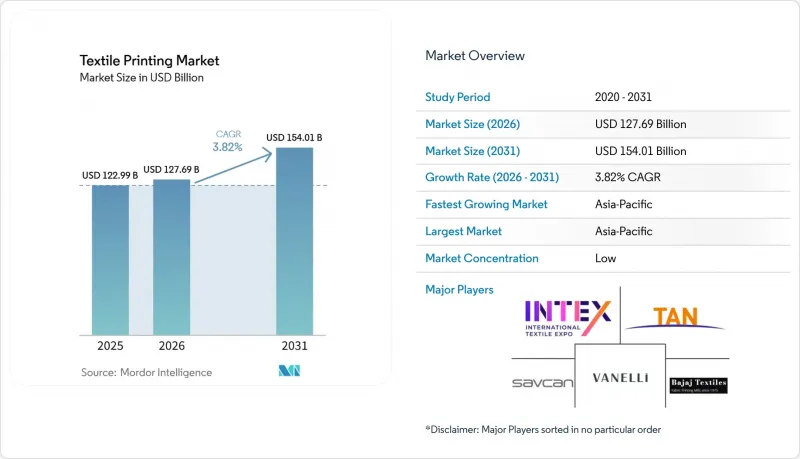
본 보고서는 프린트 원단 유형별(직물 프린트 원단, 니트 프린트 원단, 기타), 인쇄 기술별(로터리 스크린 인쇄, 디지털 텍스타일 프린팅, 기타), 원단 소재별(천연섬유, 합성 섬유, 기타), 최종 이용 산업별(의류 및 패션, 홈 텍스타일, 기타), 지역별(북미, 남미, 기타)로 분류되어 있습니다. 시장 예측은 금액(달러) 기준으로 제시되어 있습니다.
세계의 텍스타일 프린팅 시장 동향 및 인사이트
전자상거래, 주문형 인쇄, 샘플에서 생산까지의 워크플로우
2025년에는 온디맨드 인쇄 플랫폼이 전 세계적으로 약 1억 5,000만 벌의 맞춤형 의류를 처리하며, 샘플 주문 및 대량 주문의 경제성을 혁신했습니다. 디지털 플랫폼을 통해 한계 비용으로 1점 단위의 검증이 가능해져, 시제품 제작에 따른 디자인 폐기 위험이 감소합니다. BELLA+CANVAS와 Stakes Manufacturing은 2025년 4월, 미국산 및 니어쇼어 생산 모델을 통해 소매 품질의 디지털 인쇄를 대규모로 제공하기 위한 제휴를 발표했습니다. 이 제휴는 해외 생산에 따른 관세 위험 감소를 원하는 브랜드 수요에 부응하는 것입니다. 섬유 인쇄 시장에서는 협업형 디자인 툴, 자동화된 파일-투-프린트(File-to-Print) 시스템, 신뢰성 높은 디지털 출력에 대한 수요가 점점 더 높아지고 있습니다. 이러한 기능 덕분에 샘플 제작부터 양산까지의 주기가 단축되어, 고객의 선호도가 신속하게 대응할 수 있는 가공업체로 이동할 가능성이 있습니다.
패션 캘린더의 단축과 프린트 디자인의 처리 기간
세계 의류 소매업체들은 디자인에서 매장 진열까지의 기간을 단축하고 있으며, 이로 인해 더 소규모이고 빈번한 주문에 대응할 수 있는 인쇄 방식에 대한 수요가 발생하고 있습니다. 패스트 패션 기업들은 리드 타임을 평균 12주에서 3주 미만으로 단축했습니다. 로터리 스크린 인쇄기의 경우, 새로운 색상 변형마다 스크린 조각 및 설정이 필요하기 때문에 신속한 디자인 변경을 방해할 수 있습니다. 하이브리드 컨버터는 대량 생산에는 아날로그 설비를, 계절별 변형에는 디지털 라인을 활용할 수 있습니다. 소매업체의 디자인 다양성에 대한 기대가 지속적으로 높아지는 가운데, 디지털 시스템은 디자인 반복 비용을 절감합니다. 인쇄 디자인 파일은 미사용 스크린으로 인한 폐기 비용을 발생시키지 않고 활성화, 수정, 폐기가 가능하여 재사용 가능한 디지털 재고가 됩니다.
통합형 인쇄·마감 라인의 자본 집약도
디지털 텍스타일 프린팅 라인에는 엔트리 레벨 기계의 경우 20만 달러부터, 고속 싱글 패스 시스템의 경우 100만 달러를 초과하는 설비 투자가 필요합니다. 이러한 비용에는 반응성 염료나 안료 기반 워크플로우에서 사용되는 전처리 및 후처리 고정 인프라가 포함되어 있지 않습니다. 남아시아 및 동남아시아의 중견 컨버터들은 저비용 로터리 스크린 라인을 대체하기 위해 대차대조표 전체를 투입해야 하는 경우가 적지 않습니다. 프린트 헤드의 세대 교체는 4-6년마다 이루어지기 때문에 지속적인 설비 투자가 필요합니다. 도입이 늦어진 기업은 디지털 기능을 요구하는 고객의 사양에 직면할 가능성이 있는 반면, 조기 도입 기업은 원자재 및 에너지 가격 변동이 심한 시기에 자금 조달 비용을 부담하게 됩니다. 이러한 제약은 패스트 패션 바이어에게 공급하며 영업 이익률이 낮은 방글라데시, 인도, 튀르키예의 중소규모 인쇄업체들에게 특히 심각합니다.
부문 분석
2025년 섬유 인쇄 시장 규모 중 직물 프린트 원단이 54%를 차지했으며, 주요 기판 형태가 되고 있습니다. 이러한 위상을 뒷받침하는 것은 홈 퍼니싱, 정장, 전통 사리 원단, 인테리어용 원단, 산업용 원단입니다. 직물 구조는 인쇄, 세탁 또는 기계적 스트레스 하에서 안정적인 거동이 요구되는 용도에서 치수적 예측 가능성을 제공합니다. 또한, 그 다양한 구조적 선택지는 장식적 요건과 기능적 요건 모두를 충족시킵니다. 직물 형태의 텍스타일 프린팅 시장 규모는 대량 생산 용도에서 직물 형태가 확립된 역할을 반영하고 있습니다. 홈 텍스타일 제조업체와 산업 사용자는 원단의 거동에 정밀성이 요구되는 상황에서 그 안정성을 계속해서 중시하고 있습니다. 남아시아의 기존 의류 부문도 직물 형태에 대한 지속적인 수요를 뒷받침하고 있습니다. 이 부문은 높은 처리량을 자랑하는 프린팅 라인을 운영하는 공급업체에게 여전히 중요한 위치를 차지하고 있습니다.
니트 프린트 원단 시장 규모는 2026년부터 2031년까지 연평균 성장률(CAGR) 5.60%로 확대될 것으로 예측됩니다. 애슬레저, 액티브웨어, 캐주얼웨어는 신축성과 편안함을 중시하는 카테고리이므로 이러한 성장을 뒷받침하고 있습니다. RSWM은 2025년 10월, LNJ Knits 시설에 프린트 니트 제품 라인을 추가하기 위해 9억 2,000만 루피(1,100만 달러)를 투자했습니다. 이 프로젝트를 통해 총 니트 생산 능력은월750 MT에서 900 MT로 20% 확대되었으며, 니트 원단 총 수요의 30%에서 35%를 차지하는 것으로 추정되는 패션 니트 부문을 대상으로 했습니다. 부직포는 의료, 농업, 산업용 포장 용도로 사용되고 있습니다. 코팅 및 라미네이트 가공된 원단은 내마모성 및 내수성이 요구되는 자동차 시트, 여행 가방, 보호용 겉옷에 사용됩니다. 니트 원단에 디지털 인쇄를 하는 것은 신축성 있는 원단 때문에 패턴 정렬이 어긋날 가능성이 있어 더 어렵습니다. 2025년에 이르기까지 프린트 헤드와 잉크 화학 분야의 발전으로 인해 폴리에스터 니트 구조에서 나타나는 이러한 성능 격차는 축소되었습니다. 이러한 발전으로 인해 애슬레저 공급망에 서비스를 제공하는 컨버터의 대상 시장이 확대되었습니다.
2025년 시점에서 기술별로 보면, 로터리 스크린 인쇄는 텍스타일 프린팅 시장 점유율의 55.40%를 차지했습니다. 이는 인테리어 용품, 사리 원단, 산업 생산 분야의 대량 반복 패턴 인쇄에서 여전히 주요 공정으로 자리 잡고 있습니다. 분당 80-100미터의 처리 능력이라는 장점 덕분에 1,000미터를 초과하는 주문에도 대응할 수 있었습니다. 중국, 인도, 튀르키예의 주요 거점에서는 오랫동안 로터리 스크린 인쇄 장비가 가동되어 왔으며, 설비 투자의 상각이 진행되어 왔습니다. 이 기술 세계 시장 점유율은 이러한 도입 실적과 반복적인 대량 주문에서의 효율성을 반영하고 있습니다. 색상 변형이나 주문 규모가 안정적인 상황에서는 여전히 적합한 기술입니다. 또한, 로터리 스크린 인쇄는 빈번한 디자인 조정보다 규모를 중시하는 구매자의 요구에도 부응하고 있습니다. 이러한 확고한 기반을 바탕으로 아날로그 인쇄는 텍스타일 프린팅 시장에서 중요한 위치를 차지하고 있습니다.
디지털 텍스타일 프린팅는 2026-2031년 연평균 성장률(CAGR) 5.90%를 나타낼 것으로 예측되며, 이는 인쇄 기술 중 가장 빠른 속도입니다. 소량 생산, 최소 주문량 하향 조정, 지속가능성에 대한 요구가 그 보급을 뒷받침하고 있습니다. 2026년에는 싱글 패스 방식의 시스템이 분당 75미터의 생산 속도를 달성할 전망입니다. 승화형 인쇄는 폴리에스터 함량이 높은 스포츠웨어나 소프트 사이니지 제품에서 여전히 중요한 위치를 차지하고 있습니다. 플랫베드 스크린 인쇄는 개별 스크린 제어가 필요한 고급 브랜드 상품이나 장인의 솜씨가 돋보이는 홈 텍스타일 생산에 적합합니다. 전사, 플록, 호일 스탬핑, 탈색과 같은 기법은 질감이 살아있는 프리미엄 제품에서 여전히 중요한 역할을 하고 있습니다. Creditex S.A.A.의 조사에 따르면, 면 원단 1,000미터에 16가지 색상의 디자인을 적용할 경우, 디지털 텍스타일 프린팅가 여러 환경 지표에서 우위를 차지하는 것으로 나타났습니다. 이를 통해 조달 팀은 공급업체의 사양을 재검토할 근거를 얻을 수 있습니다.
지역별 분석
2025년, 아시아태평양은 전 세계 텍스타일 프린팅 시장 점유율의 45.60%를 차지할 것으로 예상되며, 2026-2031년 연평균 성장률(CAGR) 4.50%로 성장할 것으로 전망됩니다. 아시아태평양의 텍스타일 프린팅 시장은 중국을 중심으로 전개되고 있으며, 샤오싱, 항저우, 광저우 등을 포함해 이 지역에는 로터리 스크린 및 디지털 인쇄의 생산 능력이 가장 집중되어 있습니다. 중국 섬유 및 의류 평의회는 2030년까지 중국의 디지털 잉크젯 인쇄 생산량이 70억 미터를 넘어 전 세계 디지털 인쇄량의 30% 이상을 차지할 것으로 예측했습니다. 환경 규제 강화로 인해 절수형 디지털 시스템의 도입이 진행되고 있는 반면, 인도에서는 설비 투자 환급 프로그램을 통해 생산 능력 확충이 추진되고 있습니다. 슬라트와 티르푸르는 국내 패스트 패션 및 수출용 의류 생산을 담당하고 있으며, 방글라데시, 한국, 일본, 아세안(ASEAN)도 수요를 끌어올리고 있습니다.
유럽에서는 고급 홈 텍스타일 및 디지털 인쇄된 의류 원단을 통해 생산량에 비해 높은 부가가치를 창출하고 있습니다. 유럽의 텍스타일 프린팅 시장은 이탈리아, 북유럽 국가, 프랑스의 생산을 기반으로 하고 있으며, 독일, 영국, 스페인은 소량 의류 인쇄 분야에서 중요한 역할을 수행하고 있습니다. 콘피인두스트리아 모다(Confindustria Moda)의 보고서에 따르면, 2025년 이탈리아 섬유 및 의류 부문의 매출액은 583억 9,000만 유로(630억 6,000만 달러),수출액은 369억 유로(398억 5,000만 달러)였습니다. 2025년 1월부터 섬유 제품의 분리 수거가 시행되었으며, 유럽의회는 2025년 9월에 확대 생산자 책임(EPR) 제도를 승인했습니다. 튀르키예의 산업용 섬유 수출액은 2025년 첫 10개월 동안 19억 6,300만 달러에 달했으며, 지리적 이점으로 인해 공급업체들은 니어쇼어 생산의 이점을 누리고 있습니다.
북미 섬유 인쇄 시장에서는 2025년 관세 조치로 인해 멕시코 및 중미 지역의 국내 및 니어쇼어 생산 능력이 촉진됨에 따라, 온디맨드 생산, 전자상거래 주문 처리, 애슬레저 부문에서 성장이 나타나고 있습니다. USMCA 지역의 섬유 인쇄 시장은 더 신속한 주문 처리 및 생산 거점의 근접성에 대한 수요의 혜택을 받고 있습니다. 남미는 여전히 발전 단계에 있지만, 베닝거 AG와 그루포 NS는 브라질의 염색, 인쇄, 마감 생산성을 향상시키기 위해 2026년 7월 제휴를 발표했습니다. 중동 및 아프리카는 GCC(걸프협력회의)의 투자를 바탕으로 성장하는 신흥 지역이며, 튀르키예 역시 북아프리카 및 걸프 시장에 서비스를 제공합니다.
기타 혜택
- 엑셀 형식 시장 예측(ME) 시트
- 3개월간의 애널리스트 지원
자주 묻는 질문
목차
제1장 서론
제2장 조사 방법
제3장 주요 요약
제4장 시장 구도
제5장 시장 규모 및 성장 예측
제6장 경쟁 구도
제7장 시장 기회 및 향후 전망
AJY 26.09.15According to Mordor Intelligence, the textile printing market size is expected to grow from USD 122.99 billion in 2025 to USD 127.69 billion in 2026 and is forecast to reach USD 154.01 billion by 2031 at 3.82% CAGR over 2026-2031.
This report is Segmented by Fabric Type (Woven Printed Fabrics, Knitted Printed Fabrics, and More), by Printing Technology (Rotary Screen Printing, Digital Textile Printing, and More), by Fabric Material (Natural, Synthetic, Others), by End-Use Industry (Apparel, Home Textiles, and More), and by Geography (North America, South America, and More). The Market Forecasts are Provided in Terms of Value (USD).
Global Textile Printing Market Trends and Insights
E-Commerce, Print-on-Demand, and Sample-to-Production Workflows
Print-on-demand platforms handled approximately 150 million customized garments globally in 2025, changing the economics of sample and bulk orders. Digital platforms enable individual-unit verification at marginal cost and reduce the design write-off risk associated with trial runs. BELLA+CANVAS and Stakes Manufacturing announced a partnership in April 2025 to provide retail-quality digital printing at scale through Made-in-the-USA and nearshore production models. The partnership addressed demand from brands seeking to reduce tariff exposure from offshore production. The textile printing market increasingly requires connected design tools, automated file-to-print systems, and reliable digital output. These capabilities shorten the sample-to-bulk cycle and can shift customer preference toward responsive converters.
Shorter Fashion Calendars and Print-Design Turnover
Global apparel retailers have reduced design-to-shelf windows, creating demand for printing methods capable of handling smaller, more frequent orders. Fast-fashion operators pushed lead times from an average of 12 weeks toward under 3 weeks. Rotary screen printers need screen engraving and setup for each new colorway, which can slow down rapid design changes. Hybrid converters can use analog capacity for volume-based runs and digital lines for seasonal variations. Digital systems lower the cost of design iteration while retailer expectations for design variety continue to rise. Print-design files can be activated, amended, and retired without the scrap costs of unused screens, making them a reusable digital inventory.
Capital Intensity of Integrated Printing and Finishing Lines
Digital textile printing lines require capital expenditure from USD 200,000 for entry-level machines to over USD 1 million for high-speed single-pass systems. These costs exclude pre-treatment and downstream fixation infrastructure used in reactive and pigment workflows. Mid-tier converters in South Asia and Southeast Asia often require a full balance-sheet commitment to replace lower-cost rotary screen lines. Printhead generations turn over every 4 to 6 years, which creates a recurring capital requirement. Delayed adopters may face client specifications requiring digital capabilities, while early adopters absorb financing costs during periods of volatile material and energy prices. The constraint is acute for small- and medium-sized printers in Bangladesh, India, and Turkey that supply fast-fashion buyers on thin operating margins.
Other drivers and restraints analyzed in the detailed report include:
- Water, Chemical, and Wastewater Reduction in Fabric Processing
- Nearshore Production and Regional Supply-Chain Resilience
- Volatile Dye, Ink, Energy, and Base-Fabric Costs
For complete list of drivers and restraints, kindly check the Table Of Contents.
Segment Analysis
Woven printed fabrics accounted for 54% of the textile printing market size in 2025, making them the leading substrate format. Home furnishings, formal apparel, traditional sari fabrics, furnishing fabrics, and industrial uses support their position. Woven constructions provide dimensional predictability in applications that require stable behavior during printing, washing, or mechanical stress. Their range of possible constructions also supports decorative and functional requirements. The textile printing market size for woven formats reflects the established role of woven formats in large-volume applications. Home textile producers and industrial users continue to value their stability when precise fabric behavior is required. Traditional apparel categories in South Asia also support recurring demand for woven formats. The segment remains important for suppliers operating high-throughput printing lines.
Knitted printed fabrics are projected to grow at 5.60% CAGR from 2026 to 2031. Athleisure, activewear, and casual wear support this expansion because these categories depend on stretch and comfort. RSWM Ltd. committed INR 92 crore (USD 11 million) in October 2025 to add a printed knits product line at its LNJ Knits facilities. The project expanded total knitting capacity by 20% from 750 MT to 900 MT per month and targeted a fashion knitted segment estimated at 30% to 35% of total knitted fabric demand. Nonwoven fabrics serve medical, agricultural, and industrial packaging uses. Coated and laminated fabrics serve automotive seating, luggage, and protective outerwear where abrasion and water resistance are needed. Digital printing on knitted substrates is more difficult because extensible fabric can distort pattern registration. Printhead and ink-chemistry advances through 2025 narrowed this performance gap for polyester knit constructions. These advances broadened the addressable base for converters serving athleisure supply chains.
Rotary screen printing retained 55.40% of the textile printing market share by technology in 2025. It remained the primary volume process for long-run repeat patterns in home furnishings, sari fabrics, and industrial production. Its throughput advantage of 80-100 meters per minute supported orders exceeding 1,000 meters. Major hubs in China, India, and Turkey have operated and amortized rotary screen equipment over long periods. The technology's global share reflects this installed base and its efficiency in repeat-volume orders. It remains appropriate where colorways and order sizes are stable. Rotary screen printing also serves buyers who require scale rather than frequent design adjustments. This established base means analog printing remains an important part of the textile printing market.
Digital textile printing is projected to grow at 5.90% CAGR from 2026 to 2031, the fastest rate among printing technologies. Shorter runs, lower minimum orders, and sustainability requirements support its adoption. Single-pass systems in 2026 achieve production speeds of 75 meters per minute. Dye sublimation remains important for polyester-rich sportswear and soft signage products. Flatbed screen printing serves luxury branded merchandise and artisanal home-textile runs that require individual screen control. Transfer, flock, foil, and discharge methods remain relevant for premium products with tactile effects. The Creditex S.A.A. study found digital textile printing favorable across multiple environmental measures for a 16-color design on 1,000 meters of cotton fabric. This gives procurement teams evidence for reviewing supplier specifications.
Complete Report Scope:
- By Printed Fabric Type
- Woven Printed Fabrics
- Knitted Printed Fabrics
- Nonwoven Printed Fabrics
- Coated & Laminated Printed Fabrics
- Others
- By Printing Technology
- Rotary Screen Printing
- Flatbed Screen Printing
- Digital Textile Printing
- Dye Sublimation Printing
- Specialty Printing (Transfer, Flock, Foil, Discharge, etc.)
- Others
- By Fabric Material
- Natural Fibre (Cotton, Wool, Silk, etc.)
- Synthetic Fibre (Polyester, Nylon, Rayon/Viscose, etc.)
- Others (Blended & Recycled Fibers, High-Performance Fibres, etc.)
- By End-use Industry
- Apparel and Fashion
- Home Textiles
- Sportswear and Performance Textiles
- Technical and Industrial Textiles
- Automotive Textiles
- Healthcare and Protective Textiles
- Others (Soft Signage and Display Fabrics)
- By Geography
- North America
- United States
- Canada
- Mexico
- South America
- Brazil
- Argentina
- Rest of South America
- Europe
- Germany
- Italy
- United Kingdom
- France
- Spain
- BENELUX (Belgium, Netherlands, and Luxembourg)
- NORDICS (Denmark, Finland, Iceland, Norway, and Sweden)
- Rest of Europe
- Asia-Pacific
- China
- India
- Japan
- South Korea
- Bangladesh
- ASEAN (Indonesia, Thailand, Philippines, Malaysia, Vietnam)
- Rest of Asia-Pacific
- Middle East and Africa
- Saudi Arabia
- United Arab Emirates
- Qatar
- Kuwait
- Turkey
- Egypt
- South Africa
- Nigeria
- Rest of Middle East and Africa
- North America
Geography Analysis
Asia-Pacific accounted for 45.60% of the global textile printing market share in 2025 and is projected to grow at a 4.50% CAGR from 2026 to 2031. The textile printing market in Asia-Pacific is centered on China, which has the largest regional concentration of rotary screen and digital capacity, including Shaoxing, Hangzhou, and Guangzhou. The China Textile and Apparel Council projected that China's digital inkjet printing output will exceed 7 billion meters by 2030, accounting for more than 30% of global digital printing volume. Stricter environmental requirements are encouraging the adoption of water-efficient digital systems, while India is upgrading capacity through capital expenditure reimbursement programs. Surat and Tiruppur serve domestic fast-fashion and export apparel production, while Bangladesh, South Korea, Japan, and ASEAN economies add to demand.
Europe generates a high share of value relative to volume through premium home textiles and digitally printed apparel fabrics. The textile printing market in Europe draws on production in Italy, the Nordics, and France, while Germany, the United Kingdom, and Spain are important for short-run apparel printing. Confindustria Moda reported EUR 58.39 billion (USD 63.06 billion) in revenue for the Italian textile and apparel sector in 2025, and EUR 36.9 billion (USD 39.85 billion) in exports. Separate textile collection applied since January 2025, and the European Parliament approved extended producer responsibility schemes in September 2025. Turkey's technical textile exports reached USD 1.963 billion in the first 10 months of 2025, and its location gives suppliers a nearshore advantage.
The textile printing market in North America is growing in on-demand production, e-commerce fulfillment, and athleisure as 2025 tariffs encouraged domestic and nearshore capacity in Mexico and Central America. The textile printing market in the USMCA region benefits from demand for faster fulfillment and closer production locations. South America remains less developed, although Benninger AG and Grupo NS announced a July 2026 partnership to improve Brazilian dyeing, printing, and finishing productivity. Middle East and Africa is an emerging area supported by Gulf Cooperation Council investment, while Turkey also serves North African and Gulf markets.
- Bajaj Textiles
- Subhagyam Prints Pvt. Ltd.
- Savcan Textile
- Tan Group
- INTEKS International Textile
- Vespa Textiles and CizgiTeks
- Vanelli Textile
- Soletex Technical Textile
- KVS Tekstil
- Ilay Textile
- Seride S.r.l.
- Santee Print Works
- New Focus Textiles
- Hangzhou FY Textile Digital Printing Co., Ltd.
- Zhejiang Wondray Textile Printing and Dyeing Co., Ltd.
- Jiangsu Maolun Textile Technology Co., Ltd.
- Huzhou Meixin Digital Printing Co., Ltd.
- Hongtao Textile
- Muhammad Textile Manufacturing
- CottonBee
Additional Benefits:
- The market estimate (ME) sheet in Excel format
- 3 months of analyst support
TABLE OF CONTENTS
1 INTRODUCTION
- 1.1 Study Assumptions and Market Definition
- 1.2 Scope of the Study
2 RESEARCH METHODOLOGY
3 EXECUTIVE SUMMARY
4 MARKET LANDSCAPE
- 4.1 Market Overview
- 4.2 Market Drivers
- 4.2.1 Shorter Fashion Calendars and Print-Design Turnover
- 4.2.2 Demand for Customized and Low-Minimum-Order Fabrics
- 4.2.3 E-Commerce, Print-on-Demand, and Sample-to-Production Workflows
- 4.2.4 Water, Chemical, and Wastewater Reduction in Fabric Processing
- 4.2.5 Nearshore Production and Regional Supply-Chain Resilience
- 4.2.6 Digital Color Management and Faster Sampling-to-Bulk Conversion
- 4.3 Market Restraints
- 4.3.1 Capital Intensity of Integrated Printing and Finishing Lines
- 4.3.2 Volatile Dye, Ink, Energy, and Base-Fabric Costs
- 4.3.3 Skilled Operator and Color-Management Shortages
- 4.3.4 Qualification, Compliance, and Reproducibility Burden for Printed Fabrics
- 4.4 Value and Supply-Chain Analysis
- 4.5 Regulatory and Compliance Landscape
- 4.6 Technology Adoption and Innovation Landscape
- 4.7 Insights on Printing Processes and Production Workflow
- 4.8 Insights on Fabric and Substrate Trends
- 4.9 Sustainability and ESG Trends in Textile Printing
- 4.10 Spotlight on Global Trade Analysis
- 4.11 Investment and Capacity Expansion Trends
- 4.12 Innovation and Product Development Landscape
- 4.13 Impact Assessment of Geoplotical Events on the Textile Printing Market
5 MARKET SIZE AND GROWTH FORECASTS
- 5.1 By Printed Fabric Type
- 5.1.1 Woven Printed Fabrics
- 5.1.2 Knitted Printed Fabrics
- 5.1.3 Nonwoven Printed Fabrics
- 5.1.4 Coated & Laminated Printed Fabrics
- 5.1.5 Others
- 5.2 By Printing Technology
- 5.2.1 Rotary Screen Printing
- 5.2.2 Flatbed Screen Printing
- 5.2.3 Digital Textile Printing
- 5.2.4 Dye Sublimation Printing
- 5.2.5 Specialty Printing (Transfer, Flock, Foil, Discharge, etc.)
- 5.2.6 Others
- 5.3 By Fabric Material
- 5.3.1 Natural Fibre (Cotton, Wool, Silk, etc.)
- 5.3.2 Synthetic Fibre (Polyester, Nylon, Rayon/Viscose, etc.)
- 5.3.3 Others (Blended & Recycled Fibers, High-Performance Fibres, etc.)
- 5.4 By End-use Industry
- 5.4.1 Apparel and Fashion
- 5.4.2 Home Textiles
- 5.4.3 Sportswear and Performance Textiles
- 5.4.4 Technical and Industrial Textiles
- 5.4.5 Automotive Textiles
- 5.4.6 Healthcare and Protective Textiles
- 5.4.7 Others (Soft Signage and Display Fabrics)
- 5.5 By Geography
- 5.5.1 North America
- 5.5.1.1 United States
- 5.5.1.2 Canada
- 5.5.1.3 Mexico
- 5.5.2 South America
- 5.5.2.1 Brazil
- 5.5.2.2 Argentina
- 5.5.2.3 Rest of South America
- 5.5.3 Europe
- 5.5.3.1 Germany
- 5.5.3.2 Italy
- 5.5.3.3 United Kingdom
- 5.5.3.4 France
- 5.5.3.5 Spain
- 5.5.3.6 BENELUX (Belgium, Netherlands, and Luxembourg)
- 5.5.3.7 NORDICS (Denmark, Finland, Iceland, Norway, and Sweden)
- 5.5.3.8 Rest of Europe
- 5.5.4 Asia-Pacific
- 5.5.4.1 China
- 5.5.4.2 India
- 5.5.4.3 Japan
- 5.5.4.4 South Korea
- 5.5.4.5 Bangladesh
- 5.5.4.6 ASEAN (Indonesia, Thailand, Philippines, Malaysia, Vietnam)
- 5.5.4.7 Rest of Asia-Pacific
- 5.5.5 Middle East and Africa
- 5.5.5.1 Saudi Arabia
- 5.5.5.2 United Arab Emirates
- 5.5.5.3 Qatar
- 5.5.5.4 Kuwait
- 5.5.5.5 Turkey
- 5.5.5.6 Egypt
- 5.5.5.7 South Africa
- 5.5.5.8 Nigeria
- 5.5.5.9 Rest of Middle East and Africa
- 5.5.1 North America
6 COMPETITIVE LANDSCAPE
- 6.1 Market Concentration
- 6.2 Strategic Moves
- 6.2.1 Digital-Printing Line Installation and Capacity Expansion
- 6.2.2 Vertical Integration of Weaving, Dyeing, Printing, and Finishing
- 6.2.3 Nearshore Production, Contract Manufacturing, and Regional Warehousing
- 6.2.4 Sustainability Certifications and Closed-Loop Processing
- 6.3 Market Share Analysis
- 6.4 Company Profiles (includes Global Level Overview, Market Level Overview, Core Segments, Financials as available, Strategic Information, Products and Services, Recent Developments)
- 6.4.1 Bajaj Textiles
- 6.4.2 Subhagyam Prints Pvt. Ltd.
- 6.4.3 Savcan Textile
- 6.4.4 Tan Group
- 6.4.5 INTEKS International Textile
- 6.4.6 Vespa Textiles and CizgiTeks
- 6.4.7 Vanelli Textile
- 6.4.8 Soletex Technical Textile
- 6.4.9 KVS Tekstil
- 6.4.10 Ilay Textile
- 6.4.11 Seride S.r.l.
- 6.4.12 Santee Print Works
- 6.4.13 New Focus Textiles
- 6.4.14 Hangzhou FY Textile Digital Printing Co., Ltd.
- 6.4.15 Zhejiang Wondray Textile Printing and Dyeing Co., Ltd.
- 6.4.16 Jiangsu Maolun Textile Technology Co., Ltd.
- 6.4.17 Huzhou Meixin Digital Printing Co., Ltd.
- 6.4.18 Hongtao Textile
- 6.4.19 Muhammad Textile Manufacturing
- 6.4.20 CottonBee
7 MARKET OPPORTUNITIES AND FUTURE OUTLOOK
- 7.1 White-Space and Unmet-Need Assessment


