

|
시장보고서
상품코드
2154208
폴리페닐렌설파이드(PPS) 복합재료 : 시장 점유율 분석, 업계 동향과 통계, 성장 예측(2026-2031년)Polyphenylene Sulfide (PPS) Composite - Market Share Analysis, Industry Trends & Statistics, Growth Forecasts (2026 - 2031) |
||||||
 Mordor Intelligence
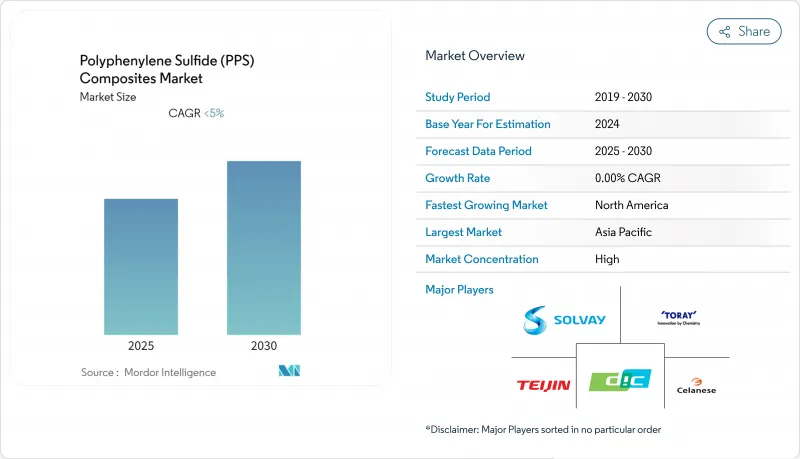
에 따르면 폴리페닐렌설파이드(PPS) 복합재료 시장 규모는 2025년에 29억 3,000만 달러로 평가되며, 2026년 31억 7,000만 달러에서 2031년까지 46억 7,000만 달러에 달할 것으로 예측되고 있으며, 예측 기간(2026-2031년)에 CAGR은 8.06%에 달할 전망입니다.
전 세계 폴리페닐렌설파이드(PPS) 복합재료 시장의 동향 및 인사이트
전기자동차(EV) 배터리 열 관리의 통합
열 관리는 리튬이온 배터리 시스템 설계에서 핵심적인 성능 요건으로 자리 잡고 있습니다. PPS 복합재료는 고밀도로 패키징된 배터리 시스템 내에서 물-글리콜 혼합액과 접촉하면서 180°C-260°C의 온도 범위에서 작동하는 냉각수 펌프 하우징, 서모스탯 본체 및 커넥터의 오버몰딩에 사용됩니다. 엔바리오(Envalio)사는 2025년 5월, 자사의 유리섬유 강화 Xytron G4080HR PPS 등급이 135°C의 물-글리콜 냉각액 속에서 3,000시간이 경과한 후에도 박리가 극히 미미했다고 보고했습니다. 각 배터리 팩에는 구조용 브래킷, 단열재, 전기 절연체, 냉각 시스템 부품 등 열적으로 안정적인 여러 폴리머 부품이 필요하므로 인증 결정은 한 번에 여러 부품군에 영향을 미칠 가능성이 있습니다. 이러한 요건으로 인해 전기자동차 1대당 PPS 복합재료의 사용량이 증가함에 따라 폴리페닐렌설파이드(PPS) 복합재료 시장에서 자동차 등급 유리섬유 강화 복합재료에 대한 수요가 촉진되고 있습니다.
소형화된 고주파 전자기기
5세대(5G) 밀리미터파 네트워크 및 인공지능(AI) 추론 인프라에는 유전 손실이 낮고, 신뢰성 높은 신호 전송이 가능하며, 고주파 영역에서도 안정적인 특성을 나타내는 기판과 커넥터가 요구됩니다. PPS 유도체는 10기가헤르츠 이상의 주파수에서 유전율 3.0 미만, 유전 정접 0.003 미만을 실현할 수 있습니다. 2025년 'Communications Materials'지의 조사에 따르면 폴리(2,6-디메틸-1,4-페닐렌설파이드)의 10 기가헤르츠에서의 유전 정접은 0.00087, 유전율은 2.80인 것으로 보고되었습니다. DIC 주식회사와 유니치카 주식회사는 2024년 10월, 30-300 기가헤르츠의 밀리파 주파수 대역에서 전송 손실을 줄이도록 설계된 PPS 필름을 발표했습니다. 이 소재는 차세대 통신 기기 및 자동차용 레이더를 위한 양산을 향해 준비가 진행되고 있으며, 이러한 분야에서는 기판의 선택이 완제품 하드웨어의 유효 성능 범위에 영향을 미칩니다.
높은 재료비와 가공 비용
PPS 복합재의 가공에는 300°C를 초과하는 용융 온도와 전용 컴파운딩 장비가 필요합니다. PPS는 황 화합물을 방출할 수 있으며, 이로 인해 표준 강철 부품을 부식시키기 때문에 스테인리스강 또는 바이메탈 재질의 배럴·스크류 어셈블리가 필요합니다. 중국산 PPS 컴파운드의 가격은 킬로그램당 3.00-3.80달러였던 반면, 유리섬유 30%를 함유한 폴리아미드 66은 킬로그램당 1.80-2.20달러였습니다. 표준 컴파운딩 라인을 내식성 금형으로 개조하려면 라인당 수백만 달러의 설비 투자가 필요할 수 있으며, 이로 인해 신규 또는 소량 생산 프로그램에 대응하기 위한 비용이 증가합니다. 비용을 중시하는 OEM 제조사의 프로젝트에서는 요구되는 성능이 PPS의 가공 비용에 비해 비효율적일 경우, 계속해서 다른 소재에 대한 검토가 진행되고 있습니다.
부문 분석
2025년, 유리섬유 강화 복합재료는 자동차, 전기 및 산업용 여과 분야에서 확립된 가공 기법에 힘입어 폴리페닐렌설파이드(PPS) 복합재료 시장 점유율의 58.45%를 차지했습니다. 30%에서 40%의 유리섬유 함유율로 260°C에 가까운 열변형 온도를 실현하여, 냉각액이나 화학 물질에 노출되었을 때도 부품의 치수 안정성을 유지하는 데 도움이 됩니다. 이러한 등급은 확립된 금형 및 재료 사양을 통해 인증 부품 도입에 필요한 시간을 단축할 수 있으므로, 대량 생산되는 사출성형 부품에 대해 계속해서 실용적인 선택지로 남아 있습니다. 이들은 냉각 시스템, 전기 커넥터, 펌프 본체 및 관리 가능한 재료 비용으로 내열성이 요구되는 기타 부품에 사용됩니다. 폭넓은 응용 분야 기반은 확립된 최종 용도 전반에 걸쳐 이 유형에 대한 지속적인 수요를 지원하며, 공급업체에게 등급 개발을 위한 견고한 기반을 제공하고 있습니다.
탄소섬유 강화 복합재료는 항공우주 분야의 인증 활동과 경량 전기자동차 배터리 하우징에 대한 수요에 힘입어 2031년까지 연평균 성장률(CAGR) 8.75%로 성장할 것으로 예측됩니다. 연속 탄소섬유 PPS 복합재료는 열경화성 탄소 에폭시 재료와 달리 용접, 열 성형, 재활용이 가능합니다. 이러한 가공 유연성 덕분에 구조용 또는 반구조용 부품에 필요한 강성을 저해하지 않으면서 부품 수와 생산 폐기물을 줄이려는 제조업체를 지원합니다. 또한 부품의 경량화를 도모하면서도 높은 강성을 요구하는 용도도 가능하게 하여, 폴리페닐렌설파이드(PPS) 복합재료 시장에서 연속 섬유 형태의 역할을 확대하고 있습니다.
지역별 분석
아시아태평양은 2025년 폴리페닐렌설파이드(PPS) 복합재료 시장 점유율의 62.87%를 차지하고 있으며, 2031년까지 연평균 성장률(CAGR) 9.21%로 확대될 것으로 예측됩니다. 중국은 세계 최대 전기자동차 생산 거점을 보유하고 있으며, 배터리 팩에 PPS 복합재 소재의 단열재, 구조용 브래킷 및 냉각 시스템용 커넥터를 채택하고 있습니다. 이 지역에서는 수지 생산, 컴파운딩 능력 및 최종 용도 제조가 일체화되어 있으며, 소재 인증부터 부품 생산에 이르는 공급 경로가 단축되었습니다. 일본과 한국은 도레이 주식회사, DIC 주식회사, 크레하 주식회사, SK케미칼이 운영하는 여러 공장 체제를 통해 고품질 PPS 수지의 중요한 공급원으로 자리매김하고 있습니다. 이 지역의 생산 거점은 폴리페닐렌설파이드(PPS) 복합재 시장에서 아시아태평양의 역할을 강화하고 있습니다.
중국의 생산 능력 확대에 따라 중급 등급의 자동차용 및 산업용 복합재료 분야에서 수입 대체가 진행되고 있습니다. NHU PM은 4단계 프로젝트를 통해 PPS의 연간 총 생산량을 3만 메트릭톤으로 늘리는 것을 목표로 하고 있습니다. 동타이 치신(Dongtai Qixin)은 2025년 8월 안후이성 황산시에서 연간 8만 메트릭톤 규모의 PPS 수지 생산 프로젝트 건설을 시작했습니다. 이 프로젝트의 1단계 투자액은 16억 위안(약 2억 2,000만 달러)이었습니다. 이러한 생산 능력 확대로 인해 하류 용도 분야에서 일본 및 한국 제조사들에 대한 경쟁 압력이 높아지고 있습니다.
북미의 수요는 항공우주·방위 분야의 조달, 자동차용 열 관리, 그리고 산업용 여과에 의해 지원되고 있습니다. Syensqo사는 2025년 5월, 조지아주 오거스타에 위치한 국제자동차태스크포스(IATF) 16949 인증을 획득한 사업장에서 Ryton PPS 컴파운드의 생산 능력을 확대했습니다. 유럽에서는 독일과 프랑스의 자동차 전기화, 그리고 영국과 프랑스의 항공우주용 복합재료가 호재로 작용하고 있습니다. 남미, 중동 및 아프리카의 경우 2031년 내내 기여도는 소폭에 그칠 것으로 예상되지만, 사우디아라비아의 에너지 투자가 정유소 및 해수 담수화 플랜트용 부품 수요를 지원하고 있습니다.
기타 혜택:
- 엑셀 형식의 시장 예측(ME) 시트
- 3개월간의 애널리스트 지원
자주 묻는 질문
목차
제1장 서론
- 조사 전제조건과 시장 정의
- 조사 범위
제2장 조사 방법
제3장 개요
제4장 시장 구도
- 시장 개요
- 시장 성장 촉진요인
- 시장 성장 억제요인
- 밸류체인 분석
- Porter's Five Forces 분석
- 규제 상황
- 기술 전망
제5장 시장 규모와 성장 예측
- 유형별
- 폼별
- 최종사용자 산업별
- 지역별
- 아시아태평양
- 중국
- 인도
- 일본
- 한국
- ASEAN 국가
- 기타 아시아태평양 국가
- 북미
- 미국
- 캐나다
- 멕시코
- 유럽
- 독일
- 영국
- 프랑스
- 이탈리아
- 북유럽 국가
- 기타 유럽 국가
- 남미
- 브라질
- 아르헨티나
- 기타 남미 국가
- 중동 및 아프리카
- 사우디아라비아
- 남아프리카공화국
- 기타 중동 및 아프리카 국가
- 아시아태평양
제6장 경쟁 구도
- 시장 집중도
- 전략적 동향
- 시장 점유율·순위 분석
- 기업 개요
- Avient Corporation
- Celanese Corporation
- DIC CORPORATION
- Ensinger
- IDEMITSU FINE COMPOSITES CO., LTD.
- KUREHA CORPORATION
- LG Chem
- NHU PM
- RTP Company
- SABIC
- SK chemicals
- Solvay
- TEIJIN LIMITED
- TORAY INDUSTRIES, INC.
- Tosoh Corporation
제7장 시장 기회와 향후 전망
KSA 26.10.23According to Mordor Intelligence, the polyphenylene sulfide (PPS) composite market size was valued at USD 2.93 billion in 2025 and is estimated to grow from USD 3.17 billion in 2026 to reach USD 4.67 billion by 2031, at a CAGR of 8.06% during the forecast period (2026-2031).
Global Polyphenylene Sulfide (PPS) Composite Market Trends and Insights
EV Battery Thermal Management Integration
Thermal management has become a major performance requirement in lithium-ion battery system design. PPS composites are used in coolant pump housings, thermostat bodies, and connector overmolds that operate at 180 °C to 260 °C while contacting water-glycol mixtures in tightly packaged battery systems. Envalior reported in May 2025 that its glass-fiber-reinforced Xytron G4080HR PPS grade showed minimal delamination after 3,000 hours in water-glycol coolant at 135 °C. Each battery pack requires multiple thermally stable polymer parts, including structural brackets, thermal barriers, electrical isolators, and cooling-system components, so that qualification decisions may affect several component families at once. This requirement increases PPS composite content per electric vehicle and supports automotive-grade glass fiber-reinforced composites in the polyphenylene sulfide (PPS) composite market.
Miniaturized High-Frequency Electronics
Fifth-generation (5G) millimeter-wave networks and artificial intelligence inference infrastructure require substrates and connectors with low dielectric loss, reliable signal transmission, and stable properties at high frequencies. PPS derivatives can deliver dielectric constants below 3.0 and dissipation factors below 0.003 at frequencies of 10 gigahertz and above. A 2025 Communications Materials study reported a dissipation factor of 0.00087 at 10 gigahertz and a dielectric constant of 2.80 for poly(2,6-dimethyl-1,4-phenylene sulfide). DIC CORPORATION and Unitika Ltd. announced a PPS film in October 2024 that was engineered to reduce transmission loss at millimeter-wave frequencies from 30 to 300 gigahertz. The material was being prepared for commercial production for next-generation communication devices and automotive radar, where the choice of substrate affects the usable performance window of the finished hardware.
High Material and Processing Cost
PPS composite processing requires melt temperatures above 300 °C and specialized compounding equipment. Stainless-steel or bimetallic barrel-and-screw assemblies are required because PPS can release sulfur compounds that corrode standard steel hardware. Chinese PPS compound prices ranged from USD 3.00 to USD 3.80 per kilogram, compared with USD 1.80 to USD 2.20 per kilogram for polyamide 66 with 30% glass fiber. Retrofitting a standard compounding line with corrosion-resistant tooling can require capital expenditure of millions of USD per line, which increases the cost of serving new or lower-volume programs. Cost-sensitive original equipment manufacturer programs continue to assess other materials where the required performance does not justify PPS processing costs.
Other drivers and restraints analyzed in the detailed report include:
- Metal Replacement and Part Consolidation
- High-Temperature Filtration Upgrades
- Competition from High-Temperature Polyamides
For complete list of drivers and restraints, kindly check the Table Of Contents.
Segment Analysis
Glass fiber-reinforced composites held 58.45% of the polyphenylene sulfide (PPS) composite market share in 2025, supported by established processing practices in automotive, electrical, and industrial filtration applications. Glass fiber loading of 30% to 40% enables heat-deflection temperatures close to 260 °C and helps components retain dimensional stability during coolant or chemical exposure. These grades remain a practical choice for high-volume injection-molded parts because established tooling and material specifications reduce the time needed to introduce a qualified component. They are used in cooling systems, electrical connectors, pump bodies, and other components that require heat resistance with manageable material cost. The broad application base supports continued demand for this type across established end uses and gives suppliers a durable base for grade development.
Carbon fiber-reinforced composites are projected to advance at an 8.75% CAGR through 2031, supported by aerospace qualification activity and demand for lightweight electric vehicle battery enclosures. Continuous carbon fiber PPS composites can be welded, thermoformed, and recycled, unlike thermoset carbon-epoxy materials. This processing flexibility supports manufacturers that are seeking to reduce part counts and production waste without giving up the stiffness required for structural or semi-structural components. It also enables applications that require high stiffness with lower component weight, which broadens the role of continuous-fiber formats in the polyphenylene sulfide (PPS) composite market.
Complete Report Scope:
- By Type
- Glass Fiber-reinforced Composites
- Carbon Fiber-reinforced Composites
- Other Types
- By Form
- Molding Compounds
- Films
- Sheets and Plates
- Other Forms
- By End-user Industry
- Automotive
- Aerospace and Defense
- Industrial (Oil and Gas)
- Electrical and Electronics
- Other End-user Industries
- By Geography
- Asia-Pacific
- China
- India
- Japan
- South Korea
- ASEAN Countries
- Rest of Asia-Pacific
- North America
- United States
- Canada
- Mexico
- Europe
- Germany
- United Kingdom
- France
- Italy
- NORDIC Countries
- Rest of Europe
- South America
- Brazil
- Argentina
- Rest of South America
- Middle East and Africa
- Saudi Arabia
- South Africa
- Rest of Middle East and Africa
- Asia-Pacific
Geography Analysis
Asia-Pacific held 62.87% of the polyphenylene sulfide (PPS) composite market share in 2025 and is projected to advance at a 9.21% CAGR through 2031. China has the largest electric vehicle production base and uses PPS composite thermal barriers, structural brackets, and coolant-system connectors in battery packs. The region combines resin production, compounding capacity, and end-use manufacturing, which shortens supply paths between material qualification and component production. Japan and South Korea remain important sources of high-grade PPS resin through multi-plant systems operated by TORAY INDUSTRIES, INC., DIC CORPORATION, KUREHA CORPORATION, and SK chemicals. This regional production base reinforces Asia-Pacific's role in the polyphenylene sulfide (PPS) composite market.
China's expanding capacity is increasing import substitution in mid-grade automotive and industrial composites. NHU PM is targeting a total PPS production of 30,000 metric tons per year through its Phase IV project. Dongtai Qixin began construction of an 80,000-metric-tons-per-year PPS resin project in Huangshan, Anhui Province, in August 2025. The project had a Phase I investment of CNY 1.6 billion (approximately USD 220 million). This capacity expansion is raising competitive pressure on Japanese and Korean producers in downstream applications.
North America's demand is supported by aerospace and defense procurement, automotive thermal management, and industrial filtration. Syensqo expanded its Ryton PPS compounding capability in Augusta, Georgia, in May 2025 at an International Automotive Task Force 16949-certified site. Europe benefits from automotive electrification in Germany and France, and aerospace composites in the United Kingdom and France. South America and the Middle East and Africa are projected to remain modest contributors through 2031, although Saudi Arabia's energy investment supports demand for refinery and desalination components.
- Avient Corporation
- Celanese Corporation
- DIC CORPORATION
- Ensinger
- IDEMITSU FINE COMPOSITES CO., LTD.
- KUREHA CORPORATION
- LG Chem
- NHU PM
- RTP Company
- SABIC
- SK chemicals
- Solvay
- TEIJIN LIMITED
- TORAY INDUSTRIES, INC.
- Tosoh Corporation
Additional Benefits:
- The market estimate (ME) sheet in Excel format
- 3 months of analyst support
TABLE OF CONTENTS
1 Introduction
- 1.1 Study Assumptions and Market Definition
- 1.2 Scope of the Study
2 Research Methodology
3 Executive Summary
4 Market Landscape
- 4.1 Market Overview
- 4.2 Market Drivers
- 4.2.1 EV Battery Thermal Management Integration
- 4.2.2 Miniaturized High-Frequency Electronics
- 4.2.3 Metal Replacement and Part Consolidation
- 4.2.4 High-Temperature Filtration Upgrades
- 4.2.5 Hydrogen Fuel-Cell Balance-of-Plant Adoption
- 4.3 Market Restraints
- 4.3.1 High Material and Processing Cost
- 4.3.2 Competition from High-Temperature Polyamides
- 4.3.3 Corrosion-Sensitive Processing Equipment
- 4.4 Value Chain Analysis
- 4.5 Porter's Five Forces Analysis
- 4.5.1 Bargaining Power of Suppliers
- 4.5.2 Bargaining Power of Buyers
- 4.5.3 Threat of New Entrants
- 4.5.4 Threat of Substitutes
- 4.5.5 Competitive Rivalry
- 4.6 Regulatory Landscape
- 4.7 Technological Outlook
5 Market Size and Growth Forecasts (Value)
- 5.1 By Type
- 5.1.1 Glass Fiber-reinforced Composites
- 5.1.2 Carbon Fiber-reinforced Composites
- 5.1.3 Other Types
- 5.2 By Form
- 5.2.1 Molding Compounds
- 5.2.2 Films
- 5.2.3 Sheets and Plates
- 5.2.4 Other Forms
- 5.3 By End-user Industry
- 5.3.1 Automotive
- 5.3.2 Aerospace and Defense
- 5.3.3 Industrial (Oil and Gas)
- 5.3.4 Electrical and Electronics
- 5.3.5 Other End-user Industries
- 5.4 By Geography
- 5.4.1 Asia-Pacific
- 5.4.1.1 China
- 5.4.1.2 India
- 5.4.1.3 Japan
- 5.4.1.4 South Korea
- 5.4.1.5 ASEAN Countries
- 5.4.1.6 Rest of Asia-Pacific
- 5.4.2 North America
- 5.4.2.1 United States
- 5.4.2.2 Canada
- 5.4.2.3 Mexico
- 5.4.3 Europe
- 5.4.3.1 Germany
- 5.4.3.2 United Kingdom
- 5.4.3.3 France
- 5.4.3.4 Italy
- 5.4.3.5 NORDIC Countries
- 5.4.3.6 Rest of Europe
- 5.4.4 South America
- 5.4.4.1 Brazil
- 5.4.4.2 Argentina
- 5.4.4.3 Rest of South America
- 5.4.5 Middle East and Africa
- 5.4.5.1 Saudi Arabia
- 5.4.5.2 South Africa
- 5.4.5.3 Rest of Middle East and Africa
- 5.4.1 Asia-Pacific
6 Competitive Landscape
- 6.1 Market Concentration
- 6.2 Strategic Moves
- 6.3 Market Share (%)/Ranking Analysis
- 6.4 Company Profiles (includes Global Overview, Market Overview, Core Segments, Financials as available, Strategic Information, Products and Services, and Recent Developments)
- 6.4.1 Avient Corporation
- 6.4.2 Celanese Corporation
- 6.4.3 DIC CORPORATION
- 6.4.4 Ensinger
- 6.4.5 IDEMITSU FINE COMPOSITES CO., LTD.
- 6.4.6 KUREHA CORPORATION
- 6.4.7 LG Chem
- 6.4.8 NHU PM
- 6.4.9 RTP Company
- 6.4.10 SABIC
- 6.4.11 SK chemicals
- 6.4.12 Solvay
- 6.4.13 TEIJIN LIMITED
- 6.4.14 TORAY INDUSTRIES, INC.
- 6.4.15 Tosoh Corporation
7 Market Opportunities and Future Outlook
- 7.1 White-Space and Unmet-Need Assessment


