

|
시장보고서
상품코드
2154252
바이오메트릭 차량 액세스 시스템 : 시장 점유율 분석, 업계 동향과 통계, 성장 예측(2026-2031년)Biometric Vehicle Access System - Market Share Analysis, Industry Trends & Statistics, Growth Forecasts (2026 - 2031) |
||||||
 Mordor Intelligence
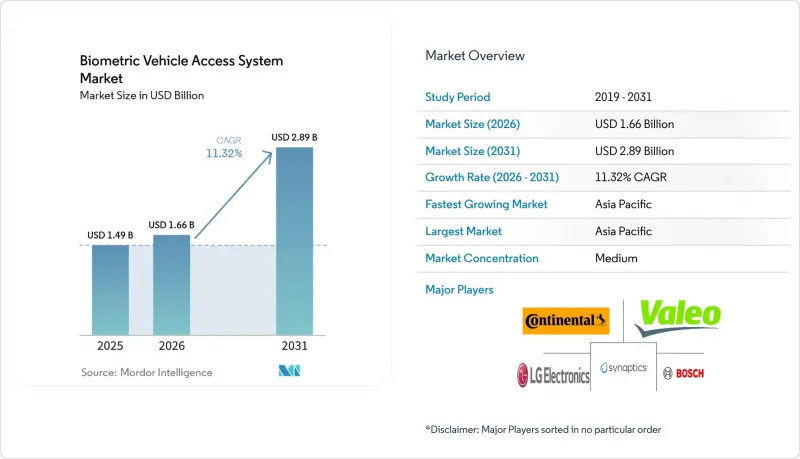
에 따르면 생체인식 차량 액세스 시스템 시장 규모는 2025년에 14억 9,000만 달러로 평가되며, 2026년 16억 6,000만 달러에서 2031년까지 28억 9,000만 달러에 달할 것으로 예측되고 있으며, 예측 기간(2026-2031년)에 CAGR은 11.32%에 달할 전망입니다.
전 세계 생체인식 차량 출입 시스템 시장의 동향 및 인사이트
중저가 자동차에서 스마트폰 수준의 지문 센서 보급 확대
프리미엄 스마트폰부터 중저가 자동차에 이르기까지 정전용량식 지문 센서가 보급됨에 따라 기존에는 기존 키 시스템이 주류를 이루던 가격대에서도 생체 인증 기술의 도입이 가속화되고 있습니다. 인피니언이 2024년 10월에 출시한, -40°C-+105°C의 온도 범위에서 작동하는 자동차용 인증 지문 센서 IC(CYFP10020A00 및 CYFP10020S00)는 양산 시장 진출에 필요한 기술적 성숙도를 입증하고 있습니다. 이 센서들은 기존 마이크로컨트롤러 아키텍처와 통합되면서 트랙패드 기능도 제공하므로 비용 효율성을 중시하는 부문를 타겟으로 하는 OEM 업체들에게 구현의 복잡성을 줄여줍니다. 중저가 승용차에는 원래 스마트폰용으로 개발된 정전용량식 지문 센서가 탑재되고 있으며, 이를 통해 단가를 5달러 미만으로 억제함으로써 OEM은 3만 달러 미만의 차량에서도 생체 인증을 통한 접근 기능을 제공할 수 있게 되었습니다.
각 OEM 업체들의 비밀번호 없는 차량내 결제 추진
각 자동차 제조사는 생체 인증 기능을 탑재하여 연료비, 통행료, 주차 요금, 디지털 서비스 등의 차량내 결제를 원활하게 처리할 수 있도록 하고 있습니다. 이를 통해 운전 중 사용자가 비밀번호를 입력하거나 결제용 카드를 꺼낼 필요가 없어집니다. 메르세데스-벤츠는 Visa와 제휴하여 ‘Mercedes me Fuel &Pay’ 시스템을 출시했습니다. 이를 통해 운전자는 차량 인포테인먼트 시스템에 통합된 지문 인증을 통해 연료비 결제를 승인할 수 있게 되었습니다. FORVIA의 생체 인증 솔루션은 Smart Eye사와 공동 개발되었으며, 2025년 4월에 실증 실험이 진행되었습니다. 이 솔루션을 통해 13개 OEM이 전개하는 32개 자동차 브랜드에 통합된 200개 이상의 애플리케이션에서 안전한 결제 및 앱 접근이 가능해졌으며, 생체 인증을 통한 접근은 지속적인 소프트웨어 수익 창출의 통로로 자리매김하고 있습니다.
저비용 지문 인식기의 한랭 지역에서의 신뢰성 관련 과제
차량 도어 핸들 및 시동 버튼에 탑재된 정전용량식 지문 센서는 한랭 지역에서 성능이 저하됩니다. 이는 추운 지역에서 피부의 전도율이 30%에서 50%까지 떨어지고, 소재의 열수축 및 배터리 전압 저하로 인해 센서의 드리프트가 증가하기 때문입니다. 칼튼 대학교의 연구에 따르면 통제된 실험실 환경에서 주변 온도와 지문 인식 정확도 사이에 약한 상관관계가 있는 것으로 밝혀졌습니다. 그러나 메르세데스 EQE 소유자 포럼에 올라온 실제 사용자들의 불만 사항에 따르면 기온이 -10°C 이하로 떨어지면 인증 실패가 반복적으로 발생하여 운전자가 예비 키포브를 사용해야만 했다고 보고되었습니다.
부문 분석
2025년에는 지문 인증의 시장 점유율이 45.23%를 차지할 것으로 예상되며, 이는 프리미엄 용도를 위한 보안 강화에 대한 업계의 진전을 반영합니다. 홍채 인증은 가장 빠르게 성장하는 인증 부문으로, 2031년까지 연평균 성장률(CAGR)이 27.58%에 달할 것으로 예측됩니다. 이러한 성장 격차는 시장 세분화를 여실히 드러내고 있습니다. 즉, 일반 차량에서는 비용 효율적인 지문 인증 솔루션이 채택되는 반면, 고급차나 상용차에서는 보안 구현 비용이 높다는 이유로 첨단 멀티모달 시스템이 선호되고 있습니다. 얼굴 인증 및 음성 인증 부문은 규모는 작지만, 특히 핸즈프리 조작이나 인포테인먼트 시스템과의 통합 측면에서 전략적으로 중요한 위치를 계속 차지하고 있습니다. 프리미엄 부문에서는 고가치 거래의 보안을 확보하고 규제 준수 요건을 충족하기 위해 생체 인증 방식을 결합한 멀티모달 및 다중 요소 인증(MFA) 시스템의 도입이 점점 더 확대되고 있습니다.
콘티넨탈이 CES 2025에서 발표한 ‘보이지 않는 생체 인증 센싱 디스플레이’는 통합형 멀티모달 시스템으로 향하는 업계의 동향을 보여줍니다. 얼굴 인식과 생체 신호 모니터링을 결합함으로써, 이러한 시스템은 포괄적인 인증 및 보안 솔루션을 제공합니다. 이러한 통합을 통해 단일 모달리티 시스템의 한계를 극복하는 동시에, 프리미엄 가격 책정을 지원하는 추가 기능도 제공됩니다. 이러한 세분화는 자동차 업계가 소프트웨어 정의 차량(SDV)으로 전환되고 있는 추세와 일치하며, 생체 인증 기능은 무선 업데이트(OTA)를 통해 갱신될 수 있으므로 OEM 각사는 하드웨어를 변경하지 않고도 새로운 인증 방식을 도입할 수 있게 됩니다.
2025년에는 승용차가 시장의 63.14%를 차지했으며, 차량 운영 사업자들이 비용 측면보다 보안, 규제 준수 및 운영 효율성을 더 중요시하고 있음이 부각되었습니다. 상용차는 연평균 성장률(CAGR) 21.43%를 기록하며 가장 빠르게 성장하는 부문이 되었습니다. FMCSA(미국 연방자동차운송안전국)가 2025년에 트럭 등록시 생체 인증을 통한 본인 확인 도입을 계획하고 있는 만큼, 이에 대한 의무화가 추진되어 민간용 애플리케이션에 앞서 상용차 분야의 생체 인증 도입이 가속화될 것으로 예상됩니다. 차량 관리 분야에서는 일원화된 조달과 차량 이용률 향상이 장점으로 작용하여, 개인용 차량에 비해 생체 인증 시스템에 대한 투자 대비 효과가 높아집니다. 상용차 생체 인증 시스템은 대부분의 경우 차량 관리 플랫폼과 통합되어 있으며, 기본적인 차량 접근 기능 외에도 접근 제어, 운전자 모니터링, 규정 준수 보고 기능 등을 사업자에게 제공합니다.
상용차 부문의 성장은 생체 인증 시스템이 성숙해지고 생산량 증가에 따라 비용이 절감됨에 따라 승용차로의 기술 이전 가능성을 시사하고 있습니다. 보쉬의 ‘Fleet Management Xtended Access’ 시스템은 상용 애플리케이션이 원격 접근 관리 및 다중 차량 인증과 같은 분야에서 혁신을 촉진하며, 이것이 결국 승용차 개발에도 영향을 미친다는 것을 보여줍니다. 이러한 기술 이전 양상은 상용차가 궁극적으로 승용차 애플리케이션에도 보급될 생체 인증 기술의 발전을 위한 시험장 역할을 하고 있음을 보여줍니다.
지역별 분석
아시아태평양은 중국 자동차 제조사들의 적극적인 생체 인증 기술 도입과 스마트 차량 개발을 지원하는 정부 정책에 힘입어, 2025년 시장 점유율 30.47% 및 2031년까지 연평균 성장률(CAGR) 18.61% 모두에서 선두를 차지하고 있습니다. 스마트 커넥티드 차량에 관한 정부의 로드맵에서는 다중 모드 운전자 식별이 기반이 되는 요소로 강조되고 있습니다. 지방 자치 단체가 이 기능을 레벨 3 자율주행 평가 기준에 포함시키면 공급업체에 대한 발주가 증가할 것입니다. 대만의 Lextar사는 AEC Q102 규격을 준수하는 VCSEL의 양산을 시작하여, 국내 및 수출 시장에 대한 안정적인 공급을 확보하고 있습니다. 이를 통해 비용이 절감되고 도입률 향상이 촉진될 것입니다.
북미는 매출 기준 2위를 차지하고 있으며, 상용 자동차 운송 사업자의 면허 갱신시 생체 인증을 통한 본인 확인을 의무화하는 규제가 이를 지원하고 있습니다. 이에 따라 차량 개조 프로그램이 촉진되고 있습니다. 디트로이트의 자동차 제조사들은 디지털 지갑을 중심으로 한 구독형 수익 모델을 추구하고 있는 반면, 미국 소비자들은 스마트폰 사용 경험에 익숙해져 있으며, 주유기에서 얼굴 인식을 통한 결제(pay-at-pump)를 점점 더 많이 채택하고 있습니다. 한랭 지역에서의 신뢰성 문제로 인해 센서가 -30°C에서도 확실하게 작동할 수 있게 될 때까지는 중서부나 캐나다 등의 지역에서 보급이 제한적일 것입니다.
유럽에서는 ISO/SAE 21434 준수 및 독일의 고급 자동차 제조사 간 경쟁을 원동력으로 삼아 꾸준히 발전하고 있습니다. GDPR(일반 데이터 보호 규정)은 암호화를 동반한 로컬 데이터 저장을 의무화하고 있으며, 이에 따라 운전자 감시 카메라에서 엣지 AI 칩으로의 아키텍처 전환이 진행되고 있습니다. 보쉬나 발레오와 같은 1차 공급업체들은 ‘프라이버시 바이 디자인’을 중시하며, 규정 준수 비용을 브랜드의 강점으로 전환하고 있습니다. 유럽의 판매 대수는 아시아에 뒤처지고 있지만, 소비자들이 디지털 키 공유와 연동된 원활한 다중 요소 인증을 요구하고 있으므로 해당 지역의 평균 판매 단가는 세계 최고 수준을 기록하고 있습니다.
기타 혜택:
- 엑셀 형식의 시장 예측(ME) 시트
- 3개월간의 애널리스트 지원
자주 묻는 질문
목차
제1장 서론
- 조사 전제조건과 시장 정의
- 조사 범위
제2장 조사 방법
제3장 개요
제4장 시장 구도
- 시장 개요
- 시장 성장 촉진요인
- 시장 성장 억제요인
- 밸류·공급망 분석
- 규제 상황
- 기술 전망
- Porter's Five Forces
- 비교 분석(제품, 재무, 특허, 가격결정)
- 스타트업 에코시스템 분석
- 시장 참여 시나리오(사업 환경 편의성, 사례 연구)
- 시장의 엔트로피(신제품 발매, M&A, 합병사업)
제5장 시장 규모와 성장 예측
- 인증 방식별
- 차종별
- 컴포넌트별
- 판매 채널별
- 지역별
- 북미
- 미국
- 캐나다
- 기타 북미 국가
- 남미
- 브라질
- 아르헨티나
- 기타 남미 국가
- 유럽
- 독일
- 영국
- 프랑스
- 이탈리아
- 스페인
- 네덜란드
- 기타 유럽 국가
- 아시아태평양
- 중국
- 일본
- 한국
- 인도
- 호주
- 기타 아시아태평양 국가
- 중동 및 아프리카
- 사우디아라비아
- 아랍에미리트
- 남아프리카공화국
- 기타 중동 및 아프리카 국가
- 북미
제6장 경쟁 구도
- 시장 집중도
- 전략적 동향
- 시장 점유율 분석
- 기업 개요
- Continental AG
- Robert Bosch GmbH
- Denso Corporation
- Safran SA
- Valeo SA
- Fingerprint Cards AB
- Synaptics Inc.
- Fujitsu Ltd
- Hitachi Ltd
- Methode Electronics
- Nuance Communications
- Cerence Inc.
- Thales Group
- Gentex Corporation
- LG Electronics
제7장 시장 기회와 향후 전망
KSAAccording to Mordor Intelligence, the biometric vehicle access system market size was valued at USD 1.49 billion in 2025 and is estimated to grow from USD 1.66 billion in 2026 to reach USD 2.89 billion by 2031, at a CAGR of 11.32% during the forecast period (2026-2031).
Global Biometric Vehicle Access System Market Trends and Insights
Ubiquity of Smartphone-Class Fingerprint Sensors in Mid-Price Cars
The democratization of capacitive fingerprint sensors from premium smartphones to mid-market vehicles accelerates biometric adoption across price segments previously dominated by traditional key systems. Infineon's October 2024 launch of automotive-qualified fingerprint sensor ICs (CYFP10020A00 and CYFP10020S00) operating over -40°C to +105°C demonstrates the technical maturation required for mass-market deployment . These sensors integrate with existing microcontroller architectures while providing trackpad functionality, reducing implementation complexity for OEMs targeting cost-sensitive segments. Mid-price passenger cars are integrating capacitive fingerprint sensors originally developed for smartphones, lowering per-unit costs to below USD 5 and enabling OEMs to offer biometric access in vehicles priced under USD 30,000.
OEM Push for Password-Free In-Car Payments
Automakers are embedding biometric authentication to enable frictionless in-car payments for fuel, tolls, parking, and digital services, eliminating the need for users to enter passwords or retrieve payment cards while driving. Mercedes-Benz launched the Mercedes me Fuel & Pay system in partnership with Visa, allowing drivers to authorize fuel purchases via fingerprint authentication integrated into the vehicle's infotainment system. FORVIA's biometric authentication solution, developed with Smart Eye and demonstrated in April 2025, enables secure payments and app access across a catalog of more than 200 applications integrated into 32 car brands from 13 OEMs, positioning biometric access as the gateway to recurring software revenue.
Cold-Weather Reliability Issues for Low-Cost Fingerprint Readers
Capacitive fingerprint sensors deployed in vehicle door handles and start buttons experience degraded performance in cold climates, where skin conductance drops 30% to 50% and sensor drift increases due to thermal contraction of materials and battery voltage sag. A Carleton University study found a weak correlation between ambient temperature and fingerprint recognition accuracy in controlled laboratory conditions. Yet, real-world user complaints on Mercedes EQE owner forums documented repeated authentication failures when temperatures fell below -10°C, forcing drivers to revert to backup key fobs.
Other drivers and restraints analyzed in the detailed report include:
- ISO/SAE 21434 Cybersecurity Mandates (2025)
- Tier-1 Suppliers' "Biometrics-as-a-Service" Revenue Models
- Data-Privacy Litigation Risk Under GDPR and CCPA
For complete list of drivers and restraints, kindly check the Table Of Contents.
Segment Analysis
In 2025, fingerprint recognition holds a 45.23% market share, reflecting the industry's progression toward enhanced security measures for premium applications. Iris recognition is the fastest-growing authentication segment, with a 27.58% CAGR projected through 2031. This growth disparity highlights a market division: mainstream vehicles adopt cost-efficient fingerprint solutions, while luxury and commercial applications prefer advanced multimodal systems, justified by higher security implementation costs. Face and voice recognition segments, though smaller, remain strategically significant, particularly in hands-free operations and integration with infotainment systems. The premium segment increasingly features multimodal and multi-factor authentication (MFA) systems, combining biometric modalities to ensure security for high-value transactions and to meet regulatory compliance requirements.
Continental's CES 2025 presentation of invisible biometric sensing displays demonstrates the industry's movement toward integrated multimodal systems. By combining facial recognition with vital sign monitoring, these systems provide comprehensive authentication and safety solutions. Such integrations address the limitations of single-modality systems while offering additional functionalities that support premium pricing. This segmentation aligns with the automotive industry's transition to software-defined vehicles, where biometric capabilities can be updated through over-the-air updates, enabling OEMs to introduce new authentication methods without hardware modifications.
In 2025, passenger cars accounted for 63.14% of the market, highlighting fleet operators' focus on security, regulatory compliance, and operational efficiency over cost concerns. Commercial vehicles represented the fastest-growing segment, with a 21.43% CAGR. The FMCSA's planned implementation of biometric identity verification for trucking registrations in 2025 is expected to drive mandatory adoption, accelerating biometric deployment in commercial vehicles ahead of consumer applications. Fleet applications benefit from centralized procurement and higher vehicle utilization, resulting in better returns on biometric system investments compared to personal vehicles. Commercial vehicle biometric systems are often integrated with fleet management platforms, providing operators with access control, driver monitoring, and compliance reporting capabilities beyond basic vehicle access.
The growth of the commercial vehicle segment suggests potential technology transfer to passenger vehicles as biometric systems mature and production volumes reduce costs. Bosch's Fleet Management Xtended Access system illustrates how commercial applications foster innovation in areas such as remote access management and multi-vehicle authentication, which subsequently influence consumer vehicle development. This transfer pattern indicates that commercial vehicles serve as testing grounds for biometric advancements that eventually reach passenger car applications.
Complete Report Scope:
- By Authentication Type
- Fingerprint Recognition
- Face Recognition
- Iris Recognition
- Voice Recognition
- Multimodal/MFA
- By Vehicle Type
- Passenger Cars
- Commercial Vehicles
- By Component
- Hardware
- Software/AI Stack
- By Sales Channel
- OEM Factory-Fit
- Aftermarket/Retrofit
- By Geography
- North America
- United States
- Canada
- Rest of North America
- South America
- Brazil
- Argentina
- Rest of South America
- Europe
- Germany
- United Kingdom
- France
- Italy
- Spain
- Netherlands
- Rest of Europe
- Asia-Pacific
- China
- Japan
- South Korea
- India
- Australia
- Rest of Asia-Pacific
- Middle East and Africa
- Saudi Arabia
- United Arab Emirates
- South Africa
- Rest of Middle East and Africa
- North America
Geography Analysis
Asia-Pacific leads both market share at 30.47% in 2025 and growth rate at 18.61% CAGR through 2031, driven by Chinese automakers' aggressive biometric integration and supportive government policies for intelligent vehicle development. Government roadmaps for intelligent connected vehicles emphasize multimodal driver identification as a foundational component. Supplier orders increase when local authorities include this feature in Level 3 autonomy scoring. Taiwan's Lextar has commenced volume production of VCSELs in accordance with AEC Q102 standards, ensuring a stable supply for domestic and export markets. This reduces costs and promotes higher adoption rates.
North America ranks second in revenue, supported by regulations that require biometric validation for commercial motor carrier license renewals. This has spurred fleet retrofit programs. Detroit OEMs are pursuing subscription-based revenue models centered on digital wallets, while US consumers increasingly adopt pay-at-pump facial recognition, driven by familiarity with smartphone experiences. Cold-weather reliability challenges limit adoption in regions like the Midwest and Canada until sensors can operate reliably at -30 °C.
Europe is advancing steadily, driven by ISO/SAE 21434 compliance and competition among premium German automakers. GDPR mandates local data storage with encryption, pushing architectures toward edge AI chips in driver-monitoring cameras. Tier-1 suppliers such as Bosch and Valeo emphasize privacy-by-design, transforming compliance costs into brand advantages. While volumes in Europe lag behind those in Asia, the region's average unit selling prices are the highest globally, as consumers demand seamless multi-factor authentication linked to digital key sharing.
- Continental AG
- Robert Bosch GmbH
- Denso Corporation
- Safran SA
- Valeo SA
- Fingerprint Cards AB
- Synaptics Inc.
- Fujitsu Ltd
- Hitachi Ltd
- Methode Electronics
- Nuance Communications
- Cerence Inc.
- Thales Group
- Gentex Corporation
- LG Electronics
Additional Benefits:
- The market estimate (ME) sheet in Excel format
- 3 months of analyst support
TABLE OF CONTENTS
1 Introduction
- 1.1 Study Assumptions and Market Definition
- 1.2 Scope of the Study
2 Research Methodology
3 Executive Summary
4 Market Landscape
- 4.1 Market Overview
- 4.2 Market Drivers
- 4.2.1 Ubiquity of Smartphone-Class Fingerprint Sensors in Mid-Price Cars
- 4.2.2 OEM Push for Password-Free In-Car Payments
- 4.2.3 ISO/SAE 21434 Cybersecurity Mandates (2025)
- 4.2.4 Tier-1 Suppliers' "Biometrics-as-a-Service" Revenue Models
- 4.2.5 Multi-Factor, Multi-Modal Access Pilots in Robotaxis
- 4.2.6 Insurance Discounts for MFA Systems
- 4.3 Market Restraints
- 4.3.1 Cold-Weather Reliability Issues for Low-Cost Fingerprint Readers
- 4.3.2 Data-Privacy Litigation Risk Under GDPR and CCPA
- 4.3.3 Lack of Global Spoof-Testing Standards
- 4.3.4 Supply-Chain Exposure to VCSEL Shortages
- 4.4 Value/Supply-Chain Analysis
- 4.5 Regulatory Landscape
- 4.6 Technological Outlook
- 4.7 Porter's Five Forces
- 4.7.1 Bargaining Power of Suppliers
- 4.7.2 Bargaining Power of Customers
- 4.7.3 Threat of New Entrants
- 4.7.4 Rivalry among Existing Players
- 4.7.5 Threat of Substitutes
- 4.8 Comparative Analysis (Product, Financials, Patents, Pricing)
- 4.9 Startup Ecosystem Analysis
- 4.10 Market Entry Scenario (Ease-of-Doing-Business, Case Studies)
- 4.11 Market Entropy (New Product Launches, MandA, JV)
5 Market Size and Growth Forecasts (Value (USD))
- 5.1 By Authentication Type
- 5.1.1 Fingerprint Recognition
- 5.1.2 Face Recognition
- 5.1.3 Iris Recognition
- 5.1.4 Voice Recognition
- 5.1.5 Multimodal/MFA
- 5.2 By Vehicle Type
- 5.2.1 Passenger Cars
- 5.2.2 Commercial Vehicles
- 5.3 By Component
- 5.3.1 Hardware
- 5.3.2 Software/AI Stack
- 5.4 By Sales Channel
- 5.4.1 OEM Factory-Fit
- 5.4.2 Aftermarket/Retrofit
- 5.5 By Geography
- 5.5.1 North America
- 5.5.1.1 United States
- 5.5.1.2 Canada
- 5.5.1.3 Rest of North America
- 5.5.2 South America
- 5.5.2.1 Brazil
- 5.5.2.2 Argentina
- 5.5.2.3 Rest of South America
- 5.5.3 Europe
- 5.5.3.1 Germany
- 5.5.3.2 United Kingdom
- 5.5.3.3 France
- 5.5.3.4 Italy
- 5.5.3.5 Spain
- 5.5.3.6 Netherlands
- 5.5.3.7 Rest of Europe
- 5.5.4 Asia-Pacific
- 5.5.4.1 China
- 5.5.4.2 Japan
- 5.5.4.3 South Korea
- 5.5.4.4 India
- 5.5.4.5 Australia
- 5.5.4.6 Rest of Asia-Pacific
- 5.5.5 Middle East and Africa
- 5.5.5.1 Saudi Arabia
- 5.5.5.2 United Arab Emirates
- 5.5.5.3 South Africa
- 5.5.5.4 Rest of Middle East and Africa
- 5.5.1 North America
6 Competitive Landscape
- 6.1 Market Concentration
- 6.2 Strategic Moves
- 6.3 Market Share Analysis
- 6.4 Company Profiles (Includes Global Level Overview, Market Level Overview, Core Segments, Financials as Available, Strategic Information, Market Rank/Share for Key Companies, Products and Services, SWOT Analysis, and Recent Developments)
- 6.4.1 Continental AG
- 6.4.2 Robert Bosch GmbH
- 6.4.3 Denso Corporation
- 6.4.4 Safran SA
- 6.4.5 Valeo SA
- 6.4.6 Fingerprint Cards AB
- 6.4.7 Synaptics Inc.
- 6.4.8 Fujitsu Ltd
- 6.4.9 Hitachi Ltd
- 6.4.10 Methode Electronics
- 6.4.11 Nuance Communications
- 6.4.12 Cerence Inc.
- 6.4.13 Thales Group
- 6.4.14 Gentex Corporation
- 6.4.15 LG Electronics
7 Market Opportunities and Future Outlook
- 7.1 White-space and Unmet-Need Assessment


