

|
시장보고서
상품코드
2154329
In-Vivo 이미징 : 시장 점유율 분석, 업계 동향과 통계, 성장 예측(2026-2031년)In-Vivo Imaging - Market Share Analysis, Industry Trends & Statistics, Growth Forecasts (2026 - 2031) |
||||||
 Mordor Intelligence
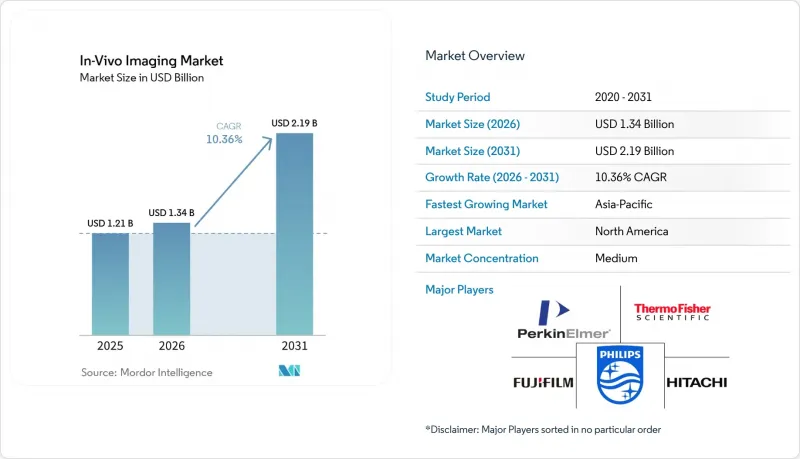
에 따르면 생체 이미징 시장 규모는 2025년에 12억 1,000만 달러로 평가되며, 2026년 13억 4,000만 달러에서 2031년까지 21억 9,000만 달러에 달할 것으로 예측되고 있으며, 예측 기간(2026-2031년)에 CAGR은 10.36%에 달할 전망입니다.
전 세계 생체내 영상 시장의 동향 및 인사이트
바이오의약품 연구개발 파이프라인의 확대와 전임상 시험의 복잡화
바이오의약품 연구 활동은 2025년 내내 견고한 추세를 보였으며, 전 세계 임상 및 전임상 파이프라인 규모는 2020년 이후 연평균 한 자릿수 후반대의 높은 성장률을 기록하며 확대되었습니다. 암 치료, 유전자 치료, 세포 치료 프로그램에서는 여러 전임상 평가 지표가 필요하므로 이러한 활동으로 인해 생체내 영상 시장은 혜택을 보고 있습니다. 이미징 기술은 동일한 동물 코호트 내에서 약물 동태, 생체내 분포 및 반복적인 질환 모니터링을 지원합니다. IQVIA 보고서에 따르면 2025년에는 전 세계에서 79종의 신규 유효 성분이 출시될 예정이며, 2030년까지는 연평균 70-80종이 출시될 것으로 전망됩니다. 또한 중국의 파이프라인에 대한 기여도가 높아지고 있는 점도 아시아의 계약연구기관(CRO)의 전임상 이미징 역량에 대한 수요를 증가시키고 있습니다. 더 복잡한 프로그램의 경우, 후보 물질 1개당 필요한 이미징 세션 수가 늘어날 가능성이 있으며, 이로 인해 파이프라인의 규모가 변동하더라도 수요가 유지될 수 있습니다.
비침습적 종단적 영상으로의 전환
비침습적 종단적 이미징은 유럽의 동물 실험 규정 및 미국의 동물 복지법에 반영된 ‘3R 원칙’에 부합합니다. 따라서 생체내 이미징 시장은 동일한 동물에 대해 스트레스를 최소화하면서 반복적인 이미징을 수행할 수 있게 해주는 기법의 혜택을 받고 있습니다. 광학 생물발광, 마이크로 MRI 및 광음향 시스템은 이러한 반복적인 평가를 지원할 수 있습니다. 2025년 동료 심사를 거친 리뷰 논문에서는 형광법과 생물발광법이 사용 편의성, 장비를 구하기 쉬운 점, 그리고 폭넓은 응용 범위 덕분에 널리 사용되는 종단적 툴로 꼽혔습니다. 종단적 설계를 채택함으로써 연구당 동물 수를 줄이면서도 생존 개체당 영상 촬영 횟수를 늘릴 수 있습니다. 이러한 추세로 인해 연구 코호트가 축소되더라도 프로브 및 소모품에 대한 수요를 유지할 수 있습니다.
높은 설비 투자, 유지 관리 및 인증 비용
설비 투자 비용은 북미 및 유럽 이외 지역에서의 도입에 있으며, 여전히 주요 장벽으로 남아 있습니다. PET/SPECT, 마이크로 MRI 및 광학 이미징을 결합한 다중 모드 시스템은 적합성 평가 활동에 앞서 수백만 달러 규모의 투자가 필요할 수 있습니다. 설치, 운영 및 성능 적합성 평가 비용도 시스템 비용에 추가됩니다. 또한 계약 연구 기관(CRO)은 후원사별 우수 실험실 관리 기준(GLP) 요건을 충족하는 문서화도 필요로 합니다. 이러한 요건으로 인해 장비 가격만으로는 드러나지 않는 비용이 발생합니다. 구독 모델이나 스캔당 과금 모델은 이러한 제약 사항을 해결하기 위한 것이지만, 그 이용은 여전히 이러한 계약을 관리할 수 있는 대규모 조직에 집중되어 있습니다.
부문 분석
2025년, 시스템은 생체내 이미징 시장 점유율의 62.48%를 차지하며 주요 제품군으로 자리매김했습니다. 이 범주에는 광학 이미징 시스템, 핵의학 이미징 시스템, 마이크로 MRI, 마이크로 초음파, 광음향 이미징 시스템 등이 포함됩니다. 광학 시스템은 생물발광 및 형광 워크플로가 널리 도입됨에 따라 시스템 부문 내에서 주도적인 위치를 유지하고 있습니다. 이들은 핵의학 영상이나 MRI의 대체 수단에 비해 세션당 소모품 비용이 낮고, 조작 요건도 간단합니다. 핵의학 영상 시스템은 방사성 의약품의 생체내 분포 연구에서 정량적 PET 및 SPECT 판독에 있으며, 여전히 중요한 역할을 수행하고 있습니다. 마이크로 MRI 및 마이크로 초음파는 연조직의 콘트라스트나 실시간 심혈관 페노타이핑과 같은 보다 전문적인 요구 사항을 충족시키고 있습니다.
시약 시장은 영상 워크플로우에서 지속적으로 중요한 역할을 수행하고 있으며, 2031년까지 연평균 성장률(CAGR) 10.89%로 성장할 것으로 예측됩니다. 이 그룹에는 광학 영상 시약, 핵의학 영상 시약, MRI 조영제, 초음파 조영제, CT 조영제 등이 포함됩니다. 핵의학용 시약은 18F-FDG, 68Ga 표지 펩티드, 99mTc 계열 화합물 등을 이용한 연구를 포함하여 PET 및 SPECT 검사에서 확립된 역할을 유지하고 있습니다. 광학 프로브는 근적외선 형광 염료, 활성화형 프로브 및 자가발광형 루시페라제 시스템을 통해 개발이 진행되고 있습니다. 이러한 제품들은 영상 깊이를 확대하고, 자가형광 배경을 저감하며, 다중 분자 측정을 가능하게 합니다. 2025년 리뷰에서는 NIH의 S10 보조금이나 이에 상응하는 유럽의 지원 제도를 통해 지원되는 공유 광학 영상 핵심 시설이 소모성 시약에 대한 지속적인 수요를 창출할 가능성이 있다고 지적하고 있습니다.
지역별 분석
북미는 미국의 공공 자금 지원 연구 센터, 제약 및 생명공학 연구 캠퍼스, 그리고 계약 연구 기관(CRO)의 집중에 힘입어 2026년 생체내 이미징 시장 매출의 36.16%를 차지했습니다. 캐나다는 종양학 및 신경과학 연구 분야에서 그 기반을 확대하고 있습니다. 멕시코는 여전히 초기 단계에 있는 국내 시장입니다. 이 지역의 수익 창출은 ‘이미징-어즈-어-서비스(IaaS)’ 및 스캔당 과금 모델로 전환되고 있습니다. 이러한 전환으로 인해 장비 판매 수익이 통합형 서비스 제공업체로 이동하고 있습니다. FDA의 바이오마커 적격성 인증 프로그램은 신청에 적합한 정량 데이터를 생성할 수 있는 플랫폼에 대한 수요를 지원하고 있습니다.
아시아태평양은 2026-2031년까지 연평균 성장률(CAGR) 13.51%로 성장할 것으로 예상되며, 이는 세계 평균보다 3퍼센트 포인트 가까이 높은 수치입니다. 중국은 전임상 연구 역량을 확충하고 있으며, 이 지역의 주요 수요 거점으로 자리 잡고 있습니다. 중국 정부는 2025년, 5개의 신규 고해상도 마이크로 CT 스캐너 개발 프로그램에 자금을 지원하겠다고 발표하며 국내 제조 역량을 지원하고 있습니다. 일본의 AMED는 2025년에 재생의학 영상 프로그램에 84억 엔(5,600만 달러 상당)을 배정했습니다. 인도, 한국, 호주 역시 연구 인프라 확충과 산학 협력을 추진하고 있습니다. 이러한 폭넓은 기반을 바탕으로, 해당 지역의 생체내 영상 시장의 기회는 중국 단독의 경우보다 훨씬 더 확대되고 있습니다.
생체내 영상 시장에서 유럽은 2위 자리를 차지하고 있으며, 독일, 영국, 프랑스가 여러 기관이 참여하는 영상 네트워크를 지원하고 있습니다. 독일의 헬름홀츠 협회와 영국 의학연구위원회(MRC)가 자금을 지원하는 네트워크는 공공 부문의 조달을 안정시키는 데 일조하고 있습니다. EU 지침 2010/63/EU는 종단적 연구 설계를 장려하는 동시에 사업자에 대한 규정 준수 요건을 강화하고 있습니다. 중동 및 아프리카, 남미에서는 도입이 아직 초기 단계에 머물러 있습니다. GCC(걸프협력회의)의 정부 산하 의료 투자 펀드는 생의학 연구 인프라에 대한 지원을 시작하고 있습니다. 브라질이 FDA 기준에 규제를 부합시킨 것은 상파울루의 연구 클러스터가 영상 기법을 많이 활용하는 전임상 연구의 라틴아메리카 거점으로 발전하는 데 박차를 가할 가능성이 있습니다. 이러한 클러스터들이 적절한 장비, 방사성 의약품 조제 지원, 그리고 전문 운영자에 대한 접근성을 확대할 수 있다면, 생체내 영상 시장은 그 혜택을 누리게 될 것입니다.
기타 혜택:
- 엑셀 형식의 시장 예측(ME) 시트
- 3개월간의 애널리스트 지원
자주 묻는 질문
목차
제1장 서론
- 조사 전제조건과 시장 정의
- 조사 범위
제2장 조사 방법
제3장 개요
제4장 시장 구도
- 시장 개요
- 시장 성장 촉진요인
- 시장 성장 억제요인
- 밸류·공급망 분석
- 규제 상황
- 기술 전망
- Porter's Five Forces 분석
제5장 시장 규모와 성장 예측
- 제품별
- 방법별
- 최종사용자별
- 지역별
- 북미
- 미국
- 캐나다
- 멕시코
- 유럽
- 독일
- 영국
- 프랑스
- 이탈리아
- 스페인
- 기타 유럽 국가
- 아시아태평양
- 중국
- 인도
- 일본
- 호주
- 한국
- 기타 아시아태평양 국가
- 중동 및 아프리카
- GCC
- 남아프리카공화국
- 기타 중동 및 아프리카 국가
- 남미
- 브라질
- 아르헨티나
- 기타 남미 국가
- 북미
제6장 경쟁 구도
- 시장 집중도
- 시장 점유율 분석
- 기업 개요
- Aspect Imaging Ltd.
- Biospace Lab
- Bruker
- CMR Naviscan
- FUJIFILM Holdings America Corporation
- General Electric
- Guerbet
- Hitachi, Ltd.
- Koninklijke Philips N.V
- LI-COR, Inc.
- Mediso Ltd.
- MILabs B.V.
- Miltenyi Biotec
- MR Solutions
- PerkinElmer Inc.
- SCANCO Medical AG
- Siemens
- Takara Bio Inc.
- Thermo Fisher Scientific Inc.
- Trifoil Imaging
제7장 시장 기회와 향후 전망
KSA 26.10.23According to Mordor Intelligence, the In-Vivo imaging market size was valued at USD 1.21 billion in 2025 and is estimated to grow from USD 1.34 billion in 2026 to reach USD 2.19 billion by 2031, at a CAGR of 10.36% during the forecast period (2026-2031).
Global In-Vivo Imaging Market Trends and Insights
Expansion of Biopharma R&D Pipelines and Preclinical Study Complexity
Biopharma research activity remained resilient through 2025, and global clinical and preclinical pipeline volumes grew at high-single-digit annual rates from 2020. The in-vivo imaging market gains from this activity because oncology, gene therapy, and cell therapy programs need several preclinical endpoints. Imaging supports pharmacokinetics, biodistribution, and repeated disease monitoring within the same animal cohort. IQVIA reported 79 novel active substances launched globally in 2025 and expects an annual average of 70-80 through 2030. China's larger pipeline contribution is also increasing demand for preclinical imaging capacity in Asian contract research organizations. More complex programs can require more imaging sessions per candidate, which supports demand even when pipeline volumes vary.
Shift Toward Non-Invasive Longitudinal Imaging
Non-invasive longitudinal imaging aligns with the 3Rs principles reflected in European animal-research rules and the U.S. Animal Welfare Act. The in-vivo imaging market, therefore, benefits from methods that allow repeated, minimally stressful imaging in the same animal. Optical bioluminescence, micro-MRI, and photoacoustic systems can support these repeated assessments. A 2025 peer-reviewed review identified fluorescence and bioluminescence as widely used longitudinal tools because of their ease of use, accessible instrumentation, and range of applications. Longitudinal designs can reduce animal numbers per study while increasing the number of sessions for each surviving animal. This pattern can protect probe and consumable demand even as study cohorts become smaller.
High Capital, Maintenance, and Qualification Costs
Capital cost remains a major barrier to adoption outside North America and Europe. A multimodal suite that combines PET/SPECT, micro-MRI, and optical imaging can require multi-million-dollar investment before qualification activities. Installation, operational, and performance qualification add to the system cost. Contract research organizations also need documentation that meets sponsor-specific good laboratory practice requirements. These needs create costs that equipment prices alone do not show. Subscription and per-scan models respond to the constraint, although use remains concentrated among larger organizations that can manage these contracts.
Other drivers and restraints analyzed in the detailed report include:
- Adoption of Multimodal Hybrid Imaging
- Rising Demand for Quantitative Translational Biomarkers
- Stringent Preclinical and Animal-Research Regulations
For complete list of drivers and restraints, kindly check the Table Of Contents.
Segment Analysis
Systems held 62.48% of the in-vivo imaging market share in 2025, making them the leading product group. The category includes optical imaging systems, nuclear imaging systems, micro-MRI, micro-ultrasound, photoacoustic imaging systems, and others. Optical systems retained a leading position within systems because bioluminescence and fluorescence workflows have been widely deployed. They offer lower per-session consumable costs and simpler operating requirements than nuclear imaging or MRI alternatives. Nuclear imaging systems remain important for quantitative PET and SPECT readouts in radiopharmaceutical biodistribution studies. Micro-MRI and micro-ultrasound meet more specialized needs for soft-tissue contrast and real-time cardiovascular phenotyping.
Reagents are forecast to grow at a 10.89% CAGR through 2031, supported by their recurring role in imaging workflows. The group includes optical imaging reagents, nuclear imaging reagents, MRI contrast agents, ultrasound contrast agents, CT contrast agents, and others. Nuclear reagents retain an established role in PET and SPECT studies, including work with 18F-FDG, 68Ga-labeled peptides, and 99mTc-based compounds. Optical probes are being developed through near-infrared fluorophores, activatable probes, and self-illuminating luciferase systems. These products can extend imaging depth, reduce autofluorescence background, and enable multiplexed molecular readouts. A 2025 review noted that shared optical imaging core facilities supported by NIH S10 grants and comparable European mechanisms can create continuing demand for consumable reagents.
Complete Report Scope:
- By Product
- Systems
- Optical Imaging Systems
- Nuclear Imaging Systems
- Micro-MRI
- Micro-Ultrasound
- Photoacoustic Imaging Systems
- Others
- Reagents
- Optical Imaging Reagents
- Nuclear Imaging Reagents
- MRI Contrast Agents
- Ultrasound Contrast Agents
- CT Contrast Agents
- Others
- Systems
- By Techniques
- Radioisotopes
- Biomarkers
- Luminescent Proteins
- Others
- By End User
- Hospitals and Clinics
- Imaging Centers
- Research Organizations
- Others
- By Geography
- North America
- United States
- Canada
- Mexico
- Europe
- Germany
- United Kingdom
- France
- Italy
- Spain
- Rest of Europe
- Asia-Pacific
- China
- India
- Japan
- Australia
- South Korea
- Rest of Asia-Pacific
- Middle East and Africa
- GCC
- South Africa
- Rest of Middle East and Africa
- South America
- Brazil
- Argentina
- Rest of South America
- North America
Geography Analysis
North America held 36.16% of the 2026 in-vivo imaging market revenue, supported by the United States' concentration of publicly funded research centers, pharmaceutical and biotechnology research campuses, and contract research organizations. Canada contributes a growing base in oncology and neuroscience research. Mexico remains an earlier-stage national market. Revenue generation in the region is shifting toward imaging-as-a-service and per-scan models. This shift moves more revenue from equipment sales toward integrated service providers. The FDA Biomarker Qualification Program supports demand for platforms that can produce quantitative data suitable for submissions.
Asia-Pacific is forecast to grow at a 13.51% CAGR from 2026 to 2031, nearly 3 percentage points above the global rate. China is adding preclinical research capacity and is a central demand center in the region. The Chinese government announced funding for 5 new high-resolution micro-CT scanner development programs in 2025, supporting domestic manufacturing capability. Japan's AMED allocated JPY 8.4 billion, equivalent to USD 56 million, for regenerative medicine imaging programs in 2025. India, South Korea, and Australia also add research infrastructure and academic-industry collaborations. This broad base makes the region's in-vivo imaging market opportunity wider than China alone.
Europe holds the second position in the in-vivo imaging market, with Germany, the United Kingdom, and France supporting multi-institutional imaging networks. Germany's Helmholtz Association and United Kingdom Medical Research Council-funded networks help stabilize public-sector procurement. EU Directive 2010/63/EU encourages longitudinal study design while increasing compliance requirements for operators. The Middle East, Africa, and South America remain at earlier stages of adoption. GCC sovereign health investment funds are beginning to support biomedical research infrastructure. Brazil's regulatory alignment with FDA standards could support Sao Paulo research clusters as Latin American hubs for imaging-intensive preclinical work. The in-vivo imaging market could benefit if these clusters gain wider access to qualified equipment, radiopharmacy support, and specialized operators.
- Aspect Imaging Ltd.
- Biospace Lab
- Bruker
- CMR Naviscan
- FUJIFILM
- GE Healthcare
- Guerbet
- Hitachi
- Koninklijke Philips
- LI-COR, Inc.
- Mediso
- MILabs
- Miltenyi Biotec
- MR Solutions
- PerkinElmer
- SCANCO Medical AG
- Siemens Healthineers
- Takara Bio
- Thermo Fisher Scientific
- Trifoil Imaging
Additional Benefits:
- The market estimate (ME) sheet in Excel format
- 3 months of analyst support
TABLE OF CONTENTS
1 Introduction
- 1.1 Study Assumptions & Market Definition
- 1.2 Scope of the Study
2 Research Methodology
3 Executive Summary
4 Market Landscape
- 4.1 Market Overview
- 4.2 Market Drivers
- 4.2.1 Expansion of Biopharma R&D Pipelines and Preclinical Study Complexity
- 4.2.2 Shift Toward Non-invasive Longitudinal Imaging
- 4.2.3 Adoption of Multimodal Hybrid Imaging
- 4.2.4 Rising Demand for Quantitative Translational Biomarkers
- 4.2.5 AI-enabled Image Segmentation and Analysis
- 4.2.6 Recurring Revenue From Probes, Software and Imaging Services
- 4.3 Market Restraints
- 4.3.1 High Capital, Maintenance and Qualification Costs
- 4.3.2 Stringent Preclinical and Animal-Research Regulations
- 4.3.3 Proprietary Isotope, Probe and Detector Supply Dependencies
- 4.3.4 Reproducibility, Protocol-Standardization and Skilled-Operator Gaps
- 4.4 Value / Supply-Chain Analysis
- 4.5 Regulatory Landscape
- 4.6 Technological Outlook
- 4.7 Porter's Five Forces Analysis
- 4.7.1 Threat of New Entrants
- 4.7.2 Bargaining Power of Buyers
- 4.7.3 Bargaining Power of Suppliers
- 4.7.4 Threat of Substitutes
- 4.7.5 Competitive Rivalry
5 Market Size & Growth Forecasts (Value, USD)
- 5.1 By Product
- 5.1.1 Systems
- 5.1.1.1 Optical Imaging Systems
- 5.1.1.2 Nuclear Imaging Systems
- 5.1.1.3 Micro-MRI
- 5.1.1.4 Micro-Ultrasound
- 5.1.1.5 Photoacoustic Imaging Systems
- 5.1.1.6 Others
- 5.1.2 Reagents
- 5.1.2.1 Optical Imaging Reagents
- 5.1.2.2 Nuclear Imaging Reagents
- 5.1.2.3 MRI Contrast Agents
- 5.1.2.4 Ultrasound Contrast Agents
- 5.1.2.5 CT Contrast Agents
- 5.1.2.6 Others
- 5.1.1 Systems
- 5.2 By Techniques
- 5.2.1 Radioisotopes
- 5.2.2 Biomarkers
- 5.2.3 Luminescent Proteins
- 5.2.4 Others
- 5.3 By End User
- 5.3.1 Hospitals and Clinics
- 5.3.2 Imaging Centers
- 5.3.3 Research Organizations
- 5.3.4 Others
- 5.4 By Geography
- 5.4.1 North America
- 5.4.1.1 United States
- 5.4.1.2 Canada
- 5.4.1.3 Mexico
- 5.4.2 Europe
- 5.4.2.1 Germany
- 5.4.2.2 United Kingdom
- 5.4.2.3 France
- 5.4.2.4 Italy
- 5.4.2.5 Spain
- 5.4.2.6 Rest of Europe
- 5.4.3 Asia-Pacific
- 5.4.3.1 China
- 5.4.3.2 India
- 5.4.3.3 Japan
- 5.4.3.4 Australia
- 5.4.3.5 South Korea
- 5.4.3.6 Rest of Asia-Pacific
- 5.4.4 Middle East and Africa
- 5.4.4.1 GCC
- 5.4.4.2 South Africa
- 5.4.4.3 Rest of Middle East and Africa
- 5.4.5 South America
- 5.4.5.1 Brazil
- 5.4.5.2 Argentina
- 5.4.5.3 Rest of South America
- 5.4.1 North America
6 Competitive Landscape
- 6.1 Market Concentration
- 6.2 Market Share Analysis
- 6.3 Company Profiles (includes Global Level Overview, Market Level Overview, Core Segments, Financials as Available, Strategic Information, Market Rank/Share for Key Companies, Products & Services, and Recent Developments)
- 6.3.1 Aspect Imaging Ltd.
- 6.3.2 Biospace Lab
- 6.3.3 Bruker
- 6.3.4 CMR Naviscan
- 6.3.5 FUJIFILM Holdings America Corporation
- 6.3.6 General Electric
- 6.3.7 Guerbet
- 6.3.8 Hitachi, Ltd.
- 6.3.9 Koninklijke Philips N.V
- 6.3.10 LI-COR, Inc.
- 6.3.11 Mediso Ltd.
- 6.3.12 MILabs B.V.
- 6.3.13 Miltenyi Biotec
- 6.3.14 MR Solutions
- 6.3.15 PerkinElmer Inc.
- 6.3.16 SCANCO Medical AG
- 6.3.17 Siemens
- 6.3.18 Takara Bio Inc.
- 6.3.19 Thermo Fisher Scientific Inc.
- 6.3.20 Trifoil Imaging
7 Market Opportunities & Future Outlook
- 7.1 White-space & Unmet-need Assessment


