

|
시장보고서
상품코드
2154343
배터리 케이스 재료 : 시장 점유율 분석, 업계 동향과 통계, 성장 예측(2026-2031년)Battery Casing Materials - Market Share Analysis, Industry Trends & Statistics, Growth Forecasts (2026 - 2031) |
||||||
 Mordor Intelligence
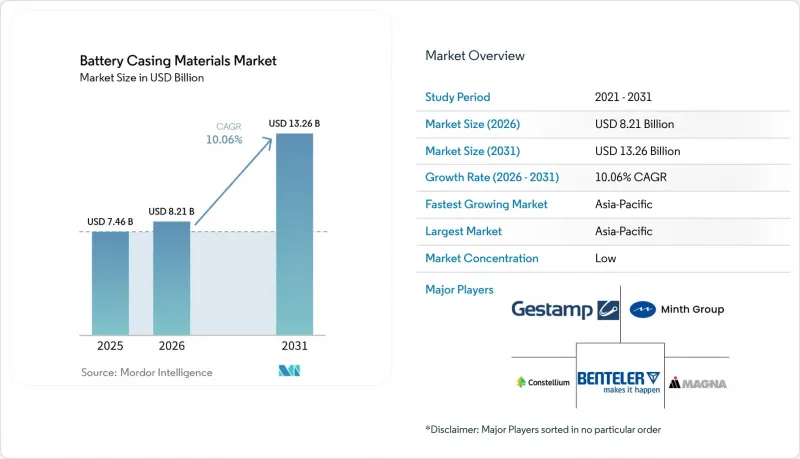
에 따르면 배터리 인클로저 재료 시장은 2025년에 74억 6,000만 달러 규모에 달하며, 2026년 82억 1,000만 달러에서 2031년까지 132억 6,000만 달러에 달할 것으로 예측되고 있으며, 예측 기간(2026-2031년)에 CAGR은 10.06%에 달할 전망입니다.
전 세계 배터리 케이스 소재 시장의 동향 및 인사이트
전기자동차(EV) 생산 가속화
전 세계 전기자동차 판매 대수는 2025년에 2,000만 대를 넘어설 것으로 예상되며, 중국, 유럽, 동남아시아, 인도, 라틴아메리카가 주도하여 2026년에는 2,330만 대에 달할 것으로 전망됩니다. 배터리식 전기자동차의 경우, 배터리 케이스, 구조 프레임, 열 관리 부품 등에 알루미늄이 사용되므로 생산 확대는 소재 수요 증가로 이어집니다. 전기 트럭 판매 대수는 2025년에 2배 이상 증가하여 전 세계 트럭 판매 대수의 9%를 차지하게 되었으며, 더 대형 배터리 팩을 탑재한 차량에 대한 수요가 더해졌습니다. 2025년에는 중국 제조업체들이 전 세계 전기자동차 생산의 75% 가까이를 공급하며 조달처를 집중시키는 동시에, 공급업체들에게 북미 및 유럽에서의 생산 능력 확대를 촉구했습니다. 모든 배터리 팩에는 구조적 봉입, 밀봉 및 열 인터페이스가 필요하므로 이러한 생산 규모는 배터리 케이스 소재 시장을 지원하고 있습니다. 또한 지역별 자동차 프로그램에 대응하는 케이스 공급업체의 경우, 현지 생산 프로그램은 물류 위험을 줄이는 데에도 기여합니다.
경량 배터리 구조에 대한 수요 증가
하우징의 질량을 줄임으로써 차량의 주행 거리 효율을 향상시킬 수 있으므로 다중 소재 배터리 하우징에 대한 관심이 높아지고 있습니다. 2026년에 발표된 조사에 따르면 탄소섬유, 유리섬유, 그래핀 나노 플레이트렛 및 바이오 유래 에폭시 수지를 사용한 하이브리드 나노복합재는 동등한 금속 부품에 비해 최대 45%의 경량화를 실현했습니다. 2024년에 완료된 콘스텔리움(Constellium)사의 ALIVE 프로젝트에서는 측면 기둥 충돌, 하부 침입 및 진동에 관한 요건을 충족하면서 12%-35%의 경량화를 입증했습니다. 'International Journal of Automotive Science and Technology'지의 조사에 따르면 시속 100킬로미터 이상에서는 탄소섬유 강화 폴리머가 알루미늄보다 높은 비에너지 흡수율을 보이는 것으로 밝혀졌습니다. 따라서 배터리 케이스 소재 시장에서는 알루미늄만으로는 중량, 안전성, 제조상의 요건을 충족할 수 없는 경우, 하이브리드 설계의 여지가 있습니다. 자동차 제조사는 중량뿐만 아니라 충돌 성능과 수리 용이성도 함께 고려하여 소재를 선정할 가능성이 높다고 볼 수 있습니다.
첨단 케이스의 높은 재료비 및 인증 비용
고급 폴리머 복합재나 다중 소재로 제작된 케이스는 대량 생산 시, 동등한 프레스 성형 알루미늄 설계와 비교하여 단위당 비용이 30%-60% 더 높아질 가능성이 있습니다. 이러한 비용 차이로 인해 고가의 소재비를 감당할 수 없는 프로그램에서는 채택이 제한될 것입니다. SGL Carbon사는 2026년 7월, 자동차 수요 부진으로 인한 매출의 대폭적인 감소를 보고하며, 단기적으로는 의미 있는 회복을 기대하기 어렵다는 전망을 밝혔습니다. 유엔 규격 38.3, 국제전기기술위원회(IEC) 규격 62619 및 각 OEM사의 충돌 시험 프로토콜에 기반한 인증 절차는 일반적으로 18-36개월이 소요됩니다. 이러한 일정은 익숙하지 않은 소재 시스템을 도입하는 공급업체에게 위험에 노출되는 자본을 증가시킵니다. 배터리 케이스 소재 시장에서는 생산 수주 전망이 불투명한 상황에서 주로 소재 제조사와 1차 공급업체들이 이러한 비용 부담을 안고 있습니다.
부문 분석
2025년, 알루미늄은 강도 대 중량 비율, 열전도율, 내식성, 그리고 확립된 글로벌 공급망에 힘입어 배터리 케이스 소재 시장 점유율의 52.38%를 차지했습니다. 콘스텔리움, 노벨리스, 노르스크 하이드로 ASA, 그리고 UACJ 코퍼레이션은 배터리 케이스 시스템에 사용되는 알루미늄 제품을 공급하고 있습니다. 콘스텔리움의 ‘ALIVE’ 프로젝트는 충돌, 진동 및 누출 시험 요건을 충족하면서 기준 설계 대비 12%-35%의 경량화를 실현했습니다. 알루미늄 합금은 제조업체가 대규모로 성형, 접합 및 조달이 가능하므로 대량 생산되는 전기자동차 플랫폼에 계속해서 채택되고 있습니다. 티센크루프(ThyssenKrupp)는 자사의 ‘selectrify’ 강철 하우징을 알루미늄과 비교했을 때 무게 차이가 거의 없으며, 재료비가 저렴한 제품으로 포지셔닝하고 있습니다.
폴리머 복합재료는 2031년까지 연평균 성장률(CAGR) 12.80%로 확대될 것으로 예측되며, 이는 배터리 하우징 재료 시장내 소재 중 가장 빠른 성장률입니다. 열가소성 수지 솔루션은 재활용성과 사출성형의 경제성을 겸비하고 있으며, 복잡한 부품 설계에서 더 광범위한 활용을 촉진할 가능성이 있습니다. Trinseo사는 2026년 5월, 열가소성 폴리카보네이트로 만든 단방향 테이프를 기반으로 한 배터리 상부 커버를 두께 1.0mm 및 1.5mm의 얇은 사양으로 출시했습니다. Tepex사의 ‘dynalite’ 유리섬유 시트와 난연성 폴리프로필렌(PP)으로 제작된 ‘STAMAX’ 트레이 코어를 채택한 하이브리드 복합재 배터리 하우징은 기존 설계에 비해 10%-20%의 경량화와 46%의 비용 절감을 실현했습니다. 2027년 이후 셀 수준의 수리 가능성과 재활용 가능성을 의무화하는 EU 배터리 규정 2023/1542는 손상 없이 분해할 수 있는 솔루션을 권장하고 있습니다.
2025년에는 리튬이온 배터리가 70.16%의 점유율을 차지하며, 전기자동차 및 고정형 시스템에서의 확고한 사용 현황을 반영했습니다. 2025년, CATL은 중국내 전기 트럭용 배터리의 80%를 공급하며 상용 CTP 팩 도입을 주도했습니다. 각 리튬이온 팩의 아키텍처에는 해당 셀의 형상 및 열 특성에 맞춘 케이스가 필요합니다. 중국에서는 2025년에 최초의 1,000볼트급 차량 모델이 등장하여 고전압 배터리 시스템의 소재 품질 향상을 촉진했습니다. 산업용 백업 전원에서는 납축전지가 여전히 중요한 역할을 하고 있지만, 배터리 케이스 소재 시장에서는 리튬계 화학 물질이 저비용 용도로 확대되고 있습니다.
나트륨 이온 배터리는 2031년까지 연평균 성장률(CAGR) 11.15%로 확대될 것으로 예상되며, 가장 빠르게 성장하는 배터리 부문이 될 전망입니다. 샬머스 공과대학은 2025년 전 세계 나트륨 이온 배터리 생산량을 70기가와트시로 추산하며, 2030년까지 250기가와트시에 달할 것으로 예측하고 있습니다. 나트륨 이온 배터리 시스템은 고유한 케이스 사양을 가지고 있으며, 화재 안전성이나 재료의 적합성이 중요해질 수 있습니다. 이러한 기회를 통해 공급업체들은 리튬이온 배터리의 요구 사항에만 국한되지 않는 케이스를 개발할 동기를 얻고 있습니다.
지역별 분석
아시아태평양은 2025년에 37.09%의 점유율을 차지할 것으로 예상되며, 2031년까지 연평균 성장률(CAGR) 11.22%로 확대될 것으로 전망됩니다. 중국은 2025년에 전 세계 전기자동차 생산 대수의 75% 가까이를 생산했으며, 전 세계 배터리 셀 생산량의 80% 이상을 차지했습니다. 이러한 수직 통합형 기반을 통해 활물질에서 팩 조립에 이르기까지 수요가 창출되고 있습니다. 인도의 전기 이륜차 및 삼륜차 부문은 2026년 1분기에 전년 동기 대비 30% 이상의 성장을 기록했습니다. LG 에너지솔루션과 SK온은 한국에서 파우치형 CTP 아키텍처의 상용화를 추진하고 있는 반면, UACJ 코퍼레이션은 일본에서 국내외 배터리 제조사에 정밀 냉간 압연 알루미늄을 공급하고 있습니다.
북미에서는 미국의 배터리 에너지 저장 시스템 도입량이 2025년 57기가와트시에서 2026년에는 70기가와트시 및 35기가와트로 증가할 것으로 예측됩니다. 이러한 확장에 252억 달러의 설비 투자가 투입되어, 내화 사양의 실외용 인클로저 시스템에 대한 수요를 지원하고 있습니다. 민즈 그룹은 2026년 3월, 미국내 제조 거점을 확대하기 위해 앨라배마주 가즈든에 4억 3,000만 달러를 투자할 것이라고 발표했습니다. 유럽의 배터리식 전기자동차(BEV) 생산 대수는 2026년 1분기에 36% 증가했으나, EU의 배터리 규제로 인해 개발사들은 모듈식이며 탈부착이 가능한 배터리 설계로 전환하고 있습니다.
남미, 중동 및 아프리카는 배터리 케이스 소재 시장에서 여전히 신흥 지역으로 남아 있습니다. 라틴아메리카의 전기자동차 판매 대수는 2025년에 75% 증가했으며, 2026년에는 추가로 45% 성장할 것으로 예상되며, 브라질과 아르헨티나가 이 지역의 수요를 지원하고 있습니다. 사우디아라비아의 산업 전략에는 전기자동차 제조에 대한 야심찬 목표가 포함되어 있는 반면, 남아프리카공화국의 광업 및 공공사업 부문에서는 전력망 안정화를 위해 대형 배터리 에너지 저장 시스템이 도입되고 있습니다. 두 지역 모두 수입된 차체 조립품에 의존하고 있지만, 현지 조달 요건으로 인해 최종 조립 현장과 가까운 곳에서의 생산이 점차 촉진될 가능성이 있습니다.
기타 혜택:
- 엑셀 형식의 시장 예측(ME) 시트
- 3개월간의 애널리스트 지원
목차
제1장 서론
- 조사 전제조건과 시장 정의
- 조사 범위
제2장 조사 방법
제3장 개요
제4장 시장 구도
- 시장 개요
- 시장 성장 촉진요인
- 시장 성장 억제요인
- 가치 및 공급망 분석
- Porter's Five Forces 분석
제5장 시장 규모와 성장 예측
- 소재별
- 배터리 유형별
- 셀 형식별
- 용도별
- 지역별
- 아시아태평양
- 중국
- 인도
- 일본
- 한국
- 기타 아시아태평양 국가
- 북미
- 미국
- 캐나다
- 멕시코
- 유럽
- 독일
- 영국
- 프랑스
- 이탈리아
- 기타 유럽 국가
- 남미
- 브라질
- 아르헨티나
- 기타 남미 국가
- 중동 및 아프리카
- 사우디아라비아
- 남아프리카공화국
- 기타 중동 및 아프리카 국가
- 아시아태평양
제6장 경쟁 구도
- 시장 집중도
- 전략적 동향
- 시장 점유율·순위 분석
- 기업 개요
- BENTELER International Austria GmbH
- Constellium
- Covestro AG
- Gestamp Automocion, S.A.
- Granges
- Kautex
- LANXESS
- Magna International Inc.
- Minth Group
- Nemak
- Norsk Hydro ASA
- Novelis
- SABIC
- SGL Carbon
- Teijin Limited
- thyssenkrupp AG
- Trinseo
- UACJ Corporation
제7장 시장 기회와 향후 전망
KSAAccording to Mordor Intelligence, the battery casing materials market was valued at USD 7.46 billion in 2025 and is estimated to grow from USD 8.21 billion in 2026 to reach USD 13.26 billion by 2031, at a CAGR of 10.06% during the forecast period (2026-2031).
Global Battery Casing Materials Market Trends and Insights
Accelerating Electric Vehicle Production
Global electric vehicle sales exceeded 20 million units in 2025 and are projected to reach 23.3 million in 2026, supported by China, Europe, Southeast Asia, India, and Latin America. Battery electric vehicles use aluminum across battery enclosures, structural frames, and thermal-management components, making production growth relevant to material demand. Electric truck sales more than doubled in 2025 and represented 9% of worldwide truck sales, adding demand from vehicles with larger battery packs. Chinese producers supplied nearly 75% of global electric car production in 2025, concentrating sourcing while encouraging suppliers to build capacity in North America and Europe. This production scale supports the battery casing materials market because every pack requires structural containment, sealing, and thermal interfaces. Local manufacturing programs can also reduce logistics exposure for enclosure suppliers serving regional vehicle programs.
Rising Demand for Lightweight Battery Structures
Lower casing mass can improve vehicle range efficiency, which is increasing interest in multi-material battery housings. Hybrid nanocomposites using carbon fiber, glass fiber, graphene nanoplatelets, and bio-based epoxy achieved up to 45% lower weight than metallic equivalents in research published in 2026. Constellium's ALIVE project, concluded in 2024, demonstrated 12%-35% weight savings while meeting side-pole crash, bottom-intrusion, and vibration requirements. Research in the International Journal of Automotive Science and Technology found that carbon-fiber-reinforced polymer provided higher specific energy absorption than aluminum above 100 kilometers per hour. The battery casing materials market, therefore, has scope for hybrid designs where aluminum alone cannot meet weight, safety, and manufacturing needs. Original equipment manufacturers are likely to assess material choice alongside crash performance and repairability rather than weight alone.
High Material and Qualification Costs for Advanced Enclosures
Advanced polymer composite and multi-material enclosures can cost 30%-60% more per unit than comparable stamped aluminum designs in high-volume production. This cost difference limits their use in programs that cannot support a premium material bill. SGL Carbon reported a significant revenue decline from weak automotive demand in July 2026 and did not expect a meaningful near-term recovery. Qualification processes under United Nations 38.3, International Electrotechnical Commission 62619, and original equipment manufacturer crash protocols typically take 18-36 months. Those timelines raise capital at risk for suppliers introducing unfamiliar material systems. The battery casing materials market faces this cost burden mainly among material producers and Tier 1 suppliers, while a production award remains uncertain.
Other drivers and restraints analyzed in the detailed report include:
- Higher Fast-Charging and Thermal-Management Requirements
- Expansion of Stationary Energy Storage Systems
- Complex Thermal-Runaway and Crash-Safety Validation
For complete list of drivers and restraints, kindly check the Table Of Contents.
Segment Analysis
Aluminum held 52.38% of the battery casing materials market share in 2025, supported by its strength-to-weight ratio, thermal conductivity, corrosion resistance, and established global supply chain. Constellium, Novelis, Norsk Hydro ASA, and UACJ Corporation supply aluminum products used in battery enclosure systems. Constellium's ALIVE project showed 12%-35% weight savings over baseline designs while meeting crash, vibration, and leak-test requirements. Aluminum alloys remain embedded in high-volume electric vehicle platforms because manufacturers can form, join, and source them at scale. The thyssenKrupp AG has positioned its selectrify steel housing as nearly weight-neutral against aluminum at a lower material cost.
Polymer composites are projected to advance at a 12.80% CAGR through 2031, the fastest rate among materials in the battery casing materials market. Thermoplastic solutions combine recyclability with injection-molding economics, which can support broader use in complex part designs. Trinseo launched a thermoplastic polycarbonate unidirectional tape-based battery top cover in May 2026 in 1.0 mm and 1.5 mm thin-wall configurations. A hybrid composite battery housing that used Tepex dynalite glass-fiber sheets and a flame-retardant polypropylene (PP) STAMAX tray core delivered 10%-20% weight reduction and 46% lower cost than traditional designs. The EU Battery Regulation 2023/1542, which requires cell-level repairability and recyclability from 2027, favors solutions that can be disassembled without damage.
Lithium-ion batteries held 70.16% share in 2025, reflecting their established use in electric vehicles and stationary deployments. CATL supplied 80% of electric truck batteries in China in 2025 and led commercial CTP pack deployment. Each lithium-ion pack architecture requires an enclosure matched to its cell geometry and thermal profile. The first 1,000-volt vehicle models in China appeared in 2025, supporting material-quality upgrades within high-voltage battery systems. Lead-acid batteries remain relevant in industrial backup power, though lithium chemistries have been extending into lower-cost uses in the battery casing materials market.
Sodium-ion batteries are projected to advance at an 11.15% CAGR through 2031, making them the fastest-growing battery-type segment. Chalmers University of Technology estimated global sodium-ion production at 70 gigawatt-hours in 2025 and projected it to reach 250 gigawatt-hours by 2030. Sodium-ion systems present a separate enclosure specification where fire safety and material compatibility can be important. This opening gives suppliers a reason to develop housings that are not limited to lithium-ion battery requirements.
Complete Report Scope:
- By Material
- Aluminum
- Steel
- Engineering Plastics
- Polymer Composites
- Other Materials (Stainless Steel, Magnesium Alloys, Hybrid Metal-Polymer Structures)
- By Battery Type
- Lithium-Ion Batteries
- Sodium-Ion Batteries
- Lead-Acid Batteries
- Other Battery Types (Nickel-Based Batteries, Solid-State Batteries, Flow Batteries)
- By Cell Format
- Prismatic Cells
- Cylindrical Cells
- Pouch Cells
- Other Cell Formats (Coin and Button Cells)
- By Application
- Electric Vehicles
- Energy Storage Systems
- Consumer Electronics
- Other Applications (Industrial Batteries, Aerospace and Defense, Marine, Medical Devices)
- By Geography
- Asia-Pacific
- China
- India
- Japan
- South Korea
- Rest of Asia-Pacific
- North America
- United States
- Canada
- Mexico
- Europe
- Germany
- United Kingdom
- France
- Italy
- Rest of Europe
- South America
- Brazil
- Argentina
- Rest of South America
- Middle-East and Africa
- Saudi Arabia
- South Africa
- Rest of Middle-East and Africa
- Asia-Pacific
Geography Analysis
Asia-Pacific held 37.09% share in 2025 and is projected to advance at an 11.22% CAGR through 2031. China produced nearly 75% of the world's electric cars in 2025 and accounted for more than 80% of global battery cell production. This vertically integrated base creates demand from active materials through pack assembly. India's electric two-wheeler and three-wheeler segment grew more than 30% year over year in the first quarter of 2026. LG Energy Solution and SK On are commercializing pouch CTP architectures in South Korea, while UACJ Corporation supplies precision cold-rolled aluminum to domestic and international battery manufacturers from Japan.
In North America, U.S. battery energy storage deployments are projected to rise to 70 gigawatt-hours and 35 gigawatts in 2026 from 57 gigawatt-hours in 2025. This buildout represented USD 25.2 billion in capital investment and supports demand for fire-rated outdoor enclosure systems. Minth Group announced a USD 430 million investment in Gadsden, Alabama, in March 2026 to expand its U.S. manufacturing footprint. Europe's battery electric vehicle production grew 36% in the first quarter of 2026, while the EU Battery Regulation is steering developers toward modular and reversibly fastened battery designs.
South America, and Middle-East and Africa remain emerging geographies for the battery casing materials market. Latin American electric vehicle sales rose 75% in 2025 and are projected to grow a further 45% in 2026, with Brazil and Argentina supporting regional demand. Saudi Arabia's industrial strategy includes electric vehicle manufacturing ambitions, while South Africa's mining and utility sectors are deploying large-format battery energy storage systems for grid stabilization. Both regions rely on imported enclosure assemblies, but local-content requirements can gradually support production closer to end-use assembly.
- BENTELER International Austria GmbH
- Constellium
- Covestro AG
- Gestamp Automocion, S.A.
- Granges
- Kautex
- LANXESS
- Magna International Inc.
- Minth Group
- Nemak
- Norsk Hydro ASA
- Novelis
- SABIC
- SGL Carbon
- Teijin Limited
- thyssenkrupp AG
- Trinseo
- UACJ Corporation
Additional Benefits:
- The market estimate (ME) sheet in Excel format
- 3 months of analyst support
TABLE OF CONTENTS
1 Introduction
- 1.1 Study Assumptions and Market Definition
- 1.2 Scope of the Study
2 Research Methodology
3 Executive Summary
4 Market Landscape
- 4.1 Market Overview
- 4.2 Market Drivers
- 4.2.1 Accelerating Electric Vehicle Production
- 4.2.2 Rising Demand for Lightweight Battery Structures
- 4.2.3 Higher Fast-Charging and Thermal-Management Requirements
- 4.2.4 Expansion of Stationary Energy Storage Systems
- 4.2.5 Battery-Pack Architecture Migration to Cell-to-Pack Designs
- 4.2.6 Increasing Demand for Repairable, Recyclable Enclosures
- 4.3 Market Restraints
- 4.3.1 High Material and Qualification Costs for Advanced Enclosures
- 4.3.2 Complex Thermal-Runaway and Crash-Safety Validation
- 4.3.3 Limited Recycling Infrastructure for Multi-Material Casings
- 4.3.4 Design Lock-In From Rapidly Changing Cell Formats and Pack Architectures
- 4.4 Value and Supply-Chain Analysis
- 4.5 Porter's Five Forces Analysis
- 4.5.1 Threat of New Entrants
- 4.5.2 Bargaining Power of Suppliers
- 4.5.3 Bargaining Power of Buyers
- 4.5.4 Threat of Substitutes
- 4.5.5 Competitive Rivalry
5 Market Size and Growth Forecasts (Value)
- 5.1 By Material
- 5.1.1 Aluminum
- 5.1.2 Steel
- 5.1.3 Engineering Plastics
- 5.1.4 Polymer Composites
- 5.1.5 Other Materials (Stainless Steel, Magnesium Alloys, Hybrid Metal-Polymer Structures)
- 5.2 By Battery Type
- 5.2.1 Lithium-Ion Batteries
- 5.2.2 Sodium-Ion Batteries
- 5.2.3 Lead-Acid Batteries
- 5.2.4 Other Battery Types (Nickel-Based Batteries, Solid-State Batteries, Flow Batteries)
- 5.3 By Cell Format
- 5.3.1 Prismatic Cells
- 5.3.2 Cylindrical Cells
- 5.3.3 Pouch Cells
- 5.3.4 Other Cell Formats (Coin and Button Cells)
- 5.4 By Application
- 5.4.1 Electric Vehicles
- 5.4.2 Energy Storage Systems
- 5.4.3 Consumer Electronics
- 5.4.4 Other Applications (Industrial Batteries, Aerospace and Defense, Marine, Medical Devices)
- 5.5 By Geography
- 5.5.1 Asia-Pacific
- 5.5.1.1 China
- 5.5.1.2 India
- 5.5.1.3 Japan
- 5.5.1.4 South Korea
- 5.5.1.5 Rest of Asia-Pacific
- 5.5.2 North America
- 5.5.2.1 United States
- 5.5.2.2 Canada
- 5.5.2.3 Mexico
- 5.5.3 Europe
- 5.5.3.1 Germany
- 5.5.3.2 United Kingdom
- 5.5.3.3 France
- 5.5.3.4 Italy
- 5.5.3.5 Rest of Europe
- 5.5.4 South America
- 5.5.4.1 Brazil
- 5.5.4.2 Argentina
- 5.5.4.3 Rest of South America
- 5.5.5 Middle-East and Africa
- 5.5.5.1 Saudi Arabia
- 5.5.5.2 South Africa
- 5.5.5.3 Rest of Middle-East and Africa
- 5.5.1 Asia-Pacific
6 Competitive Landscape
- 6.1 Market Concentration
- 6.2 Strategic Moves
- 6.3 Market Share (%)/Ranking Analysis
- 6.4 Company Profiles (includes Global Overview, Market Overview, Core Segments, Financials as available, Strategic Information, Products and Services, and Recent Developments)
- 6.4.1 BENTELER International Austria GmbH
- 6.4.2 Constellium
- 6.4.3 Covestro AG
- 6.4.4 Gestamp Automocion, S.A.
- 6.4.5 Granges
- 6.4.6 Kautex
- 6.4.7 LANXESS
- 6.4.8 Magna International Inc.
- 6.4.9 Minth Group
- 6.4.10 Nemak
- 6.4.11 Norsk Hydro ASA
- 6.4.12 Novelis
- 6.4.13 SABIC
- 6.4.14 SGL Carbon
- 6.4.15 Teijin Limited
- 6.4.16 thyssenkrupp AG
- 6.4.17 Trinseo
- 6.4.18 UACJ Corporation
7 Market Opportunities and Future Outlook
- 7.1 White-Space and Unmet-Need Assessment


