

|
시장보고서
상품코드
2154366
렘데시비르 : 시장 점유율 분석, 업계 동향과 통계, 성장 예측(2026-2031년)Remdesivir - Market Share Analysis, Industry Trends & Statistics, Growth Forecasts (2026 - 2031) |
||||||
 Mordor Intelligence
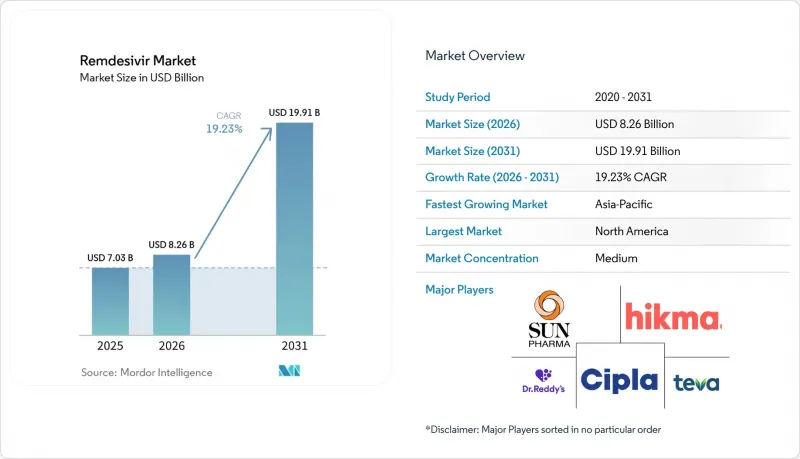
에 따르면 렘데시비르 시장 규모는 2025년 70억 3,000만 달러에서 2026년에는 82억 6,000만 달러로 확대하며, 2031년까지 199억 1,000만 달러에 달할 것으로 예상되고 있으며, 2026-2031년에 CAGR 19.23%로 성장할 것으로 전망되고 있습니다.
전 세계 렘데시비르 시장의 동향 및 인사이트
광범위 항바이러스제에 대한 지속적인 수요
렘데시비르는 바이러스의 RNA 중합효소를 억제하여 작용하므로, 한 유형 이상의 바이러스 위협에 대해 사용할 수 있습니다. 2026년 연구에 따르면 렘데시비르와 오베르데시비르는 LP.8.1 및 XFG를 포함한 10종의 유행 중인 오미크론 아형에 대해 항바이러스 활성을 유지하는 것으로 보고되었습니다. 이러한 증거를 바탕으로 조달 당국은 변이주가 변화하더라도 유용성을 유지할 수 있는 항바이러스제를 계속 보유해야 할 근거를 얻게 되었습니다. 2026년 5월, WHO 기술 자문 그룹은 분디부교 바이러스병 임상 시험에서 렘데시비르를 우선 치료제 중 하나로 지정했습니다. 길리어드사는 2026년, 우간다의 에볼라 대응을 위해 2,000바이알 이상을 기증했으며, 콩고민주공화국을 위한 비축분도 준비했습니다. 이러한 노력을 통해 렘데시비르 시장은 호흡기 및 필로바이러스 관련 비상사태에서 비축 의약품으로서의 역할을 담당하는 위치에 자리 잡게 되었습니다.
정부의 비축 및 팬데믹 대책 예산
정부 조달 담당자들은 긴급 구매에서 계획적인 비축으로 전환하고 있으며, 이를 통해 렘데시비르 시장에는 보다 안정적인 수요원이 확보되고 있습니다. 유럽연합 집행위원회는 2025년 7월 ‘EU 비축 및 의료 대책 전략’을 출범시켰으며, 2027년까지 ‘보건 비상사태 대비 및 대응 기관(ECHA)’에 대한 투자액을 2억 유로로 증액하고, 항바이러스제를 우선 과제로 지정했습니다. 이 정책은 확립된 임상 프로토콜에 따라 보관, 동원, 사용이 가능한 제품을 우선시하는 것입니다. 대만 질병관리국은 2025년 6월 기준으로 주사용 렘데시비르 20만 4,000회분을 비축하고 있다고 보고했습니다. 보고된 이 비축량은 COVID-19에 대한 광범위한 비상 조치가 종료된 후에도 치료 계획을 지속할 수 있음을 보여줍니다. 이러한 프로그램은 입원 환자 수의 변동에 따른 영향을 완화할 수는 있지만, 일반적인 병원 수요를 완전히 대체하는 것은 아닙니다.
성숙 시장에서 COVID-19로 인한 입원 부담의 감소
성숙 시장에서 COVID-19 입원 환자 수의 감소는 렘데시비르 시장에 있으며, 가장 시급한 제약 요인으로 작용하고 있습니다. 길리어드사에 따르면 2025년 ‘베클루리’의 매출은 49% 감소한 9억 1,100만 달러에 달할 것이며, 미국내 매출은 2024년의 8억 9,200만 달러에서 4억 7,000만 달러로 감소했습니다. 이 회사가 2026년 ‘베클루리’ 매출 전망치로 6억 달러를 제시한 것은 판매량이 정상화되고 있음을 시사합니다. 브랜드 의약품의 매출이 감소하면 참조 가격 제도에 영향을 미쳐, 제네릭 의약품 제조사들이 생산 능력 확충을 통해 기대하는 수익을 낮출 가능성이 있습니다. 경증 및 중등증 외래 환자를 위한 경구용 항바이러스제 또한 정맥 주사 요법의 역할을 제한하는 요인이 되고 있습니다. 비축 주문은 일정한 버팀목이 되지만, 현재의 증거에 따르면 이는 감소한 병원 수요를 부분적으로만 보충하고 있는 것으로 보입니다.
부문별 분석
2025년, 정맥내 투여는 시장 점유율의 71.83%를 차지했습니다. 이러한 주도적인 위상은 병원 치료에서 정맥내 전구체 약물로 이 제품이 확고히 자리 잡은 사용 실태를 반영합니다. 북미 및 유럽의 병원에서는 산소 공급이 필요한 COVID-19 폐렴 치료 경로에 정맥 주사 요법이 포함되어 있습니다. 2024년에 실시된 3만 3,037명의 매칭 환자를 대상으로 한 분석에 따르면 렘데시비르와 덱사메타존의 병용 요법은 덱사메타존 단독 요법에 비해 사망률이 낮은 것으로 나타났습니다. 이러한 근거는 약물 위원회에 렘데시비르 정맥 주사 제제를 처방집에 유지하기 위한 임상적 근거를 제공하고 있습니다. 또한 이로 인해 감시 하에 치료가 가능한 의료 기관에 수요가 집중되는 결과로 이어지고 있습니다.
2025년에 발표된 연구에서는 경구 생체이용률과 폐로의 표적화를 개선하는 것을 목적으로 한 나노입자 및 엑소좀을 이용한 접근법이 검토되었습니다. 2026년의 연구에서는 광범위한 항바이러스 활성을 지닌 경구 투여 가능한 N-아실화 렘데시비르 유도체가 보고되었습니다. 이러한 접근 방식은 현재의 정맥내 투여 제제를 대체하는 것은 아닙니다. 그러나 투여 경로의 혁신을 통해 치료가 외래 진료 현장으로 확대될 수 있는 근거를 제시하고 있습니다. 입원 환자에 대한 COVID-19 치료 사용이 지속적으로 감소하고 있는 상황에서 병원 약품 리스트에서 우선순위가 낮아지는 것은 여전히 위험 요인으로 남아 있습니다. 현재의 투여 경로 구성은 여전히 정맥 주사 인프라를 갖춘 의료 기관에 유리한 상황입니다.
2025년에는 동결건조 제제가 시장 점유율의 52.38%를 차지했습니다. 이는 전략적 비축 및 병원 공급망의 보관 요건을 반영한 결과입니다. 장기 보관이나 불안정한 콜드체인 상황이 조달 결정에 영향을 미치는 경우, 안정적인 건조 제제가 유용합니다. 동결건조 무균 주사제의 제조에는 클린룸, 무균 충전 및 마무리 공정, 그리고 동결건조 능력이 필요합니다. 2025년 분석에서는 첨단 동결건조 주사제 생산에 따른 막대한 제조 수요가 지적되었습니다. 이러한 요건은 무균 생산에 투자해 온 기존 제조사들에게 유리하게 작용할 것입니다.
동결건조 렘데시비르 시장 규모는 2031년까지 연평균 성장률(CAGR) 19.76%로 확대될 것으로 예측됩니다. 약국이 지속적인 냉장 설비를 갖추고 있으며, 희석 준비가 완료된 제품을 선호하는 경우, 동결 용액은 저비용 대안이 됩니다. 이 두 가지 제형은 동일한 구매 결정이라기보다는 서로 다른 운영상의 요구를 충족시키는 것입니다. 유럽 및 아시아의 비축 프로그램에서는 보관 내구성이 중요하므로 비축 용도로는 동결건조 제제가 우선시될 가능성이 있습니다. WHO의 사전 인증 프로그램은 2026년 9월에 제9회 연간 제조업체 워크숍을 개최하여 의료 제품의 품질관리 시스템에 대한 관심을 더욱 높였습니다. 인증 획득과 안정적인 공급은 저·중소득국의 입찰 참여에 영향을 미칠 수 있습니다. 무균 제조 및 유통 비용이 높다는 점은 신규 제네릭 의약품 제조사의 시장 진입을 제한하는 비용 하한선을 설정하고 있습니다.
지역별 분석
2025년, 북미는 시장 점유율의 38.63%를 차지했습니다. 이 지역은 대규모 병원 네트워크, 보험에 의한 환급, 그리고 중앙 조달 체제의 혜택을 받고 있습니다. 2025년 미국의 ‘베클루리’ 매출은 4억 7,000만 달러였으나, 2024년에는 8억 9,200만 달러였습니다. 이러한 감소에도 불구하고 미국은 제공된 자료에 명시된 국가 중 가장 큰 단일 국가 매출 기반을 유지하고 있습니다. 병원의 프로토콜과 면역결핍 환자의 수요가 지속적인 수요를 지원하고 있습니다. 캐나다와 멕시코도 WHO 지침에 따른 대비 계획을 수립하고 있으며, 이는 비축 구매를 지원할 가능성이 있습니다.
유럽은 렘데시비르 시장에서 두 번째로 큰 지역 기여도를 차지하고 있습니다. 유럽집행위원회가 2025년 7월에 발표한 전략에서는 항바이러스제가 우선적인 의료 대책으로 자리매김되었으며, 조정된 비축 네트워크가 수립되었습니다. 이 정책을 통해 상업적 판매 데이터만으로는 파악하기 어려운 보다 안정적인 조달 기반이 구축될 가능성이 있습니다. 독일의 병원 구매 그룹, 영국의 표준화된 치료 프로토콜, 그리고 프랑스의 전국적인 조달 체계가 승인된 제품을 지원하고 있습니다. 2025년, 유럽내 ‘베클루리’의 매출은 1억 5,100만 달러에 달했습니다. 가격에 민감한 시장에서는 제네릭 의약품의 등장으로 브랜드 제품의 매출이 억제되는 한편, 비축 물량이 수요를 지원하고 있습니다.
아시아태평양은 2031년까지 연평균 성장률(CAGR) 19.64%로 성장할 것으로 예측되며, 렘데시비르 시장에서 지역별 가장 빠른 성장 속도를 보일 것입니다. 인도는 국내의 막대한 수요에 더해 수출 시장에도 공급할 수 있는 대규모 제네릭 의약품 생산 기반을 갖추고 있습니다. 중국의 병원 수용 능력과 국내 수요는 이 지역의 구매 잠재력을 더욱 높이고 있습니다. 일본에서는 고위험 고령 환자에 대한 조기 치료에 중점을 두고 있으며, 이것이 의료 기관의 수요를 지원하고 있습니다. 중동 및 아프리카(MEA) 및 남미는 시장 점유율은 작지만, 감염병 발생시 대응 프로그램과 MERS-CoV에 대한 대비가 특정 수요 채널로 작용하고 있습니다. 길리어드사가 2025년에 에티오피아에 진행한 기부 및 2026년 우간다와 콩고민주공화국에서 펼친 대응 활동은 아프리카내 긴급 공급의 역할을 보여주고 있습니다. 이러한 활동은 향후 공공 조달 관계 구축에 기여할 가능성이 있습니다.
기타 혜택:
- 엑셀 형식의 시장 예측(ME) 시트
- 3개월간의 애널리스트 지원
자주 묻는 질문
목차
제1장 서론
- 조사 전제조건과 시장 정의
- 조사 범위
제2장 조사 방법
제3장 개요
제4장 시장 구도
- 시장 개요
- 시장 성장 촉진요인
- 시장 성장 억제요인
- 가치 및 공급망 분석
- 규제 상황
- 기술 전망
- Porter's Five Forces 분석
제5장 시장 규모와 성장 예측
- 투여 경로별
- 제형별
- 환자 연령별
- 용도별
- 유통 채널별
- 지역별
- 북미
- 미국
- 캐나다
- 멕시코
- 유럽
- 독일
- 영국
- 프랑스
- 이탈리아
- 스페인
- 기타 유럽 국가
- 아시아태평양
- 중국
- 일본
- 인도
- 호주
- 한국
- 기타 아시아태평양 국가
- 중동 및 아프리카
- GCC
- 남아프리카공화국
- 기타 중동 및 아프리카 국가
- 남미
- 브라질
- 아르헨티나
- 기타 남미 국가
- 북미
제6장 경쟁 구도
- 시장 집중도
- 시장 점유율 분석
- 기업 개요
- Aurobindo Pharma Limited
- BrightGene Bio-Medical Technology Co., Ltd.
- Cipla Limited
- Dr. Reddy's Laboratories Ltd.
- Ferozsons Laboratories Limited
- Fresenius Kabi AG
- Gilead Sciences, Inc.
- Hainan Haiyao Co., Ltd.
- Hetero Labs Limited
- Hikma Pharmaceuticals PLC
- Hunan Warrant Pharmaceutical Co., Ltd.
- Jubilant Pharmova Limited
- Laurus Labs Limited
- Mylan N.V.
- Sandoz Group AG
- Shenzhen BORUI Pharmaceutical Technology Co., Ltd.
- Sichuan Kelun Pharmaceutical Co., Ltd.
- Sun Pharmaceutical Industries Ltd.
- Teva Pharmaceutical Industries Ltd.
- Zydus Lifesciences Limited
제7장 시장 기회와 향후 전망
KSA 26.10.23According to Mordor Intelligence, the remdesivir market size is expected to increase from USD 7.03 billion in 2025 to USD 8.26 billion in 2026 and reach USD 19.91 billion by 2031, growing at a CAGR of 19.23% over 2026-2031.
Global Remdesivir Market Trends and Insights
Persistent Need for Broad-Spectrum Antivirals
Remdesivir acts by inhibiting viral RNA polymerase, which supports its use across more than 1 viral threat. A 2026 study reported that remdesivir and obeldesivir retained antiviral activity against 10 circulating Omicron subvariants, including LP.8.1 and XFG. This evidence gives procurement authorities a reason to retain an antiviral that can remain useful when variants change. In May 2026, the WHO Technical Advisory Group placed remdesivir among the prioritized therapies for Bundibugyo virus disease trials. Gilead donated more than 2,000 vials for the Uganda Ebola response in 2026 and prepared supplies for the Democratic Republic of the Congo. These actions position the remdesivir market around a reserve role across respiratory and filovirus emergencies.
Government Stockpiling and Pandemic Preparedness Budgets
Government buyers are moving from emergency purchasing toward planned reserves, which provides a more regular source of demand for the remdesivir market. The European Commission launched its EU Stockpiling and Medical Countermeasures Strategy in July 2025 and increased Health Emergency Preparedness and Response Authority investment to EUR 200 million by 2027, with antivirals named as a priority. This policy favors products that can be stored, mobilized, and used under established clinical protocols. Taiwan's Centers for Disease Control reported a stockpile of 204,000 injectable remdesivir doses in June 2025. The reported reserve illustrates how treatment planning can continue after broad COVID-19 emergency measures recede. Such programs can soften the effect of uneven hospitalization volumes, although they do not fully replace routine hospital demand.
Falling COVID-19 Hospitalization Burden in Mature Markets
Fewer COVID-19 admissions in mature markets are the most immediate constraint on the remdesivir market. Gilead reported that Veklury revenue declined 49% to USD 911 million in 2025, and U.S. revenue declined from USD 892 million in 2024 to USD 470 million. The company's USD 600 million Veklury guidance for 2026 indicates continued volume normalization. Lower branded revenue can affect reference pricing and reduce the returns that generic suppliers expect from added capacity. Oral antivirals for mild and moderate outpatient cases also limit the role of an infusion-based therapy. Preparedness orders provide support, but current evidence suggests that they only partly offset lost hospital demand.
Other drivers and restraints analyzed in the detailed report include:
- Rising Demand for Antiviral Treatment Among High-Risk and Immunocompromised Patients
- Expansion of Remdesivir Access in Emerging Healthcare Markets
- Viral Resistance and Therapeutic Substitution Risk
For complete list of drivers and restraints, kindly check the Table Of Contents.
Segment Analysis
Intravenous delivery held 71.83% of the market share in 2025. The leading position reflects the product's established use as an intravenous prodrug in hospital treatment. Hospitals in North America and Europe have integrated infusion into care pathways for COVID-19 pneumonia requiring supplemental oxygen. A 2024 analysis of 33,037 matched patients linked remdesivir plus dexamethasone with lower mortality than dexamethasone alone. This evidence gives pharmacy committees a clinical basis to retain intravenous remdesivir on formularies. It also keeps demand tied to institutions that can deliver monitored treatment.
Research published in 2025 examined nanoparticle and exosome approaches intended to improve oral bioavailability and lung targeting. A 2026 study reported orally bioavailable N-acylated remdesivir derivatives with broad-spectrum antiviral activity. These approaches are not a replacement for the current intravenous product. They show why route innovation could extend treatment into outpatient settings. Hospital formulary deprioritization remains a risk where inpatient COVID-19 use continues to fall. The current route mix still favors providers with infusion infrastructure.
Lyophilized solution accounted for 52.38% of the market share in 2025. Its role reflects the storage requirements of strategic reserves and hospital supply chains. A stable, dry presentation can be useful where long storage periods or variable cold-chain conditions affect procurement decisions. Manufacturing lyophilized sterile injectables requires a cleanroom, aseptic fill-finish, and lyophilization capacity. A 2025 analysis described the substantial manufacturing needs associated with advanced lyophilized injectable production. These requirements favor established manufacturers that have invested in sterile production.
The lyophilized remdesivir market size is forecast to rise at a 19.76% CAGR through 2031. Frozen solution offers a lower-cost pathway where pharmacies have continuous refrigeration and prefer ready-to-dilute products. The two forms serve different operational needs rather than identical purchase decisions. European and Asian preparedness programs can favor lyophilized presentations for reserve use because storage resilience matters. The WHO Prequalification Programme held its ninth annual manufacturer workshop in September 2026, reinforcing the attention given to quality systems for medical products. Qualification and consistent supply can influence tender access in lower- and middle-income settings. High sterile manufacturing and distribution costs set a cost floor that constrains new generic entrants.
Complete Report Scope:
- By Route of Administration
- Intravenous
- Oral
- By Dosage Form
- Lyophilized Solution
- Frozen Solution
- By Patient Age
- Adult
- Geriatric
- Pediatric
- By Application
- COVID-19
- SARS-CoV
- MERS-CoV
- Ebola
- By Distribution Channel
- Hospital Pharmacies
- Clinics
- Drug Stores and Pharmacies
- Online Pharmacies
- By Geography
- North America
- United States
- Canada
- Mexico
- Europe
- Germany
- United Kingdom
- France
- Italy
- Spain
- Rest of Europe
- Asia-Pacific
- China
- Japan
- India
- Australia
- South Korea
- Rest of Asia-Pacific
- Middle East & Africa
- GCC
- South Africa
- Rest of Middle East & Africa
- South America
- Brazil
- Argentina
- Rest of South America
- North America
Geography Analysis
North America held 38.63% of the market share in 2025. The region benefits from large hospital networks, insurance reimbursement, and central procurement arrangements. U.S. Veklury sales were USD 470 million in 2025, compared with USD 892 million in 2024. Despite this decline, the United States remained the largest single-country revenue base described in the supplied material. Hospital protocols and the needs of immunocompromised patients support continued demand. Canada and Mexico also have preparedness plans aligned with WHO guidance, which can support reserve purchasing.
Europe is the second-largest regional contributor to the remdesivir market. The European Commission's July 2025 strategy names antivirals as priority medical countermeasures and sets out a coordinated stockpiling network. The policy can create a more stable procurement base than commercial sales data alone indicates. Germany's hospital purchasing groups, the United Kingdom's standardized care pathways, and France's national procurement structure support products with established authorization. Europe generated USD 151 million in Veklury revenue in 2025. Generic alternatives in price-sensitive markets can limit branded sales while stockpiling supports demand.
Asia-Pacific is forecast to grow at a 19.64% CAGR through 2031, the fastest regional pace in the remdesivir market. India combines a large domestic need with a scaled generic manufacturing base that serves export markets. China's hospital capacity and internal demand add to regional purchasing potential. Japan's focus on early treatment for high-risk older patients supports institutional demand. MEA and South America have smaller shares, but outbreak-response programs and MERS-CoV preparedness provide specific demand channels. Gilead's 2025 Ethiopia donation and its 2026 Uganda and Democratic Republic of the Congo response activity show the role of emergency supply in Africa. These activities can support future public procurement relationships.
- Aurobindo Pharma
- BrightGene Bio-Medical Technology Co., Ltd.
- Cipla
- Dr. Reddy's Laboratories Ltd.
- Ferozsons Laboratories Limited
- Fresenius
- Gilead Sciences
- Hainan Haiyao Co., Ltd.
- Hetero Labs Limited
- Hikma Pharmaceuticals
- Hunan Warrant Pharmaceutical Co., Ltd.
- Jubilant Pharmova Limited
- Laurus Labs Limited
- Mylan
- Sandoz Group AG
- Shenzhen BORUI Pharmaceutical Technology Co., Ltd.
- Sichuan Kelun Pharmaceutical
- Sun Pharmaceuticals Industries
- Teva Pharmaceutical Industries
- Zydus Lifesciences Limited
Additional Benefits:
- The market estimate (ME) sheet in Excel format
- 3 months of analyst support
TABLE OF CONTENTS
1 INTRODUCTION
- 1.1 Study Assumptions and Market Definition
- 1.2 Scope of the Study
2 RESEARCH METHODOLOGY
3 EXECUTIVE SUMMARY
4 MARKET LANDSCAPE
- 4.1 Market Overview
- 4.2 Market Drivers
- 4.2.1 Persistent Need for Broad-Spectrum Antivirals
- 4.2.2 Government Stockpiling and Pandemic Preparedness Budgets
- 4.2.3 Expansion of Intravenous Hospital Protocols for Severe Viral Disease
- 4.2.4 Rising Demand for Antiviral Treatment Among High-Risk and Immunocompromised Patients
- 4.2.5 Expansion of Remdesivir Access in Emerging Healthcare Markets
- 4.2.6 Post-Acute and Long-Duration Viral Care Pathways
- 4.3 Market Restraints
- 4.3.1 Falling COVID-19 Hospitalization Burden in Mature Markets
- 4.3.2 Viral Resistance and Therapeutic Substitution Risk
- 4.3.3 High Cost of Sterile Injectable Manufacturing and Distribution
- 4.3.4 Hospital Formulary Deprioritization After Pandemic Procurement Normalization
- 4.4 Value and Supply-Chain Analysis
- 4.5 Regulatory Landscape
- 4.6 Technological Outlook
- 4.7 Porter's Five Forces Analysis
- 4.7.1 Bargaining Power of Suppliers
- 4.7.2 Bargaining Power of Buyers
- 4.7.3 Threat of New Entrants
- 4.7.4 Threat of Substitutes
- 4.7.5 Competitive Rivalry
5 MARKET SIZE AND GROWTH FORECASTS
- 5.1 By Route of Administration
- 5.1.1 Intravenous
- 5.1.2 Oral
- 5.2 By Dosage Form
- 5.2.1 Lyophilized Solution
- 5.2.2 Frozen Solution
- 5.3 By Patient Age
- 5.3.1 Adult
- 5.3.2 Geriatric
- 5.3.3 Pediatric
- 5.4 By Application
- 5.4.1 COVID-19
- 5.4.2 SARS-CoV
- 5.4.3 MERS-CoV
- 5.4.4 Ebola
- 5.5 By Distribution Channel
- 5.5.1 Hospital Pharmacies
- 5.5.2 Clinics
- 5.5.3 Drug Stores and Pharmacies
- 5.5.4 Online Pharmacies
- 5.6 By Geography
- 5.6.1 North America
- 5.6.1.1 United States
- 5.6.1.2 Canada
- 5.6.1.3 Mexico
- 5.6.2 Europe
- 5.6.2.1 Germany
- 5.6.2.2 United Kingdom
- 5.6.2.3 France
- 5.6.2.4 Italy
- 5.6.2.5 Spain
- 5.6.2.6 Rest of Europe
- 5.6.3 Asia-Pacific
- 5.6.3.1 China
- 5.6.3.2 Japan
- 5.6.3.3 India
- 5.6.3.4 Australia
- 5.6.3.5 South Korea
- 5.6.3.6 Rest of Asia-Pacific
- 5.6.4 Middle East & Africa
- 5.6.4.1 GCC
- 5.6.4.2 South Africa
- 5.6.4.3 Rest of Middle East & Africa
- 5.6.5 South America
- 5.6.5.1 Brazil
- 5.6.5.2 Argentina
- 5.6.5.3 Rest of South America
- 5.6.1 North America
6 COMPETITIVE LANDSCAPE
- 6.1 Market Concentration
- 6.2 Market Share Analysis
- 6.3 Company Profiles (includes Global Level Overview, Market Level Overview, Core Segments, Financials as available, Strategic Information, Market Rank/Share, Products and Services, Recent Developments)
- 6.3.1 Aurobindo Pharma Limited
- 6.3.2 BrightGene Bio-Medical Technology Co., Ltd.
- 6.3.3 Cipla Limited
- 6.3.4 Dr. Reddy's Laboratories Ltd.
- 6.3.5 Ferozsons Laboratories Limited
- 6.3.6 Fresenius Kabi AG
- 6.3.7 Gilead Sciences, Inc.
- 6.3.8 Hainan Haiyao Co., Ltd.
- 6.3.9 Hetero Labs Limited
- 6.3.10 Hikma Pharmaceuticals PLC
- 6.3.11 Hunan Warrant Pharmaceutical Co., Ltd.
- 6.3.12 Jubilant Pharmova Limited
- 6.3.13 Laurus Labs Limited
- 6.3.14 Mylan N.V.
- 6.3.15 Sandoz Group AG
- 6.3.16 Shenzhen BORUI Pharmaceutical Technology Co., Ltd.
- 6.3.17 Sichuan Kelun Pharmaceutical Co., Ltd.
- 6.3.18 Sun Pharmaceutical Industries Ltd.
- 6.3.19 Teva Pharmaceutical Industries Ltd.
- 6.3.20 Zydus Lifesciences Limited
7 MARKET OPPORTUNITIES AND FUTURE OUTLOOK
- 7.1 White-Space and Unmet-Need Assessment


