

|
시장보고서
상품코드
2154383
에폭시 경화제 : 시장 점유율 분석, 업계 동향과 통계, 성장 예측(2026-2031년)Epoxy Hardeners - Market Share Analysis, Industry Trends & Statistics, Growth Forecasts (2026 - 2031) |
||||||
 Mordor Intelligence
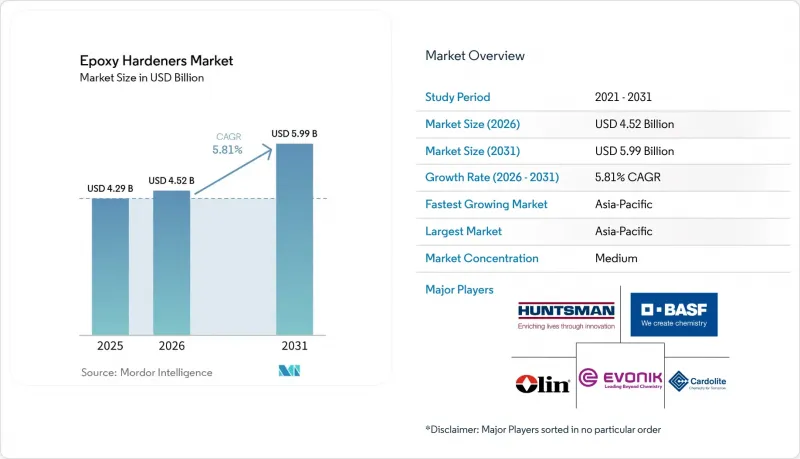
에 따르면 세계의 에폭시 경화제 시장 규모는 2025년에 42억 9,000만 달러로 평가되며, 2026년 45억 2,000만 달러에서 2031년까지 59억 9,000만 달러에 달할 것으로 예측되고 있으며, 예측 기간(2026-2031년)에 CAGR은 5.81%에 달할 전망입니다.
세계 에폭시 경화제 시장의 동향 및 인사이트
건설, 인프라 및 산업용 바닥재 수요
건설 지출은 에폭시 경화제 시장의 주요 성장 동력으로 자리 잡고 있으며, 특히 신뢰할 수 있는 상온 경화가 필수적인 용도에서 이러한 경향이 두드러집니다. 중국에서는 지속적인 토목 투자, 대규모 산업 시설, 그리고 규제 주도형 저VOC 바닥 코팅으로의 전환을 통해 아시아태평양의 소비를 지원하고 있으며, 신축 공사 및 유지 관리 공사 모두에서 에폭시 수지의 사용이 계속해서 중요한 역할을 하고 있습니다. 걸프협력회의(GCC) 프로젝트의 경우, 시공 온도가 40°C를 초과할 가능성이 있으므로, 포트 라이프가 길고 내열성이 뛰어난 경화가 가능한 아민계 경화제가 요구되고 있습니다. 2025년 3월, BASF와 Sika는 특정 바닥재 및 코팅 용도를 위해 저VOC 배출과 5-10°C에서 신뢰할 수 있는 경화 성능을 겸비한 ‘Baxxodur EC 151’을 상용화했습니다. 산업용 바닥재 역시 일반적으로 5-10년마다 재도장이 이루어지기 때문에 지속적인 수요를 창출하고 있습니다. 이러한 갱신 주기로 인해 에폭시 경화제 시장은 신축 공사의 변동에 따른 영향을 덜 받게 되었으며, 개별 프로젝트의 착공에 대한 의존도도 낮아졌습니다.
전자 제품의 소형화 및 봉지 요구 사항
팬아웃 웨이퍼 레벨 패키징, 3D 집적 및 이종 집적에는 이온 오염이 극히 적고 가수분해성 염화물 함량이 관리된 경화제가 필요합니다. 이러한 용도에서는 대개 5ppm 미만의 알칼리 금속 함량 수준이 요구되므로, 경화 거동이나 전기 절연성을 저해하지 않으면서 엄격한 오염 제한을 충족하는 고순도 사이클로알파틴 아민 및 무수물 등급으로 공급이 제한됩니다. 전기자동차(EV)용 파워 모듈을 위한 저이온 경화제도 유사한 요구 사항에 직면해 있습니다. 이는 열 안정성과 전기적 신뢰성이 모듈의 성능에 영향을 미치기 때문입니다. 공급업체는 순도와 가공성, 제어된 경화, 그리고 고전압 작동 환경에서의 안정적인 성능 간의 균형을 맞춰야 합니다. 등급별 인증 기간은 18-24개월에 달할 수 있으며, 배합이 승인되어 생산 단계에 접어들면 상당한 전환 비용이 발생합니다. 따라서 공급의 지속성, 배치 간 일관성 및 기술 지원은 조달시 중요한 고려 사항이 됩니다. 이러한 추세로 인해 에폭시 경화제 시장에서는 전자기기, 자동차용 파워 모듈, 그리고 공급업체가 수량이 아닌 성능으로 경쟁하는 기타 용도 분야에서 더 장기적인 공급 계약이 체결되는 경향이 있습니다.
유해 화학 물질 규제에 대한 준수 및 배합 변경에 소요되는 비용
REACH 및 CLP 요건에 따라 물질 등록 및 배합 변경에 드는 직접 비용 외에도, 고객 측의 재인증에 따른 간접 비용도 발생합니다. 2025년 1월 이후, 디메틸아미노프로필아민(DMAPA) 및 디에틸아미노프로필아민(DEAPA)은 생식독성 카테고리 2 물질로 분류되었으며, 한편 벤질화 아민류에는 2025년 5월에 특정 표적 장기 독성 반복 노출(STOT RE) H373 라벨이 새롭게 부여되었습니다. 2025년 8월, 유럽연합 집행위원회 규정(EU) 2025/1731에 따라 발암성, 변이원성 및 생식독성 물질에 대한 REACH 부속서 XVII의 추가 제한이 도입되었습니다. 소규모 공급업체는 영향을 받는 제품 라인에서 철수하거나, あるいは 배합 변경에 투자해야 할 가능성이 있습니다. 특히 고객이 개정된 도료, 접착제 또는 복합재료 시스템의 완제품에 대해 별도로 인증을 받아야 하는 경우, 비용 증가분을 가격 전가로 회수할 수 있을지 여부가 불투명한 상황입니다. 이러한 상황은 에폭시 경화제 시장에서 대규모 통합 공급업체의 입지를 강화할 가능성이 있습니다. 왜냐하면 이러한 기업은 규제를 준수하는 제품 포트폴리오를 유지하고, 고객의 전환을 혼란을 최소화하며 관리하는 데 있으며, 더 유리한 위치에 있기 때문입니다.
부문 분석
2025년, 아민계 경화제는 보호 코팅, 산업용 바닥재, 구조용 접착제, 토목 보수 분야에서의 사용에 힘입어 에폭시 경화제 시장 점유율의 46.56%를 차지했습니다. 수성 배합과의 폭넓은 호환성 덕분에 공급업체는 주요 용도 분야를 잃지 않고 제품 포트폴리오를 조정할 수 있습니다. 특히 건설 및 산업 분야의 고객들이 배출 규제를 충족하기 위해 용제계 시스템에서 수성 시스템으로 전환하고 있는 상황에서 이 점은 큰 강점이 되고 있습니다. 무수형 경화제는 2026-2031년까지 연평균 성장률(CAGR) 6.45%를 기록하며 가장 빠르게 성장하는 화학 계열이 될 것으로 예상됩니다. 풍력발전용 블레이드의 인퓨전 성형 및 고전압 전기 부품의 봉지가 이러한 성장을 지원하고 있습니다. 이는 저발열 특성과 유전 성능에 대한 대체재를 찾기 어려운 데다, 부품의 치수 및 전기적 부하 증가에 따라 공정 안정성이 점점 더 중요해지고 있기 때문입니다. 무수물 관련 에폭시 경화제 시장 규모는 블레이드의 예비 경화 시간을 3.0시간에서 2.3시간으로 단축하는 생산 시스템에 의해서도 지원되고 있습니다.
폴리아미드계 경화제는 유연성이 요구되는 선박용 탑코트, 토목용 멤브레인 및 접합부용 실란트에 사용되고 있습니다. 2024년 9월, 에보닉 인더스트리즈 AG는 노닐페놀을 함유하지 않는 폴리아미드계 경화제 ‘Ancamide 2853’ 및 ‘Ancamide 2865’를 발표했습니다. 이 제품들은 20-40%의 바이오 유래 성분을 함유하고 있습니다. 페날카민, 이미다졸, 머캅탄, 디시안디아미드 및 잠복형 경화제는 엄격한 성능 요건이 요구되는 보다 제한적인 용도에 사용되며, 배합 설계자는 저온 경화, 1액형 처리, 내습성 또는 정밀한 반응 제어와 같은 과제에 대응할 수 있게 됩니다. 잠복형 및 이미다졸 계열 등급은 1액형 프리프레그 시스템에 사용되는 반면, 캐슈넛 껍질 액(CNSL)을 기반으로 한 페날카민은 습도가 높고 기온이 낮은 해양 및 해양 환경(오프쇼어)에 적합합니다. 중국의 진공 주입용 블레이드 에폭시 수지에 관한 규격 ‘GB/T 31293-2025’가 2026년 1월 1일부터 시행되어, 인증된 무수물 및 잠복형 등급을 우대할 가능성이 있는 품질 기준이 확립되었습니다.
지역별 분석
아시아태평양은 2025년 전 세계 에폭시 경화제 시장 점유율의 41.78%를 차지하고 있으며, 2031년까지 지역별 가장 높은 연평균 성장률(CAGR) 6.94%를 기록할 것으로 예측됩니다. 중국은 주요 풍력 블레이드 생산, 반도체 패키징 역량, 인프라 투자에 더해 수성 및 저VOC 시스템으로의 전환이 진행되고 있습니다. 국내 공급업체들은 아민 및 무수물의 생산 능력을 확대하고 있으며, 2020년 이후 중국의 경화제 수입 의존도를 낮추고 표준 등급에서의 경쟁 압력을 높이는 한편, 고순도 및 인증된 특수 소재에 대해서는 여전히 수요가 남아 있습니다. 인도는 산업용 바닥재, 제조 플랜트용 보호 코팅, 재생 가능 에너지 인프라를 통해 추가적인 수요의 중심지로 부상하고 있습니다. 한국에서는 전자 및 조선 분야를 통해 수요가 창출되고 있습니다. 이러한 분야의 코팅 및 봉지재 사양에서는 높은 성능과 국제적인 휘발성 유기 화합물(VOC) 규제 준수가 요구되는 경우가 많아, 생산 효율과 신뢰성이 높은 도포 특성을 겸비한 제품에 대한 수요가 증가하고 있습니다.
북미는 에폭시 경화제 시장에서 두 번째로 큰 지역 시장입니다. 석유 및 가스 인프라, 산업 기계, 운송 자산용 보호 코팅이 여전히 주요 소비처로 자리 잡고 있습니다. 미국내 수성 에폭시 경화제 수요는 산업용 도장 작업에 대한 환경 규제 준수 요건에 힘입어 증가하고 있으며, 공급업체는 부식 방지 성능, 경화 속도, 표면 외관을 저해하지 않으면서 사용자가 배출 기준을 충족할 수 있도록 지원해야 합니다. 멕시코에서는 니어쇼어링과 관련된 자동차 및 전자기기 조립을 통해 수요가 확대되고 있으며, 접착제 및 실런트 등급의 제품이 지역 공급망을 점점 더 지원하는 제조 활동에 기여하고 있습니다. 2026년 6월에 발표되며, 2027년 상반기 완료를 목표로 하고 있는 올린(Olin)과 헌츠맨(Huntsman)의 합병안은 주요 염소-알칼리 및 에폭시 원료 사업을 통합하는 것으로, 4억 달러 규모의 시너지 효과가 기대되고 있습니다.
유럽에서는 생산량 확대보다는 배합 변경 요건에 따라 수요가 안정적으로 유지되고 있으며, 규제 준수, 배출량 감축, 그리고 지속적인 제품 성능 유지가 공급업체의 주요 상업적 우선순위가 되고 있습니다. 독일에서는 자동차용 복합재료, 북해 풍력발전용 블레이드 생산, 그리고 건물 개보수 프로그램을 통해 지역 수요가 지원되고 있습니다. 풍력발전과 관련된 독일의 토지 이용 목표에 따라 블레이드용 무수물 배합재에 대한 수년간의 수요가 발생하고 있습니다. 이는 터빈 규모 확대에 따라 현재의 제조 프로그램과 향후 유지보수 수요 모두에서 신뢰성 높은 복합재료가 필요하기 때문입니다. 북유럽 국가들에서는 지역 제조업체들이 블레이드 생산 능력을 확대함에 따라 해상 풍력발전용 수요가 증가하고 있습니다. 브라질에서는 해상 석유 및 가스 자산용 부식 방지 코팅을 통해 남미 지역의 소비를 지원하고 있습니다. 중동 및 아프리카에서는 걸프협력회의(GCC) 건설 프로젝트에서 40°C 이상의 온도에서 경화되는 아민계 경화제가 요구되고 있으며, 이는 표준 배합에 있으며, 큰 인증상의 장벽이 되고 있습니다.
기타 혜택:
- 엑셀 형식의 시장 예측(ME) 시트
- 3개월간의 애널리스트 지원
자주 묻는 질문
목차
제1장 서론
- 조사 전제조건과 시장 정의
- 조사 범위
제2장 조사 방법
제3장 개요
제4장 시장 구도
- 시장 개요
- 시장 성장 촉진요인
- 시장 성장 억제요인
- 밸류체인 분석
- Porter's Five Forces 분석
제5장 시장 규모와 성장 예측
- 경화제 유형별
- 용도별
- 최종사용자 산업별
- 지역별
- 아시아태평양
- 중국
- 인도
- 일본
- 한국
- ASEAN 국가
- 기타 아시아태평양 국가
- 북미
- 미국
- 캐나다
- 멕시코
- 유럽
- 독일
- 영국
- 프랑스
- 이탈리아
- 북유럽 국가
- 러시아
- 기타 유럽 국가
- 남미
- 브라질
- 아르헨티나
- 기타 남미 국가
- 중동 및 아프리카
- 사우디아라비아
- 남아프리카공화국
- 기타 중동 및 아프리카 국가
- 아시아태평양
제6장 경쟁 구도
- 시장 집중도
- 전략적 동향
- 시장 점유율·순위 분석
- 기업 개요
- Aditya Birla Chemicals(Thailand) Limited
- ALLNEX NETHERLANDS B.V.
- Atul Ltd.
- BASF
- Cardolite Corporation
- Cargill, Incorporated
- DIC CORPORATION
- Evonik Industries AG
- Hexion Inc.
- Huntsman International LLC
- KUKDO CHEMICAL CO., LTD.
- Mitsubishi Chemical Corporation
- Olin Corporation
- SHIKOKU CHEMICALS CORPORATION
- Westlake Corporation
제7장 시장 기회와 향후 전망
KSA 26.10.23According to Mordor Intelligence, the global epoxy hardeners market size was valued at USD 4.29 billion in 2025 and is estimated to grow from USD 4.52 billion in 2026 to reach USD 5.99 billion by 2031, at a CAGR of 5.81% during the forecast period (2026-2031).
Global Epoxy Hardeners Market Trends and Insights
Construction, Infrastructure, and Industrial Flooring Demand
Construction spending remains a key driver for the epoxy hardeners market, particularly in applications where reliable ambient curing is essential. China supports Asia-Pacific consumption through sustained civil engineering investment, large industrial facilities, and a regulatory-driven shift toward lower-VOC floor coatings, keeping epoxy use relevant in both new construction and maintenance work. Gulf Cooperation Council projects require amine systems with extended pot life and heat-tolerant curing, as application temperatures can exceed 40°C. In March 2025, BASF and Sika commercialized Baxxodur EC 151, which combines lower VOC emissions with reliable cure performance at 5-10°C for selected flooring and coating applications. Industrial floors also generate recurring demand, as recoating typically occurs every 5-10 years. This replacement cycle reduces the epoxy hardeners market's exposure to fluctuations in new construction activity and limits dependence on individual project starts.
Electronics Miniaturization and Encapsulation Requirements
Fan-out wafer-level packaging, 3D integration, and heterogeneous integration require hardeners with very low ionic contamination and controlled hydrolyzable chloride content. These applications often require sub-5 ppm alkali metal levels, restricting supply to high-purity cycloaliphatic amine and anhydride grades that meet narrow contamination limits without compromising cure behavior or electrical insulation. Low-ion hardeners for electric vehicle (EV) power modules face similar requirements, as thermal stability and electrical reliability affect module performance. Suppliers must balance purity with processability, controlled curing, and stable performance in high-voltage operating environments. Qualification periods can last 18-24 months per grade, creating meaningful switching costs once a formulation enters approved production. This makes continuity of supply, batch consistency, and technical support important considerations in purchasing. These dynamics give the epoxy hardeners market a path toward longer supply agreements in electronics, automotive power modules, and other applications where suppliers compete on performance rather than quantity.
Hazardous Chemical Compliance and Reformulation Costs
REACH and CLP requirements create direct costs for substance registration and reformulation, as well as indirect costs for customer requalification. Since January 2025, Dimethylaminopropylamine (DMAPA) and Diethylaminopropylamine (DEAPA) have been classified as reprotoxic Category 2 substances, while benzylated amines received new Specific Target Organ Toxicity Repeated Exposure (STOT RE) H373 labels in May 2025. Commission Regulation (EU) 2025/1731 introduced additional REACH Annex XVII restrictions for carcinogenic, mutagenic, and reprotoxic substances in August 2025. Smaller suppliers may need to exit affected product lines or invest in reformulation without certainty that higher costs can be recovered through pricing, particularly when customers must separately qualify a revised finished coating, adhesive, or composite system. This dynamic can strengthen large, integrated suppliers in the epoxy hardeners market, as they are better positioned to maintain compliant portfolios and manage customer transitions with less disruption.
Other drivers and restraints analyzed in the detailed report include:
- Wind Blade and Renewable Infrastructure Build-Out
- Low-VOC and Waterborne Formulation Adoption
- Substitution by Polyurea, Polyaspartic, Vinyl Ester, and Polyester Systems
For complete list of drivers and restraints, kindly check the Table Of Contents.
Segment Analysis
Amine hardeners accounted for 46.56% of the epoxy hardeners market share in 2025, supported by their use in protective coatings, industrial flooring, structural adhesives, and civil engineering repair. Their broad compatibility with waterborne formulations has helped suppliers adjust their portfolios without losing major application areas, particularly as construction and industrial customers replace solvent-borne systems to meet emissions requirements. Anhydride hardeners are expected to be the fastest-growing chemistry, with a CAGR of 6.45% from 2026 to 2031. Wind blade infusion and high-voltage electrical encapsulation support this growth, as low exotherm behavior and dielectric performance remain difficult to replace, and process stability becomes more important as component dimensions and electrical loads increase. The epoxy hardeners market size associated with anhydrides is also supported by production systems that reduce blade pre-curing time from 3.0 hours to 2.3 hours.
Polyamide hardeners are used in marine topcoats, civil engineering membranes, and joint sealants that require flexibility. In September 2024, Evonik Industries AG introduced Ancamide 2853 and Ancamide 2865, a nonylphenol-free polyamide curing agent with 20-40% bio-based content. Phenalkamines, imidazoles, mercaptans, dicyandiamide, and latent hardeners serve narrower applications with demanding performance requirements, allowing formulators to address low-temperature curing, one-component processing, moisture tolerance, or precise reaction control. Latent and imidazole grades are used in one-component prepreg systems, while Cashew Nut Shell Liquid (CNSL)-based phenalkamines are suited to humid and low-temperature marine or offshore conditions. China's GB/T 31293-2025 standard for vacuum-infused blade epoxy resins took effect on January 1, 2026, establishing a quality baseline that may favor certified anhydride and latent grades.
Complete Report Scope:
- By Hardener Type
- Amine Hardeners
- Polyamide Hardeners
- Anhydride Hardeners
- Others (Phenalkamine, Imidazole, Mercaptan and Polymercaptan, Dicyandiamide and Latent Hardeners)
- By Application
- Protective Coatings
- Adhesives and Sealants
- Composites
- Others (Electrical and Electronics, Industrial Flooring, Civil Engineering and Repair)
- By End-User Industry
- Building and Construction
- Transportation
- Electrical and Electronics
- Wind Energy
- Others (Marine, Aerospace and Defense, Industrial Equipment, Furniture and Consumer Goods)
- By Geography
- Asia-Pacific
- China
- India
- Japan
- South Korea
- ASEAN Countries
- Rest of Asia-Pacific
- North America
- United States
- Canada
- Mexico
- Europe
- Germany
- United Kingdom
- France
- Italy
- NORDIC Countries
- Russia
- Rest of Europe
- South America
- Brazil
- Argentina
- Rest of South America
- Middle-East and Africa
- Saudi Arabia
- South Africa
- Rest of Middle-East and Africa
- Asia-Pacific
Geography Analysis
Asia-Pacific held 41.78% of the global epoxy hardeners market share in 2025 and is forecast to record the fastest regional CAGR of 6.94% through 2031. China combines major wind-blade production, semiconductor-packaging capacity, infrastructure investment, and a shift toward waterborne and lower-VOC systems. Domestic suppliers have expanded their amine and anhydride capabilities, reducing China's dependence on imported hardeners since 2020 and increasing competitive pressure in standard grades, while leaving room for higher-purity and certified specialty materials. India is emerging as a further demand center through industrial flooring, protective coatings for manufacturing plants, and renewable energy infrastructure. South Korea generates demand through electronics and shipbuilding, where coating and encapsulant specifications often require high performance and compliance with international volatile organic compound (VOC) regulations, reinforcing demand for products that combine production efficiency with reliable application properties.
North America is the second-largest regional market for epoxy hardeners. Protective coatings for oil and gas infrastructure, industrial machinery, and transportation assets remain major sources of consumption. Demand for waterborne epoxy hardeners in the United States is supported by environmental compliance requirements in industrial painting operations, where suppliers must help users meet emissions standards without compromising corrosion protection, cure speed, or surface appearance. Mexico adds demand through automotive and electronics assembly linked to nearshoring, with adhesive and encapsulant grades serving manufacturing activity that increasingly supports regional supply chains. The proposed Olin and Huntsman transaction, announced in June 2026 and targeting a first-half 2027 close, would combine major chlor-alkali and epoxy raw-material operations with stated targeted synergies of USD 400 million.
Europe has a stable demand increasingly driven by reformulation requirements rather than output expansion, making regulatory compliance, lower emissions, and continued application performance the central commercial priorities for suppliers. Germany supports regional demand through automotive composites, North Sea wind-blade production, and building-renovation programs. Its land-use targets for wind energy create a multi-year need for blade-grade anhydride formulations, as turbine expansion requires reliable composite materials for both current manufacturing programs and subsequent maintenance demand. Nordic countries add offshore wind demand as regional manufacturers expand blade capacity. Brazil supports South American consumption through anti-corrosion coatings for offshore oil and gas assets. In the Middle-East and Africa, Gulf Cooperation Council (GCC) construction projects require amine hardeners that can cure at temperatures above 40°C, creating a meaningful qualification barrier for standard formulations.
- Aditya Birla Chemicals (Thailand) Limited
- ALLNEX NETHERLANDS B.V.
- Atul Ltd.
- BASF
- Cardolite Corporation
- Cargill, Incorporated
- DIC CORPORATION
- Evonik Industries AG
- Hexion Inc.
- Huntsman International LLC
- KUKDO CHEMICAL CO., LTD.
- Mitsubishi Chemical Corporation
- Olin Corporation
- SHIKOKU CHEMICALS CORPORATION
- Westlake Corporation
Additional Benefits:
- The market estimate (ME) sheet in Excel format
- 3 months of analyst support
TABLE OF CONTENTS
1 Introduction
- 1.1 Study Assumptions and Market Definition
- 1.2 Scope of the Study
2 Research Methodology
3 Executive Summary
4 Market Landscape
- 4.1 Market Overview
- 4.2 Market Drivers
- 4.2.1 Construction, Infrastructure, and Industrial Flooring Demand
- 4.2.2 Electronics Miniaturization and Encapsulation Requirements
- 4.2.3 Wind Blade and Renewable Infrastructure Build-Out
- 4.2.4 Low-VOC and Waterborne Formulation Adoption
- 4.2.5 Low-Ion Hardener Qualification for EV Power Modules
- 4.2.6 CNSL-Based Phenalkamine Performance in Humid and Low-Temperature Applications
- 4.3 Market Restraints
- 4.3.1 Hazardous-Chemical Compliance and Reformulation Costs
- 4.3.2 Substitution by Polyurea, Polyaspartic, Vinyl Ester, and Polyester Systems
- 4.3.3 IPDA and Specialty Amine Precursor Price Volatility
- 4.3.4 Long OEM Qualification Cycles for Specialty Grades
- 4.4 Value Chain Analysis
- 4.5 Porter's Five Forces Analysis
- 4.5.1 Threat of New Entrants
- 4.5.2 Bargaining Power of Suppliers
- 4.5.3 Bargaining Power of Buyers
- 4.5.4 Threat of Substitutes
- 4.5.5 Competitive Rivalry
5 Market Size and Growth Forecasts (Value)
- 5.1 By Hardener Type
- 5.1.1 Amine Hardeners
- 5.1.2 Polyamide Hardeners
- 5.1.3 Anhydride Hardeners
- 5.1.4 Others (Phenalkamine, Imidazole, Mercaptan and Polymercaptan, Dicyandiamide and Latent Hardeners)
- 5.2 By Application
- 5.2.1 Protective Coatings
- 5.2.2 Adhesives and Sealants
- 5.2.3 Composites
- 5.2.4 Others (Electrical and Electronics, Industrial Flooring, Civil Engineering and Repair)
- 5.3 By End-User Industry
- 5.3.1 Building and Construction
- 5.3.2 Transportation
- 5.3.3 Electrical and Electronics
- 5.3.4 Wind Energy
- 5.3.5 Others (Marine, Aerospace and Defense, Industrial Equipment, Furniture and Consumer Goods)
- 5.4 By Geography
- 5.4.1 Asia-Pacific
- 5.4.1.1 China
- 5.4.1.2 India
- 5.4.1.3 Japan
- 5.4.1.4 South Korea
- 5.4.1.5 ASEAN Countries
- 5.4.1.6 Rest of Asia-Pacific
- 5.4.2 North America
- 5.4.2.1 United States
- 5.4.2.2 Canada
- 5.4.2.3 Mexico
- 5.4.3 Europe
- 5.4.3.1 Germany
- 5.4.3.2 United Kingdom
- 5.4.3.3 France
- 5.4.3.4 Italy
- 5.4.3.5 NORDIC Countries
- 5.4.3.6 Russia
- 5.4.3.7 Rest of Europe
- 5.4.4 South America
- 5.4.4.1 Brazil
- 5.4.4.2 Argentina
- 5.4.4.3 Rest of South America
- 5.4.5 Middle-East and Africa
- 5.4.5.1 Saudi Arabia
- 5.4.5.2 South Africa
- 5.4.5.3 Rest of Middle-East and Africa
- 5.4.1 Asia-Pacific
6 Competitive Landscape
- 6.1 Market Concentration
- 6.2 Strategic Moves
- 6.3 Market Share (%)/Ranking Analysis
- 6.4 Company Profiles (includes Global Overview, Market Overview, Core Segments, Financials as available, Strategic Information, Products and Services, and Recent Developments)
- 6.4.1 Aditya Birla Chemicals (Thailand) Limited
- 6.4.2 ALLNEX NETHERLANDS B.V.
- 6.4.3 Atul Ltd.
- 6.4.4 BASF
- 6.4.5 Cardolite Corporation
- 6.4.6 Cargill, Incorporated
- 6.4.7 DIC CORPORATION
- 6.4.8 Evonik Industries AG
- 6.4.9 Hexion Inc.
- 6.4.10 Huntsman International LLC
- 6.4.11 KUKDO CHEMICAL CO., LTD.
- 6.4.12 Mitsubishi Chemical Corporation
- 6.4.13 Olin Corporation
- 6.4.14 SHIKOKU CHEMICALS CORPORATION
- 6.4.15 Westlake Corporation
7 Market Opportunities and Future Outlook
- 7.1 White-Space and Unmet-Need Assessment


