

|
시장보고서
상품코드
2154403
기업 AI 에이전트 안전 플랫폼 : 시장 점유율 분석, 업계 동향과 통계, 성장 예측(2026-2031년)Enterprise AI Agent Safety Platforms - Market Share Analysis, Industry Trends & Statistics, Growth Forecasts (2026 - 2031) |
||||||
 Mordor Intelligence
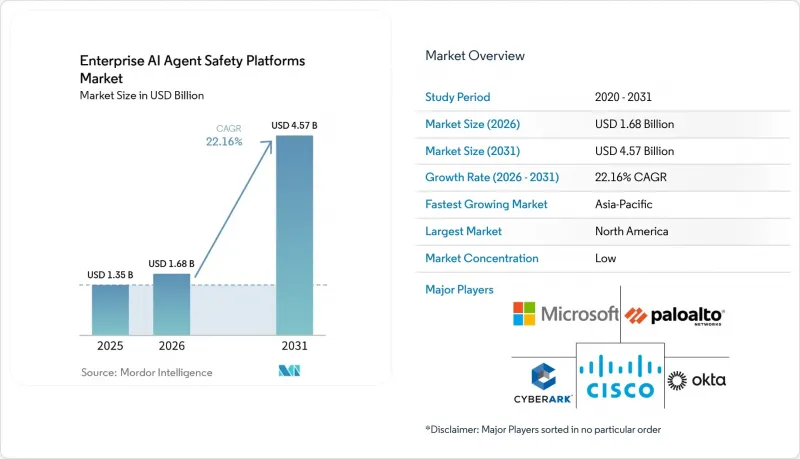
에 따르면 기업 AI 에이전트 안전 플랫폼 시장 규모는 2025년 13억 5,000만 달러에서 2026년에는 16억 8,000만 달러로 확대하며, 2031년까지 45억 7,000만 달러에 달할 것으로 예측되고 있으며, 2026-2031년까지 연평균 성장률(CAGR)은 22.16%에 달할 전망입니다.
전 세계 기업 AI 에이전트 보안 플랫폼 시장의 동향 및 인사이트
기업내 자율형 워크플로우 에이전트 도입
자율형 워크플로우 에이전트의 기업 도입으로 인해 기업 AI 에이전트 보안 플랫폼 시장의 보안 범위가 확대되고 있습니다. 에이전트는 여러 시스템에 걸쳐 있는 워크플로우에서 툴 사용, 메모리 및 다단계 추론을 결합합니다. 따라서 침해되거나 비정상적으로 작동하는 에이전트는 검토 담당자가 문제를 파악하기 전에 관련 조치를 실행해 버릴 가능성이 있습니다. 조직은 도입 규모가 확대됨에 따라 에이전트의 식별 정보를 파악하고, 권한을 제한하며, 세션을 모니터링해야 합니다. ‘EchoLeak’ 취약점(CVE-2025-32711)은 조작된 이메일을 통해 사용자의 조작 없이 Microsoft 365 Copilot을 경유하여 원격으로 데이터 유출이 가능함을 보여주었습니다. 이 취약점의 존재로 인해 에이전트가 운영 환경에 도입된 후에 제어 기능을 추가하는 것보다 설계 단계부터 보안 대책을 마련하는 것이 더욱 중요해졌습니다.
영향이 큰 AI 결정에 대한 규제상 설명 책임
규제 동향에 따라 자율형 AI 시스템에 대한 문서화된 통제 조치의 중요성이 높아지고 있습니다. 규제 당국의 관심이 높아짐에 따라 권한 관리, 시스템 설계, 행동 모니터링 및 자율형 AI 시스템의 설명 책임의 중요성이 커지고 있습니다. EU AI법에서는 제50조에 따라 사람과 상호작용하는 특정 시스템에 대해 해당 시스템의 AI로서의 성격 및 대표하는 당사자의 신원을 공개할 것을 의무화하고 있습니다. 부속서 III에 따른 고위험 시스템에 대한 의무는 수정된 일정에 따라 2027년 12월에 시행될 예정입니다. NIST는 에이전트 시스템의 상호 운용성 및 보안 기준을 다루기 위해 2026년 1월 ‘AI 에이전트 표준 구상’를 출범시켰습니다. 이러한 동향으로 인해 기업의 조달 과정에서 모니터링, 신원 확인 및 감사 기록의 중요성이 더욱 커지고 있습니다.
에이전트 프레임워크 및 프로토콜 전반에 걸친 표준의 파편화
에이전트 프레임워크와 프로토콜에 따라 신원 관리, 툴 호출, 메모리 처리 방식이 다릅니다. 이로 인해 다양한 에이전트 환경을 보유한 구매자에게는 일관된 정책을 적용하기가 어려워지고 있습니다. ‘모델 컨텍스트 프로토콜(Model Context Protocol)’은 에이전트와 툴 간의 연동을 확대했으나, 동시에 새로운 보안상 우려도 야기하고 있습니다. National Vulnerability Database(NVD)는 공식 MCP 소프트웨어 개발 키트에서 클라이언트 간 데이터 유출과 관련된 CVE-2026-25536을 기록했습니다. NIST는 AI 에이전트 표준화 구상을 통해 상호 운용성 지침을 마련 중입니다. 표준이 성숙해지기 전까지는 공급업체가 여러 런타임을 지원해야 하며, 구매자는 통합 및 테스트 비용 증가에 직면할 가능성이 있습니다.
부문 분석
2025년, 소프트웨어 플랫폼은 기업 AI 에이전트 보안 플랫폼 시장 점유율의 72.39%를 차지했습니다. 구매자들은 개별적인 포인트 솔루션보다 통합된 거버넌스 콘솔을 선호합니다. 이는 서로 다른 에이전트 런타임을 아우르는 단일 정책 계층을 구축할 수 있기 때문입니다. 통합된 제어 계층을 통해 통합 작업의 부담을 줄이고, 활동 가시성의 격차를 해소할 수 있습니다. 이 구성 요소는 공통 인터페이스를 통해 ID 관리, 정책 적용, 툴 모니터링 및 감사 기능을 지원합니다. 또한 플랫폼 제공업체는 지역 및 중견 기업 고객을 지원하기 위해 서비스 파트너 생태계를 구축하고 있습니다. 마이크로소프트는 2026년 5월 ‘Agent 365’의 일반 제공을 시작했으며, 액센츄어, 캡제미니, KPMG, 프로티비티 등을 서비스 파트너로 지정했습니다.
이 서비스는 2031년까지 연평균 성장률(CAGR)이 22.78%에 달하는 가장 빠르게 성장하는 분야입니다. 여기에는 관리형 보안 서비스, 전문가에 의한 도입 지원 및 자문 업무가 포함됩니다. 이러한 성장은 여러 에이전트 프레임워크에 걸쳐 제어 기능을 설계하고 운영할 수 있는 팀의 부족을 반영하고 있습니다. 서비스 제공업체는 기업이 거버넌스 정책을 수립하고 고위험 워크플로를 재검토할 수 있도록 지원할 수 있습니다. 플랫폼 벤더는 자사 제품과 파트너가 제공하는 도입 지원을 결합하고 있습니다. 이러한 접근 방식에 따라 독립 서비스 기업이 담당하는 업무는 감소하는 반면, 플랫폼 도입과 관련된 서비스의 총량은 증가할 가능성이 있습니다.
2025년, 기업 AI 에이전트 보안 플랫폼 시장 규모 중 클라우드 기반 도입이 59.55%를 차지했습니다. 많은 에이전트는 이미 클라우드에 존재하는 관리형 대규모 언어 모델(LLM) API나 서버리스 툴의 런타임을 활용하고 있습니다. 클라우드를 통해 제공되는 보안 툴은 운영상의 마찰을 최소화하면서 이러한 아키텍처와 함께 도입할 수 있습니다. 이를 통해 클라우드 플랫폼은 에이전트의 인벤토리 관리, 정책 배포 및 모니터링에 있으며, 실용적인 선택지가 됩니다. 또한 클라우드 배포는 분산된 기업 팀 전체에 걸쳐 일관된 업데이트를 지원합니다. 기업 AI 에이전트 보안 플랫폼 시장에서는 에이전트 워크플로우에서 관리형 서비스를 활용하는 클라우드 제공 방식이 계속해서 주류를 이루고 있습니다.
클라우드 기반 도입은 2031년까지 연평균 성장률(CAGR)이 22.94%에 달해 가장 빠르게 성장하는 모델이기도 합니다. 온프레미스 도입은 에어갭이 적용된 정부 기관, 규제 대상인 금융 인프라, 그리고 주권 데이터 요건이 있는 환경에서 여전히 중요한 역할을 수행하고 있습니다. 하이브리드 아키텍처에서는 온프레미스 오케스트레이션 계층과 클라우드 기반 툴 레지스트리를 결합할 수 있습니다. 구매 기업은 기밀성이 높은 워크플로우를 관리할 때 에이전트의 컴퓨팅 환경을 격리하고 네트워크 접근 범위를 제한할 수 있습니다. 프라이빗 클라우드 및 온프레미스 환경은 이를 필요로 하는 조직에 보다 세분화된 네트워크 세분화을 제공할 수 있습니다. 이러한 요구로 인해 클라우드 기반 제공이 확대되는 상황에서도 하이브리드 도입 패턴은 여전히 유지되고 있습니다.
지역별 분석
2025년, 북미는 기업 AI 에이전트 보안 플랫폼 시장의 40.22% 점유율을 차지했습니다. 이 지역은 기업 AI의 적극적인 도입과 확립된 사이버 보안 벤더 생태계의 혜택을 받고 있습니다. 미국에서는 테스트 및 인간에 의한 검토 프로세스에 관한 연방 정부의 조달 요건이 있으며, 이러한 요건들이 규정 준수를 준수하는 에이전트 제어에 대한 수요를 지원하고 있습니다. 캐나다는 금융 서비스 분야의 수요에 기여하고 있으며, 멕시코는 금융 인프라의 디지털화를 통해 수요를 끌어올리고 있습니다. 규제 대상 구매자들은 특권 관리, 모니터링 및 책임성을 더욱 중요하게 여기고 있습니다. 이러한 상황이 북미의 선도적 지위를 지원하고 있습니다.
유럽에서는 기업 AI 에이전트 안전 플랫폼 시장에서 규정 준수를 주도하는 구매 패턴이 나타나고 있습니다. EU AI법 제50조는 사용자와 상호작용하는 특정 에이전트형 시스템에 대해 투명성 요건을 적용하고 있습니다. 현재 일정에 따르면 2027년 12월에 고위험에 해당하는 부속서 III의 의무가 부과될 전망입니다. 독일은 2025년 12월 NIS2 도입을 통해 연방 정부의 사이버 보안 감독 의무 범위를 확대했습니다. 따라서 유럽의 구매자들은 문서화된 거버넌스, 접근 제어 및 감사 기능에 더 큰 가치를 부여할 수 있습니다. 유럽의 공급업체들은 규정 준수 요건이 구매 결정에 영향을 미치는 프로젝트에서 미국의 하이퍼스케일러와 경쟁할 수 있습니다.
아시아태평양은 2031년까지 연평균 성장률(CAGR)이 23.15%로 가장 빠르게 성장하고 있는 지역입니다. 일본에서는 2026년 4월에 시작된 IERAE AI 에이전트를 활용한 침투 테스트 서비스 ‘GMO Cybersecurity’ 등 전문적인 서비스가 개발되고 있습니다. 인도의 IT 및 ITES 부문은 국내 도입 수요에 더해, 오프쇼어 AI 워크플로우에 대한 규정 준수 증명을 요구하는 국제 고객들의 수요를 견인하고 있습니다. 중국, 한국, 호주는 각각 고유한 규제 및 상업적 조건을 제시하고 있습니다. 사우디아라비아와 아랍에미리트는 국가 주도의 AI 인프라 투자를 추진하고 있는 반면, 남아프리카공화국과 나이지리아는 금융 서비스 분야에서 조기 도입국으로 자리매김하고 있습니다. 이러한 활동의 확산으로 인해 아시아태평양의 특정 한 국가에 의존하지 않는 성장이 지원되고 있습니다.
기타 혜택:
- 엑셀 형식의 시장 예측(ME) 시트
- 3개월간의 애널리스트 지원
목차
제1장 서론
- 조사 전제조건과 시장 정의
- 조사 범위
제2장 조사 방법
제3장 개요
제4장 시장 구도
- 시장 개요
- 시장 성장 촉진요인
- 시장 성장 억제요인
- 거시경제 요인이 시장에 미치는 영향
- 업계 밸류체인 분석
- 기술 동향
- 규제 상황
- Porter's Five Forces 분석
제5장 시장 규모와 성장 예측
- 컴포넌트별
- 배포별
- 기능별
- 조직 규모별
- 산업 분야별
- 지역별
- 북미
- 미국
- 캐나다
- 멕시코
- 유럽
- 독일
- 영국
- 프랑스
- 이탈리아
- 스페인
- 기타 유럽 국가
- 아시아태평양
- 중국
- 일본
- 인도
- 한국
- 호주
- 기타 아시아태평양 국가
- 남미
- 브라질
- 아르헨티나
- 칠레
- 기타 남미 국가
- 중동
- 아랍에미리트
- 사우디아라비아
- 카타르
- 기타 중동 국가
- 아프리카
- 남아프리카공화국
- 이집트
- 나이지리아
- 기타 아프리카 국가
- 북미
제6장 경쟁 구도
- 시장 집중도
- 전략적 동향
- 시장 점유율 분석
- 기업 개요
- Microsoft Corporation
- Palo Alto Networks, Inc.
- CyberArk Software Ltd.
- Cisco Systems, Inc.
- Okta, Inc.
- CrowdStrike Holdings, Inc.
- SentinelOne, Inc.
- Google LLC
- Amazon Web Services, Inc.
- Cato Networks Ltd.
- Proofpoint, Inc.
- Zenity, Inc.
- Lakera AI AG
- Protect AI, Inc.
- HiddenLayer, Inc.
- Prompt Security, Inc.
- Astrix Security, Inc.
- Oasis Security Ltd.
- Saviynt, Inc.
- Cranium AI, Inc.
제7장 시장 기회와 향후 전망
KSAAccording to Mordor Intelligence, the enterprise AI agent safety platforms market size is projected to expand from USD 1.35 billion in 2025 to USD 1.68 billion in 2026, and to USD 4.57 billion by 2031, registering a CAGR of 22.16% between 2026 and 2031.
Global Enterprise AI Agent Safety Platforms Market Trends and Insights
Enterprise Deployment of Autonomous Workflow Agents
Enterprise adoption of autonomous workflow agents is expanding the scope of security in the Enterprise AI Agent Safety Platforms Market. Agents combine tool use, memory, and multistep reasoning in workflows that can span several systems. A compromised or misbehaving agent can therefore execute linked actions before a reviewer identifies the issue. Organizations need to discover agent identities, restrict permissions, and monitor sessions as deployments scale. The EchoLeak vulnerability, CVE-2025-32711, showed that a crafted email could enable remote data exfiltration through Microsoft 365 Copilot without user interaction. This exposure makes concurrent security design more important than adding controls after an agent reaches production.
Regulatory Accountability for High-Impact AI Decisions
Regulatory activity is raising the importance of documented controls for autonomous AI systems. Regulatory attention is increasing the importance of privilege management, system design, behavioral monitoring, and accountability for autonomous AI systems. The EU AI Act requires certain systems that interact with people to disclose their AI nature and the identity of the party they represent under Article 50. High-risk system obligations under Annex III are scheduled for December 2027 under the amended timetable. NIST launched its AI Agent Standards Initiative in January 2026 to address interoperability and security standards for agent systems. These developments make monitoring, identity verification, and audit records more relevant in enterprise procurement.
Fragmented Standards Across Agent Frameworks and Protocols
Agent frameworks and protocols handle identity, tool calling, and memory in different ways. This makes consistent policy enforcement difficult for buyers with varied agent environments. The Model Context Protocol has expanded the connection between agents and tools, but it also introduces new security concerns. The National Vulnerability Database recorded CVE-2026-25536 for cross-client data leakage in the official MCP software development kit. NIST is developing interoperability guidance through its AI Agent Standards Initiative. Until standards mature, vendors must support several runtimes, and buyers may face higher integration and testing costs.
Other drivers and restraints analyzed in the detailed report include:
- Non-Human Identity Sprawl and Least-Privilege Requirements
- Prompt Injection and Tool Misuse Risk
- Shortage of Agent-Security Engineering Skills
For complete list of drivers and restraints, kindly check the Table Of Contents.
Segment Analysis
Software Platforms held 72.39% of the Enterprise AI Agent Safety Platforms Market share in 2025. Buyers favor a consolidated governance console over separate point solutions because it enables a single policy layer across different agent runtimes. A unified control layer can reduce integration work and gaps in activity visibility. The component supports identity control, policy enforcement, tool oversight, and audit functions from a common interface. Platform providers are also building service partner ecosystems to support regional and mid-market accounts. Microsoft made Agent 365 generally available in May 2026 and identified services partners, including Accenture, Capgemini, KPMG, and Protiviti.
Services are the fastest-growing component at a 22.78% CAGR through 2031. It includes managed security services, professional deployment, and advisory work. This growth reflects the shortage of teams capable of designing and operating controls across multiple agent frameworks. Service providers can help enterprises establish governance policies and review high-risk workflows. Platform vendors are combining their products with partner-delivered implementation support. This approach may reduce the addressable work for independent service firms while increasing the total volume of services tied to platform adoption.
Cloud-Based deployment accounted for 59.55% of the Enterprise AI Agent Safety Platforms Market size in 2025. Many agents use managed large language model APIs and serverless tool runtimes that are already cloud-resident. Cloud-delivered security tools can be deployed alongside these architectures with less operational friction. This makes cloud platforms a practical option for agent inventory, policy distribution, and monitoring. Cloud adoption also supports consistent updates across distributed enterprise teams. The Enterprise AI Agent Safety Platforms Market continues to favor cloud delivery, where agent workflows use managed services.
Cloud-based deployment is also the fastest-growing model, with a 22.94% CAGR through 2031. On-premises deployments retain a role in air-gapped government settings, regulated financial infrastructure, and environments with sovereign data requirements. Hybrid architectures can combine an on-premises orchestration layer with cloud-based tool registries. Buyers can isolate agent compute environments and limit network reachability when managing sensitive workflows. Private-cloud and on-premises environments can provide more detailed network segmentation for organizations that need it. These needs sustain a mixed deployment pattern even as cloud-based delivery expands.
Complete Report Scope:
- By Component
- Software Platforms
- Services
- By Deployment
- Cloud-Based
- On-Premises
- By Function
- Identity and Access Security
- AI Governance and Risk Platforms
- Threat Detection and Response
- Data Security and Privacy
- Vulnerability Assessment and Remediation
- Other Functions
- By Organization Size
- Large Enterprises
- Small and Medium-Sized Enterprises
- By Industry Vertical
- Banking, Financial Services and Insurance
- Healthcare and Life Sciences
- Government and Defense
- IT and IT-Enabled Services
- Telecommunications
- Retail and E-Commerce
- Other Industry Verticals
- By Geography
- North America
- United States
- Canada
- Mexico
- Europe
- Germany
- United Kingdom
- France
- Italy
- Spain
- Rest of Europe
- Asia-Pacific
- China
- Japan
- India
- South Korea
- Australia
- Rest of Asia-Pacific
- South America
- Brazil
- Argentina
- Chile
- Rest of South America
- Middle East
- United Arab Emirates
- Saudi Arabia
- Qatar
- Rest of Middle East
- Africa
- South Africa
- Egypt
- Nigeria
- Rest of Africa
- North America
Geography Analysis
North America held 40.22% of the Enterprise AI Agent Safety Platforms Market share in 2025. The region benefits from strong enterprise AI adoption and an established cybersecurity vendor ecosystem. The United States has federal procurement requirements for testing and human-review pathways that support demand for compliant agent controls. Canada contributes to demand in financial services, while Mexico adds to demand through the digitization of financial infrastructure. Regulated buyers place greater value on privilege management, monitoring, and accountability. These conditions support North America's leading position.
Europe has a compliance-led purchasing pattern for the Enterprise AI Agent Safety Platforms Market. Article 50 of the EU AI Act applies transparency requirements to certain agentic systems that interact with users. High-risk Annex III obligations are expected in December 2027 under the current timetable. Germany expanded mandatory federal cybersecurity supervision through its NIS2 implementation in December 2025. European buyers can therefore place added value on documented governance, access control, and audit capability. European vendors can compete with U.S. hyperscalers in accounts where compliance requirements guide purchasing decisions.
Asia-Pacific is the fastest-growing region at a 23.15% CAGR through 2031. Japan has developed specialized offerings, including GMO Cybersecurity, an IERAE AI Agent Penetration Testing service launched in April 2026. India's IT and ITES sectors drive demand for domestic deployments and for international clients that require compliance attestations for offshore AI workflows. China, South Korea, and Australia contribute separate regulatory and commercial conditions. Saudi Arabia and the United Arab Emirates are investing in sovereign AI infrastructure, while South Africa and Nigeria are early adopters in financial services. This spread of activity supports growth that is not dependent on one Asia-Pacific country.
- Microsoft Corporation
- Palo Alto Networks, Inc.
- CyberArk Software Ltd.
- Cisco Systems, Inc.
- Okta, Inc.
- CrowdStrike Holdings, Inc.
- SentinelOne, Inc.
- Google LLC
- Amazon Web Services, Inc.
- Cato Networks Ltd.
- Proofpoint, Inc.
- Zenity, Inc.
- Lakera AI AG
- Protect AI, Inc.
- HiddenLayer, Inc.
- Prompt Security, Inc.
- Astrix Security, Inc.
- Oasis Security Ltd.
- Saviynt, Inc.
- Cranium AI, Inc.
Additional Benefits:
- The market estimate (ME) sheet in Excel format
- 3 months of analyst support
TABLE OF CONTENTS
1 INTRODUCTION
- 1.1 Study Assumptions and Market Definition
- 1.2 Scope of the Study
2 RESEARCH METHODOLOGY
3 EXECUTIVE SUMMARY
4 MARKET LANDSCAPE
- 4.1 Market Overview
- 4.2 Market Drivers
- 4.2.1 Enterprise Deployment of Autonomous Workflow Agents
- 4.2.2 Regulatory Accountability for High-Impact AI Decisions
- 4.2.3 Non-Human Identity Sprawl and Least-Privilege Requirements
- 4.2.4 Prompt Injection and Tool Misuse Risk
- 4.2.5 Delegated Authority Across Multi-Agent Handoffs
- 4.2.6 MCP Tool Ecosystem Expansion and Tool-Provenance Requirements
- 4.3 Market Restraints
- 4.3.1 Fragmented Standards Across Agent Frameworks and Protocols
- 4.3.2 Runtime Security Latency and Compute Overhead
- 4.3.3 Shortage of Agent-Security Engineering Skills
- 4.3.4 False Positives Across Dynamic Agent Workflows
- 4.4 Impact of Macroeconomic Factors on the Market
- 4.5 Industry Value-Chain Analysis
- 4.6 Technology Outlook
- 4.7 Regulatory Landscape
- 4.8 Porter's Five Forces Analysis
- 4.8.1 Threat of New Entrants
- 4.8.2 Bargaining Power of Suppliers
- 4.8.3 Bargaining Power of Buyers
- 4.8.4 Threat of Substitutes
- 4.8.5 Intensity of Competitive Rivalry
5 MARKET SIZE AND GROWTH FORECASTS (VALUE)
- 5.1 By Component
- 5.1.1 Software Platforms
- 5.1.2 Services
- 5.2 By Deployment
- 5.2.1 Cloud-Based
- 5.2.2 On-Premises
- 5.3 By Function
- 5.3.1 Identity and Access Security
- 5.3.2 AI Governance and Risk Platforms
- 5.3.3 Threat Detection and Response
- 5.3.4 Data Security and Privacy
- 5.3.5 Vulnerability Assessment and Remediation
- 5.3.6 Other Functions
- 5.4 By Organization Size
- 5.4.1 Large Enterprises
- 5.4.2 Small and Medium-Sized Enterprises
- 5.5 By Industry Vertical
- 5.5.1 Banking, Financial Services and Insurance
- 5.5.2 Healthcare and Life Sciences
- 5.5.3 Government and Defense
- 5.5.4 IT and IT-Enabled Services
- 5.5.5 Telecommunications
- 5.5.6 Retail and E-Commerce
- 5.5.7 Other Industry Verticals
- 5.6 By Geography
- 5.6.1 North America
- 5.6.1.1 United States
- 5.6.1.2 Canada
- 5.6.1.3 Mexico
- 5.6.2 Europe
- 5.6.2.1 Germany
- 5.6.2.2 United Kingdom
- 5.6.2.3 France
- 5.6.2.4 Italy
- 5.6.2.5 Spain
- 5.6.2.6 Rest of Europe
- 5.6.3 Asia-Pacific
- 5.6.3.1 China
- 5.6.3.2 Japan
- 5.6.3.3 India
- 5.6.3.4 South Korea
- 5.6.3.5 Australia
- 5.6.3.6 Rest of Asia-Pacific
- 5.6.4 South America
- 5.6.4.1 Brazil
- 5.6.4.2 Argentina
- 5.6.4.3 Chile
- 5.6.4.4 Rest of South America
- 5.6.5 Middle East
- 5.6.5.1 United Arab Emirates
- 5.6.5.2 Saudi Arabia
- 5.6.5.3 Qatar
- 5.6.5.4 Rest of Middle East
- 5.6.6 Africa
- 5.6.6.1 South Africa
- 5.6.6.2 Egypt
- 5.6.6.3 Nigeria
- 5.6.6.4 Rest of Africa
- 5.6.1 North America
6 COMPETITIVE LANDSCAPE
- 6.1 Market Concentration
- 6.2 Strategic Moves
- 6.3 Market Share Analysis
- 6.4 Company Profiles (includes Global Level Overview, Market Level Overview, Core Segments, Financials as available, Strategic Information, Market Rank/Share, Products and Services, Recent Developments)
- 6.4.1 Microsoft Corporation
- 6.4.2 Palo Alto Networks, Inc.
- 6.4.3 CyberArk Software Ltd.
- 6.4.4 Cisco Systems, Inc.
- 6.4.5 Okta, Inc.
- 6.4.6 CrowdStrike Holdings, Inc.
- 6.4.7 SentinelOne, Inc.
- 6.4.8 Google LLC
- 6.4.9 Amazon Web Services, Inc.
- 6.4.10 Cato Networks Ltd.
- 6.4.11 Proofpoint, Inc.
- 6.4.12 Zenity, Inc.
- 6.4.13 Lakera AI AG
- 6.4.14 Protect AI, Inc.
- 6.4.15 HiddenLayer, Inc.
- 6.4.16 Prompt Security, Inc.
- 6.4.17 Astrix Security, Inc.
- 6.4.18 Oasis Security Ltd.
- 6.4.19 Saviynt, Inc.
- 6.4.20 Cranium AI, Inc.
7 MARKET OPPORTUNITIES AND FUTURE OUTLOOK
- 7.1 White-Space and Unmet-Need Assessment


