

|
시장보고서
상품코드
2154405
AI 에이전트 테스트 및 검증 : 시장 점유율 분석, 업계 동향과 통계, 성장 예측(2026-2031년)AI Agent Testing and Validation - Market Share Analysis, Industry Trends & Statistics, Growth Forecasts (2026 - 2031) |
||||||
 Mordor Intelligence
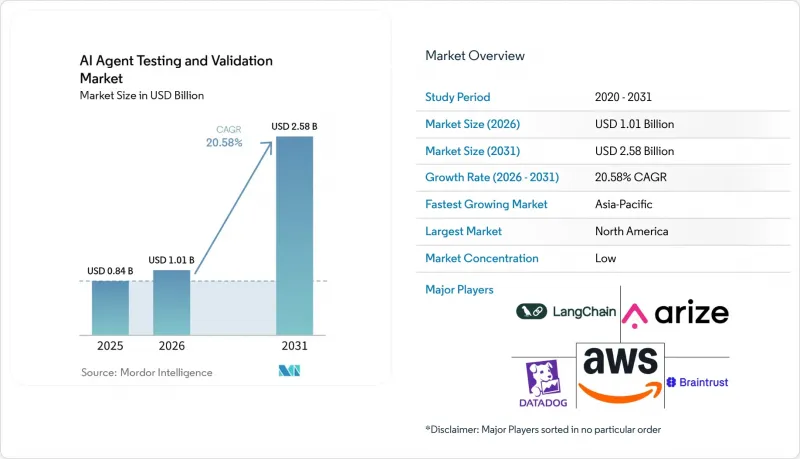
에 따르면 AI 에이전트 테스트 및 검증 시장 규모는 2025년에 8억 4,000만 달러로 평가되며, 2026년 10억 1,000만 달러에서 2031년까지 25억 8,000만 달러에 달할 것으로 예측되고 있으며, 예측 기간(2026-2031년)에 CAGR은 20.58%에 달할 전망입니다.
전 세계 AI 에이전트 테스트 및 검증 시장의 동향과 인사이트
자율형 및 다중 에이전트 워크플로우의 보급
기업에서는 계획, 검색, 실행을 담당하는 각 에이전트가 공유 메모리나 외부 툴을 통해 연동되는 다중 에이전트 시스템을 도입하고 있습니다. 이러한 설계로 인해 워크플로우가 승인되기까지 검증해야 할 경로의 수가 증가합니다. 특정 에이전트에서 발생한 오류는 직원이나 고객에게 드러나기 전에 후속 단계로 파급될 가능성이 있습니다. Patronus AI의 TRAIL 벤치마크에는 사람이 주석을 달아 놓은 148개의 트레이스, 841개의 개별 오류, 그리고 20개 이상의 에이전트 오류 범주가 포함되어 있습니다. 이 벤치마크에서 복잡한 트레이스 내의 오류를 식별하는 과제를 부여받은 최첨단 모델의 종합 정확도가 12% 미만으로 나타났습니다. 평가 능력이 기업의 도입 계획을 제약할 가능성이 있으므로 AI 에이전트 테스트 및 검증 시장은 이러한 광범위한 테스트 부담에 의해 주도되고 있습니다.
AI 소프트웨어 전달 파이프라인에서의 지속적인 평가
AI 평가는 릴리스 전에만 수행되는 작업이 아니라, 일상적인 소프트웨어 전달의 일부가 되어가고 있습니다. 프롬프트, 모델 또는 툴 정의의 변경은 의도된 비즈니스 프로세스를 변경하지 않더라도 에이전트의 동작을 바꿀 가능성이 있습니다. 코드 변경에 대해 평가 스위트를 실행함으로써, 프로덕션 환경의 사용자에게 도달하기 전에 회귀 현상을 식별할 수 있습니다. LangSmith Engine은 프로덕션 환경의 추적을 모니터링하고, 반복되는 오류를 그룹화하며, 근본 원인을 파악하고, 수정 방안을 제안합니다. Datadog은 새로운 모델이 사용 가능해졌을 때, 라벨이 지정된 테스트 세트를 재실행하여 개선 사항이나 회귀 현상을 식별하는 평가 프로세스에 대해 설명했습니다. AI 에이전트 테스트 및 검증 시장에서 배포 워크플로우와의 통합은 평가 기법만큼이나 중요해질 수 있습니다. 이는 이를 통해 오류 탐지부터 수정 테스트 실행까지의 시간을 단축할 수 있기 때문입니다.
확률적 테스트의 불안정성과 재현성의 한계
대규모 언어 모델은 서로 다른 실행에서 동일한 입력을 받아도 서로 다른 출력을 생성할 수 있습니다. 이로 인해 진정한 개선과 일반적인 변동성을 구별하기 어려워집니다. Sierra사의 tau-bench는 ‘pass^k’라는 신뢰성 지표를 도입하여, 에이전트가 동일한 작업을 반복적으로 완료해야 할수록 성공률이 어떻게 저하되는지를 보여주었습니다. 팀은 실제 환경에 도입할지 여부를 결정하기에 충분한 신뢰성을 갖춘 결과를 얻기 위해 각 테스트 케이스에 대해 다수의 시도를 필요로 할 수 있습니다. 이러한 필요성은 컴퓨팅 리소스 사용량을 증가시키고 검증 주기를 장기화시킬 가능성이 있습니다. 257편의 논문을 검토한 결과, 실행시 증거 유지, 시간적 타당성, 그리고 개방형 다중 에이전트 보증은 행동 평가에 비해 여전히 발전이 미흡한 것으로 나타났습니다. 이러한 한계는 규제 대상 사용자가 릴리스마다 일관된 증거를 필요로 하는 AI 에이전트 테스트 및 검증 시장에서 도입 지연을 초래할 가능성이 있습니다.
부문 분석
2025년, AI 에이전트 테스트 및 검증 시장에서 플랫폼이 67.41%를 차지했습니다. 이러한 선두 위상은 기업이 오프라인 평가, 운영 환경 모니터링, 회귀 테스트를 지원하는 단일 환경을 선호하는 경향을 반영한 것입니다. 통합된 시스템을 통해 개별 툴을 연동하고 그 결과를 대조하는 데 필요한 노력을 줄일 수 있습니다. LangChain에 따르면 LangSmith의 상용 월간 트레이스량은 전년 대비 12배 성장했으며, 포춘 500대 기업의 35%가 LangChain의 서비스를 이용하고 있었습니다. 이러한 결과는 에이전트를 대규모로 운영하는 조직에게 통합된 추적 및 평가 기능이 왜 중요한지를 보여줍니다. 또한 이 플랫폼은 사내에 AI 엔지니어링 팀을 보유하고 테스트 워크플로를 직접 관리하고자 하는 기술 지향적인 구매자에게도 적합합니다.
AI 에이전트 테스트 및 검증 시장에서 서비스 부문은 2026-2031년까지 연평균 성장률(CAGR) 21.37%로 성장할 것으로 예측됩니다. 구매자는 테스트 하네스, 골든 데이터세트 또는 자동 판정 시스템의 보정에 대한 지원이 필요할 때 서비스를 이용합니다. 이는 독립적이고 설명 가능한 검토가 필요한 규제 대상 조직에게 특히 중요합니다. 플랫폼의 수익은 라이선스 수나 이용 현황에 따라 확대될 수 있지만, 서비스 수익은 일반적으로 프로젝트나 전문가의 노력에 연동됩니다. Arize AX는 2026년에 에이전트 간 실험 비교 및 장애 근본 원인 분석을 위한 기능을 도입했습니다. 각 벤더는 플랫폼 이용에 필요한 전문 지식의 진입 장벽을 낮추고 있지만, 평가 설계에 전문가의 판단이 필요한 경우에는 서비스가 여전히 가치를 지니고 있습니다.
2025년 AI 에이전트 테스트 및 검증 시장 규모 중 기능 테스트와 작업 완료 테스트가 34.29%를 차지했습니다. 이는 양식 입력, 정보 검색, 데이터베이스 쿼리 실행 등 명확한 작업을 수행하는 에이전트에게 여전히 기본적인 테스트 단계로 남아 있습니다. 이러한 테스트는 정의된 조건 하에서 워크플로가 기대되는 결과를 산출하는지 팀이 확인하는 데 도움이 됩니다. 그러나 에이전트가 허용되지 않은 툴을 사용했는지, 오래된 컨텍스트에 의존했는지, 혹은 할당된 역할에서 벗어났는지와 같은 점은 반드시 명확하게 드러나지 않습니다. 다중 에이전트 금융 시스템에 대한 연구에서는 정보의 노후화, 역할 이탈, 그리고 허용되지 않은 툴 사용과 관련된 위험이 확인되었습니다. 따라서 기능 테스트는 여전히 필요하지만, 에이전트의 행동 전 과정을 검증하는 기법으로 보완되고 있습니다.
AI 에이전트 테스트 및 검증 시장에서 안전성, 보안, 그리고 적대적 테스트는 2031년까지 연평균 성장률(CAGR) 20.88%로 성장할 것으로 예측됩니다. 기업이 기밀성이 높은 환경에 에이전트를 도입함에 따라 자동화된 레드팀 활동이 운영 전달 프로세스에 통합되고 있습니다. 마이크로소프트의 조사에 따르면 100개 이상의 생성형 AI 제품에서 책임 있는 AI로 인한 피해가 광범위하게 발생하고 있으며, 이를 측정하기 어렵다는 사실이 밝혀졌습니다. 또한 이 조사에서는 자동화를 통해 수동 검증으로는 커버할 수 없는 범위까지 위험의 포괄성을 넓힐 수 있다는 점도 드러났습니다. 성능, 비용 및 지연 시간 테스트는 계산 비용이나 응답 시간이 운영 결과에 영향을 미치는 고빈도 워크플로우에서도 중요합니다. 에이전트의 구성이나 기반 모델이 변화함에 따라 공정성, 편향, 규정 준수, 회귀, 드리프트 및 툴 사용에 관한 테스트의 중요성이 높아지고 있습니다.
지역별 분석
북미는 최첨단 AI 연구소, 기업 소프트웨어 벤더, 평가 스타트업 및 초기 도입 기업이 집적되어 있는 점을 배경으로, 2025년에는 전 세계 매출의 40.43%를 차지했습니다. LangChain, Braintrust, Arize AI, Patronus AI, Galileo Technologies, Scale AI, Datadog은 북미에 본사를 두고 있으며, 이를 통해 플랫폼의 방법론과 기업의 베스트 프랙티스가 개발자 및 구매자 사이에서 빠르게 확산되고 있습니다. 캐나다의 AI 안전성 연구 커뮤니티는 상업적으로 의미 있는 평가 기법을 제공하고 있는 반면, 멕시코에서는 기술 부문이 클라우드 기반 툴을 도입함에 따라 수요가 확대되기 시작하고 있습니다. 또한 Amazon Web Services, Google, Microsoft가 평가 기능을 광범위한 개발 환경에 통합하고 있으며, 대규모 클라우드 개발자 생태계도 해당 지역의 보급에 영향을 미치고 있습니다. 이를 통해 전용 플랫폼을 구매하지 않을 가능성이 있는 클라우드 네이티브 팀에게도 평가 기능을 제공할 수 있을 뿐만 아니라, 기존 클라우드 계약을 통해 초기 도입의 복잡성을 줄일 수 있습니다.
유럽은 소규모 기반에서 확대되고 있으며, 독일, 영국, 프랑스가 기업내 도입을 주도하고 있습니다. 제50조에 따른 투명성 의무는 2026년 8월부터 적용되지만, 고위험 AI 시스템에 대한 요건에 대해서는 시행 일정이 그보다 늦춰져 있습니다. 유럽의 AI 에이전트 테스트 및 검증 시장 규모는 버전 관리가된 테스트, 문서화된 커버리지, 추적 링크가 연결된 결과 등 장기적인 규정 준수를 입증하는 기록의 필요성에 의해 지원되고 있습니다. 규제의 단계적 도입으로 인해 고객 대상이나 중대한 영향을 수반하는 용도로 에이전트의 도입이 더욱 광범위해지기 전에 기업이 테스트 프로세스를 확립해야 하므로, 수년 단위의 구축 주기가 형성되고 있습니다. 또한 구매 기업은 이러한 프로세스를 고위험 시스템에 대한 데이터 거버넌스 요구 사항 및 자사의 내부 위험 관리 체계와 조화시켜야 합니다.
아시아태평양에서는 일본, 한국, 인도, 중국, 호주가 문서화된 에이전트 검증 요구를 강화하는 거버넌스 접근 방식을 도입하고 있으며, AI 에이전트 테스트 및 검증 시장은 2031년까지 연평균 성장률(CAGR) 20.91%로 성장할 것으로 예측됩니다. 2026년 7월, 일본의 AI 안전 연구소는 가이드라인을 개정하여 AI 에이전트 시스템에 관한 고려 사항을 추가했습니다. 또한 싱가포르의 SAFR 프레임워크는 금융 분야의 AI 에이전트에 대한 테스트 지침을 제공하고 있습니다. 남미에서는 도입이 아직 초기 단계에 있으며, 브라질이 클라우드 우선 기업 활용을 주도하고 있고, 아르헨티나에서는 새로운 수요가 발생하고 있습니다. 아랍에미리트(UAE)와 사우디아라비아에서는 국가 차원의 디지털 프로그램을 통해 정부 주도의 수요가 발생하고 있습니다. 한편, 아프리카의 조달 활동은 여전히 남아프리카공화국과 나이지리아의 다국적 기업에 집중되어 있습니다.
기타 혜택:
- 엑셀 형식의 시장 예측(ME) 시트
- 3개월간의 애널리스트 지원
자주 묻는 질문
목차
제1장 서론
- 조사 전제조건과 시장 정의
- 조사 범위
제2장 조사 방법
제3장 개요
제4장 시장 구도
- 시장 개요
- 시장 성장 촉진요인
- 시장 성장 억제요인
- 거시경제 요인이 시장에 미치는 영향
- 업계 밸류체인 분석
- 기술 동향
- 규제 상황
- Porter's Five Forces 분석
제5장 시장 규모와 성장 예측
- 컴포넌트별
- 테스트 유형별
- 배포 모델별
- 최종사용자별
- 지역별
- 북미
- 미국
- 캐나다
- 멕시코
- 남미
- 브라질
- 아르헨티나
- 칠레
- 기타 남미 국가
- 유럽
- 독일
- 영국
- 프랑스
- 이탈리아
- 스페인
- 기타 유럽 국가
- 아시아태평양
- 중국
- 일본
- 인도
- 한국
- 호주
- 기타 아시아태평양 국가
- 중동
- 아랍에미리트
- 사우디아라비아
- 카타르
- 기타 중동 국가
- 아프리카
- 남아프리카공화국
- 이집트
- 나이지리아
- 기타 아프리카 국가
- 북미
제6장 경쟁 구도
- 시장 집중도
- 전략적 동향
- 시장 점유율 분석
- 기업 개요
- LangChain Inc.
- Braintrust Data, Inc.
- Arize AI, Inc.
- Patronus AI, Inc.
- Openlayer, Inc.
- Datadog, Inc.
- HoneyHive AI, Inc.
- Deepchecks Technologies Ltd.
- Galileo Technologies, Inc.
- Agenta Technologies, Inc.
- Maxim AI, Inc.
- Langfuse GmbH
- Monte Carlo Data, Inc.
- Fiddler Labs, Inc.
- WhyLabs, Inc.
- Truera, Inc.
- Weights & Biases, Inc.
- Scale AI, Inc.
- Tricentis GmbH
- Amazon Web Services, Inc.
- Google LLC
- Microsoft Corporation
- International Business Machines Corporation
- Anthropic PBC
제7장 시장 기회와 향후 전망
KSAAccording to Mordor Intelligence, the AI agent testing and Validation Market size was valued at USD 0.84 billion in 2025 and is estimated to grow from USD 1.01 billion in 2026 to reach USD 2.58 billion by 2031, at a CAGR of 20.58% during the forecast period (2026-2031).
Global AI Agent Testing and Validation Market Trends and Insights
Proliferation of Autonomous and Multi-Agent Workflows
Enterprises are deploying multi-agent systems in which planning, retrieval, and execution agents coordinate through shared memory and external tools. This design increases the number of paths that must be examined before a workflow can be approved. An error from one agent can move through later steps before it becomes visible to an employee or customer. Patronus AI's TRAIL benchmark contains 148 human-annotated traces, 841 discrete errors, and more than 20 agentic error categories. The benchmark found joint accuracy below 12% for frontier models tasked with localizing errors in complex traces. The AI Agent Testing and Validation Market is driven by this broader testing burden, as evaluation capacity can constrain enterprise rollout plans.
Continuous Evaluation in AI Software Delivery Pipelines
AI evaluation is becoming part of normal software delivery rather than a task completed only before launch. Changes to prompts, models, or tool definitions can alter agent behavior without changing the intended business process. Running evaluation suites on code changes can identify regressions before they reach production users. LangSmith Engine monitors production traces, groups repeated failures, identifies root causes, and proposes fixes. Datadog described an evaluation process that reruns labeled test sets when new models become available to identify improvements and regressions. In the AI Agent Testing and Validation Market, integration with delivery workflows can matter as much as the evaluation method because it shortens the time between a detected failure and a corrective test.
Probabilistic Test Flakiness and Reproducibility Limits
Large language models can produce different outputs when they receive the same input in separate runs. This makes it harder to separate genuine improvement from ordinary variation. Sierra's tau-bench introduced the pass^k reliability measure to show how success rates decline as agents must repeatedly complete the same task. Teams may need many trials for each test case before the results are reliable enough for a production decision. That need increases computing use and can extend validation cycles. A review of 257 papers found that runtime evidence maintenance, temporal validity, and open-ended multi-agent assurance remained less developed than behavioral evaluation. These limits can slow adoption in the AI Agent Testing and Validation Market, where regulated users need consistent evidence for every release.
Other drivers and restraints analyzed in the detailed report include:
- Regulatory Demand for Explainable and Auditable AI Assurance
- Procurement Evidence Requirements for Third-Party Agents
- Shortage of AI-First Quality Engineering Talent
For complete list of drivers and restraints, kindly check the Table Of Contents.
Segment Analysis
Platforms accounted for 67.41% of the AI Agent Testing and Validation Market in 2025. The lead reflected enterprise preference for a single environment that supports offline evaluation, production monitoring, and regression testing. A unified system can reduce the effort needed to connect separate tools and reconcile their results. LangChain reported 12x year-over-year growth in commercial monthly trace volume for LangSmith, while 35% of Fortune 500 companies used LangChain services. These results show why integrated trace and evaluation functions matter to organizations operating agents at scale. Platforms also suit technology-forward buyers with internal AI engineering teams who want direct control over testing workflows.
Services are projected to grow at a 21.37% CAGR from 2026 to 2031 within the AI Agent Testing and Validation Market. Buyers use services when they need help with test harnesses, golden datasets, or calibration of automated judges. This is particularly relevant for regulated organizations that need an independent and defensible review. Platform revenue can scale with seats or usage, while services revenue usually remains tied to projects and specialist labor. Arize AX introduced functions for agent experiment comparison and root cause analysis of failures in 2026. Vendors are lowering the expertise needed to use platforms, while services remain valuable when evaluation design requires specialist judgment.
Functional and task-completion testing accounted for 34.29% of the AI Agent Testing and Validation Market size in 2025. It remains the baseline test layer for agents that complete clear tasks such as filing forms, retrieving information, or executing a database query. These tests help teams confirm whether a workflow produces the expected result under defined conditions. They do not always reveal whether an agent used an unauthorized tool, relied on outdated context, or deviated from its assigned role. Research on multi-agent financial systems identified risks involving temporal staleness, role drift, and unauthorized tool use. Functional testing therefore remains necessary, but it is being supplemented by methods that review the full trajectory of an agent.
Safety, security, and adversarial testing is forecast to grow at a 20.88% CAGR through 2031 in the AI Agent Testing and Validation Market. Automated red-teaming is moving into operational delivery processes as enterprises deploy agents in sensitive settings. Microsoft Research found that responsible AI harms were widespread and difficult to measure across more than 100 generative AI products. The work also showed that automation can expand risk coverage beyond what manual exercises can review. Performance, cost, and latency testing is also relevant for high-frequency workflows where computing cost and response time affect operating outcomes. Fairness, bias, compliance, regression, drift, and tool-use testing are gaining importance as agent configurations and underlying models change.
Complete Report Scope:
- By Component
- Platforms
- Services
- By Testing Type
- Functional and Task-Completion Testing
- Tool-Use and Workflow Testing
- Safety, Security, and Adversarial Testing
- Performance, Cost, and Latency Testing
- Fairness, Bias, and Compliance Testing
- Regression and Drift Testing
- Other Testing Type
- By Deployment Model
- Cloud-Based
- Hybrid
- On-Premises
- By End User
- Technology Companies and AI-Native Startups
- Banking, Financial Services, and Insurance
- Healthcare and Life Sciences
- Retail and E-commerce
- IT and Telecommunications
- Manufacturing, Automotive, and Logistics
- Government and Defense
- Other End Users
- By Geography
- North America
- United States
- Canada
- Mexico
- South America
- Brazil
- Argentina
- Chile
- Rest of South America
- Europe
- Germany
- United Kingdom
- France
- Italy
- Spain
- Rest of Europe
- Asia-Pacific
- China
- Japan
- India
- South Korea
- Australia
- Rest of Asia-Pacific
- Middle East
- United Arab Emirates
- Saudi Arabia
- Qatar
- Rest of Middle East
- Africa
- South Africa
- Egypt
- Nigeria
- Rest of Africa
- North America
Geography Analysis
North America held 40.43% of global revenue in 2025, supported by its concentration of frontier AI labs, enterprise software vendors, evaluation startups, and early enterprise adopters. LangChain, Braintrust, Arize AI, Patronus AI, Galileo Technologies, Scale AI, and Datadog operate from North American headquarters, which helps platform methods and enterprise practices circulate quickly among developers and buyers. Canada's AI safety research community contributes evaluation methods with commercial relevance, while Mexico is beginning to add demand as its technology sector adopts cloud-based tools. Large cloud developer ecosystems also shape regional uptake, as Amazon Web Services, Google, and Microsoft embed evaluation capabilities into broader development environments. This can bring evaluation functions to cloud-native teams that may not purchase a dedicated platform, while existing cloud contracts can make initial adoption less complex.
Europe is expanding from a smaller base, with Germany, the United Kingdom, and France leading enterprise adoption. Article 50 transparency obligations became applicable in August 2026, while high-risk AI system requirements have a later implementation schedule. The AI Agent Testing and Validation Market size in Europe is supported by the need for records that demonstrate compliance over time, including versioned tests, documented coverage, and trace-linked results. The regulatory sequence creates a multi-year build-out cycle because enterprises need to establish test processes before agent deployments become more widespread in customer-facing and consequential uses. Buyers will also need to align those processes with data governance expectations for high-risk systems and with their own internal risk controls.
Asia-Pacific is projected to grow at a 20.91% CAGR through 2031 in the AI Agent Testing and Validation Market, as Japan, South Korea, India, China, and Australia implement governance approaches that increase the need for documented agent validation. In July 2026, Japan's AI Safety Institute updated its guide to include AI agent system considerations, and Singapore's SAFR framework provides a testing reference point for financial AI agents. South America remains earlier in adoption, with Brazil leading cloud-first enterprise use and Argentina adding emerging demand. The United Arab Emirates and Saudi Arabia are generating government-led demand through national digital programs, while African procurement remains concentrated among multinational enterprises in South Africa and Nigeria.
- LangChain Inc.
- Braintrust Data, Inc.
- Arize AI, Inc.
- Patronus AI, Inc.
- Openlayer, Inc.
- Datadog, Inc.
- HoneyHive AI, Inc.
- Deepchecks Technologies Ltd.
- Galileo Technologies, Inc.
- Agenta Technologies, Inc.
- Maxim AI, Inc.
- Langfuse GmbH
- Monte Carlo Data, Inc.
- Fiddler Labs, Inc.
- WhyLabs, Inc.
- Truera, Inc.
- Weights & Biases, Inc.
- Scale AI, Inc.
- Tricentis GmbH
- Amazon Web Services, Inc.
- Google LLC
- Microsoft Corporation
- International Business Machines Corporation
- Anthropic PBC
Additional Benefits:
- The market estimate (ME) sheet in Excel format
- 3 months of analyst support
TABLE OF CONTENTS
1 INTRODUCTION
- 1.1 Study Assumptions and Market Definition
- 1.2 Scope of the Study
2 RESEARCH METHODOLOGY
3 EXECUTIVE SUMMARY
4 MARKET LANDSCAPE
- 4.1 Market Overview
- 4.2 Market Drivers
- 4.2.1 Proliferation of Autonomous and Multi-Agent Workflows
- 4.2.2 Continuous Evaluation in AI Software Delivery Pipelines
- 4.2.3 Regulatory Demand for Explainable and Auditable AI Assurance
- 4.2.4 Procurement Evidence Requirements for Third-Party Agents
- 4.2.5 Synthetic User Simulation for Rare-Event Coverage
- 4.2.6 Evidence-Based Validation of Agent Tool and State Transitions
- 4.3 Market Restraints
- 4.3.1 Probabilistic Test Flakiness and Reproducibility Limits
- 4.3.2 Shortage of AI-First Quality Engineering Talent
- 4.3.3 High Compute and Data Costs for High-Fidelity Simulation
- 4.3.4 Fragmented Standards Across Agent Frameworks and Protocols
- 4.4 Impact of Macroeconomic Factors on the Market
- 4.5 Industry Value-Chain Analysis
- 4.6 Technology Outlook
- 4.7 Regulatory Landscape
- 4.8 Porter's Five Forces Analysis
- 4.8.1 Threat of New Entrants
- 4.8.2 Bargaining Power of Suppliers
- 4.8.3 Bargaining Power of Buyers
- 4.8.4 Threat of Substitutes
- 4.8.5 Intensity of Competitive Rivalry
5 MARKET SIZE AND GROWTH FORECASTS (VALUE)
- 5.1 By Component
- 5.1.1 Platforms
- 5.1.2 Services
- 5.2 By Testing Type
- 5.2.1 Functional and Task-Completion Testing
- 5.2.2 Tool-Use and Workflow Testing
- 5.2.3 Safety, Security, and Adversarial Testing
- 5.2.4 Performance, Cost, and Latency Testing
- 5.2.5 Fairness, Bias, and Compliance Testing
- 5.2.6 Regression and Drift Testing
- 5.2.7 Other Testing Type
- 5.3 By Deployment Model
- 5.3.1 Cloud-Based
- 5.3.2 Hybrid
- 5.3.3 On-Premises
- 5.4 By End User
- 5.4.1 Technology Companies and AI-Native Startups
- 5.4.2 Banking, Financial Services, and Insurance
- 5.4.3 Healthcare and Life Sciences
- 5.4.4 Retail and E-commerce
- 5.4.5 IT and Telecommunications
- 5.4.6 Manufacturing, Automotive, and Logistics
- 5.4.7 Government and Defense
- 5.4.8 Other End Users
- 5.5 By Geography
- 5.5.1 North America
- 5.5.1.1 United States
- 5.5.1.2 Canada
- 5.5.1.3 Mexico
- 5.5.2 South America
- 5.5.2.1 Brazil
- 5.5.2.2 Argentina
- 5.5.2.3 Chile
- 5.5.2.4 Rest of South America
- 5.5.3 Europe
- 5.5.3.1 Germany
- 5.5.3.2 United Kingdom
- 5.5.3.3 France
- 5.5.3.4 Italy
- 5.5.3.5 Spain
- 5.5.3.6 Rest of Europe
- 5.5.4 Asia-Pacific
- 5.5.4.1 China
- 5.5.4.2 Japan
- 5.5.4.3 India
- 5.5.4.4 South Korea
- 5.5.4.5 Australia
- 5.5.4.6 Rest of Asia-Pacific
- 5.5.5 Middle East
- 5.5.5.1 United Arab Emirates
- 5.5.5.2 Saudi Arabia
- 5.5.5.3 Qatar
- 5.5.5.4 Rest of Middle East
- 5.5.6 Africa
- 5.5.6.1 South Africa
- 5.5.6.2 Egypt
- 5.5.6.3 Nigeria
- 5.5.6.4 Rest of Africa
- 5.5.1 North America
6 COMPETITIVE LANDSCAPE
- 6.1 Market Concentration
- 6.2 Strategic Moves
- 6.3 Market Share Analysis
- 6.4 Company Profiles (includes Global Level Overview, Market Level Overview, Core Segments, Financials as available, Strategic Information, Market Rank/Share, Products and Services, Recent Developments)
- 6.4.1 LangChain Inc.
- 6.4.2 Braintrust Data, Inc.
- 6.4.3 Arize AI, Inc.
- 6.4.4 Patronus AI, Inc.
- 6.4.5 Openlayer, Inc.
- 6.4.6 Datadog, Inc.
- 6.4.7 HoneyHive AI, Inc.
- 6.4.8 Deepchecks Technologies Ltd.
- 6.4.9 Galileo Technologies, Inc.
- 6.4.10 Agenta Technologies, Inc.
- 6.4.11 Maxim AI, Inc.
- 6.4.12 Langfuse GmbH
- 6.4.13 Monte Carlo Data, Inc.
- 6.4.14 Fiddler Labs, Inc.
- 6.4.15 WhyLabs, Inc.
- 6.4.16 Truera, Inc.
- 6.4.17 Weights & Biases, Inc.
- 6.4.18 Scale AI, Inc.
- 6.4.19 Tricentis GmbH
- 6.4.20 Amazon Web Services, Inc.
- 6.4.21 Google LLC
- 6.4.22 Microsoft Corporation
- 6.4.23 International Business Machines Corporation
- 6.4.24 Anthropic PBC
7 MARKET OPPORTUNITIES AND FUTURE OUTLOOK
- 7.1 White-Space and Unmet-Need Assessment


