

|
시장보고서
상품코드
2154420
리튬 코발트 산화물(LCO) : 시장 점유율 분석, 업계 동향과 통계, 성장 예측(2026-2031년)Lithium Cobalt Oxide (LCO) - Market Share Analysis, Industry Trends & Statistics, Growth Forecasts (2026 - 2031) |
||||||
 Mordor Intelligence
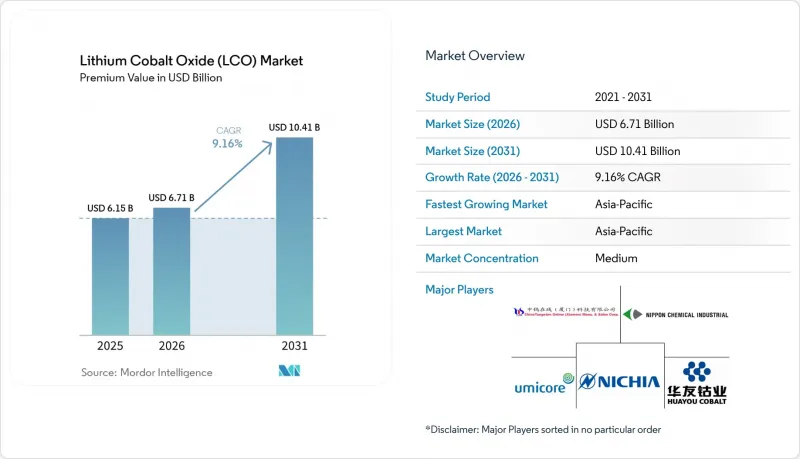
에 따르면 산화 리튬 코발트(LCO) 시장 규모는 2025년에 61억 5,000만 달러로 평가되며, 2026년 67억 1,000만 달러에서 2031년까지 104억 1,000만 달러에 달할 것으로 추정되고 있으며, 예측 기간(2026-2031년)에 CAGR은 9.16%에 달할 전망입니다.
세계 리튬코발트산화물(LCO) 시장의 동향 및 인사이트
고급 휴대용 전자기기에서의 고에너지 밀도 수요
프리미엄 스마트폰은 엄격하게 관리되는 기기 크기 내에서 높은 체적 에너지 밀도가 요구되는 배터리 사양을 갖추고 있으며, 리튬 코발트 산화물 시장의 주요 판매 채널로 자리 잡고 있습니다. 기기 제조사들은 배터리 크기를 늘리지 않으면서 셀 수준의 에너지 밀도를 높이기 위해, 고전압 리튬 코발트 산화물 양극과 실리콘·탄소 음극을 조합한 방식을 점점 더 많이 채택하고 있습니다. Syensqo사는 2025년, 자사의 전해액 첨가제 ‘Energain SA076’이 4.53V를 초과하는 전압에서 작동하는 리튬 코발트 산화물 배터리 시스템에 상용화되기 시작했다고 발표했습니다. 이 회사는 전해액의 안정성을 유지하면서 작동 전압을 높이는 노력을 지속하고 있음을 반영하여, 2026년에는 4.55V 플래그십 플랫폼에서 더욱 광범위한 도입이 이루어질 것으로 전망하고 있습니다. 인공지능(AI)을 활용한 처리, 높은 주사율의 디스플레이, 그리고 새로운 모뎀 부하로 인해 플래그십 스마트폰의 배터리 용량 수요가 증가하고 있으며, 기기 설계에서 에너지 효율이 더욱 중요해지고 있습니다. 이러한 요구 사항으로 인해 스마트폰 판매 대수가 같은 속도로 증가하지 않더라도 기기당 양극 충전량이 증가할 가능성이 있습니다.
웨어러블, 폴더블 기기, 드론, 의료용 임플란트의 성장
리튬 코발트 산화물 시장은 가동 시간을 저해하지 않으면서도 소형 배터리 셀이 필요한 기기들로부터 혜택을 받고 있습니다. 폴더블 스마트폰이나 증강현실(AR), 가상현실(VR) 기기에는 그보다 복잡한 구조를 수용할 수 있는 얇은 배터리 설계가 요구됩니다. 또한 웨어러블 의료기기 역시 수요를 지원하고 있습니다. 이는 배터리의 화학적 구성이 변경될 경우 기기의 재인증이 필요할 수 있기 때문입니다. 미국 식품의약국(FDA)의 품질 시스템 규정은 의료기기 제조에 적용되며, 승인된 제품 설계에 대해 공식적인 관리 체제가 마련되어 있습니다. 무인 항공기(UAV)는 탑재량 제한 범위 내에서 비행 시간을 연장하기 위해 고에너지 밀도의 배터리 셀을 사용하고 있습니다. 이러한 사용 사례는 대중용 가전제품만큼 규모는 크지 않지만, 검사, 농업, 의료, 국방 등의 분야에서 수요를 끌어올리고 있습니다.
코발트 가격의 변동성과 공급의 집중
코발트는 리튬코발트 산화물 양극재의 주요 원가 요소이므로, 코발트 가격의 변동성과 공급 집중이 해당 시장을 제약하고 있습니다. 콩고 민주 공화국은 할당 제도에 따라 2026년 수산화 코발트 수출량을 8만 7,000메트릭톤으로 제한했습니다. 코발트 협회(The Cobalt Institute)의 보고에 따르면 2025년 전 세계 코발트 채굴 공급량은 270킬로톤이며, 이 중 콩고민주공화국이 공급량의 73%를 차지하고 있습니다. 또한 동 협회는 2025년에 콩고민주공화국을 제외한 공급량이 96킬로톤 부족할 것이라고 보고했습니다. 2025년 한 해 동안 수산화코발트 가격이 상승하면서 양극재 및 배터리 제조사의 원자재 비용이 증가했습니다. 원자재 비용 상승은 제조사가 최종 제품 가격 책정에 민감한 소비자용 기기 분야에서 이익률을 압박할 가능성이 있습니다.
부문별 분석
2025년 리튬 코발트 산화물 시장에서 배터리 등급은 65.78%의 점유율을 차지하고 있으며, 2031년까지 연평균 성장률(CAGR) 9.74%로 확대될 것으로 예측됩니다. 이 부문은 사소한 재료의 편차만으로도 셀 성능에 영향을 미칠 수 있는 고급 스마트폰 및 휴대용 기기의 전체 공급망에서 더욱 엄격해진 순도 기준의 혜택을 받고 있습니다. 배터리 등급 소재에는 일반적으로 신뢰성 높은 제조를 지원하기 위해 높은 코발트 순도, 제어된 입자 형태, 일관된 탭 밀도가 요구됩니다. 이러한 특성 덕분에 작동 전압이 4.45V를 초과하거나, 기기 제조사가 고정된 배터리 용량에서 더 큰 용량을 요구할 때도 셀 성능을 유지할 수 있습니다. 고급 기기 제조업체들이 배터리 등급 양극재를 채택하는 이유는 저등급 원료의 경우 고전압 하에서 용량 저하가 가속화될 가능성이 있기 때문입니다. 산업용 등급의 리튬 코발트 산화물은 세라믹용 착색제, 자성 재료, 촉매 용도로 사용되며, 보다 안정적이지만 수요 증가세가 완만한 수요 기반을 형성하고 있습니다.
배터리 등급에 대한 수요는 양극재 생산에서 코발트의 재이용을 확대하기 위한 노력에 의해서도 지원되고 있습니다. 중국은 2025년 8월 블랙매스 수입 규제를 철폐하고, 해외에서 생산된 2차 전지 소재가 국내 정제 시설로 유입되도록 허용함으로써 잠재적인 원료 공급원을 확대했습니다. 이러한 변화로 인해 리튬 코발트 산화물 업계, 특히 정제 및 소재 가공 능력을 갖춘 생산자들에게 재활용 코발트 원료의 확보 가능성이 높아질 수 있습니다. DOWA ECO-SYSTEM은 2026년 6월, 사용 후 리튬이온 배터리에서 황산니켈 및 황산코발트를 회수하는 통합 공정을 확립했습니다. 회수된 소재는 본격적인 상업적 도입에 앞서 성능 검증용 샘플로 양극재 제조업체에 공급되었습니다. 이 통합 회수 시스템은 미사용 원료에 대한 의존도를 낮추고, 조달 옵션을 다각화하며, 배터리 등급 제조사의 공급 탄력성을 향상시킬 수 있습니다.
지역별 분석
아시아태평양은 2025년 시장 점유율 52.86%를 차지하고 있으며, 2031년까지 연평균 성장률(CAGR) 9.89%로 확대될 것으로 예측됩니다. 중국은 코발트 정제, 양극재 생산, 배터리 셀 제조 및 장비 조립 분야에서 중심적인 역할을 수행하고 있습니다. 이러한 통합된 공급망이 리튬 코발트 산화물 시장에서 이 지역의 선도적 지위를 지원하고 있습니다. 일본은 고정밀 소비자 가전 및 고순도 양극재 분야에서 전문적인 역할을 유지하고 있습니다. 한국은 확립된 양극재 제조 역량을 통해 전 세계 OEM(주문자 상표 생산) 고객사에 제품을 공급하고 있습니다. 또한 이 지역에서는 부품 공급업체, 배터리 셀 제조업체 및 기기 조립 제조업체 간에 견고한 협력 관계가 구축되어 있습니다.
북미와 유럽은 공급망 관리와 차별화된 기술에 중점을 둔 지역적 수요 기반을 형성하고 있습니다. 북미에서는 첨단 제조에 대한 장려책이 현지 배터리 소재 투자를 지원하고 있지만, 아시아 이외 지역의 배터리용 리튬코발트 산화물 생산 능력은 여전히 제한적입니다. 유럽의 배터리 규제에서는 코발트의 추적성을 포함하여 배터리 소재에 관한 보다 상세한 공급망 정보의 제공이 요구되고 있습니다. 이러한 요건은 조달 경로가 문서화되어 있고 감사 가능한 생산 공정을 갖춘 공급업체에게 유리하게 작용할 가능성이 있습니다. 베이징 이스프링 매트리얼 테크놀러지(Beijing East Spring Material Technology)는 핀란드 코토카에 양극 활물질 공장을 건설 중이며, 2027년에 상업 생산을 시작할 전망입니다.
남미, 중동 및 아프리카는 수요가 확대되고 있는 지역으로, 이 지역의 소비는 주로 가전제품의 보급과 밀접한 관련이 있습니다. 브라질과 아르헨티나에서는 스마트폰 사용 확대와 국내 전자기기 조립을 통해 지역내 수요 확대가 촉진되고 있습니다. 중동에서는 첨단인 제조 계획으로 인해 배터리 소재에 대한 장기적인 관심이 생길 가능성이 있습니다. 콩고 민주 공화국은 리튬 코발트 산화물 소비국이라기보다는 여전히 코발트 공급국으로서 중요한 위치를 차지하고 있습니다. 이 나라의 수출 할당량 결정은 전 세계 리튬 코발트 산화물 생산자들에게 원자재의 확보 가능성 및 비용에 영향을 미칩니다. 리튬 코발트 산화물 시장에서 이 지역에 대한 의존도는 주로 공급 측면의 고려 사항일 뿐, 현지 소비를 견인하는 요인은 아닙니다. 남아프리카공화국은 코발트 가공에 있으며, 지원적인 역할을 할 가능성이 있지만, 상용화 준비 상황은 여전히 불투명합니다.
기타 혜택:
- 엑셀 형식의 시장 예측(ME) 시트
- 3개월간의 애널리스트 지원
목차
제1장 서론
- 조사 전제조건과 시장 정의
- 조사 범위
제2장 조사 방법
제3장 개요
제4장 시장 구도
- 시장 개요
- 시장 성장 촉진요인
- 시장 성장 억제요인
- 밸류체인 분석
- Porter's Five Forces 분석
제5장 시장 규모와 성장 예측
- 등급별
- 용도별
- 지역별
- 아시아태평양
- 중국
- 인도
- 일본
- 한국
- ASEAN 국가
- 기타 아시아태평양 국가
- 북미
- 미국
- 캐나다
- 멕시코
- 유럽
- 독일
- 영국
- 프랑스
- 이탈리아
- 북유럽 국가
- 기타 유럽 국가
- 남미
- 브라질
- 아르헨티나
- 기타 남미 국가
- 중동 및 아프리카
- 사우디아라비아
- 남아프리카공화국
- 기타 중동 및 아프리카 국가
- 아시아태평양
제6장 경쟁 구도
- 시장 집중도
- 전략적 동향
- 시장 점유율·순위 분석
- 기업 개요
- BASF
- Beijing Easpring Material Technology Co., Ltd.
- Cosmo Advanced Materials & Technology Co., Ltd.
- GEM Co., Ltd.
- Huayou Cobalt Co., Ltd.
- Hunan Changyuan Lico Co., Ltd.
- Hunan Shanshan Energy Technology Co., Ltd.
- NICHIA CORPORATION
- Nippon Chemical Industrial CO., LTD.
- POSCO FUTURE M
- Reshine New Material Co., Ltd.
- Tianjin B&M Science and Technology Co., Ltd.
- Umicore
- Xiamen Tungsten Co., Ltd.
제7장 시장 기회와 향후 전망
KSAAccording to Mordor Intelligence, the lithium cobalt oxide (LCO) market size was valued at USD 6.15 billion in 2025 and is estimated to grow from USD 6.71 billion in 2026 to reach USD 10.41 billion by 2031, at a CAGR of 9.16% during the forecast period (2026-2031).
Global Lithium Cobalt Oxide (LCO) Market Trends and Insights
High-Density Demand in Premium Portable Electronics
Premium smartphones remain a major outlet for the lithium cobalt oxide market because their battery specifications favor high volumetric energy density within tightly controlled device dimensions. Device makers increasingly use silicon-carbon anodes with high-voltage lithium cobalt oxide cathodes to increase cell-level energy density without increasing battery size. Syensqo stated in 2025 that its Energain SA076 electrolyte additive had entered commercial use in lithium cobalt oxide battery systems operating above 4.53 V. The company expected broader deployment on 4.55 V flagship platforms during 2026, reflecting continued work to raise operating voltage while managing electrolyte stability. Artificial intelligence-enabled processing, high-refresh-rate displays, and newer modem loads increase battery capacity needs in flagship handsets and make energy efficiency more important to device design. These requirements can raise cathode loading per device even when handset unit sales do not increase at the same pace.
Growth in Wearables, Foldables, Drones and Medical Implants
The lithium cobalt oxide market gains from devices that require compact battery cells without compromising operating time. Foldable phones and augmented reality or virtual reality devices need thin battery designs that can accommodate their more complex structures. Wearable medical devices also support demand because battery chemistry changes can require renewed device qualification. The Food and Drug Administration's Quality System Regulation applies to medical-device manufacturing, creating formal controls around approved product designs. Unmanned Aerial Vehicles (UAVs) use energy-dense cells to extend flight times while staying within payload limits. These use cases are smaller than mass consumer electronics, but they add demand across inspection, agricultural, health care, and defense applications.
Cobalt Price Volatility and Supply Concentration
Cobalt price volatility and supply concentration constrain the lithium cobalt oxide market because cobalt is a key cost component in lithium cobalt oxide cathode materials. The Democratic Republic of the Congo limited cobalt hydroxide exports to 87,000 metric tons in 2026 under its quota system. The Cobalt Institute reported a global mined cobalt supply of 270 kilotons in 2025, with the Democratic Republic of the Congo contributing 73% of the supply. The institute also reported a 96-kiloton ex-Democratic Republic of the Congo supply deficit during 2025. Cobalt hydroxide prices increased during 2025, raising input costs for cathode and battery producers. Higher raw-material costs can pressure margins in consumer devices, where manufacturers are sensitive to final product pricing.
Other drivers and restraints analyzed in the detailed report include:
- Battery Grade Purity and Coating Innovation
- Expansion of Portable and Distributed Energy Storage
- Substitution by LFP, NMC, NCA and Cobalt-Free Chemistries
For complete list of drivers and restraints, kindly check the Table Of Contents.
Segment Analysis
Battery grade held 65.78% of the lithium cobalt oxide market share in 2025 and is projected to advance at a 9.74% CAGR through 2031. The segment benefits from stricter purity standards across premium smartphone and portable-device supply chains, where minor material variation can affect cell performance. Battery grade material generally requires high cobalt purity, controlled particle morphology, and consistent tap density to support reliable manufacturing. These characteristics help cells maintain performance as operating voltage moves beyond 4.45 V and as device makers seek greater capacity from a fixed battery volume. Premium device makers use battery grade cathodes because lower grade feedstocks can experience faster capacity loss at high voltage. Industrial grade lithium cobalt oxide serves ceramic colorants, magnetic materials, and catalyst applications, providing a more stable but slower-moving demand base.
Battery grade demand is also supported by efforts to increase secondary cobalt use in cathode production. China removed its restriction on black-mass imports in August 2025, allowing overseas secondary battery material to enter domestic refining capacity and expanding potential feedstock sources. This change can improve the availability of recycled cobalt feedstock for the lithium cobalt oxide industry, particularly for producers with refining and material-processing capabilities. DOWA ECO-SYSTEM established an integrated process for recovering nickel and cobalt sulfates from used lithium-ion batteries in June 2026. The recovered materials were supplied to cathode material producers as samples for performance verification before wider commercial adoption. Integrated recovery systems can reduce reliance on virgin feedstock, diversify procurement options, and improve supply resilience for battery grade manufacturers.
Complete Report Scope:
- By Grade
- Battery Grade
- Industrial Grade
- By Application
- Consumer Electronics
- Electric Vehicles
- Medical Devices
- Energy Storage Systems
- Telecommunications
- By Geography
- Asia-Pacific
- China
- India
- Japan
- South Korea
- ASEAN Countries
- Rest of Asia-Pacific
- North America
- United States
- Canada
- Mexico
- Europe
- Germany
- United Kingdom
- France
- Italy
- NORDIC Countries
- Rest of Europe
- South America
- Brazil
- Argentina
- Rest of South America
- Middle-East and Africa
- Saudi Arabia
- South Africa
- Rest of Middle-East and Africa
- Asia-Pacific
Geography Analysis
Asia-Pacific held 52.86% of the market share in 2025 and is projected to advance at a 9.89% CAGR through 2031. China has a central role in cobalt refining, cathode production, battery-cell manufacturing, and device assembly. This integrated supply chain supports the region's leadership in the lithium cobalt oxide market. Japan retains a specialized role in high-precision consumer electronics and high-purity cathode materials. South Korea supplies global original equipment manufacturer, or OEM, customers through established cathode-material capabilities. The region also has strong links between component suppliers, cell manufacturers, and device assemblers.
North America and Europe represent a regional demand base focused on supply-chain controls and differentiated technologies. In North America, advanced-manufacturing incentives support local battery-material investment, although battery grade lithium cobalt oxide capacity remains limited outside Asia. Europe's Battery Regulation requires more detailed supply-chain information for battery materials, including cobalt traceability. These requirements can favor suppliers with documented sourcing and auditable production processes. Beijing Easpring Material Technology Co., Ltd. is developing a cathode active material plant in Kotka, Finland, that is expected to begin commercial production in 2027.
South America, and Middle-East and Africa are developing demand regions, where consumption is tied mainly to consumer electronics adoption. Brazil and Argentina support regional uptake through growing smartphone use and domestic electronics assembly. In the Middle-East, advanced manufacturing plans may create longer-term interest in battery materials. The Democratic Republic of the Congo remains more important as a cobalt supplier than as a lithium cobalt oxide consumer. Its export quota decisions affect raw material availability and cost for lithium cobalt oxide producers worldwide. For the lithium cobalt oxide market, this regional exposure is primarily a supply-side consideration rather than a local consumption driver. South Africa could develop a supporting role in cobalt processing, although commercial readiness remains uncertain.
- BASF
- Beijing Easpring Material Technology Co., Ltd.
- Cosmo Advanced Materials & Technology Co., Ltd.
- GEM Co., Ltd.
- Huayou Cobalt Co., Ltd.
- Hunan Changyuan Lico Co., Ltd.
- Hunan Shanshan Energy Technology Co., Ltd.
- NICHIA CORPORATION
- Nippon Chemical Industrial CO., LTD.
- POSCO FUTURE M
- Reshine New Material Co., Ltd.
- Tianjin B&M Science and Technology Co., Ltd.
- Umicore
- Xiamen Tungsten Co., Ltd.
Additional Benefits:
- The market estimate (ME) sheet in Excel format
- 3 months of analyst support
TABLE OF CONTENTS
1 Introduction
- 1.1 Study Assumptions and Market Definition
- 1.2 Scope of the Study
2 Research Methodology
3 Executive Summary
4 Market Landscape
- 4.1 Market Overview
- 4.2 Market Drivers
- 4.2.1 High-Density Demand in Premium Portable Electronics
- 4.2.2 Growth in Wearables, Foldables, Drones and Medical Implants
- 4.2.3 Battery Grade Purity and Coating Innovation
- 4.2.4 Expansion of Portable and Distributed Energy Storage
- 4.2.5 Cobalt Recovery Economics and Circular Feedstock Availability
- 4.3 Market Restraints
- 4.3.1 Cobalt Price Volatility and Supply Concentration
- 4.3.2 Thermal Runaway Risk at High Charge Rates
- 4.3.3 Substitution by LFP, NMC, NCA and Cobalt-Free Chemistries
- 4.4 Value Chain Analysis
- 4.5 Porter's Five Forces Analysis
- 4.5.1 Bargaining Power of Suppliers
- 4.5.2 Bargaining Power of Buyers
- 4.5.3 Threat of New Entrants
- 4.5.4 Threat of Substitutes
- 4.5.5 Competitive Rivalry
5 Market Size and Growth Forecasts (Value)
- 5.1 By Grade
- 5.1.1 Battery Grade
- 5.1.2 Industrial Grade
- 5.2 By Application
- 5.2.1 Consumer Electronics
- 5.2.2 Electric Vehicles
- 5.2.3 Medical Devices
- 5.2.4 Energy Storage Systems
- 5.2.5 Telecommunications
- 5.3 By Geography
- 5.3.1 Asia-Pacific
- 5.3.1.1 China
- 5.3.1.2 India
- 5.3.1.3 Japan
- 5.3.1.4 South Korea
- 5.3.1.5 ASEAN Countries
- 5.3.1.6 Rest of Asia-Pacific
- 5.3.2 North America
- 5.3.2.1 United States
- 5.3.2.2 Canada
- 5.3.2.3 Mexico
- 5.3.3 Europe
- 5.3.3.1 Germany
- 5.3.3.2 United Kingdom
- 5.3.3.3 France
- 5.3.3.4 Italy
- 5.3.3.5 NORDIC Countries
- 5.3.3.6 Rest of Europe
- 5.3.4 South America
- 5.3.4.1 Brazil
- 5.3.4.2 Argentina
- 5.3.4.3 Rest of South America
- 5.3.5 Middle-East and Africa
- 5.3.5.1 Saudi Arabia
- 5.3.5.2 South Africa
- 5.3.5.3 Rest of Middle-East and Africa
- 5.3.1 Asia-Pacific
6 Competitive Landscape
- 6.1 Market Concentration
- 6.2 Strategic Moves
- 6.3 Market Share (%)/Ranking Analysis
- 6.4 Company Profiles (includes Global Overview, Market Overview, Core Segments, Financials as available, Strategic Information, Products and Services, and Recent Developments)
- 6.4.1 BASF
- 6.4.2 Beijing Easpring Material Technology Co., Ltd.
- 6.4.3 Cosmo Advanced Materials & Technology Co., Ltd.
- 6.4.4 GEM Co., Ltd.
- 6.4.5 Huayou Cobalt Co., Ltd.
- 6.4.6 Hunan Changyuan Lico Co., Ltd.
- 6.4.7 Hunan Shanshan Energy Technology Co., Ltd.
- 6.4.8 NICHIA CORPORATION
- 6.4.9 Nippon Chemical Industrial CO., LTD.
- 6.4.10 POSCO FUTURE M
- 6.4.11 Reshine New Material Co., Ltd.
- 6.4.12 Tianjin B&M Science and Technology Co., Ltd.
- 6.4.13 Umicore
- 6.4.14 Xiamen Tungsten Co., Ltd.
7 Market Opportunities and Future Outlook
- 7.1 White-Space and Unmet-Need Assessment


