

|
시장보고서
상품코드
2154449
혈액 점도계 : 시장 점유율 분석, 업계 동향과 통계, 성장 예측(2026-2031년)Blood Viscometer - Market Share Analysis, Industry Trends & Statistics, Growth Forecasts (2026 - 2031) |
||||||
 Mordor Intelligence
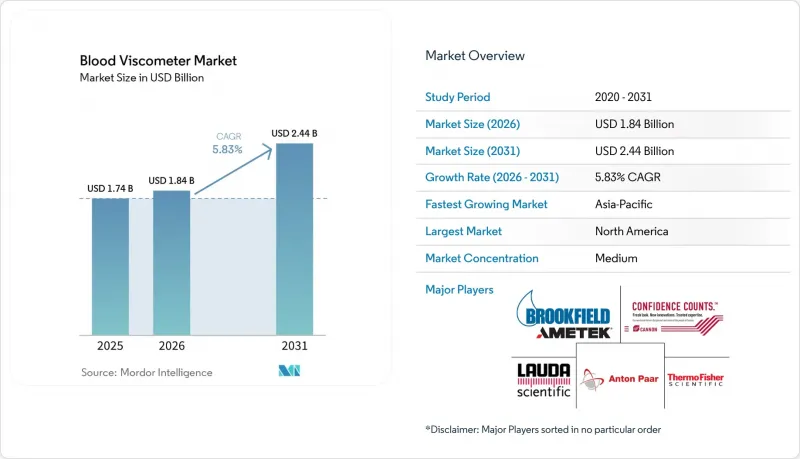
에 따르면 혈액 점도계 시장 규모는 2025년에 17억 4,000만 달러로 평가되며, 2026년 18억 4,000만 달러에서 2031년까지 24억 4,000만 달러에 달할 것으로 예측되고 있으며, 예측 기간(2026-2031년)에 CAGR은 5.83%에 달할 전망입니다.
전 세계 혈액 점도계 시장의 동향 및 인사이트
심혈관 질환 및 대사성 질환의 부담 증가
혈액 점도계 시장은 혈액 점도 상승과 심혈관 질환 간의 연관성으로 인해 성장세를 보이고 있습니다. 헤마토크리트 수치 및 피브리노겐의 상승, 그리고 적혈구의 변형 능력 저하는 관상동맥 및 뇌혈관 순환에서 전단 저항과 혈전 형성 위험을 높일 가능성이 있습니다. ‘Global Burden of Disease 2019’ 데이터를 바탕으로 한 2024년 예측에 따르면 2025년에는 심혈관 질환으로 인한 사망자가 2,050만 명에 달할 것으로 보이며, 2050년에는 3,560만 명의 사망이 예상되며, 그중 1,890만 명의 향후 심혈관 질환 사망은 수축기 고혈압에 기인하는 것으로 알려져 있습니다. 또한 2024년 연구에서는 전혈 점도의 상승이 인슐린 자극에 의한 심근의 포도당 대사 장애와 관련이 있는 것으로 나타나, 혈액 유변학과 대사성 및 심장계 동반 질환 간의 연관성이 밝혀졌습니다. 2025년 유럽심장학회(ESC)의 코호트 연구에서는 전혈 점도가 허혈성 심장 질환의 하위 유형에 따라 다르며, 임상 및 검사 소견과 상관관계가 있는 것으로 밝혀졌습니다. 이러한 연구 결과를 바탕으로, 혈액 점도계 시장은 기존에 점도 측정이 가장 일반적이었던 혈액학 분야에 국한되지 않고, 순환기학, 신경학, 당뇨병 관리 분야로도 확대될 수 있게 되었습니다.
증가하는 혈액 질환 및 고점도 증후군
고점도 증후군은 진성 적혈구증가증, 발덴스트룀 거대글로불린혈증, 겸상적혈구증, 형질세포 질환 및 자가면역 질환 등 광범위한 질환에서 발생합니다. 이러한 질환의 경우, 임상의가 혈장 교환 요법, 채혈 또는 세포 감량 요법을 고려할 때 점도 모니터링이 필요할 수 있습니다. 2025년에 실시된 낫세포성 빈혈 환자 63명을 대상으로 한 종단 연구에서는 다변량 모델에서 정상 상태의 혈액 점도가 혈관 폐색성 발작의 발생률과 독립적으로 관련된 유일한 인자임이 밝혀졌습니다. 2025년 미국혈액학회(ASH) 초록에서는 겸상적혈구증 모니터링에 중요한 저산소 조건 하에서의 전혈 점도 측정 프로토콜이 소개되었습니다. 전문 혈액 질환 센터에서는 치료 과정에서 여러 단계에서 이러한 기기를 사용할 가능성이 있으므로, 반복적인 검사 및 정기적인 교정, 소모품에 대한 수요가 예상됩니다. 또한 하이드록시우레아 대체제나 유전자 치료 개발에 주력하는 제약 기업도 임상 프로그램의 성과 지표로 점도 측정을 활용할 수 있으므로, 일상적인 전문 의료 검사에 더해 추가적인 수요가 발생할 것으로 예상됩니다.
장비, 교정 및 유지보수에 드는 높은 비용
혈액 점도계 시장은 구매 가격이 총 소유 비용의 일부에 불과하므로 비용 장벽에 직면해 있습니다. 서비스 계약, 교정 키트, 운영자 교육, 품질관리용 자재 등이 병원에 지속적인 경비로 작용합니다. AABB의 리뷰에 따르면 점탄성 검사를 도입을 고려 중인 의료 기관은 임상 결과와 그에 따른 높은 설비 투자 및 운영 비용 양측면에서 비용 대비 효과를 평가할 필요가 있다고 지적하고 있습니다. 임상 등급의 고전단 시험에는 온도 관리, 정밀한 교정, 정기적인 품질 점검도 필요합니다. 이러한 요건으로 인해 시설이 잘 갖춰진 병원에서 사용되는 고가의 자동화 시스템과 가격을 중시하는 조달 과정에서 채택되는 저비용 시스템 간에 격차가 발생하고 있습니다. 또한 훈련된 운영자 부족과 현지 애플리케이션 지원의 부재도 아시아태평양, 중동 및 아프리카, 남미 일부 지역에서 도입을 더욱 제한하고 있습니다. 이러한 지역에서는 주요 대도시권 이외의 서비스 제공 범위가 제한적인 경우가 있습니다.
부문 분석
2025년, 회전식 점도계는 매출의 38.94%를 차지했습니다. 이는 임상 현장에서 확고한 사용 실적을 보유하고 있으며, 0.1-1,000 s-1에 이르는 광범위한 전단 속도 범위를 커버하고 있음을 반영한 것입니다. 이러한 시스템은 온도 조절된 조건에서 전혈 및 혈장 검체를 평가할 수 있습니다. 혈액 점도계 시장의 병원에서는 직원이 워크플로우와 품질관리 절차를 잘 이해하고 있으므로 익숙한 시스템을 선호하는 경향이 있습니다. ISO 13485에 기반한 품질관리 요건으로 인해 제조 관리 및 시판 후 조사를 문서화할 수 있는 공급업체에 대한 수요가 증가하고 있습니다. 이로 인해 신규 공급업체가 병원과의 계약에서 이미 확립된 회전식 플랫폼을 대체하기는 어려워지고 있습니다.
모세관 점도계 시장은 2026-2031년까지 연평균 성장률(CAGR) 6.24%로 성장할 것으로 예측됩니다. 이러한 성장은 뇌졸중 연구 및 소규모 검사실 환경에서의 활용 확대를 반영한 것입니다. 2024년 및 2025년 논문에서는 스캔식 모세관 튜브 시스템을 사용하여 급성 허혈성 뇌졸중 및 백질 고신호 코호트에서 혈액 점도를 조사했습니다. 혈액 점도계 시장의 자동화된 모세관 플랫폼은 설치 면적을 줄이고 운영 인력을 절감할 수 있습니다. 2026년 2월 평가에 따르면 곡선형 모세관을 사용한 U자형 튜브 구성에서도 직선형 모세관의 벤치마크에 가까운 결과를 얻을 수 있는 것으로 밝혀졌습니다. 또한 미세유체 시스템은 소량의 검체가 필요한 소아과, 희귀 질환 및 제약 스크리닝 사용 사례에도 대응하고 있으며, RheoSense사에 따르면 자사의 m-VROC II는 단 15μL의 검체만으로도 사용이 가능하다고 합니다.
지역별 분석
2025년, 북미는 매출의 35.73%를 차지하며 지역별로는 가장 큰 혈액 점도계 시장이 되었습니다. 이 지역에는 심혈관 질환 환자 수가 많고, 의료비 지출이 높으며, 많은 대학병원이 존재합니다. 이러한 의료 기관들은 제조사에게 있으며, 사용자일 뿐만 아니라 개발 파트너로서의 역할도 수행하고 있습니다. 미국의 주요 병원 그룹은 여러 시설에서 플랫폼을 표준화할 수 있으며, 정기적인 서비스 및 소모품 수요를 지원하고 있습니다. 이러한 구조가 기존 공급업체로의 전환 장벽이 되고 있습니다.
유럽은 혈액 점도계 시장에서 2위를 차지하는 지역이며, 독일, 영국, 프랑스가 주요 국가별 시장입니다. 국민건강보험 제도, 고령화, 그리고 확립된 임상혈액학 관행이 혈장 점도 검사의 일상적인 활용을 지원하고 있습니다. 또한 ISO 13485 요건에 따라 문서화된 품질관리 시스템을 갖춘 공급업체로부터의 조달이 진행되고 있습니다. 아시아태평양은 2026-2031년까지 연평균 성장률(CAGR) 8.27%로 성장할 것으로 예측되며, 이는 지역별로는 가장 높은 성장률입니다. 중국, 인도, 한국, 일본에서는 병원의 수용 능력과 진단 인프라가 확대되고 있습니다. 중국의 공립 병원 프로그램과 베이징 Steellex Scientific Instrument사의 시스템을 포함한 국산 장비가 현립 병원 및 3차 의료 기관에서의 도입을 촉진하고 있습니다.
중국의 국가 차원 뇌졸중 관리 프로그램은 혈액 유변학 검사의 현대화를 추진하고 있으며, 개별 임상 사용자를 넘어선 수요 기반의 확대를 가져오고 있습니다. 인도의 민간 종합병원 체인에서는 신장내과 및 종양과 진료 과정에 점도 측정이 통합되어 있습니다. 한국과 일본에서는 점도 데이터를 AI 지원형 진단 대시보드 및 로봇식 지혈 분석 장치와 통합하고 있습니다. 중동 및 아프리카는 비교적 소규모 시장이지만, 사우디아라비아와 아랍에미리트(UAE)의 검사실 자동화에 대한 투자로 인해 3차 의료기관에서의 수요가 증가하고 있습니다. 남아프리카는 사하라 이남 아프리카 지역에서 여전히 가장 발전된 진단 시장이지만, 고급형 활용은 일부 시설로 제한되어 있습니다. 남미에서는 브라질과 아르헨티나가 수요를 주도하고 있으며, 이들 국가의 공립 병원에서는 뇌졸중 및 혈액학 워크플로우에 혈액 유변학 검사를 도입하기 시작했습니다. 생산량이 증가함에 따라 저비용의 현장 진단(Point-of-Care) 방식이나 미세유체 기술을 활용한 형식이 가격에 민감한 이들 지역에서 혈액 점도계 시장 점유율 확대에 기여할 가능성이 있습니다.
기타 혜택:
- 엑셀 형식의 시장 예측(ME) 시트
- 3개월간의 애널리스트 지원
자주 묻는 질문
목차
제1장 서론
- 조사 전제조건과 시장 정의
- 조사 범위
제2장 조사 방법
제3장 개요
제4장 시장 구도
- 시장 개요
- 시장 성장 촉진요인
- 시장 성장 억제요인
- 밸류·공급망 분석
- 규제 상황
- 기술 전망
- Porter's Five Forces 분석
제5장 시장 규모와 성장 예측
- 제품 유형별
- 용도별
- 최종사용자별
- 지역별
- 북미
- 미국
- 캐나다
- 멕시코
- 유럽
- 독일
- 영국
- 프랑스
- 이탈리아
- 스페인
- 기타 유럽 국가
- 아시아태평양
- 중국
- 인도
- 일본
- 호주
- 한국
- 기타 아시아태평양 국가
- 중동 및 아프리카
- GCC
- 남아프리카공화국
- 기타 중동 및 아프리카 국가
- 남미
- 브라질
- 아르헨티나
- 기타 남미 국가
- 북미
제6장 경쟁 구도
- 시장 집중도
- 시장 점유율 분석
- 기업 개요
- A&D Company, Limited
- AMETEK Brookfield
- Anton Paar GmbH
- ATAGO Co., Ltd.
- Beijing Steellex Scientific Instrument Co., Ltd.
- Benson Viscometers Ltd.
- BioFluid Technology, Inc.
- Cannon Instrument Company
- CSC Scientific Company, Inc.
- Fann Instrument Company
- Health Onvector, Inc.
- Labtron Equipment Ltd.
- LAMY RHEOLOGY
- LAUDA Scientific GmbH
- Microvisk Technologies Ltd.
- PCE Instruments
- proRheo GmbH
- Rheonics GmbH
- RheoSense, Inc.
- Thermo Fisher Scientific Inc.
제7장 시장 기회와 향후 전망
KSA 26.10.23According to Mordor Intelligence, the blood viscometer market size was valued at USD 1.74 billion in 2025 and is estimated to grow from USD 1.84 billion in 2026 to reach USD 2.44 billion by 2031, at a CAGR of 5.83% during the forecast period (2026-2031).
Global Blood Viscometer Market Trends and Insights
Rising Cardiovascular and Metabolic Disease Burden
The blood viscometer market is gaining support from the connection between elevated blood viscosity and cardiovascular disease. Higher hematocrit, fibrinogen, and reduced red blood cell deformability can increase shear resistance and thrombotic risk in coronary and cerebrovascular circulation. A 2024 projection using Global Burden of Disease 2019 data estimated 20.5 million cardiovascular deaths in 2025 and 35.6 million deaths in 2050, while high systolic blood pressure accounted for 18.9 million future cardiovascular deaths. A 2024 study also linked elevated whole-blood viscosity with impaired insulin-stimulated myocardial glucose metabolism, connecting blood rheology to metabolic and cardiac comorbidity. A 2025 European Society of Cardiology cohort found that whole-blood viscosity differed across ischemic heart disease subtypes and correlated with clinical and laboratory measures. This evidence allows the blood viscometer market to address cardiology, neurology, and diabetes care, rather than remain limited to hematology, where viscosity testing has historically been most familiar.
Growing Hematological and Hyperviscosity Disorders
Hyperviscosity syndrome occurs across polycythemia vera, Waldenstrom macroglobulinemia, sickle cell disease, plasma cell disorders, and autoimmune conditions. These conditions can require viscosity monitoring when clinicians consider plasmapheresis, phlebotomy, or cytoreductive treatment. A 2025 longitudinal study of 63 patients with sickle cell anemia found that steady-state blood viscosity was the only factor independently associated with vaso-occlusive crisis rates in its multivariate model. A 2025 American Society of Hematology abstract described protocols for measuring whole-blood viscosity under hypoxic conditions, which is important to sickle cell disease monitoring. Specialty hematology centers may use these instruments at several points during care, which supports repeat testing and recurring calibration or consumable demand. Drug developers working on hydroxyurea alternatives and gene therapies can also use viscometry as an outcome measure in clinical programs, creating demand alongside routine specialty-care testing.
High Instrument, Calibration, and Maintenance Costs
The blood viscometer market faces a cost barrier because the purchase price is only part of the total ownership. Service contracts, calibration kits, operator training, and quality-control materials add continuing expense for hospitals. An AABB review notes that institutions considering viscoelastic testing need to assess cost-effectiveness against both clinical outcomes and the higher capital and operating costs involved. Clinical-grade high-shear testing also requires temperature control, precise calibration, and regular quality checks. These requirements contribute to a split between premium automated systems in well-equipped hospitals and lower-cost systems used in price-sensitive procurement. The shortage of trained operators and local application support further limits adoption in parts of Asia-Pacific, the Middle East, Africa, and South America, where service coverage can be limited outside major urban centers.
Other drivers and restraints analyzed in the detailed report include:
- Automated and Digital Laboratory Workflows
- Point-of-Care and Decentralized Diagnostics
- Limited Clinical Standardization and Reimbursement
For complete list of drivers and restraints, kindly check the Table Of Contents.
Segment Analysis
Rotational viscometers held 38.94% of revenue in 2025, which reflected established clinical use and broad shear-rate coverage from 0.1 to 1,000 s-1. These systems can assess whole-blood and plasma samples under temperature-controlled conditions. Hospitals in the blood viscometer market often favor familiar systems because their staff understands the workflow and quality procedures. Quality management requirements under ISO 13485 reinforce demand for suppliers that can document manufacturing controls and post-market surveillance. This makes it harder for new vendors to replace established rotational platforms in hospital contracts.
Capillary viscometers are forecast to grow at a 6.24% CAGR from 2026 to 2031. This growth reflects their expanding use in stroke research and in smaller laboratory settings. Publications in 2024 and 2025 used scanning capillary-tube systems to examine blood viscosity in acute ischemic stroke and white-matter hyperintensity cohorts. Automated capillary platforms in the blood viscometer market can reduce footprint and lower operator requirements. A February 2026 evaluation found that a curved-capillary U-tube configuration produced results close to straight-capillary benchmarks. Microfluidic systems also serve low-volume pediatric, rare-disease, and pharmaceutical screening use cases, as RheoSense states that its m-VROC II uses samples as small as 15 μL.
Complete Report Scope:
- By Product Type
- Rotational Viscometers
- Capillary Viscometers
- Microfluidic Viscometers
- Others
- By Application
- Clinical Diagnostics and Patient Monitoring
- Hematology and Blood Research
- Point-of-Care Testing
- Pharmaceutical and Biotechnology Applications
- Others
- By End User
- Hospitals and Diagnostic Laboratories
- Research and Academic Institutes
- Pharmaceutical and Biotechnology Companies
- Others
- By Geography
- North America
- United States
- Canada
- Mexico
- Europe
- Germany
- United Kingdom
- France
- Italy
- Spain
- Rest of Europe
- Asia-Pacific
- China
- India
- Japan
- Australia
- South Korea
- Rest of Asia-Pacific
- Middle East and Africa
- GCC
- South Africa
- Rest of Middle East and Africa
- South America
- Brazil
- Argentina
- Rest of South America
- North America
Geography Analysis
North America held 35.73% of revenue in 2025, which made it the largest regional blood viscometer market. The region has a large cardiovascular patient population, high healthcare spending, and many academic medical centers. These centers act as users and development partners for manufacturers. Major U.S. hospital systems can standardize platforms across several sites, supporting recurring service and consumables demand. This structure creates switching barriers for incumbent vendors.
Europe was the second-largest regional blood viscometer market, with Germany, the United Kingdom, and France as key country markets. Universal healthcare systems, older populations, and established clinical hematology practices support routine use of plasma-viscosity testing. ISO 13485 requirements also direct procurement toward suppliers with documented quality systems. Asia-Pacific is forecast to grow at an 8.27% CAGR from 2026 to 2031, the fastest regional rate. China, India, South Korea, and Japan are expanding hospital capacity and diagnostic infrastructure. Chinese public hospital programs and domestic instruments, including systems from Beijing Steellex Scientific Instrument Co., Ltd., support adoption in county and tertiary hospitals.
National stroke-care programs in China are modernizing blood-rheology testing and widening the demand base beyond individual clinical users. Private multispecialty hospital chains in India have incorporated viscometry into nephrology and oncology care pathways. South Korea and Japan are integrating viscosity data with AI-assisted diagnostic dashboards and robotic hemostasis analyzers. The Middle East and Africa are smaller markets, but laboratory automation investment in Saudi Arabia and the UAE is increasing demand at tertiary hospitals. South Africa remains the most developed sub-Saharan diagnostic market, although premium use is limited to select centers. Brazil and Argentina lead South American demand, where public hospitals are beginning to add hemorheological testing to stroke and hematology workflows. Lower-cost point-of-care and microfluidic formats could help the blood viscometer market gain ground in these price-sensitive regions as production volumes increase.
- A&D Company, Limited
- AMETEK Brookfield
- Anton Paar
- ATAGO Co., Ltd.
- Beijing Steellex Scientific Instrument Co., Ltd.
- Benson Viscometers Ltd.
- BioFluid Technology, Inc.
- Canon
- CSC Scientific Company, Inc.
- Fann Instrument Company
- Health Onvector, Inc.
- Labtron Equipment
- LAMY RHEOLOGY
- LAUDA Scientific GmbH
- Microvisk Technologies Ltd.
- PCE Instruments
- proRheo GmbH
- Rheonics GmbH
- RheoSense, Inc.
- Thermo Fisher Scientific
Additional Benefits:
- The market estimate (ME) sheet in Excel format
- 3 months of analyst support
TABLE OF CONTENTS
1 Introduction
- 1.1 Study Assumptions & Market Definition
- 1.2 Scope of the Study
2 Research Methodology
3 Executive Summary
4 Market Landscape
- 4.1 Market Overview
- 4.2 Market Drivers
- 4.2.1 Rising Cardiovascular and Metabolic Disease Burden
- 4.2.2 Growing Hematological and Hyperviscosity Disorders
- 4.2.3 Shift Toward Automated and Digital Laboratory Workflows
- 4.2.4 Expansion of Point-of-Care and Decentralized Diagnostics
- 4.2.5 Microfluidic Testing for Low-Volume and High-Shear Blood Analysis
- 4.2.6 Clinical Translation of Viscosity as a Modifiable Hemodynamic Biomarker
- 4.3 Market Restraints
- 4.3.1 High Instrument, Calibration, and Maintenance Costs
- 4.3.2 Limited Clinical Standardization and Reimbursement
- 4.3.3 Shortage of Skilled Operators and Application Support
- 4.3.4 Workflow Friction From Pre-analytical Sensitivity of Whole-Blood Samples
- 4.4 Value / Supply-Chain Analysis
- 4.5 Regulatory Landscape
- 4.6 Technological Outlook
- 4.7 Porter's Five Forces Analysis
- 4.7.1 Threat of New Entrants
- 4.7.2 Bargaining Power of Buyers
- 4.7.3 Bargaining Power of Suppliers
- 4.7.4 Threat of Substitutes
- 4.7.5 Competitive Rivalry
5 Market Size & Growth Forecasts (Value, USD)
- 5.1 By Product Type
- 5.1.1 Rotational Viscometers
- 5.1.2 Capillary Viscometers
- 5.1.3 Microfluidic Viscometers
- 5.1.4 Others
- 5.2 By Application
- 5.2.1 Clinical Diagnostics and Patient Monitoring
- 5.2.2 Hematology and Blood Research
- 5.2.3 Point-of-Care Testing
- 5.2.4 Pharmaceutical and Biotechnology Applications
- 5.2.5 Others
- 5.3 By End User
- 5.3.1 Hospitals and Diagnostic Laboratories
- 5.3.2 Research and Academic Institutes
- 5.3.3 Pharmaceutical and Biotechnology Companies
- 5.3.4 Others
- 5.4 By Geography
- 5.4.1 North America
- 5.4.1.1 United States
- 5.4.1.2 Canada
- 5.4.1.3 Mexico
- 5.4.2 Europe
- 5.4.2.1 Germany
- 5.4.2.2 United Kingdom
- 5.4.2.3 France
- 5.4.2.4 Italy
- 5.4.2.5 Spain
- 5.4.2.6 Rest of Europe
- 5.4.3 Asia-Pacific
- 5.4.3.1 China
- 5.4.3.2 India
- 5.4.3.3 Japan
- 5.4.3.4 Australia
- 5.4.3.5 South Korea
- 5.4.3.6 Rest of Asia-Pacific
- 5.4.4 Middle East and Africa
- 5.4.4.1 GCC
- 5.4.4.2 South Africa
- 5.4.4.3 Rest of Middle East and Africa
- 5.4.5 South America
- 5.4.5.1 Brazil
- 5.4.5.2 Argentina
- 5.4.5.3 Rest of South America
- 5.4.1 North America
6 Competitive Landscape
- 6.1 Market Concentration
- 6.2 Market Share Analysis
- 6.3 Company Profiles (includes Global Level Overview, Market Level Overview, Core Segments, Financials as Available, Strategic Information, Market Rank/Share for Key Companies, Products & Services, and Recent Developments)
- 6.3.1 A&D Company, Limited
- 6.3.2 AMETEK Brookfield
- 6.3.3 Anton Paar GmbH
- 6.3.4 ATAGO Co., Ltd.
- 6.3.5 Beijing Steellex Scientific Instrument Co., Ltd.
- 6.3.6 Benson Viscometers Ltd.
- 6.3.7 BioFluid Technology, Inc.
- 6.3.8 Cannon Instrument Company
- 6.3.9 CSC Scientific Company, Inc.
- 6.3.10 Fann Instrument Company
- 6.3.11 Health Onvector, Inc.
- 6.3.12 Labtron Equipment Ltd.
- 6.3.13 LAMY RHEOLOGY
- 6.3.14 LAUDA Scientific GmbH
- 6.3.15 Microvisk Technologies Ltd.
- 6.3.16 PCE Instruments
- 6.3.17 proRheo GmbH
- 6.3.18 Rheonics GmbH
- 6.3.19 RheoSense, Inc.
- 6.3.20 Thermo Fisher Scientific Inc.
7 Market Opportunities & Future Outlook
- 7.1 White-space & Unmet-need Assessment


