

|
시장보고서
상품코드
2154457
흑폐병 : 시장 점유율 분석, 업계 동향과 통계, 성장 예측(2026-2031년)Black Lung Disease - Market Share Analysis, Industry Trends & Statistics, Growth Forecasts (2026 - 2031) |
||||||
 Mordor Intelligence
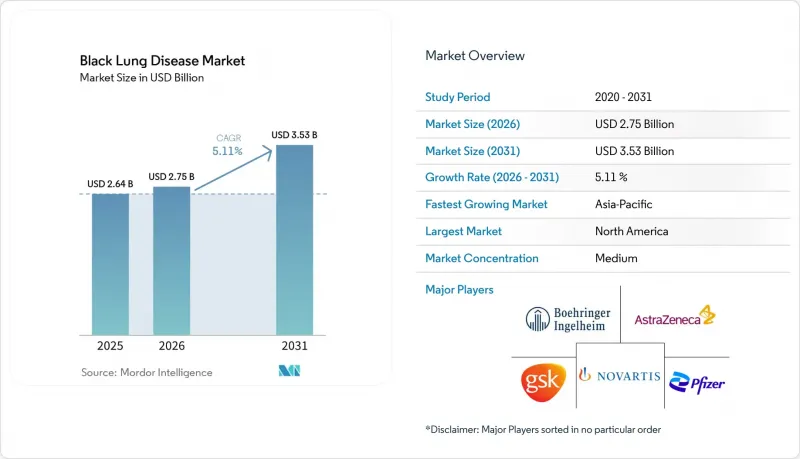
에 따르면 흑폐병 시장은 2025년 26억 4,000만 달러에서 2026년에는 27억 5,000만 달러로 확대하며, 2026-2031년에 CAGR 5.11%로 추이하며, 2031년까지 35억 3,000만 달러에 달할 것으로 예측됩니다.
전 세계 흑폐병 시장의 동향 및 인사이트
광업 분야에서의 석탄 분진 노출 증가
흑폐병 시장은 석탄 채굴량 자체보다는 탄광 분진의 구성 변화에 의해 지속적으로 견인되고 있습니다. 얇은 탄층을 채굴하는 사업자의 경우, 광부들이 더 높은 농도의 흡입성 결정질 실리카에 노출되어 있으며, 이러한 노출 양상은 피해가 심각한 석탄 생산 지역에서 질병의 진행이 가속화되고 진행성 대괴섬유증의 발생률이 높아지는 것과 관련이 있습니다. 2025년 CDC(미국 질병통제예방센터) 보고서에 따르면 사망률은 켄터키주, 웨스트버지니아주, 버지니아주, 펜실베이니아주에 여전히 집중되어 있으며, 지하 채굴 기계 운전자의 상대적 사망률은 다른 채굴 작업자에 비해 현저히 높은 것으로 나타났습니다. 흑폐병 시장에서 이는 진단받은 환자 한 명 한 명마다 더 많은 영상 진단, 더 면밀한 폐 기능 경과 관찰, 그리고 지지요법에 대한 의존도가 높아지는 등 치료의 중증도가 높아지고 있음을 의미합니다.
직업 건강 검진 프로그램의 확대
건강 감시 프로그램이 확대되면 흑폐병 시장은 활기를 띠게 됩니다. 왜냐하면 선별 검사가 바로 잠재적 질환이 의료비 청구 대상이 되고, 진단 및 치료 수요로 이어지는 전환점이기 때문입니다. 확립된 모니터링 체계에 기반한 정기적인 흉부 영상 검사, 폐기능 검사 및 보고 의무는 급성기 입원이나 중증 병태의 발생에만 의존하지 않는 지속적인 수요를 창출합니다. 이는 중요한 점입니다. 스크리닝의 범위를 넓히면 초기 단계의 사례를 더 많이 파악할 수 있고, 이러한 환자들은 일반적으로 시간이 지남에 따라 일련의 경과 관찰 검사, 약물 치료, 상담, 재활과 같은 장기적인 치료 과정에 들어가기 때문입니다. 탄광 폐질환 시장에서 감시 범위의 확대는 관리를 사후 대응형에서 체계적인 모니터링으로 전환시키며, 이를 통해 검사 기관, 산업보건 클리닉, 영상 진단 제공자의 수익 가시성이 향상됩니다. 정기적인 선별 검사 업무에서 ‘탄광 노동자 건강 감시 프로그램(Coal Workers’ Health Surveillance Program)’이 지속적으로 수행하는 역할은 체계적인 감시와 정기적인 진단 서비스 이용 간의 연관성을 더욱 공고히 하고 있습니다.
질환별 치료 선택지의 제한성
탄광 노동자 진폐증 시장은 여전히 탄광 노동자 진폐증에 특화된 승인된 근원적 치료법이나 질환 수정 요법이 존재하지 않기 때문에 제약된 상태가 지속되고 있습니다. 현재의 치료는 기관지확장제, 코르티코스테로이드, 산소 요법 및 항섬유화제에 의존하고 있지만, 이러한 치료법은 이 질환 자체를 위해 개발된 것이 아니라 다른 섬유성 또는 간질성 폐질환을 위해 개발된 것입니다. 그 결과, 보험 환급의 확실성이 약화되고 의약품의 차별화 여지가 좁아지면서, 흑폐병 시장의 대부분은 브랜드 치료제의 확대가 아닌 진단 및 지지요법에 집중된 상태를 유지하고 있습니다. 또한 이로 인해 이 시장의 수익 구조는 풍부한 의약품 파이프라인이 더 강력한 가격 책정과 명확한 치료 프로토콜을 지원하는 인접한 호흡기 계열 카테고리와는 크게 다릅니다. 이러한 격차는 여전히 탄광 노동자 진폐증 또는 진행성 광범위 섬유증에 대한 적응증을 획득한 최초의 기업에게 큰 기회를 남겨두고 있습니다. 특히 진행성 섬유증에 대한 승인 사례가 규제 당국이 인접한 섬유화 경로를 인정하고 있음을 시사하는 현재 상황에서는 더욱 그렇습니다.
부문 분석
2025년, 복잡화된 탄광 노동자 진폐증은 흑폐병 시장 점유율의 44.31%를 차지했습니다. 이는 환자가 진행성 섬유증 단계에 도달하면 치료 강도가 높아지고, 영상 진단 수요가 증가하며, 치료 부담이 확대된다는 점을 반영합니다. 흑폐병 시장에서 진행성 광범위 섬유증은 사례 수 이상으로 전략적 중요성을 지닙니다. 이는 심각한 기능 장애, 높은 사망률, 그리고 환자 1인당 전문적인 호흡기 관리에 대한 수요가 가장 높다는 점과 관련이 있기 때문입니다. 진행기 질환이 매출에서 차지하는 비중은 특정 지역에서 예방 및 조기 검진이 지속적으로 개선되고 있음에도 불구하고 왜 말기 단계의 진료가 여전히 상업적으로 중요한지를 보여줍니다.
단순 탄광 노동자 폐진증은 2031년까지 연평균 성장률(CAGR) 5.54%로 확대될 것으로 예측되며, 흑폐병 시장에서 가장 빠르게 성장하는 질환 범주가 될 전망입니다. 이러한 성장은 선별 검사 대상 범위의 확대와 일상적인 업무 흐름에서 명백한 기능 저하가 확인되기 전에 사례를 식별할 수 있는 AI 기반 영상 진단에 의해 지원되고 있습니다. 실용적인 관점에서 볼 때, 흑폐병 시장에서 단순형 탄광 노동자 진폐증 진단 건수의 증가는 성숙한 감시 시스템 내에서 심각한 임상적 부담이 단순히 증가한 것보다는 오히려 사례 발견 능력이 향상되었음을 시사하는 경우가 많습니다.
지역별 분석
2025년, 북미는 흑폐병 시장의 47.16%를 차지하며 해당 기간 중 최대 지역별 수입원이 되었습니다. 이 지역은 보상 프로그램, 감시 의무, 전문 의료 제공자 네트워크, 그리고 지속적인 치료 수요를 지원하는 재택 호흡기 치료 인프라가 성숙한 형태로 구축되어 있다는 이점이 있습니다. 멕시코에서는 여전히 잠재적 수요가 존재합니다. 이는 코아우일라주에서 이루어지는 비공식 채굴 활동이 공식적인 산업보건 시스템에서는 여전히 충분히 파악되지 않고 있기 때문이며, 접근성과 기록 체계가 개선됨에 따라 진단에 기반한 의료 수요가 향후 증가할 가능성이 있음을 의미합니다.
유럽은 탄광 폐질환 시장에서 보다 성숙한 지역이며, 그 수요는 신규 진단 건수의 급격한 증가보다는 기존 환자의 장기적인 관리에 중점을 두고 있습니다. 서유럽 국가들에서는 지속적인 산업안전 규제의 시행이 효과를 거두고 있으며, 이로 인해 신규 사례 발생률이 감소하고 있으며, 대규모 선별 검사의 확대보다는 모니터링, 증상 관리, 섬유화 관리가 필요한 고령 생존자에 대한 돌봄의 비중이 높아지고 있습니다. 2026년 7월, 영국 의약품규제청(MHRA)은 특발성 폐섬유증 및 진행성 폐섬유증에 대한 네란디미라스트를 승인했습니다. 이는 해당 지역이 첨단 호흡기 치료 도입에 있으며, 수행하는 역할을 지원하는 것이며, 향후 진행성 석탄 관련 섬유증 질환과도 관련이 있을 가능성이 있습니다. 동유럽, 특히 폴란드는 여전히 중간 수준의 성장 기회를 가진 시장이며, 석탄 산업의 활동, 과거의 질병 부담, 그리고 규정 준수에 대한 투자가 탄광 폐질환 시장의 꾸준한 확장을 계속 지원할 것으로 기대됩니다.
아시아태평양은 2031년까지 연평균 성장률(CAGR) 7.27%로 성장할 것으로 예측되며, 탄광 폐질환 시장에서 가장 빠르게 확대되는 지역 블록이 될 것입니다. 이 지역의 성장은 중국, 인도, 한국의 에너지 안보에서 석탄이 계속해서 중요한 역할을 하고 있으며, 일부 광업 시스템에서 선별 검사 및 분진 대책의 미비점이 여전히 존재하고 있음을 반영합니다. 호주는 규제 집행 강화로 조기 발견이 촉진되고, 진단된 사례마다 일관된 치료를 받을 수 있으므로 다른 추세를 보이고 있습니다. 중동 및 아프리카 및 남미는 광업 활동이 산업보건에 대한 투자 속도를 앞지르는 속도로 확대되고 있는 신흥 시장이며, 감시 체계가 확충됨에 따라 잠재적 수요가 더욱 명확하게 드러날 가능성이 있습니다.
기타 혜택:
- 엑셀 형식의 시장 예측(ME) 시트
- 3개월간의 애널리스트 지원
자주 묻는 질문
목차
제1장 서론
- 조사 전제조건과 시장 정의
- 조사 범위
제2장 조사 방법
제3장 개요
제4장 시장 구도
- 시장 개요
- 시장 성장 촉진요인
- 시장 성장 억제요인
- 공급/밸류체인 분석
- 규제 상황
- 기술 전망
- Porter's Five Forces 분석
제5장 시장 규모와 성장 예측
- 질환 유형별
- 컴포넌트별
- 최종사용자별
- 지역별
- 북미
- 미국
- 캐나다
- 멕시코
- 유럽
- 독일
- 영국
- 프랑스
- 이탈리아
- 스페인
- 기타 유럽 국가
- 아시아태평양
- 중국
- 일본
- 인도
- 호주
- 한국
- 기타 아시아태평양 국가
- 중동 및 아프리카
- GCC
- 남아프리카공화국
- 기타 중동 및 아프리카 국가
- 남미
- 브라질
- 아르헨티나
- 기타 남미 국가
- 북미
제6장 경쟁 구도
- 시장 집중도
- 시장 점유율 분석
- 기업 개요
- AbbVie Inc.
- AstraZeneca plc
- Boehringer Ingelheim International GmbH
- Chiesi Farmaceutici S.p.A.
- Cipla Limited
- Dr. Reddy's Laboratories Ltd.
- F. Hoffmann-La Roche Ltd
- GE HealthCare Technologies Inc.
- GlaxoSmithKline plc
- Inogen, Inc.
- Merck & Co., Inc.
- Novartis AG
- Pfizer Inc.
- Philips Healthcare
- ResMed Inc.
- Sanofi S.A.
- Siemens Healthineers AG
- Sun Pharmaceutical Industries Ltd.
- Teva Pharmaceutical Industries Ltd.
- Veracyte, Inc.
제7장 시장 기회와 향후 전망
KSA 26.10.23According to Mordor Intelligence, the black lung disease market is expected to grow from USD 2.64 billion in 2025 to USD 2.75 billion in 2026 and is forecasted to reach USD 3.53 billion by 2031 at 5.11% CAGR over 2026-2031.
Global Black Lung Disease Market Trends and Insights
Rising Coal Dust Exposure in Mining Operations
The black lung disease market continues to be driven by the changing composition of coal mine dust rather than by coal tonnage alone. Operators working thinner seams are exposing miners to higher respirable crystalline silica concentrations, and that exposure pattern is linked with faster disease progression and greater rates of progressive massive fibrosis in hard-hit coal regions. A 2025 CDC report showed that mortality remained heavily concentrated in Kentucky, West Virginia, Virginia, and Pennsylvania, and underground mining machine operators carried a sharply elevated proportionate mortality ratio relative to other extraction workers. For the black lung disease market, that means each diagnosed patient increasingly represents a higher-acuity care profile with more imaging, closer pulmonary follow-up, and greater dependence on supportive treatment pathways.
Expanded Occupational Health Screening Programs
The black lung disease market gains support when health surveillance programs expand because screening is the point where latent illness becomes billable, diagnostic, and treatment demand. Periodic chest imaging, spirometry, and reporting obligations under established surveillance frameworks create recurring demand that does not depend solely on acute hospital visits or severe disease presentation. This matters because a wider screening net identifies more early-stage cases, and those patients typically enter a longer sequence of follow-up testing, medication use, counseling, and rehabilitation over time. In the black lung disease market, broader surveillance also shifts care from reactive management toward structured monitoring, which improves visibility for laboratories, occupational clinics, and imaging providers. The link between institutional surveillance and recurring diagnostic utilization is reinforced by the continuing role of the Coal Workers' Health Surveillance Program in routine screening workflows.
Limited Disease-Specific Therapeutic Options
The black lung disease market remains constrained because there is still no approved curative or disease-modifying therapy labeled specifically for coal workers' pneumoconiosis. Current care depends on bronchodilators, corticosteroids, oxygen support, and antifibrotic agents that were developed for other fibrotic or interstitial lung conditions rather than for this disease itself. That weakens reimbursement certainty, narrows pharmaceutical differentiation, and keeps much of the black lung disease market centered on diagnostics and supportive care instead of branded therapy expansion. It also makes the revenue profile of this market very different from adjacent respiratory categories, where richer drug pipelines support stronger pricing and clearer treatment protocols. The same gap still leaves a meaningful opening for the first company that secures a labeled indication in coal workers' pneumoconiosis or progressive massive fibrosis, especially after progressive fibrosis approvals have shown that regulators will recognize adjacent fibrotic pathways.
Other drivers and restraints analyzed in the detailed report include:
- AI-Enabled Radiology Improves Early Case Detection
- Reimbursement Pressure Favors Earlier Diagnosis and Monitoring
- High Cost of Advanced Care and Long-Term Oxygen Support
For complete list of drivers and restraints, kindly check the Table Of Contents.
Segment Analysis
Complicated coal workers' pneumoconiosis captured 44.31% of the black lung disease market share in 2025, which reflects the higher care intensity, heavier imaging needs, and broader treatment burden seen once patients reach advanced fibrotic disease. Within the black lung disease market, progressive massive fibrosis carries strategic importance beyond its case volume because it is associated with severe functional loss, higher mortality, and the greatest per-patient demand for specialist respiratory management. The revenue weight of advanced disease also shows why late-stage presentation still matters commercially, even as prevention and earlier surveillance continue to improve in selected regions.
Simple coal workers' pneumoconiosis is projected to expand at 5.54% CAGR through 2031, making it the fastest-growing disease category in the black lung disease market. That growth is being supported by broader screening coverage and by AI-assisted image review that can surface cases before clear functional deterioration is visible in routine workflows. In practical terms, rising simple CWP diagnoses in the black lung disease market often signal better case discovery rather than a straightforward increase in severe clinical burden within mature surveillance systems.
Complete Report Scope:
- By Disease Type
- Simple Coal Workers' Pneumoconiosis
- Complicated Coal Workers' Pneumoconiosis
- Progressive Massive Fibrosis
- By Component
- Diagnostic Method
- Chest X-Ray
- CT Scan
- Pulmonary Function Test
- Other Diagnostic Methods
- Treatment Type
- Medication
- Oxygen Therapy
- Pulmonary Rehabilitation
- Lung Transplant
- Stem Cell Therapy
- Other Treatment Types
- Diagnostic Method
- By End-User
- Hospitals
- Specialty Clinics
- Diagnostic Laboratories
- Other End-Users
- By Geography
- North America
- United States
- Canada
- Mexico
- Europe
- Germany
- United Kingdom
- France
- Italy
- Spain
- Rest of Europe
- Asia-Pacific
- China
- Japan
- India
- Australia
- South Korea
- Rest of Asia-Pacific
- Middle East and Africa
- GCC
- South Africa
- Rest of Middle East and Africa
- South America
- Brazil
- Argentina
- Rest of South America
- North America
Geography Analysis
North America represented 47.16% of the black lung disease market in 2025, which made it the largest regional revenue center in the current period. The region benefits from a mature mix of compensation programs, surveillance obligations, specialist provider networks, and home respiratory care infrastructure that supports recurring treatment demand. Mexico still presents latent demand because informal mining activity in Coahuila remains less visible in formal occupational health systems, which means diagnosed care demand can rise later as access and documentation improve.
Europe is a more mature part of the black lung disease market, and demand there is weighted more toward long-term management of existing patients than toward rapid growth in new diagnoses. Western European countries benefit from sustained occupational safety enforcement, which has reduced fresh case intensity and shifted the care mix toward older survivors who need monitoring, symptom control, and fibrosis management rather than large screening expansion. In July 2026, the UK MHRA approved nerandomilast for idiopathic pulmonary fibrosis and progressive pulmonary fibrosis, which supports the region's role in premium respiratory therapy adoption and may have relevance for advanced coal-related fibrotic disease over time. Eastern Europe, especially Poland, remains a mid-tier opportunity where coal activity, legacy disease burden, and compliance investment can still support measured expansion within the black lung disease market.
Asia-Pacific is forecasted to grow at 7.27% CAGR through 2031, which makes it the fastest-expanding regional block in the black lung disease market. The region's growth reflects the continuing role of coal in energy security across China, India, and South Korea, and the persistence of screening and dust-control gaps in several mining systems. Australia shows a different profile because stronger regulatory enforcement supports earlier detection and more consistent treatment uptake per diagnosed case. Middle East and Africa and South America remain emerging opportunities where mining activity is growing faster than occupational health investment, leaving meaningful latent demand that could surface more clearly as surveillance depth improves.
- Abbvie
- AstraZeneca
- Boehringer Ingelheim
- Chiesi Farmaceutici
- Cipla
- Dr. Reddy's Laboratories
- Roche
- GE HealthCare Technologies Inc.
- GlaxoSmithKline
- Inogen
- Merck
- Novartis
- Pfizer
- Koninklijke Philips
- Resmed
- Sanofi
- Siemens Healthineers
- Sun Pharmaceuticals Industries
- Teva Pharmaceutical Industries
- Veracyte, Inc.
Additional Benefits:
- The market estimate (ME) sheet in Excel format
- 3 months of analyst support
TABLE OF CONTENTS
1 Introduction
- 1.1 Study Assumptions and Market Definition
- 1.2 Scope of the Study
2 Research Methodology
3 Executive Summary
4 Market Landscape
- 4.1 Market Overview
- 4.2 Market Drivers
- 4.2.1 Rising Coal Dust Exposure in Mining Operations
- 4.2.2 Expanded Occupational Health Screening Programs
- 4.2.3 AI-Enabled Radiology Improves Early Case Detection
- 4.2.4 Reimbursement Pressure Favors Earlier Diagnosis and Monitoring
- 4.2.5 Long-Term Survivor Management Increases Chronic Care Demand
- 4.2.6 Underdiagnosis in Informal Mining Networks Drives Latent Demand
- 4.3 Market Restraints
- 4.3.1 Limited Disease-Specific Therapeutic Options
- 4.3.2 High Cost of Advanced Care and Long-Term Oxygen Support
- 4.3.3 Uneven Access to Occupational Lung Screening in Emerging Markets
- 4.3.4 Medico-Legal Underreporting Slows Case Recognition and Treatment Uptake
- 4.4 Supply/Value Chain Analysis
- 4.5 Regulatory Landscape
- 4.6 Technological Outlook
- 4.7 Porter's Five Forces Analysis
- 4.7.1 Threat of New Entrants
- 4.7.2 Bargaining Power of Suppliers
- 4.7.3 Bargaining Power of Buyers
- 4.7.4 Threat of Substitutes
- 4.7.5 Competitive Rivalry
5 Market Size & Growth Forecasts (Value, USD)
- 5.1 By Disease Type
- 5.1.1 Simple Coal Workers' Pneumoconiosis
- 5.1.2 Complicated Coal Workers' Pneumoconiosis
- 5.1.3 Progressive Massive Fibrosis
- 5.2 By Component
- 5.2.1 Diagnostic Method
- 5.2.1.1 Chest X-Ray
- 5.2.1.2 CT Scan
- 5.2.1.3 Pulmonary Function Test
- 5.2.1.4 Other Diagnostic Methods
- 5.2.2 Treatment Type
- 5.2.2.1 Medication
- 5.2.2.2 Oxygen Therapy
- 5.2.2.3 Pulmonary Rehabilitation
- 5.2.2.4 Lung Transplant
- 5.2.2.5 Stem Cell Therapy
- 5.2.2.6 Other Treatment Types
- 5.2.1 Diagnostic Method
- 5.3 By End-User
- 5.3.1 Hospitals
- 5.3.2 Specialty Clinics
- 5.3.3 Diagnostic Laboratories
- 5.3.4 Other End-Users
- 5.4 By Geography
- 5.4.1 North America
- 5.4.1.1 United States
- 5.4.1.2 Canada
- 5.4.1.3 Mexico
- 5.4.2 Europe
- 5.4.2.1 Germany
- 5.4.2.2 United Kingdom
- 5.4.2.3 France
- 5.4.2.4 Italy
- 5.4.2.5 Spain
- 5.4.2.6 Rest of Europe
- 5.4.3 Asia-Pacific
- 5.4.3.1 China
- 5.4.3.2 Japan
- 5.4.3.3 India
- 5.4.3.4 Australia
- 5.4.3.5 South Korea
- 5.4.3.6 Rest of Asia-Pacific
- 5.4.4 Middle East and Africa
- 5.4.4.1 GCC
- 5.4.4.2 South Africa
- 5.4.4.3 Rest of Middle East and Africa
- 5.4.5 South America
- 5.4.5.1 Brazil
- 5.4.5.2 Argentina
- 5.4.5.3 Rest of South America
- 5.4.1 North America
6 Competitive Landscape
- 6.1 Market Concentration
- 6.2 Market Share Analysis
- 6.3 Company Profiles (includes Global level Overview, Market level overview, Core Segments, Financials as available, Strategic Information, Market Rank/Share for key companies, Products & Services, Recent Developments)
- 6.3.1 AbbVie Inc.
- 6.3.2 AstraZeneca plc
- 6.3.3 Boehringer Ingelheim International GmbH
- 6.3.4 Chiesi Farmaceutici S.p.A.
- 6.3.5 Cipla Limited
- 6.3.6 Dr. Reddy's Laboratories Ltd.
- 6.3.7 F. Hoffmann-La Roche Ltd
- 6.3.8 GE HealthCare Technologies Inc.
- 6.3.9 GlaxoSmithKline plc
- 6.3.10 Inogen, Inc.
- 6.3.11 Merck & Co., Inc.
- 6.3.12 Novartis AG
- 6.3.13 Pfizer Inc.
- 6.3.14 Philips Healthcare
- 6.3.15 ResMed Inc.
- 6.3.16 Sanofi S.A.
- 6.3.17 Siemens Healthineers AG
- 6.3.18 Sun Pharmaceutical Industries Ltd.
- 6.3.19 Teva Pharmaceutical Industries Ltd.
- 6.3.20 Veracyte, Inc.
7 Market Opportunities & Future Outlook
- 7.1 White-space & Unmet-need Assessment


