

|
시장보고서
상품코드
2154458
CA 125 검사 : 시장 점유율 분석, 업계 동향과 통계, 성장 예측(2026-2031년)CA 125 Test - Market Share Analysis, Industry Trends & Statistics, Growth Forecasts (2026 - 2031) |
||||||
 Mordor Intelligence
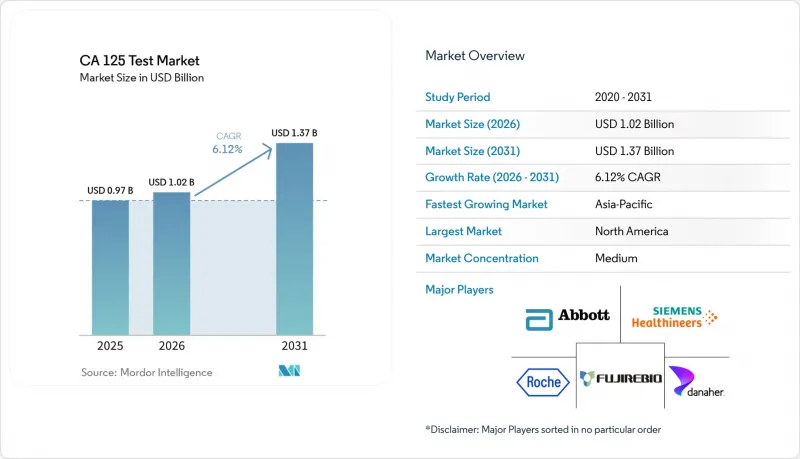
에 따르면 CA 125 검사 시장은 2025년에 9억 7,000만 달러, 2026년에 10억 2,000만 달러에 달하며, 2031년까지 13억 7,000만 달러에 달할 것으로 예측되고 있으며, 2026-2031년에 CAGR 6.12%로 성장할 것으로 전망되고 있습니다.
전 세계 CA 125 검사 시장의 동향 및 인사이트
난소암 감시 수요 증가
2024년 전 세계에서 기록된 33만 731건의 난소암 사례는 지속적인 임상 모니터링을 위한 중요한 기반이 되고 있습니다. 2026년 예측에 따르면 2050년까지 전 세계 연간 사례 수는 47만 7,000건에 달할 가능성이 있습니다. 미국에서는 메디케어 보험 적용 범위 내에서 특정 난소암 및 원발성 복막암 적응증에 대해 CA 125 검사가 승인되어 있습니다. 이 보험 적용 체계는 치료 후 반복 검사를 지원하며, 이로 인해 수요가 단일 진료 방문에 의존하기 어려워지고 있습니다. 따라서 CA 125 검사 시장은 확립된 치료 경로뿐만 아니라 새로운 진단 수요에 의해서도 지원되고 있습니다. 환자 수가 증가함에 따라 고소득 국가 및 신흥 국가의 의료 시스템에서 이러한 추적 관찰 경로에 포함되는 환자 수가 증가할 가능성이 있습니다.
핵심 검사실의 자동 면역측정 메뉴 확대
자동화 플랫폼을 통해 검사실은 단일 혈액 검체를 이용하여 보다 광범위한 종양 마커 검사 메뉴의 일환으로 CA 125 검사를 실시할 수 있게 됩니다. 지멘스 헬스인어즈는 자사의 Atellica 플랫폼을 통해 CA 125 검사를 제공하고 있으며, 로슈는 검사 진단 포트폴리오의 일환으로 Elecsys CA 125 II 어세이를 제공하고 있습니다. 이 모델을 통해 분석 장비가 이미 도입된 경우, 검사 항목을 추가할 때의 운영상의 부담이 줄어듭니다. 또한 임상의가 보다 광범위한 검사 평가가 필요한 경우, CA 125를 다른 종양 표지자와 함께 의뢰하기가 쉬워집니다. 일본 후생노동성은 자동 검사 도입 환경을 조성하는 보험 환급 및 임상 검사에 관한 정책을 수립하고 있습니다. 검사 기관이 소규모 시스템에서 확립된 종양 마커 검사 메뉴를 갖춘 고처리량 분석기로 교체함에 따라 CA 125 검사 시장은 지지를 받고 있습니다.
양성 부인과 질환에서 검사의 특이도 한계
CA 125 수치는 자궁내막증, 자궁근종, 골반 염증성 질환 등의 양성 질환에서도 상승할 수 있습니다. 이로 인해 특히 폐경 전 여성의 경우 이 검사의 진단 특이도가 제한됩니다. 2025년에 실시된 외부 검증 연구에서는 영국 1차 진료 기관에서 검사를 받은 34만 2,278명의 여성을 대상으로 CA 125 및 연령 기반 모델이 검토되었습니다. 연령 조정된 임계값은 35 U/mL라는 고정된 컷오프 값에 비해 특이도를 향상시켰으나, 50세 미만 여성의 경우 여전히 성능이 낮은 것으로 나타났습니다. 위양성 결과로 인해 추가 영상 검사, 전문의 의뢰, 경우에 따라 복강경 검사가 시행될 가능성이 있습니다. 이 때문에 저위험군 환자에 대한 CA 125 단독 검사에 대한 임상의의 신뢰도가 제한될 수 있으며, 패널 기반 평가로의 전환이 권장되고 있습니다.
부문 분석
2025년 CA 125 검사 시장 규모 중 분석 장비 및 기기가 52.42%를 차지했습니다. 이 비율은 검사실에서 사용되는 고처리량형 및 반자동형 면역측정 장치의 비용을 반영합니다. 도입된 분석 장비는 호환 가능한 시약 및 소모품에 대한 지속적인 수요를 창출합니다. 이러한 관계로 인해 확고한 입지를 갖춘 플랫폼 공급업체는 기존 검사실 인프라를 통해 지속적인 수익을 창출할 수 있습니다.
시약 및 키트는 2031년까지 연평균 성장률(CAGR) 6.47%로 성장할 것으로 예상되며, 이는 제품 카테고리 중 가장 높은 성장률입니다. 이러한 성장 전망은 이미 도입된 시스템에서 CA 125 검사 메뉴의 확충과 다중 마커 검사 경로 내에서의 검사 빈도 증가를 반영한 것입니다. 또한 유럽의 체외진단용 의료기기 관련 규제로 인해 해당 지역에서 관련 제품을 등록하려는 공급업체에 대한 문서화 요건도 강화되고 있습니다.
2025년 시점에 자동 면역측정 시스템은 CA 125 검사 시장 점유율의 43.53%를 차지했습니다. 이러한 시스템은 다수의 분석 대상을 처리하고 표준화된 워크플로우가 필요한 검사실에서 사용되고 있습니다. CA 125는 동일한 플랫폼에서 다른 종양 표지자와 함께 측정할 수 있으므로 일상적인 검사실 사용에 적합합니다.
반자동 면역측정 시스템은 2031년까지 연평균 성장률(CAGR) 7.23%로 성장할 것으로 예측됩니다. 이러한 성장은 지역 병원, 진단 센터 및 분산형 검사 시설에서 비용 효율적이고 신속한 CA 125 검사에 대한 수요가 증가함에 따라 주도되고 있습니다. 이러한 시스템은 자동화와 합리적인 가격 사이에서 실용적인 균형을 제공하여, 난소암의 정기적인 모니터링 및 추적 검사에서 매력적인 선택지가 되고 있습니다. 신흥 의료 시장에서 특히 성장이 두드러지지만, 대규모 참조 실험실에서는 처리 능력과 워크플로우 효율성이 높기 때문에 완전 자동화 플랫폼이 여전히 선호되는 선택지로 남아 있습니다.
지역별 분석
2025년, 북미는 CA 125 검사 시장의 47.33%를 차지했습니다. 미국에서는 메디케어의 적용 범위와 난소암 관련 다중 마커 검사에 관한 지역 정책이 검사 수행을 위한 체계적인 기반을 형성하고 있습니다. 이러한 체계는 치료 후 재검사를 지원하고, 검사 기관이 일관된 검사량을 계획하는 데 도움이 되고 있습니다. 캐나다에서는 주 정부 차원의 종양학 프로그램이 시장에 기여하고 있으며, 멕시코의 민간 병원은 면역측정 플랫폼에 대한 수요를 끌어올리고 있습니다.
2025년, 유럽은 2위 지역 시장이 되었으며, 독일과 영국이 가장 큰 국내 점유율을 차지했습니다. 프랑스, 이탈리아, 스페인은 공립 병원의 조달 및 중앙 검사 기관과의 계약을 통해 시장에 기여하고 있습니다. 유럽연합(EU)의 체외진단용 의료기기 규제로 인해 관련 면역측정 플랫폼에 대한 기술 문서 및 적합성 평가 요건이 강화되고 있습니다. 이에 따라 규정을 준수하는 제품 포트폴리오를 유지하고, 규제 변경을 통해 고객을 지원할 수 있는 공급업체가 유리한 입장에 서게 됩니다. 아시아태평양은 중국의 암 환자 수, 한국의 자동화 투자, 인도의 진단 네트워크, 그리고 일본의 보험 급여 환경에 힘입어 2031년까지 연평균 성장률(CAGR) 8.24%로 성장할 것으로 전망됩니다.
중동 및 아프리카와 남미는 CA 125 검사 분야에서 여전히 초기 단계에 있는 지역입니다. 이 지역들의 성장은 검사실 인프라, 조달 능력, 그리고 자동화 면역 분석 시스템에 대한 접근성에 달려 있습니다. 사우디아라비아와 아랍에미리트의 민간 병원은 암 검사 역량을 확대하고 있는 반면, 남아프리카공화국에서는 주요 플랫폼을 활용한 대학 병원 네트워크가 구축되어 있습니다. 남미에서는 브라질이 민간 진단 검사 기관 및 공공 암 프로그램을 통해 매출을 주도하고 있는 반면, 정량형 래터럴 플로우 키트는 완전한 자동화 시스템이 갖춰지지 않은 검사 기관에 있으며, 이용하기 쉬운 선택지가 되고 있습니다.
기타 혜택:
- 엑셀 형식의 시장 예측(ME) 시트
- 3개월간의 애널리스트 지원
자주 묻는 질문
목차
제1장 서론
- 조사 전제조건과 시장 정의
- 조사 범위
제2장 조사 방법
제3장 개요
제4장 시장 구도
- 시장 개요
- 시장 성장 촉진요인
- 시장 성장 억제요인
- 공급/밸류체인 분석
- 규제 상황
- 기술 전망
- Porter's Five Forces 분석
제5장 시장 규모와 성장 예측
- 제품 유형별
- 기술별
- 적응증별
- 최종사용자별
- 지역별
- 북미
- 미국
- 캐나다
- 멕시코
- 유럽
- 독일
- 영국
- 프랑스
- 이탈리아
- 스페인
- 기타 유럽 국가
- 아시아태평양
- 중국
- 일본
- 인도
- 호주
- 한국
- 기타 아시아태평양 국가
- 중동 및 아프리카
- GCC
- 남아프리카공화국
- 기타 중동 및 아프리카 국가
- 남미
- 브라질
- 아르헨티나
- 기타 남미 국가
- 북미
제6장 경쟁 구도
- 시장 집중도
- 시장 점유율 분석
- 기업 개요
- Abbott Laboratories
- Becton, Dickinson and Company
- bioMerieux SA
- Bio-Rad Laboratories, Inc.
- Danaher Corporation
- DiaSorin S.p.A.
- F. Hoffmann-La Roche Ltd.
- Fujirebio Holdings, Inc.
- Hologic, Inc.
- Ortho Clinical Diagnostics Holdings plc
- QIAGEN N.V.
- Quest Diagnostics Incorporated
- Randox Laboratories Ltd.
- Sekisui Diagnostics LLC
- Shenzhen New Industries Biomedical Engineering Co., Ltd.
- Siemens Healthineers AG
- Sysmex Corporation
- Thermo Fisher Scientific Inc.
- Tosoh Corporation
- Werfen S.A.
제7장 시장 기회와 향후 전망
KSA 26.10.23According to Mordor Intelligence, the CA 125 testing market is projected to be USD 0.97 billion in 2025, USD 1.02 billion in 2026, and reach USD 1.37 billion by 2031, growing at a CAGR of 6.12% from 2026 to 2031.
Global CA 125 Test Market Trends and Insights
Rising Ovarian Cancer Surveillance Demand
The 330,731 ovarian cancer cases recorded globally in 2024 provide a large base for ongoing clinical monitoring. A 2026 projection estimated that annual global cases could reach 477,000 by 2050. In the United States, Medicare coverage recognizes CA 125 for specified ovarian and primary peritoneal carcinoma indications. The coverage framework supports repeat testing after therapy, which makes demand less dependent on a single clinical visit. The CA 125 testing market, therefore, relies on established care pathways as well as new diagnostic demand. Rising patient numbers could increase the number of patients who enter these follow-up pathways across high-income and emerging health systems.
Expansion of Automated Immunoassay Menus in Core Laboratories
Automated platforms allow laboratories to run CA 125 within wider tumor-marker menus from a single blood sample. Siemens Healthineers offers CA 125 testing on its Atellica platform, and Roche offers the Elecsys CA 125 II assay within its laboratory diagnostics portfolio.This model reduces the operational burden of adding a test once an analyzer has already been installed. It can also make CA 125 easier to order with other tumor markers when clinicians require a broader laboratory assessment. Japan's health ministry sets reimbursement and laboratory diagnostics policies that shape the adoption environment for automated testing. The CA 125 testing market is supported when laboratories replace smaller systems with high-throughput analyzers that have established tumor-marker menus.
Limited Test Specificity in Benign Gynecologic Conditions
CA 125 levels can be elevated in benign conditions, including endometriosis, fibroids, and pelvic inflammatory disease. This limits the test's diagnostic specificity, particularly for premenopausal women. A 2025 external validation study examined CA 125 and age-based models in 342,278 women tested in English primary care. Age-adjusted thresholds improved specificity compared with a fixed 35 U/mL cutoff, but performance remained lower in women under 50. False-positive results can lead to additional imaging, specialist referrals, and sometimes laparoscopy. This may limit clinician confidence in standalone CA 125 testing for lower-risk patients and supports the move toward panel-based assessment.
Other drivers and restraints analyzed in the detailed report include:
- Bundling of CA 125 With HE4 and ROMA Workflows
- AI-Enabled Reflex Testing and Result Triage
- Low Sensitivity for Early-Stage Ovarian Cancer Detection
For complete list of drivers and restraints, kindly check the Table Of Contents.
Segment Analysis
Analyzers and instruments accounted for 52.42% of the CA 125 testing market size in 2025. This position reflects the cost of high-throughput and semi-automated immunoassay equipment used by laboratories. An installed analyzer can create ongoing demand for compatible reagents and consumables. That relationship gives established platform suppliers recurring revenue from their existing laboratory base.
Reagents and kits are forecasted to grow at a 6.47% CAGR through 2031, the fastest rate among product categories. The growth outlook reflects the expansion of CA 125 menus on installed systems and more frequent testing within multi-marker pathways. European in vitro diagnostic rules also increase documentation demands for suppliers that seek to register relevant products in the region.
Automated immunoassay systems held 43.53% of the CA 125 testing market share in 2025. These systems are used in laboratories that process many analytes and require standardized workflows. CA 125 can be run with other tumor markers on the same platform, which supports routine laboratory use.
Semi-automated immunoassay systems are forecasted to grow at a CAGR of 7.23% through 2031. Their expansion is driven by the increasing demand for cost-effective and rapid CA 125 testing in community hospitals, diagnostic centers, and decentralized laboratory settings. These systems offer a practical balance between automation and affordability, making them attractive for routine ovarian cancer monitoring and follow-up testing. Growth is particularly strong in emerging healthcare markets, although fully automated platforms remain the preferred choice in large reference laboratories due to their higher throughput and workflow efficiency.
Complete Report Scope:
- By Product Type
- Reagents and Kits
- Analyzers and Instruments
- By Technology
- Automated Immunoassay Systems
- Semi-Automated Immunoassay Systems
- By Indication
- Cancer
- Uterine Fibroids
- Endometriosis
- Liver Disease
- Other Indications
- By End-User
- Hospitals
- Clinical Laboratories
- Diagnostic Centers
- Academic and Research Organizations
- By Geography
- North America
- United States
- Canada
- Mexico
- Europe
- Germany
- United Kingdom
- France
- Italy
- Spain
- Rest of Europe
- Asia-Pacific
- China
- Japan
- India
- Australia
- South Korea
- Rest of Asia-Pacific
- Middle East and Africa
- GCC
- South Africa
- Rest of Middle East and Africa
- South America
- Brazil
- Argentina
- Rest of South America
- North America
Geography Analysis
North America held 47.33% of the CA 125 testing market share in 2025. Medicare coverage and local policy for ovarian cancer-related multimarker tests create a structured basis for testing in the United States. This framework supports repeat testing after therapy and helps laboratories plan for consistent volumes. Canada contributes through provincial oncology programs, while private hospitals in Mexico add demand for immunoassay platforms.
Europe was the second-largest regional market in 2025, with Germany and the United Kingdom holding the largest national shares. France, Italy, and Spain contribute through public hospital procurement and centralized laboratory contracts. The European Union's in vitro diagnostic regulation raises technical documentation and conformity assessment requirements for relevant immunoassay platforms. This favors suppliers that can maintain compliant portfolios and support customers through regulatory changes. Asia-Pacific is forecasted to grow at an 8.24% CAGR through 2031, supported by China's oncology patient base, South Korean automation investment, India's diagnostic networks, and Japan's reimbursement environment.
The Middle East, Africa, and South America remain earlier-stage regions for CA 125 testing. Their growth depends on laboratory infrastructure, procurement capacity, and access to automated immunoassay systems. Private hospitals in Saudi Arabia and the United Arab Emirates are expanding oncology-testing capabilities, while South Africa has established academic hospital networks using major platforms. Brazil leads South American revenue through its private diagnostic laboratories and public oncology programs, while quantitative lateral-flow kits offer an accessible option for laboratories without full automation.
- Abbott Laboratories
- Beckton Dickinson
- bioMerieux
- Bio-Rad Laboratories
- Danaher
- DiaSorin
- Roche
- Fujirebio Holdings, Inc.
- Hologic
- Ortho Clinical Diagnostics Holdings plc
- QIAGEN
- Quest Diagnostics
- Randox Laboratories
- Sekisui Diagnostics
- Shenzhen New Industries Biomedical Engineering
- Siemens Healthineers
- Sysmex
- Thermo Fisher Scientific
- Tosoh
- Werfen S.A.
Additional Benefits:
- The market estimate (ME) sheet in Excel format
- 3 months of analyst support
TABLE OF CONTENTS
1 Introduction
- 1.1 Study Assumptions and Market Definition
- 1.2 Scope of the Study
2 Research Methodology
3 Executive Summary
4 Market Landscape
- 4.1 Market Overview
- 4.2 Market Drivers
- 4.2.1 Rising Ovarian Cancer Surveillance Demand
- 4.2.2 Expansion of Automated Immunoassay Menus in Core Labs
- 4.2.3 Bundling of CA 125 with HE4 and ROMA Workflows
- 4.2.4 Reimbursement Pressure Favoring Earlier Risk Stratification
- 4.2.5 Self-Collection and Decentralized Sample Logistics
- 4.2.6 AI-Enabled Reflex Testing and Result Triage
- 4.3 Market Restraints
- 4.3.1 Limited Test Specificity in Benign Gynecologic Conditions
- 4.3.2 Clinical Preference for Multi-Marker Panels Over CA 125 Alone
- 4.3.3 Budget Constraints in Low-Resource Laboratory Networks
- 4.3.4 Low Sensitivity for Early-Stage Ovarian Cancer Detection
- 4.4 Supply/Value Chain Analysis
- 4.5 Regulatory Landscape
- 4.6 Technological Outlook
- 4.7 Porter's Five Forces Analysis
- 4.7.1 Threat of New Entrants
- 4.7.2 Bargaining Power of Suppliers
- 4.7.3 Bargaining Power of Buyers
- 4.7.4 Threat of Substitutes
- 4.7.5 Competitive Rivalry
5 Market Size & Growth Forecasts (Value, USD)
- 5.1 By Product Type
- 5.1.1 Reagents and Kits
- 5.1.2 Analyzers and Instruments
- 5.2 By Technology
- 5.2.1 Automated Immunoassay Systems
- 5.2.2 Semi-Automated Immunoassay Systems
- 5.3 By Indication
- 5.3.1 Cancer
- 5.3.2 Uterine Fibroids
- 5.3.3 Endometriosis
- 5.3.4 Liver Disease
- 5.3.5 Other Indications
- 5.4 By End-User
- 5.4.1 Hospitals
- 5.4.2 Clinical Laboratories
- 5.4.3 Diagnostic Centers
- 5.4.4 Academic and Research Organizations
- 5.5 By Geography
- 5.5.1 North America
- 5.5.1.1 United States
- 5.5.1.2 Canada
- 5.5.1.3 Mexico
- 5.5.2 Europe
- 5.5.2.1 Germany
- 5.5.2.2 United Kingdom
- 5.5.2.3 France
- 5.5.2.4 Italy
- 5.5.2.5 Spain
- 5.5.2.6 Rest of Europe
- 5.5.3 Asia-Pacific
- 5.5.3.1 China
- 5.5.3.2 Japan
- 5.5.3.3 India
- 5.5.3.4 Australia
- 5.5.3.5 South Korea
- 5.5.3.6 Rest of Asia-Pacific
- 5.5.4 Middle East and Africa
- 5.5.4.1 GCC
- 5.5.4.2 South Africa
- 5.5.4.3 Rest of Middle East and Africa
- 5.5.5 South America
- 5.5.5.1 Brazil
- 5.5.5.2 Argentina
- 5.5.5.3 Rest of South America
- 5.5.1 North America
6 Competitive Landscape
- 6.1 Market Concentration
- 6.2 Market Share Analysis
- 6.3 Company Profiles (includes Global level Overview, Market level overview, Core Segments, Financials as available, Strategic Information, Market Rank/Share for key companies, Products & Services, Recent Developments)
- 6.3.1 Abbott Laboratories
- 6.3.2 Becton, Dickinson and Company
- 6.3.3 bioMerieux SA
- 6.3.4 Bio-Rad Laboratories, Inc.
- 6.3.5 Danaher Corporation
- 6.3.6 DiaSorin S.p.A.
- 6.3.7 F. Hoffmann-La Roche Ltd.
- 6.3.8 Fujirebio Holdings, Inc.
- 6.3.9 Hologic, Inc.
- 6.3.10 Ortho Clinical Diagnostics Holdings plc
- 6.3.11 QIAGEN N.V.
- 6.3.12 Quest Diagnostics Incorporated
- 6.3.13 Randox Laboratories Ltd.
- 6.3.14 Sekisui Diagnostics LLC
- 6.3.15 Shenzhen New Industries Biomedical Engineering Co., Ltd.
- 6.3.16 Siemens Healthineers AG
- 6.3.17 Sysmex Corporation
- 6.3.18 Thermo Fisher Scientific Inc.
- 6.3.19 Tosoh Corporation
- 6.3.20 Werfen S.A.
7 Market Opportunities & Future Outlook
- 7.1 White-space & Unmet-need Assessment


