

|
시장보고서
상품코드
2154463
BFSI용 에이전틱 AI 거버넌스 플랫폼 : 시장 점유율 분석, 업계 동향과 통계, 성장 예측(2026-2031년)Agentic AI Governance Platforms In BFSI - Market Share Analysis, Industry Trends & Statistics, Growth Forecasts (2026 - 2031) |
||||||
 Mordor Intelligence
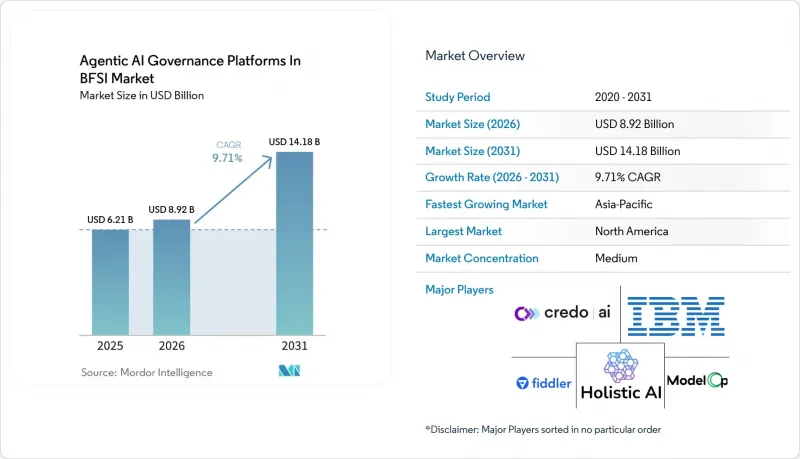
에 따르면 BFSI용 에이전트형 AI 거버넌스 플랫폼 시장 규모는 2025년 62억 1,000만 달러에서 2026년에는 89억 2,000만 달러로 확대하며, 2026-2031년에 CAGR 9.71%로 추이하며, 2031년에는 141억 8,000만 달러에 달할 것으로 예측됩니다.
세계의 BFSI용 에이전트형 AI 거버넌스 플랫폼 시장 동향 및 인사이트
자율형 워크플로우 혁신에 대한 기업의 수요
금융기관들은 실제 업무 워크플로우에 에이전트형 AI를 도입하고 있으며, 각 단계에서의 통제 필요성이 높아지고 있습니다. 바클레이즈는 문서 검토, 제재 대상 스크리닝, 승인 경로 등 각 공정에 걸친 에이전트형 오케스트레이션을 통해 고객 실사를 재구축하는 동시에, 각 단계별 감사 추적을 유지하고 있습니다. 스탠다드차타드는 에이전트형 AI가 기존 아키텍처 내에서 안전하게 도입된다는 전제 하에, 금융 기관이 오늘부터 바로 도입할 수 있는 운영 모델이라고 설명하고 있습니다. 따라서 BFSI 시장의 에이전트형 AI 거버넌스 플랫폼은 기존의 모델 검증 범위를 넘어, 에이전트의 식별 정보, 권한, 의사결정, 기록을 포괄하는 수명주기관리로 전환되고 있습니다. 다중 에이전트 시스템은 오케스트레이션, 공유 메모리, 결정론적 및 비결정론적 워크플로우를 결합하고 있으므로 사후 시정 조치보다는 초기 단계에서 제어 설계를 수행하는 것이 더 현실적입니다. 이러한 요구 사항으로 인해 단순한 규정 준수 저장소로서 기능할 뿐만 아니라, 업무 시스템과 통합할 수 있는 플랫폼에 대한 수요가 높아지고 있습니다.
AI 거버넌스 및 소버린 AI 대응 준비에 대한 높아지는 수요
규제 요건에 따라 거버넌스는 단순한 베스트 프랙티스의 실천을 넘어 조달상의 필수 요건이 되었습니다. EU AI법은 2026년 8월 2일부터 투명성 의무를 도입하여, 고객용 AI 시스템을 도입하는 기관에 직접적인 의무를 부과하고 있습니다. 유럽은행감독청(EBA)은 2026년 1월 내부 거버넌스 지침을 갱신하여, 이사회에 대한 설명 책임, 검증, 그리고 신용 결정에 대한 설명 가능성을 포괄하는 AI 리스크 관리 요건을 추가했습니다. 영국 금융 당국은 2026년 5월, 각 기업이 AI로 인한 위협의 진전 속도에 맞춰 AI 관련 사이버 취약점에 대한 대책을 계획하고 실행해야 한다고 밝혔습니다. 또한 ‘소버린 AI’의 우선 과제는 금융 기관이 기밀 데이터와 관리 조치를 정의된 보안 경계 내에 유지하는 하이브리드형 및 내부 배포를 장려하고 있습니다. BFSI 시장의 에이전트형 AI 거버넌스 플랫폼은 단일 시스템에서 규제 요건과 데이터 상주 요건에 걸친 관리 조치를 매핑하고, 증거 작성 작업의 중복을 유발하지 않으면서 운영될 수 있을 때 그 장점을 발휘합니다.
자율성이 높은 워크플로우에서의 투자 대비 효과(ROI) 불확실성
거버넌스 플랫폼의 예산은 그 이점의 상당 부분이 즉각적인 수익이 아닌, 위험 감소나 감사 업무의 신속화라는 형태로 나타나기 때문에 정당화하기 어려울 수 있습니다. NTT DATA의 보고서에 따르면 에이전트형 AI 인프라 업그레이드에는 당초 AI 투자 예산의 3-5배에 달하는 비용이 필요할 수 있으며, 복잡한 도입은 실질적인 비효율 비용을 증가시킬 우려가 있습니다. EY는 도입 규모가 확대됨에 따라 거버넌스, 조직 변혁, 그리고 규제의 영향이 더욱 두드러지게 나타나므로 총소유비용(TCO)을 포괄적으로 파악할 필요가 있다고 지적하고 있습니다. BFSI 시장의 에이전트형 AI 거버넌스 플랫폼은 통제를 통한 이점이 명확한 비즈니스 성과로 이어지지 않을 경우, 구매 주기가 장기화될 가능성이 있습니다. 2026년 조사에 따르면 은행 업계 경영진 중 자사의 AI 통제가 독립적인 심사를 통과할 것이라고 확신하는 사람은 불과 18%에 불과했습니다. 감사 시간, 승인 주기, 시정 조치에 드는 노력을 절감할 수 있음을 문서화할 수 있는 공급업체는 구매자가 비즈니스 사례를 평가하기 쉽게 할 수 있습니다.
부문 분석
2025년, BFSI 시장의 Agentic AI 거버넌스 플랫폼 시장 점유율 중 소프트웨어가 68.23%를 차지했습니다. BFSI 시장에서 Agentic AI 거버넌스 플랫폼을 이용하는 금융 기관들은 당초, 확대되는 AI 환경 전반에 걸친 자산 관리, 정책 적용, 규제 매핑을 지원하는 플랫폼 라이선스를 우선시했습니다. 이러한 기능들은 수동 점검 작업의 증가에 쫓기지 않고도 계속 늘어나는 에이전트에 적용할 수 있습니다. 또한 소프트웨어는 리스크, 컴플라이언스 및 기술 팀에 정책 관리 및 증거 수집을 위한 공유 플랫폼을 제공합니다. 이러한 높은 점유율은 도입 시마다 개별 자문 프로젝트를 수행하는 대신, 반복 가능한 통제 수단에 대한 요구를 반영하고 있습니다.
BFSI 시장에서 Agentic AI 거버넌스 플랫폼의 서비스 규모는 2026-2031년까지 연평균 성장률(CAGR) 11.34%로 성장할 것으로 예측됩니다. 플랫폼 도입에는 변경 관리, 데이터 통합, 워크플로우 재설계, 그리고 각 금융 기관 고유의 규칙에 대한 적합성 조정이 필요합니다. 내부 팀에는 기존 통제 프로그램을 유지하면서 이 작업을 완료할 수 있는 충분한 전문 인력이 없는 경우가 있습니다. 이로 인해 금융 서비스 프로세스를 이해하고 있는 매니지드 서비스나 전문 도입 파트너에 대한 수요가 증가할 가능성이 있습니다. BFSI 시장의 Agentic AI 거버넌스 플랫폼 업계에서는 소프트웨어와 실무적인 도입 지원을 결합한 벤더가 우위를 점할 것으로 전망됩니다.
2025년, BFSI 시장의 Agentic AI 거버넌스 플랫폼 시장 규모 중 클라우드 배포이 54.61%를 차지했습니다. BFSI 시장의 Agentic AI 거버넌스 플랫폼 클라우드 환경은 거버넌스 운영을 위한 공유 모니터링 워크로드, 표준화된 업데이트 및 유연한 컴퓨팅 용량을 지원합니다. 또한 금융 기관의 클라우드 네이티브 리스크 및 컴플라이언스 인프라의 광범위한 활용에도 적합합니다. 많은 금융 기관은 기밀성이 가장 높은 에이전트 기록이 포함되지 않은 워크로드에 대해 클라우드 서비스를 이용할 수 있습니다. 이를 통해 클라우드 배포는 거버넌스 구축을 위한 실용적인 출발점이 됩니다.
BFSI 시장에서 Agentic AI 거버넌스 플랫폼의 하이브리드 아키텍처는 2026-2031년까지 연평균 성장률(CAGR) 11.27%로 성장할 것으로 예측됩니다. 여러 관할 구역에서 사업을 영위하는 금융 기관은 클라우드의 효율성과 데이터 저장 위치, 감사 권한, 제3자 리스크 관리 간의 균형을 맞춰야 합니다. 하이브리드 설계를 통해 금융 기관은 기밀성이 높은 감사 로그, 검증 증거 및 의사결정 기록을 자체 환경 내에 보관할 수 있습니다. AI 활용에 따른 ICT 위험에 관한 BaFin의 2025년 12월 지침은 금융 기관이 기술적 위험을 관리해야 할 필요성을 재차 강조하고 있습니다. BFSI 시장의 Agentic AI 거버넌스 플랫폼은 클라우드와 사내 시스템 모두에 동일한 정책을 적용하는 제품을 활용함으로써 그 혜택을 누릴 수 있습니다.
지역별 분석
2025년, 북미는 BFSI 시장의 에이전틱 AI 거버넌스 플랫폼 시장 점유율의 38.17%를 차지했습니다. 대형 은행의 기술 예산, 첨단 리스크 관리 기능, 그리고 치밀한 감독 활동이 이 지역 전체의 수요를 지원하고 있습니다. 2026년 4월에 개정된 미국의 부처 간 모델 리스크 지침은 은행에 대한 정책 프레임워크를 변경했으나, 생성형 AI 및 에이전트형 AI에 관한 거버넌스 수립은 공식적인 모델 리스크 범위를 벗어난 사항으로 각 금융 기관에 맡겨져 있습니다. 미국 재무부의 금융 서비스 AI 리스크 프레임워크는 금융 기관이 이러한 프로그램을 구축하는 데 도움이 되는 부문별 통제 목표를 제시하고 있습니다. 유럽은 여전히 큰 기회를 품고 있습니다. 이는 은행들이 운영 탄력성과 AI 거버넌스라는 부담을 동시에 해결해야 하는 반면, ECB의 2026-2028년까지의 감독 우선순위에는 은행업내 생성형 AI 애플리케이션에 대한 보다 집중적인 관심이 포함되어 있기 때문입니다.
아시아태평양은 2026-2031년까지 연평균 성장률(CAGR) 10.81%로 성장할 것으로 예측됩니다. 싱가포르의 SAFR 프레임워크에서는 에이전트형 AI의 행동에 대해 실행 전에 신고, 승인, 평가를 수행할 것을 요구하고 있으며, 이로 인해 액션 레벨 통제에 대한 수요가 증가하고 있습니다. 인도 BFSI 시장의 에이전트형 AI 거버넌스 플랫폼에 대한 요구 사항은 지속적으로 진화하고 있으며, 금융 기관에 대해 설명 가능성, 설명 책임, 리스크 관리 및 도입 후 모니터링을 중시하고 있습니다. 중국, 일본, 한국, 호주는 각각 서로 다른 감독 방침을 채택하고 있지만, 모두 모니터링과 공정성 입증에 대한 관심을 높이고 있습니다. 중동은 각국의 AI 전략, 금융 현대화 프로그램, 그리고 정부 주도 투자의 우선순위가 도입을 지원하고 있으며, 조기 도입이 기대되는 지역으로서 기회를 제공하고 있습니다.
남미는 BFSI 시장에서 에이전트형 AI 거버넌스 플랫폼에 있으며, 새로운 기회로 부상하고 있습니다. 페루의 DS 115-2025-PCM에서는 고위험 AI 활용에 대해 문서화, 투명성 및 인간에 의한 감독을 의무화하고 있으며, 금융 분야에서의 통제 필요성이 강화되고 있습니다. 콜롬비아와 칠레는 각자의 일정에 따라 국가 AI 전략을 추진하고 있습니다. 아프리카에서는 남아프리카공화국, 나이지리아, 이집트에 큰 잠재력이 예상됩니다. 이들 국가에서는 핀테크 도입이 거버넌스 인프라 구축 속도를 앞지를 가능성이 있으며, 현지 요건이 성숙해짐에 따라 전문적인 컴플라이언스 툴에 대한 수요가 발생할 것입니다.
기타 혜택:
- 엑셀 형식의 시장 예측(ME) 시트
- 3개월간의 애널리스트 지원
목차
제1장 서론
- 조사 전제조건과 시장 정의
- 조사 범위
제2장 조사 방법
제3장 개요
제4장 시장 구도
- 시장 개요
- 시장 성장 촉진요인
- 시장 성장 억제요인
- 거시경제 요인이 시장에 미치는 영향
- 업계 밸류체인 분석
- 기술 동향
- 규제 상황
- Porter's Five Forces 분석
제5장 시장 규모와 성장 예측
- 제공별
- 배포별
- 조직 규모별
- 거버넌스 기능별
- 지역별
- 북미
- 미국
- 캐나다
- 멕시코
- 남미
- 브라질
- 아르헨티나
- 칠레
- 기타 남미 국가
- 유럽
- 독일
- 영국
- 프랑스
- 이탈리아
- 스페인
- 기타 유럽 국가
- 아시아태평양
- 중국
- 일본
- 인도
- 한국
- 호주
- 기타 아시아태평양 국가
- 중동
- 아랍에미리트
- 사우디아라비아
- 카타르
- 기타 중동 국가
- 아프리카
- 남아프리카공화국
- 이집트
- 나이지리아
- 기타 아프리카 국가
- 북미
제6장 경쟁 구도
- 시장 집중도
- 전략적 동향
- 시장 점유율 분석
- 기업 개요
- Credo AI, Inc.
- ValidMind, Inc.
- Fiddler AI, Inc.
- Holistic AI Limited
- ModelOp, Inc.
- Monitaur, Inc.
- Asenion Inc.
- Arthur AI, Inc.
- Trustible, Inc.
- Aporia Technologies Ltd.
- Truera, Inc.
- Saidot Oy
- International Business Machines Corporation
- Enkrypt AI, Inc.
- LatticeFlow AG
- Lakera AI AG
- Virtue AI, Inc.
- Veilfire, Inc.
- Straiker AI, Inc.
- Pillar Security, Inc.
- Cranium AI, Inc.
- Geordie AI, Inc.
- Aethryx AI Ltd.
- KLA Digital Ltd.
제7장 시장 기회와 향후 전망
KSAAccording to Mordor Intelligence, the agentic AI governance platforms in BFSI Market size is expected to grow from USD 6.21 billion in 2025 to USD 8.92 billion in 2026, and is forecast to reach USD 14.18 billion by 2031, at a 9.71% CAGR over 2026-2031.
Global Agentic AI Governance Platforms In BFSI Market Trends and Insights
Enterprise Demand for Autonomous Workflow Transformation
Financial institutions are deploying agentic AI in production workflows, increasing the need for controls at each step. Barclays re-engineered client due diligence with agentic orchestration across document review, sanctions screening, and approval routing, while retaining audit evidence at each step. Standard Chartered described agentic AI as an operating model that institutions can begin adopting today, provided it is deployed safely within existing architecture. The Agentic AI Governance Platforms in BFSI Market is therefore moving beyond traditional model validation toward lifecycle controls that cover agent identity, permissions, decisions, and records. Multi-agent systems combine orchestration, shared memory, and deterministic and nondeterministic workflows, which makes early control design more practical than later remediation. This requirement supports demand for platforms that integrate with operational systems rather than serving only as a compliance repository.
Growing Need for AI Governance and Sovereign AI Readiness
Regulatory requirements are making governance a procurement need rather than a separate best-practice exercise. The EU AI Act introduces transparency obligations as of August 2, 2026, adding direct duties for institutions that deploy relevant customer-facing AI systems. The EBA updated internal governance guidelines in January 2026 to include AI risk management expectations covering board accountability, validation, and explainability for credit decisions. The United Kingdom's financial authorities stated in May 2026 that firms should plan for and address AI-related cyber vulnerabilities at a pace that matches the pace of AI-driven threats. Sovereign AI priorities also encourage hybrid and internal deployments in which institutions retain sensitive data and controls within defined security boundaries. The Agentic AI Governance Platforms in BFSI Market can benefit when one system maps controls across regulatory and data-residency requirements without creating duplicate evidence work.
Unclear Return on Investment for High-Autonomy Workflows
Governance platform budgets can be difficult to justify because much of the benefit appears as lower risk and faster audit work rather than immediate revenue. NTT DATA reported that agentic AI infrastructure upgrades may require 3 to 5 times the original AI investment budget, while complex implementations can add material inefficiency costs. EY noted that governance, organizational change, and regulatory impact become more visible as deployments scale, which requires a full view of the cost of ownership. The Agentic AI Governance Platforms in BFSI Market may face longer purchasing cycles when control benefits cannot be connected to clear business outcomes. A 2026 survey reported that only 18% of banking leaders were confident their AI controls would pass an independent review. Suppliers that document savings in audit time, approval cycles, and remediation effort can make the business case easier for buyers to evaluate.
Other drivers and restraints analyzed in the detailed report include:
- Rising Complexity of Multi-Agent Enterprise Deployments
- Expansion of Agentic AI Use Cases Across Regulated Industries
- Accountability Gaps in Autonomous Decision-Making
For complete list of drivers and restraints, kindly check the Table Of Contents.
Segment Analysis
Software held 68.23% of the Agentic AI Governance Platforms in BFSI Market share in 2025. Financial institutions in the Agentic AI Governance Platforms in BFSI Market initially prioritized platform licenses that support inventories, policy enforcement, and regulatory mapping across their expanding AI estates. These functions can be applied to a growing number of agents without matching the growth in manual-checking workload. Software also provides risk, compliance, and technology teams with a shared platform for managing policies and gathering evidence. The leading share reflects a need for repeatable controls rather than separate advisory projects for every implementation.
Services in the Agentic AI Governance Platforms in BFSI Market is forecast to grow at 11.34% CAGR from 2026 to 2031. Platform implementation requires change management, data integration, workflow redesign, and calibration against institution-specific rules. Internal teams may not have enough specialized staff to complete this work while maintaining existing control programs. This can shift demand toward managed services and specialist implementation partners that understand financial services processes. The Agentic AI Governance Platforms in BFSI Market industry is likely to reward vendors that combine software with practical deployment support.
Cloud deployment accounted for 54.61% of the Agentic AI Governance Platforms in BFSI Market size in 2025. Cloud environments in the Agentic AI Governance Platforms in BFSI Market support shared monitoring workloads, standardized updates, and flexible computing capacity for governance operations. They also fit the broader use of cloud-native risk and compliance infrastructure by financial institutions. Many institutions can use cloud services for workloads that do not contain their most sensitive agent records. This makes cloud deployment a practical starting point for governance rollouts.
Hybrid architecture in the Agentic AI Governance Platforms in BFSI Market is forecast to grow at 11.27% CAGR from 2026 to 2031. Institutions operating in several jurisdictions must balance cloud efficiency with data residency, audit rights, and third-party risk controls. Hybrid designs let institutions retain sensitive audit logs, validation evidence, and decision records within their own environments. BaFin's December 2025 guidance on ICT risks associated with AI use reinforces the need for financial institutions to manage technology risk. The Agentic AI Governance Platforms in BFSI Market can benefit from products that apply the same policy across cloud and internal systems.
Complete Report Scope:
- By Offering
- Software
- Services
- By Deployment
- Cloud Deployment
- On-Premises Deployment
- Hybrid
- By Organization Size
- Large Banks and Financial Groups
- Mid-Size Banks and Credit Institutions
- Small Banks, Fintechs and Insurtechs
- Asset Managers and Capital Markets Firms
- Insurance Companies and Reinsurers
- By Governance Function
- AI Inventory and Discovery
- Risk Classification and Tiering
- Model and Agent Lifecycle Management
- Policy Management and Policy-as-Code
- Model Risk Management and Validation
- Monitoring, Testing and Evaluation
- Bias, Fairness and Discrimination Management
- Explainability and Transparency
- Privacy, Data Protection and Confidentiality
- Regulatory Compliance and Control Mapping
- Audit Evidence and Reporting
- Third-Party AI Risk Management
- Incident Management and Remediation
- By Geography
- North America
- United States
- Canada
- Mexico
- South America
- Brazil
- Argentina
- Chile
- Rest of South America
- Europe
- Germany
- United Kingdom
- France
- Italy
- Spain
- Rest of Europe
- Asia-Pacific
- China
- Japan
- India
- South Korea
- Australia
- Rest of Asia-Pacific
- Middle East
- United Arab Emirates
- Saudi Arabia
- Qatar
- Rest of Middle East
- Africa
- South Africa
- Egypt
- Nigeria
- Rest of Africa
- North America
Geography Analysis
North America held 38.17% of the Agentic AI Governance Platforms in BFSI Market share in 2025. Large bank technology budgets, sophisticated risk functions, and dense supervisory activity support demand across the region. Revised U.S. interagency model risk guidance in April 2026 changed the policy context for banks while leaving institutions to establish governance for generative and agentic AI outside the formal model risk scope. The U.S. Treasury's financial services AI risk framework provides sector-specific control objectives that can help institutions structure these programs. Europe remains a major opportunity because banks must address the combined operational resilience and AI governance burden, while the ECB's 2026 to 2028 supervisory priorities include a closer focus on generative AI applications in banking.
Asia-Pacific is forecast to grow at 10.81% CAGR from 2026 to 2031. Singapore's SAFR framework requires agentic actions to be declared, authorized, and assessed before execution, thereby supporting the demand for action-level controls. India's evolving requirements for the Agentic AI Governance Platforms in BFSI Market emphasize explainability, accountability, risk management, and post-deployment monitoring for financial institutions. China, Japan, South Korea, and Australia are following different oversight paths, but each increases attention to monitoring and fairness documentation. The Middle East is an early-adopting regional opportunity as national AI strategies, financial modernization programs, and sovereign investment priorities support deployment.
South America is an emerging opportunity for the Agentic AI Governance Platforms in BFSI Market. Peru's DS 115-2025-PCM requires documentation, transparency, and human oversight for high-risk AI use, strengthening the need for controls in finance. Colombia and Chile are advancing their national AI strategies on their own timelines. Africa has focused potential in South Africa, Nigeria, and Egypt, where fintech deployment can outpace governance infrastructure, creating demand for specialized compliance tools as local requirements mature.
- Credo AI, Inc.
- ValidMind, Inc.
- Fiddler AI, Inc.
- Holistic AI Limited
- ModelOp, Inc.
- Monitaur, Inc.
- Asenion Inc.
- Arthur AI, Inc.
- Trustible, Inc.
- Aporia Technologies Ltd.
- Truera, Inc.
- Saidot Oy
- International Business Machines Corporation
- Enkrypt AI, Inc.
- LatticeFlow AG
- Lakera AI AG
- Virtue AI, Inc.
- Veilfire, Inc.
- Straiker AI, Inc.
- Pillar Security, Inc.
- Cranium AI, Inc.
- Geordie AI, Inc.
- Aethryx AI Ltd.
- KLA Digital Ltd.
Additional Benefits:
- The market estimate (ME) sheet in Excel format
- 3 months of analyst support
TABLE OF CONTENTS
1 INTRODUCTION
- 1.1 Study Assumptions and Market Definition
- 1.2 Scope of the Study
2 RESEARCH METHODOLOGY
3 EXECUTIVE SUMMARY
4 MARKET LANDSCAPE
- 4.1 Market Overview
- 4.2 Market Drivers
- 4.2.1 Enterprise Demand for Autonomous Workflow Transformation
- 4.2.2 Rising Complexity of Multi-Agent Enterprise Deployments
- 4.2.3 Growing Need for AI Governance and Sovereign AI Readiness
- 4.2.4 Shortage of Specialized Agentic AI Engineering and Change-Management Talent
- 4.2.5 Expansion of Agentic AI Use Cases Across Regulated Industries
- 4.2.6 Shift Toward Outcome-Based Agentic AI Transformation Programs
- 4.3 Market Restraints
- 4.3.1 Unclear Return on Investment for High-Autonomy Workflows
- 4.3.2 Fragmented Agent Interoperability and Evaluation Standards
- 4.3.3 Rising Compute, Inference, and AgentOps Costs
- 4.3.4 Accountability Gaps in Autonomous Decision-Making
- 4.4 Impact of Macroeconomic Factors on the Market
- 4.5 Industry Value-Chain Analysis
- 4.6 Technology Outlook
- 4.7 Regulatory Landscape
- 4.8 Porter's Five Forces Analysis
- 4.8.1 Threat of New Entrants
- 4.8.2 Bargaining Power of Suppliers
- 4.8.3 Bargaining Power of Buyers
- 4.8.4 Threat of Substitutes
- 4.8.5 Intensity of Competitive Rivalry
5 MARKET SIZE AND GROWTH FORECASTS (VALUE)
- 5.1 By Offering
- 5.1.1 Software
- 5.1.2 Services
- 5.2 By Deployment
- 5.2.1 Cloud Deployment
- 5.2.2 On-Premises Deployment
- 5.2.3 Hybrid
- 5.3 By Organization Size
- 5.3.1 Large Banks and Financial Groups
- 5.3.2 Mid-Size Banks and Credit Institutions
- 5.3.3 Small Banks, Fintechs and Insurtechs
- 5.3.4 Asset Managers and Capital Markets Firms
- 5.3.5 Insurance Companies and Reinsurers
- 5.4 By Governance Function
- 5.4.1 AI Inventory and Discovery
- 5.4.2 Risk Classification and Tiering
- 5.4.3 Model and Agent Lifecycle Management
- 5.4.4 Policy Management and Policy-as-Code
- 5.4.5 Model Risk Management and Validation
- 5.4.6 Monitoring, Testing and Evaluation
- 5.4.7 Bias, Fairness and Discrimination Management
- 5.4.8 Explainability and Transparency
- 5.4.9 Privacy, Data Protection and Confidentiality
- 5.4.10 Regulatory Compliance and Control Mapping
- 5.4.11 Audit Evidence and Reporting
- 5.4.12 Third-Party AI Risk Management
- 5.4.13 Incident Management and Remediation
- 5.5 By Geography
- 5.5.1 North America
- 5.5.1.1 United States
- 5.5.1.2 Canada
- 5.5.1.3 Mexico
- 5.5.2 South America
- 5.5.2.1 Brazil
- 5.5.2.2 Argentina
- 5.5.2.3 Chile
- 5.5.2.4 Rest of South America
- 5.5.3 Europe
- 5.5.3.1 Germany
- 5.5.3.2 United Kingdom
- 5.5.3.3 France
- 5.5.3.4 Italy
- 5.5.3.5 Spain
- 5.5.3.6 Rest of Europe
- 5.5.4 Asia-Pacific
- 5.5.4.1 China
- 5.5.4.2 Japan
- 5.5.4.3 India
- 5.5.4.4 South Korea
- 5.5.4.5 Australia
- 5.5.4.6 Rest of Asia-Pacific
- 5.5.5 Middle East
- 5.5.5.1 United Arab Emirates
- 5.5.5.2 Saudi Arabia
- 5.5.5.3 Qatar
- 5.5.5.4 Rest of Middle East
- 5.5.6 Africa
- 5.5.6.1 South Africa
- 5.5.6.2 Egypt
- 5.5.6.3 Nigeria
- 5.5.6.4 Rest of Africa
- 5.5.1 North America
6 COMPETITIVE LANDSCAPE
- 6.1 Market Concentration
- 6.2 Strategic Moves
- 6.3 Market Share Analysis
- 6.4 Company Profiles (includes Global Level Overview, Market Level Overview, Core Segments, Financials as available, Strategic Information, Market Rank/Share, Products and Services, Recent Developments)
- 6.4.1 Credo AI, Inc.
- 6.4.2 ValidMind, Inc.
- 6.4.3 Fiddler AI, Inc.
- 6.4.4 Holistic AI Limited
- 6.4.5 ModelOp, Inc.
- 6.4.6 Monitaur, Inc.
- 6.4.7 Asenion Inc.
- 6.4.8 Arthur AI, Inc.
- 6.4.9 Trustible, Inc.
- 6.4.10 Aporia Technologies Ltd.
- 6.4.11 Truera, Inc.
- 6.4.12 Saidot Oy
- 6.4.13 International Business Machines Corporation
- 6.4.14 Enkrypt AI, Inc.
- 6.4.15 LatticeFlow AG
- 6.4.16 Lakera AI AG
- 6.4.17 Virtue AI, Inc.
- 6.4.18 Veilfire, Inc.
- 6.4.19 Straiker AI, Inc.
- 6.4.20 Pillar Security, Inc.
- 6.4.21 Cranium AI, Inc.
- 6.4.22 Geordie AI, Inc.
- 6.4.23 Aethryx AI Ltd.
- 6.4.24 KLA Digital Ltd.
7 MARKET OPPORTUNITIES AND FUTURE OUTLOOK
- 7.1 White-Space and Unmet-Need Assessment


