

|
시장보고서
상품코드
2154464
우울증 치료제 : 시장 점유율 분석, 업계 동향과 통계, 성장 예측(2026-2031년)Depression Therapeutics - Market Share Analysis, Industry Trends & Statistics, Growth Forecasts (2026 - 2031) |
||||||
 Mordor Intelligence
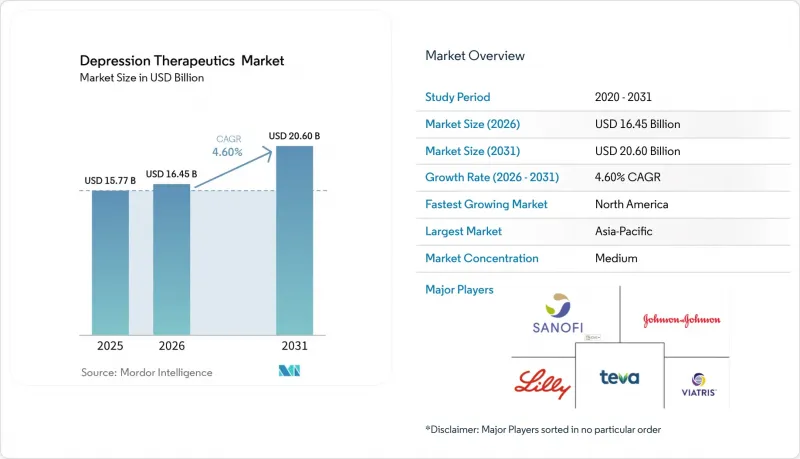
에 따르면 우울증 치료제 시장 규모는 2025년 157억 7,000만 달러에서 2026년에는 164억 5,000만 달러로 확대하며, 2031년까지 206억 달러에 달할 것으로 예상되고 있으며, 2026-2031년에 CAGR 4.60%로 성장할 것으로 전망되고 있습니다.
전 세계 우울증 치료제 시장의 동향 및 인사이트
주요 우울 장애의 진단 및 치료 확산
주요 우울 장애는 우울증 치료제 시장의 주요 판매량 견인 역할을 계속하고 있지만, 현재는 유병률 그 자체보다 일차 진료 단계에서의 조기 발견의 중요성이 더욱 커지고 있습니다. 2025년 초 시점에 추정 2,100만 명의 미국 성인이 연간 적어도 한 번은 주요 우울 에피소드를 경험했으나, 그중 3명 중 1명 가까이가 치료를 받지 못하고 있었습니다. 이 ‘진단은 받았으나 치료를 받지 않은’ 그룹은, 특히 일상적인 의료 현장에서 1차 진료의 선별 검사, 의뢰 시스템 및 후속 조치가 개선된 지역에서는 질병 발생률이 높아지지 않더라도 사용량을 확대시킬 가능성이 있습니다. 또한 여러 경구 치료에 반응하지 않은 환자들도 대체요법에 대한 수요를 창출하고 있습니다. 이는 세 번째 경구용 항우울제를 시도한 환자의 86%가 완치에 이르지 못했기 때문입니다. 2025년 체계적 문헌인사이트에서는 전 세계에서 3상 임상시험이 진행 중인 18개의 화합물이 확인되었으며, 이들 화합물은 기존의 항우울제 개발 프로그램보다 더 광범위한 작용 기전을 가지고 있는 것으로 밝혀졌습니다. 2013-2023년에 조사 대상이었던 8개 시장에서 유럽의 SSRI 소비량은 인구 1,000명당 하루 3.7-14.4 정의 일일 용량(DDD)으로 증가했습니다. 이는 치료 접근성이 개선되고 낙인이 완화됨에 따라 치료 건수가 증가할 수 있음을 보여줍니다.
즉각적인 효과와 새로운 작용 기전을 가진 치료법의 확대
즉효성이 있는 치료법은 표준 경구 치료에 반응하지 않은 환자를 대상으로 할 수 있으므로 우울증 치료제 시장을 확대시키고 있습니다. FDA는 2025년 1월, 24시간 이내에 증상 완화가 확인된다는 증거를 바탕으로, 치료 저항성 우울증을 앓는 성인 환자를 위한 최초이자 유일한 단일 요법인 ‘스프라바토(Spravato)’를 승인했습니다. 단일 요법을 통해 에스케타민과 함께 경구용 항우울제를 계속 복용할 필요가 없어지므로, 기존 치료에서 효과를 얻지 못한 환자에게 있으며, 실질적인 장벽이 완화될 가능성이 있습니다. 컴퍼스 패스웨이즈(Compass Pathways)는 2026년 4월, FDA가 COMP360에 대해 NDA(신약 승인 신청)의 단계적 심사를 승인하고, 국장이 국가 우선 바우처를 부여했다고 발표했습니다. NDA 제출은 2026년 4분기로 예정되어 있습니다. 이 회사는 치료 저항성 우울증 환자 1,000명 이상을 대상으로 한 2건의 3상 임상시험에서 양호한 결과를 얻었으며, 26주간의 지속성 데이터를 보고했습니다. 또한 ‘브레이크스루 테라피’ 및 REMS(위험 평가 및 완화 전략) 요건은 시판 계획 수립 및 의료 제공자의 의무 정의에 영향을 미칠 뿐만 아니라, 승인된 신약의 프리미엄 포지셔닝을 지원하는 역할도 하고 있습니다.
1차 선택 항우울제의 제네릭 의약품 전환 및 가격 압박
SSRI와 SNRI가 여전히 많은 환자에게 1차 치료제로 사용되고 있으므로 제네릭 의약품으로의 전환이 우울증 치료제 시장의 매출 성장을 제약하고 있습니다. 2024년 브루킹스 연구소의 분석에 따르면 제네릭 경구 고형 제제의 연간 조달 비용이 10%에서 15% 하락한 것으로 보고되었습니다. 이로 인해 특허 만료 제품에 계속 의존하고 있는 제약사들에 압박이 가해지고 있습니다. 프랑스 의약품청은 2025년 1월부터 같은 해 중반에 걸쳐 세르트랄린, 퀘티아핀, 벤라팍신 등 향정신성 약물에서 14건의 공급 부족 또는 재고 소진이 발생했다고 보고했습니다. 해당 보고서는 이러한 공급 부족을 제조의 상품화와 연관 지었습니다. 미국에서는 2026년에 제네릭 시탈로프람이 30일분당 4-15달러에 판매되고 있으며, 브랜드 제품의 1차 선택약으로서의 가격 책정 여지는 거의 남아 있지 않습니다. 따라서 구식 제품 구성을 가진 기업은 대량 판매와 지속적인 이익률 압박 사이에서 균형을 맞춰야 합니다.
부문별 분석
SSRI는 1차 선택 약제로서의 지침, 광범위한 보험 적용, 그리고 저렴한 제네릭 의약품에 힘입어 2025년 우울증 치료제 시장에서 34.8%의 점유율을 차지했습니다. 셀트랄린, 에스시탈로프람, 플루옥세틴이 처방전의 대부분을 차지하고 있습니다. 이러한 약물의 존재로 인해 우울증 치료제 업계는 높은 판매량 기반을 확보하고 있지만, 처방전 1건당 매출은 여전히 낮은 수준에 머물러 있습니다. 매출 기준으로 두 번째로 큰 약제 클래스은 SNRI이며, 한편 비정형 항우울제 및 비정형 항정신병제는 대체요법이나 병용 요법이 필요한 환자를 대상으로 하고 있습니다.
NMDA 및 새로운 즉효성 치료제는 2031년까지 연평균 성장률(CAGR) 12.8%로 성장할 것으로 예측되며, 이는 약물 분류별 가장 높은 성장률입니다. ‘스프라바토(Spravato)’의 2025년 단독 요법 적응증 확대 및 COMP360의 지속적인 NDA 심사는 치료 저항성 우울증에 대한 프리미엄 치료로의 전환을 시사합니다. 2025년 리뷰에서는 NMDA 조절, GABA-A 조절, 오렉신-2 길항 작용 및 Kv7 칼륨 채널 개방 작용을 아우르는 후기 임상 개발 프로그램이 소개되었습니다. 삼환계 항우울제나 MAOI는 안전성 우려와 식이 제한으로 인해 사용이 제한되고 있으며, 계속해서 감소 추세를 보이고 있습니다. REMS(위험 평가 및 완화 전략) 및 브레이크스루 테라피 제도는 신제품 상용화에 있으며, 중요한 이정표가 되고 있습니다.
2025년, 주요 우울 장애는 우울증 치료제 시장 규모의 67.4%를 차지했습니다. 광범위한 적응증 범위와 주요 최초 승인 경로로서의 역할로 인해 이 질환은 핵심 수입원이 되고 있습니다. 새로운 약제 클래스은 일반적으로 치료 저항성 우울증, 양극성 장애 또는 기타 적응증으로의 확장을 추진하기 전에, 주요 우울 장애(MDD)에서 효능을 입증합니다. 양극성 우울증은 세 번째로 큰 수입원이며, 그보다 규모가 작은 적응증으로는 계절성 정서 장애, 월경 전 불쾌 기분 장애, 신경질환과 관련된 우울증 등이 포함됩니다.
산후 우울증은 2031년까지 연평균 성장률(CAGR) 10.9%로 성장할 것으로 예측되며, 이는 모든 적응증 중 가장 높은 성장률입니다. 미국, 영국, 유럽, 캐나다 및 일본에서 즈라놀론의 출시로 독자적인 경구 치료 경로가 확립되었습니다. 346명의 환자를 대상으로 한 임상 데이터에 따르면 투여 시작 3일째까지 개선이 확인되었으며, 45일째까지 그 효과가 지속된 것으로 나타났습니다. 브렉사놀론의 판매 중단으로 경구 치료 옵션이 좁아지면서, 즈라놀론에 대한 관심이 높아졌습니다. 아시아와 남미에서는 여전히 진단 누락이 흔하므로 선별 검사 방법의 개선을 통해 치료 대상이 되는 환자 수는 현재의 치료 실적이 보여주는 수치보다 더욱 확대될 가능성이 있습니다.
지역별 분석
2025년, 북미는 우울증 치료제 시장의 41.5%를 차지했습니다. 치료 보급률이 높고, 풍부한 신약 파이프라인, 그리고 브랜드 의약품 및 중재 요법에 대한 신속한 보험 적용 절차가 이러한 위상을 지원하고 있습니다. 미국은 해당 지역내 매출의 대부분을 차지하고 있으며, 에스케타민, TMS, 디지털 치료제를 처방하는 전문 클리닉이 다수 존재합니다. 캐나다에서는 2025년 12월 즈라놀론이 승인되어, 해당 국가에서 최초로 산후 우울증에 특화된 경구용 치료제로 이용 가능해졌습니다. 한편, 멕시코에서는 전문의 수가 제한적이며, 제네릭 의약품을 우선하는 처방 기준이 마련되어 있습니다.
유럽은 우울증 치료제 시장에서 지역별 기여도 2위를 차지하고 있습니다. 즈라놀론은 2025년에 유럽연합(EU) 및 영국에서 승인되어, 두 지역 모두에서 최초의 경구용 산후 우울증 치료제가 되었습니다. 유럽의 대부분의 시장에서 항우울제 소비량은 증가 추세를 보이고 있으나, 2030년 성장 전망치는 0.1%에서 80.9%까지 폭이 넓습니다. 독일, 프랑스, 영국이 최대 매출 시장이지만, 2025년에는 프랑스의 처방전 수 증가가 공급 차질의 한 원인이 되었습니다. 새로운 작용 기전을 가진 약물은 미국에 비해 시장에 출시되기까지의 기간이 길어질 가능성이 있습니다.
아시아태평양은 2031년까지 연평균 성장률(CAGR) 8.7%로 성장할 것으로 예측되며, 이는 우울증 치료제 시장에서 지역별 가장 높은 성장률입니다. 인프라 개선, 보험 가입자 수 증가, 그리고 공중보건에 대한 노력이 이러한 성장 속도를 지원하고 있습니다. 중국의 우울증 환자 수는 약 5,400만 명에 달하는 것으로 추정되며, 2025-2027년에 정신건강 및 디지털 헬스 서비스 강화를 추진하고 있습니다. 일본은 2025년 12월에 즈라놀론을 승인했으며, 호주는 2025년 5월에 케타민을 의약품 급여 제도(Pharmaceutical Benefits Scheme)에 추가하는 한편, 실로시빈 및 MDMA에 대해 감독 하의 임상 환경을 마련하고 있습니다. 인도의 도시와 농촌 간 의료 격차, 그리고 중동 및 아프리카의 정신의료 인프라가 초기 단계에 있다는 점은 장기적인 기회를 의미합니다.
기타 혜택:
- 엑셀 형식의 시장 예측(ME) 시트
- 3개월간의 애널리스트 지원
자주 묻는 질문
목차
제1장 서론
- 조사 전제조건과 시장 정의
- 조사 범위
제2장 조사 방법
제3장 개요
제4장 시장 구도
- 시장 개요
- 시장 성장 촉진요인
- 시장 성장 억제요인
- 가치 및 공급망 분석
- 규제 상황
- 기술 전망
- Porter's Five Forces 분석
- 가격 분석
- 시장 리스크 분석
제5장 시장 규모와 성장 예측
- 약제 클래스별
- 적응증별
- 제품 유형별
- 투여 경로별
- 유통 채널별
- 최종사용자별
- 지역별
- 북미
- 미국
- 캐나다
- 멕시코
- 유럽
- 독일
- 영국
- 프랑스
- 이탈리아
- 스페인
- 기타 유럽 국가
- 아시아태평양
- 중국
- 일본
- 인도
- 한국
- 호주
- 기타 아시아태평양 국가
- 중동 및 아프리카
- GCC
- 남아프리카공화국
- 기타 중동 및 아프리카 국가
- 남미
- 브라질
- 아르헨티나
- 기타 남미 국가
- 북미
제6장 경쟁 구도
- 시장 집중도
- 시장 점유율 분석
- 기업 개요
- Johnson & Johnson
- Eli Lilly and Company
- Pfizer Inc.
- AbbVie Inc.
- H. Lundbeck A/S
- Otsuka Pharmaceutical Co., Ltd.
- Takeda Pharmaceutical Company Limited
- GSK plc
- Bristol Myers Squibb Company
- AstraZeneca
- Sanofi
- Teva Pharmaceutical Industries Ltd.
- Viatris Inc.
- Sun Pharmaceutical Industries Ltd.
- Alkermes plc
- Neurocrine Biosciences, Inc.
- Axsome Therapeutics, Inc.
- Sage Therapeutics, Inc.
- Biogen Inc.
- Acadia Pharmaceuticals Inc.
- Intra-Cellular Therapies, Inc.
- Compass Pathways plc
- Cybin Inc.
- atai Life Sciences N.V.
- MindMed Inc.
제7장 시장 기회와 향후 전망
KSA 26.10.23According to Mordor Intelligence, the depression therapeutics market size is expected to increase from USD 15.77 billion in 2025 to USD 16.45 billion in 2026 and reach USD 20.60 billion by 2031, growing at a CAGR of 4.60% over 2026-2031.
Global Depression Therapeutics Market Trends and Insights
Rising Diagnosis and Treatment Uptake for Major Depressive Disorder
Major depressive disorder remains the main volume driver for the Depression therapeutics market, although better primary care detection now matters more than incidence alone. An estimated 21 million U.S. adults experienced at least 1 major depressive episode annually by early 2025, while nearly 1 in 3 received no treatment. This diagnosed but untreated group can expand use without requiring higher disease incidence, especially where primary care screening, referral systems, and follow-up are improving across routine care settings. Patients who fail several oral treatments also create demand for alternatives, since 86% of those trying a third oral antidepressant did not achieve remission. A 2025 systematic review identified 18 compounds in global Phase 3 trials, with a wider range of mechanisms than earlier antidepressant development programs. European SSRI consumption rose by 3.7 to 14.4 defined daily doses per 1,000 inhabitants per day across 8 measured markets from 2013 to 2023, showing that access and lower stigma can increase treatment volume
Expansion of Rapid-Acting and Novel-Mechanism Therapies
Rapid-acting therapies are expanding the Depression therapeutics market because they address patients who have not responded to standard oral treatment. The FDA approved Spravato as the first and only monotherapy for adults with treatment-resistant depression in January 2025, based on evidence of symptom relief that could appear within 24 hours. Monotherapy removes the need to continue an oral antidepressant alongside esketamine, which may reduce a practical barrier for patients with prior treatment failures. Compass Pathways stated in April 2026 that the FDA granted rolling NDA review for COMP360 and awarded a Commissioner's National Priority Voucher, with a planned NDA completion in Q4 2026. The company reported 2 positive Phase 3 trials involving more than 1,000 treatment-resistant depression patients and 26-week durability data. Breakthrough Therapy and REMS requirements also shape launch planning, define provider obligations, and help support premium positioning for approved novel agents.
Generic Substitution and Pricing Pressure in First-Line Antidepressants
Generic substitution constrains revenue growth in the Depression therapeutics market because SSRIs and SNRIs remain the first treatment option for many patients. A 2024 Brookings analysis reported annual acquisition-cost deflation of 10% to 15% for generic oral solids. This creates pressure on manufacturers that continue to depend on off-patent products. France's medicines agency reported 14 supply tensions or stock-outs for psychotropic medicines between January and mid-2025, including sertraline, quetiapine, and venlafaxine. The report linked shortages to the commoditization of production. In the United States, generic citalopram was available for USD 4 to USD 15 for a 30-day supply in 2026, leaving little room for branded first-line pricing. Companies with an older product mix must therefore balance high volumes against continued margin pressure.
Other drivers and restraints analyzed in the detailed report include:
- Growing Screening and Treatment of Postpartum Depression
- Increasing Mental Health Awareness and Reduction in Treatment Stigma
- Safety Monitoring and Controlled-Administration Requirements
For complete list of drivers and restraints, kindly check the Table Of Contents.
Segment Analysis
SSRIs held 34.8% of the Depression therapeutics market in 2025, supported by first-line guidelines, broad formulary access, and low generic prices. Sertraline, escitalopram, and fluoxetine account for a substantial share of prescriptions. Their role gives the Depression therapeutics industry a high-volume base, although revenue per prescription remains low. SNRIs are the second-largest drug class by revenue, while atypical antidepressants and atypical antipsychotics serve patients who need alternatives or adjunct treatment.
NMDA and novel rapid-acting therapies are forecast to grow at a 12.8% CAGR through 2031, the highest rate within drug classes. Spravato's 2025 monotherapy label and the COMP360 rolling NDA review show the move toward premium treatments for treatment-resistant depression. The 2025 review described late-stage programs across NMDA modulation, GABA-A modulation, orexin-2 antagonism, and Kv7 potassium channel opening. Tricyclics and MAOIs continue to decline because safety concerns and dietary restrictions limit use. REMS and Breakthrough Therapy frameworks set important commercialization milestones for new products.
Major depressive disorder accounted for 67.4% of the Depression therapeutics market size in 2025. Its breadth and role as the main initial approval pathway make it the central revenue source. New drug classes commonly establish evidence in MDD before pursuing treatment-resistant, bipolar, or other labels. Bipolar depression is the third-largest revenue pool, while smaller indications include seasonal affective disorder, premenstrual dysphoric disorder, and depression linked to neurological conditions.
Postpartum depression is forecast to grow at a 10.9% CAGR through 2031, the fastest rate within indications. The rollout of zuranolone in the United States, United Kingdom, Europe, Canada, and Japan established a distinct oral treatment pathway. Clinical evidence from 346 patients showed improvement by day 3 and sustained benefit through day 45. The withdrawal of brexanolone narrowed oral treatment choices and directed attention toward zuranolone. Underdiagnosis remains common in Asia and South America, so screening updates could make the accessible population larger than current treated volumes indicate.
Complete Report Scope:
- By Drug Class
- SSRIs
- SNRIs
- Atypical Antidepressants
- Tricyclic & MAOI Antidepressants
- Atypical Antipsychotics
- NMDA & Novel Rapid-Acting Therapies
- Other Depression Therapeutics
- By Indication
- Major Depressive Disorder (MDD)
- Postpartum Depression
- Bipolar Depression
- Other Depression Indications
- By Product Type
- Generic Therapies
- Branded Therapies
- By Route of Administration
- Oral
- Intranasal
- Injectable (IV/IM/SC)
- Transdermal & Other Routes
- Digital Delivery
- By Distribution Channel
- Retail Pharmacies
- Hospital Pharmacies
- Specialty Pharmacies
- Online Pharmacies
- Other Channels
- By End User
- Hospitals
- Specialty Mental Health Clinics
- Primary Care Practices
- Outpatient Psychiatric Practices
- Other End Users
- By Geography
- North America
- United States
- Canada
- Mexico
- Europe
- Germany
- United Kingdom
- France
- Italy
- Spain
- Rest of Europe
- Asia-Pacific
- China
- Japan
- India
- South Korea
- Australia
- Rest of Asia-Pacific
- Middle East and africa
- GCC
- South Africa
- Rest of Middle East and Africa
- South America
- Brazil
- Argentina
- Rest of South America
- North America
Geography Analysis
North America held 41.5% of the depression therapeutics market share in 2025. High treatment penetration, a large novel-drug pipeline, and faster reimbursement pathways for branded and interventional therapies support this position. The United States generates most regional revenue and has many specialty clinics offering esketamine, TMS, and digital therapeutic prescriptions. Canada approved zuranolone in December 2025, making it the first postpartum depression-specific oral therapy available in the country, while Mexico has limited specialist capacity and generic-first formulary restrictions.
Europe is the second-largest regional contributor to the Depression therapeutics market. Zuranolone received authorization in the European Union and the United Kingdom in 2025, creating the first oral postpartum depression treatment option in both settings. Antidepressant consumption is rising in most European markets, although 2030 growth expectations vary from 0.1% to 80.9%. Germany, France, and the United Kingdom are the largest revenue markets, while French prescription growth contributed to supply disruptions in 2025. Novel mechanisms can face longer access timelines than in the United States.
Asia-Pacific is forecast to grow at an 8.7% CAGR through 2031, the highest regional rate for the Depression therapeutics market. Improving infrastructure, a larger insured population, and public-health efforts underpin this pace. China has an estimated 54 million people with depression and is pursuing stronger mental health and digital health services for 2025 to 2027. Japan approved zuranolone in December 2025, while Australia added ketamine to the Pharmaceutical Benefits Scheme in May 2025 and has a supervised clinical context for psilocybin and MDMA. India's urban-rural care gap and early-stage psychiatric infrastructure in the Middle East and Africa represent longer-term opportunities.
List of Companies Covered in this Report:
- Johnson & Johnson
- Eli Lilly and Company
- Pfizer
- Abbvie
- H. Lundbeck
- Otsuka
- Takeda Pharmaceuticals
- GlaxoSmithKline
- Bristol-Myers Squibb
- AstraZeneca
- Sanofi
- Teva Pharmaceutical Industries
- Viatris
- Sun Pharmaceuticals Industries
- Alkermes plc
- Neurocrine Biosciences
- Axsome Therapeutics
- Sage Therapeutics
- Biogen
- Acadia Pharmaceuticals Inc.
- Intra-Cellular Therapies, Inc.
- Compass Pathways plc
- Cybin Inc.
- atai Life Sciences N.V.
- MindMed Inc.
Additional Benefits:
- The market estimate (ME) sheet in Excel format
- 3 months of analyst support
TABLE OF CONTENTS
1 INTRODUCTION
- 1.1 Study Assumptions and Market Definition
- 1.2 Scope of the Study
2 RESEARCH METHODOLOGY
3 EXECUTIVE SUMMARY
4 MARKET LANDSCAPE
- 4.1 Market Overview
- 4.2 Market Drivers
- 4.2.1 Rising Diagnosis and Treatment Uptake for Major Depressive Disorder
- 4.2.2 Expansion of Rapid-Acting and Novel-Mechanism Therapies
- 4.2.3 Growing Screening and Treatment of Postpartum Depression
- 4.2.4 Increasing Mental Health Awareness and Reduction in Treatment Stigma
- 4.2.5 Clinic-Ready Delivery Models for Treatment-Resistant Depression
- 4.2.6 Biomarker-Guided and Digital Adherence-Based Treatment Pathways
- 4.3 Market Restraints
- 4.3.1 Generic Substitution and Pricing Pressure in First-Line Antidepressants
- 4.3.2 Safety Monitoring and Controlled-Administration Requirements
- 4.3.3 Fragmented Reimbursement for Digital and Interventional Therapies
- 4.3.4 Limited Predictive Biomarkers for Treatment Selection and Response
- 4.4 Value and Supply-Chain Analysis
- 4.5 Regulatory Landscape
- 4.6 Technological Outlook
- 4.7 Porters Five Forces Analysis
- 4.7.1 Competitive Rivalry
- 4.7.2 Supplier Bargaining Power
- 4.7.3 Buyer Bargaining Power
- 4.7.4 Threat of New Entrants
- 4.7.5 Threat of Substitutes
- 4.8 Pricing Analysis
- 4.9 Market Risk Analysis
5 MARKET SIZE AND GROWTH FORECASTS
- 5.1 By Drug Class
- 5.1.1 SSRIs
- 5.1.2 SNRIs
- 5.1.3 Atypical Antidepressants
- 5.1.4 Tricyclic & MAOI Antidepressants
- 5.1.5 Atypical Antipsychotics
- 5.1.6 NMDA & Novel Rapid-Acting Therapies
- 5.1.7 Other Depression Therapeutics
- 5.2 By Indication
- 5.2.1 Major Depressive Disorder (MDD)
- 5.2.2 Postpartum Depression
- 5.2.3 Bipolar Depression
- 5.2.4 Other Depression Indications
- 5.3 By Product Type
- 5.3.1 Generic Therapies
- 5.3.2 Branded Therapies
- 5.4 By Route of Administration
- 5.4.1 Oral
- 5.4.2 Intranasal
- 5.4.3 Injectable (IV/IM/SC)
- 5.4.4 Transdermal & Other Routes
- 5.4.5 Digital Delivery
- 5.5 By Distribution Channel
- 5.5.1 Retail Pharmacies
- 5.5.2 Hospital Pharmacies
- 5.5.3 Specialty Pharmacies
- 5.5.4 Online Pharmacies
- 5.5.5 Other Channels
- 5.6 By End User
- 5.6.1 Hospitals
- 5.6.2 Specialty Mental Health Clinics
- 5.6.3 Primary Care Practices
- 5.6.4 Outpatient Psychiatric Practices
- 5.6.5 Other End Users
- 5.7 By Geography
- 5.7.1 North America
- 5.7.1.1 United States
- 5.7.1.2 Canada
- 5.7.1.3 Mexico
- 5.7.2 Europe
- 5.7.2.1 Germany
- 5.7.2.2 United Kingdom
- 5.7.2.3 France
- 5.7.2.4 Italy
- 5.7.2.5 Spain
- 5.7.2.6 Rest of Europe
- 5.7.3 Asia-Pacific
- 5.7.3.1 China
- 5.7.3.2 Japan
- 5.7.3.3 India
- 5.7.3.4 South Korea
- 5.7.3.5 Australia
- 5.7.3.6 Rest of Asia-Pacific
- 5.7.4 Middle East and africa
- 5.7.4.1 GCC
- 5.7.4.2 South Africa
- 5.7.4.3 Rest of Middle East and Africa
- 5.7.5 South America
- 5.7.5.1 Brazil
- 5.7.5.2 Argentina
- 5.7.5.3 Rest of South America
- 5.7.1 North America
6 COMPETITIVE LANDSCAPE
- 6.1 Market Concentration
- 6.2 Market Share Analysis
- 6.3 Company Profiles (includes Global Level Overview, Market Level Overview, Core Segments, Financials as available, Strategic Information, Market Rank/Share, Products and Services, Recent Developments)
- 6.3.1 Johnson & Johnson
- 6.3.2 Eli Lilly and Company
- 6.3.3 Pfizer Inc.
- 6.3.4 AbbVie Inc.
- 6.3.5 H. Lundbeck A/S
- 6.3.6 Otsuka Pharmaceutical Co., Ltd.
- 6.3.7 Takeda Pharmaceutical Company Limited
- 6.3.8 GSK plc
- 6.3.9 Bristol Myers Squibb Company
- 6.3.10 AstraZeneca
- 6.3.11 Sanofi
- 6.3.12 Teva Pharmaceutical Industries Ltd.
- 6.3.13 Viatris Inc.
- 6.3.14 Sun Pharmaceutical Industries Ltd.
- 6.3.15 Alkermes plc
- 6.3.16 Neurocrine Biosciences, Inc.
- 6.3.17 Axsome Therapeutics, Inc.
- 6.3.18 Sage Therapeutics, Inc.
- 6.3.19 Biogen Inc.
- 6.3.20 Acadia Pharmaceuticals Inc.
- 6.3.21 Intra-Cellular Therapies, Inc.
- 6.3.22 Compass Pathways plc
- 6.3.23 Cybin Inc.
- 6.3.24 atai Life Sciences N.V.
- 6.3.25 MindMed Inc.
7 MARKET OPPORTUNITIES AND FUTURE OUTLOOK
- 7.1 White-Space and Unmet-Need Assessment
- 7.2 Future Outlook


