

|
시장보고서
상품코드
2154466
리튬 망간철인산염(LMFP) 분말 : 시장 점유율 분석, 업계 동향과 통계, 성장 예측(2026-2031년)Lithium Manganese Iron Phosphate (LMFP) Powder - Market Share Analysis, Industry Trends & Statistics, Growth Forecasts (2026 - 2031) |
||||||
 Mordor Intelligence
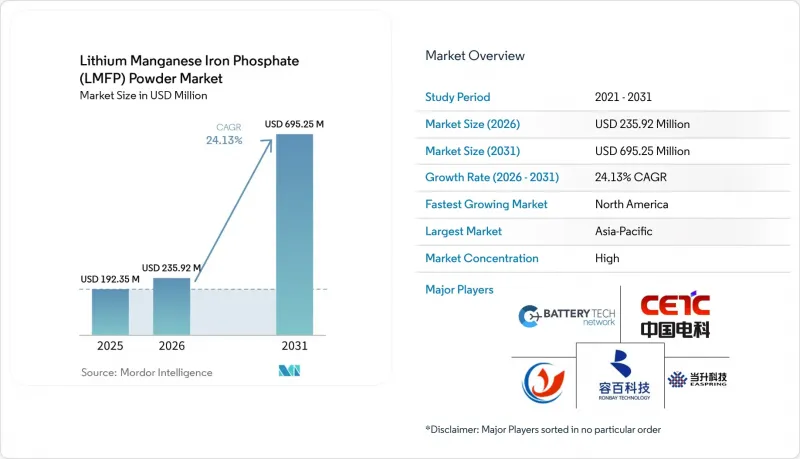
에 따르면 인산 리튬·망간·철(LMFP) 분말 시장 규모는 2025년에 1억 9,235만 달러로 추계되고 있으며, 2026년 2억 3,592만 달러에서 2031년까지 6억 9,525만 달러로 확대하며, 예측 기간(2026-2031년) 사이에, CAGR 24.13%로 확대할 것으로 전망되고 있습니다.
세계 리튬·망간·철·인산염(LMFP) 분말 시장의 동향 및 인사이트
LFP와 동등한 비용으로 더 높은 에너지 밀도를 추구하는 전기자동차(EV) 수요
리튬-망간-철 인산염(LFP)과 동등한 비용으로 더 높은 에너지 밀도를 추구하는 전기자동차(EV) 프로그램이 승용차 및 상용차 플랫폼 전반에 걸쳐 리튬-망간-철-인산염(LMFP) 분말 시장을 지원하고 있습니다. LMFP는 올리빈 결정 구조를 채택하고 있으며, 기존 LFP의 3.2V에 비해 3.7-3.8V에서 작동합니다. 그 결과, 15-20%의 에너지 밀도 향상이 실현되어, 인산염계 화학 조성을 유지하면서 차량의 주행 거리를 연장하거나, 배터리 팩의 크기를 축소하거나 또는 차량 설계의 자유도를 높일 수 있게 됩니다. 이러한 조합은 니켈 함량이 높은 양극재에 수반되는 안전성 문제나 원자재 의존 위험을 회피하면서도, 더 높은 팩 효율이 요구되는 중거리 승용차, 상용차 및 셀 개발 프로그램에 적합합니다. 또한 LMFP는 확립된 전해액의 작동 범위 내에서 니켈·망간·코발트(NMC)와 혼합할 수 있으며, 이를 통해 배터리 제조사는 기존의 셀 구조와 제조 공정의 대부분을 유지하면서 에너지 밀도를 향상시킬 수 있습니다. 이러한 호환성 덕분에 인증 절차 단축 및 재설계 비용 절감이 가능해지며, 이미 인산철리튬(LFP) 셀 라인을 운영 중인 제조사에게도 LMFP 분말 시장 진출이 용이해집니다.
전력망 규모 및 상업용 에너지 저장 장치의 확대
LMFP 분말 시장은 재생 가능 에너지 발전의 확대에 따라 전력 시스템 전반에서 전력 회사 규모 및 상업용 축전지가 확대되고 있는 점도 지원하고 있습니다. 에너지 밀도가 높기 때문에 기존의 LFP 기반 시스템에 비해 에너지 저장 설비의 설치 면적을 줄일 수 있습니다. 이는 이용 가능한 토지, 지역의 허가 조건, 지역 사회와의 근접성 등이 새로운 에너지 저장 시설의 설계를 제약할 수 있는 도시 지역의 송전망에서 중요한 의미를 가집니다. 이러한 특성은 재생 가능 에너지를 기반으로 하는 마이크로그리드를 지속적으로 운영하며, 제한된 부지 내에 설치할 수 있는 에너지 저장 시스템을 필요로 하는 상업 및 산업 고객에게도 적용됩니다. LMFP는 특히 화재 위험이나 가동 신뢰성이 조달 결정의 요소가 되는 경우, 고정형 축전지 시스템에서 인산염계 화학 물질이 중요시되어 온 안전성을 유지하고 있습니다. 이 사용 사례는 구매자가 초기 자재 비용의 절감보다 콤팩트한 설치 설계, 열적 안정성, 신뢰성 높은 충방전 사이클, 긴 수명 및 간소화된 설치 설계를 중시하는 경우에 가장 적합합니다.
망간의 용출과 사이클 수명의 상충 관계
충방전 사이클 중 망간의 용출은 리튬 망간 철 인산염(LMFP) 분말 시장, 특히 따뜻한 기후나 고전압 조건에서 작동할 것으로 예상되는 셀의 경우 여전히 핵심적인 기술적 제약 사항으로 남아 있습니다. 이 문제는 고온에서 더욱 두드러지며, 용해된 망간이 양극에서 이동하여 음극에 침전되어 셀의 보호층인 고체 전해질 계면에 영향을 미칠 가능성이 있습니다. LMFP 및 흑연 셀에 대한 연구에 따르면 망간 침착은 사이클 수가 증가함에 따라 커지며, 고체 전해질 계면의 열화 원인 중 하나가 되는 것으로 밝혀졌습니다. 고온 작동시 망간 침착을 줄이는 혼합 염 접근법을 포함한 전해질 공학을 통해 이러한 영향을 완화할 수 있습니다. 트리메틸실릴붕산염 첨가제를 사용한 경우, 4.3 V, 60°C 조건에서 LMFP 반전지의 500회 사이클 후 용량 유지율은 86.4%에 달했으나, 반면, 흑연/LMFP 파우치 전지의 경우 200사이클 후 80.1%의 유지율에 그쳤습니다. 고망간 배합에서는 여전히 조성상의 상충 관계에 직면해 있습니다. 이는 에너지 밀도의 최대 향상이 임피던스의 현저한 증가, 전압의 불안정화, 그리고 망간의 산화-환원 반응 중 셀 제어 요건의 엄격화를 수반할 가능성이 있기 때문입니다.
부문 분석
2025년, 리튬 망간 철 인산염(LMFP) 분말 시장에서 배터리 등급이 90.34%의 점유율을 차지했습니다. 이러한 압도적인 위상은 주류 자동차용 및 고정형 에너지 저장 셀의 요구 사항을 반영한 것입니다. 이러한 분야에서는 압축 밀도, 초기 사이클 효율, 1C율 용량, 그리고 로트 간 품질 일관성이 조달 결정의 지침이 되고 있습니다. 이 등급은 고출력 양극재 생산에 사용되며, 대규모 고객 주문이나 여러 거점에서의 제조 프로그램에서 재현 가능한 입자 특성, 안정적인 조성, 그리고 신뢰할 수 있는 가공 특성을 제공해야 합니다. 또한 제조업체들은 일관된 전압 특성과 가공 성능이 중요한 혼합 양극재에도 이 소재를 사용하고 있습니다. LFP와 배터리 등급 LMFP를 전환할 수 있는 유연한 소결 라인을 도입함으로써 한계 용량 비용을 절감하고, 주문 패턴의 변화에 신속하게 대응할 수 있게 됩니다.
고순도 등급은 2031년까지 연평균 성장률(CAGR) 25.56%로 성장할 것으로 예측되며, LMFP 분말 시장에서 가장 빠르게 성장하는 등급이 될 전망입니다. 수요는 국방 관련 에너지 프로그램, 고급 휴대용 전자기기 및 에너지 저장 용도에서 발생하고 있으며, 이러한 분야에서는 캘린더 수명, 낮은 자가 방전율, 안정적인 출력 및 엄격하게 관리된 재료 순도가 더 높은 사양을 지원하고 있습니다. Integral Power사의 보고서에 따르면 QinetiQ사는 망간 함량 80%, 비용량 약 150mAh/g의 고망간 LMFP 소재를 검증했습니다. 이 소재는 LFP에 비해 최대 20%의 에너지 밀도 향상을 가져올 수 있는 것으로 확인되었습니다. 특수 등급은 여전히 규모가 가장 작은 범주에 속하며, 특정 셀 구조를 위해 설계된 도핑 처리 또는 코팅 처리된 제품을 대상으로 합니다. 블렌드 전극 프로그램에서 독자적인 배합이 채택되고, 양극 성능에 대한 보다 엄격한 제어가 요구됨에 따라 이 분야는 확대될 여지가 있습니다.
지역별 분석
2025년, 아시아태평양은 리튬 망간 인산염(LMFP) 분말 시장 점유율의 55.23%를 차지했습니다. 이 지역의 호조로운 실적은 중국의 상업적 규모의 소결 능력, 통합된 망간 공급망, 확립된 셀 제조 거점, 그리고 파일럿 라인에서 양산으로의 양극 배합 규모 확대에 대한 경험을 반영합니다. 이러한 조건은 소재의 가용성, 운영 경험, 분말 제조사와 셀 제조사 간의 신속한 피드백, 그리고 양극재 공급업체와 하류 배터리 제조사 간의 긴밀한 협력을 지원하고 있습니다. 일본과 한국은 배터리 통합, 부품 공급, 확립된 셀 개발 역량을 통해 기여하고 있는 반면, 인도는 ‘첨단 화학 배터리(Advanced Chemistry Cell)’ 정책의 지원과 투자 관심 확대를 배경으로 부상하고 있습니다. 아세안(ASEAN) 국가들은 양극재 생산지라기보다는 배터리 조립 거점으로서 더 중요한 위치를 차지하고 있습니다.
북미는 2031년까지 연평균 성장률(CAGR) 25.78%로 성장할 것으로 예측되며, 이는 LMFP 분말 시장에서 지역별 가장 높은 성장률입니다. 정책적 요건과 현지 양극재 공급을 요구하는 고객의 수요로 인해 현지 조달 요건을 충족하고 공급망 리스크를 줄일 수 있는 중국산 이외의 리튬철인산염(LFP) 및 LMFP 소재에 대한 관심이 높아지고 있습니다. Western CAM사는 2025년 4월 미국에서 LFP 및 LMFP 양극재 생산을 시작했으며, Wildcat Discovery Technologies사와 EnergyX사는 2026년 6월 텍사스주에서 1만 5,000톤 규모의 LFP 양극재를 생산하는 합작 사업을 발표했습니다. 캐나다의 인산염 자원은 망간 처리 능력이 확대되고, 생산자들이 채굴, 정제, 양극재 생산, 배터리 셀 제조 과정에서 신뢰할 수 있는 협력을 구축할 수 있다면 지역 공급망을 지원할 수 있을 것입니다. 고순도 황산망간의 처리 능력은 여전히 전략적 약점으로 남아 있습니다. 이 처리 능력은 중국에 집중되어 있으며, 경쟁력 있는 LMFP 양극재 공급을 확보하는 데 필수적이기 때문입니다.
유럽에서는 기술 개발, 공급 계약 및 공공 투자를 통해 현지 소재 기반을 구축하고 있습니다. IBU-tec사와 PowerCo SE 간의 협약을 통해 유럽내 양극재 개발, 지역내 원자재 조달 및 공정 개발이 하류 배터리 수요와 연계되고 있습니다. 스페인은 바야돌리드에서 Gotion High-Tech사의 9억 4,000만 유로(약 10억 8,367만 달러) 규모의 투자를 승인했습니다. 이 투자는 PERTE VEC 프로그램 하에서 1억 3,800만 유로(약 1억 5,909만 달러)의 지원을 받고 있으며, 양극재 생산 능력도 포함될 예정입니다. 남미에는 관련 망간 및 리튬 자원이 있지만, 상업 규모의 양극재 분말 생산은 이루어지지 않고 있습니다. 한편, 중동 및 아프리카는 여전히 신흥 수요 지역이며, 소재 제조에 이르기까지 갈 길이 먼 상황입니다.
기타 혜택:
- 엑셀 형식의 시장 예측(ME) 시트
- 3개월간의 애널리스트 지원
목차
제1장 서론
- 조사 전제조건과 시장 정의
- 조사 범위
제2장 조사 방법
제3장 개요
제4장 시장 구도
- 시장 개요
- 시장 성장 촉진요인
- 시장 성장 억제요인
- 밸류체인 분석
- Porter's Five Forces 분석
제5장 시장 규모와 성장 예측
- 등급별
- 용도별
- 지역별
- 아시아태평양
- 중국
- 인도
- 일본
- 한국
- ASEAN 국가
- 기타 아시아태평양 국가
- 북미
- 미국
- 캐나다
- 멕시코
- 유럽
- 독일
- 영국
- 프랑스
- 이탈리아
- 북유럽 국가
- 기타 유럽 국가
- 남미
- 브라질
- 아르헨티나
- 기타 남미 국가
- 중동 및 아프리카
- 사우디아라비아
- 남아프리카공화국
- 기타 중동 및 아프리카 국가
- 아시아태평양
제6장 경쟁 구도
- 시장 집중도
- 전략적 동향
- 시장 점유율·순위 분석
- 기업 개요
- A123 Systems Corp
- Beijing Easpring Material Technology Co., LTD
- Gotion High-Tech Co., Ltd.
- Guizhou Anda Energy Technology Co., Ltd.
- HCM
- Hengchuang Nano
- Hunan Yuneng New Energy Battery Material Co., Ltd.
- IBU-tec
- Integrals Power
- Livium Ltd
- Pulead Technology Industry Co., Ltd.
- Ronbay Technology
- Samsung SDI Co., Ltd.
- Shenzhen Dynanonic Co., Ltd.
- Sunwoda Electronic Co., Ltd.
- Western CAM
제7장 시장 기회와 향후 전망
KSAAccording to Mordor Intelligence, the lithium manganese iron phosphate (LMFP) powder market size was estimated at USD 192.35 million in 2025 and is estimated to grow from USD 235.92 million in 2026 to USD 695.25 million by 2031, at a CAGR of 24.13% during the forecast period (2026-2031).
Global Lithium Manganese Iron Phosphate (LMFP) Powder Market Trends and Insights
EV Demand for Higher Energy Density at LFP-Like Cost
The lithium manganese iron phosphate (LMFP) powder market is supported by EV programs that require higher energy density than conventional LFP can provide across passenger and commercial vehicle platforms. LMFP uses an olivine crystal structure and operates at 3.7-3.8 V, compared with 3.2 V for conventional LFP. The resulting energy density gain of 15-20% can extend vehicle range, reduce pack size, or allow more room for vehicle design while retaining a phosphate-based chemistry. This combination is relevant to mid-range passenger vehicles, commercial vehicles, and cell programs that require better pack efficiency without the safety and raw-material exposure associated with nickel-rich cathodes. LMFP can also be blended with nickel manganese cobalt (NMC) within established electrolyte operating ranges, allowing battery makers to improve energy density while preserving much of the existing cell architecture and manufacturing process. This compatibility can shorten qualification work, limit redesign costs, and make the LMFP powder market more accessible to producers already serving lithium iron phosphate (LFP) cell lines.
Expansion of Grid-Scale and Commercial Energy Storage
The LMFP powder market is also supported by the expansion of utility-scale and commercial battery storage across power systems as renewable generation grows. Higher energy density can reduce the physical footprint of storage installations compared with conventional LFP-based systems. This is relevant in urbanized grids where land availability, local permitting conditions, and proximity to communities can constrain the design of new storage sites. The same characteristic applies to commercial and industrial customers that operate renewable-backed microgrids on a continuous basis and require storage systems that fit within limited sites. LMFP retains the safety profile that has made phosphate chemistries important for stationary battery systems, particularly where fire risk and operating reliability are part of procurement decisions. The use case is strongest where buyers value compact installation design, thermal stability, reliable cycling, long operating life, and simplified site design over the lowest initial material cost.
Manganese Dissolution and Cycle-Life Trade-Offs
Manganese dissolution during cycling remains a central technical constraint for the lithium manganese iron phosphate (LMFP) powder market, particularly for cells expected to operate in warm climates or at high voltages. The issue is more pronounced at elevated temperatures, where dissolved manganese can migrate from the positive electrode, deposit on the negative electrode, and affect the cell's protective interphase. Research on LMFP and graphite cells found that manganese deposition increased with cycle count and contributed to the degradation of the solid-electrolyte interphase. Electrolyte engineering, including mixed-salt approaches that reduce manganese deposition at high operating temperatures, can mitigate this effect. A trimethylsilyl borate additive achieved 86.4% capacity retention after 500 cycles in LMFP half-cells at 4.3 V and 60°C, while graphite/LMFP pouch cells retained 80.1% after 200 cycles. High-manganese formulations still face a composition trade-off, as the largest energy-density benefit can be accompanied by greater impedance growth, voltage instability, and more demanding cell-control requirements during manganese redox activity.
Other drivers and restraints analyzed in the detailed report include:
- Reduced Dependence on Nickel and Cobalt
- Localization of Battery-Material Supply Chains
- Qualification Delays Against Mature LFP and NMC Chemistries
For complete list of drivers and restraints, kindly check the Table Of Contents.
Segment Analysis
Battery grade held 90.34% of the lithium manganese iron phosphate (LMFP) powder market share in 2025. Its dominant position reflects requirements in mainstream automotive and stationary storage cells, where compaction density, first-cycle efficiency, 1C-rate capacity, and consistent batch-to-batch quality guide procurement decisions. The grade serves high-output cathode production and must deliver repeatable particle properties, stable composition, and reliable processing behavior across large customer orders and multi-site manufacturing programs. Producers also use the material in blended cathodes where consistent voltage behavior and processing performance are important. Flexible sintering lines that switch between LFP and battery-grade LMFP can lower marginal capacity costs and respond more quickly to changes in order patterns.
High-purity grade is forecast to grow at a 25.56% CAGR through 2031, making it the fastest-growing grade in the LMFP powder market. Demand comes from defense-adjacent energy programs, premium portable electronics, and storage applications, where calendar life, low self-discharge, stable output, and closely controlled material purity support higher specifications. Integral Power reported that QinetiQ validated its high-manganese LMFP material, with an 80% manganese content and a specific capacity of nearly 150 mAh/g. The same material was associated with an energy density improvement of up to 20% over LFP. Specialty grade remains the smallest category and covers doped or coated products built for specific cell architectures, with scope to expand as blended-electrode programs adopt proprietary formulations and seek tighter control over cathode performance.
Complete Report Scope:
- By Grade
- Battery Grade
- High-Purity Grade
- Specialty Grade
- By Application
- Electric Vehicles
- Energy Storage Systems
- Consumer Electronics
- Other Applications
- By Geography
- Asia-Pacific
- China
- India
- Japan
- South Korea
- ASEAN Countries
- Rest of Asia-Pacific
- North America
- United States
- Canada
- Mexico
- Europe
- Germany
- United Kingdom
- France
- Italy
- NORDIC Countries
- Rest of Europe
- South America
- Brazil
- Argentina
- Rest of South America
- Middle-East and Africa
- Saudi Arabia
- South Africa
- Rest of Middle-East and Africa
- Asia-Pacific
Geography Analysis
Asia-Pacific held 55.23% of the lithium manganese iron phosphate (LMFP) powder market share in 2025. The region's performance reflects China's commercial-scale sintering capacity, integrated manganese supply chains, established cell manufacturing base, and experience in scaling cathode formulations from pilot lines to mass production. These conditions support material availability, operational experience, faster feedback between powder producers and cell manufacturers, and close coordination between cathode suppliers and downstream battery manufacturers. Japan and South Korea contribute through battery integration, component supply, and established cell development capabilities, while India is emerging with support from the Advanced Chemistry Cell policy and growing investment interest. ASEAN countries remain more significant as battery assembly locations than as cathode-material producers.
North America is forecast to grow at a 25.78% CAGR through 2031, the highest regional growth rate in the LMFP powder market. Policy requirements and customer demand for local cathode supply are increasing interest in non-Chinese lithium iron phosphate (LFP) and LMFP materials that can meet local-content requirements and reduce supply chain exposure. Western CAM started US-based LFP and LMFP cathode production in April 2025, while Wildcat Discovery Technologies and EnergyX announced a 15,000-ton LFP cathode joint venture in Texas in June 2026. Canada's phosphate resources could support a regional supply chain if manganese processing capacity develops and producers establish reliable links between mining, purification, cathode production, and battery-cell manufacturing. High-purity manganese sulfate processing remains a strategic vulnerability, as processing capacity is concentrated in China and is essential to securing a competitive LMFP cathode supply.
Europe is building a local materials base through technical development, supply agreements, and public investment. IBU-tec's agreement with PowerCo SE links European cathode-material development, regional raw-material sourcing, and process development to downstream battery demand. Spain confirmed a EUR 940 million (~USD 1,083.67 million) investment by Gotion High-Tech in Valladolid, supported by EUR 138 million (~USD 159.09 million) under the PERTE VEC program, which will include cathode production capacity. South America has relevant manganese and lithium assets but no commercial cathode powder production, while the Middle East and Africa remain emerging demand areas with a longer path toward materials manufacturing.
- A123 Systems Corp
- Beijing Easpring Material Technology Co., LTD
- Gotion High-Tech Co., Ltd.
- Guizhou Anda Energy Technology Co., Ltd.
- HCM
- Hengchuang Nano
- Hunan Yuneng New Energy Battery Material Co., Ltd.
- IBU-tec
- Integrals Power
- Livium Ltd
- Pulead Technology Industry Co., Ltd.
- Ronbay Technology
- Samsung SDI Co., Ltd.
- Shenzhen Dynanonic Co., Ltd.
- Sunwoda Electronic Co., Ltd.
- Western CAM
Additional Benefits:
- The market estimate (ME) sheet in Excel format
- 3 months of analyst support
TABLE OF CONTENTS
1 Introduction
- 1.1 Study Assumptions and Market Definition
- 1.2 Scope of the Study
2 Research Methodology
3 Executive Summary
4 Market Landscape
- 4.1 Market Overview
- 4.2 Market Drivers
- 4.2.1 EV Demand for Higher Energy Density at LFP-Like Cost
- 4.2.2 Expansion of Grid-Scale and Commercial Energy Storage
- 4.2.3 Reduced Dependence on Nickel and Cobalt
- 4.2.4 Localization of Battery-Material Supply Chains
- 4.2.5 Flexible LFP-to-LMFP Production Lines
- 4.2.6 Rising Qualification Demand for High-Manganese Cathode Grades
- 4.3 Market Restraints
- 4.3.1 Manganese-Dissolution and Cycle-Life Trade-Offs
- 4.3.2 Qualification Delays Against Mature LFP and NMC Chemistries
- 4.3.3 Concentration of Commercial-Scale Production in China
- 4.3.4 Export-Control Exposure for Cathode-Preparation Technology
- 4.4 Value Chain Analysis
- 4.5 Porter's Five Forces Analysis
- 4.5.1 Bargaining Power of Suppliers
- 4.5.2 Bargaining Power of Buyers
- 4.5.3 Threat of New Entrants
- 4.5.4 Threat of Substitutes
- 4.5.5 Competitive Rivalry
5 Market Size and Growth Forecasts (Value)
- 5.1 By Grade
- 5.1.1 Battery Grade
- 5.1.2 High-Purity Grade
- 5.1.3 Specialty Grade
- 5.2 By Application
- 5.2.1 Electric Vehicles
- 5.2.2 Energy Storage Systems
- 5.2.3 Consumer Electronics
- 5.2.4 Other Applications
- 5.3 By Geography
- 5.3.1 Asia-Pacific
- 5.3.1.1 China
- 5.3.1.2 India
- 5.3.1.3 Japan
- 5.3.1.4 South Korea
- 5.3.1.5 ASEAN Countries
- 5.3.1.6 Rest of Asia-Pacific
- 5.3.2 North America
- 5.3.2.1 United States
- 5.3.2.2 Canada
- 5.3.2.3 Mexico
- 5.3.3 Europe
- 5.3.3.1 Germany
- 5.3.3.2 United Kingdom
- 5.3.3.3 France
- 5.3.3.4 Italy
- 5.3.3.5 NORDIC Countries
- 5.3.3.6 Rest of Europe
- 5.3.4 South America
- 5.3.4.1 Brazil
- 5.3.4.2 Argentina
- 5.3.4.3 Rest of South America
- 5.3.5 Middle-East and Africa
- 5.3.5.1 Saudi Arabia
- 5.3.5.2 South Africa
- 5.3.5.3 Rest of Middle-East and Africa
- 5.3.1 Asia-Pacific
6 Competitive Landscape
- 6.1 Market Concentration
- 6.2 Strategic Moves
- 6.3 Market Share (%)/Ranking Analysis
- 6.4 Company Profiles (includes Global Overview, Market Overview, Core Segments, Financials as available, Strategic Information, Products and Services, and Recent Developments)
- 6.4.1 A123 Systems Corp
- 6.4.2 Beijing Easpring Material Technology Co., LTD
- 6.4.3 Gotion High-Tech Co., Ltd.
- 6.4.4 Guizhou Anda Energy Technology Co., Ltd.
- 6.4.5 HCM
- 6.4.6 Hengchuang Nano
- 6.4.7 Hunan Yuneng New Energy Battery Material Co., Ltd.
- 6.4.8 IBU-tec
- 6.4.9 Integrals Power
- 6.4.10 Livium Ltd
- 6.4.11 Pulead Technology Industry Co., Ltd.
- 6.4.12 Ronbay Technology
- 6.4.13 Samsung SDI Co., Ltd.
- 6.4.14 Shenzhen Dynanonic Co., Ltd.
- 6.4.15 Sunwoda Electronic Co., Ltd.
- 6.4.16 Western CAM
7 Market Opportunities and Future Outlook
- 7.1 White-Space and Unmet-Need Assessment


