

|
시장보고서
상품코드
2154478
세라믹 3D 프린팅 재료 : 시장 점유율 분석, 업계 동향과 통계, 성장 예측(2026-2031년)Ceramic 3D Printing Materials - Market Share Analysis, Industry Trends & Statistics, Growth Forecasts (2026 - 2031) |
||||||
 Mordor Intelligence
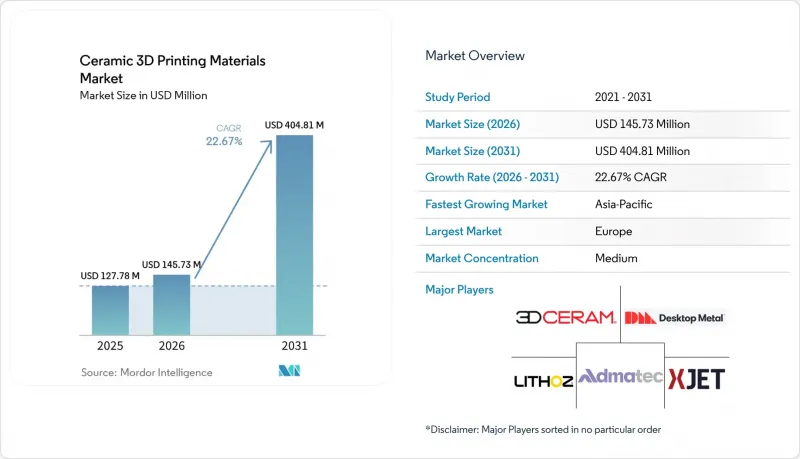
에 따르면 세라믹 3D 프린팅 재료 시장 규모는 2025년에 1억 2,778만 달러로 추정되며, 2026년 1억 4,573만 달러에서 2031년까지 4억 481만 달러로 확대되어, 예측 기간(2026-2031년) 사이에 CAGR 22.67%로 확대될 것으로 전망됩니다.
세계 세라믹 3D 프린팅 재료 시장의 동향 및 인사이트
경량이며 내열성이 뛰어난 항공우주·방위용 부품
사프란 에어크래프트 엔진즈(Safran Aircraft Engines)는 2025년 10월 장느빌리에(Jeanne-Vilier) 시설에 리토즈(Lithoz)사의 CeraFab S65 프린터 3대를 도입하여, 차세대 터빈 블레이드용 세라믹 주조 코어의 양산을 실현했습니다. 이번 도입으로 프린터와 소재 시스템은 실험실 환경이 아닌 생산 환경에 배치되었으며, 연속적인 주조 코어 배치 간 재현성이 요구됩니다. 터빈 블레이드는 1,300°C를 넘는 온도에서 작동하기 때문에 복잡한 내부 냉각 채널이 필요하지만, 세라믹 적층 제조를 통해 기존의 코어 사출 성형으로는 재현할 수 없는 채널을 제작할 수 있습니다. 이러한 용도가 양산 단계에 접어들면, 인증된 배합이 장기적인 부품 프로그램의 일부가 되므로 세라믹 3D 프린팅 재료 시장은 그 혜택을 누리게 됩니다. 이러한 연관성으로 인해 프린터의 성능뿐만 아니라 소재의 일관성, 열적 거동 및 공정 문서화가 중요해집니다. 2026년 5월, AeroVironment사는 미국 공군 연구소로부터 공력 차량, 로켓 추진, 투명 장갑 및 열 보호 타일을 대상으로 한 세라믹 및 세라믹 매트릭스 복합재료 개발에 관한 2,000만 달러 규모의 CAMP 계약을 수주했습니다. 항공우주 분야의 인증 프로그램은 우주 추진 및 초음속 용도로 전환되는 배합 개발 노력을 지원할 수도 있습니다. 항공우주 통신 시스템용 세라믹 재료에는 유전율 2-6 및 90%를 초과하는 간섭파 내성이 요구됩니다. 이 때문에 전문 배합 기술자가 활용할 수 있는 적격 원료의 선택지는 제한적입니다.
환자 맞춤형 치과용 및 생체용 세라믹
2025년 4월에 발표된 5년간의 임상 추적 조사에 따르면, Lithoz CeraFab 시스템으로 제조된 환자 맞춤형 β-인산삼칼슘 임플란트의 종합 성공률은 92%였습니다. 보고된 결과는 자가 골 블록에 필적하는 골전도성 및 골유도성을 입증하고 있으며, 규제 대상인 의료 현장에서 이러한 임플란트의 사용을 뒷받침합니다. 이러한 증거는 병원 구매 담당자가 개별 임상 사례에서 일상적인 구매로 전환하기 전에 장기적인 성과를 요구할 때 특히 중요합니다. 디지털 워크플로우를 확대하고 있는 병원 시스템 및 치과 그룹에 서비스를 제공하는 재료 공급업체에게 ISO 13485 인증은 필수 조달 요건이며, Lithoz사는 2025년에 자사의 재료 생산 품질 관리 시스템에 대해 이 인증을 획득했습니다. 이러한 진전은 세라믹 3D 프린팅 재료 시장에 유익합니다. 왜냐하면 임상적 증거를 통해 검증된 소재와 일상적인 조달 간의 격차가 좁혀지는 한편, 공급업체 역시 소재의 추적성, 임상 평가 및 분산형 치과 생산에 필요한 재현성을 뒷받침하기 위해 문서화된 품질 관리 시스템이 필요하기 때문입니다. Lithoz사의 보고에 따르면, 이 회사의 최대 의료 분야 고객은 2025년에 400만 개의 부품을 생산하고 있으며, 이는 맞춤형 바이오세라믹 생산이 상당한 규모로 운영 가능함을 보여줍니다. 플린더스 대학교의 조사에 따르면, 하이드록시아파타이트 및 지르코니아로 제작된 치과용 스캐폴드에서 0.21%에서 0.27%의 치수 오차가 보고되었으며, 이는 임상용 프린팅에 요구되는 정밀도 기준을 뒷받침하는 것입니다.
재료, 설비 및 후처리의 높은 비용
고순도 알루미나, 안정화 지르코니아 및 실리콘 카바이드 원료는 기존의 폴리머 필라멘트에 비해 1kg당 비용이 훨씬 더 높습니다. 산업용 세라믹 적층 제조 시스템의 가격은 일반적으로 대당 15만 달러에서 50만 달러 이상이며, 여기에는 소성로 및 기타 후처리 인프라 비용은 포함되어 있지 않습니다. 구매자는 소성로의 용량, 에너지 소비량, 안정적인 후처리 공정을 확립하는 데 필요한 시간도 고려해야 합니다. 이러한 비용 구조로 인해, 처음 도입하는 곳은 검증된 사용 사례가 있고 수년 내에 투자 회수가 예상되는 조직으로 제한됩니다. 2025년 11월, XJet사는 Carmel 1400 시리즈에 비해 초기 투자 비용을 60%에서 70%까지 절감한 것으로 알려진 ‘Carmel Pro’를 발표하며, 중소기업 및 연구 기관을 타겟으로 삼고 있습니다. 세라믹 3D 프린팅 재료 시장에서는 고객이 장비를 직접 구매하지 않고도 양산 능력을 확보할 수 있도록 지원하는 위탁 생산 경로도 중요한 역할을 하고 있습니다. 이러한 경로를 통해 OEM 제조사는 인증된 장비 및 소재에 대한 접근성을 유지하면서 대차대조표상의 부담을 줄일 수 있습니다. Lithoz사의 보고에 따르면, 해당사의 고객 중 20%가 이미 도입된 CeraFab 시스템의 50% 이상을 차지하고 있어, 위탁 제조에 대한 집중적인 접근이 얼마나 중요한지 여실히 드러나고 있습니다.
부문별 분석
2025년, 세라믹 3D 프린팅 재료 시장에서 분말은 46.56%의 점유율을 차지했습니다. 이는 선택적 레이저 소결(SLS), 바인더 제팅, 다이렉트 인클레이팅과의 호환성 덕분입니다. 이러한 폭넓은 호환성 덕분에 분말은 여러 장비 방식을 아우르는 유연성이 필요한 산업용 프로그램에서 표준 원료로 자리 잡았습니다. 알루미나, 지르코니아, 실리콘 카바이드, 실리콘 나이트라이드는 일반적으로 분말 형태로 가공되므로, 이 형태는 다양한 작동 조건에 대응할 수 있습니다. 이러한 폭넓은 소재 라인업을 통해 분말 공급업체들은 항공우주, 전자, 헬스케어 및 산업용 분야 등에서 비즈니스 기회를 얻고 있습니다. 세라믹 3D 프린팅 재료 시장에서 분말 기반 수요는 여러 프린팅 플랫폼에 걸쳐 유연한 소재 옵션을 필요로 하는 생산 사용자들에 의해 주도되고 있습니다.
세라믹 수지는 2026년부터 2031년까지 연평균 성장률(CAGR) 24.45%로 성장할 것으로 예상되며, 이는 재료 형태 부문 내에서 가장 높은 성장률입니다. 조내 광중합 플랫폼은 표면 품질과 치수 정밀도가 광경화성 현탁액에 있어 매우 중요한 치과 및 의료 분야에서 채택이 확대되고 있습니다. Lithoz사의 리소그래피 기반 세라믹 제조(LCM) 기술은 세라믹이 혼합된 광중합 현탁액을 처리하는 것으로, 이 회사의 고객들은 2025년에 수백만 개의 의료용 부품을 생산했습니다. 슬러리가 여전히 중요하게 여겨지는 이유는 광중합 시스템에서 각 성형마다 점도와 경화 깊이를 제어해야 하기 때문입니다. 페이스트, 잉크 및 결합 세라믹 필라멘트는 다이렉트 라이트, 잉크젯, 압출 성형 등 각 제조 공정을 지원하며, 사용자들은 폴리머 프린팅에서 점차 전환하고 있으며 더 높은 다공성을 수용하고 있습니다.
지역별 분석
2025년 매출액 중 유럽이 35.34%를 차지했습니다. 이는 오스트리아, 독일, 프랑스의 기술 개발 기업 및 수탁 제조 기업의 존재에 힘입은 결과입니다. 독일에서는 세라믹 적층 조형에 관한 연구를 산업용 생산 용도로 전환하기 위한 노력이 계속해서 활발히 진행되고 있습니다. 코블렌츠 대학의 3DKI 프로젝트는 유럽 및 주 정부로부터 지원받은 780만 유로(약 902만 달러)의 자금을 활용하여 라인란트-팔츠주의 세라믹 제조업체에 인공지능 통합을 더욱 추진하고 있습니다. 2026년 봄 독일 기계·플랜트 산업협회(VDMA)가 실시한 조사에 따르면, 조사 대상인 독일 적층 제조 기업의 76%가 향후 2년 동안 국내 시장의 성장을 예상하고 있습니다. 프랑스 항공우주 공급망에서는 사프란(Safran)사의 주조용 코어 생산을 통해 실리카계 세라믹 슬러리에 대한 지속적인 수요가 발생하고 있으며, 북유럽의 임상 사용자와 이탈리아의 산업용 세라믹 공급업체들도 이 지역을 더욱 뒷받침하고 있습니다.
아시아태평양은 2026년부터 2031년까지 연평균 성장률(CAGR) 25.89%로 확대될 것으로 예측되며, 세라믹 3D 프린팅 재료 시장에서 가장 빠르게 성장하는 지역이 될 전망입니다. 이 지역에서는 대규모 제조, 반도체 투자, 그리고 확대되는 국방 조달이 예상됩니다. NGK가 계획 중인 700억 엔(4억 4,000만 달러) 규모의 노미(Nomi) 공장은 2029년까지 세라믹 생산능력을 20% 증강하는 것을 목표로 하고 있습니다. 교세라의 투자 계획은 반도체 제조 장비 및 인공지능(AI) 데이터센터용 세라믹에 중점을 두고 있는 반면, TOTO의 확장 계획은 정전식 척 및 웨이퍼 가공용 부품을 우선시하고 있습니다. 중국은 알루미나 및 지르코니아 분말의 국내 생산능력을 구축하고 있는 반면, 한국, 아세안(ASEAN) 국가들, 인도는 전자, 방위, 의료기기 생산을 통해 수요를 확대하고 있습니다.
북미는 세라믹 3D 프린팅 재료 시장에서 큰 점유율을 차지하고 있으며, 미국에서는 국방 예산에 따른 연구와 활발한 항공우주 공급망이 이를 뒷받침하고 있습니다. 미국 공군 연구소가 AeroVironment사에 수여한 2,000만 달러 규모의 CAMP 보조금은 첨단 세라믹 및 세라믹 매트릭스 복합재료에 관한 연구를 지속적으로 지원하고 있습니다. 미국의 의료·치과 분야에서는 환자별로 맞춤 제작된 정형외과용 및 두개악안면용 임플란트를 위해 바이오세라믹을 이용한 적층 조형 기술이 채택되고 있습니다. 한편, 캐나다와 멕시코에서는 전자기기 수탁 제조 및 에너지 분야의 마모 부품을 통해 2차적인 수요가 발생하고 있습니다. 브라질에서는 항공우주 및 에너지 분야에서 단기적인 비즈니스 기회가 예상되며, 사우디아라비아에서는 산업 다각화가 진행되면서 현지 공급업체 개발이 여전히 필요한 첨단 소재에 대한 수요를 견인하고 있습니다.
기타 혜택:
- 엑셀 형식의 시장 예측(ME) 시트
- 3개월간의 애널리스트 지원
자주 묻는 질문
목차
제1장 소개
- 조사 가정과 시장 정의
- 조사 범위
제2장 조사 방법
제3장 주요 요약
제4장 시장 구도
- 시장 개요
- 시장 성장 촉진요인
- 시장 성장 억제요인
- 가치 및 공급망 분석
- Porter's Five Forces 분석
제5장 시장 규모와 성장 예측
- 소재 형태별
- 세라믹 유형별
- 최종 이용 산업별
- 지역별
- 아시아태평양
- 중국
- 인도
- 일본
- 한국
- ASEAN 국가
- 기타 아시아태평양 국가
- 북미
- 미국
- 캐나다
- 멕시코
- 유럽
- 독일
- 영국
- 프랑스
- 이탈리아
- 북유럽 국가
- 기타 유럽 국가
- 남미
- 브라질
- 아르헨티나
- 기타 남미 국가
- 중동 및 아프리카
- 사우디아라비아
- 남아프리카공화국
- 기타 중동 및 아프리카 국가
- 아시아태평양
제6장 경쟁 구도
- 시장 집중도
- 전략적 동향
- 시장 점유율·순위 분석
- 기업 개요
- 3DCeram
- Admatec
- AMAREA Technology GmbH
- Baikowski SAS
- CeramTec GmbH
- Ceraprint s.r.o.
- CONCR3DE
- Desktop Metal, Inc.
- Formlabs
- Johnson Matthey
- Lithoz
- Mitsui Kinzoku Co., Ltd.
- Nanoe
- Tethon3D
- XJet Ltd.
- ZRapid Tech
제7장 시장 기회와 향후 전망
KSM 26.10.29According to Mordor Intelligence, the ceramic 3D printing materials market size was estimated at USD 127.78 million in 2025 and is estimated to grow from USD 145.73 million in 2026 to USD 404.81 million by 2031, at a CAGR of 22.67% during the forecast period (2026-2031).
Global Ceramic 3D Printing Materials Market Trends and Insights
Lightweight, High-Temperature Aerospace and Defense Parts
Safran Aircraft Engines installed three Lithoz CeraFab S65 printers at its Gennevilliers facility in October 2025 to enable serial production of ceramic casting cores for next-generation turbine blades. The deployment places the printer and material system within a production environment rather than a laboratory setting, requiring repeatability across successive casting-core batches. Turbine blades need complex internal cooling channels to operate above 1,300°C, and ceramic additive manufacturing can produce channels that conventional core injection molding cannot replicate. The ceramic 3D printing materials market benefits when these applications enter serial production because qualified formulations become part of long-running component programs. This linkage makes material consistency, thermal behavior, and process documentation important alongside printer performance. In May 2026, AeroVironment received a USD 20 million CAMP contract from the U.S. Air Force Research Laboratory for ceramic and ceramic matrix composite development, covering aerodynamic vehicles, rocket propulsion, transparent armor, and thermal-protection tiles. Aerospace qualification programs can also support formulation work that transfers to space propulsion and hypersonic applications. Ceramic materials for aerospace communication systems require dielectric constants of 2 to 6 and anti-jamming capability exceeding 90%, which narrows the pool of qualified feedstocks for specialist formulators.
Patient-Specific Dental and Biomedical Ceramics
A five-year clinical follow-up published in April 2025 reported a 92% total success rate for patient-specific beta-tricalcium phosphate implants produced on the Lithoz CeraFab System. The reported outcomes demonstrated osteoconductivity and osteoinductivity comparable to those of autogenous bone blocks, supporting the use of these implants in regulated healthcare settings. This evidence is particularly relevant where hospital buyers require long-term outcomes before shifting from individual clinical cases to routine purchasing. ISO 13485 certification has become a procurement requirement for material suppliers serving hospital systems and dental groups that are scaling digital workflows, and Lithoz achieved this certification for its material production quality management system in 2025. The ceramic 3D printing materials market benefits from this development because clinical evidence reduces the gap between a validated material and routine purchasing, while suppliers also need documented quality systems to support material traceability, clinical review, and the repeatability required for distributed dental production. Lithoz reported that its largest medical customer produced 4 million parts in 2025, demonstrating that customized bioceramic production can operate at substantial scale. Research from Flinders University reported dimensional discrepancies of 0.21% to 0.27% for hydroxyapatite and zirconia dental scaffolds, which supports precision requirements for clinical printing.
High Material, Equipment, and Post-Processing Costs
High-purity alumina, stabilized zirconia, and silicon carbide feedstocks cost significantly more per kilogram than conventional polymer filament. Industrial ceramic additive manufacturing systems typically cost between USD 150,000 and more than USD 500,000 per unit, before accounting for furnaces and other post-processing infrastructure. Buyers must also consider furnace capacity, energy consumption, and the time required to establish a stable post-processing route. This cost structure limits first-time adoption to organizations with verified use cases and multiyear payback expectations. In November 2025, XJet introduced the Carmel Pro with a stated upfront investment 60% to 70% lower than the Carmel 1400 series, targeting small and medium enterprises and research centers. The ceramic 3D printing materials market also relies on contract production routes that help customers reach serial capacity without a direct equipment purchase. These routes can reduce the balance-sheet commitment for original equipment manufacturers while maintaining access to qualified equipment and materials. Lithoz reported that 20% of its customers account for more than 50% of installed CeraFab systems, underscoring the importance of concentrated access to contract manufacturing.
Other drivers and restraints analyzed in the detailed report include:
- Complex Thermal-Management and Semiconductor Components
- AI-Assisted Process Optimization and Digital Qualification
- Debinding, Sintering, and Dimensional-Shrinkage Complexity
For complete list of drivers and restraints, kindly check the Table Of Contents.
Segment Analysis
Powders held 46.56% of the ceramic 3D printing materials market share in 2025, driven by their compatibility with selective laser sintering, binder jetting, and direct ink writing. This broad compatibility makes powders the standard feedstock for industrial programs that require flexibility across multiple equipment routes. Alumina, zirconia, silicon carbide, and silicon nitride are routinely processed as powders, enabling the format to serve varied operating conditions. This material range gives powder suppliers exposure across aerospace, electronics, healthcare, and industrial applications. Powder-based demand in the ceramic 3D printing materials market is driven by production users who require flexible material options across multiple print platforms.
Ceramic resins are forecast to grow at a 24.45% CAGR from 2026 to 2031, the fastest rate within the material form segment. Vat photopolymerization platforms are gaining adoption in dental and medical applications, where surface quality and dimensional precision are critical for photocurable suspensions. Lithoz's Lithography-based Ceramic Manufacturing (LCM) technology processes ceramic-loaded photopolymer suspensions, and its customers produced millions of medical parts in 2025. Slurries remain important because photopolymerization systems require controlled viscosity and cure depth across each build. Pastes, inks, and bound ceramic filaments support direct-write, inkjet, and extrusion routes, with users transitioning from polymer printing and accepting higher porosity.
Complete Report Scope:
- By Material Form
- Powders
- Ceramic Resins
- Slurries
- Pastes and Inks
- Bound Ceramic Filaments
- By Ceramic Type
- Oxide Ceramics
- Non-Oxide Ceramics
- Bioceramics
- Glass Ceramics
- Others
- By End-User Industry
- Aerospace and Defense
- Healthcare and Dental
- Electronics and Semiconductor
- Industrial Manufacturing
- Other Industries
- By Geography
- Asia-Pacific
- China
- India
- Japan
- South Korea
- ASEAN Countries
- Rest of Asia-Pacific
- North America
- United States
- Canada
- Mexico
- Europe
- Germany
- United Kingdom
- France
- Italy
- NORDIC Countries
- Rest of Europe
- South America
- Brazil
- Argentina
- Rest of South America
- Middle-East and Africa
- Saudi Arabia
- South Africa
- Rest of Middle-East and Africa
- Asia-Pacific
Geography Analysis
Europe accounted for 35.34% of revenue in 2025, supported by technology developers and contract manufacturers in Austria, Germany, and France. Germany remains active in transferring ceramic additive manufacturing research into production applications for industrial users. The University of Koblenz's 3DKI project is using EUR 7.8 million (~USD 9.02 million) in European and state funding to deepen the integration of artificial intelligence for ceramic producers in Rhineland-Palatinate. A Verband Deutscher Maschinen- und Anlagenbau (VDMA) survey conducted in spring 2026 found that 76% of surveyed German additive manufacturing companies expect domestic growth over the following two years. France's aerospace supply chain is generating serial demand for silica-based ceramic slurries through Safran's casting-core production, while Nordic clinical users and Italian technical-ceramics suppliers provide further regional support.
Asia-Pacific is forecast to expand at a 25.89% CAGR from 2026 to 2031, making it the fastest-growing geography in the ceramic 3D printing materials market. The region combines large-scale manufacturing, semiconductor investment, and expanding defense procurement. NGK's planned JPY 70 billion (USD 440 million) Nomi facility targets a 20% ceramics capacity increase by 2029. Kyocera's investment plan focuses on semiconductor equipment and artificial intelligence data-center ceramics, while Toto's expansion prioritizes electrostatic chucks and wafer-processing components. China is building domestic capabilities in alumina and zirconia powders, while South Korea, ASEAN countries, and India are adding demand through electronics, defense, and medical-device production.
North America holds a significant share of the ceramic 3D printing materials market, with the United States supported by defense-funded research and an active aerospace supply chain. The U.S. Air Force Research Laboratory's USD 20 million CAMP award to AeroVironment sustains work on advanced ceramic and ceramic matrix composite materials. The United States medical and dental sector is adopting bioceramic additive manufacturing for patient-specific orthopedic and cranio-maxillofacial implants, while Canada and Mexico provide secondary demand through electronics contract manufacturing and energy-sector wear components. Brazil offers a near-term opportunity in aerospace and energy, while Saudi Arabia's industrial diversification is driving demand for advanced materials that still require local supplier development.
- 3DCeram
- Admatec
- AMAREA Technology GmbH
- Baikowski SAS
- CeramTec GmbH
- Ceraprint s.r.o.
- CONCR3DE
- Desktop Metal, Inc.
- Formlabs
- Johnson Matthey
- Lithoz
- Mitsui Kinzoku Co., Ltd.
- Nanoe
- Tethon3D
- XJet Ltd.
- ZRapid Tech
Additional Benefits:
- The market estimate (ME) sheet in Excel format
- 3 months of analyst support
TABLE OF CONTENTS
1 Introduction
- 1.1 Study Assumptions and Market Definition
- 1.2 Scope of the Study
2 Research Methodology
3 Executive Summary
4 Market Landscape
- 4.1 Market Overview
- 4.2 Market Drivers
- 4.2.1 Industrialization of High-Performance Ceramic Components
- 4.2.2 Lightweight, High-Temperature Aerospace and Defense Parts
- 4.2.3 Patient-Specific Dental and Biomedical Ceramics
- 4.2.4 Complex Thermal-Management and Semiconductor Components
- 4.2.5 AI-Assisted Process Optimization and Digital Qualification
- 4.3 Market Restraints
- 4.3.1 High Material, Equipment and Post-Processing Costs
- 4.3.2 Debinding, Sintering and Dimensional-Shrinkage Complexity
- 4.3.3 Qualification and Certification Lead Times in Regulated Industries
- 4.4 Value and Supply-Chain Analysis
- 4.5 Porter's Five Forces Analysis
- 4.5.1 Threat of New Entrants
- 4.5.2 Bargaining Power of Suppliers
- 4.5.3 Bargaining Power of Buyers
- 4.5.4 Threat of Substitutes
- 4.5.5 Competitive Rivalry
5 Market Size and Growth Forecasts (Value)
- 5.1 By Material Form
- 5.1.1 Powders
- 5.1.2 Ceramic Resins
- 5.1.3 Slurries
- 5.1.4 Pastes and Inks
- 5.1.5 Bound Ceramic Filaments
- 5.2 By Ceramic Type
- 5.2.1 Oxide Ceramics
- 5.2.2 Non-Oxide Ceramics
- 5.2.3 Bioceramics
- 5.2.4 Glass Ceramics
- 5.2.5 Others
- 5.3 By End-User Industry
- 5.3.1 Aerospace and Defense
- 5.3.2 Healthcare and Dental
- 5.3.3 Electronics and Semiconductor
- 5.3.4 Industrial Manufacturing
- 5.3.5 Other Industries
- 5.4 By Geography
- 5.4.1 Asia-Pacific
- 5.4.1.1 China
- 5.4.1.2 India
- 5.4.1.3 Japan
- 5.4.1.4 South Korea
- 5.4.1.5 ASEAN Countries
- 5.4.1.6 Rest of Asia-Pacific
- 5.4.2 North America
- 5.4.2.1 United States
- 5.4.2.2 Canada
- 5.4.2.3 Mexico
- 5.4.3 Europe
- 5.4.3.1 Germany
- 5.4.3.2 United Kingdom
- 5.4.3.3 France
- 5.4.3.4 Italy
- 5.4.3.5 NORDIC Countries
- 5.4.3.6 Rest of Europe
- 5.4.4 South America
- 5.4.4.1 Brazil
- 5.4.4.2 Argentina
- 5.4.4.3 Rest of South America
- 5.4.5 Middle-East and Africa
- 5.4.5.1 Saudi Arabia
- 5.4.5.2 South Africa
- 5.4.5.3 Rest of Middle-East and Africa
- 5.4.1 Asia-Pacific
6 Competitive Landscape
- 6.1 Market Concentration
- 6.2 Strategic Moves
- 6.3 Market Share (%)/Ranking Analysis
- 6.4 Company Profiles (includes Global Overview, Market Overview, Core Segments, Financials as available, Strategic Information, Products and Services, and Recent Developments)
- 6.4.1 3DCeram
- 6.4.2 Admatec
- 6.4.3 AMAREA Technology GmbH
- 6.4.4 Baikowski SAS
- 6.4.5 CeramTec GmbH
- 6.4.6 Ceraprint s.r.o.
- 6.4.7 CONCR3DE
- 6.4.8 Desktop Metal, Inc.
- 6.4.9 Formlabs
- 6.4.10 Johnson Matthey
- 6.4.11 Lithoz
- 6.4.12 Mitsui Kinzoku Co., Ltd.
- 6.4.13 Nanoe
- 6.4.14 Tethon3D
- 6.4.15 XJet Ltd.
- 6.4.16 ZRapid Tech
7 Market Opportunities and Future Outlook
- 7.1 White-Space and Unmet-Need Assessment


