

|
시장보고서
상품코드
2154485
일회용 복강경 기구 : 시장 점유율 분석, 업계 동향과 통계, 성장 예측(2026-2031년)Disposable Laparoscopic Instruments - Market Share Analysis, Industry Trends & Statistics, Growth Forecasts (2026 - 2031) |
||||||
 Mordor Intelligence
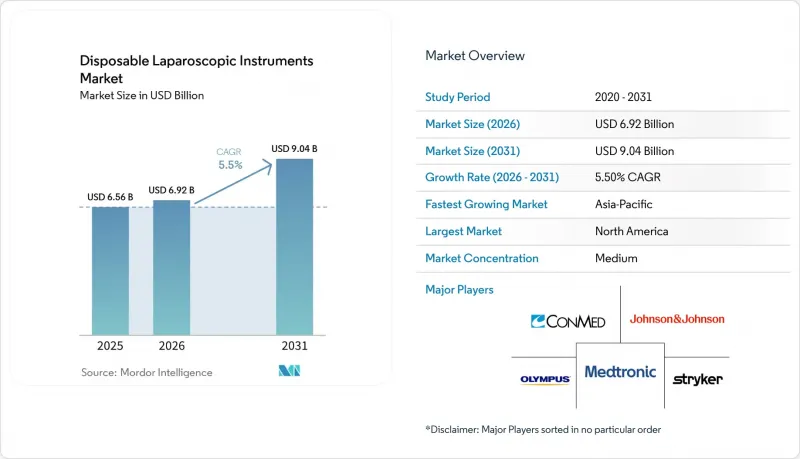
에 따르면 일회용 복강경용 기구 시장 규모는 2025년 65억 6,000만 달러에서 2026년에는 69억 2,000만 달러로 확대되어, 2031년까지 90억 4,000만 달러에 달할 것으로 예상되며, 2026년부터 2031년까지 CAGR 5.5%로 성장할 것으로 전망됩니다.
전 세계 일회용 복강경 기구 시장의 동향 및 인사이트
최소침습 수술 건수의 증가
최소침습 수술은 일회용 복강경 기구 시장의 주요 수요 요인으로 자리 잡고 있습니다. 복강경 탈장 교정술, 담낭 절제술 및 종양학 수술은 회복 기간 단축과 입원 일수 감소에 기여하며, 병원이 수술실 가동률을 최적화할 수 있도록 돕고 있습니다. 로봇 수술의 보급에 따라, 이에 대응하는 일회용 클립 어프라이어, 스테이플러용 리로드 카트리지 및 혈관 봉합 팁의 사용이 확대되고 있습니다. 따라서 기본 기구에 대한 가격 압박이 있음에도 불구하고, 수술 건수의 증가는 지속적인 수요를 뒷받침하고 있습니다.
감염 관리에 있어 멸균된 일회용 기구의 선호
감염 예방은 일회용 복강경 기구 시장에서 멸균된 일회용 기구의 채택을 촉진하는 중요한 요인으로 계속 작용하고 있습니다. 2025년 연구에 따르면, 표준 세척 후에도 검사 대상이었던 모든 재사용 가능한 중공 수술기구에서 눈에 띄는 오염이나 잔류물이 확인되었으며, 95%에서는 녹 반점이 관찰되었습니다. 또한, 2025년에 실시된 또 다른 조사에서는 연속으로 발생한 2건의 세라티아 마르세센스(Serratia marcescens)에 의한 수술 관련 집단 감염이 재사용 가능한 LigaSure 기기의 부적절한 재처리와 관련이 있는 것으로 밝혀졌습니다. 이러한 연구 결과는 복잡하고 위험도가 높은 기구에 대해 일회용 대체품을 고려해야 할 근거가 되고 있습니다.
완전 일회용 트로카 시스템의 높은 수명주기 비용
지속가능성에 대한 요구 사항은, 특히 유럽의 입찰 과정에서 일회용 복강경 기구 시장에 대한 압박을 가중시키고 있습니다. 2026년 체계적 문헌인사이트에서는 연구 방법론상의 차이로 인해 결정적인 결론을 내릴 수는 없었으나, 일회용 기구가 재사용 가능한 대체품보다 환경 부하가 더 높다는 사실이 밝혀졌습니다. 또 다른 수명주기 연구에 따르면, 일회용 트로카의 경우 복강경 담낭 절제술 1건당 배출량이 1.13 kgCO2e인 반면, 재사용 가능한 트로카는 0.236 kgCO2e인 것으로 산출되었습니다. 이 조사를 통해 재사용 가능한 트로카를 사용하면 1건당 배출량을 21% 줄일 수 있는 것으로 밝혀졌으며, 제조사는 조달 평가 및 입찰 사양에서 폐기물, 포장, 처리 및 수명주기 성능에 대한 대응을 한층 더 강화할 필요가 커지고 있습니다.
부문 분석
2025년, 트로카는 매출의 18.54%를 차지하며 최대 제품 카테고리가 되었습니다. 복강경 수술 전반에서 접근 포트로 사용되기 때문에 각 수술 사례마다 접근 포트가 필요하다는 점에서 안정적인 수요가 뒷받침되고 있습니다. 블레이드리스 제품 및 광학식 진입 제품은 기존의 블레이드가 장착된 모델보다 높은 가격으로 책정되어 있습니다. 전기 수술 기기는 혈관 봉합, 초음파 절단 및 연기 관리 기능을 통합한 제품에 대한 수요에 힘입어 2031년까지 연평균 성장률(CAGR) 7.22%로 성장할 것으로 예측됩니다. 올림푸스는 2025년 10월 유럽에서 ‘THUNDERBEAT II’를 출시했으며, 메드트로닉은 2025년 11월 ‘Tri-Staple’ 기술을 채택한 ‘Signia Circular Stapler’의 한정 출시를 발표했습니다.
글라스파, 가위, 집게, 해부용 집게, 클립 어프라이어 및 회수 기구는 제품 라인업 내에서 안정적인 중견 부문을 차지하고 있습니다. 이러한 제품에 대한 수요는 일반 외과, 산부인과 및 대장항문외과 분야의 수술 건수와 연동되어 있습니다. 스테이플러는 로봇 호환 리로드 카트리지가 수술 1회당 사용되며, 표준 복강경용 대체 제품보다 높은 가격에 판매되고 있어 전략적으로 중요한 위치를 계속 차지하고 있습니다. 에시콘은 3D 스테이플 기술을 탑재한 ‘에셸론 3000’을 기반으로 한 ‘에시콘 4000’ 스테이플러에 대해 CE 마크를 획득했습니다.
2025년에는 접근 및 포트 형성용 기구가 매출의 27.66%를 차지하며, 일회용 복강경 기구 시장에서 기능별 점유율 1위를 기록했습니다. 복강경 수술 1건당 2-4개의 접근 포트가 필요하기 때문에 안정적인 수요가 뒷받침되고 있습니다. 블레이드리스 및 광학식 트로카는 수술 건수의 증가 없이도 평균 단가를 끌어올리고 있습니다. 일회용 트로카에 대한 FDA 510(k) 신청에서는 일반적으로 생체적합성, 멸균 검증 및 보관 기간 시험이 대상이 되며, 확립된 규제 관련 문서를 보유한 공급업체가 유리합니다.
해부·절단 기구는 2031년까지 연평균 성장률(CAGR) 7.56%로 확대될 것으로 예측되며, 이는 기능별 카테고리 중 가장 높은 성장률입니다. 초음파, 양극성 및 하이브리드 기구는 기존의 단극성 가위와 비교하여 조직 절단 및 봉합을 한 단계로 수행하는 동시에 열의 횡방향 확산을 줄여줍니다. 복강경 및 로봇 수술 플랫폼에서는 기계식 가위보다 다기능 에너지 기구가 선호됩니다. 스테이플링, 조직 밀봉, 흡입, 관류, 연기 관리, 봉합 및 검체 회수 제품은 복잡한 종양학 수술과 수술 시간의 장기화로 인해 혜택을 보고 있습니다.
지역별 분석
북미는 2025년 매출의 39.56%를 차지할 것으로 예상되며, 이는 높은 복강경 수술 건수, 문서화된 무균 요건, 그리고 확립된 외래 수술 보험 급여에 힘입은 결과입니다. CMS의 2026년 규정에 따라 외래 수술 센터의 대상 수술 목록에 547건의 수술이 추가되고, 입원 환자 전용 서비스 285건이 삭제됨에 따라 외래 시설에 대한 수요가 촉진되었습니다. 캐나다에서도 유사한 도입 양상이 관찰된 반면, 멕시코의 주요 도시에서는 사립 병원과 의료 관광이 수술 건수 증가를 뒷받침했습니다. 그러나 공동 조달 기관은 저비용 트로카 대체품을 우선시함으로써 공급업체의 이익률에 계속해서 압박을 가하고 있습니다.
아시아태평양은 2031년까지 연평균 성장률(CAGR) 6.90%로 성장할 것으로 예상되며, 이는 일회용 복강경 기구 시장에서 지역별 가장 높은 성장률입니다. 중국은 이 지역 내에서 가장 많은 수술 건수를 기록했으나, 중국의 수량 기반 조달 프로그램으로 인해 해외 공급업체의 평균 판매 가격이 하락했으며, 2025년과 2026년에는 이 조치가 최소침습 스테이플러로까지 확대되었습니다. 일본, 한국, 호주는 첨단 에너지 기술 및 로봇 수술용 기기에 있어 계속해서 주요 프리미엄 시장으로 남아 있는 반면, 인도는 ‘생산 연계형 인센티브(PLI) 프로그램’을 통해 국내 의료기기 생산능력을 확대했습니다. 2025년에 도입된 중국의 ‘의료기기 등록 보유자 제도’는 국내에서 개발된 의료기기의 승인 절차를 효율화했습니다.
유럽 및 기타 지역이 나머지 매출을 차지했습니다. 규정(EU) 2017/745 제17조에 따라 일회용 의료기기의 재처리는 각국에서 승인된 시설로 제한되었으나, 유럽집행위원회가 2024년 11월에 실시한 조사에 따르면 27개 회원국 중 10개국이 어떤 형태로든 재처리를 허용하고 있는 것으로 나타났습니다. 이러한 체계는 새로운 멸균 의료기기에 대한 수요를 뒷받침했지만, 입찰에서는 수명주기 비용, 폐기물 문제, 가격 압박 등이 여전히 중요한 과제로 남아 있었습니다. 중동 및 아프리카에서는 새로운 3차 외과 의료 센터의 개설이 호재로 작용했습니다. 한편, 브라질과 아르헨티나의 민간 병원에서는 공공 부문의 예산 제약에도 불구하고 일회용 키트가 채택되었습니다.
기타 혜택:
- 엑셀 형식의 시장 예측(ME) 시트
- 3개월간의 애널리스트 지원
자주 묻는 질문
목차
제1장 소개
- 조사 가정과 시장 정의
- 조사 범위
제2장 조사 방법
제3장 주요 요약
제4장 시장 구도
- 시장 개요
- 시장 성장 촉진요인
- 시장 성장 억제요인
- 가치 및 공급망 분석
- 규제 상황
- 기술 전망
- Porter's Five Forces 분석
제5장 시장 규모와 성장 예측
- 제품 유형별
- 기기 기능별
- 시술 유형별
- 용도별
- 최종사용자별
- 지역별
- 북미
- 미국
- 캐나다
- 멕시코
- 유럽
- 독일
- 영국
- 프랑스
- 이탈리아
- 스페인
- 기타 유럽 국가
- 아시아태평양
- 중국
- 인도
- 일본
- 호주
- 한국
- 기타 아시아태평양 국가
- 중동 및 아프리카
- GCC
- 남아프리카공화국
- 기타 중동 및 아프리카 국가
- 남미
- 브라질
- 아르헨티나
- 기타 남미 국가
- 북미
제6장 경쟁 구도
- 시장 집중도
- 시장 점유율 분석
- 기업 개요
- Applied Medical Resources Corporation
- B. Braun Melsungen AG
- BOWA electronic GmbH & Co. KG
- CONMED Corporation
- Cook Group Incorporated
- CooperSurgical, Inc.
- Hangzhou Kangji Medical Instruments Co., Ltd.
- Johnson & Johnson(Ethicon, Inc.)
- Karl Storz SE & Co. KG
- KLS Martin Group
- LaproSurge Ltd
- Medtronic plc
- Olympus Corporation
- Peters Surgical
- Purple Surgical Holdings Limited
- Richard Wolf GmbH
- Smith & Nephew plc
- Stryker Corporation
- Surgical Innovations Group plc
- Teleflex Incorporated
- Trokamed GmbH
- Victor Medical Instruments Co., Ltd.
- Zhejiang Geyi Medical Instrument Co., Ltd.
제7장 시장 기회와 향후 전망
KSM 26.10.29According to Mordor Intelligence, the disposable laparoscopic instruments market size is expected to increase from USD 6.56 billion in 2025 to USD 6.92 billion in 2026 and reach USD 9.04 billion by 2031, growing at a CAGR of 5.5% over 2026-2031.
Global Disposable Laparoscopic Instruments Market Trends and Insights
Rising Minimally Invasive Surgery Volumes
Minimally invasive procedures remain a key demand driver for the disposable laparoscopic instruments market. Laparoscopic hernia repair, cholecystectomy, and oncology procedures support shorter recovery periods and lower bed-day requirements, helping hospitals optimize operating room capacity. Robotic surgery has expanded the use of compatible single-use clip appliers, stapler reloads, and vessel-sealing tips. Higher procedure volumes therefore continue to support recurring demand despite pricing pressure on basic instruments.
Infection-Control Preference for Sterile Single-Use Tools
Infection prevention remains a key factor driving the adoption of sterile single-use tools in the disposable laparoscopic instruments market. A 2025 study found visible soil or debris on all inspected reusable lumened surgical instruments after standard cleaning, while 95% had rust patches. A separate 2025 investigation linked two consecutive Serratia marcescens surgical outbreaks to inadequate reprocessing of reusable LigaSure devices. These findings support the evaluation of disposable alternatives for complex, high-risk instruments.
Higher Lifecycle Cost of Fully Disposable Trocar Systems
Sustainability requirements are increasing pressure on the disposable laparoscopic instruments market, particularly in European tenders. A 2026 systematic review found that single-use instruments had higher environmental footprints than multi-use alternatives, although methodological differences limited definitive conclusions. A separate lifecycle study calculated emissions of 1.13 kgCO2e per laparoscopic cholecystectomy for disposable trocars, compared with 0.236 kgCO2e for reusable trocars. The study found that reusable trocars reduced per-procedure emissions by 21%, increasing the need for manufacturers to address waste, packaging, disposal, and lifecycle performance in procurement assessments and tender specifications.
Other drivers and restraints analyzed in the detailed report include:
- Operating-Room Turnover and Reprocessing Labor Avoidance
- Growth of Ambulatory Laparoscopic Procedures
- Sustainability and Sharps-Waste Scrutiny
For complete list of drivers and restraints, kindly check the Table Of Contents.
Segment Analysis
Trocars held 18.54% of revenue in 2025, making them the largest product category. Their use as access points across laparoscopic procedures supports consistent demand, as each case requires access ports. Bladeless and optical-entry products command higher prices than legacy bladed models. Electrosurgical devices are forecast to grow at a 7.22% CAGR through 2031, driven by demand for integrated vessel sealing, ultrasonic cutting, and smoke-management capabilities. Olympus launched THUNDERBEAT II in Europe in October 2025, while Medtronic announced a limited launch of the Signia Circular Stapler with Tri-Staple technology in November 2025.
Graspers, scissors, forceps, dissectors, clip appliers, and retrieval instruments represent a stable middle segment within the product mix. Demand for these products follows procedure volumes in general surgery, gynecology, and colorectal surgery. Staplers remain strategically important because robotic-compatible reloads are used once per engagement and sell at a premium to standard laparoscopic alternatives. Ethicon received a CE mark for the Ethicon 4000 stapler, based on the Echelon 3000 with 3D staple technology.
Access and port-creation instruments held 27.66% of revenue in 2025, representing the largest functional share of the disposable laparoscopic instruments market. Each laparoscopic procedure requires two to four access ports, supporting stable demand. Bladeless and optical-entry trocars increase average unit values without requiring higher procedure volumes. FDA 510(k) submissions for disposable trocars typically address biocompatibility, sterilization validation, and shelf-life testing, favoring suppliers with established regulatory documentation.
Dissection and cutting instruments are forecast to expand at a 7.56% CAGR through 2031, the fastest rate among functional categories. Ultrasonic, bipolar, and hybrid tools cut and seal tissue in a single step while reducing lateral thermal spread compared with conventional monopolar scissors. Laparoscopic and robotic platforms favor multifunctional energy instruments over mechanical scissors. Stapling, tissue-sealing, suction, irrigation, smoke-management, closure, and specimen-retrieval products benefit from complex oncology procedures and longer operating times.
Complete Report Scope:
- By Product Type
- Trocars
- Graspers
- Scissors
- Forceps and Dissectors
- Staplers
- Electrosurgical Devices
- Suction and Irrigation Devices
- Clip Appliers
- Retrieval and Closure Instruments
- Other Instruments
- By Instrument Function
- Access and Port Creation
- Dissection and Cutting
- Grasping and Tissue Handling
- Stapling and Tissue Sealing
- Suction, Irrigation, and Smoke Management
- Closure and Specimen Retrieval
- Others
- By Procedure Type
- Diagnostic Laparoscopy
- Operative Laparoscopy
- Advanced Therapeutic Laparoscopy
- Oncology-Linked Laparoscopy
- By Application
- General and Gastrointestinal Surgery
- Gynecological Surgery
- Urological Surgery
- Bariatric Surgery
- Thoracic and Pediatric Laparoscopy
- Others
- By End User
- Hospitals
- Ambulatory Surgical Centers
- Specialty Clinics
- Others
- By Geography
- North America
- United States
- Canada
- Mexico
- Europe
- Germany
- United Kingdom
- France
- Italy
- Spain
- Rest of Europe
- Asia-Pacific
- China
- India
- Japan
- Australia
- South Korea
- Rest of Asia-Pacific
- Middle East and Africa
- GCC
- South Africa
- Rest of Middle East and Africa
- South America
- Brazil
- Argentina
- Rest of South America
- North America
Geography Analysis
North America accounted for 39.56% of revenue in 2025, supported by high laparoscopic procedure volumes, documented sterility requirements, and established ambulatory reimbursement. The CMS 2026 rule added 547 surgical procedures to the Ambulatory Surgical Center Covered Procedures List and removed 285 inpatient-only services, supporting outpatient facility demand. Canada followed a similar adoption pattern, while private hospitals and medical tourism supported procedure growth in major Mexican cities. However, group purchasing organizations continued to pressure supplier margins by prioritizing lower-cost trocar alternatives.
Asia-Pacific is forecast to grow at a CAGR of 6.90% through 2031, the fastest regional rate in the disposable laparoscopic instruments market. China had the largest regional procedure base, although its volume-based procurement program reduced average selling prices for international suppliers and extended to minimally invasive staplers in 2025 and 2026. Japan, South Korea, and Australia remained key premium markets for advanced-energy and robotics-compatible devices, while India expanded domestic medical-device capacity through its Production-Linked Incentive program. China's Medical Device Registration Holder system, implemented in 2025, streamlined approval pathways for locally developed devices.
Europe and the remaining regions accounted for the balance of revenue. Article 17 of Regulation (EU) 2017/745 restricted single-use device reprocessing to nationally authorized settings, and the European Commission's November 2024 review found that 10 of 27 member states permitted some form of reprocessing. This framework supported demand for new sterile devices, although lifecycle costs, waste concerns, and pricing pressures remained important in tenders. The Middle East and Africa benefited from new tertiary surgical centers, while private hospitals in Brazil and Argentina adopted disposable kits despite public-sector budget constraints.
- Applied Medical Resources
- B. Braun
- BOWA electronic GmbH & Co. KG
- Conmed
- Cook Group
- The Cooper Companies
- Hangzhou Kangji Medical Instruments Co., Ltd.
- Johnson & Johnson
- Karl Storz
- KLS Martin Group
- LaproSurge Ltd
- Medtronic
- Olympus
- Peters Surgical
- Purple Surgical Holdings Limited
- Richard Wolf
- Smiths Group
- Stryker
- Surgical Innovations Group plc
- Teleflex
- Trokamed GmbH
- Victor Medical Instruments Co., Ltd.
- Zhejiang Geyi Medical Instrument Co., Ltd.
Additional Benefits:
- The market estimate (ME) sheet in Excel format
- 3 months of analyst support
TABLE OF CONTENTS
1 INTRODUCTION
- 1.1 Study Assumptions and Market Definition
- 1.2 Scope of the Study
2 RESEARCH METHODOLOGY
3 EXECUTIVE SUMMARY
4 MARKET LANDSCAPE
- 4.1 Market Overview
- 4.2 Market Drivers
- 4.2.1 Rising Minimally Invasive Surgery Volumes
- 4.2.2 Infection-Control Preference for Sterile Single-Use Tools
- 4.2.3 Operating-Room Turnover and Reprocessing Labor Avoidance
- 4.2.4 Growth of Ambulatory Laparoscopic Procedures
- 4.2.5 Optical and Advanced-Energy Instrument Migration
- 4.2.6 Procedure-Kit Standardization in Emerging Surgical Systems
- 4.3 Market Restraints
- 4.3.1 Higher Lifecycle Cost of Fully Disposable Trocar Systems
- 4.3.2 Sustainability and Sharps-Waste Scrutiny
- 4.3.3 Surgeon and Hospital Preference for Reusable Platforms
- 4.3.4 Sterility, Supply Continuity, and Device-Approval Complexity
- 4.4 Value/Supply-Chain Analysis
- 4.5 Regulatory Landscape
- 4.6 Technological Outlook
- 4.7 Porter's Five Forces Analysis
- 4.7.1 Competitive Rivalry Analysis
- 4.7.2 Threat of New Entrants Analysis
- 4.7.3 Bargaining Power of Suppliers Analysis
- 4.7.4 Bargaining Power of Buyers Analysis
- 4.7.5 Threat of Substitutes Analysis
5 MARKET SIZE AND GROWTH FORECASTS (VALUE, USD)
- 5.1 By Product Type
- 5.1.1 Trocars
- 5.1.2 Graspers
- 5.1.3 Scissors
- 5.1.4 Forceps and Dissectors
- 5.1.5 Staplers
- 5.1.6 Electrosurgical Devices
- 5.1.7 Suction and Irrigation Devices
- 5.1.8 Clip Appliers
- 5.1.9 Retrieval and Closure Instruments
- 5.1.10 Other Instruments
- 5.2 By Instrument Function
- 5.2.1 Access and Port Creation
- 5.2.2 Dissection and Cutting
- 5.2.3 Grasping and Tissue Handling
- 5.2.4 Stapling and Tissue Sealing
- 5.2.5 Suction, Irrigation, and Smoke Management
- 5.2.6 Closure and Specimen Retrieval
- 5.2.7 Others
- 5.3 By Procedure Type
- 5.3.1 Diagnostic Laparoscopy
- 5.3.2 Operative Laparoscopy
- 5.3.3 Advanced Therapeutic Laparoscopy
- 5.3.4 Oncology-Linked Laparoscopy
- 5.4 By Application
- 5.4.1 General and Gastrointestinal Surgery
- 5.4.2 Gynecological Surgery
- 5.4.3 Urological Surgery
- 5.4.4 Bariatric Surgery
- 5.4.5 Thoracic and Pediatric Laparoscopy
- 5.4.6 Others
- 5.5 By End User
- 5.5.1 Hospitals
- 5.5.2 Ambulatory Surgical Centers
- 5.5.3 Specialty Clinics
- 5.5.4 Others
- 5.6 By Geography
- 5.6.1 North America
- 5.6.1.1 United States
- 5.6.1.2 Canada
- 5.6.1.3 Mexico
- 5.6.2 Europe
- 5.6.2.1 Germany
- 5.6.2.2 United Kingdom
- 5.6.2.3 France
- 5.6.2.4 Italy
- 5.6.2.5 Spain
- 5.6.2.6 Rest of Europe
- 5.6.3 Asia-Pacific
- 5.6.3.1 China
- 5.6.3.2 India
- 5.6.3.3 Japan
- 5.6.3.4 Australia
- 5.6.3.5 South Korea
- 5.6.3.6 Rest of Asia-Pacific
- 5.6.4 Middle East and Africa
- 5.6.4.1 GCC
- 5.6.4.2 South Africa
- 5.6.4.3 Rest of Middle East and Africa
- 5.6.5 South America
- 5.6.5.1 Brazil
- 5.6.5.2 Argentina
- 5.6.5.3 Rest of South America
- 5.6.1 North America
6 COMPETITIVE LANDSCAPE
- 6.1 Market Concentration
- 6.2 Market Share Analysis
- 6.3 Company Profiles (includes Global Level Overview, Market Level Overview, Core Segments, Financials as available, Strategic Information, Market Rank/Share, Products and Services, Recent Developments)
- 6.3.1 Applied Medical Resources Corporation
- 6.3.2 B. Braun Melsungen AG
- 6.3.3 BOWA electronic GmbH & Co. KG
- 6.3.4 CONMED Corporation
- 6.3.5 Cook Group Incorporated
- 6.3.6 CooperSurgical, Inc.
- 6.3.7 Hangzhou Kangji Medical Instruments Co., Ltd.
- 6.3.8 Johnson & Johnson (Ethicon, Inc.)
- 6.3.9 Karl Storz SE & Co. KG
- 6.3.10 KLS Martin Group
- 6.3.11 LaproSurge Ltd
- 6.3.12 Medtronic plc
- 6.3.13 Olympus Corporation
- 6.3.14 Peters Surgical
- 6.3.15 Purple Surgical Holdings Limited
- 6.3.16 Richard Wolf GmbH
- 6.3.17 Smith & Nephew plc
- 6.3.18 Stryker Corporation
- 6.3.19 Surgical Innovations Group plc
- 6.3.20 Teleflex Incorporated
- 6.3.21 Trokamed GmbH
- 6.3.22 Victor Medical Instruments Co., Ltd.
- 6.3.23 Zhejiang Geyi Medical Instrument Co., Ltd.
7 MARKET OPPORTUNITIES AND FUTURE OUTLOOK
- 7.1 White-Space and Unmet-Need Assessment


