

|
시장보고서
상품코드
2154498
공공 부문 에이전틱 AI 거버넌스 플랫폼 : 시장 점유율 분석, 업계 동향과 통계, 성장 예측(2026-2031년)Agentic AI Governance Platform In Public Sector - Market Share Analysis, Industry Trends & Statistics, Growth Forecasts (2026 - 2031) |
||||||
 Mordor Intelligence
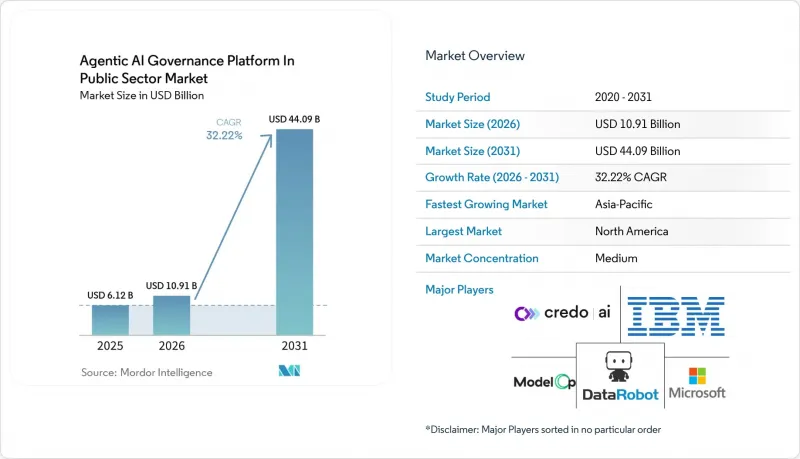
에 따르면 공공 부문 에이전틱 AI 거버넌스 플랫폼 시장 규모는 2025년에 61억 2,000만 달러로 평가되며, 2026년 109억 1,000만 달러에서 2031년까지 440억 9,000만 달러에 달할 것으로 예측되며, 예측 기간(2026-2031년) 동안 CAGR은 32.22%가 될 전망입니다.
공공 부문 에이전틱 AI 거버넌스 플랫폼의 세계 동향 및 인사이트
공공 부문의 디지털 서비스 현대화
2025년부터 2026년까지 OECD 회원국 정부 기관들은 허가, 급여, 세무 지원, 국경 관리 분야에서 AI 에이전트를 활용했습니다. 이러한 도구는 불완전한 기록이나 모호한 규정을 처리할 수 있어, 기존 자동화 제어의 유용성을 제한하던 요인을 해소합니다. 2026년 4월에는 70개의 정부 기능을 에이전틱 AI의 잠재력과 도입 복잡성 측면에서 분석했습니다. 데이터를 현대화한 정부 기관은 상호 연동이 되지 않는 레거시 시스템을 보유한 기관보다 신속하게 도입을 진행할 수 있습니다. 공공 부문의 에이전틱 AI 거버넌스 플랫폼 시장에서는 데이터 통합과 정책 제어를 결합한 솔루션을 제공하는 벤더가 이러한 차이를 해소할 수 있습니다. 보고서에 따르면, 정부 기관의 투명성 레지스트리 및 조달 지원 인프라는 여전히 뒤처져 있어 거버넌스 플랫폼에 운영상의 공백이 남아 있습니다.
AI의 설명 책임 및 보증에 관한 의무적 요건
2025년부터 2026년까지 규제 요건은 단순한 지침에서 강제력 있는 의무로 전환되었으며, 조달 기간이 단축되었습니다. 이탈리아는 법률 제132/2025호를 제정하여 AgID를 국가 AI 프레임워크의 통보 기관으로 지정했습니다. 일본의 2025년 AI법은 정부의 위험 평가 및 감독을 위한 체계적인 기반을 마련했습니다. 이러한 규정으로 인해 공공 서비스가 AI 시스템을 이용할 때 지속적인 기록과 명확한 책임 소재가 더욱 중요해졌습니다. 공공 부문 시장에서 Agentic의 AI 거버넌스 플랫폼은 구매자가 여러 공식 요건에 부합하는 관리 조치를 필요로 하는 상황에서 그 진가를 발휘합니다. 또한, ISO/IEC 42001 준수를 통해 각 기관은 거버넌스 절차를 평가하기 위한 공통 기준을 확보할 수 있습니다.
자율적인 행정 결정에 관한 미해결 법적 책임
급여 청구에 대한 자율적인 기각이나 보안 위험 표시가 이루어진 경우, 책임 소재를 특정하기 어려워질 수 있습니다. 기존 행정 규정에서는 행정 기관, 플랫폼 제공업체, 모델 개발자의 책임이 반드시 명확하게 구분되어 있는 것은 아닙니다. 이러한 불확실성으로 인해 법무 부서가 도입을 승인하기 전에 위험을 명확히 파악해야 하므로 조달이 지연될 가능성이 있습니다. 또한, 공급업체가 계약 조건에 불확실성을 포함시킴으로써 도입 비용이 증가할 가능성도 있습니다. 공공 부문 시장에서 ‘Agentic’ AI 거버넌스 플랫폼은 기술적 관리 수단이 갖춰져 있더라도 이러한 제약에 직면하고 있습니다. 단계적인 도입과 계약상 책임을 신중하게 정의함으로써, 공공 부문 규정이 명확해질 때까지 이러한 마찰을 완화할 수 있습니다.
부문 분석
2025년 공공 부문의 ‘Agentic’ AI 거버넌스 플랫폼 시장에서 플랫폼이 64.23%의 점유율을 차지했습니다. 이는 각 기관이 개별 포인트 툴보다 통합형 제품군을 선호했기 때문입니다. 이러한 제품군은 정책 적용, 편향성 모니터링, 설명 가능성, 감사 로그를 단일 작업 환경에 통합하고 있습니다. 통합된 환경을 통해 여러 공급업체나 증거 보관 장소를 조정해야 하는 부담을 줄일 수 있습니다. 이는 기관이 여러 AI 애플리케이션에 공통적으로 적용되는 정책을 필요로 할 때 특히 유용합니다. 플랫폼에 대한 수요는 모델과 자율형 에이전트 모두를 모니터링해야 할 필요성도 반영하고 있습니다. 통합된 제어 지점에 대한 선호는 공공 조달에서 플랫폼이 수행하는 핵심적인 역할을 뒷받침합니다.
각 기관이 설정, 조정 및 지속적인 운영 지원을 필요로 하고 있기 때문에 서비스 시장은 2026년부터 2031년까지 연평균 성장률(CAGR) 33.47%로 성장할 것으로 예측됩니다. 많은 정부 IT 팀은 거버넌스 도구를 지속적으로 관리하는 데 필요한 전문 기술을 아직 갖추지 못하고 있습니다. 따라서 관리형 서비스는 도입 후에도 각 기관이 관리 체계를 유지하는 데 도움이 됩니다. Credo AI는 2026년 1월, NASA SEWP V, ITES-SW2, NASPO ValuePoint, TIPS 및 OMNIA Partners를 통해 해당 플랫폼을 이용할 수 있도록 하는 계약을 발표했습니다. 이러한 접근 방식은 구매자에게 상용 채널 이용을 의무화하지 않으면서도 정부 조달 절차에 부합합니다. 이를 통해 공공 부문 시장에서 Agentic AI 거버넌스 플랫폼 내의 서비스 기회가 강화될 것입니다.
2025년 공공 부문 시장에서 Agentic AI 거버넌스 플랫폼의 시장 점유율 중 28.61%를 ‘정책 관리 및 규정 준수’가 차지했습니다. 각 기관은 다른 통제 조치가 조직 차원에서 실효성을 발휘하기 전에, 강제력 있는 정책과 문서화된 규정 준수 기록을 마련해야 합니다. 이 기능은 시스템이 승인된 범위 내에서 운영되고 있는지 검증하기 위한 프레임워크를 제공합니다. 또한 내부 감사나 외부 심사에 활용할 수 있는 기록도 생성합니다. 편향 및 공정성 모니터링은 급여 결정이나 예측형 경찰 활동 등 중대한 영향을 수반하는 업무에서 여전히 중요합니다. 보안, 개인정보 보호, 사고 관리 및 성능 모니터링은 에이전트가 시스템 전반에서 조치를 실행할 때 발생하는 기타 위험을 다루는 것입니다.
‘설명 가능성 및 투명성’ 시장은 2031년까지 연평균 성장률(CAGR) 33.84%로 확대될 것으로 예측됩니다. 이러한 성장세는 시민과 직접 관련된 AI 기반 결정이 이해 가능하고 검증 가능해야 한다는 기대감이 높아지고 있음을 반영합니다. 영국에서는 2025년부터 중앙정부 각 부처에 알고리즘 투명성에 관한 보고가 의무화되었으며, 연중반까지 125건의 기록이 공개되었습니다. 아르헨티나의 공공 조달 지침 제44/2026호에서는 정부 AI 계약에 설명 가능성을 필수 요건으로 규정했습니다. 이러한 요건으로 인해 AI의 결과가 어떻게 도출되었는지를 보여주는 도구의 가치가 높아지고 있습니다. 또한, 이는 공공 부문 시장에서 ‘Agentic AI’ 거버넌스 플랫폼의 보다 광범위한 도입을 촉진하고 있습니다.
지역별 분석
2025년 공공 부문 ‘에이전틱 AI 거버넌스 플랫폼’ 시장 점유율 중 북미가 42.37%를 차지했습니다. 미국 연방 정부의 조달 채널과 국방·정보 기관에서의 도입이 이 지역의 입지를 뒷받침했습니다. 2026년 6월에 발령된 대통령령 제14409호는 각 기관에 적대세력에 의한 악용으로부터 AI 인프라를 강화하고 정부 시스템을 현대화하도록 지시했습니다. 이에 따라 민간 및 국방 분야에서의 관리 중요성이 더욱 높아지고 있습니다. 감사 가능한 AI 감시에 관한 연방 정부의 요건 또한 지속적인 기록에 대한 수요를 창출하고 있습니다. 이 지역의 기반은 규제, 조달 인프라, 그리고 고위험 도입 수요에 의해 뒷받침되고 있습니다.
캐나다는 2026년 6월 ‘AI for All’ 전략을 출범시켜 공공 부문 전반에 걸친 도입에 있어 설명 책임과 조달 요건을 확대했습니다. 이 전략으로 인해 거버넌스에 대한 수요는 연방 수준을 넘어 주 정부 기관으로 확대되고 있습니다. 아시아태평양은 가장 빠르게 성장하는 지역으로, 2031년까지 연평균 성장률(CAGR)이 34.08%에 달할 것으로 예측됩니다. 일본의 2025년 법률 및 부처 차원의 조달 지침은 국가 기관에 대한 공식적인 거버넌스 요건을 규정하고 있습니다. 싱가포르는 2025년 4월, 정부 전체를 대상으로 한 ‘Agentic AI Primer’를 발표하며 거버넌스와 규정 준수를 설계상의 기본 요건 중 하나로 규정했습니다. 이러한 움직임에 힘입어 Agentic AI 거버넌스 플랫폼은 몇 가지 명확한 국가 정책 프로그램 속에서 공공 부문 시장에서 입지를 확고히 하고 있습니다.
유럽은 2025년에 두 번째로 큰 점유율을 차지하고 있으며, 2026년 EU AI법 시행 환경에 힘입고 있습니다. 독일은 ‘Agentic AI Hub’를 통해 17개 지방 자치단체를 AI 스타트업과 연결하는 동시에, 국가 차원의 투명성 등록 제도 구축도 추진하고 있습니다. 이러한 매칭은 정부가 도입과 감독을 동시에 지원할 수 있음을 보여줍니다. 중동의 공공기관들도 주권 AI의 컴플라이언스 기능에 관심을 보이고 있습니다. 브라질의 2025년 규제 샌드박스 및 아르헨티나의 2026년 조달 지침은 남미 지역의 정책 활동이 활발해지고 있음을 보여줍니다. 이러한 지역들이 합쳐져 공공 부문 시장에서 ‘Agentic AI’ 거버넌스 플랫폼의 기회를 현재 최대 규모를 넘어 확장시키고 있습니다.
기타 혜택:
- 엑셀 형식의 시장 예측(ME) 시트
- 3개월간의 애널리스트 지원
목차
제1장 소개
- 조사 가정과 시장 정의
- 조사 범위
제2장 조사 방법
제3장 주요 요약
제4장 시장 구도
- 시장 개요
- 시장 성장 촉진요인
- 시장 성장 억제요인
- 거시경제 요인이 시장에 미치는 영향
- 업계 밸류체인 분석
- 기술 동향
- 규제 상황
- Porter's Five Forces 분석
제5장 시장 규모와 성장 예측
- 제공별
- 거버넌스 기능별
- 전개 방식별
- 최종사용자별
- 조직 규모별
- 지역별
- 북미
- 미국
- 캐나다
- 멕시코
- 남미
- 브라질
- 아르헨티나
- 칠레
- 기타 남미 국가
- 유럽
- 독일
- 영국
- 프랑스
- 이탈리아
- 스페인
- 기타 유럽 국가
- 아시아태평양
- 중국
- 일본
- 인도
- 한국
- 호주
- 기타 아시아태평양 국가
- 중동
- 아랍에미리트
- 사우디아라비아
- 카타르
- 기타 중동 국가
- 아프리카
- 남아프리카공화국
- 이집트
- 나이지리아
- 기타 아프리카 국가
- 북미
제6장 경쟁 구도
- 시장 집중도
- 전략적 동향
- 시장 점유율 분석
- 기업 개요
- Credo AI, Inc.
- Microsoft Corporation
- International Business Machines Corporation
- ModelOp, Inc.
- Fiddler AI, Inc.
- Arthur AI, Inc.
- Monitaur, Inc.
- Fairly AI, Inc.
- DataRobot, Inc.
- Saidot Oy
- LatticeFlow AI AG
- Lumenova AI, Inc.
- Cranium AI, Inc.
- Enzai Limited
- Naaia SAS
- Fruggr SAS
- Corvair AI, Inc.
- Clarifai, Inc.
- Truera, Inc.
- Superwise AI Ltd.
제7장 시장 기회와 향후 전망
KSMAccording to Mordor Intelligence, the agentic AI governance platform in public sector market size was valued at USD 6.12 billion in 2025 and is estimated to grow from USD 10.91 billion in 2026 to reach USD 44.09 billion by 2031, at a CAGR of 32.22% during the forecast period (2026-2031).
Global Agentic AI Governance Platform In Public Sector Market Trends and Insights
Public-Sector Digital Service Modernization
Government agencies across OECD countries used AI agents in permits, benefits, tax support, and border management during 2025 and 2026. These tools can work through incomplete records and ambiguous rules, which limits the usefulness of earlier automation controls. mapped 70 government functions by agentic AI potential and deployment complexity in April 2026. Agencies with modernized data can move into deployment faster than agencies with disconnected legacy systems. In the Agentic AI governance platform in public sector market, suppliers that join data integration with policy controls can address this difference. reported that transparency registries and procurement support infrastructure still lag in government, leaving an operational gap for governance platforms.
Mandatory AI Accountability and Assurance Requirements
Regulatory requirements shifted from guidance to enforceable obligations during 2025 and 2026, shortening procurement timelines. Italy enacted Law No. 132/2025, assigning AgID as a notifying authority for its national AI framework. Japan's 2025 AI law created a structured basis for government risk assessment and oversight. These rules make continuous records and clear responsibility more relevant when public services use AI systems. The Agentic AI governance platform in public sector market benefits where buyers need controls that map to multiple formal requirements. ISO/IEC 42001 alignment also provides agencies with a common reference point for assessing governance procedures.
Unresolved Legal Liability for Autonomous Public Decisions
An autonomous denial of a benefit claim or a security risk flag can make it difficult to assign responsibility. Existing administrative rules do not always separate the responsibilities of the agency, platform provider, and model developer. This uncertainty can delay procurement because legal teams need clearer exposure before approving deployments. It can also increase implementation costs when vendors include uncertainty in contract terms. The Agentic AI governance platform in public sector market faces this restraint even where technical controls are ready. Phased deployment and carefully defined contractual responsibilities can reduce friction until public rules become clearer.
Other drivers and restraints analyzed in the detailed report include:
- Rising Deployment of Autonomous Government Workflows
- Demand for Sovereign and Audit-Ready AI Operations
- Fragmented Cross-Border AI Rules and Procurement Controls
For complete list of drivers and restraints, kindly check the Table Of Contents.
Segment Analysis
Platform held 64.23% of the 2025 Agentic AI governance platform in public sector market share because agencies preferred integrated suites over separate point tools. These suites bring policy enforcement, bias monitoring, explainability, and audit logging into a single working environment. A consolidated setup can reduce the burden of coordinating several suppliers and evidence stores. It is particularly useful when an agency needs common policies across several AI applications. Platform demand also reflects the need to monitor both models and autonomous agents. The preference for integrated control points supports the central role of platforms in public procurement.
Services are projected to grow at a 33.47% CAGR from 2026 to 2031 as agencies require configuration, calibration, and ongoing operational support. Many government IT teams do not yet have the specialist skills needed to continuously manage governance tooling. Managed services can therefore help agencies maintain their controls after implementation. Credo AI announced a January 2026 arrangement that made the platform available through NASA SEWP V, ITES-SW2, NASPO ValuePoint, TIPS, and OMNIA Partners. This approach aligns with government purchasing processes rather than requiring buyers to use commercial channels. It reinforces the services opportunity within the Agentic AI governance platform in public sector market.
Policy Management and Compliance captured 28.61% of the 2025 Agentic AI governance platform in public sector market share. Agencies need enforceable policies and a documented compliance record before other controls can carry institutional weight. This function provides the structure for reviewing whether systems operate within approved boundaries. It also creates a record that can be used in internal oversight and external review. Bias and fairness monitoring remains relevant for high-stakes work, including benefit decisions and predictive policing. Security, privacy, incident management, and performance monitoring address other risks that emerge as agents take actions across systems.
Explainability and Transparency is forecast to expand at a 33.84% CAGR through 2031. This pace reflects stronger expectations that citizen-facing AI decisions should be understandable and reviewable. The United Kingdom required algorithmic transparency reporting by central government departments in 2025, and 125 records had been published by midyear. Argentina's Public Procurement Directive No. 44/2026 established explainability as a requirement for government AI contracts. These requirements raise the value of tools that show how an AI output was reached. They also support broader adoption in the Agentic AI governance platform in public sector market.
Complete Report Scope:
- By Offering
- Platform
- Services
- By Governance Function
- Policy Management and Compliance
- Bias and Fairness Monitoring
- Explainability and Transparency
- Security and Privacy
- Risk and Incident Management
- Performance and Drift Monitoring
- Other Governance Functions
- By Deployment Mode
- Cloud
- On-Premises
- Hybrid
- By End User
- Central and Federal Government
- State, Provincial, and Regional Government
- Local Government and Municipal Authorities
- Defense and National Security Agencies
- Public Healthcare Institutions
- Public Education Institutions
- Public Utilities and Infrastructure Authorities
- By Organization Size
- Large Government Organizations
- Small and Medium-Sized Government Organizations
- By Geography
- North America
- United States
- Canada
- Mexico
- South America
- Brazil
- Argentina
- Chile
- Rest of South America
- Europe
- Germany
- United Kingdom
- France
- Italy
- Spain
- Rest of Europe
- Asia-Pacific
- China
- Japan
- India
- South Korea
- Australia
- Rest of Asia-Pacific
- Middle East
- United Arab Emirates
- Saudi Arabia
- Qatar
- Rest of Middle East
- Africa
- South Africa
- Egypt
- Nigeria
- Rest of Africa
- North America
Geography Analysis
North America held 42.37% of the 2025 Agentic AI governance platform in public sector market share. U.S. federal purchasing channels and deployments across defense and intelligence agencies supported the region's position. Executive Order 14409, issued in June 2026, directed agencies to strengthen AI infrastructure against exploitation by adversaries and modernize government systems. This reinforces the importance of controls across civilian and defense uses. Federal requirements for auditable AI oversight also create demand for continuous records. The regional base rests on regulation, procurement infrastructure, and high-stakes deployment needs.
Canada launched its AI for All strategy in June 2026, extending accountability and procurement requirements across public-sector deployments. The strategy broadens the demand for governance beyond the federal tier and into provincial bodies. Asia-Pacific is the fastest-growing geography, with a 34.08% CAGR projected through 2031. Japan's 2025 law and ministry-level procurement guidance create formal governance requirements for national bodies. Singapore published its whole-of-government Agentic AI Primer in April 2025, placing governance and compliance among foundational design considerations. These actions place the Agentic AI governance platform in public sector market within several distinct national policy programs.
Europe held the second-largest share in 2025, supported by the EU AI Act enforcement environment in 2026. Germany paired 17 municipalities with AI startups through its Agentic AI Hub while also pursuing a national transparency register. This pairing shows that governments can support both deployment and oversight simultaneously. Middle Eastern public institutions are also showing interest in sovereign AI compliance capabilities. Brazil's 2025 regulatory sandbox and Argentina's 2026 procurement directive show growing policy activity in South America. Together, these regions extend the opportunity for the Agentic AI governance platform in public sector market beyond its current largest geography.
- Credo AI, Inc.
- Microsoft Corporation
- International Business Machines Corporation
- ModelOp, Inc.
- Fiddler AI, Inc.
- Arthur AI, Inc.
- Monitaur, Inc.
- Fairly AI, Inc.
- DataRobot, Inc.
- Saidot Oy
- LatticeFlow AI AG
- Lumenova AI, Inc.
- Cranium AI, Inc.
- Enzai Limited
- Naaia SAS
- Fruggr SAS
- Corvair AI, Inc.
- Clarifai, Inc.
- Truera, Inc.
- Superwise AI Ltd.
Additional Benefits:
- The market estimate (ME) sheet in Excel format
- 3 months of analyst support
TABLE OF CONTENTS
1 INTRODUCTION
- 1.1 Study Assumptions and Market Definition
- 1.2 Scope of the Study
2 RESEARCH METHODOLOGY
3 EXECUTIVE SUMMARY
4 MARKET LANDSCAPE
- 4.1 Market Overview
- 4.2 Market Drivers
- 4.2.1 Public-Sector Digital Service Modernization
- 4.2.2 Mandatory AI Accountability and Assurance Requirements
- 4.2.3 Rising Deployment of Autonomous Government Workflows
- 4.2.4 Demand for Sovereign and Audit-Ready AI Operations
- 4.2.5 Agent Registries for Shadow-AI Discovery
- 4.2.6 Cross-Agent Permission and Identity Complexity
- 4.3 Market Restraints
- 4.3.1 Unresolved Legal Liability for Autonomous Public Decisions
- 4.3.2 Fragmented Cross-Border AI Rules and Procurement Controls
- 4.3.3 Prompt-Injection and Tool-Misuse Exposure in Citizen Services
- 4.3.4 Evidence Retention Burden Across Long-Lived Government Records
- 4.4 Impact of Macroeconomic Factors on the Market
- 4.5 Industry Value-Chain Analysis
- 4.6 Technology Outlook
- 4.7 Regulatory Landscape
- 4.8 Porter's Five Forces Analysis
- 4.8.1 Threat of New Entrants
- 4.8.2 Bargaining Power of Suppliers
- 4.8.3 Bargaining Power of Buyers
- 4.8.4 Threat of Substitutes
- 4.8.5 Intensity of Competitive Rivalry
5 MARKET SIZE AND GROWTH FORECASTS (VALUE)
- 5.1 By Offering
- 5.1.1 Platform
- 5.1.2 Services
- 5.2 By Governance Function
- 5.2.1 Policy Management and Compliance
- 5.2.2 Bias and Fairness Monitoring
- 5.2.3 Explainability and Transparency
- 5.2.4 Security and Privacy
- 5.2.5 Risk and Incident Management
- 5.2.6 Performance and Drift Monitoring
- 5.2.7 Other Governance Functions
- 5.3 By Deployment Mode
- 5.3.1 Cloud
- 5.3.2 On-Premises
- 5.3.3 Hybrid
- 5.4 By End User
- 5.4.1 Central and Federal Government
- 5.4.2 State, Provincial, and Regional Government
- 5.4.3 Local Government and Municipal Authorities
- 5.4.4 Defense and National Security Agencies
- 5.4.5 Public Healthcare Institutions
- 5.4.6 Public Education Institutions
- 5.4.7 Public Utilities and Infrastructure Authorities
- 5.5 By Organization Size
- 5.5.1 Large Government Organizations
- 5.5.2 Small and Medium-Sized Government Organizations
- 5.6 By Geography
- 5.6.1 North America
- 5.6.1.1 United States
- 5.6.1.2 Canada
- 5.6.1.3 Mexico
- 5.6.2 South America
- 5.6.2.1 Brazil
- 5.6.2.2 Argentina
- 5.6.2.3 Chile
- 5.6.2.4 Rest of South America
- 5.6.3 Europe
- 5.6.3.1 Germany
- 5.6.3.2 United Kingdom
- 5.6.3.3 France
- 5.6.3.4 Italy
- 5.6.3.5 Spain
- 5.6.3.6 Rest of Europe
- 5.6.4 Asia-Pacific
- 5.6.4.1 China
- 5.6.4.2 Japan
- 5.6.4.3 India
- 5.6.4.4 South Korea
- 5.6.4.5 Australia
- 5.6.4.6 Rest of Asia-Pacific
- 5.6.5 Middle East
- 5.6.5.1 United Arab Emirates
- 5.6.5.2 Saudi Arabia
- 5.6.5.3 Qatar
- 5.6.5.4 Rest of Middle East
- 5.6.6 Africa
- 5.6.6.1 South Africa
- 5.6.6.2 Egypt
- 5.6.6.3 Nigeria
- 5.6.6.4 Rest of Africa
- 5.6.1 North America
6 COMPETITIVE LANDSCAPE
- 6.1 Market Concentration
- 6.2 Strategic Moves
- 6.3 Market Share Analysis
- 6.4 Company Profiles (includes Global Level Overview, Market Level Overview, Core Segments, Financials as available, Strategic Information, Market Rank/Share, Products and Services, Recent Developments)
- 6.4.1 Credo AI, Inc.
- 6.4.2 Microsoft Corporation
- 6.4.3 International Business Machines Corporation
- 6.4.4 ModelOp, Inc.
- 6.4.5 Fiddler AI, Inc.
- 6.4.6 Arthur AI, Inc.
- 6.4.7 Monitaur, Inc.
- 6.4.8 Fairly AI, Inc.
- 6.4.9 DataRobot, Inc.
- 6.4.10 Saidot Oy
- 6.4.11 LatticeFlow AI AG
- 6.4.12 Lumenova AI, Inc.
- 6.4.13 Cranium AI, Inc.
- 6.4.14 Enzai Limited
- 6.4.15 Naaia SAS
- 6.4.16 Fruggr SAS
- 6.4.17 Corvair AI, Inc.
- 6.4.18 Clarifai, Inc.
- 6.4.19 Truera, Inc.
- 6.4.20 Superwise AI Ltd.
7 MARKET OPPORTUNITIES AND FUTURE OUTLOOK
- 7.1 White-Space and Unmet-Need Assessment


