

|
시장보고서
상품코드
2154500
엔터프라이즈 AI 코딩 에이전트 : 시장 점유율 분석, 업계 동향과 통계, 성장 예측(2026-2031년)Enterprise AI Coding Agent - Market Share Analysis, Industry Trends & Statistics, Growth Forecasts (2026 - 2031) |
||||||
 Mordor Intelligence
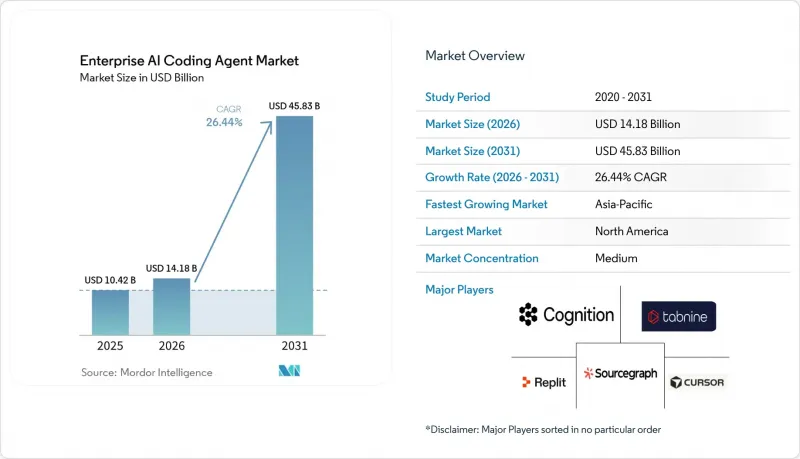
에 따르면 엔터프라이즈 AI 코딩 에이전트 시장 규모는 2025년 104억 2,000만 달러에서 2026년에는 141억 8,000만 달러로 확대되어, 2031년까지 458억 3,000만 달러에 달할 것으로 예측되며, 2026년부터 2031년까지 연평균 성장률(CAGR)은 26.44%가 될 전망입니다.
세계 엔터프라이즈 AI 코딩 에이전트 시장의 동향 및 인사이트
엔터프라이즈 소프트웨어 엔지니어링의 용량 제약
엔지니어링 역량은 소프트웨어를 많이 사용하는 조직에게 핵심적인 운영상의 제약요인으로 작용하고 있으며, 이것이 엔터프라이즈 AI 코딩 에이전트 시장의 도입을 촉진하고 있습니다. 2025년에 마이크로소프트, 액센츄어 및 포춘 100대 기업을 대상으로 실시된 현장 실험에서, AI 코딩 지원 도구를 사용한 4,867명의 개발자의 완료된 작업 수가 26.08% 증가한 것으로 나타났습니다. 2026년에 발표된 마이크로소프트의 조사에 따르면, 엔지니어들은 이러한 도구를 가장 빈번하게 사용한 주에 도구를 사용하지 않은 주와 비교해 풀 리퀘스트 완료 건수가 40.5% 증가한 것으로 나타났습니다. 대규모 엔지니어링 조직에서는 개별 개발자의 생산성이 향상되더라도 여전히 증가하는 소프트웨어 수요에 직면해 있습니다. 따라서 특히 팀이 고립된 코딩 문제를 해결하는 것이 아니라 파일 전체에 걸친 일련의 관련 변경 사항을 처리해야 하는 경우, 단순히 코드를 제안하는 도구보다 자율적인 작업 실행이 더욱 중요해지고 있습니다. 엔터프라이즈 AI 코딩 에이전트 시장은 기술 인력을 증원하지 않고도delivery 능력을 향상시켜야 하는 조직에 이점을 제공합니다.
에이전트형 SDLC 자동화의 확대
엔터프라이즈 AI 코딩 에이전트 시장은 코드 완성에서 벗어나, 소프트웨어 개발 수명주기 전반에 걸쳐 협업 작업을 수행하는 시스템으로 확대되고 있습니다. 조직들은 다단계 워크플로우를 위해 에이전트를 도입하고 있으며, 2026년까지 기업의 91%가 AI 코딩 에이전트를 실제 코드에 도입했습니다. 에이전트 기반 워크플로우에서는 제품 요구 사항을 개별 작업으로 분할하고, 전문화된 에이전트를 조정하며, 출력을 통합된 결과물로 정리할 수 있습니다. GitHub 보고서에 따르면, 멀티 에이전트 워크플로로 전환한 조직에서는 풀 리퀘스트 처리량이 93.3% 증가했습니다. 이러한 운영 모델로 인해 도입 근거는 개별 개발자에 대한 지원에서 보다 광범위한 배포 자동화로 전환되고 있습니다. 또한, 연계된 워크플로우에서는 개발자의 직접적인 개입을 최소화하면서 요구사항 정의, 구현, 검증, 릴리스와 같은 각 활동 간에 작업을 이관할 수 있기 때문에 코드가 프로덕션 환경에 도달하기 전의 테스트, 검토, 승인에 대한 관리의 필요성이 높아지고 있습니다.
소스 코드의 기밀성과 데이터 소재지 관련 위험
독자적인 알고리즘, 고객 정보 또는 중요한 인프라의 코드가 외부 추론 시스템에 노출될 가능성이 있는 경우, 소스 코드의 기밀성은 여전히 큰 장벽이 됩니다. 유럽연합 집행위원회의 ‘EU AI법’에 관한 지침에는 2026년 8월 2일에 시행될 투명성 요건이 명시되어 있습니다. 법무 및 보안 팀은 이러한 요건이 코드 생성이나 고위험 용도에 어떻게 적용되는지 해석해야 합니다. 또한, 공개 코드나 상호 라이선싱 의무가 감지되지 않은 채 자체 코드 저장소에 추가될 경우, 조직은 지적 재산권상의 위험에 직면하게 됩니다. JFrog는 개발 워크플로우 중에 악의적이거나 부적절한 코드 스니펫을 식별하기 위한 AI 생성 코드 검증 기능을 도입했습니다. Tabnine은 별도의 설정이 없는 한 고객의 신뢰 경계 내에서 작동하도록 ‘Enterprise Context Engine’을 설계했습니다. 이러한 요구 사항으로 인해, 기업용 AI 코딩 에이전트 시장의 규제 대상 분야에서는 프라이빗 클라우드, 자체 호스팅, 에어갭 방식의 도입 옵션이 선호되고 있습니다. 이러한 분야에서는 정보 처리 방식에 대한 관리가 구현 속도와 마찬가지로 중요할 수 있습니다.
부문 분석
2025년, AI 코딩 어시스턴트는 제공 부문의 43.92%를 차지했습니다. 이러한 위상은 공식적인 조달 프로세스가 확대되기 이전에, 기존 통합 개발 환경(IDE) 워크플로우 내에서의 조기 도입과 개별 개발자들의 사용 편의성이 반영된 결과입니다. 이 범주에는 내장형 코파일럿과 독립형 코딩 채팅 인터페이스가 포함됩니다. 많은 기업에서는 여전히 이러한 제품을 생산성 향상 도구로 분류하고 있으며, 이는 예산 관할권과 도입 속도에 영향을 미치는 한편, 필요한 거버넌스 모델의 정의는 조달 팀에 맡겨져 있습니다. 엔터프라이즈 AI 코딩 에이전트 시장에서는 상황에 맞는 제안이나 일상적인 코딩 작업의 신속화가 필요한 팀을 위해 어시스턴트가 계속해서 접근하기 쉬운 진입점으로 활용되고 있습니다. 한편, 개발자는 익숙한 코딩, 테스트, 승인 관행을 유지할 수 있습니다.
자율형 소프트웨어 엔지니어링 에이전트는 2026년부터 2031년까지 연평균 성장률(CAGR) 45.59%로 성장할 것으로 예측됩니다. 이러한 시스템은 인간의 개입을 최소화하면서 여러 단계와 여러 파일에 걸친 작업을 수행할 수 있으므로, 더 광범위한 전달 작업을 처리할 수 있습니다. Cognition사는 2026년 연간 기업 매출이 4억 9,200만 달러에 달했다고 보고했으며, 기업 내 이용은 6개월 연속 전월 대비 50% 이상의 성장세를 보이고 있습니다. 또한 생성되는 코드의 양이 증가하고 엔지니어링 검토 프로세스에 부담이 가중됨에 따라, AI 코드 검토 및 거버넌스 플랫폼의 중요성도 높아지고 있습니다. 장기적인 제품 방향성으로는 생성, 테스트, 검토, 배포에 대한 거버넌스를 더욱 통합된 제품군으로 결합하여, 각 활동을 별도의 도구로 분할하지 않고도 팀 간 업무 인계를 지원할 수 있도록 하는 것입니다. 이러한 기능의 확대로 인해 엔터프라이즈 AI 코딩 에이전트 시장은 좁은 의미의 어시스턴트라는 범주에서 관리형 소프트웨어 전달 플랫폼으로 변화하고 있습니다.
2025년, 코드 자동 완성 기능은 기능 부문의 36.78%를 차지했습니다. 이는 가장 성숙한 기능으로, 기업 개발 팀 전반에 걸쳐 지속적으로 널리 도입되고 있습니다. 이러한 위상은 향후 토큰 예측 및 개발자용 인터페이스에 대한 지속적인 투자와 더불어, 일상적인 워크플로우에서 이미 코드 완성 기능을 활용하고 있는 개발자들의 친숙함이 반영된 결과입니다. GitHub Copilot과 Cursor는 많은 조직이 AI 지원 개발을 시작할 때 채택하는 상호작용 모델을 확립하는 데 기여했습니다. 개발자가 제안된 코드를 수락하거나, 편집하거나, 거부할 수 있도록 직접 제어할 수 있기 때문에 코드 자동 완성 기능은 여전히 실용적인 출발점이 되고 있습니다.
자동 테스트 및 검증 시장은 2026년부터 2031년까지 연평균 성장률(CAGR) 45.52%로 확대될 것으로 예측됩니다. 코드 생성 및 변환, 코드 검토 및 최적화, 테스트가 하나로 통합되어 전체 배포 주기에 걸친 보다 광범위한 자동화 모델을 뒷받침하고 있습니다. 개발 팀이 출시 기한에 쫓길 때, 테스트는 기능 개발에 비해 주목받기 어려운 경향이 있지만, 테스트 커버리지가 불충분하면 출시 후 문제 조사에 소요되는 시간이 늘어날 가능성이 있습니다. 에이전트를 활용하면 구현이 완료될 때까지 기다릴 필요 없이 코드 생성과 병행하여 테스트 스위트를 작성할 수 있습니다. Diffblue는 2025년에 ‘Testing Agent’를 출시하며 테스트 생성을 독립적인 엔지니어링 워크플로우로 자리매김했습니다. IBM Research의 조사에 따르면, 코딩 어시스턴트를 활용하는 기업 팀은 단기 자동화 계획에서 코드 검토보다 자동 테스트 커버리지를 우선시하는 것으로 나타났습니다.
지역별 분석
2025년, 북미는 지역별 부문의 38.12%를 차지했습니다. 이 지역은 성숙한 엔터프라이즈 소프트웨어 구매자 기반, 하이퍼스케일러 및 파운데이션 모델 제공업체의 집중, 그리고 대규모 개발자 인구라는 이점을 가지고 있습니다. 2026년 1분기 Digital Applied의 조사에 따르면, 북미 전문 개발자의 71%가 매일 AI 코딩 에이전트를 이용하고 있는 것으로 나타났습니다. 지역별 수요에서는 미국이 가장 큰 점유율을 차지했으며, 금융 서비스 기업과 기술 기업이 도입을 주도했습니다. 캐나다와 멕시코에서는 금융 기관 및 공공 부문 조직을 통해 수요가 확대되었습니다. 2026년 엔터프라이즈 AI 코딩 에이전트 시장에서 유럽도 중요한 구성요소로 자리 잡았으며, 독일, 영국, 프랑스, 네덜란드, 러시아가 주도적인 역할을 수행했습니다. Adesso사가 독일 경영진 500명을 대상으로 실시한 조사에 따르면, 59%의 기업이 코드 생성 및 최적화를 위해 에이전트 기반 시스템을 이용하고 있으며, 체계적으로 도입한 기업에서는 생산성이 21% 향상되었다고 보고되었습니다. 같은 조사에서 AI 성숙도가 낮은 기업의 3분의 1은 측정 가능한 성과를 보고하지 않은 것으로 밝혀졌으며, 이는 도입 방식이 성과에 영향을 미친다는 점을 보여줍니다. 또한, EU의 투명성 요건도 거버넌스 및 감사 추적 도구에 대한 유럽의 수요를 촉진하고 있습니다.
아시아태평양은 2026년부터 2031년까지 연평균 성장률(CAGR) 45.57%로 확대될 것으로 예측됩니다. 일본은 엔지니어 인력 감소와 레거시 코드의 노후화라는 과제에 직면해 있으며, 인력 부족에 대한 대응책으로서 에이전트의 중요성이 점점 더 높아지고 있습니다. 미즈호 증권은 2026년 1월, 엔지니어 70명을 대상으로 Cognition사의 ‘Devin’ 도입을 시작했으며, 2026년도 하반기에는 소프트웨어 라이프사이클 전체의 자동화를 목표로 하고 있습니다. 중국에서는 2025년 AI 코딩 벤더의 매출액이 총 3억 9,900만 위안(5,500만 달러)에 달했으며, 알리바바 산하의 Qoder가 매출 점유율의 47.6%를 차지했습니다. 동 정보원에 따르면, 2025년 중국 개발자의 30%가 AI 코딩 도구를 이용했던 반면, 미국에서는 91%에 달했습니다. OutSystems의 조사 대상국 중 전문적인 에이전틱 AI 사용자 비율이 가장 높았던 곳은 인도였습니다. 호주와 한국에서는 본격적인 도입에 앞서 기업 거버넌스 체계를 구축해 두었습니다.
중동 및 아프리카, 남미는 현재 엔터프라이즈 AI 코딩 에이전트 시장에서 점유율이 가장 낮은 지역입니다. 아랍에미리트(UAE)와 사우디아라비아는 국가 주도의 AI 프로그램 및 공공 부문의 소프트웨어 현대화를 통해 수요를 창출하고 있습니다. 2026년 조사에 따르면, 중동 및 아프리카의 코딩 에이전트 실제 도입률은 16%이며, 그 대부분은 UAE와 사우디아라비아에 집중되어 있으며 국가 주도의 프로젝트와 관련이 있습니다. 남미의 경우, 같은 조사에서 19%의 실제 도입률이 보고되었습니다. 브라질은 이타우 유니방코의 코드베이스 전환을 포함한 은행업 및 핀테크 분야를 통해 지역 내 도입을 주도하고 있습니다. 아프리카는 남아프리카공화국과 나이지리아를 제외하고는 여전히 초기 단계에 있습니다. 개발자 커뮤니티 육성 및 클라우드 인프라 투자를 통해 향후 도입을 위한 기반이 마련되고 있지만, 도입의 성패는 조직의 역량, 현지 조달 관행, 그리고 적절한 도입 모델의 가용성에 달려 있습니다.
기타 혜택:
- 엑셀 형식의 시장 예측(ME) 시트
- 3개월간의 애널리스트 지원
목차
제1장 소개
- 조사 가정과 시장 정의
- 조사 범위
제2장 조사 방법
제3장 주요 요약
제4장 시장 구도
- 시장 개요
- 시장 성장 촉진요인
- 시장 성장 억제요인
- 업계 밸류체인 분석
- 규제 상황
- 기술 전망
- Porter's Five Forces 분석
제5장 시장 규모와 성장 예측
- 제공별
- 기능성별
- 전개 방식별
- 조직 규모별
- 최종 이용 산업별
- 용도별
- 지역별
- 북미
- 미국
- 캐나다
- 멕시코
- 유럽
- 독일
- 영국
- 프랑스
- 네덜란드
- 러시아
- 기타 유럽 국가
- 아시아태평양
- 중국
- 일본
- 인도
- 한국
- 호주
- 기타 아시아태평양 국가
- 중동
- 아랍에미리트
- 사우디아라비아
- 튀르키예
- 기타 중동 국가
- 아프리카
- 남아프리카공화국
- 이집트
- 나이지리아
- 기타 아프리카 국가
- 남미
- 브라질
- 아르헨티나
- 기타 남미 국가
- 북미
제6장 경쟁 구도
- 시장 집중도
- 전략적 동향
- 시장 점유율 분석
- 기업 개요
- Anysphere, Inc.
- Cognition AI, Inc.
- Tabnine Ltd.
- Sourcegraph, Inc.
- Replit, Inc.
- Google LLC
- Augment Code, Inc.
- Factory AI, Inc.
- Qodo Ltd.
- CodeRabbit, Inc.
- Poolside AI, Inc.
- Magic AI, Inc.
- Blackbox AI, Inc.
- Mutable, Inc.
- Cosine Labs, Inc.
- Pythagora AI, Inc.
- Sweep AI, Inc.
- Codegen, Inc.
- Bito, Inc.
- Safurai, Inc.
- Refact AI, Inc.
- CodeStory, Inc.
제7장 시장 기회와 향후 전망
KSMAccording to Mordor Intelligence, the enterprise AI coding agent market size is projected to expand from USD 10.42 billion in 2025 to USD 14.18 billion in 2026, and to USD 45.83 billion by 2031, registering a CAGR of 26.44% between 2026 and 2031.
Global Enterprise AI Coding Agent Market Trends and Insights
Enterprise Software Engineering Capacity Constraints
Engineering capacity has become a central operating constraint for software-intensive organizations, which is supporting adoption in the enterprise AI coding agent market. A 2025 field experiment across Microsoft, Accenture, and a Fortune 100 company found a 26.08% increase in completed tasks among 4,867 developers who used AI coding assistance. A Microsoft study released in 2026 found that engineers completed 40.5% more pull requests during their highest-usage weeks than during weeks with no use of these tools. Large engineering organizations still face rising software demand even when individual developer output improves. This makes autonomous task execution more relevant than a tool that only suggests code, especially when teams must address a series of related changes across files rather than resolve isolated coding questions. The enterprise AI coding agent market benefits where organizations need to increase delivery capacity without matching increases in technical headcount.
Expansion of Agentic SDLC Automation
The enterprise AI coding agent market is extending from code completion toward systems that perform connected work across the software development life cycle. Organizations are deploying agents for multi-stage workflows, and 91% of enterprises had moved AI coding agents into production code in 2026. Agent workflows can divide a product requirement into separate tasks, coordinate specialized agents, and combine outputs into an integrated result. GitHub reported that organizations moving to multi-agent workflows recorded a 93.3% increase in pull request throughput. This operating model shifts the purchase case from individual developer assistance to broader delivery automation. It also raises the need for testing, review, and approval controls before code reaches production, since connected workflows can move work across requirements, implementation, validation, and release activities with less direct developer intervention.
Source-Code Confidentiality and Data-Residency Risk
Source-code confidentiality remains a major barrier when proprietary algorithms, customer information, or critical infrastructure code could be exposed to external inference systems. The European Commission's guidance on the EU AI Act set out transparency requirements that became enforceable on August 2, 2026. Legal and security teams must interpret how those requirements apply to code generation and high-risk uses. Organizations also face intellectual property risk if public code and reciprocal license obligations are added to proprietary repositories without detection. JFrog introduced AI-generated code validation to identify malicious or unsuitable code snippets during development workflows. Tabnine designed its Enterprise Context Engine to operate within a customer trust boundary unless configured otherwise. These requirements favor private-cloud, self-hosted, and air-gapped deployment options in regulated segments of the enterprise AI coding agent market, where control over how information is processed can be as important as implementation speed.
Other drivers and restraints analyzed in the detailed report include:
- Enterprise Demand for Legacy-System Modernization
- IDE and Developer-Workflow Distribution
- Hallucinated Code and Vulnerability Liability
For complete list of drivers and restraints, kindly check the Table Of Contents.
Segment Analysis
AI coding assistants held 43.92% of the offering segment in 2025. Their position reflects early adoption within existing integrated development environment workflows and ease of use by individual developers before formal procurement processes expanded. The category includes embedded copilots and standalone coding chat interfaces. Many enterprises still classify these products as productivity tools, which affects both budget ownership and adoption speed while leaving procurement teams to define the required governance model. The enterprise AI coding agent market continues to use assistants as an accessible entry point for teams that need contextual suggestions and faster routine coding work, while allowing developers to retain familiar coding, testing, and approval practices.
Autonomous software engineering agents are projected to expand at a 45.59% CAGR from 2026 to 2031. These systems can perform multi-step, multi-file work with limited human intervention, making them relevant to a broader range of delivery tasks. Cognition reported USD 492 million in annualized enterprise revenue in 2026, with enterprise usage expanding by more than 50% month over month for 6 consecutive months. AI code review and governance platforms are also becoming increasingly important as the volume of generated code puts pressure on engineering review processes. The longer-term product direction combines generation, testing, review, and deployment governance in more integrated suites that can support handoffs between teams without separating each activity into a different tool. This broadening of capability changes the enterprise AI coding agent market from a narrow assistant category into a controlled software delivery platform.
Code completion held 36.78% of the functionality segment in 2025. It is the most mature capability and remains widely deployed across enterprise development teams. Its position reflects sustained investment in next-token prediction and developer-facing interfaces, as well as familiarity among developers who already use completion features in their daily workflows. GitHub Copilot and Cursor helped establish the interaction model that many organizations use when beginning AI-assisted development. Code completion remains a practical starting point because developers retain direct control over whether to accept, edit, or reject suggested code.
Automated testing and validation are projected to expand at a 45.52% CAGR from 2026 to 2031. Together, code generation and transformation, code review and optimization, and testing support a broader automation model across the delivery cycle. Testing has often received less attention than feature work when development teams face release deadlines, even though incomplete coverage can increase the time required to investigate issues after a release. Agents can create test suites alongside code production rather than waiting until implementation is complete. Diffblue launched its Testing Agent in 2025 to treat test generation as a distinct engineering workflow. IBM Research found that enterprise teams using coding assistants were prioritizing automated testing coverage over code review in near-term automation plans
Complete Report Scope:
- By Offering
- AI Coding Assistants
- Autonomous Software Engineering Agents
- AI Code Review and Governance Platforms
- Other Offerings
- By Functionality
- Code Completion
- Code Generation and Transformation
- Code Review and Optimization
- Automated Testing and Validation
- Other Functionalities
- By Deployment Mode
- Cloud-Based
- On-Premises
- By Organization Size
- Large Enterprises
- Small and Medium-Sized Enterprises
- By End-User Industry
- Software and Technology Providers
- Information Technology and Telecommunications
- BFSI
- Healthcare and Life Sciences
- Retail and E-Commerce
- Manufacturing and Automotive
- Media and Entertainment
- Government and Public Sector
- Energy and Utilities
- By Application
- Enterprise Software Development
- Cloud Services and DevOps
- Data Science and Machine Learning
- Web Development
- Mobile Application Development
- Legacy Modernization and Refactoring
- Other Applications
- By Geography
- North America
- United States
- Canada
- Mexico
- Europe
- Germany
- United Kingdom
- France
- Netherlands
- Russia
- Rest of Europe
- Asia-Pacific
- China
- Japan
- India
- South Korea
- Australia
- Rest of Asia-Pacific
- Middle East
- United Arab Emirates
- Saudi Arabia
- Turkey
- Rest of Middle East
- Africa
- South Africa
- Egypt
- Nigeria
- Rest of Africa
- South America
- Brazil
- Argentina
- Rest of South America
- North America
Geography Analysis
North America held 38.12% of the geographic segment in 2025. The region benefits from a mature enterprise software buyer base, a concentration of hyperscalers and foundation-model providers, and a large developer population. A Q1 2026 Digital Applied survey found that 71% of professional developers in North America used an AI coding agent daily. The United States accounted for the largest share of regional demand, with financial services and technology firms leading adoption. Canada and Mexico added demand through financial institutions and public-sector organizations. Europe was also a significant component of the enterprise AI coding agent market in 2026, with Germany, the United Kingdom, France, the Netherlands, and Russia leading. An Adesso survey of 500 German executives found that 59% of companies used agent-based systems for code generation and optimization, and that structured adopters reported a 21% increase in productivity. The same survey found that 1-third of companies with low AI maturity reported no measurable return, showing that deployment practices influence outcomes. EU transparency requirements also support European demand for governance and audit-trail tools.
Asia-Pacific is projected to expand at a 45.57% CAGR from 2026 to 2031. Japan faces a shrinking engineering workforce and an aging legacy-code estate, making agents increasingly relevant in response to workforce constraints. Mizuho Securities began deploying Cognition's Devin with 70 engineers in January 2026 and targeted full software life cycle automation in the second half of fiscal year 2026. In China, AI coding vendor revenue totaled CNY 399 million (USD 55 million) in 2025, and Alibaba's Qoder held a 47.6% revenue share. The same source stated that 30% of Chinese developers used AI coding tools in 2025, compared with 91% in the United States. India recorded the highest concentration of expert agentic AI users among countries covered by the OutSystems survey. Australia and South Korea were building enterprise governance frameworks before wider deployments.
The Middle East, Africa, and South America held the smallest current shares of the enterprise AI coding agent market. The United Arab Emirates and Saudi Arabia are creating demand through sovereign AI programs and public-sector software modernization. A 2026 survey found a 16% production deployment rate for coding agents in the Middle East and Africa, concentrated in the United Arab Emirates and Saudi Arabia, with sovereign-linked projects. South America reported a 19% production deployment rate in the same survey. Brazil leads regional adoption through banking and fintech, including Itau Unibanco's codebase migration. Africa remains at an early stage, except for South Africa and Nigeria. Developer community development and cloud infrastructure investment are establishing conditions for later adoption, although adoption remains dependent on organizational skills, local procurement practices, and availability of suitable deployment models.
- Anysphere, Inc.
- Cognition AI, Inc.
- Tabnine Ltd.
- Sourcegraph, Inc.
- Replit, Inc.
- Google LLC
- Augment Code, Inc.
- Factory AI, Inc.
- Qodo Ltd.
- CodeRabbit, Inc.
- Poolside AI, Inc.
- Magic AI, Inc.
- Blackbox AI, Inc.
- Mutable, Inc.
- Cosine Labs, Inc.
- Pythagora AI, Inc.
- Sweep AI, Inc.
- Codegen, Inc.
- Bito, Inc.
- Safurai, Inc.
- Refact AI, Inc.
- CodeStory, Inc.
Additional Benefits:
- The market estimate (ME) sheet in Excel format
- 3 months of analyst support
TABLE OF CONTENTS
1 INTRODUCTION
- 1.1 Study Assumptions and Market Definition
- 1.2 Scope of the Study
2 RESEARCH METHODOLOGY
3 EXECUTIVE SUMMARY
4 MARKET LANDSCAPE
- 4.1 Market Overview
- 4.2 Market Drivers
- 4.2.1 Enterprise Software Engineering Capacity Constraints
- 4.2.2 Expansion of Agentic SDLC Automation
- 4.2.3 Enterprise Demand for Legacy-System Modernization
- 4.2.4 IDE and Developer-Workflow Distribution
- 4.2.5 Cloud Credits and Model-Platform Bundling
- 4.2.6 AI-Assisted Security and Compliance Testing
- 4.3 Market Restraints
- 4.3.1 Source-Code Confidentiality and Data-Residency Risk
- 4.3.2 Hallucinated Code and Vulnerability Liability
- 4.3.3 Inference Cost and GPU Capacity Volatility
- 4.3.4 Developer Trust, Accountability, and Skill Erosion
- 4.4 Industry Value Chain Analysis
- 4.5 Regulatory Landscape
- 4.6 Technological Outlook
- 4.7 Porter's Five Forces Analysis
- 4.7.1 Bargaining Power of Suppliers
- 4.7.2 Bargaining Power of Buyers
- 4.7.3 Threat of New Entrants
- 4.7.4 Threat of Substitutes
- 4.7.5 Intensity of Competitive Rivalry
5 MARKET SIZE AND GROWTH FORECASTS (VALUE)
- 5.1 By Offering
- 5.1.1 AI Coding Assistants
- 5.1.2 Autonomous Software Engineering Agents
- 5.1.3 AI Code Review and Governance Platforms
- 5.1.4 Other Offerings
- 5.2 By Functionality
- 5.2.1 Code Completion
- 5.2.2 Code Generation and Transformation
- 5.2.3 Code Review and Optimization
- 5.2.4 Automated Testing and Validation
- 5.2.5 Other Functionalities
- 5.3 By Deployment Mode
- 5.3.1 Cloud-Based
- 5.3.2 On-Premises
- 5.4 By Organization Size
- 5.4.1 Large Enterprises
- 5.4.2 Small and Medium-Sized Enterprises
- 5.5 By End-User Industry
- 5.5.1 Software and Technology Providers
- 5.5.2 Information Technology and Telecommunications
- 5.5.3 BFSI
- 5.5.4 Healthcare and Life Sciences
- 5.5.5 Retail and E-Commerce
- 5.5.6 Manufacturing and Automotive
- 5.5.7 Media and Entertainment
- 5.5.8 Government and Public Sector
- 5.5.9 Energy and Utilities
- 5.6 By Application
- 5.6.1 Enterprise Software Development
- 5.6.2 Cloud Services and DevOps
- 5.6.3 Data Science and Machine Learning
- 5.6.4 Web Development
- 5.6.5 Mobile Application Development
- 5.6.6 Legacy Modernization and Refactoring
- 5.6.7 Other Applications
- 5.7 By Geography
- 5.7.1 North America
- 5.7.1.1 United States
- 5.7.1.2 Canada
- 5.7.1.3 Mexico
- 5.7.2 Europe
- 5.7.2.1 Germany
- 5.7.2.2 United Kingdom
- 5.7.2.3 France
- 5.7.2.4 Netherlands
- 5.7.2.5 Russia
- 5.7.2.6 Rest of Europe
- 5.7.3 Asia-Pacific
- 5.7.3.1 China
- 5.7.3.2 Japan
- 5.7.3.3 India
- 5.7.3.4 South Korea
- 5.7.3.5 Australia
- 5.7.3.6 Rest of Asia-Pacific
- 5.7.4 Middle East
- 5.7.4.1 United Arab Emirates
- 5.7.4.2 Saudi Arabia
- 5.7.4.3 Turkey
- 5.7.4.4 Rest of Middle East
- 5.7.5 Africa
- 5.7.5.1 South Africa
- 5.7.5.2 Egypt
- 5.7.5.3 Nigeria
- 5.7.5.4 Rest of Africa
- 5.7.6 South America
- 5.7.6.1 Brazil
- 5.7.6.2 Argentina
- 5.7.6.3 Rest of South America
- 5.7.1 North America
6 COMPETITIVE LANDSCAPE
- 6.1 Market Concentration
- 6.2 Strategic Moves
- 6.3 Market Share Analysis
- 6.4 Company Profiles (includes Global Level Overview, Market Level Overview, Core Segments, Financials as available, Strategic Information, Market Rank/Share, Products and Services, Recent Developments)
- 6.4.1 Anysphere, Inc.
- 6.4.2 Cognition AI, Inc.
- 6.4.3 Tabnine Ltd.
- 6.4.4 Sourcegraph, Inc.
- 6.4.5 Replit, Inc.
- 6.4.6 Google LLC
- 6.4.7 Augment Code, Inc.
- 6.4.8 Factory AI, Inc.
- 6.4.9 Qodo Ltd.
- 6.4.10 CodeRabbit, Inc.
- 6.4.11 Poolside AI, Inc.
- 6.4.12 Magic AI, Inc.
- 6.4.13 Blackbox AI, Inc.
- 6.4.14 Mutable, Inc.
- 6.4.15 Cosine Labs, Inc.
- 6.4.16 Pythagora AI, Inc.
- 6.4.17 Sweep AI, Inc.
- 6.4.18 Codegen, Inc.
- 6.4.19 Bito, Inc.
- 6.4.20 Safurai, Inc.
- 6.4.21 Refact AI, Inc.
- 6.4.22 CodeStory, Inc.
7 MARKET OPPORTUNITIES AND FUTURE OUTLOOK
- 7.1 White-Space and Unmet-Need Assessment


