

|
시장보고서
상품코드
2154510
남미의 인공 채유 시스템 : 시장 점유율 분석, 업계 동향과 통계, 성장 예측(2026-2031년)South America Artificial Lift Systems - Market Share Analysis, Industry Trends & Statistics, Growth Forecasts (2026 - 2031) |
||||||
 Mordor Intelligence
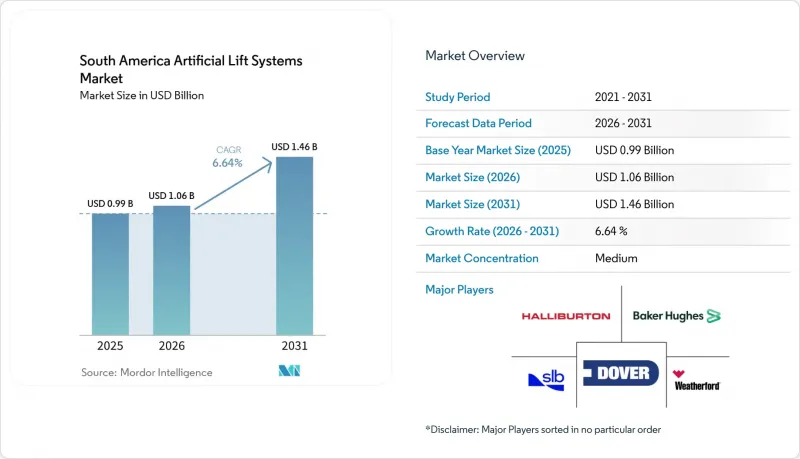
에 따르면 남미의 인공 채유 시스템 시장 규모는 2025년에 9억 9,000만 달러, 2026년에 10억 6,000만 달러에 달하고, 2031년까지 14억 6,000만 달러에 달할 것으로 예측됩니다.
2026년부터 2031년까지의 연평균 성장률(CAGR)은 6.64%가 될 것으로 전망됩니다.
남미 인공 채유 시스템 시장의 동향 및 인사이트
성숙 유정의 재생 및 생산 수명 연장
남미 전역의 성숙한 생산 유전에서는 천연 저류층 압력이 저하된 후 인공 채유에 의존하고 있습니다. 이로 인해 기존 분지 전역에서 설비 교체, 수리 및 유지보수 작업에 대한 지속적인 수요가 발생하고 있습니다. 에코페트롤(Ecopetrol)사는 콜롬비아에서 ESP(전기 잠수 펌프), 기계식 펌프, 프로그레시브 캐비티 펌프의 설치를 포함한 자사의 인공 채유 시스템에서 고장 감소와 에너지 사용량 절감에 주력하고 있습니다. 이러한 노력은 유정이 노후화됨에 따라 사업자가 펌프의 신뢰성과 에너지 성능을 중시하는 이유를 보여줍니다. 따라서 남미의 인공 채유 시스템 시장에는 신규 시추뿐만 아니라 생산 유지와 관련된 수요도 포함되어 있습니다. 이러한 기반은 사업자가 중요도가 낮은 확장 프로젝트를 연기하더라도 서비스 활동을 뒷받침할 수 있습니다.
성숙한 유정에서는 물 생산량, 유체의 점도, 가스 함유량이 유전마다 다르기 때문에 더 폭넓은 양수 방법의 조합이 필요합니다. 운영사는 유체량이 많은 경우 ESP를 채택하는 한편, 로드 리프트나 PCP 시스템은 많은 기존 육상 운영에서 여전히 중요한 역할을 하고 있습니다. 수리를 미루면 생산량 손실로 이어질 수 있으므로 현장 팀은 이러한 시스템을 정기적으로 유지보수해야 합니다. 워크오버나 장비 교체가 신속하게 필요한 경우, 현지 서비스 체계가 중요해집니다. 남미의 인공 채유 시스템 시장은 이러한 도입 실적을 통해 혜택을 보고 있습니다. 서비스 계약이 여러 차례의 개입 주기에 걸쳐 지속될 수 있기 때문입니다. 인근에 재고를 보유하고 경험이 풍부한 현장 작업 인력을 갖춘 공급업체는 운영사의 가동 중단 시간을 단축할 수 있습니다.
브라질의 프레솔트층 및 가이아나의 해양 개발 확대
브라질의 프리솔트 프로그램은 여전히 이 지역의 해양 시스템 수요를 주도하는 주요 원천입니다. 페트로브라스는 2025년에 자사의 프리솔트 생산을 통해 하루 256만 배럴 상당의 원유를 생산했다고 보고했습니다. 또한 이 회사는 2025년 한 해 동안 FPSO ‘알미란테 타만다레’가 하루 27만 배럴을 생산했다고 보고했습니다. 이러한 개발에는 심해의 수압, 대량의 가스, 그리고 가혹한 유체 조건에서도 작동할 수 있는 장비가 필요합니다. 남미의 인공 원유 채취 시스템 시장은 양수 방식의 선정이 유정 및 생산 시스템 설계에 반영된 프로젝트로부터 혜택을 받고 있습니다. 공급업체는 이러한 프로젝트에 참여하기 전에 기술적 자격 요건을 충족해야 합니다.
가이아나는 이 지역의 수요 기반에 새로운 해양 개발 경로를 추가하고 있습니다. 엑슨모빌은 스타브로크 블록의 생산량이 2025년 11월에 하루 90만 배럴에 도달했다고 보고했습니다. 이 회사는 우알 FPSO가 2026년에 가동을 시작할 것이며, 설계 생산량은 하루 25만 배럴이라고 밝혔습니다. 신규 프로젝트의 진전에 따라, 추가된 유정군 전체에 걸쳐 적절한 완공·감시·생산 지원 시스템에 대한 수요가 증가하고 있습니다. 해저에서의 개입 작업은 어렵고 비용이 많이 들 수 있으므로, 해양 운영사는 가동 수명을 매우 중요하게 여깁니다. 이 때문에 대규모 개입이 필요해지기 전에 운영상의 문제를 파악할 수 있는 감시 시스템의 도입이 촉진되고 있습니다.
초심해에서의 개입 및 워크오버의 경제성
심해용 리프트 시스템은 교체 시 특수한 선박, 해저 설비 및 치밀한 계획이 필요할 수 있으므로 반드시 안정적으로 가동되어야 합니다. 이로 인해 브라질의 프레솔트층이나 가이아나의 해양 개발 프로젝트에서 고장으로 인한 비용이 급증하고 있습니다. 'Journal of Petroleum Technology'지의 2025년 기사에서는 브라질의 초심해·중질유전인 아틀란타 유전에서 ESP의 운영상의 과제에 대해 논의되었습니다. 해당 기사에서는 중질유, 가스 조건, 수심이 ESP 운영을 얼마나 복잡하게 만드는지 설명하고 있습니다. 이러한 조건으로 인해 빈번한 교체 작업보다는 가동 수명 향상 및 모니터링에 대한 투자가 우선시될 가능성이 있습니다. 따라서 남미의 인공 채유 시스템 시장에서는 고사양 하드웨어의 가치와 개입 비용 간의 균형을 맞춰야 합니다.
운영사는 장비의 적합성 평가와 고장 방지에 더 중점을 둠으로써 이러한 위험을 완화하고 있습니다. 생산 위험이 높은 지역에서는 이중화 구성이나 모니터링 도구를 채택하는 경우도 있습니다. 이러한 접근 방식은 가혹한 해양 환경에서의 경험이 있는 평판 좋은 공급업체에 유리하게 작용할 수 있습니다. 또한, 운영사가 신뢰성이나 서비스 체계를 면밀히 검토하기 때문에 조달 과정이 장기화될 가능성도 있습니다. 개입 비용이 고액이기 때문에 중요한 유정에서 실적이 없는 시스템을 시험적으로 도입하려는 의지가 제한될 가능성이 있습니다. 남미의 인공 채유 시스템 시장은 자격을 갖춘 공급업체에게 여전히 매력적인 시장이지만, 심해 작업에 진출하기 위해서는 높은 기술적 신뢰성이 요구됩니다.
부문 분석
2025년 기준, 전기식 잠수 펌프(ESP)는 남미 인공 채유 시스템 시장의 32.6%를 차지하고 있으며, 2031년까지 연평균 성장률(CAGR) 6.8%로 성장할 것으로 예측됩니다. ESP는 해양 및 심지상 응용 분야의 고생산량 유정에서 활용되고 있습니다. 뛰어난 적응성 덕분에 성숙한 기존 유정부터 복잡한 해양 완공 유정에 이르기까지 폭넓게 사용되고 있습니다. 페트로브라스는 장비의 신뢰성이 중요한 프리솔트층 생산 아키텍처에서 인공 채유 시스템을 채택하고 있습니다. BW 에너지사가 2025년 5월에 발표한 마롬바 프로젝트 결정에는 유정 내 ESP 시스템을 갖춘 6개의 초기 수평 생산정이 포함되어 있었습니다.
프로그레시브 캐비티 펌프는 고점도 유체나 성숙한 저류층을 다루는 육상 운영에서 여전히 중요한 역할을 수행하고 있습니다. 로드 리프트는 오래된 생산 지역 전반에 걸쳐 여전히 상당한 도입 실적을 유지하고 있습니다. 가스 리프트, 플런저 리프트, 유압 펌프 및 기타 시스템은 ESP가 적합하지 않은 유정에서 활용되고 있습니다. 모든 유정에 단일 시스템이 적합한 것은 아니기 때문에 인공 채유 시스템 업계는 이러한 광범위한 기술의 조합에 의존하고 있습니다. ISO 15551:2023은 튜브 내에 설치되는 ESP 시스템의 설계 검증, 성능 평가 및 기능 평가에 관한 요구 사항을 규정하고 있습니다.
2025년 기준, 남미의 인공 채유 시스템 시장 중 수직 유정이 57.4%를 차지했습니다. 비전통 자원 개발이 확대됨에 따라, 수평 유정은 2031년까지 연평균 성장률(CAGR) 7.1%로 성장할 것으로 예측됩니다. 수직 유정의 설치 실적은 아르헨티나, 콜롬비아, 브라질에 걸쳐 있는 확립된 육상 분지에 집중되어 있습니다. 수평 유정의 완공에는 서로 다른 형태의 펌프나 더 강력한 가스 처리 능력이 필요할 수 있습니다. 남미의 인공 채유 시스템 시장에서 수평 유정용 시장 규모는 비전통적 광구에서의 다중 유정 개발에 따라 확대되고 있습니다.
수평 유정에 리프트 설비를 설치하려면 유정 완성 설계와 저류층 압력 변화를 고려한 계획이 필요합니다. 장비는 고장 위험을 높이지 않으면서 안정적인 유량을 유지할 수 있어야 합니다. 설계 과정에는 펌프의 흡입구, 가스의 거동 및 출력 평가가 포함됩니다. 비전통적 자원 개발 경험을 보유한 세계 공급업체는 검증된 설계를 이 지역에 도입할 수 있습니다. 유정 현장에서의 설치 및 문제 해결에는 여전히 현지 서비스 팀이 필수적입니다.
기타 혜택:
- 엑셀 형식의 시장 예측(ME) 시트
- 3개월간의 애널리스트 지원
자주 묻는 질문
목차
제1장 소개
- 조사 가정과 시장 정의
- 조사 범위
제2장 조사 방법
제3장 주요 요약
제4장 시장 구도
- 시장 개요
- 시장 성장 촉진요인
- 시장 성장 억제요인
- 공급망 분석
- Porter's Five Forces 분석
- 기술 동향
- 규제 상황
- 투자 분석
제5장 시장 규모와 성장 예측
- 리프트 종류별
- 유정 오리엔테이션별
- 레저버 유형별
- 용도별
- 구성요소별
- 서비스별
- 지역별
- 브라질
- 아르헨티나
- 가이아나
- 콜롬비아
- 칠레
- 기타 남미 국가
제6장 경쟁 구도
- 시장 집중도
- 전략적 동향
- 시장 점유율 분석
- 기업 개요
- Baker Hughes Company
- AccessESP
- Alkhorayef Petroleum Company
- Borets International Limited
- Dover Corporation
- Flotek Industries, Inc.
- Halliburton Company
- JJ Tech Systems
- Kudu Industries Inc.
- NOV Inc.
- Novomet Group
- Novomet Oil Services Holding Ltd.
- Odessa Separator
- PCM Artificial Lift
- SLB
- Tenaris S.A.
- Weatherford International plc
제7장 시장 기회와 향후 전망
KSM 26.10.29According to Mordor Intelligence, the South America artificial lift systems market size is projected to be USD 0.99 billion in 2025, USD 1.06 billion in 2026, and reach USD 1.46 billion by 2031, at a CAGR of 6.64% from 2026 to 2031.
South America Artificial Lift Systems Market Trends and Insights
Mature-Well Rejuvenation And Production-Life Extension
Mature producing fields across South America rely on artificial lift after natural reservoir pressure declines. This creates recurring demand for equipment replacement, repairs, and service work across established basins. Ecopetrol has addressed failure reduction and energy use in its artificial lifting systems, covering ESP, mechanical pumping, and progressive cavity pump installations in Colombia. The work shows why operators focus on pump reliability and energy performance as wells age. The South America artificial lift systems market therefore includes demand that is tied to preserving production, rather than only to new drilling. That base can support service activity when operators delay less essential expansion projects.
Mature wells also require a broader mix of lift methods because water production, fluid viscosity, and gas content vary across fields. Operators use ESPs where high fluid volumes justify the system, while rod lift and PCP systems remain relevant in many established onshore operations. Field teams must maintain these systems regularly because deferred repairs can result in lost output. Local service capacity is important when workovers or equipment changes are needed quickly. The South America artificial lift systems market benefits from this installed base because service contracts can continue through several intervention cycles. Suppliers that hold nearby inventory and experienced field crews can reduce downtime for operators.
Brazil Pre-Salt And Guyana Offshore Expansion
Brazil's pre-salt program remains a major source of offshore system demand in the region. Petrobras reported 2.56 million barrels of oil equivalent per day from its own pre-salt production in 2025. The company also reported that the Almirante Tamandare FPSO produced 270,000 barrels per day during 2025. These developments require equipment that can operate under deepwater pressure, high gas volumes, and demanding fluid conditions. The South America artificial lift systems market gains from projects where lift selection is incorporated into well and production-system design. Suppliers need to meet technical qualification requirements before they can participate in these projects.
Guyana adds another offshore development path to the regional demand base. ExxonMobil reported that Stabroek Block production reached 900,000 barrels per day in November 2025. The company stated that the Uaru FPSO began operations in 2026 with a design rate of 250,000 barrels per day. New projects increase the need for qualified completion, monitoring, and production-support systems across added well clusters. Offshore operators place high value on run life because subsea intervention can be difficult and expensive. This encourages the use of monitoring systems that identify operating issues before they require a major intervention.
Ultra-Deepwater Intervention And Workover Economics
Deepwater lift systems must operate reliably because replacement can require specialized vessels, subsea equipment, and detailed planning. This raises the cost of failures in Brazil's pre-salt fields and Guyana's offshore developments. A 2025 article in the Journal of Petroleum Technology discussed operating challenges for an ESP in the ultra-deepwater, heavy-oil Atlanta field in Brazil. The article described how heavy oil, gas conditions, and water depth complicate ESP operation. These conditions can shift investment toward run-life improvements and monitoring instead of frequent replacement activity. The South America artificial lift systems market must therefore balance the value of high-specification hardware against the cost of intervention.
Operators reduce this exposure by placing greater emphasis on equipment qualification and failure prevention. They may use redundant configurations or monitoring tools where the production risk is high. This approach can favor established suppliers with experience in demanding offshore applications. It can also lengthen purchasing processes because operators review reliability and service capability closely. High intervention costs can limit the willingness to test unproven systems in critical wells. The South America artificial lift systems market remains attractive for qualified providers, but entry into deepwater work requires significant technical credibility.
Other drivers and restraints analyzed in the detailed report include:
- Digital Lift Optimization And Remote Surveillance
- Automated Gas-Handling Retrofits In High-GOR Wells
- Specialty-Elastomer And Power-Electronics Bottlenecks
For complete list of drivers and restraints, kindly check the Table Of Contents.
Segment Analysis
Electric submersible pumps held 32.6% of the South America artificial lift systems market in 2025 and are forecast to grow at a 6.8% CAGR through 2031. ESPs serve high-volume wells across offshore and deep onshore applications. Their adaptability supports use from mature conventional wells to complex offshore completions. Petrobras uses artificial lift within its pre-salt production architecture, where equipment reliability is important. BW Energy's May 2025 Maromba decision included 6 initial horizontal production wells with downhole ESP systems.
Progressive cavity pumps remain important in onshore operations with viscous fluids and mature reservoirs. Rod lift retains a substantial installed base across older producing areas. Gas lift, plunger lift, hydraulic pumps, and other systems serve wells where ESPs are less suitable. The artificial lift systems industry depends on this broad technology mix because no single system suits every well. ISO 15551:2023 sets requirements for design verification, performance ratings, and functional evaluation for tubing-deployed ESP systems.
Vertical wells accounted for 57.4% of the South America artificial lift systems market in 2025. Horizontal wells are projected to grow at a 7.1% CAGR through 2031 as unconventional development expands. The vertical installed base is concentrated in established onshore basins across Argentina, Colombia, and Brazil. Horizontal completions can require different pump geometry and stronger gas-handling capability. The South America artificial lift systems market size for horizontal wells is growing with multi-well development in unconventional acreage.
Lift installation in horizontal wells requires planning around completion design and reservoir pressure changes. Equipment must support stable flow without increasing failure risk. The design process includes pump intake, gas behavior, and power assessments. Global suppliers with unconventional experience can bring proven designs to the region. Local service teams remain essential for installation and troubleshooting at the well site.
Complete Report Scope:
- By Lift Type
- Electric Submersible Pumps (ESP)
- Progressive Cavity Pump (PCP)
- Rod Lift (Beam, Sucker-Rod)
- Gas Lift
- Hydraulic Piston & Jet Pumps
- Plunger Lift
- Other Niche Systems (Hydraulic Submersible, Capillary)
- By Well Orientation
- Horizontal Wells
- Vertical Wells
- By Reservoir Type
- Conventional
- Unconventional (Shale/Tight)
- By Application
- Onshore
- Offshore
- By Component
- Pump
- Motor
- Variable Speed Drive & Controls
- Surface Equipment
- Ancillary (Sensors, Seal-Sections, Packers)
- By Service
- Installation and Commissioning
- Optimization and Monitoring
- Maintenance, Repair & Overhaul (MRO)
- By Geography
- Brazil
- Argentina
- Guyana
- Colombia
- Chile
- Rest of South America
List of Companies Covered in this Report:
- Baker Hughes Company
- AccessESP
- Alkhorayef Petroleum Company
- Borets International Limited
- Dover Corporation
- Flotek Industries, Inc.
- Halliburton Company
- JJ Tech Systems
- Kudu Industries Inc.
- NOV Inc.
- Novomet Group
- Novomet Oil Services Holding Ltd.
- Odessa Separator
- PCM Artificial Lift
- SLB
- Tenaris S.A.
- Weatherford International plc
Additional Benefits:
- The market estimate (ME) sheet in Excel format
- 3 months of analyst support
TABLE OF CONTENTS
1 INTRODUCTION
- 1.1 Study Assumptions and Market Definition
- 1.2 Scope of the Study
2 RESEARCH METHODOLOGY
3 EXECUTIVE SUMMARY
4 MARKET LANDSCAPE
- 4.1 Market Overview
- 4.2 Market Drivers
- 4.2.1 Mature-Well Rejuvenation and Production-Life Extension
- 4.2.2 Vaca Muerta Horizontal-Well Development
- 4.2.3 Brazil Pre-Salt and Guyana-Adjacent Offshore Expansion
- 4.2.4 Digital Lift Optimization and Remote Surveillance
- 4.2.5 Local Supply Hubs for Corrosive-Service Lift Equipment
- 4.2.6 Automated Gas-Handling Retrofits in High-GOR Wells
- 4.3 Market Restraints
- 4.3.1 Crude-Price-Driven Upstream CAPEX Deferrals
- 4.3.2 Ultra-Deepwater Intervention and Workover Economics
- 4.3.3 Specialty-Elastomer and Power-Electronics Bottlenecks
- 4.3.4 Shortage of Automation-Ready Field Personnel
- 4.4 Supply-Chain Analysis
- 4.5 Porter's Five Forces Analysis
- 4.5.1 Bargaining Power of Suppliers
- 4.5.2 Bargaining Power of Buyers
- 4.5.3 Threat of New Entrants
- 4.5.4 Threat of Substitutes
- 4.5.5 Competitive Rivalry
- 4.6 Technology Outlook
- 4.7 Regulatory Landscape
- 4.8 Investment Analysis
5 MARKET SIZE AND GROWTH FORECASTS
- 5.1 By Lift Type
- 5.1.1 Electric Submersible Pumps (ESP)
- 5.1.2 Progressive Cavity Pump (PCP)
- 5.1.3 Rod Lift (Beam, Sucker-Rod)
- 5.1.4 Gas Lift
- 5.1.5 Hydraulic Piston & Jet Pumps
- 5.1.6 Plunger Lift
- 5.1.7 Other Niche Systems (Hydraulic Submersible, Capillary)
- 5.2 By Well Orientation
- 5.2.1 Horizontal Wells
- 5.2.2 Vertical Wells
- 5.3 By Reservoir Type
- 5.3.1 Conventional
- 5.3.2 Unconventional (Shale/Tight)
- 5.4 By Application
- 5.4.1 Onshore
- 5.4.2 Offshore
- 5.5 By Component
- 5.5.1 Pump
- 5.5.2 Motor
- 5.5.3 Variable Speed Drive & Controls
- 5.5.4 Surface Equipment
- 5.5.5 Ancillary (Sensors, Seal-Sections, Packers)
- 5.6 By Service
- 5.6.1 Installation and Commissioning
- 5.6.2 Optimization and Monitoring
- 5.6.3 Maintenance, Repair & Overhaul (MRO)
- 5.7 By Geography
- 5.7.1 Brazil
- 5.7.2 Argentina
- 5.7.3 Guyana
- 5.7.4 Colombia
- 5.7.5 Chile
- 5.7.6 Rest of South America
6 COMPETITIVE LANDSCAPE
- 6.1 Market Concentration
- 6.2 Strategic Moves
- 6.3 Market Share Analysis
- 6.4 Company Profiles (includes Global Level Overview, Market Level Overview, Core Segments, Financials as available, Strategic Information, Market Rank/Share, Products and Services, Recent Developments)
- 6.4.1 Baker Hughes Company
- 6.4.2 AccessESP
- 6.4.3 Alkhorayef Petroleum Company
- 6.4.4 Borets International Limited
- 6.4.5 Dover Corporation
- 6.4.6 Flotek Industries, Inc.
- 6.4.7 Halliburton Company
- 6.4.8 JJ Tech Systems
- 6.4.9 Kudu Industries Inc.
- 6.4.10 NOV Inc.
- 6.4.11 Novomet Group
- 6.4.12 Novomet Oil Services Holding Ltd.
- 6.4.13 Odessa Separator
- 6.4.14 PCM Artificial Lift
- 6.4.15 SLB
- 6.4.16 Tenaris S.A.
- 6.4.17 Weatherford International plc
7 MARKET OPPORTUNITIES AND FUTURE OUTLOOK
- 7.1 White-space & Unmet-need Assessment


