

|
시장보고서
상품코드
2154518
표면 세정용 화학제품 : 시장 점유율 분석, 업계 동향과 통계, 성장 예측(2026-2031년)Surface Cleaning Chemicals - Market Share Analysis, Industry Trends & Statistics, Growth Forecasts (2026 - 2031) |
||||||
 Mordor Intelligence
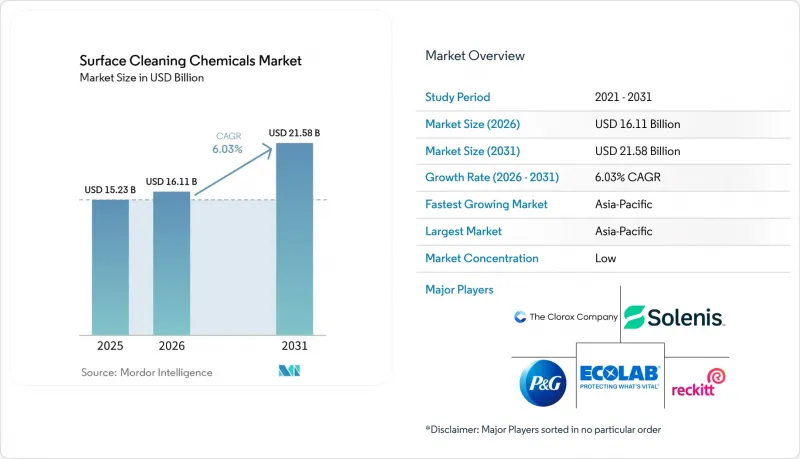
에 따르면 표면 세정용 화학제품 시장 규모는 2025년에 152억 3,000만 달러로 추정되며, 예측 기간(2026-2031년) 동안 CAGR 6.03%로 확대되어, 2026년 161억 1,000만 달러에서 2031년에는 215억 8,000만 달러에 달할 것으로 전망됩니다.
전 세계 표면 세정용 화학제품 시장의 동향 및 인사이트
위생 및 감염 관리 기준 강화
시설 측에서는 환자의 안전, 진료 절차, 혹은 일상적인 공중보건 관리에 필수적인 청소 활동을 미룰 수 없기 때문에 기관의 위생 요건이 표면 세정용 화학제품 시장에 안정적인 수요 기반을 마련해 주고 있습니다. 세계보건기구(WHO)는 급성기 의료 시설의 감염 예방 및 관리 프로그램의 핵심 요소로 환경 청소와 소독을 꼽고 있습니다. 미국 질병통제예방센터(CDC)는 표면 청소 및 소독에 관한 요건을 포함하여 의료 현장을 위한 환경 감염 관리 지침을 제공하고 있습니다. 이러한 요건으로 인해 청소용 화학약품의 구매는 단순한 재량 예산의 문제가 아니라, 병원, 진료소, 외식 시설, 공공 시설의 운영 활동과 더욱 밀접하게 연계되게 되었습니다. 제품 선정 시에는 입증된 유효성, 안전한 취급 방법, 규정 준수 관련 문서, 그리고 업무가 바쁜 시기에도 직원이 일관되게 준수할 수 있는 지침이 중시됩니다. 2025년에 시행될 캐나다 보건부의 살생물제 관련 프레임워크는 관련 용도에서의 소독제 사양에 영향을 미치며, 북미의 인증 요건을 더욱 엄격하게 만들 것입니다.
아시아태평양의 식품 가공 및 CIP(정지 세척) 시스템 확대
식품·음료 생산은 표면 세정용 화학제품 시장에서 알칼리성 및 산성 화학약품의 수요를 견인하고 있습니다. 이는 제조 설비에 정기적인 세정 주기가 필요하며, 공장에서는 확립된 위생 관리 절차에 부합하는 제품이 요구되기 때문입니다. CIP(고정식 세정) 시스템에서는 정의된 세정 절차, 농도 수준, 온도 및 접촉 시간이 사용되므로, 작업자에게는 배합의 일관성이 중요해지며, 관리되지 않은 대체품의 사용 여지가 제한됩니다. 포장·가공 기술 협회(PMMI)의 보고서에 따르면, 식품·음료 제조업체들은 디지털을 통한 위생 관리 모니터링과 보다 체계화된 위생 절차에 주력하고 있습니다. 이러한 접근 방식에 따라 구매는 문서화가 가능하고, 관리된 공정 내에서 사용할 수 있으며, 편차 조사나 감사 결과 시 품질 팀의 검토가 가능한 제품으로 전환되고 있습니다. 약제 투여 및 위생 관리에 관한 디지털 기록은 공장에서 소비량을 추적하고, 사이클 완료를 확인하며, 생산에 영향을 미치기 전에 편차를 파악하고, 세척 절차가 표준 운영 요건을 충족하는지 검증하는 데 도움이 됩니다. 그 결과, 근본적인 세척 작업이 여전히 일상적인 업무이긴 하지만, 전용으로 개발된 세척제의 역할이 더욱 중요해지고 있습니다.
화학제품, VOC, PFAS 및 살생물제에 관한 규제 강화
화학 성분에 대한 요건이 강화됨에 따라 표면 세정용 화학제품 시장에서 개발, 시험, 문서화 및 제품 전환에 소요되는 비용이 증가하고 있습니다. 특히 공급업체가 여러 규제 대상 지역에서 유사한 제품 라인을 판매하는 경우 이러한 경향이 두드러집니다. 규정(EU) 2026/405는 세제 및 계면활성제를 대상으로 하며, 성분 관리 및 인 관련 평가에 영향을 미치는 조항을 포함하고 있습니다. 캐나다의 2025년 특정 유해 물질 규제에 따르면, 2026년 6월 30일부터 지정된 퍼플루오로알킬 물질(PFAS) 및 폴리플루오로알킬 물질과 관련된 물질의 사용이 제한됩니다. 유럽연합(EU)은 2026년 2월, 과산화수소계 살생물제 제품군에 대해 10년간의 승인을 부여했습니다. 그 결과, 기존 성분의 대체가 필요해지는 한편, 일부 대체 화학제품에 대해서는 규제 방향이 명확해졌기 때문에 제조업체는 시기, 표시 및 고객 승인을 신중하게 관리해야 합니다. 소규모 배합 제조업체는 관할 구역을 넘나드는 등록, 안전성 문서, 배합 변경 및 고객에 대한 전환 계획 관리에 필요한 자원이 제한적인 경우가 많아 더 큰 어려움에 직면하고 있습니다.
부문 분석
2025년, 알칼리성 세정제는 표면 세정용 화학제품 시장 점유율의 33.23%를 차지하며 가장 큰 제품 카테고리가 되었습니다. 이 제품의 사용은 유제품, 음료, 식품 제조의 세정 주기와 밀접한 관련이 있으며, 다음 생산 주기가 시작되기 전에 공정 장비에서 단백질 및 지방 잔류물을 제거해야 합니다. 세정제 소비량은 생산량, 위생 관리 일정, 설비 설계, 오염 정도, 수질 및 각 시설에서 채택된 운영 규정에 따라 달라지기 때문에 수요는 지속적으로 발생합니다. 산성 세정제는 설비의 스케일 제거, 급수 시스템 세척, 식품 접촉면의 광물 침전물 처리에서 중요한 역할을 하며, 특히 알칼리 세척 주기만으로는 스케일 형성을 억제할 수 없는 상황에서 그 가치가 발휘됩니다. 용제계 세정제는 유기 잔류물 제거에 높은 세정력, 증발 제어 또는 잔류물의 신중한 제거가 요구되는 자동차, 금속 가공, 전자기기 분야에서 여전히 중요한 역할을 하고 있습니다. 규제 및 근로자 안전에 관한 요건으로 인해, 표면 세정 화학약품 업계에서는 용제 함량이 적고 물과 혼합 가능하며 효소가 배합된 대체 제품의 개발이 진행되고 있습니다.
소독제 및 살균제는 2031년까지 연평균 성장률(CAGR) 7.12%로 성장할 것으로 예측되며, 이는 제품 유형 중 가장 높은 성장률입니다. 그 사용은 의료, 식품 가공 및 공공 시설에서의 지속적인 감염 관리 요건에 의해 뒷받침되고 있으며, 이러한 시설에서는 세척 절차에서 ‘오염 제거’‘세척’, ‘살균’, ‘소독’이 구분되는 경우가 많습니다. BASF는 2025년 7월, 세탁 및 세척 용도를 위한 ‘Lavergy’ 액상 효소 제품군을 확충했습니다. 여기에는 저에너지 운전 조건에서도 세척 성능을 유지하는 저온 세척 사이클용 제품도 포함되어 있습니다. 과산화수소계 살생물제에 대한 유럽의 10년간 승인 덕분에, 배합 개발자들은 특정 과산화수소계 제품군에 대해 보다 확실한 전망을 얻을 수 있습니다. 효소계 특수 세정제는 잔류물 관리, 공정 검증, 표면 및 장비와의 호환성이 구매 결정의 핵심이 되는 용도에서 사용됩니다. 따라서 제품 혁신은 소독 효과에 대한 주장에 그치지 않고, 저온 세척, 재료와의 호환성, 문서화된 사용 절차, 그리고 특정 운영 환경을 위해 설계된 배합에 이르기까지 확대되고 있습니다.
지역별 분석
아시아태평양은 2025년에 전 세계 매출의 35.78%를 차지할 것으로 예상되며, 2031년까지 연평균 성장률(CAGR) 6.84%로 성장할 것으로 전망됩니다. 이 지역은 대규모 식품 가공 사업, 확대되는 전자기기 생산, 의료 분야 투자, 상업 시설에 대한 수요, 그리고 다양한 현지 청소 관행이 특징입니다. 중국은 식품 가공, 반도체 제조 및 위탁 청소 분야에서 수요를 주도하고 있습니다. 인도의 수요는 의료 인프라 및 기관의 구매와 밀접한 관련이 있습니다. 일본과 한국은 전자기기 및 반도체 생산에 사용되는 고순도 화학 약품의 수요에 기여하고 있습니다.
베트남, 인도네시아, 태국을 포함한 아세안(ASEAN) 시장에서는 식품·음료 수출을 위한 가공 및 호텔·레스토랑 산업의 발전을 통해 수요가 창출되고 있습니다. 아시아태평양의 표면 세정용 화학제품 시장 공급업체들은 일상적인 청소를 위한 가성비 높은 제품과 산업용 고사양 제품 간의 균형을 맞춰야 합니다. 이러한 제품들은 대개 서로 다른 판매 채널과 애플리케이션 지원이 필요합니다.
북미 시장은 의료 요건, 제품 등록 및 성분 규정 준수에 의해 형성되고 있습니다. 미국 환경보호청(EPA)은 라벨의 지침에 따라 사용했을 때 SARS-CoV-2에 대한 사용 기준을 충족하는 소독제의 참고 자료로 ‘리스트 N’을 관리하고 있습니다. 유럽에서는 환경 기준과 세제 규제로 인해 생분해성이며 환경 부하가 낮고, 효과가 입증된 배합에 대한 수요가 뒷받침되고 있습니다. 독일과 프랑스는 각각의 제조 거점을 통해 유럽의 산업용 세척 수요를 지원하고 있습니다. 유럽의 식품 가공 업계에서는 물 관리가 운영 관행, 세척 주기 설계, 그리고 기존형과 농축형 중 어느 것을 채택할지에 영향을 미치기 때문에 헹굼물 절감과 원료 효율성은 여전히 중요한 과제로 남아 있습니다.
남미, 중동 및 아프리카는 비교적 소규모 시장이지만, 식품 가공, 호텔·레스토랑 분야 투자 및 의료 관련 프로젝트가 두 지역의 수요를 뒷받침하고 있습니다. 브라질과 아르헨티나는 육류 가공 및 음료 생산을 통해 수요에 기여하고 있는 반면, 중동 및 아프리카에서는 호텔·레스토랑 시설 및 의료 시설의 기관용 수요가 발생하고 있습니다. 이 지역 전체에서 시장 규모는 공급업체가 규정을 준수하는 배합, 신뢰할 수 있는 유통, 애플리케이션 지원, 그리고 현지 운영 조건에 적합한 제품을 제공할 수 있는지 여부에 따라 좌우됩니다.
기타 혜택:
- 엑셀 형식의 시장 예측(ME) 시트
- 3개월간의 애널리스트 지원
자주 묻는 질문
목차
제1장 소개
- 조사 가정과 시장 정의
- 조사 범위
제2장 조사 방법
제3장 주요 요약
제4장 시장 구도
- 시장 개요
- 시장 성장 촉진요인
- 시장 성장 억제요인
- 밸류체인 분석
- Porter's Five Forces 분석
제5장 시장 규모와 성장 예측
- 제품 유형별
- 표면 유형별
- 용도별
- 지역별
- 아시아태평양
- 중국
- 인도
- 일본
- 한국
- ASEAN 국가
- 기타 아시아태평양 국가
- 북미
- 미국
- 캐나다
- 멕시코
- 유럽
- 독일
- 영국
- 프랑스
- 이탈리아
- 러시아
- 기타 유럽 국가
- 남미
- 브라질
- 아르헨티나
- 기타 남미 국가
- 중동 및 아프리카
- 사우디아라비아
- 남아프리카공화국
- 기타 중동 및 아프리카 국가
- 아시아태평양
제6장 경쟁 구도
- 시장 집중도
- 전략적 동향
- 시장 점유율·순위 분석
- 기업 개요
- 3M
- BASF
- Betco Corporation
- Colgate-Palmolive Company
- Diversey, Inc.
- Ecolab Inc.
- Godrej Chemicals
- GOJO Industries, Inc.
- Henkel AG & Co. KGaA
- Kao Corporation
- Procter & Gamble
- Reckitt
- S.C. Johnson & Son, Inc.
- Solenis
- The Clorox Company
- Unilever
- Zep Inc.
제7장 시장 기회와 향후 전망
KSM 26.10.29According to Mordor Intelligence, the surface cleaning chemicals market size was estimated at USD 15.23 billion in 2025 and is estimated to grow from USD 16.11 billion in 2026 to USD 21.58 billion by 2031, at a CAGR of 6.03% during the forecast period (2026-2031).
Global Surface Cleaning Chemicals Market Trends and Insights
Rising Hygiene and Infection-Control Standards
Institutional hygiene requirements create a stable demand base for the surface-cleaning chemicals market, as facilities cannot defer cleaning activities integral to patient safety, operating procedures, or routine public health management. The World Health Organization identifies environmental cleaning and disinfection as core elements of infection prevention and control programs in acute healthcare facilities. The U.S. Centers for Disease Control and Prevention provides environmental infection control guidance for healthcare settings, including requirements for surface cleaning and disinfection. These requirements tie chemical purchasing for cleaning more closely to operating activity in hospitals, clinics, foodservice sites, and public facilities, rather than to discretionary budgets alone. Product selection depends on verified efficacy, safe handling practices, compliance documentation, and instructions that staff can follow consistently during busy operating periods. Health Canada's biocide framework, effective in 2025, affects sanitizer specifications for relevant applications and adds to qualification requirements in North America.
Expansion of Food Processing and Clean-in-Place Systems in Asia-Pacific
Food and beverage production drives demand for alkaline and acidic chemistries in the surface cleaning chemicals market, as process equipment requires regular cleaning cycles and plants need products that fit established sanitation routines. Clean-in-place systems use defined cleaning steps, concentration levels, temperatures, and contact periods, making formulation consistency important for operators and limiting the scope for uncontrolled substitution. PMMI, The Association for Packaging and Processing Technologies, reported that food and beverage manufacturers focus on digital sanitation monitoring and more formalized sanitation procedures. This approach shifts purchasing toward products that can be documented, used within a controlled process, and reviewed by quality teams when investigating deviations or auditing results. Digital records for dispensing and sanitation help plants track consumption, confirm completed cycles, identify deviations before they affect production, and verify that cleaning procedures meet standard operating requirements. The result is a stronger role for purpose-built cleaning formulations, even where the underlying cleaning task remains routine.
Stricter Chemical, VOC, PFAS, and Biocidal Regulations
Stricter requirements for chemical ingredients increase development, testing, documentation, and product transition costs in the surface cleaning chemicals market, particularly when a supplier sells similar product lines across several regulated jurisdictions. Regulation (EU) 2026/405 addresses detergents and surfactants and includes provisions affecting ingredient controls and phosphorus-related assessments. Canada's 2025 regulations on certain toxic substances restrict specified Per- and Polyfluoroalkyl Substances (PFAS)-related substances from June 30, 2026. The European Union granted a 10-year authorization in February 2026 for a family of hydrogen peroxide-based biocidal products. As a result, legacy ingredients may need replacement while some alternative chemistries gain a clearer regulatory path, requiring manufacturers to manage timing, labeling, and customer approvals carefully. Smaller formulators face greater difficulty, as they often have fewer resources to manage registrations, safety documentation, reformulation, and customer transition plans across jurisdictions.
Other drivers and restraints analyzed in the detailed report include:
- Sustainability-Led Shift Toward Bio-Based and Concentrated Formulations
- Healthcare, Hospitality, Foodservice, and Commercial Facility Expansion
- Petrochemical Feedstock and Surfactant Price Volatility
For complete list of drivers and restraints, kindly check the Table Of Contents.
Segment Analysis
Alkaline cleaners held 33.23% of the surface cleaning chemicals market share in 2025, making them the largest product category. Their use is closely linked to cleaning cycles in dairy, beverage, and food manufacturing, where protein and fat residues must be removed from process equipment before the next production run begins. Demand is recurring because cleaning consumption follows production throughput, sanitation schedules, equipment design, soil load, water conditions, and the operating rules used by each facility. Acidic cleaners hold an important position in descaling equipment, cleaning water systems, and treating mineral deposits on food-contact surfaces, particularly where alkaline cycles alone cannot control scale formation. Solvent-based cleaners remain relevant in automotive, metalworking, and electronics settings where organic residues require higher cleaning strength, controlled evaporation, or carefully managed residue removal. Regulatory and worker-safety requirements are encouraging the development of lower-solvent, water-miscible, and enzyme-supported alternatives in the surface cleaning chemicals industry.
Disinfectants and sanitizers are forecast to grow at a 7.12% CAGR through 2031, the highest rate among product types. Their use is supported by sustained infection-control requirements in healthcare, food processing, and institutional facilities, where cleaning instructions often distinguish between soil removal, cleaning, sanitizing, and disinfection. BASF expanded its Lavergy liquid enzyme portfolio in July 2025 for laundry and cleaning applications, including low-temperature cleaning cycles that support cleaning performance under lower-energy operating conditions. The 10-year European authorization for hydrogen peroxide-based biocidal products gives formulators greater certainty for selected peroxide-based product families. Enzyme-based specialty cleaners are used in applications where residue control, process validation, and compatibility with surfaces or equipment are central to the purchasing decision. Product innovation, therefore, extends beyond disinfection claims to include lower-temperature cleaning, material compatibility, documented use procedures, and formulations designed for defined operating environments.
Complete Report Scope:
- By Product Type
- Alkaline Cleaners
- Acidic Cleaners
- Solvent-Based Cleaners
- Disinfectants and Sanitizers
- Others
- By Surface Type
- Metal Surfaces
- Glass Surfaces
- Plastic Surfaces
- Other Surface Types
- By Application
- Industrial Cleaning
- Commercial and Institutional Cleaning
- Household Cleaning
- Food and Beverage Processing
- Other Applications
- By Geography
- Asia-Pacific
- China
- India
- Japan
- South Korea
- ASEAN Countries
- Rest of Asia-Pacific
- North America
- United States
- Canada
- Mexico
- Europe
- Germany
- United Kingdom
- France
- Italy
- Russia
- Rest of Europe
- South America
- Brazil
- Argentina
- Rest of South America
- Middle East and Africa
- Saudi Arabia
- South Africa
- Rest of Middle East and Africa
- Asia-Pacific
Geography Analysis
Asia-Pacific held 35.78% of global revenue in 2025 and is forecast to grow at a 6.84% CAGR through 2031. The region is characterized by large food-processing operations, expanding electronics production, healthcare investment, demand for commercial facilities, and diverse local cleaning practices. China drives demand across food processing, semiconductor manufacturing, and contract cleaning. India's demand is linked to healthcare infrastructure and institutional purchasing. Japan and South Korea contribute to the demand for high-purity chemistries used in electronics and semiconductor production.
ASEAN markets, including Vietnam, Indonesia, and Thailand, generate demand through food and beverage export processing and hospitality development. Suppliers in the Asia-Pacific surface cleaning chemicals market must balance value products for routine cleaning with higher-specification products for industrial applications, which often require different sales channels and application support.
North America's market is shaped by healthcare requirements, product registration, and ingredient compliance. The U.S. Environmental Protection Agency maintains List N as a reference for disinfectants that meet its criteria for use against SARS-CoV-2 when used according to label directions. In Europe, environmental standards and detergent regulations support demand for biodegradable, low-impact, and documented formulations. Germany and France support European industrial cleaning demand through their manufacturing bases. Rinse reduction and material efficiency remain relevant in European food processing, as water management affects operating practices, cleaning cycle design, and the choice between conventional and concentrated formats.
South America and the Middle East and Africa are smaller markets, though food processing, hospitality investment, and healthcare projects support demand in both regions. Brazil and Argentina contribute through meat processing and beverage production, while the Middle East and Africa generate institutional demand from hospitality and healthcare facilities. Across these regions, market size depends on suppliers' ability to offer compliant formulations, reliable distribution, application support, and products suited to local operating conditions.
- 3M
- BASF
- Betco Corporation
- Colgate-Palmolive Company
- Diversey, Inc.
- Ecolab Inc.
- Godrej Chemicals
- GOJO Industries, Inc.
- Henkel AG & Co. KGaA
- Kao Corporation
- Procter & Gamble
- Reckitt
- S.C. Johnson & Son, Inc.
- Solenis
- The Clorox Company
- Unilever
- Zep Inc.
Additional Benefits:
- The market estimate (ME) sheet in Excel format
- 3 months of analyst support
TABLE OF CONTENTS
1 Introduction
- 1.1 Study Assumptions and Market Definition
- 1.2 Scope of the Study
2 Research Methodology
3 Executive Summary
4 Market Landscape
- 4.1 Market Overview
- 4.2 Market Drivers
- 4.2.1 Rising Hygiene and Infection-Control Standards
- 4.2.2 Expansion of Food Processing and Clean-in-Place Systems in Asia-Pacific
- 4.2.3 Sustainability-Led Shift Toward Bio-Based and Concentrated Formulations
- 4.2.4 Healthcare, Hospitality, Foodservice, and Commercial Facility Expansion
- 4.2.5 Digital Dosing, Dispensing, and Robotic Cleaning Adoption
- 4.2.6 Precision Cleaning Demand from Semiconductor and Electronics Manufacturing
- 4.3 Market Restraints
- 4.3.1 Stricter Chemical, VOC, PFAS, and Biocidal Regulations
- 4.3.2 Petrochemical Feedstock and Surfactant Price Volatility
- 4.3.3 Water Scarcity and Rinse-Reduction Constraints
- 4.3.4 Surface-Compatibility and Validated Contact-Time Requirements
- 4.4 Value Chain Analysis
- 4.5 Porter's Five Forces Analysis
- 4.5.1 Threat of New Entrants
- 4.5.2 Bargaining Power of Suppliers
- 4.5.3 Bargaining Power of Buyers
- 4.5.4 Threat of Substitutes
- 4.5.5 Competitive Rivalry
5 Market Size and Growth Forecasts (Value)
- 5.1 By Product Type
- 5.1.1 Alkaline Cleaners
- 5.1.2 Acidic Cleaners
- 5.1.3 Solvent-Based Cleaners
- 5.1.4 Disinfectants and Sanitizers
- 5.1.5 Others
- 5.2 By Surface Type
- 5.2.1 Metal Surfaces
- 5.2.2 Glass Surfaces
- 5.2.3 Plastic Surfaces
- 5.2.4 Other Surface Types
- 5.3 By Application
- 5.3.1 Industrial Cleaning
- 5.3.2 Commercial and Institutional Cleaning
- 5.3.3 Household Cleaning
- 5.3.4 Food and Beverage Processing
- 5.3.5 Other Applications
- 5.4 By Geography
- 5.4.1 Asia-Pacific
- 5.4.1.1 China
- 5.4.1.2 India
- 5.4.1.3 Japan
- 5.4.1.4 South Korea
- 5.4.1.5 ASEAN Countries
- 5.4.1.6 Rest of Asia-Pacific
- 5.4.2 North America
- 5.4.2.1 United States
- 5.4.2.2 Canada
- 5.4.2.3 Mexico
- 5.4.3 Europe
- 5.4.3.1 Germany
- 5.4.3.2 United Kingdom
- 5.4.3.3 France
- 5.4.3.4 Italy
- 5.4.3.5 Russia
- 5.4.3.6 Rest of Europe
- 5.4.4 South America
- 5.4.4.1 Brazil
- 5.4.4.2 Argentina
- 5.4.4.3 Rest of South America
- 5.4.5 Middle East and Africa
- 5.4.5.1 Saudi Arabia
- 5.4.5.2 South Africa
- 5.4.5.3 Rest of Middle East and Africa
- 5.4.1 Asia-Pacific
6 Competitive Landscape
- 6.1 Market Concentration
- 6.2 Strategic Moves
- 6.3 Market Share (%)/Ranking Analysis
- 6.4 Company Profiles (includes Global Overview, Market Overview, Core Segments, Financials as available, Strategic Information, Products and Services, and Recent Developments)
- 6.4.1 3M
- 6.4.2 BASF
- 6.4.3 Betco Corporation
- 6.4.4 Colgate-Palmolive Company
- 6.4.5 Diversey, Inc.
- 6.4.6 Ecolab Inc.
- 6.4.7 Godrej Chemicals
- 6.4.8 GOJO Industries, Inc.
- 6.4.9 Henkel AG & Co. KGaA
- 6.4.10 Kao Corporation
- 6.4.11 Procter & Gamble
- 6.4.12 Reckitt
- 6.4.13 S.C. Johnson & Son, Inc.
- 6.4.14 Solenis
- 6.4.15 The Clorox Company
- 6.4.16 Unilever
- 6.4.17 Zep Inc.
7 Market Opportunities and Future Outlook
- 7.1 White-Space and Unmet-Need Assessment


