

|
시장보고서
상품코드
2154732
비인간 신원(NHI) 보안 및 거버넌스 : 시장 점유율 분석, 업계 동향과 통계, 성장 예측(2026-2031년)Non-Human Identity (NHI) Security and Governance - Market Share Analysis, Industry Trends & Statistics, Growth Forecasts (2026 - 2031) |
||||||
 Mordor Intelligence
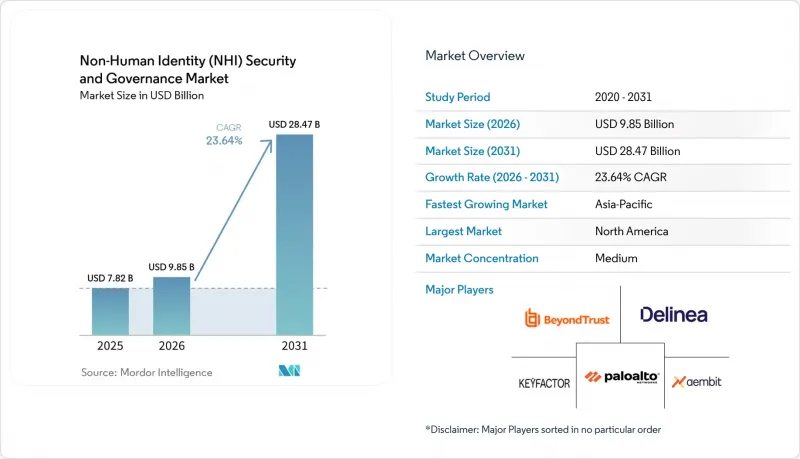
에 따르면 비인간 신원(NHI) 보안 및 거버넌스 시장 규모는 2025년 78억 2,000만 달러, 2026년 98억 5,000만 달러에서 2031년까지 284억 7,000만 달러로 확대될 것으로 예측되며, 2026년부터 2031년까지 연평균 성장률(CAGR)은 23.64%가 될 전망입니다.
전 세계 비인간 신원(NHI) 보안 및 거버넌스 시장의 동향과 인사이트
클라우드 네이티브 워크로드 및 API의 확대
API는 클라우드 네이티브 환경에서 주요 공격 대상이 되고 있으며, 각 엔드포인트에 연결된 인증 정보를 적절히 관리해야 할 필요성이 커지고 있습니다. 아카마이(Akamai)의 보고서에 따르면, 2025년에는 조직 1곳당 하루 평균 258건의 API 공격이 발생할 것으로 예상되며, 이는 전년 대비 113% 증가한 수치입니다. 또한, 조사 대상 조직의 87%가 API와 관련된 보안 사고를 보고했습니다. API 엔드포인트가 하나 늘어날 때마다 관련 서비스 계정, 토큰 또는 키가 추가되어, 이에 대한 인벤토리 관리 및 정책 제어가 필요합니다. 조직이 인증된 API 활동을 단순한 네트워크 이벤트가 아닌 머신 아이덴티티 이벤트로 취급하게 된다면, 비인간 아이덴티티(NHI) 보안 및 거버넌스 시장이 그 혜택을 누리게 될 것입니다. Salt Security의 조사에 따르면, 응답자의 47%가 전년 대비 API가 51%-100% 확대되었다고 보고했으며, 또한 47%는 자율 시스템에 공개된 API에 대한 보안 우려로 인해 프로덕션 환경으로의 출시를 연기했다고 응답했습니다. API 게이트웨이를 통한 제어를 통해 각 요청을 ID 정책에 대조하여 평가함으로써, 유출된 인증 정보의 영향 범위를 제한할 수 있습니다.
AI 에이전트 및 자율형 워크플로우 도입
AI 에이전트는 정적 서비스 계정과 관련된 위험과는 다른 신원 관련 위험을 초래합니다. 이러한 에이전트는 실행 시 인증 정보를 소비하고, 하위 에이전트를 생성하며, 외부 API를 호출하고, 여러 시스템에 걸쳐 작업을 수행할 수 있습니다. OWASP는 신원 및 특권 남용을 에이전트형 애플리케이션의 중대한 위험으로 지목하고 있습니다. NIST의 국립 사이버 보안 우수 센터(National Cybersecurity Center of Excellence)는 2026년 2월, 소프트웨어 에이전트 및 에이전틱 AI 애플리케이션의 신원 및 권한 부여 관행에 관한 개념 문서를 발표했습니다. 따라서 비인간 신원(NHI) 보안 및 거버넌스 시장에서는 도구 사용 시점에 에이전트의 신원, 요청된 권한 범위 및 승인을 검증하는 통제 조치로 전환되고 있습니다. 클라우드 보안 연합(CSA)의 보고서에 따르면, 16%가 넘는 조직이 AI 관련 신원 생성 현황을 추적하지 않고 있어 모니터링 체계에 미비점이 발생하고 있습니다.
엔지니어링 팀과 보안 팀 간의 책임 분산
머신 아이덴티티 거버넌스는 엔지니어링 팀과 보안 팀 간의 책임 분담이 명확하지 않아 종종 지연이 발생합니다. 엔지니어링 팀은 공식적인 보안 관리 프로세스 없이 CI/CD 파이프라인, 쿠버네티스 클러스터, SaaS 통합 및 AI 워크플로우 내에서 인증 정보를 생성하는 경우가 있습니다. 클라우드 보안 연합(Cloud Security Alliance)의 조사에 따르면, NHI를 악용한 공격을 방지할 수 있는 능력에 대해 “매우 자신 있습니다. ”고 응답한 조직은 15%에 그쳤으며, 서비스 계정을 완전히 가시화하고 있는 조직은 5.7%에 불과했습니다. 인간 신원 관리 프로세스는 배포 시 생성되고 인프라 인스턴스가 재활용될 때 삭제되는 서비스 계정에는 명확하게 적용되지 않습니다. 탐지 도구는 위험을 식별할 수 있지만, 필요한 변경을 수행할 권한을 가진 팀이 존재하지 않으면 시정 조치가 지연됩니다. 이 문제는 다수의 엔지니어링 팀을 보유하고 배포 방식이 다양해지고 있는 대기업에서 더욱 심각합니다.
부문 분석
2025년에는 애플리케이션 및 서비스 ID가 매출의 26.58%를 차지했습니다. 이 카테고리가 가장 큰 매출 점유율을 기록한 이유는 매니지드 서비스 제공업체가 광범위한 기업 환경 전반에 걸쳐 거버넌스 통제를 전개하고 있기 때문입니다. 이러한 적용 범위에는 온프레미스 서비스 계정, SaaS의 OAuth 그랜트, 클라우드 워크로드 토큰 등이 포함됩니다. AI 에이전트 ID는 2031년까지 연평균 성장률(CAGR) 25.05%로 확대될 것으로 예측됩니다. NHI의 보안 및 거버넌스 시장에서 AI 에이전트 ID에 대한 수요는 실행 시 인증 정보를 사용하는 에이전트를 관리해야 할 필요성에 의해 뒷받침되고 있습니다. OWASP는 에이전트 기반 시스템의 주요 위험으로 도구의 오용 및 ID 권한 남용을 꼽고 있습니다. 이러한 위험 프로필로 인해, 에이전트가 연결된 도구를 사용하기 전에 해당 에이전트를 평가할 수 있는 액세스 제어에 대한 수요가 증가하고 있습니다. 또한, 이로 인해 초점이 정기적인 검토에서 지속적인 승인으로 이동하고 있습니다.
워크로드 및 컨테이너 ID, 애플리케이션 간 및 API ID, 그리고 머신 및 디바이스 ID가 이 전체 카테고리에서 실질적인 수요를 창출하고 있습니다. 마이크로서비스 및 연결된 디바이스 군의 도입으로 인해 이러한 ID의 양과 다양성이 증가하고 있습니다. 인증서를 통해 애플리케이션과 디바이스 간의 신뢰할 수 있는 통신이 확립되는 상황에서는 암호화 신원의 중요성이 여전히 높습니다. 또한, 기존의 자동화 프로그램이 새로운 거버넌스 플랫폼과 연동됨에 따라 봇 및 RPA 신원 관리의 중요성도 커지고 있습니다. CA/Browser Forum이 계획하고 있는 인증서 유효 기간 단축으로 인해 암호 신원 관리의 운영 부담이 증가하고 있습니다. 갱신 주기가 단축됨에 따라 자동화의 가치는 더욱 높아집니다. ISO/IEC 27001 및 NIST SP 800-57은 암호화 신원 라이프사이클 관리의 실천을 지원하는 기술적 지침을 제공합니다.
2025년에는 솔루션이 매출의 61.24%를 차지했습니다. 이러한 상황은 디스커버리 엔진, 액세스 거버넌스, 시크릿 보관 및 인증서 수명주기 관리 기능에 대한 수요를 반영합니다. 초기 구매자들은 사내에서 설정 작업을 수행할 수 있는 보안 팀을 보유하고 있기 때문에 플랫폼을 선호하는 경우가 많습니다. 서비스 시장은 2031년까지 연평균 성장률(CAGR) 24.05%로 확대될 것으로 예측됩니다. 비인간 신원(NHI) 보안 및 거버넌스 시장에서 서비스에 대한 수요는 소유권 모델, 인벤토리 관리, 시정 조치 절차에 대한 지원이 필요한 고객들에 의해 주도되고 있습니다. 프로그램이 성숙해짐에 따라 이사회와 보안 책임자들은 단순한 도구 도입 실적뿐만 아니라 문서화된 거버넌스 성과를 요구하게 될 것입니다. 관리형 서비스와 도입 지원은 사내 역량 부족을 보완하는 역할을 합니다.
솔루션과 서비스는 대체 관계라기보다는 상업적으로 상호 보완적인 관계에 있습니다. 고객은 플랫폼을 구매하더라도 책임 있는 소유자를 확립하고 실용적인 운영 프로세스를 구축하기 위한 지원이 여전히 필요합니다. 또한 자문 지원은 통제 조치를 규정 준수 요건에 부합하도록 조정하는 데에도 도움이 됩니다. SailPoint사는 2026년 3월, 체계화된 4주간의 도입 프레임워크를 갖춘 ‘Machine Identity Security QuickStart’를 출시했습니다. 이러한 프레임워크를 통해 초기 탐지부터 실질적인 시정 조치에 이르기까지 소요되는 시간을 단축할 수 있습니다. 도입 과정에 자문 기법을 접목한 벤더는 도입 장벽을 낮출 수 있습니다. 이러한 접근 방식은 고객이 다양한 인증 정보 유형에 걸쳐 플랫폼을 적용하는 데에도 도움이 됩니다.
지역별 분석
2025년, 북미는 전 세계 매출의 41.37%를 차지했습니다. 이 지역의 비인간 신원(NHI) 보안 및 거버넌스 시장은 클라우드 네이티브 기술의 조기 도입, 전문 벤더의 높은 밀집도, 규제 산업에서의 활발한 활동이라는 혜택을 누리고 있습니다. 금융 서비스, 의료, 국방 각 업계에는 신원 관리에 대한 지속적인 투자를 뒷받침하는 규정 준수 요건이 존재합니다. 미국 정부는 2026년에 NSA와 CISA가 공동으로 SBOM의 최신 버전 최소 요건을 수립함으로써 소프트웨어 공급망 관행을 강화했습니다. 이러한 관행으로 인해 ID와 연계된 소프트웨어 공급망 증명에 대한 수요가 증가할 가능성이 있습니다. 캐나다와 멕시코도 클라우드 도입 및 제조 자동화를 통해 시장에 기여하고 있습니다.
유럽은 NHI의 보안 및 거버넌스 시장에서 전략적으로 중요한 부분을 차지하고 있습니다. DORA는 2025년 1월부터 금융 기관 및 중요 ICT 공급업체를 위한 공통 운영 복원력 프레임워크를 확립했습니다. 독일의 NIS2 이행법에 따라 2025년 12월에는 약 29,000개 기관이 BSI의 감독 하에 들어갔습니다. 프랑스는 이번 보고 기간 동안에도 NIS2의 국내법화 절차를 계속 진행했습니다. EU AI법은 2026년과 2027년까지 고위험 AI 시스템에 대한 의무를 추가하고 있습니다. 이러한 조치로 인해 규제 대상인 유럽 전역의 도입 환경에서 감사 가능한 머신 아이덴티티 거버넌스의 중요성이 높아지고 있습니다.
아시아태평양은 2031년까지 연평균 성장률(CAGR) 24.21%로 확대될 것으로 예측됩니다. 중국은 클라우드 인프라의 확장과 국내 사이버 보안 대책에 대한 높은 우선순위에 힘입어 2025년 지역별 매출 점유율에서 1위를 차지했습니다. 인도는 핀테크의 확대, IT 서비스 사업의 활성화, 그리고 아웃소싱된 소프트웨어 개발로 인한 방대한 양의 API 인증 정보 덕분에 이 지역에서 가장 빠르게 성장하는 국가가 되었습니다. 일본, 한국, 호주는 클라우드 도입 및 자동화 프로그램을 통해 수요를 뒷받침하고 있습니다. 남미는 아직 초기 단계에 있지만, 브라질은 금융 서비스의 디지털화와 클라우드 네이티브 개발을 통해 지역 내 도입을 주도하고 있습니다. 중동의 디지털 전환 프로그램은 BFSI(은행·금융·보험) 및 통신 분야에 기회를 창출하고 있는 반면, 남아프리카공화국과 나이지리아에서는 모바일 금융 서비스 및 기술 부문의 발전과 관련된 초기 수요가 나타나고 있습니다. 클라우드 관리형 서비스나 파트너를 통한 서비스를 제공하는 벤더는 현지 보안 엔지니어링 역량이 제한적인 시장에 대응할 수 있습니다.
기타 혜택:
- 엑셀 형식의 시장 예측(ME) 시트
- 3개월간의 애널리스트 지원
자주 묻는 질문
목차
제1장 소개
- 조사 가정과 시장 정의
- 조사 범위
제2장 조사 방법
제3장 주요 요약
제4장 시장 구도
- 시장 개요
- 거시경제 요인이 시장에 미치는 영향
- 시장 성장 촉진요인
- 시장 성장 억제요인
- 업계 밸류체인 분석
- 규제 상황
- 기술 전망
- Porter's Five Forces 분석
제5장 시장 규모와 성장 예측
- ID 유형별
- 제공별
- 전개별
- 조직 규모별
- 용도별
- 최종사용자별
- 지역별
- 북미
- 미국
- 캐나다
- 멕시코
- 남미
- 브라질
- 아르헨티나
- 기타 남미 국가
- 유럽
- 독일
- 영국
- 프랑스
- 러시아
- 기타 유럽 국가
- 아시아태평양
- 중국
- 일본
- 인도
- 한국
- 호주
- 기타 아시아태평양 국가
- 중동
- 사우디아라비아
- 아랍에미리트
- 튀르키예
- 기타 중동 국가
- 아프리카
- 남아프리카공화국
- 나이지리아
- 기타 아프리카 국가
- 북미
제6장 경쟁 구도
- 시장 집중도
- 전략적 동향
- 시장 점유율 분석
- 기업 개요
- Aembit, Inc.
- Akeyless Security Ltd.
- AppViewX, Inc.
- Astrix Security Ltd.
- BeyondTrust Corporation
- Britive, Inc.
- Clutch Security Ltd.
- Palo Alto Networks
- Delinea, Inc.
- Entro Security Ltd.
- GitGuardian SAS
- Keyfactor, Inc.
- Oasis Security Ltd.
- P0 Security, Inc.
- Permiso Security, Inc.
- Saviynt, Inc.
- Silverfort Ltd.
- Teleport, Inc.
- Token Security Ltd.
- Apono, Inc.
제7장 시장 기회와 향후 전망
KSM 26.10.29According to Mordor Intelligence, the Non-Human identity security and governance market size is projected to expand from USD 7.82 billion in 2025 and USD 9.85 billion in 2026 to USD 28.47 billion by 2031, registering a CAGR of 23.64% between 2026 and 2031.
Global Non-Human Identity (NHI) Security and Governance Market Trends and Insights
Cloud-Native Workload and API Expansion
APIs have become a major attack surface in cloud-native environments, increasing the need to govern the credentials associated with each endpoint. Akamai reported 258 daily API attacks per organization in 2025, a 113% increase from the prior year, while 87% of surveyed organizations reported an API-related security incident. Every additional API endpoint can introduce an associated service account, token, or key that requires inventory and policy control. The Non-Human Identity (NHI) security and governance market benefits when organizations treat authenticated API activity as a machine identity event rather than only a network event. Salt Security found that 47% of respondents reported API expansion of 51%-100% over the prior year, and 47% delayed a production release due to security concerns about APIs exposed to autonomous systems. Controls at the API gateway can limit the reach of a compromised credential by assessing each request against an identity policy.
AI Agent and Autonomous Workflow Adoption
AI agents create identity risks that differ from those associated with static service accounts. These agents can consume credentials at runtime, create sub-agents, call external APIs, and carry out actions across multiple systems. OWASP identifies identity and privilege abuse as a material risk for agentic applications. NIST's National Cybersecurity Center of Excellence published a February 2026 concept paper on identity and authorization practices for software agents and agentic AI applications. The Non-Human Identity (NHI) security and governance market is therefore moving toward controls that verify an agent's identity, requested scope, and authorization at the point of tool use. The Cloud Security Alliance reported that more than 16% of organizations did not track the creation of AI-related identities, leaving a gap in oversight.
Fragmented Ownership Across Engineering and Security Teams
Machine identity governance is often slowed by divided accountability between engineering and security teams. Engineering teams can create credentials in CI/CD pipelines, Kubernetes clusters, SaaS integrations, and AI workflows without a formal security ownership process. The Cloud Security Alliance found that 15% of organizations were highly confident in their ability to prevent NHI-based attacks, and 5.7% had full visibility into service accounts. Human identity processes do not map cleanly to a service account created at deployment and removed when an infrastructure instance is recycled. Discovery tools can identify risk, but remediation is delayed when no team has the authority to make the needed change. This issue is more severe in large enterprises with many engineering teams and varied delivery practices.
Other drivers and restraints analyzed in the detailed report include:
- Zero Trust and Regulatory Enforcement
- Secretless Access and Ephemeral Credential Rotation
- Native Hyperscaler Identity Features Reduce Incremental Spend
For complete list of drivers and restraints, kindly check the Table Of Contents.
Segment Analysis
Application and Service Identities represented 26.58% of revenue in 2025. This category had the largest revenue share because managed service providers deploy governance controls across broad enterprise environments. These deployments can cover on-premises service accounts, SaaS OAuth grants, and cloud workload tokens. AI Agent Identities are projected to expand at a 25.05% CAGR through 2031. NHI security and governance market demand for AI Agent Identities is supported by the need to govern agents that use credentials at runtime. OWASP lists tool misuse and identity privilege abuse among key risks for agentic systems. This risk profile raises demand for access controls that can assess an agent before it uses a connected tool. It also shifts attention from periodic review toward continuous authorization.
Workload and Container Identities, Application-to-Application and API Identities, and Machine and Device Identities provide material demand across the category. The adoption of microservices and connected device fleets increases the volume and diversity of these identities. Cryptographic Identities remain important where certificates establish trusted application and device communications. Bots and RPA Identities are also relevant as older automation programs connect with newer governance platforms. The CA/Browser Forum's planned reductions in certificate validity increase the operational burden of cryptographic identity management. Automation becomes more valuable as renewal intervals shorten. ISO/IEC 27001 and NIST SP 800-57 provide technical guidance that supports cryptographic identity lifecycle practices.
Solutions accounted for 61.24% of revenue in 2025. This position reflects demand for discovery engines, access governance, secrets vaulting, and certificate lifecycle capabilities. Early buyers often prioritize platforms because they have internal security teams able to configure them. Services are projected to expand at a 24.05% CAGR through 2031. Non-Human Identity (NHI) security and governance market demand for Services is driven by customers who need help with ownership models, inventory management, and remediation procedures. As programs mature, boards and security leaders seek documented governance outcomes rather than evidence of tool deployment alone. Managed services and implementation support address gaps in internal capability.
Solutions and Services are commercially complementary rather than substitutes. A customer may buy a platform but still needs assistance to establish accountable owners and workable operating processes. Advisory support can also help align controls with compliance requirements. SailPoint launched Machine Identity Security QuickStart in March 2026 with a structured 4-week deployment framework. Such frameworks can reduce the time between initial discovery and practical remediation. Vendors that build advisory methods into implementation can reduce adoption barriers. This approach also helps customers apply the platform across diverse credential types.
Complete Report Scope:
- By Identity Type
- Application and Service Identities
- Application-to-Application and API Identities
- Workload and Container Identities
- Machine and Device Identities
- Cryptographic Identities
- AI Agent Identities
- Bots and Robotic Process Automation Identities
- By Offering
- Solutions
- Services
- By Deployment
- Cloud-Native
- Hybrid
- On-Premises
- By Organization Size
- Large Enterprises
- Small and Medium-Sized Enterprises
- By Application
- Access Management
- Identity Governance and Administration
- Secrets Management and Rotation
- Certificate Lifecycle Management
- Compliance Management
- Other Applications
- By End User
- BFSI
- Healthcare and Life Sciences
- Information Technology and Telecommunications
- Government and Public Sector
- Retail and E-Commerce
- Industrial Manufacturing
- Energy and Utilities
- Other End Users
- By Geography
- North America
- United States
- Canada
- Mexico
- South America
- Brazil
- Argentina
- Rest of South America
- Europe
- Germany
- United Kingdom
- France
- Russia
- Rest of Europe
- Asia-Pacific
- China
- Japan
- India
- South Korea
- Australia
- Rest of Asia-Pacific
- Middle East
- Saudi Arabia
- United Arab Emirates
- Turkey
- Rest of Middle East
- Africa
- South Africa
- Nigeria
- Rest of Africa
- North America
Geography Analysis
North America held 41.37% of global revenue in 2025. The Non-Human Identity (NHI) security and governance market in the region benefits from early adoption of cloud-native technologies, a high concentration of dedicated vendors, and strong activity in regulated industries. Financial services, healthcare, and defense have compliance requirements that support recurring investment in identity controls. The US government has reinforced software supply chain practices by issuing updated minimum elements for SBOMs, jointly by the NSA and CISA in 2026. These practices can increase demand for identity-bound software supply chain attestation. Canada and Mexico also contribute through cloud adoption and manufacturing automation.
Europe represents a strategically important part of the NHI security and governance market. DORA established a common operational resilience framework for financial entities and critical ICT providers from January 2025. Germany's NIS2 Implementation Act brought an estimated 29,000 organizations under BSI supervision in December 2025. France continued its NIS2 transposition process during the period supplied. The EU AI Act adds obligations for high-risk AI systems through 2026 and 2027. These measures make auditable machine identity governance more relevant across regulated European deployments.
Asia-Pacific is projected to expand at a 24.21% CAGR through 2031. China held the largest regional revenue share in 2025, supported by cloud infrastructure expansion and domestic cybersecurity priorities. India is the fastest-growing country in the region because of fintech expansion, IT services activity, and high volumes of API credentials from outsourced software development. Japan, South Korea, and Australia support demand through cloud adoption and automation programs. South America is at an earlier stage, with Brazil leading regional uptake through financial services digitization and cloud-native development. Middle East digital transformation programs create opportunities in BFSI and telecommunications, while South Africa and Nigeria show early demand linked to mobile financial services and the development of the technology sector. Vendors that offer cloud-managed or partner-delivered services can address markets with limited local security engineering capacity.
- Aembit, Inc.
- Akeyless Security Ltd.
- AppViewX, Inc.
- Astrix Security Ltd.
- BeyondTrust Corporation
- Britive, Inc.
- Clutch Security Ltd.
- Palo Alto Networks
- Delinea, Inc.
- Entro Security Ltd.
- GitGuardian SAS
- Keyfactor, Inc.
- Oasis Security Ltd.
- P0 Security, Inc.
- Permiso Security, Inc.
- Saviynt, Inc.
- Silverfort Ltd.
- Teleport, Inc.
- Token Security Ltd.
- Apono, Inc.
Additional Benefits:
- The market estimate (ME) sheet in Excel format
- 3 months of analyst support
TABLE OF CONTENTS
1 INTRODUCTION
- 1.1 Study Assumptions and Market Definition
- 1.2 Scope of the Study
2 RESEARCH METHODOLOGY
3 EXECUTIVE SUMMARY
4 MARKET LANDSCAPE
- 4.1 Market Overview
- 4.2 Impact of Macroeconomic Factors on the Market
- 4.3 Market Drivers
- 4.3.1 Cloud-Native Workload and API Expansion
- 4.3.2 AI Agent and Autonomous Workflow Adoption
- 4.3.3 Zero Trust and Regulatory Enforcement
- 4.3.4 Secretless Access and Ephemeral Credential Rotation
- 4.3.5 NHI Attack Surface Quantification by Identity Graphs
- 4.3.6 Identity-Bound Software Supply Chain Attestation
- 4.4 Market Restraints
- 4.4.1 Fragmented Ownership Across Engineering and Security Teams
- 4.4.2 Native Hyperscaler Identity Features Reduce Incremental Spend
- 4.4.3 Ephemeral Identity Discovery and Attribution Gaps
- 4.4.4 Secret Zero and Legacy Protocol Dependence
- 4.5 Industry Value Chain Analysis
- 4.6 Regulatory Landscape
- 4.7 Technological Outlook
- 4.8 Porter's Five Forces Analysis
- 4.8.1 Intensity of Competitive Rivalry
- 4.8.2 Threat of New Entrants
- 4.8.3 Bargaining Power of Suppliers
- 4.8.4 Bargaining Power of Buyers
- 4.8.5 Threat of Substitutes
5 MARKET SIZE AND GROWTH FORECASTS (VALUE)
- 5.1 By Identity Type
- 5.1.1 Application and Service Identities
- 5.1.2 Application-to-Application and API Identities
- 5.1.3 Workload and Container Identities
- 5.1.4 Machine and Device Identities
- 5.1.5 Cryptographic Identities
- 5.1.6 AI Agent Identities
- 5.1.7 Bots and Robotic Process Automation Identities
- 5.2 By Offering
- 5.2.1 Solutions
- 5.2.2 Services
- 5.3 By Deployment
- 5.3.1 Cloud-Native
- 5.3.2 Hybrid
- 5.3.3 On-Premises
- 5.4 By Organization Size
- 5.4.1 Large Enterprises
- 5.4.2 Small and Medium-Sized Enterprises
- 5.5 By Application
- 5.5.1 Access Management
- 5.5.2 Identity Governance and Administration
- 5.5.3 Secrets Management and Rotation
- 5.5.4 Certificate Lifecycle Management
- 5.5.5 Compliance Management
- 5.5.6 Other Applications
- 5.6 By End User
- 5.6.1 BFSI
- 5.6.2 Healthcare and Life Sciences
- 5.6.3 Information Technology and Telecommunications
- 5.6.4 Government and Public Sector
- 5.6.5 Retail and E-Commerce
- 5.6.6 Industrial Manufacturing
- 5.6.7 Energy and Utilities
- 5.6.8 Other End Users
- 5.7 By Geography
- 5.7.1 North America
- 5.7.1.1 United States
- 5.7.1.2 Canada
- 5.7.1.3 Mexico
- 5.7.2 South America
- 5.7.2.1 Brazil
- 5.7.2.2 Argentina
- 5.7.2.3 Rest of South America
- 5.7.3 Europe
- 5.7.3.1 Germany
- 5.7.3.2 United Kingdom
- 5.7.3.3 France
- 5.7.3.4 Russia
- 5.7.3.5 Rest of Europe
- 5.7.4 Asia-Pacific
- 5.7.4.1 China
- 5.7.4.2 Japan
- 5.7.4.3 India
- 5.7.4.4 South Korea
- 5.7.4.5 Australia
- 5.7.4.6 Rest of Asia-Pacific
- 5.7.5 Middle East
- 5.7.5.1 Saudi Arabia
- 5.7.5.2 United Arab Emirates
- 5.7.5.3 Turkey
- 5.7.5.4 Rest of Middle East
- 5.7.6 Africa
- 5.7.6.1 South Africa
- 5.7.6.2 Nigeria
- 5.7.6.3 Rest of Africa
- 5.7.1 North America
6 COMPETITIVE LANDSCAPE
- 6.1 Market Concentration
- 6.2 Strategic Moves
- 6.3 Market Share Analysis
- 6.4 Company Profiles (includes Global Level Overview, Market Level Overview, Core Segments, Financials as available, Strategic Information, Market Rank/Share, Products and Services, Recent Developments)
- 6.4.1 Aembit, Inc.
- 6.4.2 Akeyless Security Ltd.
- 6.4.3 AppViewX, Inc.
- 6.4.4 Astrix Security Ltd.
- 6.4.5 BeyondTrust Corporation
- 6.4.6 Britive, Inc.
- 6.4.7 Clutch Security Ltd.
- 6.4.8 Palo Alto Networks
- 6.4.9 Delinea, Inc.
- 6.4.10 Entro Security Ltd.
- 6.4.11 GitGuardian SAS
- 6.4.12 Keyfactor, Inc.
- 6.4.13 Oasis Security Ltd.
- 6.4.14 P0 Security, Inc.
- 6.4.15 Permiso Security, Inc.
- 6.4.16 Saviynt, Inc.
- 6.4.17 Silverfort Ltd.
- 6.4.18 Teleport, Inc.
- 6.4.19 Token Security Ltd.
- 6.4.20 Apono, Inc.
7 MARKET OPPORTUNITIES AND FUTURE OUTLOOK
- 7.1 White-Space and Unmet-Need Assessment


