

|
시장보고서
상품코드
2154765
고체 수소 저장 재료 : 시장 점유율 분석, 업계 동향과 통계, 성장 예측(2026-2031년)Solid State Hydrogen Storage Materials - Market Share Analysis, Industry Trends & Statistics, Growth Forecasts (2026 - 2031) |
||||||
 Mordor Intelligence
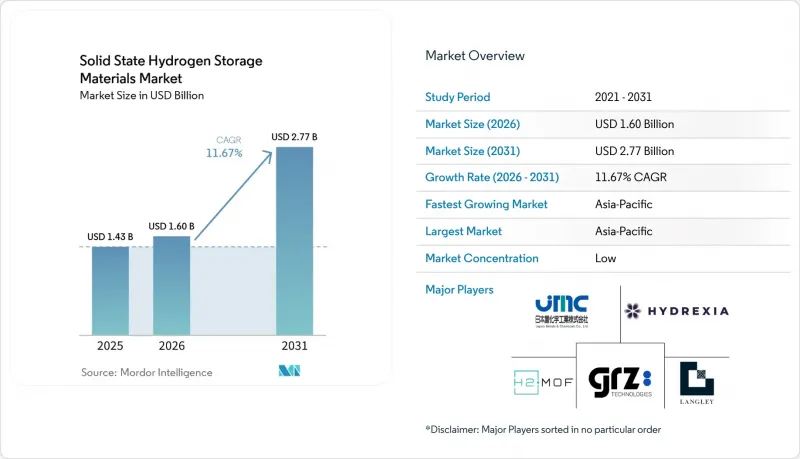
에 따르면 고체 수소 저장 재료 시장 규모는 2025년에 14억 3,000만 달러로 평가되며, 2026년 16억 달러에서 2031년까지 27억 7,000만 달러에 달할 것으로 예측되며, 예측 기간(2026-2031년) 동안 CAGR은 11.67%가 될 전망입니다.
전 세계 고체 수소 저장 소재 시장의 동향 및 인사이트
수소 인프라에 대한 투자
저배출형 수소 프로젝트에 대한 설비 투자액은 2025년에 70억 달러에 육박했습니다. 2026년 투자액 중 전해 방식이 70% 가까이 차지하며, 탄소 포집형 수소에 대한 투자액을 처음으로 넘어섰습니다. 2026년 투자의 85% 이상은 산업 및 정유소의 기존 수소 수요를 대상으로 하고 있으며, 이는 고정형 금속 수소화물 유닛에 대한 단기적 수요를 뒷받침할 뿐만 아니라, 이미 수소가 산업용 원료로 사용되고 있는 현장에서 명확한 초기 고객 기반을 형성하고 있습니다. 미국 에너지부의 조사에 따르면, 금속 수소화물 시스템은 170바르의 압축 가스 저장 방식에 비해 최대 65% 적은 부지만으로도 충분하다는 사실이 밝혀졌으며, 이는 배송 거점이나 공간이 제한된 산업 부지에서의 도입을 촉진할 가능성이 있습니다. 고체 수소 저장 재료 시장은 저장 설비의 직접 조달 및 수소 인프라의 설치 면적을 축소하고자 하는 사업자들의 요구로부터 혜택을 받을 수 있습니다.
연료전지차 및 대형 차량의 도입
상용 트럭은 고체 수소 저장 재료 시장에서 경차 이외의 대상 수요 기반을 확대하고 있습니다. 스위스에서는 2025년까지 1,600대의 연료전지 트럭이 운행될 것으로 보고되었으며, H2Accelerate TRUCKS 프로그램을 통해 유럽연합(EU) 회원국 6개국에 125대의 대형 연료전지 트럭이 도입되었습니다. 이 프로그램의 차세대 충전소는 하루 1,000kg 이상의 수소 공급 능력을 목표로 하고 있습니다. 압축 가스 탱크에는 차량당 200-300kg의 탄소섬유 보강재가 필요하며, 이로 인해 적재량이 감소할 가능성이 있습니다. 바나듐-티타늄 합금은 거의 상온·상압 조건에서 2중량퍼센트(wt%)를 초과하는 가역 수소 저장 용량을 달성하여, 차량용 저장 소재로서의 적합성을 입증하고 있습니다. 일본과 한국은 여전히 중요한 연료전지 전기자동차 시장인 반면, 유럽의 화물 운송 사업자들은 더 높은 처리량을 갖춘 시스템에 대한 요건을 마련하고 있습니다.
높은 재료비 및 시스템 통합 비용
높은 재료비 및 시스템 통합 비용은 고체 수소 저장 재료 시장의 상용화에 있어 여전히 장벽으로 작용하고 있습니다. AB5 합금에 포함된 희토류 원소, 특히 란탄의 경우, 중국이 막대한 가공 능력을 보유하고 있어 공급 집중의 위험에 직면해 있습니다. 미국 에너지부는 광범위한 상업적 경쟁력을 확보하기 위한 금속 수소화물의 생산 비용 기준치를 10달러/kg으로 정했습니다. 중소규모 설비의 경우, 열교환기, 압력 조절 장치, 안전 인클로저 및 열 관리 어셈블리의 비용이 원자재비를 초과하는 경우가 있어, 이는 분산형 도입을 제한하고 구매 결정이 현지 시스템 요구 사항에 좌우되기 쉽게 만듭니다. 2025년 5월, 한국재료과학연구소는 제조 비용과 에너지 사용량 절감을 목표로 마그네슘·니켈·주석 합금을 개발했습니다. 새로운 합금의 조성은 일반적으로 상업적 비용 균형에 도달하기까지 3-5년의 공정 확대 기간이 소요됩니다.
부문 분석
2025년 현재, 금속 수소화물은 고체 수소 저장 재료 시장의 38.53%를 차지하고 있으며, 2031년까지 연평균 성장률(CAGR) 12.76%로 확대될 것으로 예측됩니다. 이러한 위상은 높은 체적 에너지 밀도와 자동차, 고정형 전원, 선박 용도의 연료전지 시스템과의 호환성을 반영한 것입니다. 2025년 7월, FDK사는 기존 AB5형 소재보다 질량 대비 용량이 20% 높은 대용량 AB2형 수소 흡수 합금을 개발했습니다. FDK는 2025년 7월부터 선정된 고객에게 샘플 공급을 시작했으며, 2025년 10월부터 양산 출하를 계획하고 있습니다. 용량이 증가함에 따라 저장장치당 필요한 합금의 질량이 감소하여, 무게에 민감한 자동차 및 항공우주 분야에서의 도입에 중요한 요소가 될 것입니다.
복합 수소화물은 393 K 이하에서 가역적인 수소 방출이 가능하여, 연료전지의 폐열을 활용한 운전을 가능하게 합니다. 화학적 수소화물은 군사 및 항공우주 용도 등 재생이 가능한 특수 시스템에서 활용되고 있습니다. 흡착 용도에서는 탄소계 재료가 주목받고 있으며, 그래핀 복합재료와 활성탄 시스템은 제어된 조건 하에서 7-10 중량 퍼센트(wt%)의 저장 용량을 달성하고 있습니다. H2MOF사는 무인항공기(UAV)의 수소 저장에 망상 구조 재료를 적용하고 있습니다. 고체 수소 저장 재료 시장은 온도 범위, 방전 속도 및 총 소유 비용(TCO)을 기반으로 한 재료 선정으로 전환되고 있습니다.
지역별 분석
아시아태평양은 2025년에 고체 수소 저장 재료 시장 점유율의 32.81%를 차지할 것으로 예상되며, 2031년까지 연평균 성장률(CAGR) 13.34%로 확대될 것으로 전망됩니다. 중국에서는 정부 주도의 프로그램을 통해 다운스트림 저장 기술의 상용화가 지원되고 있습니다. 일본은 FDK, 산토쿠 주식회사, 미쓰이 금속 등의 기업을 통해 합금 제조 및 시스템 연구에 기여하고 있습니다. 2025년 5월, 한국재료과학연구소(KIMS)는 고압 용기나 극저온 설비 없이도 수소를 안전하게 저장·수송할 수 있도록 설계된 마그네슘·니켈·주석 합금을 개발하여, 이 지역 내 재료 개발의 역할을 강화했습니다.
인도는 아직 초기 단계에 있지만, 수소 인프라가 성숙해짐에 따라 다운스트림 저장 수요를 창출할 가능성이 있으며, 인도의 ‘국가 그린 수소 미션’에서는 2030년까지 연간 500만 메트르톤의 그린 수소 생산을 목표로 하고 있습니다. 유럽의 역할은 파이프라인 인프라와 순환형 소재 조달에 중점을 두고 있습니다. 2025년 1월에 시작된 REMEDHYS 프로젝트에서는 유럽에서 재활용된 금속을 활용한 고체 저장 기술 개발과 2MW의 양성자 교환막형 전해조를 이용한 소재 검증이 진행되고 있습니다. 북미에서는 정책적 불확실성이 높아지고 있지만, 캘리포니아주는 2026년 8월, 9,520만 달러 규모의 ‘청정 교통 프로그램’의 일환으로 수소 충전 인프라에 1,500만 달러를 배정했습니다.
남미, 중동 및 아프리카 시장은 규모는 작지만, 분산형 및 오프그리드 용도에 주력하는 공급업체에게는 중요한 시장입니다. LAVO사는 데이터센터 및 통신 타워의 탈탄소화를 목적으로 사우디아라비아와 남아프리카공화국에서 사업을 전개하고 있습니다. 사우디아라비아의 그린 수소 수출 계획은 수송 인프라가 정비됨에 따라 향후 저장 수요를 창출할 가능성이 있습니다. 브라질과 아르헨티나에서는 수소 저장을 포함한 재생에너지 통합 계획이 수립되어 있으나, 2028년까지 상업적 조달 규모가 소규모에 그칠 것으로 예상됩니다. 중동의 높은 기온은 흡수 재료에 있어 열 관리상의 과제가 되므로, 일부 지역의 용도에서는 흡착 시스템이나 열적으로 안정화된 복합 수소화물이 더 적합합니다. 따라서 고체 수소 저장 재료 시장의 지리적 특징은 아시아에서의 대량 생산과 기타 지역에서의 보다 전문적인 비즈니스 기회가 결합된 형태를 띠고 있습니다.
기타 혜택:
- 엑셀 형식의 시장 예측(ME) 시트
- 3개월간의 애널리스트 지원
자주 묻는 질문
목차
제1장 소개
- 조사 가정과 시장 정의
- 조사 범위
제2장 조사 방법
제3장 주요 요약
제4장 시장 구도
- 시장 개요
- 시장 성장 촉진요인
- 시장 성장 억제요인
- 밸류체인 분석
- Porter's Five Forces 분석
제5장 시장 규모와 성장 예측
- 소재 유형별
- 스토리지 메커니즘별
- 용도별
- 지역별
- 아시아태평양
- 중국
- 인도
- 일본
- 한국
- 기타 아시아태평양 국가
- 북미
- 미국
- 캐나다
- 멕시코
- 유럽
- 독일
- 영국
- 프랑스
- 이탈리아
- 기타 유럽 국가
- 남미
- 브라질
- 아르헨티나
- 기타 남미 국가
- 중동 및 아프리카
- 사우디아라비아
- 남아프리카공화국
- 기타 중동 및 아프리카 국가
- 아시아태평양
제6장 경쟁 구도
- 시장 집중도
- 전략적 동향
- 시장 점유율·순위 분석
- 기업 개요
- Ergenics Corp.
- GRZ Technologies
- H2GO Power Limited
- H2MOF
- Hydrexia
- Hystorsys
- Japan Metals & Chemicals Co., Ltd.
- Langley Holdings plc
- LAVO
- Mincatec Energy
- Mitsui Kinzoku Co., Ltd.
- NIPPON DENKO CO., LTD.
- Plasma Kinetics
- Safe Hydrogen LLC
- SANTOKU CORPORATION
제7장 시장 기회와 향후 전망
KSM 26.10.29According to Mordor Intelligence, the solid state hydrogen storage materials market size was valued at USD 1.43 billion in 2025 and is estimated to grow from USD 1.60 billion in 2026 to reach USD 2.77 billion by 2031, at a CAGR of 11.67% during the forecast period (2026-2031).
Global Solid State Hydrogen Storage Materials Market Trends and Insights
Hydrogen Infrastructure Investment
Capital spending on low-emissions hydrogen projects reached nearly USD 7 billion in 2025. Electrolysis accounted for nearly 70% of this 2026 investment, and it overtook carbon-capture-based hydrogen investment for the first time. More than 85% of investment in 2026 targets existing hydrogen demand in industry and refineries, which supports near-term demand for stationary metal hydride units and creates a defined initial customer base at sites where hydrogen is already used as an industrial feedstock. The U.S. Department of Energy found that metal hydride systems can require up to 65% less land than 170-bar compressed-gas storage, which can aid integration at delivery nodes and constrained industrial sites. The solid state hydrogen storage materials market can gain from direct storage procurement and from operators' need to reduce the footprint of hydrogen infrastructure.
Fuel-Cell Vehicle and Heavy-Duty Mobility Deployment
Commercial trucking expands the addressable demand base beyond light-duty vehicles within the solid state hydrogen storage materials market. Switzerland reported 1,600 fuel-cell trucks in operation by 2025, and the H2Accelerate TRUCKS program deployed 125 heavy-duty fuel-cell trucks across 6 European Union member states. A next-generation station in that program targets hydrogen dispensing capacity above 1,000 kg per day. Compressed-gas tanks need 200-300 kg of carbon-fiber reinforcement per vehicle, which can reduce payload capacity. Vanadium-titanium alloys achieved more than 2 weight percent (wt%) reversible hydrogen capacity at near-ambient temperatures and pressures, supporting their suitability for onboard storage. Japan and South Korea remain important fuel-cell electric vehicle markets, while European freight operators are shaping requirements for higher-throughput systems.
High Material and System-Integration Costs
High material and system-integration costs remain a commercialization barrier for the solid state hydrogen storage materials market. Rare-earth elements in AB5 alloys, particularly lanthanum, face supply-concentration risk because China has substantial processing capacity. The U.S. Department of Energy identified USD 10/kg as the metal hydride production-cost threshold for broad commercial competitiveness. Heat exchangers, pressure-regulation hardware, safety enclosures, and thermal-management assemblies can cost more than raw materials in small and medium installations, which limits distributed deployments and makes the purchase decision sensitive to local system requirements. In May 2025, the Korea Institute of Materials Science developed a magnesium-nickel-tin alloy intended to reduce manufacturing costs and energy use. New alloy compositions usually need 3-5 years of process scale-up before they can reach commercial cost parity.
Other drivers and restraints analyzed in the detailed report include:
- Long-Duration Renewable-Energy Storage Demand
- Government Hydrogen Incentives and Decarbonization Mandates
- Slow Absorption and Desorption Kinetics
For complete list of drivers and restraints, kindly check the Table Of Contents.
Segment Analysis
Metal hydrides held 38.53% of the solid state hydrogen storage materials market in 2025 and are projected to advance at a 12.76% CAGR through 2031. Their position reflected high volumetric energy density and compatibility with fuel-cell systems in automotive, stationary power, and maritime uses. In July 2025, FDK developed a high-capacity AB2-type hydrogen-absorbing alloy with 20% higher gravimetric capacity than incumbent AB5-type materials. FDK began sample supply to selected customers in July 2025 and planned mass-production shipments from October 2025. Higher capacity reduces the alloy mass required per storage unit, which matters in weight-sensitive automotive and aerospace installations.
Complex hydrides can provide reversible hydrogen release below 393 K, enabling operation with fuel-cell waste heat. Chemical hydrides serve specialized systems where regeneration is possible, including military and aerospace uses. Carbon-based materials are gaining traction in adsorption applications, with graphene composites and activated-carbon systems reaching 7-10 weight percent (wt%) storage capacity under controlled conditions. H2MOF applies reticular materials to unmanned aerial vehicle hydrogen storage. The solid state hydrogen storage materials market is moving toward material selection based on temperature range, discharge rate, and total cost of ownership.
Complete Report Scope:
- By Material Type
- Metal Hydrides
- Complex Hydrides
- Chemical Hydrides
- Carbon-Based Materials
- Other Material Types
- By Storage Mechanism
- Absorption
- Adsorption
- Other Storage Mechanisms
- By Application
- Automotive
- Stationary Power
- Portable Power
- Aerospace
- Other Applications
- By Geography
- Asia-Pacific
- China
- India
- Japan
- South Korea
- Rest of Asia-Pacific
- North America
- United States
- Canada
- Mexico
- Europe
- Germany
- United Kingdom
- France
- Italy
- Rest of Europe
- South America
- Brazil
- Argentina
- Rest of South America
- Middle-East and Africa
- Saudi Arabia
- South Africa
- Rest of Middle-East and Africa
- Asia-Pacific
Geography Analysis
Asia-Pacific held 32.81% of the solid state hydrogen storage materials market share in 2025 and is projected to advance at a 13.34% CAGR through 2031. State-backed programs support downstream storage commercialization in China. Japan contributes to alloy manufacturing and system research through companies including FDK, SANTOKU CORPORATION, and Mitsui Kinzoku Co., Ltd. In May 2025, the Korea Institute of Materials Science (KIMS) developed a magnesium-nickel-tin alloy intended for safe hydrogen storage and transport without high-pressure vessels or cryogenic equipment, reinforcing the region's role in materials development.
India is at an early stage and can create downstream storage demand as hydrogen infrastructure matures, with its National Green Hydrogen Mission targeting 5 million metric tons of green hydrogen production per year by 2030. Europe's role centers on pipeline infrastructure and circular materials sourcing. The REMEDHYS project began in January 2025 to develop solid-state storage from recycled European metals and validate the materials with a 2 MW proton exchange membrane electrolyzer. North America has more policy uncertainty, but California allocated USD 15 million for hydrogen refueling infrastructure in August 2026 within a USD 95.2 million Clean Transportation Program.
South America, and Middle-East and Africa markets are smaller but relevant to suppliers focused on distributed and off-grid uses. LAVO has operations in Saudi Arabia and South Africa for data-center and telecom-tower decarbonization. Saudi Arabia's green-hydrogen export plans can create future demand for storage as transport infrastructure develops. Brazil and Argentina have renewable-energy integration plans that include hydrogen storage, although commercial procurement is expected to remain modest through 2028. High ambient temperatures in the Middle-East create thermal-management challenges for absorption materials, making adsorption systems and thermally stabilized complex hydrides more suitable for some regional uses. The geographic profile of the solid state hydrogen storage materials market, therefore, combines high-volume Asian manufacturing with more specialized opportunities in other regions.
- Ergenics Corp.
- GRZ Technologies
- H2GO Power Limited
- H2MOF
- Hydrexia
- Hystorsys
- Japan Metals & Chemicals Co., Ltd.
- Langley Holdings plc
- LAVO
- Mincatec Energy
- Mitsui Kinzoku Co., Ltd.
- NIPPON DENKO CO., LTD.
- Plasma Kinetics
- Safe Hydrogen LLC
- SANTOKU CORPORATION
Additional Benefits:
- The market estimate (ME) sheet in Excel format
- 3 months of analyst support
TABLE OF CONTENTS
1 Introduction
- 1.1 Study Assumptions and Market Definition
- 1.2 Scope of the Study
2 Research Methodology
3 Executive Summary
4 Market Landscape
- 4.1 Market Overview
- 4.2 Market Drivers
- 4.2.1 Hydrogen Infrastructure Investment
- 4.2.2 Fuel-Cell Vehicle and Heavy-Duty Mobility Deployment
- 4.2.3 Long-Duration Renewable-Energy Storage Demand
- 4.2.4 Government Hydrogen Incentives and Decarbonization Mandates
- 4.2.5 Waste-Heat Integration in Metal-Hydride Systems
- 4.3 Market Restraints
- 4.3.1 High Material and System-Integration Costs
- 4.3.2 Slow Absorption and Desorption Kinetics
- 4.3.3 Thermal-Management and Heat-Rejection Complexity
- 4.4 Value Chain Analysis
- 4.5 Porter's Five Forces Analysis
- 4.5.1 Bargaining Power of Suppliers
- 4.5.2 Bargaining Power of Buyers
- 4.5.3 Threat of New Entrants
- 4.5.4 Threat of Substitutes
- 4.5.5 Competitive Rivalry
5 Market Size and Growth Forecasts (Value)
- 5.1 By Material Type
- 5.1.1 Metal Hydrides
- 5.1.2 Complex Hydrides
- 5.1.3 Chemical Hydrides
- 5.1.4 Carbon-Based Materials
- 5.1.5 Other Material Types
- 5.2 By Storage Mechanism
- 5.2.1 Absorption
- 5.2.2 Adsorption
- 5.2.3 Other Storage Mechanisms
- 5.3 By Application
- 5.3.1 Automotive
- 5.3.2 Stationary Power
- 5.3.3 Portable Power
- 5.3.4 Aerospace
- 5.3.5 Other Applications
- 5.4 By Geography
- 5.4.1 Asia-Pacific
- 5.4.1.1 China
- 5.4.1.2 India
- 5.4.1.3 Japan
- 5.4.1.4 South Korea
- 5.4.1.5 Rest of Asia-Pacific
- 5.4.2 North America
- 5.4.2.1 United States
- 5.4.2.2 Canada
- 5.4.2.3 Mexico
- 5.4.3 Europe
- 5.4.3.1 Germany
- 5.4.3.2 United Kingdom
- 5.4.3.3 France
- 5.4.3.4 Italy
- 5.4.3.5 Rest of Europe
- 5.4.4 South America
- 5.4.4.1 Brazil
- 5.4.4.2 Argentina
- 5.4.4.3 Rest of South America
- 5.4.5 Middle-East and Africa
- 5.4.5.1 Saudi Arabia
- 5.4.5.2 South Africa
- 5.4.5.3 Rest of Middle-East and Africa
- 5.4.1 Asia-Pacific
6 Competitive Landscape
- 6.1 Market Concentration
- 6.2 Strategic Moves
- 6.3 Market Share (%)/Ranking Analysis
- 6.4 Company Profiles (includes Global Overview, Market Overview, Core Segments, Financials as available, Strategic Information, Products and Services, and Recent Developments)
- 6.4.1 Ergenics Corp.
- 6.4.2 GRZ Technologies
- 6.4.3 H2GO Power Limited
- 6.4.4 H2MOF
- 6.4.5 Hydrexia
- 6.4.6 Hystorsys
- 6.4.7 Japan Metals & Chemicals Co., Ltd.
- 6.4.8 Langley Holdings plc
- 6.4.9 LAVO
- 6.4.10 Mincatec Energy
- 6.4.11 Mitsui Kinzoku Co., Ltd.
- 6.4.12 NIPPON DENKO CO., LTD.
- 6.4.13 Plasma Kinetics
- 6.4.14 Safe Hydrogen LLC
- 6.4.15 SANTOKU CORPORATION
7 Market Opportunities and Future Outlook
- 7.1 White-Space and Unmet-Need Assessment


