

|
시장보고서
상품코드
2154781
남미의 인슐린 투여 기기 : 시장 점유율 분석, 업계 동향과 통계, 성장 예측(2026-2031년)South America Insulin Delivery Devices - Market Share Analysis, Industry Trends & Statistics, Growth Forecasts (2026 - 2031) |
||||||
 Mordor Intelligence
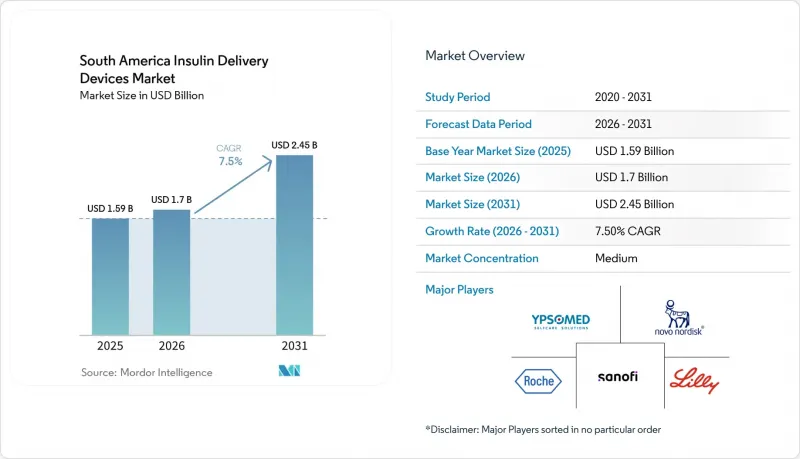
에 따르면 남미의 인슐린 투여 기기 시장 규모는 2025년에 15억 9,000만 달러로 평가되며, 2026년 17억 달러에서 2031년까지 24억 5,000만 달러에 달할 것으로 예측되며, 예측 기간(2026-2031년) 동안 CAGR은 7.5%가 될 전망입니다.
남미 인슐린 투여 기기 시장의 동향 및 인사이트
당뇨병 부담 증가와 인슐린 치료를 받는 인구 증가
당뇨병 유병률은 남미 인슐린 투여 기기 시장에서 광범위하고 지속적인 수요 기반을 창출하고 있습니다. 국제당뇨병연맹(IDF) 보고서에 따르면, 남미 및 중남미의 성인 당뇨병 환자 수는 3,540만 명이며, 2050년까지 5,200만 명에 달할 것으로 예측됩니다. 동 보고서는 이 지역의 성인 당뇨병 환자 중 30.4%에 해당하는 1,070만 명이 아직 진단을 받지 못한 상태라고 밝히고 있습니다. 브라질의 성인 당뇨병 환자 수는 1,660만 명이며, 연령 조정 유병률은 10.6%로, 이는 공급업체에게 펜형 주사기, 바늘 및 기타 인슐린 투여 제품에 대한 거대한 시장 기반을 제공하고 있습니다. 공공 의료 분야에서 지속형 인슐린 아날로그의 사용 확대는 해당 펜형 주사기에 대한 수요와 일회용 소모품에 대한 지속적인 수요를 뒷받침하고 있습니다. 또한, 브라질의 의료기기 등록 요건은 공공 및 민간 유통에 필요한 품질 문서 및 승인을 보유한 공급업체에게 유리하게 작용하고 있습니다.
공공 당뇨병 프로그램의 확대와 인슐린 펜에 대한 접근성
공공 프로그램을 통해 남미의 인슐린 투여 기기 시장 수요는 민간 구매의 범위를 넘어 변화하고 있습니다. 브라질에서는 2026년 2월, 4개 시범 지역에서 NPH 인슐린에서 장기 작용형 그랄긴으로의 체계적인 전환을 시작했으며, 초기 단계에서는 5만 명 이상의 환자가 대상이 되었습니다. Biomm, Fiocruz, Gan & Lee가 참여하는 ‘생산 개발 파트너십’이 국내 그랄긴 공급을 지원했습니다. 브라질 보건부는 전국 확대의 일환으로 2026년 7월, 16개 주에서 5만 2,350개의 재사용 가능한 주사 펜을 배포했습니다. 아르헨티나의 의료 보장 제도에서는 사회보험 제도를 통해 인슐린 및 관련 당뇨병 의료용품에 대한 전액 급여가 의무화되어 있습니다. 칠레의 ‘리카르테 소토법’은 대상 1형 당뇨병 환자에게 인슐린 펌프 본체와 매월 소모품을 제공함으로써, 자격을 갖춘 환자의 비용 부담을 경감하고 있습니다.
높은 본인 부담금과 불균등한 환급
공적 보험의 적용 범위에 첨단 인슐린 투여 시스템이 완전히 포함되지 않았기 때문에 가계 부담이 큰 제약요인으로 작용했습니다. 칠레에서는 ‘리카르테 소토법’에 따라 임상적 기준 및 행정적 승인을 조건으로, 대상 개인에게 펌프 본체 및 정기적인 소모품이 지급되었습니다. 2025년 정성 조사에서는 비용, 행정 절차의 복잡성, 그리고 대도시권 외 지역의 전문의 부족이 펌프 이용을 가로막는 주요 장벽으로 지목되었습니다. 2024년 체계적 문헌인사이트에 따르면, 남미 전체의 치료율은 64.6%로 보고되었으며, 이는 진단을 받은 환자 중 상당수가 종합적인 치료를 받지 못하고 있음을 시사합니다. 남미의 인슐린 투여 기기 시장은 기본적인 주사기나 표준 펜형 주사기부터 펌프 및 센서 연동 시스템에 이르기까지 다양한 가격대의 제품을 제공했으나, 법 집행의 불일치와 비정규 고용이 보험 환급 접근을 제한하고 있었습니다.
부문 분석
2025년, 인슐린 펜은 남미 인슐린 투여 기기 시장 점유율의 52.44%를 차지했습니다. 이는 2형 당뇨병 치료에서의 광범위한 사용, 공공 조달, 그리고 펜형 인슐린 제제와의 호환성에 힘입은 결과입니다. 일회용 펜은 유통 및 투여 과정을 간소화함으로써 계속해서 공공 입찰 물량을 뒷받침하고 있습니다. 브라질에서는 그랄긴 카트리지와 함께 내구성이 뛰어난 하드웨어가 배포됨에 따라 재사용 가능한 펜의 보급이 확대되고 있습니다. 2026년 7월, 브라질 보건부는 16개 주에 걸쳐 5만 2,350개의 재사용 가능한 펜과 25만 4,000개 이상의 그랄긴 카트리지를 배포하여, 이에 상응하는 바늘, 카트리지, 환자 교육 및 교체용 소모품에 대한 향후 수요를 뒷받침하고 있습니다.
인슐린 펌프는 2026년부터 2031년까지 연평균 성장률(CAGR) 9.35%로 성장할 것으로 예측되며, 가장 빠르게 성장하는 제품 카테고리가 될 전망입니다. 펌프 요법에는 임상 지원, 보험 적용 및 소모품의 안정적인 공급이 필요하기 때문에 성장은 비교적 작은 기반에서 시작됩니다. 패치형 펌프와 자동 하이브리드 폐쇄 루프 시스템은 인슐린 투여와 자동화된 당뇨병 관리를 결합함으로써 성장을 뒷받침하고 있습니다. 아르헨티나, 브라질, 콜롬비아, 칠레의 MiniMed 780G 사용자를 대상으로 한 실세계 연구에 따르면, 사용자의 78.1%가 70%를 초과하는 ‘목표 범위 내 체류 시간’을 달성한 것으로 보고되었습니다. 농촌 지역이나 비용에 민감한 환경에서는 주사기가 여전히 중요한 역할을 하고 있지만, 무바늘 주사기나 제트 인젝터는 보험 환급 지원이 제한적이어서 틈새 시장 수준에 머물고 있습니다.
2025년 기준, 남미의 인슐린 투여 기기 시장 중 비연결형 기기가 71.34%를 차지했습니다. 기존의 펜형 인슐린 주사기, 주사기, 펌프는 가격이 저렴하고 표준 조달 계약에 포함하기 쉬워 여전히 널리 사용되고 있습니다. 공공 조달 기관은 단가를 중시하는 반면, 지방 도시에서는 디지털 헬스 인프라나 데이터 기반 인슐린 관리를 지원하는 전문가의 지원이 제한적인 경우가 많습니다. 이러한 요인으로 인해 첨단 시스템이 임상적으로 점차 수용되고 있음에도 불구하고, 기존 기기에 대한 수요와 호환 가능한 소모품의 지속적인 구매가 유지되고 있습니다.
연결형 기기의 시장 규모는 2026년부터 2031년까지 연평균 성장률(CAGR) 10.45%로 확대될 것으로 예측됩니다. 블루투스 지원 펜형 인슐린 주사기, 센서 연동형 펌프, 앱 연동 시스템을 통해 환자는 투여량을 기록하고 임상팀과 데이터를 공유할 수 있게 됩니다. 아르헨티나의 규제 개정과 칠레의 모니터링 비용에 대한 공공 보장으로 인해 특정 환자 그룹의 커넥티드 케어 접근성이 개선되었습니다. 브라질에서는 2026년에 실시간 연속 혈당 모니터링에 관한 협의가 진행될 예정이며, 이를 통해 커넥티드 제품에 대한 공공 접근 경로가 더욱 확대될 가능성이 있습니다. 도입의 진전은 앞으로도 보험 급여, 교육, 그리고 센서 및 소모품에 대한 안정적인 공급에 좌우될 것입니다.
기타 혜택:
- 엑셀 형식의 시장 예측(ME) 시트
- 3개월간의 애널리스트 지원
자주 묻는 질문
목차
제1장 소개
- 조사 가정과 시장 정의
- 조사 범위
제2장 조사 방법
제3장 주요 요약
제4장 시장 구도
- 시장 개요
- 시장 성장 촉진요인
- 시장 성장 억제요인
- 가치 및 공급망 분석
- 규제 상황
- 기술 전망
- Porter's Five Forces 분석
제5장 시장 규모와 성장 예측
- 제품 유형별
- 테크놀러지/연결성별
- 환자 연령층별
- 유통 채널별
- 최종사용자별
- 지역별
- 브라질
- 아르헨티나
- 콜롬비아
- 칠레
- 페루
- 기타 남미 국가
제6장 경쟁 구도
- 시장 집중도
- 시장 점유율 분석
- 기업 개요
- Abbott Laboratories
- B. Braun Melsungen SE
- Becton, Dickinson and Company
- BERLIN-CHEMIE AG
- Biocon Limited
- Biomm S.A.
- Eli Lilly and Company
- embecta Corp.
- F. Hoffmann-La Roche Ltd
- Insulet Corporation
- Medtronic plc
- Novo Nordisk A/S
- Owen Mumford Limited
- Sanofi S.A.
- SOOIL Development Co., Ltd.
- Tandem Diabetes Care, Inc.
- Terumo Corporation
- Ypsomed Holding AG
제7장 시장 기회와 향후 전망
KSM 26.10.29According to Mordor Intelligence, the South America insulin delivery devices market size was valued at USD 1.59 billion in 2025 and is estimated to grow from USD 1.70 billion in 2026 to reach USD 2.45 billion by 2031, at a CAGR of 7.5% during the forecast period (2026-2031).
South America Insulin Delivery Devices Market Trends and Insights
Rising Diabetes Burden and Insulin-Treated Population
Diabetes prevalence is creating a broad and sustained demand base for the South America insulin delivery devices market. The International Diabetes Federation reported 35.4 million adults with diabetes in South and Central America, with the total projected to reach 52 million by 2050. The same source reported that 30.4% of adults with diabetes in the region, or 10.7 million people, remained undiagnosed. Brazil had 16.6 million adults with diabetes and an age-standardized prevalence of 10.6%, providing suppliers with a large base for pens, needles, and other insulin administration products. The growing use of long-acting insulin analogs in public care supports compatible pen delivery and recurring disposable supply demand. Brazil's device registration requirements also favor suppliers with the quality documentation and approvals required for public and private distribution.
Expansion of Public Diabetes Programs and Pen Access
Public programs are shifting demand in the South American insulin delivery devices market beyond private purchasing. Brazil began a structured transition from NPH insulin to long-acting glargine across four pilot locations in February 2026, covering more than 50,000 patients in the initial phase. A Productive Development Partnership involving Biomm, Fiocruz, and Gan & Lee supported domestic glargine supply. Brazil's Ministry of Health distributed 52,350 reusable injection pens across 16 states in July 2026 as part of the national rollout. Argentina's coverage framework requires full coverage of insulin and related diabetes supplies through social insurance arrangements. Chile's Ley Ricarte Soto provides pump hardware and monthly consumables for eligible people with Type 1 diabetes, reducing cost barriers for qualifying patients.
High Out-of-Pocket Cost and Uneven Reimbursement
Household spending was a major constraint, where public coverage did not fully include advanced insulin delivery systems. In Chile, Ley Ricarte Soto covered pump hardware and recurring consumables for eligible individuals, subject to clinical criteria and administrative approval. A 2025 qualitative study identified cost, administrative complexity, and limited specialist availability outside metropolitan areas as key barriers to pump access. A 2024 systematic review reported a 64.6% treatment rate across South America, indicating that many diagnosed patients did not receive comprehensive treatment. The South American insulin delivery devices market served varied affordability segments, from basic syringes and standard pens to pumps and sensor-linked systems, while inconsistent enforcement and informal employment limited reimbursement access.
Other drivers and restraints analyzed in the detailed report include:
- Shift From Syringes Toward Pen-Based Administration in Urban Care
- Connected Pens, Wearable Pumps, and Continuous Glucose Monitoring Integration
- Currency Volatility and Import Dependence
For complete list of drivers and restraints, kindly check the Table Of Contents.
Segment Analysis
Insulin pens held 52.44% of the South America insulin delivery devices market share in 2025, supported by their broad use in Type 2 diabetes care, public procurement, and compatibility with pen-based insulin formulations. Disposable pens continue to support public tender volumes by simplifying distribution and administration. Reusable pens are gaining traction as Brazil distributes durable hardware alongside glargine cartridges. In July 2026, Brazil's Ministry of Health distributed 52,350 reusable pens and more than 254,000 glargine cartridges across 16 states, supporting future demand for compatible needles, cartridges, patient education, and replacement supplies.
Insulin pumps are projected to grow at a CAGR of 9.35% from 2026 to 2031, making them the fastest-growing product category. Growth begins from a smaller base, as pump therapy requires clinical support, reimbursement, and a reliable supply of consumables. Patch pumps and automated hybrid closed-loop systems support growth by combining insulin administration with automated diabetes management. A real-world study of MiniMed 780G users in Argentina, Brazil, Colombia, and Chile reported that 78.1% of users achieved time-in-range targets above 70%. Syringes remain important in rural and cost-sensitive settings, while needle-free and jet injectors remain niche due to limited reimbursement support.
Non-connected devices held 71.34% of the South American insulin delivery devices market in 2025. Conventional pens, syringes, and pumps remain widely used because they are affordable and easier to include in standard procurement contracts. Public purchasers prioritize unit costs, while secondary cities often have limited digital health infrastructure and specialist support for data-driven insulin management. These factors sustain demand for conventional devices and recurring purchases of compatible consumables, even as advanced systems gain clinical acceptance.
Connected devices are projected to grow at a CAGR of 10.45% from 2026 to 2031. Bluetooth-enabled pens, sensor-linked pumps, and app-supported systems enable patients to record doses and share data with clinical teams. Argentina's revised rules and Chile's guaranteed monitoring coverage have improved access to connected care for selected patient groups. Brazil's 2026 consultation on real-time continuous glucose monitoring could create an additional public access route for connected products. Adoption will continue to depend on reimbursement, training, and consistent access to sensors and consumables.
Complete Report Scope:
- By Product Type
- Insulin Pens
- Reusable Pens
- Disposable Pens
- Insulin Pumps
- Tethered Pumps
- Patch / Wearable Pumps
- Automated Hybrid Closed-Loop Systems
- Insulin Syringes
- Needle-Free Injectors
- Jet Injectors
- Others
- Insulin Pens
- By Technology / Connectivity
- Connected (Bluetooth / NFC)
- Non-Connected / Conventional
- By Patient Age Group
- Pediatrics (Less Than 18 yrs)
- Adults (Equal to, More Than 18 yrs)
- Geriatrics (Above 65 years+)
- By Distribution Channel
- Hospital Pharmacies
- Retail Pharmacies
- Online Pharmacies
- Diabetes Clinics & Centers
- By End User
- Homecare Settings
- Hospitals & Specialty Clinics
- Ambulatory Surgical Centers
- Others
- By Geography
- Brazil
- Argentina
- Colombia
- Chile
- Peru
- Rest of South America
List of Companies Covered in this Report:
- Abbott Laboratories
- B. Braun Melsungen SE
- Beckton Dickinson
- BERLIN-CHEMIE AG
- Biocon
- Biomm S.A.
- Eli Lilly and Company
- embecta Corp.
- Roche
- Insulet
- Medtronic
- Novo Nordisk
- Owen Mumford Limited
- Sanofi
- SOOIL Development Co., Ltd.
- Tandem Diabetes Care
- Terumo
- Ypsomed
Additional Benefits:
- The market estimate (ME) sheet in Excel format
- 3 months of analyst support
TABLE OF CONTENTS
1 INTRODUCTION
- 1.1 Study Assumptions and Market Definition
- 1.2 Scope of the Study
2 RESEARCH METHODOLOGY
3 EXECUTIVE SUMMARY
4 MARKET LANDSCAPE
- 4.1 Market Overview
- 4.2 Market Drivers
- 4.2.1 Rising Diabetes Burden and Insulin-Treated Population
- 4.2.2 Expansion of Public Diabetes Programs and Pen Access
- 4.2.3 Shift From Syringes Toward Pen-Based Administration in Urban Care
- 4.2.4 Connected Pens, Wearable Pumps, and Continuous Glucose Monitoring Integration
- 4.2.5 Advanced-Device Demand From Specialized Type 1 Diabetes Centers
- 4.3 Market Restraints
- 4.3.1 High Out-of-Pocket Cost and Uneven Reimbursement
- 4.3.2 Currency Volatility and Import Dependence
- 4.3.3 Regional Inequality in Specialist Training and Device Support
- 4.4 Value/Supply-Chain Analysis
- 4.5 Regulatory Landscape
- 4.6 Technological Outlook
- 4.7 Porter's Five Forces Analysis
- 4.7.1 Bargaining Power of Suppliers
- 4.7.2 Bargaining Power of Buyers
- 4.7.3 Threat of New Entrants
- 4.7.4 Threat of Substitutes
- 4.7.5 Intensity of Competitive Rivalry
5 MARKET SIZE AND GROWTH FORECASTS (VALUE, USD)
- 5.1 By Product Type
- 5.1.1 Insulin Pens
- 5.1.1.1 Reusable Pens
- 5.1.1.2 Disposable Pens
- 5.1.2 Insulin Pumps
- 5.1.2.1 Tethered Pumps
- 5.1.2.2 Patch / Wearable Pumps
- 5.1.2.3 Automated Hybrid Closed-Loop Systems
- 5.1.3 Insulin Syringes
- 5.1.4 Needle-Free Injectors
- 5.1.5 Jet Injectors
- 5.1.6 Others
- 5.1.1 Insulin Pens
- 5.2 By Technology / Connectivity
- 5.2.1 Connected (Bluetooth / NFC)
- 5.2.2 Non-Connected / Conventional
- 5.3 By Patient Age Group
- 5.3.1 Pediatrics (Less Than 18 yrs)
- 5.3.2 Adults (Equal to, More Than 18 yrs)
- 5.3.3 Geriatrics (Above 65 years+)
- 5.4 By Distribution Channel
- 5.4.1 Hospital Pharmacies
- 5.4.2 Retail Pharmacies
- 5.4.3 Online Pharmacies
- 5.4.4 Diabetes Clinics & Centers
- 5.5 By End User
- 5.5.1 Homecare Settings
- 5.5.2 Hospitals & Specialty Clinics
- 5.5.3 Ambulatory Surgical Centers
- 5.5.4 Others
- 5.6 By Geography
- 5.6.1 Brazil
- 5.6.2 Argentina
- 5.6.3 Colombia
- 5.6.4 Chile
- 5.6.5 Peru
- 5.6.6 Rest of South America
6 COMPETITIVE LANDSCAPE
- 6.1 Market Concentration
- 6.2 Market Share Analysis
- 6.3 Company Profiles (includes Global Level Overview, Market Level Overview, Core Segments, Financials as available, Strategic Information, Market Rank/Share, Products and Services, Recent Developments)
- 6.3.1 Abbott Laboratories
- 6.3.2 B. Braun Melsungen SE
- 6.3.3 Becton, Dickinson and Company
- 6.3.4 BERLIN-CHEMIE AG
- 6.3.5 Biocon Limited
- 6.3.6 Biomm S.A.
- 6.3.7 Eli Lilly and Company
- 6.3.8 embecta Corp.
- 6.3.9 F. Hoffmann-La Roche Ltd
- 6.3.10 Insulet Corporation
- 6.3.11 Medtronic plc
- 6.3.12 Novo Nordisk A/S
- 6.3.13 Owen Mumford Limited
- 6.3.14 Sanofi S.A.
- 6.3.15 SOOIL Development Co., Ltd.
- 6.3.16 Tandem Diabetes Care, Inc.
- 6.3.17 Terumo Corporation
- 6.3.18 Ypsomed Holding AG
7 MARKET OPPORTUNITIES AND FUTURE OUTLOOK
- 7.1 White-Space and Unmet-Need Assessment


