

|
시장보고서
상품코드
2154804
말레이시아의 페인트 및 코팅 : 시장 점유율 분석, 업계 동향과 통계, 성장 예측(2026-2031년)Malaysia Paints and Coatings - Market Share Analysis, Industry Trends & Statistics, Growth Forecasts (2026 - 2031) |
||||||
 Mordor Intelligence
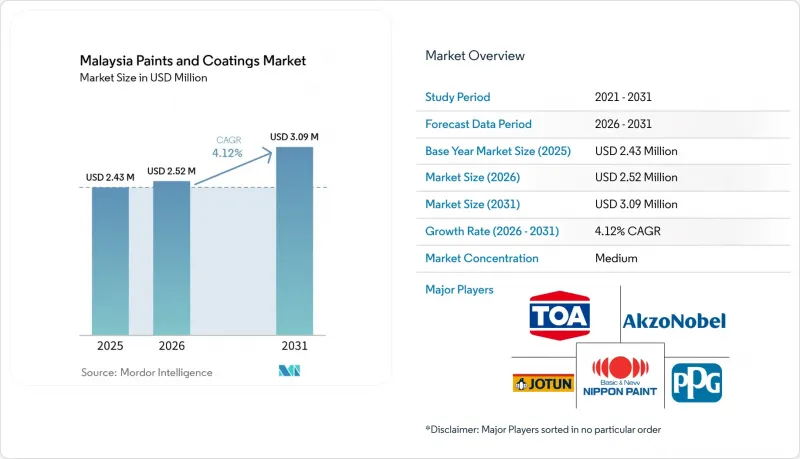
에 따르면 말레이시아의 페인트 및 코팅 시장 규모는 2025년에 24억 3,000만 달러로 평가되며, 2026년 25억 2,000만 달러에서 2031년까지 30억 9,000만 달러에 달할 것으로 예측되며, 예측 기간(2026-2031년) 동안 CAGR은 4.12%가 될 전망입니다.
말레이시아 페인트 및 코팅 시장의 동향 및 인사이트
주택, 상업, 인프라 건설 분야의 파이프라인
말레이시아 건설 부문은 2025년에 1,786억 링깃(403억 달러)의 공사액을 기록하며 전년 대비 12.5%의 성장률을 보였습니다. 건설 활동은 주택, 상업, 공공 프로젝트를 막론하고 건축용 도료 소비의 가장 큰 직접적인 원천으로 자리 잡고 있습니다. 2025년도 예산에서는 주택부에 100억 링깃(23억 달러)이 배정된 데 이어, 첫 주택 구매자를 지원하기 위한 주택담보대출 보증 제도도 마련되었습니다. 신축 주택의 경우, 건설의 각 단계에서 도료, 밑칠 도료, 방수 시스템 및 관련 마감재가 필요합니다. 말레이시아의 페인트·코팅 시장도 구조 공사에서 내외장 마감 공사로 공사가 진행됨에 따라 혜택을 보고 있습니다. 이러한 수요는 폭넓은 기반을 갖추고 있으며, 착공에 따라 판매 대리점, 도급업체 및 프로젝트 명세서를 통해 소비가 발생하고 있습니다.
건설 공사의 비중은 건설 총생산액과 마찬가지로 중요해지고 있습니다. 2025년 2분기에는 비주거용 건축이 56.7% 증가했고, 특수 공사는 22.2% 증가하여, 모두 주거 부문의 성장률을 상회했습니다. 이러한 프로젝트에서는 기존의 실내용 에멀전 도료보다 에폭시 바닥용 도료, 내화 시스템, 지붕 마감재 및 기타 특수 제품이 빈번하게 사용됩니다. 따라서 산업 및 상업 프로젝트의 기반이 확대되면, 가치 구성은 보호성이 더 높은 용도로 이동할 가능성이 있습니다. 조호르, 셀랑고르, 페낭은 건설 활동과 산업 개발이 융합된 중요한 지역으로 계속 자리 잡고 있습니다. 말레이시아의 페인트·코팅 시장은 프로젝트 완공 시 및 그 이후의 유지보수 주기에서 코팅이 필요하기 때문에 이러한 건설 파이프라인과 직접적으로 연결되어 있습니다.
자동차 및 전기자동차 제조의 확대
자동차 제조의 확대로 말레이시아 내 도료의 잠재 시장이 확대되고 있습니다. '뉴 스트레이츠 타임스'지가 인용한 케낭가(Kenanga) 조사에 따르면, 2025년 순수 전기자동차 등록 대수는 3만 848대에 달해 42%의 성장률을 기록했습니다. 이노콤(Inocom)은 2026년 8월, 3억 말레이시아 링깃(7,300만 달러)을 투자하여 크림(Klim) 복합 단지에 제3 도장 공장을 가동했습니다. 이 시설을 통해 1교대당 연간 생산능력이 5만 대 증가하여, 도장 공장의 총 처리 능력은 연간 10만 대의 차체에 달하게 됩니다. 현지 자동차 조립의 경우, 도장된 차체를 수입하는 것이 아니라 말레이시아 국내에서 도장을 수행해야 하므로, E-코트 프라이머, 베이스 코트, 클리어 코트 각 공정에 걸쳐 수요가 발생하고 있습니다.
EP Manufacturing Berhad사는 2026년 6월 말라카주 페고에서 2억 말레이시아 링깃(4,600만 달러)을 투자해 자동차 도장 시설 건설을 시작했습니다. 계획 중인 이 시설은 연간 3만 대의 차체를 처리하는 것을 목표로 하고 있으며, BEV, HEV, PHEV, 그리고 ICE 플랫폼을 모두 지원할 수 있도록 설계되었습니다. 새로운 조립 라인 가동에 따라, 공급업체들은 수성 프라이머 및 탑코트 시스템, 전착도장, 내구성이 뛰어난 클리어 코트에 대한 인증을 취득해야 합니다. 이러한 사양으로 인해 범용 에멀전이 아닌 폴리우레탄 및 고고형분 배합에 대한 수요가 증가하고 있습니다. 말레이시아의 페인트·코팅 시장은 자동차용 도료가 성능 및 생산 요건에 따라 선정되기 때문에 이러한 변화의 혜택을 받고 있습니다. 또한, 이러한 시장 확대에 따라 자동차 제조사에게 있어 신뢰성 높은 현지 기술 서비스의 중요성이 커지고 있습니다.
수지, 이산화티타늄, 안료 및 용제의 원가 변동
원자재 가격 변동은 도료 제조사, 특히 구매력이 제한된 기업에게 직접적인 이익률 위험을 초래합니다. 이 위험의 핵심은 이산화티타늄으로, 건축용 도료의 현금 생산 비용의 25%-30%, 산업용 배합의 12%-18%를 차지하고 있습니다. 2025년 상반기, 중국산 루틸계 이산화티타늄의 평균 가격은 톤당 1만 4,461위안(2,000달러 상당)으로, 2024년 동기 대비 6.65% 하락했습니다. 유럽과 미국의 공급업체들은 2025년 4분기를 앞두고 톤당 100-150달러의 가격 인상을 발표했습니다. 국내 소규모 생산자들은 일반적으로 장기 공급 계약을 체결하지 않았기 때문에 이러한 가격 변동을 흡수할 여지가 제한적입니다.
무역 조치는 가격 측면의 압박을 더욱 악화시킬 가능성이 있습니다. EU가 중국의 이산화티타늄에 부과한 반덤핑 관세는 14.4%에서 39.7% 사이였습니다. EU와 브라질이 부과한 관세로 인해 중국의 수출처는 말레이시아를 포함한 아시아태평양경제협력체(APEC) 시장으로 이동했습니다. 단기적으로는 공급량 증가가 상품 가격을 끌어내릴 가능성이 있지만, 가격 하락은 고부가가치 배합으로 전환하지 못하는 제조사에 대한 압박을 가중시킬 우려가 있습니다. 말레이시아의 페인트·코팅 시장은 수입 원자재와 도급업체 주도의 가격 책정이 동시에 작용하는 이러한 긴장 관계에 노출되어 있습니다. 수지, 안료, 용제, 이산화티타늄의 원가는 여전히 생산자의 이익률에 영향을 미치는 중요한 요인으로 작용하고 있습니다.
부문 분석
아크릴 수지는 2025년 시장 규모의 44.23%를 차지하며, 말레이시아 페인트·코팅 시장에서 수지 종류별 최대 점유율을 기록하고 있습니다. 이러한 위상은 외장 및 내장용 건축 도료에서의 폭넓은 용도에 의해 뒷받침되고 있습니다. 내후성, 발색 유지성, 그리고 합리적인 배합 비용은 주택 및 상업용 건물의 요구 사항을 충족시킵니다. 아크릴 수지는 경제적인 롤러 도포용 에멀전으로도, 고급 엘라스토머계 외장 시스템으로도 기능합니다. 이러한 다용도성 덕분에 유통업체 및 프로젝트 채널에서 폭넓은 수요 기반을 구축하고 있습니다.
알키드 수지는 유성 광택 도료가 여전히 지정되는 목재 마감 및 일반적인 산업 용도에서 현재도 사용되고 있습니다. 에폭시 수지는 산업용 바닥 및 선박 자산의 보호 코팅에서 중요한 역할을 하고 있습니다. 폴리에스테르 수지는 금속 가구, 건축용 알루미늄, 가전제품 마감의 분체 도장에 사용되고 있습니다. 폴리우레탄 수지는 2031년까지 연평균 성장률(CAGR) 4.67%로 확대될 것으로 예측되며, 말레이시아 페인트·코팅 시장에서 가장 빠르게 성장하는 수지 유형이 될 전망입니다. 자동차용 탑코트, 데이터센터의 철골 구조, 재생에너지용 랙이 이러한 성장을 뒷받침하고 있습니다. 프로톤(Proton)은 2026년 5월, AHTV 공장의 생산능력을 연간 4만 2,000대로 확대하여 2액형 클리어 코트용 현지 자동차 생산 기반을 강화했습니다. 폴리우레탄 시장은 유연성이나 내스크래치성이 요구되는 용도에서의 사용에 의해서도 뒷받침되고 있습니다. 개정된 MS 134 규격의 요건은 저VOC 폴리우레탄 및 아크릴·폴리우레탄계 시스템에 대한 관심을 더욱 부추기고 있습니다.
기타 혜택:
- 엑셀 형식의 시장 예측(ME) 시트
- 3개월간의 애널리스트 지원
자주 묻는 질문
목차
제1장 소개
- 조사 가정과 시장 정의
- 조사 범위
제2장 조사 방법
제3장 주요 요약
제4장 시장 구도
- 시장 개요
- 시장 성장 촉진요인
- 시장 성장 억제요인
- 밸류체인 분석
- Porter's Five Forces 분석
제5장 시장 규모와 성장 예측
- 수지 유형별
- 기술별
- 최종 이용 산업별
제6장 경쟁 구도
- 시장 집중도
- 전략적 동향
- 시장 점유율·순위 분석
- 기업 개요
- Akzo Nobel N.V.
- Axalta Coating Systems Ltd.
- Chugoku Marine Paints, Ltd.
- Federal Paints Manufacturing(M) Sdn. Bhd.
- Jotun
- Kansai Paint Co., Ltd.
- KCC Corporation
- Kossan Paint(M) Sdn. Bhd.
- KTH Paint Industries Sdn. Bhd.
- MCI Paint Sdn. Bhd.
- Nippon Paint Holdings Co., Ltd.
- Platinum Phase Sdn. Bhd.
- PPG Industries, Inc.
- Seamaster Paint(Malaysia) Sdn. Bhd.
- SK Kaken Co., Ltd.
- Smart Asia Chemical Bhd.
- Suzuka Chemical Co., Ltd.
- Syncoates(M) Sdn. Bhd.
- The Sherwin-Williams Company
- TOA Paint Public Company Limited
제7장 시장 기회와 향후 전망
KSM 26.10.29According to Mordor Intelligence, the Malaysia paints and coatings market size was valued at USD 2.43 billion in 2025 and is estimated to grow from USD 2.52 billion in 2026 to reach USD 3.09 billion by 2031, at a CAGR of 4.12% during the forecast period (2026-2031).
Malaysia Paints and Coatings Market Trends and Insights
Residential, Commercial, and Infrastructure Construction Pipeline
Malaysia's construction sector generated MYR 178.6 billion (USD 40.3 billion) in work value in 2025, representing 12.5% year-over-year growth. Construction activity remains the largest direct source of architectural coating consumption across residential, commercial, and public projects. The 2025 Budget allocated MYR 10 billion (USD 2.3 billion) to the Ministry of Housing, along with mortgage guarantee facilities to support first-time homebuyers. New homes require paint, primers, waterproofing systems, and related finishing materials at multiple stages of construction. The Malaysia Paints and Coatings market also benefits as work progresses from structural construction to interior and exterior finishing. This demand is broad-based, as building starts generate consumption across dealer channels, contractors, and project specifications.
The mix of construction work is becoming as important as total construction output. Nonresidential buildings grew 56.7% in the second quarter of 2025, while special trade activities grew 22.2%, both exceeding residential growth. These projects use epoxy floor coatings, fire-resistant systems, roof finishes, and other specialized products more frequently than conventional interior emulsions. A larger industrial and commercial project base can therefore shift the value mix toward more protective applications. Johor, Selangor, and Penang remain important locations, combining construction activity with industrial development. The Malaysia Paints and Coatings market is directly linked to this building pipeline, as coatings are required at project completion and during subsequent maintenance cycles.
Automotive and Electric Vehicle Manufacturing Expansion
Automotive manufacturing is expanding the addressable base for coatings in Malaysia. Pure electric vehicle registrations reached 30,848 units in 2025, reflecting 42% growth, according to Kenanga Research as cited by the New Straits Times. Inokom launched Paint Shop 3 at its Kulim complex in August 2026, with an investment of MYR 300 million (USD 73 million). The facility adds 50,000 units of annual capacity per shift, bringing total paint-shop throughput to 100,000 vehicle bodies per year. Local vehicle assembly requires coating to be applied in Malaysia rather than importing pre-painted vehicle bodies, creating demand across the e-coat primer, basecoat, and clearcoat stages.
EP Manufacturing Berhad began construction of a MYR 200 million (USD 46 million) vehicle painting facility in Pegoh, Melaka, in June 2026. The planned facility targets 30,000 vehicle bodies annually and is designed to support BEV, HEV, PHEV, and ICE platforms. New assembly lines require suppliers to qualify waterborne primer and topcoat systems, electrodeposition coatings, and durable clearcoats. These specifications support demand for polyurethane and high-solids formulations rather than commodity emulsions. The Malaysia Paints and Coatings market benefits from this shift, as automotive coatings are selected based on performance and production requirements. This expansion also increases the importance of reliable local technical service for vehicle manufacturers.
Resin, Titanium Dioxide, Pigment, and Solvent Cost Volatility
Raw material volatility creates direct margin risk for coating producers, particularly those with limited purchasing capacity. Titanium dioxide is central to this risk, accounting for 25% to 30% of cash production costs for architectural paints and 12% to 18% for industrial formulations. Chinese domestic rutile titanium dioxide averaged 14,461 yuan (equivalent to USD 2,000) per ton in the first half of 2025, down 6.65% from the same period in 2024. Western suppliers announced price increases of USD 100-150 per ton for the fourth quarter of 2025. Smaller domestic producers are less able to absorb these price movements, as they typically lack long-term supply contracts.
Trade actions can further compound pricing pressures. EU anti-dumping duties on Chinese titanium dioxide ranged from 14.4% to 39.7%. Tariffs imposed by the EU and Brazil redirected Chinese exports toward Asia-Pacific Economic Cooperation (APEC) markets, including Malaysia. While greater short-term supply availability can reduce commodity prices, lower prices can intensify pressure on manufacturers that are unable to shift to higher-value formulations. The Malaysia paints and coatings market is exposed to this tension, where imported inputs and contractor-led pricing operate simultaneously. Resin, pigment, solvent, and titanium dioxide costs remain material factors affecting producer margins.
Other drivers and restraints analyzed in the detailed report include:
- Electronics, Data Center, and Electrical Equipment Cluster Growth
- Protective Coating Demand from Renewable Power, Marine, and Energy Assets
- Volatile Organic Compound (VOC), Hazardous Air Pollutant, and Product Compliance Costs
For complete list of drivers and restraints, kindly check the Table Of Contents.
Segment Analysis
Acrylic held 44.23% of the 2025 value, giving it the largest share by resin type in the Malaysia Paints and Coatings market. Its broad use in exterior and interior architectural paints supports this position. Weather resistance, color retention, and accessible formulation costs align with the requirements of residential and commercial buildings. Acrylic can serve as both an economical roller-coat emulsion and a premium elastomeric exterior system. This versatility gives the resin a wide base across dealer and project channels.
Alkyd remains in use in wood finishing and general industrial applications where oil-based gloss paints are still specified. Epoxy is important for protective coatings on industrial floors and marine assets. Polyester is used in powder coating for metal furniture, architectural aluminum, and appliance finishes. Polyurethane is forecast to expand at a 4.67% CAGR through 2031, making it the fastest-growing resin type in the Malaysia Paints and Coatings market. Automotive topcoats, data center steel structures, and renewable energy racking support this growth. Proton expanded its AHTV plant to 42,000 units annually in May 2026, reinforcing the local vehicle-production base for two-pack clearcoats. The market for polyurethane is also supported by its use in flexible and scratch-resistant applications. Revised MS 134 requirements further support interest in low-VOC polyurethane and acrylic-polyurethane systems.
Complete Report Scope:
- By Resin Type
- Acrylic
- Alkyd
- Polyurethane
- Epoxy
- Polyester
- Other Resin Types
- By Technology
- Water-Borne
- Solvent-Borne
- Powder Coating
- UV-Cured Coating
- By End-User Industry
- Architectural
- Automotive
- Wood
- Protective Coating
- General Industrial
List of Companies Covered in this Report:
- Akzo Nobel N.V.
- Axalta Coating Systems Ltd.
- Chugoku Marine Paints, Ltd.
- Federal Paints Manufacturing (M) Sdn. Bhd.
- Jotun
- Kansai Paint Co., Ltd.
- KCC Corporation
- Kossan Paint (M) Sdn. Bhd.
- KTH Paint Industries Sdn. Bhd.
- MCI Paint Sdn. Bhd.
- Nippon Paint Holdings Co., Ltd.
- Platinum Phase Sdn. Bhd.
- PPG Industries, Inc.
- Seamaster Paint (Malaysia) Sdn. Bhd.
- SK Kaken Co., Ltd.
- Smart Asia Chemical Bhd.
- Suzuka Chemical Co., Ltd.
- Syncoates (M) Sdn. Bhd.
- The Sherwin-Williams Company
- TOA Paint Public Company Limited
Additional Benefits:
- The market estimate (ME) sheet in Excel format
- 3 months of analyst support
TABLE OF CONTENTS
1 Introduction
- 1.1 Study Assumptions and Market Definition
- 1.2 Scope of the Study
2 Research Methodology
3 Executive Summary
4 Market Landscape
- 4.1 Market Overview
- 4.2 Market Drivers
- 4.2.1 Residential, Commercial, and Infrastructure Construction Pipeline
- 4.2.2 Automotive and Electric Vehicle Manufacturing Expansion
- 4.2.3 Electronics, Data Center, and Electrical Equipment Cluster Growth
- 4.2.4 Protective Coating Demand from Renewable Power, Marine, and Energy Assets
- 4.2.5 Low-VOC and Water-Borne Specification Shift
- 4.2.6 Tropical-Climate Heat-Reflective and Antimicrobial Coating Adoption
- 4.3 Market Restraints
- 4.3.1 Resin, Titanium Dioxide, Pigment, and Solvent Cost Volatility
- 4.3.2 VOC, Hazardous Air Pollutant, and Product Compliance Costs
- 4.3.3 Fragmented Competition and Contractor-Led Price Pressure
- 4.3.4 Commercial Office Oversupply and Project Timing Risk
- 4.4 Value Chain Analysis
- 4.5 Porter's Five Forces Analysis
- 4.5.1 Bargaining Power of Suppliers
- 4.5.2 Bargaining Power of Buyers
- 4.5.3 Threat of New Entrants
- 4.5.4 Threat of Substitutes
- 4.5.5 Competitive Rivalry
5 Market Size and Growth Forecasts (Value)
- 5.1 By Resin Type
- 5.1.1 Acrylic
- 5.1.2 Alkyd
- 5.1.3 Polyurethane
- 5.1.4 Epoxy
- 5.1.5 Polyester
- 5.1.6 Other Resin Types
- 5.2 By Technology
- 5.2.1 Water-Borne
- 5.2.2 Solvent-Borne
- 5.2.3 Powder Coating
- 5.2.4 UV-Cured Coating
- 5.3 By End-User Industry
- 5.3.1 Architectural
- 5.3.2 Automotive
- 5.3.3 Wood
- 5.3.4 Protective Coating
- 5.3.5 General Industrial
6 Competitive Landscape
- 6.1 Market Concentration
- 6.2 Strategic Moves
- 6.3 Market Share (%)/Ranking Analysis
- 6.4 Company Profiles (includes Global Overview, Market Overview, Core Segments, Financials as available, Strategic Information, Products and Services, and Recent Developments)
- 6.4.1 Akzo Nobel N.V.
- 6.4.2 Axalta Coating Systems Ltd.
- 6.4.3 Chugoku Marine Paints, Ltd.
- 6.4.4 Federal Paints Manufacturing (M) Sdn. Bhd.
- 6.4.5 Jotun
- 6.4.6 Kansai Paint Co., Ltd.
- 6.4.7 KCC Corporation
- 6.4.8 Kossan Paint (M) Sdn. Bhd.
- 6.4.9 KTH Paint Industries Sdn. Bhd.
- 6.4.10 MCI Paint Sdn. Bhd.
- 6.4.11 Nippon Paint Holdings Co., Ltd.
- 6.4.12 Platinum Phase Sdn. Bhd.
- 6.4.13 PPG Industries, Inc.
- 6.4.14 Seamaster Paint (Malaysia) Sdn. Bhd.
- 6.4.15 SK Kaken Co., Ltd.
- 6.4.16 Smart Asia Chemical Bhd.
- 6.4.17 Suzuka Chemical Co., Ltd.
- 6.4.18 Syncoates (M) Sdn. Bhd.
- 6.4.19 The Sherwin-Williams Company
- 6.4.20 TOA Paint Public Company Limited
7 Market Opportunities and Future Outlook
- 7.1 White-Space and Unmet-Need Assessment


