

|
시장보고서
상품코드
2154899
NFV MANO 소프트웨어 : 시장 점유율 분석, 업계 동향과 통계, 성장 예측(2026-2031년)NFV MANO Software - Market Share Analysis, Industry Trends & Statistics, Growth Forecasts (2026 - 2031) |
||||||
 Mordor Intelligence
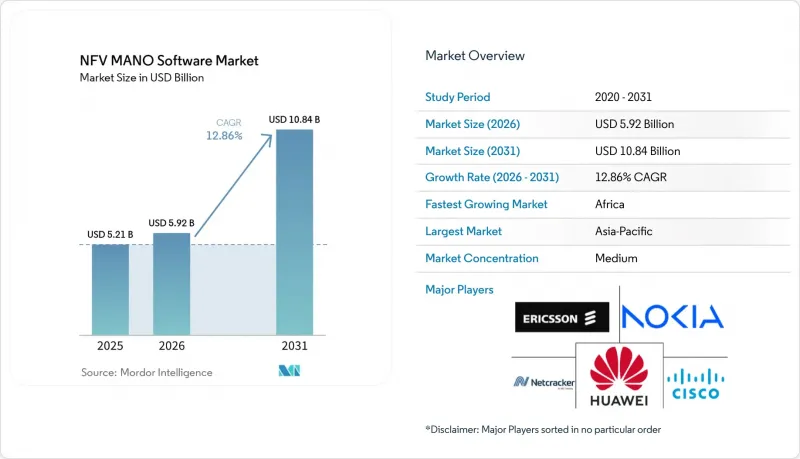
에 따르면 NFV MANO 소프트웨어 시장 규모는 2025년 52억 1,000만 달러, 2026년 59억 2,000만 달러에서 2031년까지 108억 4,000만 달러로 확대될 것으로 예측되고 있으며, 2026-2031년까지 연평균 성장률(CAGR)은 12.86%에 달할 전망입니다.
글로벌 NFV MANO 소프트웨어 시장의 동향 및 인사이트
5G 독립형(SA) 및 네트워크 슬라이싱 오케스트레이션
5G 독립형(SA)의 도입으로 오케스트레이션에 대한 수요가 증가하고 있습니다. 이는 네트워크 슬라이싱에 무선, 코어, 전송 각 도메인에 걸친 협력적인 수명주기관리가 필요하기 때문입니다. 슬라이스는 공유된 물리적 인프라 상의 논리적 종단 간 네트워크이므로, 통신사업자는 이러한 도메인 전반에 걸쳐 슬라이스의 설계, 활성화, 확장, 보증 및 폐지를 관리할 수 있는 플랫폼이 필요합니다. NFV MANO 소프트웨어 시장은 통신사업자가 슬라이스를 생성, 변경, 폐지할 때 수동 워크플로우에 의존하지 않아도 된다는 점에서 이점을 얻습니다. 수동 워크플로는 서비스 제공 지연을 초래하고, 전문 인력을 소모하며, 차별화된 서비스 제공의 실용성을 제한할 우려가 있습니다. 특히 기업 고객이 끊임없이 변화하는 애플리케이션 조합에서 신뢰할 수 있는 성능, 신속한 활성화, 명확한 서비스 수준 보장을 기대하는 경우 그 영향이 두드러집니다. Orange는 벨기에에서 5G 독립형 슬라이싱(Stand-Alone Slicing) 시험을 실시한 후, 2025년 6월에 에릭슨을 선정하여 유럽 전역의 계열사에 서비스 오케스트레이션 및 어슈어런스를 도입했습니다. 이 시험에서는 프라이빗 네트워크, 지오펜싱 및 고정 무선 액세스를 지원했습니다. 슬라이스 활성화를 가속화함으로써 통신사업자는 기반 네트워크를 재구축하지 않고도 특정 성능 보장이 수반되는 기업 서비스를 제공하여 사용자의 변화하는 요구에 대응할 수 있게 됩니다. 특히 프라이빗 네트워크나 고정 무선 액세스에서는 독자적인 운영 매개변수, 제어된 커버리지 영역, 서비스 고유의 용량 규칙이 필요하므로 NFV MANO 소프트웨어 시장의 역할이 확대되고 있습니다. 2025년 11월에 완성된 O-RAN 얼라이언스의 사양 릴리스 5에는 AI를 활용한 관리 사양이 포함되어 있으며, 이를 통해 오케스트레이션 요구 사항이 분산된 무선 네트워크까지 확장되었습니다.
통신사업자의 CAPEX에서 OPEX로의 전환
네트워크 가상화는 VNF 기반 설계에서 CNF 네이티브 수평형 클라우드 플랫폼으로 전환되고 있습니다. 이러한 변화로 인해 초기에는 독자적인 하드웨어 구매에 초점이 맞춰졌던 것에서 공유 인프라, 자동화, 운영 효율성, 그리고 개별 네트워크 도메인 간의 중복을 줄이면서 공통 클라우드 리소스에서 워크로드를 일관되게 실행하는 능력으로 관심이 이동하고 있습니다. 도이치 통신은 20만 개의 vCPU에서 40개의 워크로드를 지원하고, 2028년까지 80개의 워크로드를 목표로 하는 수평형 통신사 클라우드 아키텍처를 문서화했습니다. 이 회사의 2026년 자료에 따르면 2026-2030년에 수평형 클라우드 접근 방식에 대한 모바일 코어 지출의 연평균 성장률(CAGR)은 16%에 달할 것으로 예측되는 반면, 수직 통합형 스택의 경우 8%에 그칠 것으로 전망됩니다. 따라서 NFV MANO 소프트웨어 시장에서는 여러 도메인과 거점에 걸쳐 있는 복잡한 워크로드를 포함하여, 통신 서비스에 필요한 신뢰성, 운영 제어, 서비스 연속성을 유지하면서 공유 클라우드 리소스 전체의 수명주기관리를 자동화할 수 있는 플랫폼이 지지를 받고 있습니다. ETSI는 전환 기간 중 VNF 환경과 CNF 환경이 공존할 것으로 예상하고 있으며, 이로 인해 통합된 관리 인터페이스가 계속해서 필요할 것으로 보이며, 단순한 단일 단계로의 전환은 어려울 것으로 전망됩니다.
레거시 OSS/BSS 통합의 복잡성
레거시 OSS/BSS 환경은 여전히 도입에 있으며, 핵심적인 제약 요인으로 남아 있습니다. 그 이유는 많은 시스템이 NFV 아키텍처 이전에 구축되었으며, 정적인 하드웨어 기반의 서비스 프로세스를 위해 설계되었기 때문입니다. 최신 MANO 플랫폼은 확립된 프로비저닝 및 과금 워크플로우를 중단하지 않으면서 장애, 구성, 과금, 성능 및 보안 시스템과 연동되어야 합니다. 이러한 작업에는 대개 여러 벤더 시스템에 걸쳐 맞춤형 어댑터가 필요하며, 이로 인해 구현, 테스트, 유지보수 및 지속적인 변경 관리에 소요되는 시간과 조정 부담이 증가합니다. VNF와 CNF의 병렬 운영으로 인해 통합 작업에는 서로 다른 데이터 모델, 설명자 형식 및 리소스 추상화 계층이 추가됩니다. 따라서 통합 팀은 서비스 연속성을 유지하면서 프로비저닝, 청구, 과금 및 고객 지원 프로세스를 포함한 하류 비즈니스 시스템에 서비스 이벤트가 확실하게 전달되도록 보장하는 동시에 개별적인 기술적 접근 방식을 처리해야 합니다. TM Forum의 Open API 준수를 통해 이러한 부담을 경감하는 것은 가능하지만, 도입 현황에 편차가 있으며, 레거시 환경, 비즈니스 프로세스, 공급업체와의 관계가 서로 다른 각 통신사업자의 환경을 아우르는 공통 솔루션으로서의 역할은 제한적입니다.
부문 분석
2025년, NFV MANO 소프트웨어 시장 점유율의 77.72%를 솔루션이 차지했습니다. 이러한 선도적 지위는 초기 가상화 프로그램에서 플랫폼 라이선스, 통합 미들웨어 및 독자 사양의 디스크립터 툴체인에 대한 지출을 반영한 것입니다. 통신사업자들은 서비스 설계, 리소스 조정 및 수명주기관리를 위한 공통 플랫폼을 필요로 하므로 이 솔루션은 여전히 중심적인 위치를 차지하고 있습니다. 네트워크의 분산화가 진행됨에 따라 NFV MANO 소프트웨어 업계는 계속해서 이러한 플랫폼에 의존하고 있습니다. 그러나 초기 도입 작업이 완료되었다고 해서 지원의 필요성이 사라지는 것은 아닙니다. 통신사업자들은 일상적인 운영, 최적화, 업그레이드 및 클라우드 네이티브로의 전환으로 관심을 옮기고 있습니다.
서비스 시장은 2026-2031년까지 연평균 성장률(CAGR) 13.86%로 확대될 것으로 예측됩니다. 도입 요건이 높아짐에 따라 매니지드 서비스, 전문 서비스, 교육 및 지원의 중요성이 커지고 있습니다. 벤더는 매니지드 MANO 서비스 및 자동 업그레이드를 제공함으로써 일회성 소프트웨어 거래를 다년간의 계약으로 전환할 수 있습니다. 이러한 구조를 통해 통신사업자는 AI를 활용한 어슈어런스, 멀티벤더 서비스 관리 및 GitOps 워크플로를 지속적으로 유지할 수 있게 됩니다. ETSI 릴리스 5에는 관리 데이터 분석 기능과 인텐트 관리 인터페이스가 포함되어 있으며, 이로 인해 운영 요구 사항이 추가되고 있습니다. 따라서 NFV MANO 소프트웨어 시장에서는 플랫폼의 기능뿐만 아니라 제공 역량도 더욱 중요시되고 있습니다.
2025년, NFV 오케스트레이터는 NFV MANO 소프트웨어 수요의 27.18%를 차지했습니다. 이는 인프라 및 네트워크 기능 관리 계층 전반에 걸쳐 서비스의 패키징, 인스턴스화, 확장 및 종료를 관리합니다. 또한 이 기능은 서비스 수준 보장, 슬라이스 관리, 종단 간 리소스 할당도 지원합니다. 이러한 역할 덕분에 차별화된 기업 서비스를 구축하는 통신사업자에게 NFV 오케스트레이터는 핵심적인 존재가 되었습니다. 가상화 인프라 관리자 및 가상화 네트워크 기능 관리자의 기능은 통신사업자의 기존 네트워크에서 수명주기 자동화의 상당 부분을 계속해서 담당하고 있습니다.
컨테이너 인프라 서비스 관리자는 2031년까지 연평균 성장률(CAGR) 13.39%로 확대될 것으로 예측됩니다. 이러한 성장세는 가상 네트워크 기능에서 클라우드 네이티브 네트워크 기능으로의 전환을 반영합니다. 도이치 통신은 CNF가 2025년에는 36%였던 반면, 2030년까지는 모바일 코어 네트워크 기능 총 지출의 76%를 차지할 것으로 전망한다고 보고했습니다. 또한 엣지 배포가 확대됨에 따라 분산된 인프라 거점 간의 연결 요구 사항이 증가함에 따라 ‘광역 네트워크 인프라 관리자’의 중요성도 커지고 있습니다. 3GPP의 ‘Coordinated Closed Control Loop’는 관리 기능 전반에 걸친 제로 터치 자동화를 지원합니다. 이 프레임워크는 컨테이너 및 인프라 관리 분야에서 MANO의 로드맵을 형성하고 있으며, 특히 통신사업자가 클라우드 리소스, 네트워크 기능, 서비스 보장 프로세스에 걸친 협업적 자동화가 필요한 상황에서 그 중요성이 더욱 커지고 있습니다.
지역별 분석
2025년, 아시아태평양은 NFV MANO 소프트웨어 시장 점유율의 32.07%를 차지했습니다. 중국, 한국, 일본, 인도는 5G 독립형(SA) 방식의 구축 활동을 통해 이러한 입지를 공고히 했습니다. 인도에서 클라우드 네이티브 코어 아키텍처의 성장세는 오케스트레이션 툴에 대한 지속적인 수요를 지원하고 있습니다. 한국의 통신사업자들은 초기 독립형 방식 도입 이후, 네트워크 슬라이싱을 통한 수익 창출에 주력하고 있습니다. 이를 위해서는 고급 NFV 오케스트레이터 기능과 기업급 서비스 관리가 필요합니다.
북미, 유럽, 중동 및 아프리카 역시 수요가 집중되는 주요 지역으로 부상하고 있습니다. 유럽에서는 수평형 클라우드 아키텍처 도입과 표준 준수에 대한 집중을 강화함으로써 코어 네트워크의 현대화가 진행되고 있습니다. 도이치 통신의 ‘Horizontal TelCo Cloud’는 20만 개의 vCPU에서 40개의 워크로드를 지원하고 있으며, 2028년까지 80개의 워크로드를 지원하는 것을 목표로 하고 있습니다. 북미의 통신사업자들은 초기 투자를 마친 후, 5G 독립형 인프라 확장을 계속하고 있습니다. ETSI의 요구 사항과 유럽의 사이버 보안 프레임워크가 MANO 플랫폼의 조달 기준에 영향을 미치고 있습니다.
중동 및 아프리카에서는 시장마다 상이한 상황이 관찰됩니다. 사우디아라비아와 아랍에미리트(UAE) 등 걸프협력회의(GCC) 회원국의 통신사업자들은 5G 독립형(SA) 및 보다 광범위한 네트워크 현대화에 투자하고 있습니다. 아프리카는 2031년까지 연평균 성장률(CAGR) 13.79%로 확대될 것으로 예측되며, 이는 지역별 성장률 중 가장 높은 수치입니다. 그린필드 5G 네트워크는 구형 4G VNF 환경을 보유한 통신사업자가 직면한 OSS/BSS 통합 부담의 일부를 회피할 수 있습니다. 남미는 시장 규모는 작지만, 브라질과 아르헨티나가 독립형 방식의 도입을 추진하고 있으며, 수요가 증가하는 추세입니다. 브라질의 5G 라이선스 계약에는 커버리지 및 품질에 관한 의무가 포함되어 있으며, 이는 자동화된 보증 및 오케스트레이션에 대한 투자를 촉진하고 있습니다.
기타 혜택:
- 엑셀 형식의 시장 예측(ME) 시트
- 3개월간의 애널리스트 지원
자주 묻는 질문
목차
제1장 서론
- 조사 전제조건과 시장 정의
- 조사 범위
제2장 조사 방법
제3장 개요
제4장 시장 구도
- 시장 개요
- 시장 성장 촉진요인
- 시장 성장 억제요인
- 거시경제 요인이 시장에 미치는 영향
- 업계 밸류체인 분석
- 규제 상황
- 기술 전망
- Porter's Five Forces 분석
제5장 시장 규모와 성장 예측
- 컴포넌트별
- MANO 함수별
- 배포 모드별
- 최종사용자별
- 조직 규모별
- 지역별
- 북미
- 미국
- 캐나다
- 멕시코
- 유럽
- 영국
- 독일
- 프랑스
- 이탈리아
- 스페인
- 러시아
- 기타 유럽 국가
- 아시아태평양
- 중국
- 인도
- 일본
- 한국
- 호주·뉴질랜드
- 기타 아시아태평양 국가
- 남미
- 브라질
- 아르헨티나
- 기타 남미 국가
- 중동
- 사우디아라비아
- 아랍에미리트
- 튀르키예
- 기타 중동 국가
- 아프리카
- 남아프리카공화국
- 나이지리아
- 기타 아프리카 국가
- 북미
제6장 경쟁 구도
- 시장 집중도
- 전략적 동향
- 시장 점유율 분석
- 기업 개요
- Ericsson AB
- Nokia Corporation
- Huawei Technologies Co., Ltd.
- Netcracker Technology Corporation
- Cisco Systems, Inc.
- Amdocs Limited
- Hewlett Packard Enterprise Company
- VMware, Inc.
- Red Hat, Inc.
- Juniper Networks, Inc.
- Oracle Corporation
- ZTE Corporation
- NEC Corporation
- Samsung Electronics Co., Ltd.
- Wind River Systems, Inc.
- SUSE S.A.
- Dell Technologies Inc.
- IBM Corporation
- Mavenir Systems, Inc.
- Ribbon Communications Inc.
제7장 시장 기회와 향후 전망
KSA 26.10.28According to Mordor Intelligence, the NFV MANO software market size is projected to expand from USD 5.21 billion in 2025 and USD 5.92 billion in 2026 to USD 10.84 billion by 2031, registering a CAGR of 12.86% between 2026 and 2031.
Global NFV MANO Software Market Trends and Insights
5G Standalone and Network Slicing Orchestration
5G Standalone deployment raises demand for orchestration because network slicing requires coordinated lifecycle management across radio, core, and transport domains. A slice is a logical end-to-end network on shared physical infrastructure, so operators need a platform that can manage its design, activation, scaling, assurance, and retirement across these domains. The NFV MANO software market benefits when operators need to create, modify, and retire slices without relying on manual workflows that can delay service delivery, consume specialist resources, and limit the practical use of differentiated service offers, particularly where enterprise customers expect reliable performance, rapid activation, and clear service-level commitments across a changing mix of applications. Orange selected Ericsson in June 2025 to deploy Service Orchestration and Assurance across its European affiliates after a 5G Standalone slicing trial in Belgium, supporting private networks, geofencing, and fixed wireless access. Faster slice activation can help operators offer enterprise services with specific performance commitments and respond to changes in user needs without rebuilding the underlying network, especially where private networks and fixed wireless access require distinct operating parameters, controlled coverage areas, and service-specific capacity rules, which broadens the role of the NFV MANO software market. O-RAN Alliance Specification Release 5, completed in November 2025, included AI-driven management specifications that extend orchestration requirements into disaggregated radio networks.
Telco CAPEX-to-OPEX Migration
Network virtualization is moving from VNF-based designs toward CNF-native horizontal cloud platforms. This change shifts attention from initial proprietary hardware purchases to shared infrastructure, automation, operating efficiency, and the ability to run workloads consistently across common cloud resources while reducing duplication among separate network domains. Deutsche Telekom documented a Horizontal TelCo Cloud architecture that supports 40 workloads on 200,000 vCPUs and targets 80 workloads by 2028. The company's 2026 material projected a 16% CAGR for mobile core spending on horizontal cloud approaches between 2026 and 2030, compared with 8% for vertically integrated stacks. The NFV MANO software market therefore favors platforms that can automate lifecycle management across shared cloud resources while retaining the reliability, operational control, and service continuity required for telecom services, including complex workloads that span multiple domains and locations. ETSI expects VNF and CNF environments to coexist during the transition, which keeps unified management interfaces necessary and prevents a simple one-step migration.
Legacy OSS/BSS Integration Complexity
Legacy OSS/BSS environments remain a core limitation on adoption because many systems predate NFV architecture and were designed for static, hardware-based service processes. A modern MANO platform must connect with fault, configuration, accounting, performance, and security systems without interrupting established provisioning and charging workflows. This work often requires custom adapters across several vendor systems, which increases the time and coordination required for implementation, testing, maintenance, and ongoing change management. Parallel VNF and CNF operations add different data models, descriptor formats, and resource abstraction layers to the integration task. Integration teams must then support separate technical approaches while preserving service continuity and making sure that service events still reach downstream business systems, including provisioning, billing, charging, and customer-support processes. TM Forum Open API alignment can reduce this burden, but uneven adoption limits its role as a common solution across operator environments with different legacy estates, business processes, and supplier relationships.
Other drivers and restraints analyzed in the detailed report include:
- Edge Cloud and Distributed Network Function Deployment
- Closed-Loop Automation and AI-Assisted Service Assurance
- VNF and CNF Interoperability Gaps
For complete list of drivers and restraints, kindly check the Table Of Contents.
Segment Analysis
Solutions accounted for 77.72% of the NFV MANO software market share in 2025. This leadership reflected spending on platform licenses, integration middleware, and proprietary descriptor toolchains during initial virtualization programs. Solutions remain central because operators need a common platform for service design, resource coordination, and lifecycle control. The NFV MANO software industry continues to rely on these platforms as networks become more distributed. Yet initial deployment work does not end the need for support. Operators are shifting attention toward daily operations, optimization, upgrades, and cloud-native migration.
Services are projected to expand at a 13.86% CAGR from 2026 to 2031. Managed services, professional services, training, and support are becoming more important as implementation requirements increase. Vendors can turn one-time software transactions into multi-year contracts by providing managed MANO services and automated upgrades. This arrangement can help operators sustain AI-driven assurance, multi-vendor service management, and GitOps workflows. ETSI Release 5 includes management data analytics functions and intent management interfaces that add operating requirements. The NFV MANO software market therefore gives greater weight to delivery capabilities alongside platform functionality.
NFV Orchestrator held 27.18% of NFV MANO software demand in 2025. It manages service packaging, instantiation, scaling, and termination across infrastructure and network-function management layers. The function also supports service-level commitments, slice management, and end-to-end resource allocation. These responsibilities make it central to operators that are creating differentiated enterprise services. Virtualized Infrastructure Manager and Virtualized Network Function Manager functions continue to cover much of the lifecycle automation in installed operator networks.
Container Infrastructure Service Manager is projected to expand at a 13.39% CAGR through 2031. The pace reflects the move from virtual network functions to cloud-native network functions. Deutsche Telekom reported that CNFs are expected to represent 76% of total mobile core network function expenditure by 2030, compared with 36% in 2025. Wide Area Network Infrastructure Manager is also becoming more relevant as edge deployments increase connectivity requirements among distributed infrastructure points. 3GPP's Coordinated Closed Control Loop supports zero-touch automation across management functions. This framework is shaping MANO roadmaps for container and infrastructure management, particularly where operators need coordinated automation across cloud resources, network functions, and service-assurance processes.
Complete Report Scope:
- By Component
- Solutions
- Services
- By MANO Function
- NFV Orchestrator
- Virtualized Network Function Manager
- Virtualized Infrastructure Manager
- Wide Area Network Infrastructure Manager
- Container Infrastructure Service Manager
- By Deployment Mode
- On-Premises
- Cloud
- By End-user
- Telecom Service Providers
- Cloud Service Providers
- Enterprises
- Government and Defense Organizations
- Data Center Operators
- Managed Network Service Providers
- By Organization Size
- Large Enterprises
- Small and Medium Enterprises
- By Geography
- North America
- United States
- Canada
- Mexico
- Europe
- United Kingdom
- Germany
- France
- Italy
- Spain
- Russia
- Rest of Europe
- Asia-Pacific
- China
- India
- Japan
- South Korea
- Australia and New Zealand
- Rest of Asia-Pacific
- South America
- Brazil
- Argentina
- Rest of South America
- Middle East
- Saudi Arabia
- United Arab Emirates
- Turkey
- Rest of Middle East
- Africa
- South Africa
- Nigeria
- Rest of Africa
- North America
Geography Analysis
Asia-Pacific held 32.07% of the NFV MANO software market share in 2025. China, South Korea, Japan, and India supported this position through 5G Standalone rollout activity. India's momentum in cloud-native core architecture supports continuing demand for orchestration tools. South Korean operators are focusing on network slicing monetization after initial Standalone deployments. This requires advanced NFV Orchestrator capabilities and enterprise service-level management.
North America and Europe, the Middle East, and Africa form another major demand concentration. Europe is modernizing core networks through horizontal cloud architectures and greater attention to standards compliance. Deutsche Telekom's Horizontal TelCo Cloud supports 40 workloads on 200,000 vCPUs and targets 80 workloads by 2028. North American operators continue to extend 5G Standalone infrastructure after their initial investments. ETSI requirements and European cybersecurity frameworks influence procurement criteria for MANO platforms.
The Middle East and Africa presents different conditions across its markets. Gulf Cooperation Council operators in Saudi Arabia and the United Arab Emirates are investing in 5G Standalone and wider network modernization. Africa is projected to expand at a 13.79% CAGR through 2031, the highest regional rate. Greenfield 5G networks can avoid part of the OSS/BSS integration burden faced by operators with older 4G VNF estates. South America is smaller but has increasing demand as Brazil and Argentina advance their Standalone programs. Brazil's 5G licensing commitments include coverage and quality obligations that support investment in automated assurance and orchestration.
- Ericsson AB
- Nokia Corporation
- Huawei Technologies Co., Ltd.
- Netcracker Technology Corporation
- Cisco Systems, Inc.
- Amdocs Limited
- Hewlett Packard Enterprise Company
- VMware, Inc.
- Red Hat, Inc.
- Juniper Networks, Inc.
- Oracle Corporation
- ZTE Corporation
- NEC Corporation
- Samsung Electronics Co., Ltd.
- Wind River Systems, Inc.
- SUSE S.A.
- Dell Technologies Inc.
- IBM Corporation
- Mavenir Systems, Inc.
- Ribbon Communications Inc.
Additional Benefits:
- The market estimate (ME) sheet in Excel format
- 3 months of analyst support
TABLE OF CONTENTS
1 INTRODUCTION
- 1.1 Study Assumptions and Market Definition
- 1.2 Scope of the Study
2 RESEARCH METHODOLOGY
3 EXECUTIVE SUMMARY
4 MARKET LANDSCAPE
- 4.1 Market Overview
- 4.2 Market Drivers
- 4.2.1 5G Standalone and Network Slicing Orchestration
- 4.2.2 Telco CAPEX-to-OPEX Migration
- 4.2.3 Edge Cloud and Distributed Network Function Deployment
- 4.2.4 Closed-Loop Automation and AI-Assisted Service Assurance
- 4.2.5 Open RAN and Multi-Vendor Network Disaggregation
- 4.2.6 Private 5G and Industry-Specific Network Virtualization
- 4.3 Market Restraints
- 4.3.1 Legacy OSS/BSS Integration Complexity
- 4.3.2 VNF and CNF Interoperability Gaps
- 4.3.3 Cloud-Native Telco Operations Skills Shortage
- 4.3.4 Security, Sovereignty, and Supply-Chain Exposure
- 4.4 Impact of Macroeconomic Factors on the Market
- 4.5 Industry Value Chain Analysis
- 4.6 Regulatory Landscape
- 4.7 Technological Outlook
- 4.8 Porter's Five Forces Analysis
- 4.8.1 Bargaining Power of Suppliers
- 4.8.2 Bargaining Power of Buyers
- 4.8.3 Threat of New Entrants
- 4.8.4 Threat of Substitutes
- 4.8.5 Competitive Rivalry
5 MARKET SIZE AND GROWTH FORECASTS (VALUE)
- 5.1 By Component
- 5.1.1 Solutions
- 5.1.2 Services
- 5.2 By MANO Function
- 5.2.1 NFV Orchestrator
- 5.2.2 Virtualized Network Function Manager
- 5.2.3 Virtualized Infrastructure Manager
- 5.2.4 Wide Area Network Infrastructure Manager
- 5.2.5 Container Infrastructure Service Manager
- 5.3 By Deployment Mode
- 5.3.1 On-Premises
- 5.3.2 Cloud
- 5.4 By End-user
- 5.4.1 Telecom Service Providers
- 5.4.2 Cloud Service Providers
- 5.4.3 Enterprises
- 5.4.4 Government and Defense Organizations
- 5.4.5 Data Center Operators
- 5.4.6 Managed Network Service Providers
- 5.5 By Organization Size
- 5.5.1 Large Enterprises
- 5.5.2 Small and Medium Enterprises
- 5.6 By Geography
- 5.6.1 North America
- 5.6.1.1 United States
- 5.6.1.2 Canada
- 5.6.1.3 Mexico
- 5.6.2 Europe
- 5.6.2.1 United Kingdom
- 5.6.2.2 Germany
- 5.6.2.3 France
- 5.6.2.4 Italy
- 5.6.2.5 Spain
- 5.6.2.6 Russia
- 5.6.2.7 Rest of Europe
- 5.6.3 Asia-Pacific
- 5.6.3.1 China
- 5.6.3.2 India
- 5.6.3.3 Japan
- 5.6.3.4 South Korea
- 5.6.3.5 Australia and New Zealand
- 5.6.3.6 Rest of Asia-Pacific
- 5.6.4 South America
- 5.6.4.1 Brazil
- 5.6.4.2 Argentina
- 5.6.4.3 Rest of South America
- 5.6.5 Middle East
- 5.6.5.1 Saudi Arabia
- 5.6.5.2 United Arab Emirates
- 5.6.5.3 Turkey
- 5.6.5.4 Rest of Middle East
- 5.6.6 Africa
- 5.6.6.1 South Africa
- 5.6.6.2 Nigeria
- 5.6.6.3 Rest of Africa
- 5.6.1 North America
6 COMPETITIVE LANDSCAPE
- 6.1 Market Concentration
- 6.2 Strategic Moves
- 6.3 Market Share Analysis
- 6.4 Company Profiles (includes Global Level Overview, Market Level Overview, Core Segments, Financials as available, Strategic Information, Market Rank/Share, Products and Services, Recent Developments)
- 6.4.1 Ericsson AB
- 6.4.2 Nokia Corporation
- 6.4.3 Huawei Technologies Co., Ltd.
- 6.4.4 Netcracker Technology Corporation
- 6.4.5 Cisco Systems, Inc.
- 6.4.6 Amdocs Limited
- 6.4.7 Hewlett Packard Enterprise Company
- 6.4.8 VMware, Inc.
- 6.4.9 Red Hat, Inc.
- 6.4.10 Juniper Networks, Inc.
- 6.4.11 Oracle Corporation
- 6.4.12 ZTE Corporation
- 6.4.13 NEC Corporation
- 6.4.14 Samsung Electronics Co., Ltd.
- 6.4.15 Wind River Systems, Inc.
- 6.4.16 SUSE S.A.
- 6.4.17 Dell Technologies Inc.
- 6.4.18 IBM Corporation
- 6.4.19 Mavenir Systems, Inc.
- 6.4.20 Ribbon Communications Inc.
7 MARKET OPPORTUNITIES AND FUTURE OUTLOOK
- 7.1 White-Space and Unmet-Need Assessment


