

|
시장보고서
상품코드
2154939
염소화 파라핀 : 시장 점유율 분석, 업계 동향과 통계, 성장 예측(2026-2031년)Chlorinated Paraffins - Market Share Analysis, Industry Trends & Statistics, Growth Forecasts (2026 - 2031) |
||||||
 Mordor Intelligence
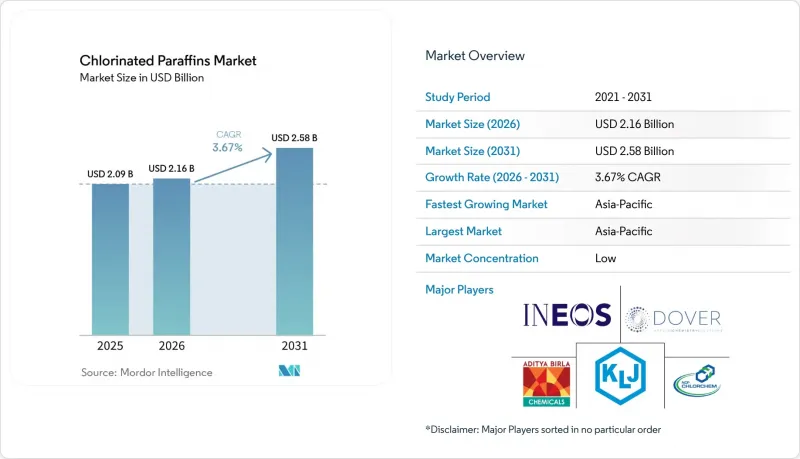
에 따르면 염소화 파라핀 시장 규모는 2025년에 20억 9,000만 달러에 달하며, 예측 기간(2026-2031년)에 CAGR 3.67%로 확대하며, 2026년 21억 6,000만 달러에서 2031년에는 25억 8,000만 달러에 달할 것으로 전망되고 있습니다.
전 세계 염소화 파라핀 시장의 동향 및 인사이트
가소화된 PVC의 수요
연질 PVC는 여전히 염소화 파라핀의 세계 최대 소비 분야입니다. 제조업체들은 DINP나 DEHP와 같은 1차 가소제와 함께 염소화 파라핀을 2차 가소제 및 난연 보조제로 사용하고 있습니다. 케이블 절연재, 자동차 내장재, 바닥재, 보호 시트에서의 수요는 건설 및 전기화 활동과 계속해서 밀접한 관련을 맺고 있습니다. 1차 가소제 가격 상승은 컴파운더들이 저비용의 2차 가소제를 사용하도록 유도할 가능성이 있으며, 이는 원자재 가격 변동이 심한 시기의 수요를 지원하게 될 것입니다. 2035년까지 동남아시아의 도시 인구 증가 전망은 주택, 파이프, 프로파일, 케이블 절연재에 대한 향후 수요를 지원할 것으로 예상됩니다. 2024년 8월, 릴라이언스 인더스트리즈는 통합 PVC 생산 능력 확대 계획을 발표하며, 염소화 파라핀 시장에서 PVC의 입지를 더욱 공고히 했습니다.
금속 가공용 윤활유 소비량
염소화 파라핀은 절삭, 연삭, 성형, 심압 성형용 가공액에서 극압 첨가제 역할을 합니다. 이 물질들은 접촉 압력이 많은 대체 화학 물질의 성능 한계를 초과하는 용도에서 경계 윤활을 제공합니다. 그 결과, 자동차 부품 제조, 항공우주 산업, 정밀 기계 가공은 여전히 염소화 파라핀 시장의 주요 수요원입니다. 북미 제조업의 국내 복귀와 더불어, 인도 및 동남아시아의 CNC 생산 능력 확대가 이러한 용도 전반에 걸친 수요를 지원하고 있습니다. 스톡홀름 협약에서는 2036년 12월 31일까지 상업용 및 산업용 고부하 금속 가공유에 대한 MCCP 사용에 대해 기간 한정 적용 예외를 허용하고 있습니다. 이 적용 예외는 가장 가혹한 절삭 및 성형 용도에서 기술적으로 동등한 대체품이 존재하지 않음을 반영한 것입니다.
단쇄 염소화 파라핀 및 중쇄 염소화 파라핀에 대한 규제상 제한
2025년 5월에 제안된 중쇄 염소화 파라핀(MCCP)의 부속서 A 등재는 염소화 파라핀 시장에 있으며, 규제의 대폭적인 강화를 의미합니다. 이 결정에 따라 규제 조치는 단쇄 염소화 파라핀(SCCP)에서 2025년 전 세계 매출의 46.72%를 차지한 MCCP까지 확대될 것입니다. 기간 한정 적용 제외 조치에 따라 금속 가공액에서의 MCCP 사용은 2036년 12월 31일까지 국방 및 항공우주 용도에서의 사용은 2041년 12월 31일까지 허용됩니다. 그러나 이러한 적용 제외 조치는 서명국 및 지역 전체에서 MCCP의 광범위한 사용을 단계적으로 폐지해 나가겠다는 방침을 정한 것입니다. 염소화 파라핀 시장에서 사업을 운영하는 유럽의 배합 제조업체는 물질, 혼합물 및 제품에 대한 0.1%(중량비)라는 농도 제한안에 대비해야 합니다. 비서명국 시장에서는 MCCP의 사용 기간이 더 길게 허용되므로, 수요는 지역별로 점점 더 분산될 것으로 보입니다.
부문 분석
2025년, 중쇄 염소화 파라핀은 전 세계 매출의 46.72%를 차지했습니다. 염소화 파라핀 시장에서 이 물질이 차지하는 중요한 위상은 PVC용 2차 가소제, 금속 가공액내 극압 첨가제, 그리고 폴리머 배합물내 난연 첨가제로서의 용도에서 기인합니다. 균형 잡힌 점도와 호환성 특성이 이러한 용도 전반에 걸친 사용을 지원하고 있습니다. 비용 대비 성능의 우위는 가격에 민감한 아시아태평양의 건설 및 케이블 시장에서 특히 중요한 요소로 작용하고 있습니다. 단쇄 염소화 파라핀(SCCP)은 2017년 이후 잔류성 유기 오염 물질(POPs)로 지정됨에 따라 규제 대상 시장에서의 수요는 감소 추세를 보이고 있습니다. SCCP의 잔여 수요는 동등한 규제를 시행하지 않는 관할 구역에 집중되어 있습니다.
장쇄 염소화 파라핀은 2026-2031년까지 연평균 성장률(CAGR) 4.23%를 기록하며 가장 빠르게 성장하는 제품 유형이 될 것으로 예상됩니다. 유럽 및 북미의 배합 제조업체들이 제품 등록을 갱신하고 중쇄 염소화 파라핀(MCCP)에 대한 규제의 영향을 완화함에 따라 장쇄 염소화 파라핀의 시장 점유율은 확대되고 있습니다. 장쇄 등급 염소화 파라핀 시장 규모는 규제를 준수하는 특수 배합으로의 전환에 힘입어 성장할 것으로 예상됩니다. Vantage Leuna사는 C14부터 C17까지의 MCCP 등급 및 C17부터 C30까지의 LCCP 등급을 다양한 안정제 구성으로 제공하고 있습니다. Caffaro Industrie는 Torviscosa 공장에서 MCCP 및 LCCP 등급을 생산하고 있으며, 이 회사의 제품 포트폴리오에서 LCCP의 점유율이 확대되고 있습니다. 규제가 비교적 완화된 아시아태평양 시장에서는 규제상 분류보다 비용 및 용도별 성능이 등급 선정에 계속해서 큰 영향을 미치고 있습니다.
지역별 분석
아시아태평양은 2025년에 전 세계 매출의 31.27%를 차지할 것으로 예상되며, 2031년까지 연평균 성장률(CAGR) 4.18%를 기록하며 가장 빠르게 성장하는 지역으로 남을 것으로 전망됩니다. 중국은 산둥성, 장쑤성, 저장성의 제조 클러스터를 통해 이 지역의 생산 및 소비 중심지 역할을 하고 있습니다. 그러나 환경 규제 준수 비용과 원자재 제약으로 인해 중국 중부 및 서부의 일부 시설에서는 가동률이 하락하고 있습니다. 인도는 이 지역에서 두 번째로 큰 소비국이며, 아시아태평양에서 가장 빠르게 성장하는 주요 생산국입니다. 인도의 수요는 PVC 케이블 생산, 자동차 부품, 가죽 가공, 금속 가공 용도에 의해 지원되고 있습니다. Lords Chloro Alkali사는 3억 인도 루피(360만 달러) 규모의 설비 투자를 바탕으로, 2024년 12월에 CPW 생산 능력을 20 TPD에서 50 TPD로 확대하고, 2025년 6월에는 100 TPD로 증산할 계획입니다.
베트남, 태국, 인도네시아를 포함한 동남아시아 국가들은 여전히 중국 생산자들의 제품을 주로 순수입하고 있습니다. 이러한 무역 패턴은 염소화 파라핀 시장의 가격 형성에 있으며, 중국의 역할을 강화하고 있습니다. 북미에서는 금속 가공용 작동유 및 PVC 용도가 수요를 지원하고 있습니다. 미국은 국내 제조용으로 C21+ 탄소 사슬을 포함하는 vLCCP를 승인하여, 특정 산업 용도에서 규제 준수를 위한 길을 열어주고 있습니다. 유럽에서는 MCCP에 대한 규제가 강화됨에 따라 더욱 까다로운 사업 환경에 직면하고 있습니다. 2026년 8월에는 INEOS Inovyn사가 Runcorn MCP Limited의 잔여 지분 50% 및 관련 EDC 자산을 인수할 전망이며, 이를 통해 영국내 해당 기업의 통합 공급망이 강화될 것입니다.
남미, 중동 및 아프리카는 규제 체계가 아직 발전 초기 단계에 있는 수요 시장입니다. 브라질의 PVC 가공 및 건설 활동은 염소화 파라핀 시장에서 2차 가소제에 대한 수요를 지원하고 있습니다. 사우디아라비아와 남아프리카공화국은 중동 및 아프리카의 주요 수요 거점입니다. NCP Chlorchem사는 하우텡 주에서 광업, 플라스틱, 산업용 화학 제품 용도로 사용되는 ‘Plasticlor’ 브랜드의 염소화 파라핀 제품을 생산하고 있습니다. Nuberg EPC사는 2025년 11월 오만에서 염소-알칼리 확장 프로젝트 계약을 수주할 전망이며, 이 프로젝트에는 하류 공정인 염소화 파라핀 왁스 생산 능력이 포함되어 있습니다. 이 지역들은 유럽과 북미에서 규제가 강화되고 있는 용도 시장을 흡수할 수 있습니다.
기타 혜택:
- 엑셀 형식의 시장 예측(ME) 시트
- 3개월간의 애널리스트 지원
자주 묻는 질문
목차
제1장 서론
- 조사 전제조건과 시장 정의
- 조사 범위
제2장 조사 방법
제3장 개요
제4장 시장 구도
- 시장 개요
- 시장 성장 촉진요인
- 시장 성장 억제요인
- 밸류체인 분석
- Porter's Five Forces 분석
제5장 시장 규모와 성장 예측
- 제품 유형별
- 염소 함유량별
- 용도별
- 지역별
- 아시아태평양
- 중국
- 인도
- 일본
- 한국
- 기타 아시아태평양 국가
- 북미
- 미국
- 캐나다
- 멕시코
- 유럽
- 독일
- 영국
- 프랑스
- 이탈리아
- 기타 유럽 국가
- 남미
- 브라질
- 아르헨티나
- 기타 남미 국가
- 중동 및 아프리카
- 사우디아라비아
- 남아프리카공화국
- 기타 중동 및 아프리카 국가
- 아시아태평양
제6장 경쟁 구도
- 시장 집중도
- 전략적 동향
- 시장 점유율·순위 분석
- 기업 개요
- Aditya Birla Chemicals Limited
- Ajanta Group
- Ajinomoto Fine-Techno Co.,Inc.
- Altair Chimica S.p.A.
- Caffaro Industrie
- Dover Chemical Corporation
- Flow Tech Group of Industries
- INEOS
- JSC Kaustik
- KH Chemicals
- KLJ Group
- NCP Chlorchem(Pty) Ltd
- Quimica del Cinca
- United Chemical
- Vantage Leuna GmbH
제7장 시장 기회와 향후 전망
KSA 26.10.28According to Mordor Intelligence, the chlorinated paraffins market size stood at USD 2.09 billion in 2025, and is projected to grow from USD 2.16 billion in 2026 to USD 2.58 billion by 2031, at a CAGR of 3.67% during the forecast period (2026-2031).
Global Chlorinated Paraffins Market Trends and Insights
Flexible PVC Demand
Flexible PVC remains the largest global consumption channel for chlorinated paraffins. Manufacturers use chlorinated paraffins as secondary plasticizers and flame-retardant co-agents alongside primary phthalates, such as DINP and DEHP. Demand from cable insulation, automotive interiors, flooring, and protective sheeting remains closely linked to construction and electrification activity. Higher prices for primary plasticizers can encourage compounders to use lower-cost secondary plasticizers, supporting demand during periods of feedstock price volatility. Southeast Asia's projected urban population growth through 2035 is expected to support future demand for housing, pipes, profiles, and cable insulation. In August 2024, Reliance Industries announced plans to expand its integrated PVC capacity, reinforcing PVC's role in the chlorinated paraffins market.
Metalworking Fluid Consumption
Chlorinated paraffins serve as extreme-pressure additives in cutting, grinding, forming, and deep-drawing fluids. They provide boundary lubrication in applications where contact pressures exceed the capabilities of many alternative chemistries. Consequently, automotive component manufacturing, aerospace fabrication, and precision engineering remain key demand sources for the chlorinated paraffins market. Manufacturing reshoring in North America, along with expanded CNC capacity in India and Southeast Asia, supports demand across these applications. The Stockholm Convention provides a time-limited exemption for the use of MCCPs in professional and industrial heavy-duty metalworking fluids through December 31, 2036. This exemption reflects the lack of technically equivalent alternatives for the most demanding cutting and forming applications.
Short-Chain Chlorinated Paraffins and Medium-Chain Chlorinated Paraffins Regulatory Restrictions
The proposed May 2025 Annex A listing of Medium-Chain Chlorinated Paraffins (MCCPs) marks a significant regulatory escalation for the chlorinated paraffins market. The decision would extend control measures beyond Short-Chain Chlorinated Paraffins (SCCPs) to MCCPs, which accounted for 46.72% of global revenue in 2025. Time-limited exemptions would permit the use of MCCPs in metalworking fluids until December 31, 2036, and in defense and aerospace applications until December 31, 2041. However, these exemptions establish a planned phaseout of broader MCCP use across signatory jurisdictions. European formulators operating in the chlorinated paraffins market must prepare for a proposed concentration limit of 0.1% w/w for substances, mixtures, and articles. Demand is likely to become increasingly geographically fragmented as non-signatory markets retain a broader window for MCCP use.
Other drivers and restraints analyzed in the detailed report include:
- Fire-Safety Requirements for Polymers and Textiles
- Construction and Manufacturing Expansion in Emerging Economies
- Substitution by Non-Chlorinated Additives
For complete list of drivers and restraints, kindly check the Table Of Contents.
Segment Analysis
Medium-chain chlorinated paraffins accounted for 46.72% of global revenue in 2025. Their significant position in the chlorinated paraffins market stems from their use as PVC secondary plasticizers, extreme-pressure additives in metalworking fluids, and flame-retardant additives in polymer formulations. Their balanced viscosity and compatibility characteristics support their use across these applications. Their cost-performance advantage remains particularly important in price-sensitive construction and cable markets across Asia-Pacific. Demand for short-chain chlorinated paraffins (SCCPs) is declining in regulated markets, as they have been listed as persistent organic pollutants since 2017. Residual SCCP demand remains concentrated in jurisdictions that have not implemented equivalent restrictions.
Long-chain chlorinated paraffins are expected to be the fastest-growing product type during 2026-2031 with a CAGR of 4.23%. They are gaining market share as formulators in Europe and North America update product registrations and reduce exposure to restrictions on medium-chain chlorinated paraffins (MCCPs). The chlorinated paraffins market size for long-chain grades is expected to benefit from the shift toward compliant specialty formulations. Vantage Leuna offers MCCP grades ranging from C14 to C17 and LCCP grades ranging from C17 to C30, with different stabilizer configurations. Caffaro Industrie manufactures MCCP and LCCP grades at its Torviscosa facility, where LCCPs represent a growing share of the product portfolio. In less-regulated Asia-Pacific markets, cost and application performance continue to influence grade selection more strongly than regulatory classification.
Complete Report Scope:
- By Product Type
- Short-Chain Chlorinated Paraffins
- Medium-Chain Chlorinated Paraffins
- Long-Chain Chlorinated Paraffins
- By Chlorine Content
- Low Chlorinated
- Medium Chlorinated
- High Chlorinated
- By Application
- Metalworking Fluids
- Lubricating Additives
- PVC Plasticizers
- Flame Retardants
- Rubber and Elastomers
- Others
- By Geography
- Asia-Pacific
- China
- India
- Japan
- South Korea
- Rest of Asia-Pacific
- North America
- United States
- Canada
- Mexico
- Europe
- Germany
- United Kingdom
- France
- Italy
- Rest of Europe
- South America
- Brazil
- Argentina
- Rest of South America
- Middle East and Africa
- Saudi Arabia
- South Africa
- Rest of Middle East and Africa
- Asia-Pacific
Geography Analysis
Asia-Pacific accounted for 31.27% of global revenue in 2025 and is expected to remain the fastest-growing region through 2031 with a CAGR of 4.18%. China anchors regional production and consumption through manufacturing clusters in Shandong, Jiangsu, and Zhejiang. However, environmental compliance costs and feedstock constraints reduce utilization rates at some facilities in central and western China. India is the second-largest regional consumer and the fastest-growing major producing country in the Asia-Pacific. PVC cable production, automotive components, leather processing, and metalworking applications support demand in India. Lords Chloro Alkali plans to expand its CPW capacity from 20 to 50 TPD in December 2024, followed by a further expansion to 100 TPD in June 2025, supported by capital expenditure of INR 300 million (USD 3.6 million).
Southeast Asian countries, including Vietnam, Thailand, and Indonesia, remain significant net importers of products from Chinese producers. This trade pattern reinforces China's role in price formation within the chlorinated paraffins market. Metalworking fluid and PVC applications sustain demand in North America. The United States has approved vLCCPs with C21+ carbon chains for domestic manufacturing, providing a compliance pathway for certain industrial applications. Europe faces a more restrictive operating environment as controls on MCCPs advance. In August 2026, INEOS Inovyn is expected to acquire the remaining 50% shareholding in Runcorn MCP Limited and related EDC assets, strengthening its integrated supply chain in the United Kingdom.
South America, the Middle East, and Africa offer demand outlets where regulatory frameworks remain at earlier stages of development. Brazil's PVC processing and construction activities support demand for secondary plasticizers in the chlorinated paraffins market. Saudi Arabia and South Africa represent significant demand centers in the Middle East and Africa. NCP Chlorchem manufactures Plasticlor chlorinated paraffin products in Gauteng for mining, plastics, and industrial chemical applications. Nuberg EPC is expected to receive a contract in November 2025 for a chlor-alkali expansion project in Oman that includes downstream chlorinated paraffin wax production capability. These regions can absorb applications that face increasing restrictions in Europe and North America.
- Aditya Birla Chemicals Limited
- Ajanta Group
- Ajinomoto Fine-Techno Co.,Inc.
- Altair Chimica S.p.A.
- Caffaro Industrie
- Dover Chemical Corporation
- Flow Tech Group of Industries
- INEOS
- JSC Kaustik
- KH Chemicals
- KLJ Group
- NCP Chlorchem (Pty) Ltd
- Quimica del Cinca
- United Chemical
- Vantage Leuna GmbH
Additional Benefits:
- The market estimate (ME) sheet in Excel format
- 3 months of analyst support
TABLE OF CONTENTS
1 INTRODUCTION
- 1.1 Study Assumptions and Market Definition
- 1.2 Scope of the Study
2 RESEARCH METHODOLOGY
3 EXECUTIVE SUMMARY
4 MARKET LANDSCAPE
- 4.1 Market Overview
- 4.2 Market Drivers
- 4.2.1 Flexible PVC Demand
- 4.2.2 Metalworking Fluid Consumption
- 4.2.3 Fire-Safety Requirements for Polymers and Textiles
- 4.2.4 Construction and Manufacturing Expansion in Emerging Economies
- 4.2.5 Integrated Chlorine and Paraffin Supply Security
- 4.2.6 Grade Migration Toward Compliant MCCP and LCCP Formulations
- 4.3 Market Restraints
- 4.3.1 SCCP and MCCP Regulatory Restrictions
- 4.3.2 Substitution by Non-Chlorinated Additives
- 4.3.3 Analytical Ambiguity and Testing Costs
- 4.4 Value Chain Analysis
- 4.5 Porter's Five Forces Analysis
- 4.5.1 Threat of New Entrants
- 4.5.2 Bargaining Power of Suppliers
- 4.5.3 Bargaining Power of Buyers
- 4.5.4 Threat of Substitutes
- 4.5.5 Competitive Rivalry
5 MARKET SIZE AND GROWTH FORECASTS (VALUE)
- 5.1 By Product Type
- 5.1.1 Short-Chain Chlorinated Paraffins
- 5.1.2 Medium-Chain Chlorinated Paraffins
- 5.1.3 Long-Chain Chlorinated Paraffins
- 5.2 By Chlorine Content
- 5.2.1 Low Chlorinated
- 5.2.2 Medium Chlorinated
- 5.2.3 High Chlorinated
- 5.3 By Application
- 5.3.1 Metalworking Fluids
- 5.3.2 Lubricating Additives
- 5.3.3 PVC Plasticizers
- 5.3.4 Flame Retardants
- 5.3.5 Rubber and Elastomers
- 5.3.6 Others
- 5.4 By Geography
- 5.4.1 Asia-Pacific
- 5.4.1.1 China
- 5.4.1.2 India
- 5.4.1.3 Japan
- 5.4.1.4 South Korea
- 5.4.1.5 Rest of Asia-Pacific
- 5.4.2 North America
- 5.4.2.1 United States
- 5.4.2.2 Canada
- 5.4.2.3 Mexico
- 5.4.3 Europe
- 5.4.3.1 Germany
- 5.4.3.2 United Kingdom
- 5.4.3.3 France
- 5.4.3.4 Italy
- 5.4.3.5 Rest of Europe
- 5.4.4 South America
- 5.4.4.1 Brazil
- 5.4.4.2 Argentina
- 5.4.4.3 Rest of South America
- 5.4.5 Middle East and Africa
- 5.4.5.1 Saudi Arabia
- 5.4.5.2 South Africa
- 5.4.5.3 Rest of Middle East and Africa
- 5.4.1 Asia-Pacific
6 COMPETITIVE LANDSCAPE
- 6.1 Market Concentration
- 6.2 Strategic Moves
- 6.3 Market Share (%)/Ranking Analysis
- 6.4 Company Profiles (includes Global Level Overview, Market Level Overview, Core Segments, Financials as available, Strategic Information, Products and Services, Recent Developments)
- 6.4.1 Aditya Birla Chemicals Limited
- 6.4.2 Ajanta Group
- 6.4.3 Ajinomoto Fine-Techno Co.,Inc.
- 6.4.4 Altair Chimica S.p.A.
- 6.4.5 Caffaro Industrie
- 6.4.6 Dover Chemical Corporation
- 6.4.7 Flow Tech Group of Industries
- 6.4.8 INEOS
- 6.4.9 JSC Kaustik
- 6.4.10 KH Chemicals
- 6.4.11 KLJ Group
- 6.4.12 NCP Chlorchem (Pty) Ltd
- 6.4.13 Quimica del Cinca
- 6.4.14 United Chemical
- 6.4.15 Vantage Leuna GmbH
7 MARKET OPPORTUNITIES AND FUTURE OUTLOOK
- 7.1 White-Space and Unmet-Need Assessment


