

|
시장보고서
상품코드
2154982
SIM 스왑 사기 탐지 소프트웨어 : 시장 점유율 분석, 업계 동향과 통계, 성장 예측(2026-2031년)SIM Swap Fraud Detection Software - Market Share Analysis, Industry Trends & Statistics, Growth Forecasts (2026 - 2031) |
||||||
 Mordor Intelligence
에 따르면 SIM 스왑 사기 탐지 소프트웨어 시장 규모는 2025년에 158억 4,000만 달러로 평가되며, 2026년 193억 9,000만 달러에서 확대하며, 2031년까지 553억 7,000만 달러에 달할 것으로 예측됩니다.
예측 기간(2026-2031년) 동안 연평균 성장률(CAGR)은 23.35%에 달할 것으로 전망됩니다.
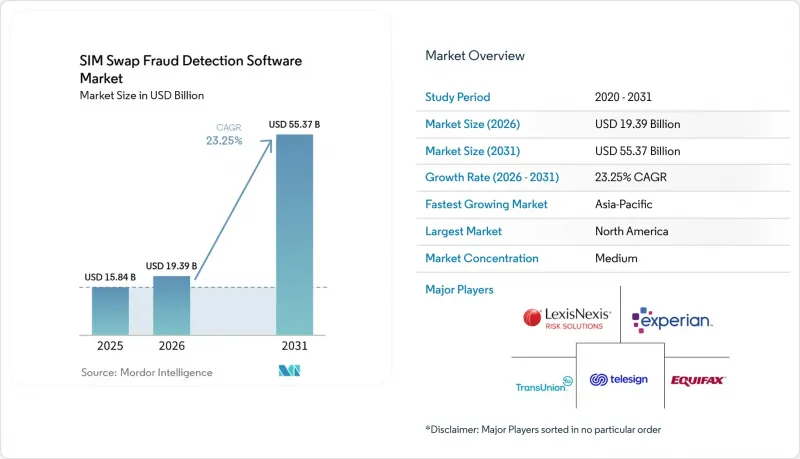
전 세계 SIM 스왑 사기 탐지 소프트웨어 시장의 동향 및 인사이트
증가하는 SIM 스왑, 번호 이동성 및 계정 탈취 공격
SIM 스왑 사건 건수와 피해액의 증가는 기술 투자가 더욱 선별적으로 이루어지는 상황 속에서도 SIM 스왑 사기 탐지 소프트웨어 시장에 지속적인 수요 기반을 마련해 주고 있습니다. FBI 보고서에 따르면 2025년 SIM 스왑 사건은 48% 증가했으며, 전 세계 피해액은 27억 달러를 넘어섰습니다. 다만, 직접 신고된 사례만으로는 탈취된 전화번호로 인해 발생한 후속 계좌 자금 유출 사건을 모두 파악할 수 없습니다. Cifas의 기록에 따르면 2024년 영국의 SIM 스왑 사건은 1,055% 증가했으며, 사기꾼들이 소매점의 SIM 교환 채널을 이용하여 보호된 계좌에 접근하고 있었다는 사실이 드러났습니다. 전화번호 탈취를 통해 SMS 메시지에 의존하는 비밀번호 재설정, 거래 확인 및 계정 복구 절차에 접근할 수 있게 됩니다. 사기 방지 팀은 공격을 가능하게 한 초기 SIM 변경을 파악하지 못한 채, 최종적인 지급 손실만 기록하는 경우가 있습니다. 이러한 보고상의 공백은 대응 조치 결정을 지연시킬 수 있지만, 동시에 고위험 거래, 계정 복구 및 지급 승인 전에 SIM 수준의 확인을 원하는 기업에게는 명확한 근거가 됩니다.
모바일 네트워크 사기 방지 API의 확대
표준화된 통신사 API를 통해 과거에는 통신사 시스템 내에 고립되어 있던 데이터가 이제 SIM 스왑 사기 탐지 소프트웨어 시장 전반에서 애플리케이션 개발자가 위험 판단을 내리는 데 필요한 입력 정보로 활용될 수 있게 되었습니다. GSMA Open Gateway 프로그램은 80개 이상의 통신사 그룹, 292개 네트워크, 그리고 전 세계 모바일 연결의 80% 이상을 포괄하며, 통신사 기능에 대한 공통된 접근 경로를 구축하고 있습니다. 폴란드의 주요 4개 통신사는 2026년 2월부터 SIM 스왑 및 번호 검증 API 제공을 시작했으며, 그리스의 COSMOTE TELEKOM과 Vodafone도 2026년 3월에 유사한 서비스를 시작했습니다. Itau Unibanco는 2025년 4월까지 CAMARA의 SIM 스왑 API를 3,650만 회 이상 이용했으며, 월간 이용 횟수는 500만 회에 달합니다. 이 동일한 인터페이스를 통해 여러 모바일 네트워크에서 사업을 운영하는 은행의 통합 작업을 경감할 수 있습니다. 이러한 인터페이스가 더욱 널리 이용 가능해짐에 따라 각 벤더들은 특정 통신사의 데이터에 대한 독점적 접근권보다는 리스크 관리, 워크플로우 설계, 모델 성능 및 도입 지원 측면에서 경쟁을 펼치게 될 것입니다.
모바일 네트워크 데이터에 대한 접근이 파편화되어 있습니다.
통신사업자 데이터의 파편화는 여전히 주요 제약 요인으로 남아 있습니다. 이는 관련 통신사업자가 제공업체의 통합 네트워크 외부에 위치할 경우, 검사를 수행하더라도 유용한 신호를 얻지 못할 가능성이 있기 때문입니다. GSMA는 2026년에 성숙한 시장에서 API 가용성이 개선되었다고 보고했으나, 이용 가능한 API를 기업의 수익으로 전환하는 상황에는 여전히 편차가 나타나고 있습니다. SIM 스왑 사기 탐지 소프트웨어 시장에서는 모든 통신사와 직접적인 상업 계약을 체결할 필요성을 줄일 수 있으므로 플랫폼을 통한 유통 모델이 선호되고 있습니다. 그러나 공급자는 커버리지가 불완전한 지역에서는 여전히 통신사업자와의 관계나 CAMARA와의 협력을 유지해야 합니다. 이로 인해 운영 비용이 증가하고 제품 유지보수가 복잡해지며, 모바일 데이터 접근이 표준화되지 않은 시장이나 상업 계약이 아직 정비 중인 시장으로의 진출이 지연됩니다. 소규모 핀테크 기업은 주요 통신사와의 관계에만 검증을 적용하는 경우가 있는데, 그 결과 사기꾼이 피해자의 전화번호를 서비스 범위 밖의 네트워크로 옮겨 악용할 수 있는 허점이 남게 됩니다.
부문 분석
2025년 SIM 스왑 사기 탐지 소프트웨어 시장의 매출 중 소프트웨어가 62.13%를 차지했습니다. 이는 대량의 통신사 및 거래 신호를 처리할 수 있는 플랫폼에 대한 수요를 반영한 것입니다. 이 부문은 공급자가 모델을 학습하고 배포한 후, 추가 API 호출을 처리할 때 발생하는 증분 비용이 낮다는 장점이 있습니다. 은행은 단일 플랫폼을 사용하여 SIM 변경 이벤트, 기기 데이터, 행동 패턴 및 컨소시엄의 인텔리전스를 하나의 의사결정 워크플로우로 통합할 수 있습니다. 이러한 접근 방식을 통해 사기 신호마다 개별 공급자를 관리해야 하는 부담이 줄어드는 한편, 소프트웨어 공급업체는 사기 방법이 변화함에 따라 규칙과 모델을 지속적으로 업데이트합니다. 이러한 입지를 바탕으로 소프트웨어 공급업체는 관련 신원 확인, 인증 및 거래 모니터링 툴을 제공하기 위한 대규모 도입 기반을 확보할 수 있습니다. 또한 제품 업데이트를 통해 고객을 유지하면서, 고객이 전체 포트폴리오에 걸쳐 기반이 되는 의사결정 플랫폼을 교체할 필요 없이 변화하는 보안 우선순위에 대응할 수 있게 됩니다.
지역 통신사업자와 핀테크 기업이 모델 튜닝, 임계값 관리, 규정 준수 보고 지원을 요구하는 가운데, 서비스 시장은 2031년까지 연평균 성장률(CAGR) 24.13%로 확대될 것으로 예측됩니다. 이러한 구매 기업은 복잡한 사기 방지 기술 스택을 운영하기 위해 필요한 사내 인력이 부족할 수 있습니다. CAMARA의 Fall25 릴리스에서는 매니지드 서비스를 위한 안정적인 API와 인증이 제공되었습니다. 바티 에어텔, 릴라이언스 지오, 보다폰 아이디어는 ‘인도 모바일 콩그레스 2025’에서 페더레이티드 SIM 스왑 API에 대한 접근을 시작함으로써, 서비스 제공업체가 단일 계약을 통해 여러 통신사의 검증을 제공할 수 있는 길을 열었습니다. 이러한 서비스는 소규모 구매자의 도입을 가속화하고, 그렇지 않으면 유지하기 어려운 통제 운영을 지원할 수 있습니다. 그 결과, SIM 스왑 사기 탐지 소프트웨어 업계는 확장 가능한 플랫폼과 전문적인 운영 지원 모두에 기회를 제공하고 있습니다.
SIM 스왑 사기 탐지 소프트웨어 시장에서 2025년 매출의 61.43%를 클라우드 배포이 차지할 것으로 예상되며, 2031년까지 연평균 성장률(CAGR) 25.11%로 확대될 것으로 전망됩니다. 이러한 선도적 지위는 이동통신사업자들이 클라우드 네이티브 네트워크 기능으로 전환하고 있다는 점과, SIM 스왑 사기 탐지 소프트웨어 시장에서 공통 API에 대한 저지연 접근이 요구되고 있음을 반영합니다. 클라우드 환경에서는 부정 판정을 정책, 본인 확인 및 거래 서비스와 더 가까운 위치에 배치할 수 있을 뿐만 아니라, 기업이 여러 통신사업자에 걸쳐 단일 연결을 이용할 수 있게 됩니다. 이 모델을 통해 은행, 결제 사업자 또는 마켓플레이스가 새로운 지역에 진출할 때의 개발 부담을 줄일 수 있습니다. 또한 클라우드 플랫폼에서는 고객 환경별로 개별적인 소프트웨어 업그레이드를 수행하지 않고도 모델 업데이트를 배포할 수 있습니다.
온프레미스 배포는 가입자 데이터에 대해 보다 엄격한 관리가 필요한 대형 통신사업자나 규제 대상 조직 사이에서 여전히 중요한 위치를 차지하고 있습니다. 유럽연합(EU) 관할 구역이나 일부 걸프협력회의(GCC) 시장의 데이터 거주 요건으로 인해 조직이 본인 확인 관련 정보를 처리할 수 있는 장소가 제한될 수 있습니다. 이러한 요건으로 인해 로컬 인프라를 직접 관리하는 것이 필수적일 수 있습니다. 그러나 GSMA는 2026년 1분기 최신 보고서에서 생태계가 플랫폼을 통한 배포로 전환되고 있다고 밝혔습니다. 이러한 전환은 통합의 용이성과 사업자 간 접근성을 우선시하는 기업 간의 클라우드 집중화를 촉진합니다. SIM 스왑 사기 탐지 소프트웨어 시장에서는 규제상 의무, 기존 인프라, 그리고 요구되는 데이터 관리 수준에 따라 선택이 좌우되므로 여전히 두 가지 도입 모델 모두 선택지로 남아 있습니다.
지역별 분석
2025년, 북미는 SIM 스왑 사기 탐지 소프트웨어 시장 점유율의 32.12%를 차지했습니다. 이는 공식적인 규제, 디지털 뱅킹의 보급, 그리고 확립된 기업의 보안 조달 관행에 힘입은 결과입니다. 2024년 7월 이후, FCC 23-95에 따라 SIM 변경 및 번호 이동성 신청 전에 안전한 인증이 의무화되어 통신사업자에 대한 명확한 규정 준수 요건이 마련되었습니다. 2026년 3월, ATIS는 표준화된 CAMARA API를 통해 북미 통신사업자들이 사기 방지 기능을 단순한 네트워크 기능이 아닌 인텔리전스 서비스로 패키징할 수 있게 될 것이라고 설명했습니다. 또한 2026년 3월, Infobip과 T-Mobile은 제휴를 맺고, 인증된 플랫폼을 통해 기업 고객에게 SIM 스왑 및 번호 검증 API에 대한 접근 권한을 제공했습니다. 2025년 11월, Bell Canada, Rogers, TELUS의 합작 회사인 EnStream은 Proximus Global과 제휴하여 캐나다 은행 업계를 대상으로 전화번호 사기 방지 서비스를 제공했습니다.
2025년, 유럽은 두 번째로 큰 시장을 차지했으며, PSD2의 인증 요건과 eIDAS 2.0 규정에 힘입어 수요가 지원되었습니다. 또한 GDPR에 기반한 동의 및 개인 데이터 관련 요건도 SIM 스왑 사기 탐지 소프트웨어 시장의 제공 방식에 영향을 미치고 있습니다. 2025년 9월, 영국의 주요 4대 통신사는 KYC Match API를 출시하여, 기업이 개인정보를 수집하지 않고도 본인 확인 정보를 통신사의 검증된 기록과 대조할 수 있도록 했습니다. 폴란드와 그리스는 2026년 초에 표준화된 SIM 스왑 및 번호 검증 서비스를 도입하여 중부, 동부, 남부 유럽 전역으로 서비스를 확대했습니다. 독일과 프랑스는 디지털 뱅킹 거래량이 많고 규제 대상 금융 기관의 수도 많아 여전히 중요한 시장으로 남아 있습니다.
아시아태평양은 2031년까지 연평균 성장률(CAGR) 25.21%로 확대될 것으로 예측되며, 이는 모든 지역 중 가장 높은 성장률입니다. 이 지역에서는 인도, 인도네시아, 중국, 대만에서 대규모 모바일 가입자 기반에 더해 디지털 결제 활동의 증가와 통신사 간 표준화가 진행되고 있습니다. 인도의 주요 통신사 3곳은 2025년에 페더레이티드 SIM 스왑 및 번호 검증 API를 도입했습니다. 2025년 말까지 전기통신국은 부정 사용이 의심되는 SIM 카드 30만-40만 장을 차단했습니다. 차이나모바일(China Mobile)은 CAMARA 표준을 준수하는 SIM 스왑 및 기기 스왑 API를 자사의 부정 방지 아키텍처에 도입했습니다.
기타 혜택:
- 엑셀 형식의 시장 예측(ME) 시트
- 3개월간의 애널리스트 지원
자주 묻는 질문
목차
제1장 서론
- 조사 전제조건과 시장 정의
- 조사 범위
제2장 조사 방법
제3장 개요
제4장 시장 구도
- 시장 개요
- 시장 성장 촉진요인
- 시장 성장 억제요인
- 거시경제 요인이 시장에 미치는 영향
- 업계 밸류체인 분석
- 규제 상황
- 기술 전망
- Porter's Five Forces 분석
제5장 시장 규모와 성장 예측
- 컴포넌트별
- 배포 모드별
- 조직 규모별
- 용도별
- 최종사용자별
- 지역별
- 북미
- 미국
- 캐나다
- 멕시코
- 남미
- 브라질
- 아르헨티나
- 기타 남미 국가
- 유럽
- 영국
- 독일
- 프랑스
- 기타 유럽 국가
- 아시아태평양
- 중국
- 인도
- 일본
- 기타 아시아태평양 국가
- 중동
- 아랍에미리트
- 사우디아라비아
- 기타 중동 국가
- 아프리카
- 남아프리카공화국
- 나이지리아
- 기타 아프리카 국가
- 북미
제6장 경쟁 구도
- 시장 집중도
- 전략적 동향
- 시장 점유율 분석
- 기업 개요
- BICS SA/NV
- Telesign Corporation
- Mobileum Inc.
- Prove Identity, Inc.
- LexisNexis Risk Solutions Inc.
- Syniverse Technologies, LLC
- Infobip Ltd.
- Twilio Inc.
- Experian plc
- TransUnion
- Equifax Inc.
- Subex Limited
- Tata Communications Limited
- Transaction Network Services, Inc.
- AdaptiveMobile Security Limited
- Enea AB
- Araxxe S.A.
- Comviva Technologies Limited
- Equinox Information Systems, Inc.
제7장 시장 기회와 향후 전망
KSA 26.10.28According to Mordor Intelligence, the SIM swap fraud detection software market size was valued at USD 15.84 billion in 2025 and estimated to expand from USD 19.39 billion in 2026 to reach USD 55.37 billion by 2031, at a CAGR of 23.35% during the forecast period (2026-2031).
Global SIM Swap Fraud Detection Software Market Trends and Insights
Rising SIM Swap, Port-Out, and Account Takeover Attacks
The increasing volume and cost of SIM swaps establish a lasting demand base for the SIM swap fraud-detection software market, even as technology spending becomes more selective. The FBI reported that SIM swap incidents increased by 48% in 2025 and caused global losses exceeding USD 2.7 billion, although direct reports do not capture every subsequent account-drain event enabled by a hijacked number. Cifas recorded a 1,055% increase in UK SIM swap cases in 2024, highlighting how fraudsters used retail SIM-change channels to access protected accounts. A number takeover can provide access to password resets, transaction confirmations, and recovery flows that depend on SMS messages. Fraud teams may record the eventual payment loss without identifying the earlier SIM change that enabled the attack. That reporting gap can delay procurement decisions, but it also creates a clear case for enterprises that want SIM-level checks before high-risk transactions, account recovery, and payment approvals.
Expansion of Mobile Network Fraud-Prevention APIs
Standardized carrier APIs are turning data that was once isolated within operator systems into an input that application developers can use to make risk decisions across the SIM swap fraud detection software market. The GSMA Open Gateway program covers more than 80 operator groups, 292 networks, and over 80% of global mobile connections, creating a common route to carrier capabilities. Poland's 4 major operators launched SIM Swap and Number Verification APIs in February 2026, and Greece's COSMOTE TELEKOM and Vodafone followed with comparable services in March 2026. Itau Unibanco used the CAMARA SIM Swap API more than 36.5 million times through April 2025, with a monthly run rate of 5 million calls. The same interface can reduce integration work for banks operating across multiple mobile networks. As these interfaces become more widely available, vendors will compete more on risk orchestration, workflow design, model performance, and deployment support than on exclusive access to one operator's data.
Fragmented Access to Mobile Network Data
Fragmented carrier data remains a central limitation because a check can return no useful signal when the relevant operator is outside a provider's integration network. The GSMA reported in 2026 that API availability in mature markets had improved, but the conversion of available APIs into enterprise revenue remained uneven. Platform-mediated distribution models are gaining preference in the SIM swap fraud detection software market because they reduce the need for direct commercial agreements with every operator. Yet providers still need to maintain operator relationships and CAMARA integrations where coverage is incomplete. This increases operating cost, complicates product maintenance, and delays expansion into markets where mobile data access is less standardized or commercial agreements are still developing. Smaller fintechs may apply checks only to their largest operator relationships, leaving gaps that fraudsters can exploit by moving a victim's number to an uncovered network.
Other drivers and restraints analyzed in the detailed report include:
- Regulatory Requirements for Secure SIM Changes and Strong Authentication
- Growth of Mobile Banking, Instant Payments, and Digital Identity Services
- False Positives and Customer Friction
For complete list of drivers and restraints, kindly check the Table Of Contents.
Segment Analysis
Software accounted for 62.13% of the SIM swap fraud detection software market revenue in 2025, reflecting demand for platforms capable of processing high volumes of carrier and transaction signals. The segment benefits from the low incremental cost of processing additional API calls once providers have trained and deployed a model. Banks can use a single platform to integrate SIM-change events, device data, behavioral patterns, and consortium intelligence into a single decision workflow. This approach reduces the need to manage separate providers for each fraud signal, while software vendors continuously update rules and models as fraudsters change their methods. This position gives software providers a large installed base from which to offer related identity, authentication, and transaction-monitoring tools. It also enables them to retain customers through product updates and address changing security priorities without requiring customers to replace the underlying decision platform across their portfolios.
Services are projected to expand at a 24.13% CAGR through 2031 as regional carriers and fintech firms seek support for model tuning, threshold management, and compliance reporting. These buyers may lack the internal teams required to operate a complex fraud technology stack. The CAMARA Fall25 release provided stable APIs and certification for managed services. Bharti Airtel, Reliance Jio, and Vodafone Idea launched federated SIM Swap API access at India Mobile Congress 2025, providing service providers with a route to offer multi-operator checks through a single arrangement. Services can accelerate adoption among smaller buyers and help them operate controls that would otherwise be difficult to maintain. Consequently, the SIM swap fraud detection software industry provides opportunities for both scalable platforms and specialized operational support.
Cloud deployment accounted for 61.43% of revenue in 2025 and is projected to expand at a 25.11% CAGR through 2031 in the SIM swap fraud detection software market. Its leading position reflects mobile operators' transition toward cloud-native network functions and the need for low-latency access to common APIs in the SIM-swap fraud-detection software market. Cloud environments can position fraud decisions closer to policy, identity, and transaction services while enabling enterprises to use a single connection across multiple operators. This model can reduce development efforts when banks, payment providers, or marketplaces expand into new territories. Cloud platforms can also distribute model updates without requiring separate software upgrades across each customer environment.
On-premises deployments remain relevant among large operators and regulated organizations that require tighter control over subscriber data. Data residency requirements in European Union jurisdictions and selected Gulf Cooperation Council markets can restrict the locations where organizations process identity-related information. These requirements can make direct control over local infrastructure essential. However, the GSMA stated in its first-quarter 2026 update that the ecosystem was moving toward platform-mediated distribution. This transition supports cloud aggregation among enterprises that prioritize ease of integration and cross-operator access. The SIM swap fraud detection software market remains open to both deployment models, as the choice depends on regulatory obligations, existing infrastructure, and required levels of data control.
Complete Report Scope:
- By Component
- Software
- Services
- By Deployment Mode
- Cloud
- On-Premises
- By Organization Size
- Large Enterprises
- Small and Medium Enterprises
- By Application
- Fraud Detection and Prevention
- Identity Verification
- Account Takeover Prevention
- Authentication and Transaction Risk Assessment
- Compliance Monitoring
- By End User
- Mobile Network Operators
- Banks and Financial Institutions
- Fintech and Digital Payment Providers
- E-Commerce and Marketplaces
- Government and Public Sector
- Healthcare, Insurance and Other Regulated Enterprises
- By Geography
- North America
- United States
- Canada
- Mexico
- South America
- Brazil
- Argentina
- Rest of South America
- Europe
- United Kingdom
- Germany
- France
- Rest of Europe
- Asia-Pacific
- China
- India
- Japan
- Rest of Asia-Pacific
- Middle East
- United Arab Emirates
- Saudi Arabia
- Rest of Middle East
- Africa
- South Africa
- Nigeria
- Rest of Africa
- North America
Geography Analysis
North America accounted for 32.12% of the SIM swap fraud detection software market share in 2025, supported by formal regulations, widespread adoption of digital banking, and established enterprise security procurement practices. Since July 2024, FCC 23-95 has required secure authentication before SIM changes and port-out requests, creating a clear compliance requirement for operators. In March 2026, ATIS described how standardized CAMARA APIs can enable North American operators to package fraud prevention as an intelligence service rather than solely as a network feature. In March 2026, Infobip and T-Mobile formed a partnership that provides enterprise clients with access to SIM Swap and Number Verification APIs through a certified platform. In November 2025, EnStream, a joint venture between Bell Canada, Rogers, and TELUS, partnered with Proximus Global to provide phone number fraud prevention services to Canada's banking ecosystem.
Europe was the second-largest geography in 2025, with demand supported by PSD2 authentication requirements and eIDAS 2.0 provisions. GDPR consent and personal data requirements also influence delivery practices in the SIM swap fraud detection software market. In September 2025, the United Kingdom's four largest operators launched KYC Match APIs, enabling businesses to compare identity details against verified operator records without receiving personal information. Poland and Greece introduced standardized SIM Swap and Number Verification services in early 2026, extending the rollout across Central, Eastern, and Southern Europe. Germany and France remain important country markets due to their high digital banking volumes and large numbers of regulated financial institutions.
Asia-Pacific is projected to expand at a CAGR of 25.21% through 2031, the fastest growth rate among all regions. The region combines a large mobile subscriber base with rising digital payment activity and increasing operator standardization across India, Indonesia, China, and Taiwan. India's three leading operators introduced federated SIM Swap and Number Verification APIs in 2025. By late 2025, the Department of Telecommunications had blocked between 300,000 and 400,000 SIMs for suspected fraud. China Mobile deployed CAMARA-standardized SIM Swap and Device Swap APIs into its fraud-prevention architecture.
- BICS SA/NV
- Telesign Corporation
- Mobileum Inc.
- Prove Identity, Inc.
- LexisNexis Risk Solutions Inc.
- Syniverse Technologies, LLC
- Infobip Ltd.
- Twilio Inc.
- Experian plc
- TransUnion
- Equifax Inc.
- Subex Limited
- Tata Communications Limited
- Transaction Network Services, Inc.
- AdaptiveMobile Security Limited
- Enea AB
- Araxxe S.A.
- Comviva Technologies Limited
- Equinox Information Systems, Inc.
Additional Benefits:
- The market estimate (ME) sheet in Excel format
- 3 months of analyst support
TABLE OF CONTENTS
1 INTRODUCTION
- 1.1 Study Assumptions and Market Definition
- 1.2 Scope of the Study
2 RESEARCH METHODOLOGY
3 EXECUTIVE SUMMARY
4 MARKET LANDSCAPE
- 4.1 Market Overview
- 4.2 Market Drivers
- 4.2.1 Rising SIM Swap, Port-Out and Account Takeover Attacks
- 4.2.2 Expansion of Mobile Network Fraud-Prevention APIs
- 4.2.3 Regulatory Requirements for Secure SIM Changes and Strong Authentication
- 4.2.4 Growth of Mobile Banking, Instant Payments and Digital Identity Services
- 4.2.5 Carrier Data Monetization Through Standardized Network Signals
- 4.2.6 Real-Time Risk Scoring for Low-Friction Authentication
- 4.3 Market Restraints
- 4.3.1 Fragmented Access to Mobile Network Data
- 4.3.2 False Positives and Customer Friction
- 4.3.3 Privacy, Consent and Cross-Border Data Restrictions
- 4.3.4 Uneven Operator API Readiness Across Developing Markets
- 4.4 Impact of Macroeconomic Factors on the Market
- 4.5 Industry Value Chain Analysis
- 4.6 Regulatory Landscape
- 4.7 Technological Outlook
- 4.8 Porter's Five Forces Analysis
- 4.8.1 Bargaining Power of Suppliers Analysis
- 4.8.2 Bargaining Power of Buyers Analysis
- 4.8.3 Threat of New Entrants Analysis
- 4.8.4 Threat of Substitutes Analysis
- 4.8.5 Competitive Rivalry Analysis
5 MARKET SIZE AND GROWTH FORECASTS (VALUE)
- 5.1 By Component
- 5.1.1 Software
- 5.1.2 Services
- 5.2 By Deployment Mode
- 5.2.1 Cloud
- 5.2.2 On-Premises
- 5.3 By Organization Size
- 5.3.1 Large Enterprises
- 5.3.2 Small and Medium Enterprises
- 5.4 By Application
- 5.4.1 Fraud Detection and Prevention
- 5.4.2 Identity Verification
- 5.4.3 Account Takeover Prevention
- 5.4.4 Authentication and Transaction Risk Assessment
- 5.4.5 Compliance Monitoring
- 5.5 By End User
- 5.5.1 Mobile Network Operators
- 5.5.2 Banks and Financial Institutions
- 5.5.3 Fintech and Digital Payment Providers
- 5.5.4 E-Commerce and Marketplaces
- 5.5.5 Government and Public Sector
- 5.5.6 Healthcare, Insurance and Other Regulated Enterprises
- 5.6 By Geography
- 5.6.1 North America
- 5.6.1.1 United States
- 5.6.1.2 Canada
- 5.6.1.3 Mexico
- 5.6.2 South America
- 5.6.2.1 Brazil
- 5.6.2.2 Argentina
- 5.6.2.3 Rest of South America
- 5.6.3 Europe
- 5.6.3.1 United Kingdom
- 5.6.3.2 Germany
- 5.6.3.3 France
- 5.6.3.4 Rest of Europe
- 5.6.4 Asia-Pacific
- 5.6.4.1 China
- 5.6.4.2 India
- 5.6.4.3 Japan
- 5.6.4.4 Rest of Asia-Pacific
- 5.6.5 Middle East
- 5.6.5.1 United Arab Emirates
- 5.6.5.2 Saudi Arabia
- 5.6.5.3 Rest of Middle East
- 5.6.6 Africa
- 5.6.6.1 South Africa
- 5.6.6.2 Nigeria
- 5.6.6.3 Rest of Africa
- 5.6.1 North America
6 COMPETITIVE LANDSCAPE
- 6.1 Market Concentration
- 6.2 Strategic Moves
- 6.3 Market Share Analysis
- 6.4 Company Profiles (includes Global Level Overview, Market Level Overview, Core Segments, Financials as available, Strategic Information, Market Rank/Share, Products and Services, Recent Developments)
- 6.4.1 BICS SA/NV
- 6.4.2 Telesign Corporation
- 6.4.3 Mobileum Inc.
- 6.4.4 Prove Identity, Inc.
- 6.4.5 LexisNexis Risk Solutions Inc.
- 6.4.6 Syniverse Technologies, LLC
- 6.4.7 Infobip Ltd.
- 6.4.8 Twilio Inc.
- 6.4.9 Experian plc
- 6.4.10 TransUnion
- 6.4.11 Equifax Inc.
- 6.4.12 Subex Limited
- 6.4.13 Tata Communications Limited
- 6.4.14 Transaction Network Services, Inc.
- 6.4.15 AdaptiveMobile Security Limited
- 6.4.16 Enea AB
- 6.4.17 Araxxe S.A.
- 6.4.18 Comviva Technologies Limited
- 6.4.19 Equinox Information Systems, Inc.
7 MARKET OPPORTUNITIES AND FUTURE OUTLOOK
- 7.1 White-Space and Unmet-Need Assessment


