

|
시장보고서
상품코드
2155005
남미의 의약품 수탁제조 시장 : 시장 점유율 분석, 업계 동향과 통계, 성장 예측(2026-2031년)South America Pharmaceutical Contract Manufacturing - Market Share Analysis, Industry Trends & Statistics, Growth Forecasts (2026 - 2031) |
||||||
 Mordor Intelligence
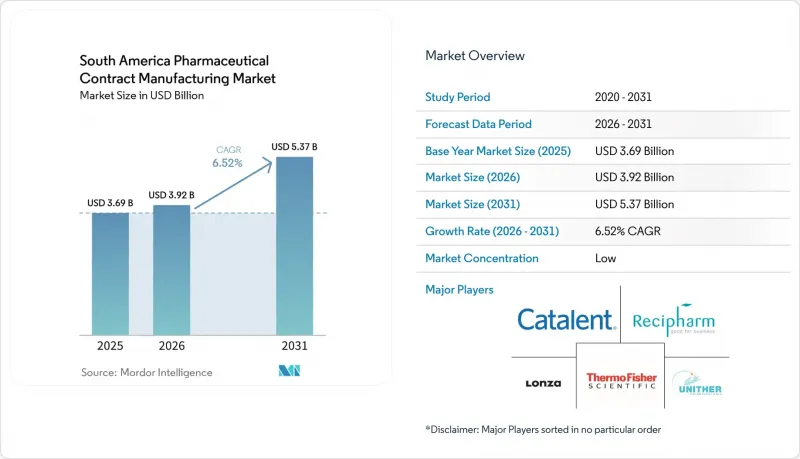
에 따르면 남미의 의약품 수탁제조 시장 규모는 2025년 36억 9,000만 달러, 2026년 39억 2,000만 달러에서 2031년까지 53억 7,000만 달러로 확대될 것으로 예측되고 있으며, 2026-2031년까지 연평균 성장률(CAGR)은 6.52%에 달할 전망입니다.
남미 의약품 수탁제조 시장의 동향 및 인사이트
국내 및 다국적 제약 기업의 아웃소싱
아웃소싱은 해당 지역에서 사업을 운영하는 국내 제약 기업 및 다국적 기업에게 전략적 요건이 되었습니다. 브라질의 주요 제약 기업은 생산량 증가에 따라 생산 능력의 제약에 직면했으며, 이는 외부 제조 파트너에 대한 수요를 촉진했습니다. Blau Farmaceutica는 2025년 말 상파울루의 복합 시설에서 2개의 새로운 생산 라인을 완공했으며, 2026년에 상업 운전을 시작하기 전에 이 라인들은 ANVISA(브라질 국가위생감독청)의 검증 절차를 거쳤습니다. 바이오시밀러나 특수 주사제를 출시하는 다국적 기업에게도 완제품을 항공편으로 수입하는 것보다 지역 파트너를 선정하는 것이 더 합리적입니다. 공공 입찰에서 현지 조달을 우선시하는 경향과 ANVISA의 의존도 평가 체계의 발전으로 인해 시장 진입에 있으며, 적격한 지역 생산 역량이 더욱 중요해지고 있습니다. 따라서 남미의 의약품 위탁 제조 시장에는 무균 생물제제, 동결건조 및 고효능 API의 제조 능력을 필요로 하는 국내 기업과 다국적 스폰서들의 수요가 집중되고 있습니다.
제네릭 의약품, 바이오시밀러 및 만성질환 치료제에 대한 수요
제네릭 의약품 및 바이오시밀러에 대한 수요가 확대됨에 따라 위탁 제조업체에 제공되는 업무의 폭이 넓어지고 있습니다. 브라질에서는 Biomm, Wockhardt, Fundacao Ezequiel Dias가 주도한 ‘생산 개발 파트너십’을 통해 20년간의 중단 끝에 2025년 7월 국내 인슐린 생산을 재개했습니다. 이 프로그램은 기술 이전이 만성질환 치료에 필수적인 의약품의 국내 생산을 어떻게 지원할 수 있는지를 입증한 사례였습니다. PAHO는 2025년 2월, 각국에 필수 암 치료제에 대한 접근성을 개선할 것을 요청하는 한편, 바이오시밀러 도입을 지원할 수 있는 지역적 노력을 장려했습니다. 따라서 수탁제조업체는 바이오시밀러 완제품 충전 및 마무리 작업과 저비용 제네릭 의약품을 위한 원료의약품(API) 배치 제조 업무 모두를 수주할 가능성이 있습니다. 이러한 조합으로 인해 단일 제조 공정만이 아닌 여러 서비스를 제공할 수 있는 업체가 유리해집니다.
GMP 준수, 감사 및 시정 조치의 비용
GMP 준수는 남미의 위탁 제조업체들에게 큰 비용상의 장벽이 되고 있습니다. ANVISA의 RDC 982/2025는 2025년 7월, GMP 및 적정 유통 기준(GDP) 인증 갱신을 위한 건강 위험 기반 모델을 도입했습니다. 이 프레임워크는 공정의 현대화로 이어질 수 있지만, 제조업체에게는 더욱 엄격한 문서 관리와 품질 시스템의 유지가 요구됩니다. 2025년 4월 mAbxience사의 갈린 시설에서 실시된 FDA 현장 조사에서는 바이오버든 관리, 환경 모니터링 및 검증 활동과 관련된 문제가 지적되었습니다. 지역 거점에서의 지적 사항은 기술 이전 작업을 지연시키고, 스폰서가 대체 공급업체를 확보하게 되는 요인이 될 수 있습니다. 클린룸 개보수, 설비 재인증 및 재사찰은 중규모 시설의 생산 능력 확대를 위한 투자를 제한하는 요인이 될 수 있습니다. 또한 콜롬비아 대통령령 제335호에 따른 GMP 요건에서는 엄격한 공정 검증 기록이 요구되고 있으며, 소규모 시설에게는 과제가 될 수 있습니다.
부문별 분석
2025년, 남미의 의약품 수탁제조 시장에서 API 제조는 42.73%의 점유율을 차지했습니다. 이 부문은 브라질에 다수 존재하는 제네릭 의약품 제조 거점과 아르헨티나에서 확대되고 있는 바이오시밀러용 API 생산 능력에 힘입었습니다. 확립된 분자에 대한 장기 배치 생산은 제조업체에게 예측 가능한 생산 일정과 현금 흐름을 제공합니다. 이것이 국내의 유서 깊은 제약 기업이 API 생산 능력을 유지하면서도 특정 제형 제조 업무를 외부에 위탁하는 이유 중 하나입니다. 제제 개발 및 제조 부문은 제형화 지원, 등록용 배치, 그리고 지역별 임상 프로그램을 위한 완제품을 필요로 하는 기업에 서비스를 제공하고 있습니다. 또한 자체 공장을 건설하지 않고도 공급이 필요한 가상 바이오테크 기업에도 대응하고 있습니다.
2차 포장 시장은 2031년까지 연평균 성장률(CAGR) 7.98%로 확대될 것으로 예측되며, 이 부문 내에서 가장 높은 성장률을 보이고 있습니다. 시리얼화, 위조 방지 기능 및 각국별 고유한 표시 요건으로 인해 스폰서에게 현지 포장 역량의 중요성이 커지고 있습니다. 이러한 요건으로 인해 남미 여러 국가를 대상으로 하는 제품의 경우, 유럽이나 북미에서의 집중 포장이 적합하지 않을 수 있습니다. 유니저 파마슈티컬스는 브라질에 2개의 GMP 인증 시설을 운영하고 있으며, ANVISA, INVIMA, DIGEMID로부터 인가를 획득했습니다. 이 회사의 사업 전개는 다국적 포장 및 규제 대응 역량이 왜 경쟁 우위를 가져다주는지를 여실히 보여주고 있습니다. 남미의 의약품 수탁제조 시장에서 스폰서가 시장 출시가 가능하고 현지 규제를 준수하는 제품을 필요로 할 경우, 포장 공급업체의 역할이 더욱 중요해집니다.
2025년, 남미 의약품 수탁제조 시장 규모 중 저분자 의약품이 56.83%를 차지했습니다. 이 비율은 상파울루 의약품 산업 회랑 전역에 확립된 제네릭 의약품 기반과 화학 인프라를 반영한 것입니다. 브라질의 통합 보건 시스템(SUS)을 통한 공공 조달은 특허 만료 의약품에 대한 막대한 수요를 지원하고 있습니다. 이러한 수요에 부응하는 제조 체인은 여전히 주로 저분자 제품에 중점을 두고 있습니다. 검증된 화학 공정과 효율적인 배치 생산 능력을 갖춘 공급업체는 이러한 광범위한 수요 기반에 지속적에 대응할 수 있습니다. 또한 이 부문은 제조업체가 더 복잡한 제품군에 투자할 수 있는 기반이 되기도 합니다.
첨단 치료법은 2031년까지 연평균 성장률(CAGR) 7.78%로 확대될 것으로 예측되며, 가장 빠르게 성장하는 분자 카테고리가 될 전망입니다. 세포 치료 및 유전자 치료는 기존 분자에 비해 기반이 좁기 때문에 개별 생산 능력에 대한 결정이 이 카테고리의 발전에 큰 영향을 미칠 가능성이 있습니다. 또한 바이오시밀러인 모노클로널 항체와 재조합 단백질의 지역 생산이 국내 및 수출 공급을 모두 지원할 수 있으므로 바이오의약품의 역할도 확대되고 있습니다. ITC-CDMO는 세포 치료제를 위한 GMP 준수 서비스를 제공하며, 임상 단계의 프로젝트를 지원해 왔습니다. 이러한 활동은 남미의 의약품 위탁 제조 시장이 첨단 치료법에 대한 초기 단계의 생산 능력을 갖추고 있음을 보여줍니다. 후원 기업은 품질 및 기술 요건이 충족될 경우, 임상 제조에 있으며, 지역 공급업체를 고려할 수 있습니다.
기타 혜택:
- 엑셀 형식의 시장 예측(ME) 시트
- 3개월간의 애널리스트 지원
자주 묻는 질문
목차
제1장 서론
- 조사 전제조건과 시장 정의
- 조사 범위
제2장 조사 방법
제3장 개요
제4장 시장 구도
- 시장 개요
- 시장 성장 촉진요인
- 시장 성장 억제요인
- 업계 밸류체인 분석
- 규제 상황
- 기술 전망
- Porter's Five Forces 분석
- 거시경제 요인이 시장에 미치는 영향
- 투자 분석
제5장 시장 규모와 성장 예측
- 서비스 유형별
- 약제 분자 유형별
- 사업 스케일별
- 최종사용자별
- 치료 영역별
- 국가별
- 브라질
- 아르헨티나
- 칠레
- 콜롬비아
- 페루
- 기타 남미 국가
제6장 경쟁 구도
- 시장 집중도
- 전략적 동향
- 시장 점유율 분석
- 기업 개요
- Catalent Inc.
- Thermo Fisher Scientific Inc.
- Lonza Group Ltd.
- Recipharm AB
- Unither Pharmaceuticals
- mAbxience S.L.
- Insud Pharma S.L.
- Eurofarma Laboratorios S.A.
- Laboratorio Cristalia S.A.
- Grupo Centroflora
- TRIQUIM S.A.
- Laboratorios LASCA S.A.
- Sinergium Biotech S.A.
- Altea Farmaceutica S.A.
- Zambon Laboratorios Farmaceuticos Ltda.
- Myralis Industria Farmaceutica Ltda.
- Biosidus S.A.
- Laboratorio Pablo Cassara S.R.L.
- Laboratorios Richmond S.A.C.I.F.
제7장 시장 기회와 향후 전망
KSA 26.10.28According to Mordor Intelligence, the South America pharmaceutical contract manufacturing market size is projected to expand from USD 3.69 billion in 2025 and USD 3.92 billion in 2026 to USD 5.37 billion by 2031, registering a CAGR of 6.52% between 2026 and 2031.
South America Pharmaceutical Contract Manufacturing Market Trends and Insights
Outsourcing by Domestic and Multinational Pharmaceutical Companies
Outsourcing became a strategic requirement for domestic laboratories and multinational sponsors operating in the region. Large Brazilian drug makers faced capacity constraints as production volumes increased, which spurred demand for external manufacturing partners. Blau Farmaceutica completed 2 new lines at its Sao Paulo complex in late 2025, and the lines entered ANVISA validation before commercial operations began in 2026. Multinational companies launching biosimilars and specialized injectable medicines also have stronger reasons to select regional partners rather than import finished products by air. Local-content preferences in public tenders and ANVISA's evolving reliance framework make qualified regional capacity more useful for market entry. The South America pharmaceutical contract manufacturing market, therefore, draws demand from domestic companies seeking sterile biologics, lyophilization, and high-potency API capabilities, as well as from multinational sponsors.
Demand for Generics, Biosimilars, and Chronic-Disease Therapies
Demand for generic drugs and biosimilars is broadening the work available to contract manufacturers. Brazil resumed domestic insulin production in July 2025 after a 20-year hiatus, through a Productive Development Partnership among Biomm, Wockhardt, and Fundacao Ezequiel Dias. This program demonstrated how technology transfer can support domestic production of a critical medicine for chronic diseases. PAHO urged countries in February 2025 to improve access to essential cancer medicines and encouraged regional approaches that can support biosimilar adoption. Contract manufacturers can therefore receive both finished-product fill-finish work for biosimilars and API batch work for lower-cost generic medicines. This combination favors providers that can offer multiple services instead of a single production step.
GMP Compliance, Inspection, and Remediation Costs
GMP compliance is a major cost barrier for contract manufacturers in South America. ANVISA's RDC 982/2025 introduced a health risk-based model for GMP and good distribution practice certification renewal in July 2025. The framework may modernize the process, but it requires manufacturers to maintain stronger documentation and quality systems. An FDA inspection at mAbxience's Garin facility in April 2025 identified issues involving bioburden control, environmental monitoring, and validation activities. Findings at a regional site can delay technology-transfer work and lead sponsors to maintain secondary suppliers. Clean-room upgrades, equipment requalification, and repeat inspections can restrict a mid-sized facility's ability to invest in capacity expansion. Colombia's GMP requirements under Decree 335 also require rigorous process-validation records, which can challenge smaller facilities.
Other drivers and restraints analyzed in the detailed report include:
- Rising Biologics and Injectable Localization
- Regional Supply-Chain Resilience and Import Substitution
- Currency Volatility and Imported API Dependence
For complete list of drivers and restraints, kindly check the Table Of Contents.
Segment Analysis
API manufacturing held 42.73% of the South America pharmaceutical contract manufacturing market share in 2025. The segment was supported by Brazil's large base of generic-drug production sites and Argentina's expanding biosimilar API capacity. Long batch runs for established molecules create predictable production schedules and cash flow for manufacturers. This helps explain why established domestic laboratories retain API capabilities while outsourcing selected dosage-form activities. Finished dosage form development and manufacturing serve companies that need formulation support, registration batches, and finished products for regional clinical programs. It also serves virtual biotechnology companies that need a supply without building their own plants.
Secondary packaging is projected to expand at a 7.98% CAGR through 2031, the highest rate within this segmentation. Serialization, tamper evidence, and country-specific labeling requirements make local packaging capacity more important to sponsors. These requirements can make centralized packaging in Europe or North America less suitable for products intended for several South American countries. Unither Pharmaceuticals operates 2 GMP-certified facilities in Brazil and holds authorizations from ANVISA, INVIMA, and DIGEMID. Its footprint illustrates why multi-country packaging and regulatory capabilities can create an advantage. The South America pharmaceutical contract manufacturing market gives packaging providers a larger role when sponsors need market-ready, locally compliant units.
Small molecules accounted for 56.83% of the South America pharmaceutical contract manufacturing market size in 2025. Their position reflected the established generics base and chemistry infrastructure across Sao Paulo's pharmaceutical corridor. Public procurement through Brazil's Unified Health System supports high-volume demand for off-patent medicines. The manufacturing chain serving this demand remains largely focused on small-molecule products. Providers with validated chemistry processes and efficient batch operations can continue to serve this broad volume base. The segment also gives manufacturers a foundation for investments in more complex product classes.
Advanced therapies are projected to expand at a 7.78% CAGR through 2031, making them the fastest-growing molecule category. Cell and gene therapies started from a narrower base than conventional molecules, so individual capacity decisions can materially shape development in the category. Biologics also have a growing role, as regional production of biosimilar monoclonal antibodies and recombinant proteins can support both local and export supply. ITC-CDMO offers GMP-compliant services for cell-based therapies and has supported clinical-phase projects. This activity shows that the South America pharmaceutical contract manufacturing market has early-stage capacity for advanced modalities. Sponsors can consider regional providers for clinical manufacturing when their quality and technical requirements are met.
Complete Report Scope:
- By Service Type
- API Manufacturing
- FDF Development and Manufacturing
- Secondary Packaging
- By Drug Molecule Type
- Small Molecule
- Biologics
- Advanced Therapies, Cell and Gene
- By Scale of Operation
- Clinical-Phase Manufacturing
- Commercial-Scale Manufacturing
- By End User
- Big Pharma
- Generic Pharma
- Emerging and Virtual Biotech
- Specialty Pharma
- By Therapeutic Area
- Oncology
- Cardiovascular
- Central Nervous System (CNS)
- Infectious Disease
- Other Therapeutic Areas
- By Country
- Brazil
- Argentina
- Chile
- Colombia
- Peru
- Rest of South America
List of Companies Covered in this Report:
- Catalent Inc.
- Thermo Fisher Scientific Inc.
- Lonza Group Ltd.
- Recipharm AB
- Unither Pharmaceuticals
- mAbxience S.L.
- Insud Pharma S.L.
- Eurofarma Laboratorios S.A.
- Laboratorio Cristalia S.A.
- Grupo Centroflora
- TRIQUIM S.A.
- Laboratorios LASCA S.A.
- Sinergium Biotech S.A.
- Altea Farmaceutica S.A.
- Zambon Laboratorios Farmaceuticos Ltda.
- Myralis Industria Farmaceutica Ltda.
- Biosidus S.A.
- Laboratorio Pablo Cassara S.R.L.
- Laboratorios Richmond S.A.C.I.F.
Additional Benefits:
- The market estimate (ME) sheet in Excel format
- 3 months of analyst support
TABLE OF CONTENTS
1 INTRODUCTION
- 1.1 Study Assumptions and Market Definition
- 1.2 Scope of the Study
2 RESEARCH METHODOLOGY
3 EXECUTIVE SUMMARY
4 MARKET LANDSCAPE
- 4.1 Market Overview
- 4.2 Market Drivers
- 4.2.1 Outsourcing by Domestic and Multinational Pharmaceutical Companies
- 4.2.2 Demand for Generics, Biosimilars, and Chronic-Disease Therapies
- 4.2.3 Rising Biologics and Injectable Localization
- 4.2.4 Regional Supply-Chain Resilience and Import Substitution
- 4.2.5 Cross-Border Regulatory and Export-Platform Specialization
- 4.2.6 Modular and Continuous-Flow Manufacturing Under Capital Constraints
- 4.3 Market Restraints
- 4.3.1 GMP Compliance, Inspection, and Remediation Costs
- 4.3.2 Currency Volatility and Imported API Dependence
- 4.3.3 Regulatory Fragmentation Across National Markets
- 4.3.4 Utility Reliability, Cold-Chain Gaps, and Specialized Talent Shortages
- 4.4 Industry Value Chain Analysis
- 4.5 Regulatory Landscape
- 4.6 Technological Outlook
- 4.7 Porter's Five Forces Analysis
- 4.7.1 Bargaining Power of Suppliers
- 4.7.2 Bargaining Power of Buyers
- 4.7.3 Threat of New Entrants
- 4.7.4 Intensity of Competitive Rivalry
- 4.7.5 Threat of Substitute Products
- 4.8 Impact of Macroeconomic Factors on the Market
- 4.9 Investment Analysis
5 MARKET SIZE AND GROWTH FORECASTS (VALUE)
- 5.1 By Service Type
- 5.1.1 API Manufacturing
- 5.1.2 FDF Development and Manufacturing
- 5.1.3 Secondary Packaging
- 5.2 By Drug Molecule Type
- 5.2.1 Small Molecule
- 5.2.2 Biologics
- 5.2.3 Advanced Therapies, Cell and Gene
- 5.3 By Scale of Operation
- 5.3.1 Clinical-Phase Manufacturing
- 5.3.2 Commercial-Scale Manufacturing
- 5.4 By End User
- 5.4.1 Big Pharma
- 5.4.2 Generic Pharma
- 5.4.3 Emerging and Virtual Biotech
- 5.4.4 Specialty Pharma
- 5.5 By Therapeutic Area
- 5.5.1 Oncology
- 5.5.2 Cardiovascular
- 5.5.3 Central Nervous System (CNS)
- 5.5.4 Infectious Disease
- 5.5.5 Other Therapeutic Areas
- 5.6 By Country
- 5.6.1 Brazil
- 5.6.2 Argentina
- 5.6.3 Chile
- 5.6.4 Colombia
- 5.6.5 Peru
- 5.6.6 Rest of South America
6 COMPETITIVE LANDSCAPE
- 6.1 Market Concentration
- 6.2 Strategic Moves
- 6.3 Market Share Analysis
- 6.4 Company Profiles (includes Global Level Overview, Market Level Overview, Core Segments, Financials as available, Strategic Information, Market Rank/Share, Products and Services, Recent Developments)
- 6.4.1 Catalent Inc.
- 6.4.2 Thermo Fisher Scientific Inc.
- 6.4.3 Lonza Group Ltd.
- 6.4.4 Recipharm AB
- 6.4.5 Unither Pharmaceuticals
- 6.4.6 mAbxience S.L.
- 6.4.7 Insud Pharma S.L.
- 6.4.8 Eurofarma Laboratorios S.A.
- 6.4.9 Laboratorio Cristalia S.A.
- 6.4.10 Grupo Centroflora
- 6.4.11 TRIQUIM S.A.
- 6.4.12 Laboratorios LASCA S.A.
- 6.4.13 Sinergium Biotech S.A.
- 6.4.14 Altea Farmaceutica S.A.
- 6.4.15 Zambon Laboratorios Farmaceuticos Ltda.
- 6.4.16 Myralis Industria Farmaceutica Ltda.
- 6.4.17 Biosidus S.A.
- 6.4.18 Laboratorio Pablo Cassara S.R.L.
- 6.4.19 Laboratorios Richmond S.A.C.I.F.
7 MARKET OPPORTUNITIES AND FUTURE OUTLOOK
- 7.1 White-Space and Unmet-Need Assessment


