

|
시장보고서
상품코드
2155010
컴팩트 머신 비전 시스템 : 시장 점유율 분석, 업계 동향과 통계, 성장 예측(2026-2031년)Compact Machine Vision Systems - Market Share Analysis, Industry Trends & Statistics, Growth Forecasts (2026 - 2031) |
||||||
 Mordor Intelligence
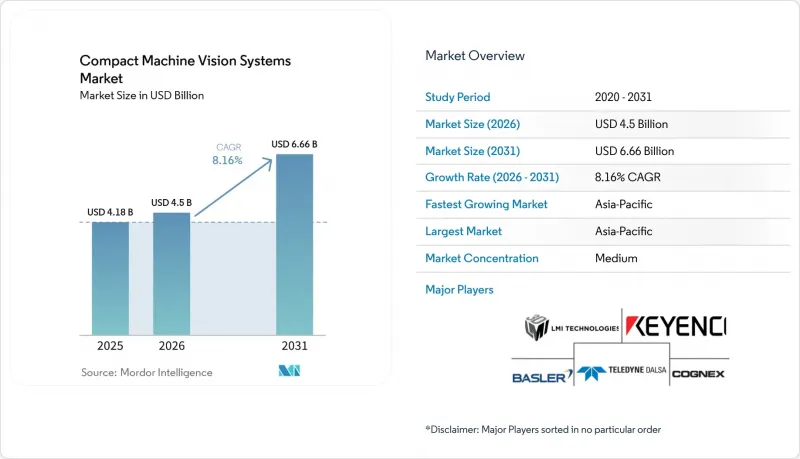
에 따르면 컴팩트 머신 비전 시스템 시장 규모는 2025년 41억 8,000만 달러, 2026년 45억 달러에서 2031년까지 66억 6,000만 달러로 확대될 것으로 예측되고 있으며, 2026-2031년까지 연평균 성장률(CAGR)은 8.16%에 달할 전망입니다.
글로벌 소형 머신 비전 시스템 시장의 동향 및 인사이트
공장 자동화의 확대와 인더스트리 4.0의 도입
컴팩트 머신 비전 시스템 시장은 검사 공정을 생산 설비 근처에 배치하는 공장에 대한 투자의 혜택을 받고 있습니다. 중국은 2026년 1월, 8개 부처가 공동으로 수립한 ‘AI+제조’ 지침을 발표하고, 생산 라인 전반에 걸쳐 머신 비전 및 무인 지능형 검사의 도입을 촉구했습니다. 이 지침에서는 2027년까지 1,000개의 AI 선도 기업과 500건의 벤치마크가 될 제조 도입 사례를 목표로 하고 있습니다. 이러한 정책 방향은 비전 장비를 보다 광범위한 산업 현대화 계획에 통합함으로써, 단기적인 생산 주기를 넘어서는 수요를 지원하고 있습니다. 2026년 체계적 검토 결과, 딥러닝을 활용한 머신 비전이 인더스트리 4.0의 품질관리 워크플로우의 핵심을 이루는 것으로 밝혀졌습니다. 또한 이 검토를 통해 트랜스포머 기반 접근 방식을 활용하면 생산 속도를 유지한 채 복잡한 결함 형태의 처리를 개선할 수 있음이 밝혀졌으며, 이는 AI 지원 소형 플랫폼의 도입을 촉진하고 있습니다.
강화되는 ‘무결함’ 및 추적성 요구 사항
품질관리가 공급업체 및 규정 준수 요건으로 자리 잡으면서, 소형 머신 비전 시스템 시장은 성장세를 보이고 있습니다. 자동차 및 의료기기 공급업체들은 검사 이미지, 결함 좌표, 생산 조건을 일련번호가 부여된 부품과 연계한 기록을 점점 더 필요로 하고 있습니다. 2026년 조사에서는 여러 SKU가 혼재된 병입 라인을 위한 소형 단일 카메라 방식의 자동 광학 검사 스테이션이 소개되었습니다. 이 시스템은 생산 속도를 유지하면서 결함 감지, 치수 측정, 바코드 확인 기능을 통합했습니다. 또한 우수 제조 기준(GMP) 요건에 부합하는 ‘Quality 4.0’ 추적성 기록도 생성했습니다. 이러한 기능 덕분에 제조업체가 동일한 생산 셀 내에서 검사, 문서화 및 제한된 바닥 면적 활용이 필요한 상황에서 소형 시스템의 도입이 효과적입니다.
통합 및 교정의 복잡성
통합과 보정은 여전히 소형 시스템의 광범위한 도입에 있으며, 큰 장벽으로 남아 있습니다. 제조업체는 카메라, 렌즈, 조명 및 소프트웨어 설정의 초기 도입과 지속적인 유지 관리를 관리해야 합니다. 제시된 증거에 따르면 온도에 따른 렌즈 마운트의 이동으로 인해 주변 온도 32°C 조건에서 4시간이 경과한 후 ±0.012 mm를 초과하는 위치 오차가 발생할 가능성이 있다고 지적되고 있습니다. 또한 일부 비전 센서의 경우, 연속 생산 부하 하에서 7-15시간의 가동 시간마다 재교정이 필요하다는 점도 지적되고 있습니다. NPU 컴파일러가 특정 운영 체제와 밀접하게 연동되어 있는 경우, 소프트웨어 업데이트가 어려워질 수 있습니다. 그 결과, 소형 머신 비전 시스템 시장에서는 연결성이 문서화되어 있고, 제조 실행 시스템(MES)용 네이티브 플러그인을 제공하며, 명확한 지원 체계를 갖춘 공급업체가 선호되고 있습니다.
부문 분석
2025년, 스마트 카메라는 소형 머신 비전 시스템 시장 점유율의 38.89%를 차지했습니다. 이러한 위상은 광학 시스템, 이미지 센서, 처리 기능, 통신 인터페이스가 하나의 장치에 통합되어 있음을 반영합니다. 이러한 구조 덕분에 많은 일상적인 용도에서 별도의 컴퓨팅 장비가 필요하지 않게 됩니다. 스마트 카메라는 안정적인 생산 라인에서 결함 감지 및 코드 판독에 널리 사용되고 있습니다. 또한 확립된 산업용 소프트웨어 환경과의 호환성 덕분에 도입 기반도 탄탄합니다. 비전 센서는 비교적 저렴한 가격대에서 단순한 합격/불합격 판정 작업에 대응합니다. 비전 컨트롤러는 높은 AI 처리량, 모듈식 카메라 또는 유연한 조명 구성이 필요한, 더 까다로운 애플리케이션을 지원합니다. 코그넥스(Cognex)는 이러한 요구에 부응하여 NVIDIA Jetson 기술, 최대 157 TOPS의 처리 성능, 모듈식 카메라 및 조명 지원을 갖춘 ‘In-Sight 6900’ 컨트롤러를 출시했습니다.
임베디드 비전 시스템 시장은 2031년까지 연평균 성장률(CAGR) 9.19%로 확대될 것으로 예측됩니다. 이러한 성장은 AI 추론이 로봇 셀이나 컨베이어에 통합된 위치에 설치 가능한 애플리케이션 특화형 모듈로 전환되고 있는 것과 관련이 있습니다. 이 부문의 소형 머신 비전 시스템 시장 규모는 공간이 제한적이고 로컬 처리가 필요한 생산 환경에 의해 지원되고 있습니다. 미쓰비시 전기와 소니 세미컨덕터 솔루션즈는 2026년 7월, 이미지 센서 상에서 직접 AI 분석을 수행하는 ‘Advanced Vision Solutions’를 발표했습니다. 이 계획된 공동 사업은 소니의 이미지 센서 및 엣지 AI 역량과 미쓰비시 전기의 공장 자동화 전문 지식을 결합한 것입니다. 센서 상에서의 처리를 통해 센서와 프로세서 간의 통신을 줄일 수 있습니다. 또한 기계 용도에서는 결정론적인 고장 대응이 중요하므로 IEC 62061의 안전 요구 사항도 임베디드 시스템 설계에 영향을 미치고 있습니다. 라인 스캔 카메라와 3D 비행 시간(ToF) 카메라는 웹 검사나 빈 피킹 분야에서 여전히 특수한 역할을 담당하고 있습니다.
2D 비전 시스템은 2025년에 매출의 69.19%를 차지하며, 소형 머신 비전 시스템 시장에서 핵심적인 이미징 형식으로 자리 잡고 있습니다. 기술적 성숙도, 저렴한 비용, 그리고 통합 업체들의 폭넓은 숙련도 덕분에 표면 검사, 코드 판독, 치수 측정 분야에서 널리 활용되고 있습니다. 엣지 러닝 소프트웨어 덕분에 2D 시스템이 대응할 수 있는 가변적인 외관 및 질감 판별 작업의 범위가 확대되고 있습니다. 코그넥스(Cognex)는 이러한 검사 요구에 대응하기 위해 In-Sight 3900에 ViDi 엣지 러닝 기능을 탑재했습니다. 3D 시스템은 깊이 정보가 중요한 자동차 화이트 바디 조립, 로봇을 이용한 빈 피킹, 그리고 전자 부품 실장에 활용되고 있습니다. 구조화된 광 및 비행 시간(ToF) 시스템은 부품 비용의 하락에 따라 이러한 작업을 지원하고 있습니다. 이 범주는 2D 이미지로 제공할 수 없는 공간 정보가 생산 작업에 필요한 상황에서 여전히 중요한 역할을 수행하고 있습니다.
다중 스펙트럼 및 하이퍼스펙트럼 이미징 시스템은 2031년까지 연평균 성장률(CAGR) 10.12%로 확대될 것으로 예측됩니다. 이러한 시스템의 역할은 표면의 외관뿐만 아니라 재료의 특성을 식별할 수 있는 능력에 기반을 두고 있습니다. Specim사는 자사의 SpecimONE 시스템을 산업용 선별 및 품질관리를 위한 인라인형 하이퍼스펙트럼 플랫폼으로 소개하고 있습니다. 이 회사의 라인 스캔 방식은 컨베이어 작업에 적합한 속도로 다수의 스펙트럼 대역을 포착합니다. 이를 통해 식품, 의약품, 재활용 공정에서 실시간으로 화학 물질을 식별할 수 있습니다. 2025년 과학 연구에 따르면 하이퍼스펙트럼 이미징과 케모메트릭스를 결합하면 온라인 의약품 모니터링을 위한 공정 분석 기술(PAT) 툴로 기능할 수 있는 것으로 밝혀졌습니다. 이러한 모니터링은 제공된 자료에 기재된 FDA의 공정 분석 기술 관련 지침을 따릅니다. 따라서 소형 머신 비전 시스템 시장은 재료 수준의 정보가 필요한 검사 업무를 지원할 수 있습니다.
지역별 분석
아시아태평양은 2025년 소형 머신 비전 시스템 시장의 39.87%를 차지하고 있으며, 2031년까지 연평균 성장률(CAGR) 8.65%로 확대될 것으로 예측됩니다. 중국의 소비자용 전자기기, 신에너지 차량, 반도체 생산의 집적이 이 지역의 수요를 지원하고 있습니다. 2026년 1월에 발표된 ‘AI 플러스 제조’ 정책 방침에서는 생산 라인에 머신 비전 및 무인 지능형 검사 도입을 요구했습니다. 일본과 한국은 고사양 전자기기 및 자동차 용도 분야에서 여전히 중요한 위치를 차지하고 있습니다. 2026년 7월에 발표된 ‘Advanced Vision Solutions’는 제조 자동화를 위한 온센서 AI 비전에 대한 일본의 관심을 부각시켰습니다.
북미 및 유럽에서는 규제 대상 생산 현장에서 사용되는 임베디드 AI 시스템 및 검사 플랫폼에 대한 수요가 지원되고 있습니다. 북미에서는 리쇼어링으로 인해 검사 요건이 증가하는 반면, 숙련된 노동력 공급은 여전히 부족한 상황입니다. 독일은 자동차, 기계, 의료기기 제조 기반을 갖추고 있으며, 유럽내 도입의 선구자 역할을 하고 있습니다. EU의 기계 규제는 안전상 중요한 기계의 역할에 사용되는 비전 시스템 선정에 영향을 미치고 있습니다. Basler사의 초소형 25×30mm 비전 센서는 유럽의 기계 제조업체들이 즉시 통합 가능한 부품을 원하고 있음을 반영합니다. 장비 공급업체들이 이러한 부품을 기존 기계 설계에 통합함에 따라 소형 머신 비전 시스템 시장은 그 혜택을 누리고 있습니다.
남미, 중동 및 아프리카는 여전히 도입 초기 단계에 있는 지역입니다. 브라질과 아르헨티나에서는 검사 자동화가 주목받고 있는 식품, 음료, 포장 생산 분야를 통해 수요가 지원되고 있습니다. 사우디아라비아와 아랍에미리트(UAE)는 ‘비전 2030’ 프로그램의 일환으로, 자동화 대응 검사 인프라를 포함한 산업 및 제약 분야의 생산 역량을 구축하고 있습니다. 남아프리카는 자동차 조립 분야에서 지역내 도입을 선도하고 있으며, 국제적인 OEM 공장에서는 비전 가이드 방식의 품질관리 시스템이 채택되고 있습니다. 이 지역 전반에 걸쳐 시스템 비용의 높이가 여전히 주요 장벽으로 작용하고 있습니다. 하드웨어 비용의 하락과 현지 시스템 통합 역량의 발전에 따라 소형 머신 비전 시스템 시장은 그 입지를 더욱 확대해 나갈 수 있을 것입니다.
기타 혜택:
- 엑셀 형식의 시장 예측(ME) 시트
- 3개월간의 애널리스트 지원
자주 묻는 질문
목차
제1장 서론
- 조사 전제조건과 시장 정의
- 조사 범위
제2장 조사 방법
제3장 개요
제4장 시장 구도
- 시장 개요
- 시장 성장 촉진요인
- 시장 성장 억제요인
- 거시경제 요인이 시장에 미치는 영향
- 업계 밸류체인 분석
- 규제 상황
- 기술 전망
- Porter's Five Forces 분석
제5장 시장 규모와 성장 예측
- 제품 유형별
- 이미징 유형별
- 용도별
- 최종사용자 산업별
- 지역별
- 북미
- 미국
- 캐나다
- 멕시코
- 남미
- 브라질
- 아르헨티나
- 기타 남미 국가
- 유럽
- 독일
- 영국
- 프랑스
- 이탈리아
- 스페인
- 기타 유럽 국가
- 아시아태평양
- 중국
- 일본
- 인도
- 한국
- ASEAN
- 기타 아시아태평양 국가
- 중동
- 사우디아라비아
- 아랍에미리트
- 기타 중동 국가
- 아프리카
- 남아프리카공화국
- 기타 아프리카 국가
- 북미
제6장 경쟁 구도
- 시장 집중도
- 전략적 동향
- 시장 점유율 분석
- 기업 개요
- Cognex Corporation
- KEYENCE CORPORATION
- Basler AG
- Teledyne DALSA, Inc.
- Omron Corporation
- Allied Vision Technologies GmbH
- LMI Technologies Inc.
- IDS Imaging Development Systems GmbH
- HIKROBOT
- Vision Components GmbH
- VITRONIC Dr.-Ing. Stein Bildverarbeitungssysteme GmbH
- Euresys S.A.
- JAI A/S
- SVS-Vistek GmbH
- Chromasens GmbH
- SICK AG
- Baumer Holding AG
- Datalogic S.p.A.
- LUCID Vision Labs Inc.
- Emergent Vision Technologies Inc.
제7장 시장 기회와 향후 전망
KSA 26.10.28According to Mordor Intelligence, the compact machine vision systems market size is projected to expand from USD 4.18 billion in 2025 and USD 4.50 billion in 2026 to USD 6.66 billion by 2031, registering a CAGR of 8.16% between 2026 and 2031.
Global Compact Machine Vision Systems Market Trends and Insights
Expanding Factory Automation and Industry 4.0 Adoption
The compact machine vision systems market benefits from factory investments that place inspection closer to production equipment. China issued an eight-ministry AI plus Manufacturing directive in January 2026 that called for machine vision and unmanned intelligent inspection across production lines. The directive also targeted 1,000 flagship AI enterprises and 500 benchmark manufacturing deployments by 2027. This policy direction embeds vision equipment in wider industrial modernization plans and supports demand beyond short-term production cycles. A 2026 systematic review identified deep-learning machine vision as a central part of Industry 4.0 quality-control workflows. The review also found that transformer-based approaches can improve the handling of complex defect shapes at production speed, supporting adoption of AI-capable compact platforms.
Rising Zero-Defect and Traceability Requirements
The compact machine vision systems market gains support as quality control becomes a supplier and compliance requirement. Automotive and medical-device suppliers increasingly need records that link inspection images, defect coordinates, and production conditions to serialized parts. A 2026 study described a compact single-camera automated optical inspection station for mixed-SKU bottling lines. The system combined defect detection, dimensional measurement, and barcode confirmation at production speed. It also generated Quality 4.0 traceability records suited to good manufacturing practice requirements. These capabilities make compact installations relevant where manufacturers need inspection, documentation, and limited floor-space use in the same production cell.
Integration and Calibration Complexity
Integration and calibration remain material barriers to broader deployment of compact systems. Manufacturers must manage the initial installation and the continuing maintenance of camera, lens, lighting, and software settings. The supplied evidence notes that temperature-related lens-mount movement can create positional errors above +-0.012 mm after 4 hours at 32°C ambient conditions. It also notes that some vision sensors need recalibration every 7-15 operating hours under continuous production load. Software updates can add difficulty when NPU compilers are tied closely to particular operating systems. The compact machine vision systems market consequently favors suppliers that offer documented connectivity, native manufacturing-execution-system plugins, and defined support arrangements.
Other drivers and restraints analyzed in the detailed report include:
- Labor Shortages in Inspection and Quality Roles
- Embedded AI Inference Enabling Low-Latency Inspection
- Upfront Cost for High-Performance Compact Systems
For complete list of drivers and restraints, kindly check the Table Of Contents.
Segment Analysis
Smart cameras held 38.89% of the compact machine vision systems market share in 2025. Their position reflects the combination of optics, an image sensor, processing, and communication interfaces in one device. This structure removes the need for separate computing equipment in many routine applications. Smart cameras are widely used for defect detection and code reading on stable production lines. Their installed base is also supported by compatibility with established industrial software environments. Vision sensors serve simpler pass-fail tasks at lower price points. Vision controllers support more demanding applications that require high AI throughput, modular cameras, or flexible lighting arrangements. Cognex positioned its In-Sight 6900 controller for this need with NVIDIA Jetson technology, up to 157 TOPS, and modular camera and lighting support.
Embedded vision systems are projected to expand at a 9.19% CAGR through 2031. Their development is linked to AI inference moving onto application-specific modules that can be placed in robotic cells and conveyor-integrated positions. The compact machine vision systems market size for this category is supported by production settings where space is restricted and local processing is needed. Mitsubishi Electric and Sony Semiconductor Solutions announced Advanced Vision Solutions in July 2026 to develop AI analysis directly on the image sensor. The planned venture combines Sony image-sensor and edge-AI capabilities with Mitsubishi Electric factory-automation expertise. On-sensor processing can reduce communication between the sensor and processor. IEC 62061 safety requirements also influence embedded system design because deterministic fault responses are important in machinery applications. Line-scan cameras and 3D time-of-flight cameras retain specialized roles in web inspection and bin-picking.
2D vision systems held 69.19% of revenue in 2025, making them the core imaging format for the compact machine vision systems market. Their technical maturity, lower cost, and broad integrator familiarity support use in surface inspection, code reading, and dimensional gauging. Edge-learning software is expanding the range of variable-appearance and texture-discrimination tasks that 2D systems can address. Cognex included ViDi Edge Learning capabilities in the In-Sight 3900 for these types of inspection needs. 3D systems serve automotive body-in-white assembly, robotic bin-picking, and electronics placement where depth information is important. Structured-light and time-of-flight systems support this work as component costs fall. The category remains relevant where a production task needs spatial information that a 2D image cannot provide.
Multispectral and hyperspectral imaging systems are projected to expand at a 10.12% CAGR through 2031. Their role is based on the ability to identify material characteristics rather than surface appearance alone. Specim described its SpecimONE system as an inline hyperspectral platform for industrial sorting and quality control. Its line-scan approach captures many spectral bands at speeds suited to conveyor operations. This allows real-time chemical identification in food, pharmaceutical, and recycling operations. A 2025 scientific study found that hyperspectral imaging combined with chemometrics can serve as a process analytical technology tool for online pharmaceutical monitoring. Such monitoring aligns with the FDA's process analytical technology guidance described in the supplied material. The compact machine vision systems market can therefore support inspection tasks that require material-level information.
Complete Report Scope:
- By Product Type
- Vision Sensors
- Smart Cameras
- Embedded Vision Systems
- Vision Controllers
- Other Product Types
- By Imaging Type
- 2D Vision Systems
- 3D Vision Systems
- Multispectral and Hyperspectral Imaging Systems
- By Application
- Inspection and Defect Detection
- Measurement and Metrology
- Identification and Code Reading
- Guidance and Positioning
- Other Applications
- By End-User Industry
- Automotive
- Electronics and Semiconductors
- Food and Beverage
- Healthcare and Pharmaceuticals
- Logistics and Retail
- Packaging
- Other End-User Industries
- By Geography
- North America
- United States
- Canada
- Mexico
- South America
- Brazil
- Argentina
- Rest of South America
- Europe
- Germany
- United Kingdom
- France
- Italy
- Spain
- Rest of Europe
- Asia-Pacific
- China
- Japan
- India
- South Korea
- ASEAN
- Rest of Asia-Pacific
- Middle East
- Saudi Arabia
- United Arab Emirates
- Rest of the Middle East
- Africa
- South Africa
- Rest of Africa
- North America
Geography Analysis
Asia-Pacific held 39.87% of the compact machine vision systems market share in 2025 and is projected to expand at an 8.65% CAGR through 2031. China's concentration of consumer electronics, new-energy vehicles, and semiconductor production supports regional demand. The January 2026 AI plus Manufacturing policy direction called for machine vision and unmanned intelligent inspection in production lines. Japan and South Korea remain important for high-specification electronics and automotive applications. The July 2026 announcement of Advanced Vision Solutions highlighted Japanese interest in on-sensor AI vision for manufacturing automation.
North America and Europe support demand for embedded AI systems and inspection platforms used in regulated production. In North America, reshoring can increase inspection requirements while the supply of skilled labor remains constrained. Germany is a leading European adopter because of its automotive, machinery, and medical-device manufacturing base. The EU Machinery Regulation influences choices for vision systems used in safety-critical machinery roles. Basler's ultra-compact 25 X 30 mm vision sensor reflects the need among European machine builders for components that are ready to integrate. The compact machine vision systems market benefits when equipment suppliers place these components inside original machine designs.
South America, the Middle East, and Africa remain earlier-stage adoption areas. Brazil and Argentina support demand through food, beverage, and packaging production where inspection automation is gaining attention. Saudi Arabia and the UAE are building industrial and pharmaceutical capacity under Vision 2030 programs that include automation-ready inspection infrastructure. South Africa leads regional use in automotive assembly, where international OEM plants use vision-guided quality systems. High system cost remains a key barrier across these regions. The compact machine vision systems market can broaden its presence as hardware costs decline and local system-integration capabilities develop.
- Cognex Corporation
- KEYENCE CORPORATION
- Basler AG
- Teledyne DALSA, Inc.
- Omron Corporation
- Allied Vision Technologies GmbH
- LMI Technologies Inc.
- IDS Imaging Development Systems GmbH
- HIKROBOT
- Vision Components GmbH
- VITRONIC Dr.-Ing. Stein Bildverarbeitungssysteme GmbH
- Euresys S.A.
- JAI A/S
- SVS-Vistek GmbH
- Chromasens GmbH
- SICK AG
- Baumer Holding AG
- Datalogic S.p.A.
- LUCID Vision Labs Inc.
- Emergent Vision Technologies Inc.
Additional Benefits:
- The market estimate (ME) sheet in Excel format
- 3 months of analyst support
TABLE OF CONTENTS
1 INTRODUCTION
- 1.1 Study Assumptions and Market Definition
- 1.2 Scope of the Study
2 RESEARCH METHODOLOGY
3 EXECUTIVE SUMMARY
4 MARKET LANDSCAPE
- 4.1 Market Overview
- 4.2 Market Drivers
- 4.2.1 Expanding Factory Automation and Industry 4.0 Adoption
- 4.2.2 Rising Zero-Defect and Traceability Requirements
- 4.2.3 Labor Shortages in Inspection and Quality Roles
- 4.2.4 Embedded AI Inference Enabling Low-Latency Inspection
- 4.2.5 Shrinking Equipment Footprints in High-Mix Production Lines
- 4.2.6 Edge Processing Reducing Vision-Data Bandwidth
- 4.3 Market Restraints
- 4.3.1 Integration and Calibration Complexity
- 4.3.2 Upfront Cost for High-Performance Compact Systems
- 4.3.3 Shortage of Machine Vision Integrators and AI Specialists
- 4.3.4 Thermal and Optical Constraints in Miniaturized Housings
- 4.4 Impact of Macroeconomic Factors on the Market
- 4.5 Industry Value Chain Analysis
- 4.6 Regulatory Landscape
- 4.7 Technological Outlook
- 4.8 Porter's Five Forces Analysis
- 4.8.1 Bargaining Power of Suppliers
- 4.8.2 Bargaining Power of Buyers
- 4.8.3 Threat of New Entrants
- 4.8.4 Threat of Substitutes
- 4.8.5 Competitive Rivalry
5 MARKET SIZE AND GROWTH FORECASTS (VALUE)
- 5.1 By Product Type
- 5.1.1 Vision Sensors
- 5.1.2 Smart Cameras
- 5.1.3 Embedded Vision Systems
- 5.1.4 Vision Controllers
- 5.1.5 Other Product Types
- 5.2 By Imaging Type
- 5.2.1 2D Vision Systems
- 5.2.2 3D Vision Systems
- 5.2.3 Multispectral and Hyperspectral Imaging Systems
- 5.3 By Application
- 5.3.1 Inspection and Defect Detection
- 5.3.2 Measurement and Metrology
- 5.3.3 Identification and Code Reading
- 5.3.4 Guidance and Positioning
- 5.3.5 Other Applications
- 5.4 By End-User Industry
- 5.4.1 Automotive
- 5.4.2 Electronics and Semiconductors
- 5.4.3 Food and Beverage
- 5.4.4 Healthcare and Pharmaceuticals
- 5.4.5 Logistics and Retail
- 5.4.6 Packaging
- 5.4.7 Other End-User Industries
- 5.5 By Geography
- 5.5.1 North America
- 5.5.1.1 United States
- 5.5.1.2 Canada
- 5.5.1.3 Mexico
- 5.5.2 South America
- 5.5.2.1 Brazil
- 5.5.2.2 Argentina
- 5.5.2.3 Rest of South America
- 5.5.3 Europe
- 5.5.3.1 Germany
- 5.5.3.2 United Kingdom
- 5.5.3.3 France
- 5.5.3.4 Italy
- 5.5.3.5 Spain
- 5.5.3.6 Rest of Europe
- 5.5.4 Asia-Pacific
- 5.5.4.1 China
- 5.5.4.2 Japan
- 5.5.4.3 India
- 5.5.4.4 South Korea
- 5.5.4.5 ASEAN
- 5.5.4.6 Rest of Asia-Pacific
- 5.5.5 Middle East
- 5.5.5.1 Saudi Arabia
- 5.5.5.2 United Arab Emirates
- 5.5.5.3 Rest of the Middle East
- 5.5.6 Africa
- 5.5.6.1 South Africa
- 5.5.6.2 Rest of Africa
- 5.5.1 North America
6 COMPETITIVE LANDSCAPE
- 6.1 Market Concentration
- 6.2 Strategic Moves
- 6.3 Market Share Analysis
- 6.4 Company Profiles (includes Global Level Overview, Market Level Overview, Core Segments, Financials as available, Strategic Information, Market Rank/Share, Products and Services, Recent Developments)
- 6.4.1 Cognex Corporation
- 6.4.2 KEYENCE CORPORATION
- 6.4.3 Basler AG
- 6.4.4 Teledyne DALSA, Inc.
- 6.4.5 Omron Corporation
- 6.4.6 Allied Vision Technologies GmbH
- 6.4.7 LMI Technologies Inc.
- 6.4.8 IDS Imaging Development Systems GmbH
- 6.4.9 HIKROBOT
- 6.4.10 Vision Components GmbH
- 6.4.11 VITRONIC Dr.-Ing. Stein Bildverarbeitungssysteme GmbH
- 6.4.12 Euresys S.A.
- 6.4.13 JAI A/S
- 6.4.14 SVS-Vistek GmbH
- 6.4.15 Chromasens GmbH
- 6.4.16 SICK AG
- 6.4.17 Baumer Holding AG
- 6.4.18 Datalogic S.p.A.
- 6.4.19 LUCID Vision Labs Inc.
- 6.4.20 Emergent Vision Technologies Inc.
7 MARKET OPPORTUNITIES AND FUTURE OUTLOOK
- 7.1 White-Space and Unmet-Need Assessment


