

|
시장보고서
상품코드
2155219
구조화광 3D 비전 시스템 : 시장 점유율 분석, 업계 동향과 통계, 성장 예측(2026-2031년)Structured-Light 3D Vision Systems - Market Share Analysis, Industry Trends & Statistics, Growth Forecasts (2026 - 2031) |
||||||
 Mordor Intelligence
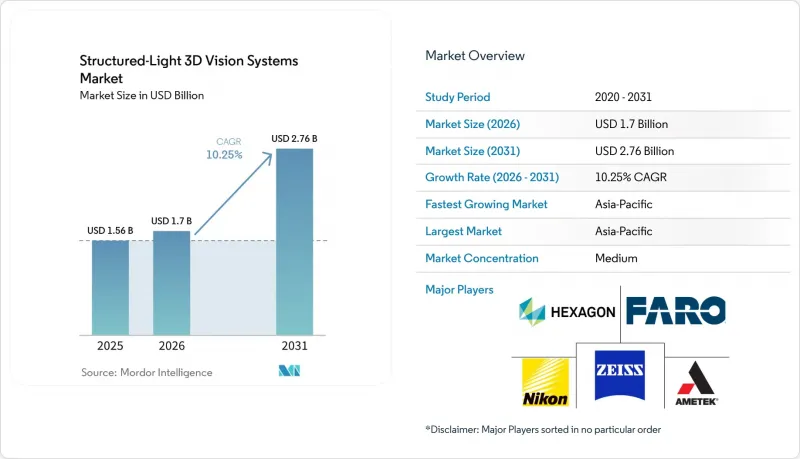
에 따르면 구조화광 3D 비전 시스템 시장 규모는 2025년에 15억 6,000만 달러로 평가되며, 2026년 17억 달러에서 2031년까지 27억 6,000만 달러에 달할 것으로 예측되고 있으며, 예측 기간(2026-2031년)에 CAGR은 10.25%에 달할 전망입니다.
전 세계 구조화된 광 3D 비전 시스템 시장의 동향 및 인사이트
스마트 팩토리 및 로봇 도입 확대
구조화 광 3D 비전 시스템 시장은 로봇 셀에 깊이 인식이나 치수 피드백이 필요할 때마다 새로운 도입 기회를 얻고 있습니다. 국제로봇연맹(IFR)의 보고서에 따르면 2025년 전 세계 산업용 로봇 도입 대수는 62만 1,000대였습니다. 로봇 공급업체들은 비전 처리를 별도의 계측 장비로 취급하기보다는 컨트롤러에 통합하는 경향이 강해지고 있으며, 이를 통해 제조업체는 셀 설계 단계에서 센싱, 모션, 검사 각 기능을 통합하여 지정할 수 있게 되었습니다. KUKA의 ‘iiQKA.AI Vision’ 플랫폼은 로봇 환경 내에 2D 및 3D 비전 기능을 통합하여, 로봇 공학과 머신 비전의 더욱 긴밀한 연계를 반영하고 있습니다. 이러한 조달 접근 방식을 통해 구조화 광 장치의 승인 주기를 단축할 수 있습니다. 이는 센서가 셀 전체의 일부로 예산에 반영되며, 구매 결정이 개별 측정 예산이 아닌 취급, 조립, 품질 성능과 연계되기 때문입니다. 또한 구매 담당자가 단일 센서의 가격이 아닌 자동화 셀의 성과에 초점을 맞추게 됨으로써 도입에 대한 거부감을 줄일 수도 있습니다. a
전기자동차 및 반도체 제조의 부상
전기자동차의 구조 부품, 배터리 트레이, 모터 하우징은 표면이나 형상을 일관되게 측정하기 어렵기 때문에 상세한 검사가 필요합니다. ‘구조화된 광학 3D 비전 시스템 시장’은 이러한 요구에 부응하는 것으로, 일체 성형된 알루미늄 다이캐스팅 부품을 넓은 표면에 걸쳐 검사해야 합니다. Vision3D사는 샤오미 SU7 및 Zhijie V9 생산 프로그램에서 자사의 PowerScan 5M330 Pro 스캐너를 활용한 사례를 소개하며, 0.02mm의 단일 프레임 정밀도를 달성했다고 보고했습니다. 또한 첨단 반도체 패키징 분야에서도 웨이퍼 레벨, 팬아웃(fan-out), 시스템 인 패키지(SiP) 조립에 대한 검사가 요구되고 있으며, 패키지 형상의 미세한 편차가 조립 품질이나 후공정 신뢰성에 영향을 미칠 가능성이 있습니다. Koh Young사는 AI 서버 및 첨단 반도체 고객의 수요에 부응하기 위해 생산 능력을 두 배로 늘릴 것이라고 발표했습니다. 로직 노드 피치의 미세화와 칩의 수직 적층화가 진행되는 가운데, 처리량을 희생할 수 없는 상황에서는 신속한 표면 형상 측정의 중요성이 더욱 높아지고 있으며, 검사 능력은 첨단 패키징 라인의 생산 요건과 더욱 밀접하게 연결되어 있습니다.
높은 초기 시스템 및 통합 비용
완벽한 검사 셀을 구축하려면 스캐너 하드웨어, 지그, 보정 타겟, 재구성 소프트웨어 및 통합 엔지니어링이 필요합니다. 이러한 요건으로 인해 제조업체가 첫 번째 검사 결과를 얻기 전에 막대한 설비 투자라는 큰 장벽이 발생할 수 있습니다. 따라서 구조화된 광 3D 비전 시스템 시장에 진입하는 것은 확립된 자동화 팀을 보유한 대량 생산 제조업체에게는 비교적 용이합니다. 환경 제어 및 제조 실행 시스템(MES)과의 연동에는 스캐너 구입 비용 외에도 추가 비용이 발생합니다. 이는 장비가 기존 라인 환경 및 데이터 관리 프로세스 내에서 안정적으로 작동해야 하기 때문입니다. 재보정, 소프트웨어 업데이트 및 작업자 교육은 도입 후 소유 비용을 더욱 높일 가능성이 있습니다. 특히 사내 팀이 광학 측정 시스템이나 생산 라인 통합에 대한 경험이 부족한 경우, 이러한 경향이 두드러집니다. 소량 다품종 생산을 하는 제조업체는 예상 가동률만으로는 필요한 투자를 정당화하기 어려울 수 있으므로, 여전히 충분한 서비스를 받지 못하고 있는 실정입니다.
부문 분석
2025년에는 인라인 및 생산 통합형 시스템이 매출의 42.18%를 차지할 것으로 예상되며, 2031년까지 연평균 성장률(CAGR) 13.48%로 성장할 것으로 전망됩니다. 이 제품 유형은 구조화된 광 3D 비전 시스템 시장에서 가장 규모가 크고 가장 빠르게 성장하는 카테고리입니다. 고정식 또는 로봇 탑재형 센서를 통해 제조업체는 생산 흐름 속에서 부품을 검사할 수 있습니다. 이를 통해 부품이 다음 공정으로 진행되기 전, 혹은 더 큰 규모의 조립품의 일부가 되기 전에 라인상에서 편차를 식별할 수 있으며, 이것이 구조화된 광 3D 비전 시스템 시장의 핵심 사용 사례가 되고 있습니다. 스냅숏 센서는 한 번의 투영 패턴 노출로 표면 맵을 캡처할 수 있으므로, 컨베이어의 움직임이나 로봇의 사이클 타임으로 인해 검사 가능 범위가 제한되는 경우에도 측정 범위를 유지하는 데 도움이 됩니다. 이 기능은 부품 이동 및 사이클 타임이 중요한 고처리량 생산 라인에 적합하며, 품질관리 팀이 모든 유닛의 기하학적 편차를 관찰할 수 있는 실용적인 수단이 됩니다.
LMI Technologies는 로봇 검사 셀에서 중소형 부품을 대상으로 ‘Gocator 3500’ 시리즈를 포지셔닝했습니다. 고정식 및 데스크톱형 시스템은 실험실에서의 계측이나 초도품 검사에서 여전히 유용합니다. 이러한 환경에서는 담당자가 조명을 제어하고, 부품을 신중하게 배치하며, 생산이 본격화되기 전에 상세한 점검을 수행할 수 있습니다. 이러한 시스템은 생산 속도보다 고해상도의 상세 정보가 중시되는 상황에서 사용됩니다. 핸드헬드 시스템은 현장 검사, 입고 검사 및 공급업체 감사에 사용됩니다. 자동차 업계의 인라인 도입 시에는 측정 시스템 분석이나 게이지 재현성 조사가 필요할 수 있으며, 이로 인해 이미 도입된 시스템을 교체하는 데 드는 비용이 증가할 가능성이 있습니다.
2025년에는 구성 요소별 매출의 72.64%를 하드웨어가 차지했으나, 소프트웨어는 2031년까지 연평균 성장률(CAGR) 12.96%로 성장할 것으로 예측됩니다. 카메라, 프로젝터, 광학 시스템, 프로세서는 모든 검사 셀에서 여전히 필수적인 구매 품목입니다. 구조화된 광학 3D 비전 시스템 시장 전체에서 하드웨어는 여전히 현재 지출의 기반을 이루고 있는 반면, 소프트웨어는 각 시스템의 성능을 좌우하는 중요한 요소가 되고 있습니다. 벤더 간 장비 사양이 유사해짐에 따라 소프트웨어 계층의 중요성이 커지고 있습니다. 이는 구매자가 시스템의 이미지 해석 능력, 예외 처리 능력, 자동화 셀과의 연동 능력을 점점 더 중시하게 되면서, 구조화 광 3D 비전 시스템 시장의 경쟁이 격화되고 있기 때문입니다. 재구성, 결함 분류 및 로봇 유도 기능은 특히 제조업체가 수작업에 의한 대규모 이미지 확인 없이 불규칙한 표면에서도 신뢰할 수 있는 판단을 필요로 할 때 강력한 차별화 요소가 됩니다.
각 공급업체는 산업용 비전 장비에서 센싱, 이미징, AI 기능을 더욱 긴밀하게 통합하고 있습니다. 서비스에는 설치, 보정, 인증, 교육, 지원이 포함되며, 이러한 요소들은 기술적 시스템이 고객의 특정 생산 환경에서 일관된 결과를 도출할 수 있는지 판단하는 데 중요한 역할을 합니다. 단일 시설 내에서 여러 센서가 연동되어 작동하는 경우, 이러한 서비스의 중요성은 더욱 커집니다. 초기 도입 후 애플리케이션 설정, 재료 마감, 생산 조건 등이 변화할 가능성이 있으므로, 정기적인 조정이 필요한 시스템의 경우 구매자는 지속적인 지원 계약을 선호할 수 있습니다. 소프트웨어 및 서비스로의 전환에 따라 애플리케이션에 대한 지식과 현장 통합 능력의 가치가 높아지고 있습니다.
지역별 분석
아시아태평양은 2025년에 매출의 38.56%를 차지할 것으로 예상되며, 2031년까지 연평균 성장률(CAGR) 12.31%로 성장할 것으로 전망됩니다. 이 지역은 전자기기, 전기자동차, 반도체 제조가 집중되어 있으며, 생산 속도와 정밀도에 대한 요구가 까다로운 고객 근처에 시스템 공급업체가 위치해 있으며, 구조화된 광 3D 비전 시스템 시장을 주도하고 있습니다. 중국은 3D 산업용 카메라의 하드웨어 및 알고리즘 각 분야에서 국내 기술력을 높이고 있습니다. 한국과 대만은 고대역폭 메모리 및 첨단 로직용 반도체 패키징 사업을 확대하고 있습니다. 일본은 여전히 정밀 머신 비전 통합업체에게 중요한 거점이며, 한편 인도는 전자기기 조립이 확대됨에 따라 장기적인 잠재력을 지니고 있습니다.
북미는 2025년에 2위 시장 규모를 기록했습니다. 이는 자동차, 항공우주, 방위, 반도체 분야의 수요에 힘입은 것으로, 구조화된 광 3D 비전 시스템 시장의 고객 기반을 확대하고 있습니다. 미국, 캐나다, 멕시코는 각각 로봇 탑재형 검사 시스템의 제조 환경을 제공하고 있으며, 그 수요는 부품의 정확한 위치 파악, 치수 피드백, 문서화된 품질 검사가 필요한 생산 라인에 의해 주도되고 있습니다. 구조화된 광 3D 비전 시스템 시장은 식품 및 음료 및 제약 분야에서도 잠재력을 가지고 있으며, 이러한 분야에서는 제품, 포장, 밀봉 및 생산 라인에서의 취급 과정에 대한 일관된 점검을 포함한 품질관리 및 규정 준수 활동을 검사가 지원할 수 있습니다. 멕시코는 자동차 생산 능력 확대의 혜택을 받고 있으며, 자동차 품질 요건을 충족하는 인라인 시스템이 필요하므로 공급업체와 조립 거점을 넘어 일관되게 가동될 수 있는 생산 설비에 대한 수요가 발생하고 있습니다. 캐나다에서는 자원 및 항공우주 분야의 유지보수 작업에서 휴대용 스캐닝에 대한 수요가 증가하고 있습니다.
유럽은 세 번째로 큰 지역으로, 독일의 엔지니어링 기반, 프랑스의 항공우주 공급망, 그리고 영국의 정밀 제조 및 제약 부문이 주도적인 역할을 하고 있습니다. 독일 제조업체들은 특히 개별 프로브 포인트로는 평가하기 어려운 복잡한 형상의 검사에서 고밀도 기하학적 데이터를 통해 정확도를 향상시킬 수 있는 분야를 중심으로 일부 접촉식 워크플로우를 전 영역 광학 측정으로 대체하고 있습니다. 각 지역의 연구개발 활동은 더욱 고속화된 인라인 3D 측정 시스템 개발을 지속적으로 지원하고 있습니다. 남미는 여전히 초기 단계에 있으며, 수요는 자동차 조립 및 광산 기계 유지보수에 집중되어 있지만, 이러한 분야에서는 투자 결정이 여전히 장비 비용이나 현지 상황에 좌우되기 쉬운 상황입니다. 중동 및 아프리카의 수요는 사우디아라비아, 아랍에미리트, 남아프리카공화국, 그리고 산업 디지털화 프로그램에 집중되어 있습니다.
기타 혜택:
- 엑셀 형식의 시장 예측(ME) 시트
- 3개월간의 애널리스트 지원
목차
제1장 서론
- 조사 전제조건과 시장 정의
- 조사 범위
제2장 조사 방법
제3장 개요
제4장 시장 구도
- 시장 개요
- 시장 성장 촉진요인
- 시장 성장 억제요인
- 거시경제 요인이 시장에 미치는 영향
- 업계의 공급망 분석
- 규제 상황
- 기술 전망
- Porter's Five Forces 분석
제5장 시장 규모와 성장 예측
- 제품 유형별
- 컴포넌트별
- 기술별
- 용도별
- 최종사용자별
- 지역별
- 북미
- 미국
- 캐나다
- 멕시코
- 남미
- 브라질
- 아르헨티나
- 기타 남미 국가
- 유럽
- 독일
- 영국
- 프랑스
- 이탈리아
- 스페인
- 기타 유럽 국가
- 아시아태평양
- 중국
- 일본
- 인도
- 한국
- 기타 아시아태평양 국가
- 중동 및 아프리카
- 중동
- 사우디아라비아
- 아랍에미리트
- 튀르키예
- 기타 중동 국가
- 아프리카
- 남아프리카공화국
- 나이지리아
- 기타 아프리카 국가
- 중동
- 북미
제6장 경쟁 구도
- 시장 집중도
- 전략적 동향
- 시장 점유율 분석
- 기업 개요
- Hexagon AB
- ZEISS Group
- Nikon Corporation
- FARO Technologies, Inc.
- AMETEK, Inc.
- SHINING 3D Tech Co., Ltd.
- LMI Technologies Inc.
- Cognex Corporation
- KEYENCE CORPORATION
- Basler AG
- SICK AG
- Photoneo s.r.o.
- Perceptron, Inc.
- Artec 3D
- Solutionix Corporation
- RangeVision
- ScanTech International, Inc.
- ShapeGrabber, Inc.
- Kreon Technologies
- SmartRay GmbH
- Revopoint 3D Technologies Inc.
제7장 시장 기회와 향후 전망
KSAAccording to Mordor Intelligence, the Structured-Light 3D vision systems market size was valued at USD 1.56 billion in 2025 and estimated to grow from USD 1.70 billion in 2026 to reach USD 2.76 billion by 2031, at a CAGR of 10.25% during the forecast period (2026-2031).
Global Structured-Light 3D Vision Systems Market Trends and Insights
Expansion of Smart Factory and Robotics Deployments
The Structured-Light 3D Vision Systems Market gains a new installation point whenever a robot cell requires depth perception or dimensional feedback. The International Federation of Robotics reported 621,000 industrial robot installations worldwide in 2025. Robot suppliers are increasingly incorporating vision processing into the controller rather than treating it as a separate metrology purchase, allowing manufacturers to specify sensing, motion, and inspection functions together during cell design. KUKA's iiQKA.AI Vision platform integrates 2D and 3D vision functions within the robot environment, reflecting the closer integration of robotics and machine vision. That purchasing approach can shorten approval cycles for structured-light equipment because the sensor is funded as part of a complete cell, with the purchasing decision tied to handling, assembly, and quality performance rather than a stand-alone measurement budget. It can also lower resistance to adoption, where buyers focus on the output of the automated cell rather than the price of a single sensor.
Rising Electric Vehicle and Semiconductor Manufacturing
Electric vehicle structures, battery trays, and motor housings need detailed inspection because their surfaces and shapes are difficult to measure consistently. The Structured-Light 3D Vision Systems Market serves this need, in which integrated die-cast aluminum parts must be inspected across a broad surface. Vision3D described the use of its PowerScan 5M330 Pro scanner on Xiaomi SU7 and Zhijie V9 production programs, reporting 0.02 mm single-frame accuracy. Advanced semiconductor packaging also requires inspection of wafer-level, fan-out, and system-in-package assemblies, where small variations in package geometry can affect assembly quality and downstream reliability. Koh Young stated that it is doubling production capacity in response to demand from AI server and advanced semiconductor customers. Narrower logic-node pitches and vertically stacked chips increase the value of rapid surface-geometry measurement, when throughput cannot be compromised, making inspection capability more closely linked to the production requirements of advanced packaging lines.
High Initial System and Integration Costs
A complete inspection cell requires scanner hardware, fixtures, calibration targets, reconstruction software, and integration engineering. These requirements can create a significant capital hurdle before a manufacturer receives its first inspection result. The Structured-Light 3D Vision Systems Market is, therefore, easier to enter for high-volume producers with established automation teams. Environmental controls and connections to manufacturing execution systems add costs beyond the scanner purchase, because the equipment must operate reliably under existing line conditions and within data-management processes. Recalibration, software renewals, and worker training can further increase ownership costs after installation, especially when internal teams lack experience with optical measurement systems and production-line integration. Low-volume, high-mix manufacturers remain underserved because their expected utilization may not justify the required investment.
Other drivers and restraints analyzed in the detailed report include:
- Growth of Non-Contact Measurement and Reverse Engineering
- AI-Enabled Computational 3D Imaging
- Calibration Complexity and Measurement Uncertainty
For complete list of drivers and restraints, kindly check the Table Of Contents.
Segment Analysis
Inline and production-integrated systems held 42.18% of revenue in 2025 and are projected to grow at a 13.48% CAGR through 2031. This product type is the largest and fastest-growing category in the Structured-Light 3D Vision Systems Market. Fixed or robot-mounted sensors allow manufacturers to inspect parts within the production flow, so a line can identify deviations before parts move to the next operation or become part of a larger assembly, which is a central use case for the Structured-Light 3D Vision Systems Market. A snapshot sensor can capture a surface map in a single projected-pattern exposure, which helps maintain measurement coverage when the available inspection window is limited by conveyor movement or robotic cycle time. That capability suits high-throughput lines where part movement and cycle time are important, and it gives quality teams a practical way to observe geometric variation across every unit.
LMI Technologies positioned the Gocator 3500 series for small and medium-sized parts in robotic inspection cells. Stationary and desktop systems remain relevant for laboratory metrology and first-article inspection, where personnel can control lighting, position parts carefully, and carry out detailed checks before production ramps up. They are used where high-resolution detail is more important than production speed. Handheld systems are used for field inspections, incoming goods checks, and supplier audits. Inline automotive installations may also require measurement system analysis and gauge repeatability studies, thereby increasing switching costs for installed systems.
Hardware accounted for 72.64% of component revenue in 2025, while software is projected to grow at a 12.96% CAGR through 2031. Cameras, projectors, optics, and processors remain essential purchases for every inspection cell. Hardware continues to anchor current spending across the Structured-Light 3D Vision Systems Market, while software shapes how effectively each system performs. The software layer is gaining importance as equipment specifications become more similar across vendors, since buyers increasingly assess how well a system interprets images, handles exceptions, and connects with the automation cell, strengthening competition within the Structured-Light 3D Vision Systems Market. Reconstruction, defect classification, and robot guidance functions can provide a stronger point of differentiation, particularly when manufacturers need reliable decisions on variable surfaces without extensive manual image review.
Suppliers are combining sensing, imaging, and AI functions more closely within industrial vision equipment. Services include installation, calibration, certification, training, and support, and they can determine whether a technical system produces consistent results in the customer's particular production environment. These services become more important when several sensors operate together within a single facility. Buyers may prefer ongoing support arrangements for systems that require regular adjustments, as application settings, material finishes, and production conditions can change after the initial installation. The shift toward software and services places greater value on application knowledge and local integration capability.
Complete Report Scope:
- By Product Type
- Handheld Structured-Light 3D Vision Systems
- Stationary/Desktop Structured-Light 3D Vision Systems
- Inline/Production-Integrated Structured-Light 3D Vision Systems
- By Component
- Hardware
- Cameras and Sensors
- Projectors and Illumination
- Optics and Lenses
- Processors and Frame Grabbers
- Software
- 3D Reconstruction Software
- Inspection and Measurement Software
- Robot Guidance Software
- Services
- Installation and Integration
- Calibration and Certification
- Training, Support, and Consulting
- Hardware
- By Technology
- Fringe Projection Structured Light
- Phase-Shifting Structured Light
- Gray-Code Structured Light
- Multi-Pattern and Hybrid Structured Light
- Other Structured-Light Technologies
- By Application
- Dimensional Measurement and Gauging
- Surface Defect Detection
- Assembly Verification
- Robot Guidance and Bin Picking
- Reverse Engineering and 3D Modeling
- Medical and Body Scanning
- Virtual Simulation and Digital Twins
- Cultural Heritage and Media Applications
- By End User
- Automotive and Electric Vehicles
- Electronics and Semiconductors
- Aerospace and Defense
- Industrial Equipment and Machinery
- Healthcare and Medical Devices
- Logistics and Warehousing
- Consumer Products
- Food and Beverages
- Pharmaceuticals
- Architecture, Construction, and Heritage
- By Geography
- North America
- United States
- Canada
- Mexico
- South America
- Brazil
- Argentina
- Rest of South America
- Europe
- Germany
- United Kingdom
- France
- Italy
- Spain
- Rest of Europe
- Asia-Pacific
- China
- Japan
- India
- South Korea
- Rest of Asia-Pacific
- Middle East and Africa
- Middle East
- Saudi Arabia
- United Arab Emirates
- Turkey
- Rest of the Middle East
- Africa
- South Africa
- Nigeria
- Rest of Africa
- Middle East
- North America
Geography Analysis
Asia-Pacific accounted for 38.56% of revenue in 2025 and is projected to grow at a 12.31% CAGR through 2031. The region leads the Structured-Light 3D Vision Systems Market because it concentrates electronics, electric vehicle, and semiconductor manufacturing, placing system suppliers near customers with demanding requirements for production speed and precision. China is increasing its domestic capabilities across the 3D industrial camera hardware and algorithm layers. South Korea and Taiwan are expanding semiconductor packaging activity for high-bandwidth memory and advanced logic. Japan remains an important base for precision machine-vision integrators, while India has longer-term potential as electronics assembly expands.
North America was the second-largest region in 2025, supported by demand in automotive, aerospace, defense, and semiconductors, which broadens the customer base for the Structured-Light 3D Vision Systems Market. The United States, Canada, and Mexico each provide manufacturing environments for robot-mounted inspection systems, with demand driven by production lines that require accurate part location, dimensional feedback, and documented quality checks. The Structured-Light 3D Vision Systems Market also has potential in food and beverages and pharmaceuticals, where inspection can support quality and compliance activities, including consistent checks of products, packages, seals, and production-line handling. Mexico benefits from automotive capacity expansion and requires inline systems that meet automotive quality requirements, creating demand for production equipment that can operate consistently across supplier and assembly locations. Canada supports the demand for portable scanning in resource and aerospace maintenance work.
Europe was the third major geography, led by Germany's engineering base, France's aerospace supply chain, and the United Kingdom's precision-manufacturing and pharmaceutical sectors. German manufacturers are replacing some contact-based workflows with full-field optical measurement, particularly where dense geometric data can improve the inspection of complex forms that are difficult to assess through individual probe points. Regional research activity continues to support the development of faster inline 3D measurement systems. South America remains at an earlier stage, with demand centered on automotive assembly and mining-equipment maintenance, where investment decisions remain sensitive to equipment costs and local conditions. The Demand in the Middle East and Africa is concentrated in Saudi Arabia, the United Arab Emirates, South Africa, and industrial digitization programs.
- Hexagon AB
- ZEISS Group
- Nikon Corporation
- FARO Technologies, Inc.
- AMETEK, Inc.
- SHINING 3D Tech Co., Ltd.
- LMI Technologies Inc.
- Cognex Corporation
- KEYENCE CORPORATION
- Basler AG
- SICK AG
- Photoneo s.r.o.
- Perceptron, Inc.
- Artec 3D
- Solutionix Corporation
- RangeVision
- ScanTech International, Inc.
- ShapeGrabber, Inc.
- Kreon Technologies
- SmartRay GmbH
- Revopoint 3D Technologies Inc.
Additional Benefits:
- The market estimate (ME) sheet in Excel format
- 3 months of analyst support
TABLE OF CONTENTS
1 INTRODUCTION
- 1.1 Study Assumptions and Market Definition
- 1.2 Scope of the Study
2 RESEARCH METHODOLOGY
3 EXECUTIVE SUMMARY
4 MARKET LANDSCAPE
- 4.1 Market Overview
- 4.2 Market Drivers
- 4.2.1 Demand for High-Accuracy Automated Inspection
- 4.2.2 Expansion of Smart Factory and Robotics Deployments
- 4.2.3 Rising Electric Vehicle and Semiconductor Manufacturing
- 4.2.4 Growth of Non-Contact Measurement and Reverse Engineering
- 4.2.5 AI-Enabled Computational 3D Imaging
- 4.2.6 Embedded Calibration and Edge Processing Requirements
- 4.3 Market Restraints
- 4.3.1 High Initial System and Integration Costs
- 4.3.2 Calibration Complexity and Measurement Uncertainty
- 4.3.3 Reflective, Transparent, and Dark-Surface Capture Limitations
- 4.3.4 Interoperability and Data-Ownership Constraints
- 4.4 Impact of Macroeconomic Factors on the Market
- 4.5 Industry Supply Chain Analysis
- 4.6 Regulatory Landscape
- 4.7 Technological Outlook
- 4.8 Porter's Five Forces Analysis
- 4.8.1 Bargaining Power of Suppliers
- 4.8.2 Bargaining Power of Buyers
- 4.8.3 Threat of New Entrants
- 4.8.4 Threat of Substitutes
- 4.8.5 Intensity of Competitive Rivalry
5 MARKET SIZE AND GROWTH FORECASTS (VALUE)
- 5.1 By Product Type
- 5.1.1 Handheld Structured-Light 3D Vision Systems
- 5.1.2 Stationary/Desktop Structured-Light 3D Vision Systems
- 5.1.3 Inline/Production-Integrated Structured-Light 3D Vision Systems
- 5.2 By Component
- 5.2.1 Hardware
- 5.2.1.1 Cameras and Sensors
- 5.2.1.2 Projectors and Illumination
- 5.2.1.3 Optics and Lenses
- 5.2.1.4 Processors and Frame Grabbers
- 5.2.2 Software
- 5.2.2.1 3D Reconstruction Software
- 5.2.2.2 Inspection and Measurement Software
- 5.2.2.3 Robot Guidance Software
- 5.2.3 Services
- 5.2.3.1 Installation and Integration
- 5.2.3.2 Calibration and Certification
- 5.2.3.3 Training, Support, and Consulting
- 5.2.1 Hardware
- 5.3 By Technology
- 5.3.1 Fringe Projection Structured Light
- 5.3.2 Phase-Shifting Structured Light
- 5.3.3 Gray-Code Structured Light
- 5.3.4 Multi-Pattern and Hybrid Structured Light
- 5.3.5 Other Structured-Light Technologies
- 5.4 By Application
- 5.4.1 Dimensional Measurement and Gauging
- 5.4.2 Surface Defect Detection
- 5.4.3 Assembly Verification
- 5.4.4 Robot Guidance and Bin Picking
- 5.4.5 Reverse Engineering and 3D Modeling
- 5.4.6 Medical and Body Scanning
- 5.4.7 Virtual Simulation and Digital Twins
- 5.4.8 Cultural Heritage and Media Applications
- 5.5 By End User
- 5.5.1 Automotive and Electric Vehicles
- 5.5.2 Electronics and Semiconductors
- 5.5.3 Aerospace and Defense
- 5.5.4 Industrial Equipment and Machinery
- 5.5.5 Healthcare and Medical Devices
- 5.5.6 Logistics and Warehousing
- 5.5.7 Consumer Products
- 5.5.8 Food and Beverages
- 5.5.9 Pharmaceuticals
- 5.5.10 Architecture, Construction, and Heritage
- 5.6 By Geography
- 5.6.1 North America
- 5.6.1.1 United States
- 5.6.1.2 Canada
- 5.6.1.3 Mexico
- 5.6.2 South America
- 5.6.2.1 Brazil
- 5.6.2.2 Argentina
- 5.6.2.3 Rest of South America
- 5.6.3 Europe
- 5.6.3.1 Germany
- 5.6.3.2 United Kingdom
- 5.6.3.3 France
- 5.6.3.4 Italy
- 5.6.3.5 Spain
- 5.6.3.6 Rest of Europe
- 5.6.4 Asia-Pacific
- 5.6.4.1 China
- 5.6.4.2 Japan
- 5.6.4.3 India
- 5.6.4.4 South Korea
- 5.6.4.5 Rest of Asia-Pacific
- 5.6.5 Middle East and Africa
- 5.6.5.1 Middle East
- 5.6.5.1.1 Saudi Arabia
- 5.6.5.1.2 United Arab Emirates
- 5.6.5.1.3 Turkey
- 5.6.5.1.4 Rest of the Middle East
- 5.6.5.2 Africa
- 5.6.5.2.1 South Africa
- 5.6.5.2.2 Nigeria
- 5.6.5.2.3 Rest of Africa
- 5.6.5.1 Middle East
- 5.6.1 North America
6 COMPETITIVE LANDSCAPE
- 6.1 Market Concentration
- 6.2 Strategic Moves
- 6.3 Market Share Analysis
- 6.4 Company Profiles (includes Global Level Overview, Market Level Overview, Core Segments, Financials as available, Strategic Information, Market Rank/Share, Products and Services, Recent Developments)
- 6.4.1 Hexagon AB
- 6.4.2 ZEISS Group
- 6.4.3 Nikon Corporation
- 6.4.4 FARO Technologies, Inc.
- 6.4.5 AMETEK, Inc.
- 6.4.6 SHINING 3D Tech Co., Ltd.
- 6.4.7 LMI Technologies Inc.
- 6.4.8 Cognex Corporation
- 6.4.9 KEYENCE CORPORATION
- 6.4.10 Basler AG
- 6.4.11 SICK AG
- 6.4.12 Photoneo s.r.o.
- 6.4.13 Perceptron, Inc.
- 6.4.14 Artec 3D
- 6.4.15 Solutionix Corporation
- 6.4.16 RangeVision
- 6.4.17 ScanTech International, Inc.
- 6.4.18 ShapeGrabber, Inc.
- 6.4.19 Kreon Technologies
- 6.4.20 SmartRay GmbH
- 6.4.21 Revopoint 3D Technologies Inc.
7 MARKET OPPORTUNITIES AND FUTURE OUTLOOK
- 7.1 White-Space and Unmet-Need Assessment


