

|
시장보고서
상품코드
2155325
로봇 교정 비전 시스템 : 시장 점유율 분석, 업계 동향과 통계, 성장 예측(2026-2031년)Robot Calibration Vision Systems - Market Share Analysis, Industry Trends & Statistics, Growth Forecasts (2026 - 2031) |
||||||
 Mordor Intelligence
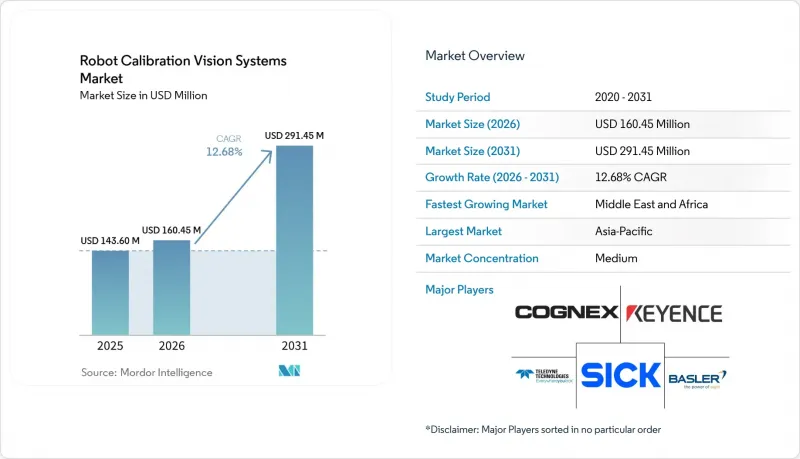
에 따르면 로봇용 캘리브레이션 비전 시스템 시장 규모는 2025년 1억 4,360만 달러에서 2026년에는 1억 6,045만 달러로 확대하며, 2031년까지 2억 9,145만 달러에 달할 것으로 예측되고 있으며, 2026-2031년까지 연평균 성장률(CAGR)은 12.68%에 달할 전망입니다.
전 세계 로봇 캘리브레이션용 비전 시스템 시장의 동향 및 인사이트
스마트 팩토리에서 비전 가이드형 로봇의 확대
스마트 팩토리 프로젝트는 로봇 캘리브레이션 비전 시스템 시장에 새로운 수요를 창출하고, 기존 로봇 군의 업그레이드 활동을 활성화시키고 있습니다. 로봇 밀도가 높아짐에 따라 생산 셀 전체에서 수동 캘리브레이션에 할애할 수 있는 시간은 줄어들고 있습니다. 이에 따라 각 제조사들은 여러 로봇과 센서의 협업적 캘리브레이션으로 전환하고 있습니다. ABB는 2025년 9월 ‘OmniCore EyeMotion’을 출시하여, OmniCore 탑재 로봇이 타사 카메라 및 센서를 사용하여 실시간 2D 및 3D 애플리케이션을 처리할 수 있도록 했습니다. ABB에 따르면 이 시스템을 통해 맞춤형 솔루션에 비해 시운전 시간이 최대 90% 단축되었다고 합니다. KUKA의 ‘iiQKA.AI Vision’은 카메라 보정, 시스템 보정 및 AI 기반 훈련을 하나의 드래그 앤 드롭 워크플로로 통합하고 있습니다.
복잡한 조립 공정에서의 AI 지원 3D 비전 도입
AI 지원 3D 비전의 도입으로 인해 ‘로봇 캘리브레이션·비전 시스템 시장’에서 기존의 2D 시스템에 깊이 캘리브레이션 요건이 추가되었습니다. 이는 부품의 형상이 가변적이고 작업 위치가 변화하는 조립 작업에서 중요합니다. ABB와 NVIDIA는 2026년 3월, NVIDIA Omniverse 라이브러리와 ABB의 Absolute Accuracy 기술을 결합한 ‘RobotStudio HyperReality’를 발표했습니다. ABB의 보고에 따르면 이 기술을 통해 캘리브레이션되지 않은 시스템의 위치 결정 오차가 8-15 mm에서 0.5 mm로 감소했습니다. 한편, Foxconn은 99%의 정확도로 첫 번째 사용 사례의 시범 운영을 진행했습니다. 2026년 제조 관련 연구에서는 거친 조정에 캘리브레이션 보드를, 미세 조정에 플렉서블 로드를 사용하는 ‘3DVAC-HiPRoM’ 기법이 소개되었습니다. 이러한 접근 방식은 작업별 캘리브레이션 기법에 대응할 수 있는 소프트웨어 플랫폼에 대한 수요를 지원하고 있습니다.
기존 생산 라인의 높은 통합 비용
기존 생산 라인에 통합하는 데는 캘리브레이션 하드웨어 자체의 비용보다 더 많은 비용이 들 수 있습니다. 독자적인 사양의 컨트롤러, 호환되지 않는 필드버스 프로토콜, 고정된 PLC 로직 등이 엔지니어링상의 요구 사항을 높이고 있습니다. 또한 여러 로봇 브랜드를 사용하는 셀에서 카메라와 로봇의 좌표계를 확립하는 것 또한 도입 지연으로 이어질 수 있습니다. ABB사는 RobotStudio HyperReality를 통해 가상 설계, 테스트, 최적화를 거쳐 설정 및 시운전 비용을 최대 40%까지 절감할 수 있다고 밝혔습니다. 이러한 이점은 OmniCore 세대 컨트롤러를 사용하는 시설에 적용되므로, 그보다 오래된 설비의 경우 선택의 폭이 좁아집니다. 이러한 제약으로 인해 시스템 통합사업자의 서비스 범위나 OEM의 지원이 그리 넓지 않은 남미, 중동 및 아프리카에서는 로봇 보정 비전 시스템의 도입이 제한되고 있습니다.
부문 분석
2025년에는 핸드-아이 보정이 매출의 29.91%를 차지했습니다. 이는 로봇의 손목이나 플랜지에 카메라를 장착하여 픽 앤 플레이스, 빈 피킹, 용접, 조립 작업 등에서 사용됩니다. 카메라는 엔드 이펙터와 함께 이동하므로 공구와의 공간적 관계를 유지하는 데 도움이 됩니다. 다만, 공구 교체나 기계적 충격으로 인해 재보정이 필요할 수 있습니다. 로봇 보정 비전 시스템 시장은 일반적인 비전 유도 작업에서 이 기술이 정착되어 있다는 점에서 혜택을 보고 있습니다.
로봇 간 보정은 2031년까지 연평균 성장률(CAGR) 14.23%로 성장할 것으로 예측됩니다. 자동차 및 전자기기 공장에서는 로봇이 스테이션 간에 부품을 직접 운반하는 워크셀의 도입이 진행되고 있습니다. 이에 따라 로봇 간의 위치 관계는 개별 로봇의 독립적인 정밀도와 마찬가지로 중요해지고 있습니다. 헥사곤은 2026년 7월, 로봇의 절대 위치 결정 정밀도를 최대 10배 향상시키는 멀티존 및 멀티툴 루틴용 ‘SARCA’를 출시했습니다. 이에 따라 ‘로봇 대 세계(Robot-to-World)’, ‘TCP’ 및 멀티 카메라 구성에서의 로봇 보정 비전 시스템 시장 기회가 확대되고 있습니다.
2025년에는 산업용 로봇이 매출의 61.34%를 차지하며 ‘로봇 보정 비전 시스템 시장’에서 가장 큰 점유율을 기록했습니다. 이 로봇의 도입 실적은 자동차 화이트 바디 생산, 전자기기 조립 및 자재 취급 분야에 달합니다. 이러한 수요의 상당 부분은 신규 도입보다는 재보정, 소프트웨어 업그레이드 및 교체를 통한 것입니다. 델타형 및 스칼라형 로봇은 식품 및 의약품 포장에서의 고속 픽 앤 플레이스 작업에서 중요한 역할을 수행하고 있습니다. 또한 코봇도 기계 조작 보조, 검사, 키트 조립 등의 작업에서 점점 더 빈번하게 활용되고 있습니다.
이동형 로봇은 2031년까지 연평균 성장률(CAGR) 18.45%로 성장할 것으로 예측됩니다. AMR(자율 이동 로봇)은 RGB 카메라, LiDAR, ToF 센서, 초음파 어레이에서 얻은 정보를 공통 좌표계에서 통합해야 합니다. 진동, 섀시의 처짐, 충돌로 인해 사용 중에 이러한 센서의 위치가 어긋날 가능성이 있습니다. 이 때문에 로봇 보정·비전 시스템 시장에서는 정기적인 보정에만 의존하는 것이 아니라, 온보드 모니터링이 지속적으로 요구되고 있습니다. 야스카와 전기의 ‘MOTOMAN NEXT’는 비전, 경로 계획, 힘 감지 기능이 로봇 플랫폼에 어떻게 통합되어 있는지를 입증하고 있습니다.
지역별 분석
2025년, 아시아태평양은 로봇 캘리브레이션·비전 시스템 시장에서 38.72%의 점유율을 차지했습니다. 중국, 일본, 한국에서는 산업용 로봇 도입이 집중되고 있습니다. 중국의 스마트 제조 프로그램은 비전 유도형 자동화에 대한 투자를 촉진하고 있습니다. 파낙, 야스카와 전기, 오므론을 포함한 일본의 OEM 기반은 지속적인 시스템 업그레이드를 지원하고 있습니다. 한국의 반도체 및 디스플레이 제조 분야에서는 서브마이크론 수준의 검사를 위해 정기적인 보정 검증이 요구되고 있습니다.
북미는 전기자동차(EV) 제조, 항공우주 분야의 조립, 물류 자동화에 힘입어 2025년 로봇 캘리브레이션·비전 시스템 시장에서 중요한 위치를 유지했습니다. 미국에는 코그넥스(Cognex)와 텔디네 테크놀러지스(Teledyne Technologies)가 있으며, 두 회사 모두 임베디드 AI 비전 시스템 개발을 지원하고 있습니다. 전자 및 방위 산업 제조의 국내 복귀(리쇼어링)로 인해 신규 및 설비 갱신된 시설에서 수요가 발생하고 있습니다. 유럽에서는 KUKA, SICK, Basler, Hexagon, ABB를 통해 머신 비전 및 계측 기술의 기반이 확립되어 있습니다. 독일의 자동차 제조사들은 화이트 바디 및 전기자동차(EV) 파워트레인 조립 공정에서 멀티 카메라 시스템과 구조화 광 시스템에 대한 수요를 지원하고 있습니다.
중동 및 아프리카는 2031년까지 연평균 성장률(CAGR) 14.52%로 성장할 것으로 예측됩니다. 사우디아라비아의 ‘비전 2030’과 관련된 제조 프로젝트 및 UAE의 자동화 프로그램이 새로운 도입을 촉진하고 있습니다. 남아프리카공화국과 나이지리아에서는 자동차 조립 및 물류 생산 능력이 확대되고 있으며, 브라질은 남미의 주요 수요 거점으로 부상하고 있습니다. 또한 아르헨티나의 농업 산업 분야에서의 자동화도 규모는 작지만 수요를 끌어올리고 있습니다. 이러한 지역적 확장은 로봇 보정용 비전 시스템 시장을 지원하고 있지만, 현지 시스템 통합사업자의 서비스 범위가 제한적이며 해외 OEM 지원에 대한 의존도가 지속되고 있는 점이 도입을 저해하고 있습니다.
기타 혜택:
- 엑셀 형식의 시장 예측(ME) 시트
- 3개월간의 애널리스트 지원
목차
제1장 서론
- 조사 전제조건과 시장 정의
- 조사 범위
제2장 조사 방법
제3장 개요
제4장 시장 구도
- 시장 개요
- 시장 성장 촉진요인
- 시장 성장 억제요인
- 거시경제 요인이 시장에 미치는 영향
- 업계의 공급망 분석
- 규제 상황
- 기술 전망
- Porter's Five Forces 분석
제5장 시장 규모와 성장 예측
- 캘리브레이션 유형별
- 로봇 유형별
- 비전 기술별
- 최종사용자 산업별
- 지역별
- 북미
- 미국
- 캐나다
- 멕시코
- 남미
- 브라질
- 아르헨티나
- 기타 남미 국가
- 유럽
- 독일
- 영국
- 프랑스
- 이탈리아
- 스페인
- 기타 유럽 국가
- 아시아태평양
- 중국
- 일본
- 인도
- 한국
- 기타 아시아태평양 국가
- 중동 및 아프리카
- 중동
- 사우디아라비아
- 아랍에미리트
- 튀르키예
- 기타 중동 국가
- 아프리카
- 남아프리카공화국
- 나이지리아
- 기타 아프리카 국가
- 중동
- 북미
제6장 경쟁 구도
- 시장 집중도
- 전략적 동향
- 시장 점유율 분석
- 기업 개요
- ABB Ltd.
- Allied Vision Technologies GmbH
- Basler AG
- Cognex Corporation
- Denso Wave Incorporated
- FARO Technologies, Inc.
- FANUC Corporation
- Hexagon AB
- IDS Imaging Development Systems GmbH
- ISRA VISION GmbH
- KEYENCE CORPORATION
- KUKA AG
- LMI Technologies Inc.
- MVTec Software GmbH
- Nikon Metrology NV
- OMRON Corporation
- Photoneo s.r.o.
- SICK AG
- Teledyne Technologies Incorporated
- Yaskawa Electric Corporation
제7장 시장 기회와 향후 전망
KSAAccording to Mordor Intelligence, the robot calibration vision systems market size is projected to expand from USD 143.60 million in 2025 to USD 160.45 million in 2026, and to USD 291.45 million by 2031, registering a CAGR of 12.68% between 2026 and 2031.
Global Robot Calibration Vision Systems Market Trends and Insights
Expansion of Vision-Guided Robotics in Smart Factories
Smart factory projects are creating new demand for the Robot Calibration Vision Systems Market and increasing upgrade activity in existing fleets. A higher robot density reduces the time available for manual calibration across a production cell. Manufacturers are therefore moving toward coordinated calibration of multiple robots and sensors. ABB launched OmniCore EyeMotion in September 2025, allowing OmniCore-powered robots to use third-party cameras and sensors for real-time 2D and 3D applications. ABB stated that the system reduced commissioning time by up to 90% compared with custom solutions. KUKA's iiQKA.AI Vision combined camera calibration, system calibration, and AI-supported training in one drag-and-drop workflow.
Adoption of AI-Enabled 3D Vision for Complex Assembly
AI-enabled 3D vision introduces depth-calibration requirements to established 2D systems in the Robot Calibration Vision Systems Market. This is important for assembly tasks with variable part geometry and changing work positions. ABB and NVIDIA announced RobotStudio HyperReality in March 2026, combining NVIDIA Omniverse libraries with ABB Absolute Accuracy technology. ABB reported that the technology reduced positioning errors from 8-15 mm in uncalibrated systems to 0.5 mm, while Foxconn piloted the first use case at 99% accuracy. A 2026 manufacturing study described the 3DVAC-HiPRoM method, which used a calibration board for coarse alignment and a flexible rod for refined alignment. These approaches support demand for software platforms that can accommodate task-specific calibration methods.
High Integration Costs with Legacy Production Lines
Legacy production lines can cost more to integrate than the calibration hardware itself. Proprietary controllers, incompatible fieldbus protocols, and fixed PLC logic raise engineering requirements. Establishing camera-to-robot coordinate frames can also delay deployment in cells that use several robot brands. ABB stated that RobotStudio HyperReality could reduce setup and commissioning costs by up to 40% through virtual design, testing, and optimization. That benefit applies to facilities using OmniCore-generation controllers, leaving older installations with fewer options. This constraint limits the adoption of Robot Calibration Vision Systems in South America, the Middle East, and Africa, where integrator coverage and OEM support are less extensive.
Other drivers and restraints analyzed in the detailed report include:
- Growth of Collaborative Robots and Autonomous Mobile Robots
- Demand for High-Precision Inspection and Zero-Defect Manufacturing
- Shortage of Robot Vision Integration Expertise
For complete list of drivers and restraints, kindly check the Table Of Contents.
Segment Analysis
Hand-eye calibration accounted for 29.91% of revenue in 2025. It is used in pick-and-place, bin picking, welding, and assembly tasks that mount cameras on a robot wrist or flange. The camera moves with the end effector, which helps preserve its spatial relationship with the tool. However, tooling changes or mechanical impacts can require recalibration. The Robot Calibration Vision Systems Market benefits from the technique's established use across common vision-guided tasks.
Robot-to-robot calibration is forecast to grow at a 14.23% CAGR through 2031. Automotive and electronics plants are using more workcells where robots transfer parts directly between stations. This makes the positional relationship among robots as important as each robot's independent accuracy. Hexagon launched SARCA in July 2026 for multi-zone and multi-tool routines that improve absolute robot positioning accuracy by up to 10 times. This expands the Robot Calibration Vision Systems Market opportunity for robot-to-world, TCP, and multi-camera configurations.
Industrial robots accounted for 61.34% of revenue in 2025, giving them the largest share in the Robot Calibration Vision Systems Market. Their installed base spans automotive body-in-white production, electronics assembly, and heavy material handling. Much of this demand comes from recalibration, software upgrades, and replacements rather than new installations. Delta and SCARA models are important for fast pick-and-place work in food and pharmaceutical packaging. Cobots are also being used more often for machine tending, inspection, and kitting tasks.
Mobile robots are forecast to grow at an 18.45% CAGR through 2031. AMRs must combine information from RGB cameras, LiDAR, ToF sensors, and ultrasonic arrays in a common coordinate frame. Vibration, chassis flex, and collisions can shift those sensors during use. This creates an ongoing requirement for on-board monitoring in the Robot Calibration Vision Systems Market, rather than relying solely on scheduled calibration. Yaskawa's MOTOMAN NEXT demonstrates how vision, path planning, and force sensing are integrated into the robot platform.
Complete Report Scope:
- By Calibration Type
- Robot-to-World Calibration
- Hand-Eye Calibration
- Tool Center Point (TCP) Calibration
- Robot-to-Robot Calibration
- Multi-Camera / Multi-Sensor Calibration
- By Robot Type
- Industrial Robots
- Collaborative Robots (Cobots)
- Mobile Robots (AMR/AGV)
- Delta / SCARA Robots
- Other Robot Types
- By Vision Technology
- 2D Vision Calibration
- 3D Stereo Vision Calibration
- Structured-Light 3D Calibration
- Time-of-Flight (ToF) Calibration
- Laser / 3D Scanner Calibration
- Other Vision Technologies
- By End-User Industry
- Automotive and Mobility
- Electronics and Semiconductors
- General Manufacturing
- Aerospace and Defense
- Food and Beverage
- Pharmaceutical and Medical Devices
- Logistics and Warehousing
- Other End-User Industries
- Robotic-Mounted Vision Systems
- Mobile / Autonomous Vision Systems
- By Geography
- North America
- United States
- Canada
- Mexico
- South America
- Brazil
- Argentina
- Rest of South America
- Europe
- Germany
- United Kingdom
- France
- Italy
- Spain
- Rest of Europe
- Asia-Pacific
- China
- Japan
- India
- South Korea
- Rest of Asia-Pacific
- Middle East and Africa
- Middle East
- Saudi Arabia
- United Arab Emirates
- Turkey
- Rest of the Middle East
- Africa
- South Africa
- Nigeria
- Rest of Africa
- Middle East
- North America
Geography Analysis
Asia-Pacific held 38.72% of the Robot Calibration Vision Systems Market share in 2025. China, Japan, and South Korea have a high concentration of industrial robot installations. China's smart manufacturing programs support investment in vision-guided automation. Japan's OEM base, including FANUC, Yaskawa, and OMRON, supports continuing system upgrades. South Korean semiconductor and display manufacturing requires regular calibration verification for sub-micron inspection.
North America maintained a significant position in the Robot Calibration Vision Systems Market in 2025, driven by EV manufacturing, aerospace assembly, and logistics automation. The United States is home to Cognex and Teledyne Technologies, both of which support the development of embedded AI vision systems. Reshoring of electronics and defense manufacturing is creating demand in new and retooled facilities. Europe has established machine vision and metrology capabilities through KUKA, SICK, Basler, Hexagon, and ABB. Germany's automotive manufacturers support demand for multi-camera and structured-light systems in body-in-white and EV powertrain assembly.
The Middle East and Africa are forecast to grow at a 14.52% CAGR through 2031. Saudi Arabia's Vision 2030-linked manufacturing projects and the UAE's automation programs are supporting new deployments. South Africa and Nigeria are adding automotive assembly and logistics capacity, while Brazil is South America's main demand center, and Argentina's agroindustrial automation adds smaller demand. This regional expansion supports the Robot Calibration Vision Systems Market, although limited local integrator coverage and reliance on overseas OEM support continue to limit adoption.
- ABB Ltd.
- Allied Vision Technologies GmbH
- Basler AG
- Cognex Corporation
- Denso Wave Incorporated
- FARO Technologies, Inc.
- FANUC Corporation
- Hexagon AB
- IDS Imaging Development Systems GmbH
- ISRA VISION GmbH
- KEYENCE CORPORATION
- KUKA AG
- LMI Technologies Inc.
- MVTec Software GmbH
- Nikon Metrology NV
- OMRON Corporation
- Photoneo s.r.o.
- SICK AG
- Teledyne Technologies Incorporated
- Yaskawa Electric Corporation
Additional Benefits:
- The market estimate (ME) sheet in Excel format
- 3 months of analyst support
TABLE OF CONTENTS
1 INTRODUCTION
- 1.1 Study Assumptions and Market Definition
- 1.2 Scope of the Study
2 RESEARCH METHODOLOGY
3 EXECUTIVE SUMMARY
4 MARKET LANDSCAPE
- 4.1 Market Overview
- 4.2 Market Drivers
- 4.2.1 Expansion of Vision-Guided Robotics in Smart Factories
- 4.2.2 Adoption of AI-Enabled 3D Vision for Complex Assembly
- 4.2.3 Growth of Collaborative Robots and Autonomous Mobile Robots
- 4.2.4 Rising Demand for High-Precision Inspection and Zero-Defect Manufacturing
- 4.2.5 Automated Calibration for Multi-Camera and Multi-Sensor Cells
- 4.2.6 Increasing Use of Self-Calibrating Vision Software in Brownfield Facilities
- 4.3 Market Restraints
- 4.3.1 High Integration Costs with Legacy Production Lines
- 4.3.2 Shortage of Robot Vision Integration Expertise
- 4.3.3 Calibration Drift from Thermal, Mechanical, and Optical Variations
- 4.3.4 Fragmented Robot, Camera, and Software Interoperability Standards
- 4.4 Impact of Macroeconomic Factors on the Market
- 4.5 Industry Supply Chain Analysis
- 4.6 Regulatory Landscape
- 4.7 Technological Outlook
- 4.8 Porter's Five Forces Analysis
- 4.8.1 Bargaining Power of Suppliers
- 4.8.2 Bargaining Power of Buyers
- 4.8.3 Threat of New Entrants
- 4.8.4 Threat of Substitutes
- 4.8.5 Intensity of Competitive Rivalry
5 MARKET SIZE AND GROWTH FORECASTS (VALUE)
- 5.1 By Calibration Type
- 5.1.1 Robot-to-World Calibration
- 5.1.2 Hand-Eye Calibration
- 5.1.3 Tool Center Point (TCP) Calibration
- 5.1.4 Robot-to-Robot Calibration
- 5.1.5 Multi-Camera / Multi-Sensor Calibration
- 5.2 By Robot Type
- 5.2.1 Industrial Robots
- 5.2.2 Collaborative Robots (Cobots)
- 5.2.3 Mobile Robots (AMR/AGV)
- 5.2.4 Delta / SCARA Robots
- 5.2.5 Other Robot Types
- 5.3 By Vision Technology
- 5.3.1 2D Vision Calibration
- 5.3.2 3D Stereo Vision Calibration
- 5.3.3 Structured-Light 3D Calibration
- 5.3.4 Time-of-Flight (ToF) Calibration
- 5.3.5 Laser / 3D Scanner Calibration
- 5.3.6 Other Vision Technologies
- 5.4 By End-User Industry
- 5.4.1 Automotive and Mobility
- 5.4.2 Electronics and Semiconductors
- 5.4.3 General Manufacturing
- 5.4.4 Aerospace and Defense
- 5.4.5 Food and Beverage
- 5.4.6 Pharmaceutical and Medical Devices
- 5.4.7 Logistics and Warehousing
- 5.4.8 Other End-User Industries
- 5.4.9 Robotic-Mounted Vision Systems
- 5.4.10 Mobile / Autonomous Vision Systems
- 5.5 By Geography
- 5.5.1 North America
- 5.5.1.1 United States
- 5.5.1.2 Canada
- 5.5.1.3 Mexico
- 5.5.2 South America
- 5.5.2.1 Brazil
- 5.5.2.2 Argentina
- 5.5.2.3 Rest of South America
- 5.5.3 Europe
- 5.5.3.1 Germany
- 5.5.3.2 United Kingdom
- 5.5.3.3 France
- 5.5.3.4 Italy
- 5.5.3.5 Spain
- 5.5.3.6 Rest of Europe
- 5.5.4 Asia-Pacific
- 5.5.4.1 China
- 5.5.4.2 Japan
- 5.5.4.3 India
- 5.5.4.4 South Korea
- 5.5.4.5 Rest of Asia-Pacific
- 5.5.5 Middle East and Africa
- 5.5.5.1 Middle East
- 5.5.5.1.1 Saudi Arabia
- 5.5.5.1.2 United Arab Emirates
- 5.5.5.1.3 Turkey
- 5.5.5.1.4 Rest of the Middle East
- 5.5.5.2 Africa
- 5.5.5.2.1 South Africa
- 5.5.5.2.2 Nigeria
- 5.5.5.2.3 Rest of Africa
- 5.5.5.1 Middle East
- 5.5.1 North America
6 COMPETITIVE LANDSCAPE
- 6.1 Market Concentration
- 6.2 Strategic Moves
- 6.3 Market Share Analysis
- 6.4 Company Profiles (includes Global Level Overview, Market Level Overview, Core Segments, Financials as available, Strategic Information, Market Rank/Share, Products and Services, Recent Developments)
- 6.4.1 ABB Ltd.
- 6.4.2 Allied Vision Technologies GmbH
- 6.4.3 Basler AG
- 6.4.4 Cognex Corporation
- 6.4.5 Denso Wave Incorporated
- 6.4.6 FARO Technologies, Inc.
- 6.4.7 FANUC Corporation
- 6.4.8 Hexagon AB
- 6.4.9 IDS Imaging Development Systems GmbH
- 6.4.10 ISRA VISION GmbH
- 6.4.11 KEYENCE CORPORATION
- 6.4.12 KUKA AG
- 6.4.13 LMI Technologies Inc.
- 6.4.14 MVTec Software GmbH
- 6.4.15 Nikon Metrology NV
- 6.4.16 OMRON Corporation
- 6.4.17 Photoneo s.r.o.
- 6.4.18 SICK AG
- 6.4.19 Teledyne Technologies Incorporated
- 6.4.20 Yaskawa Electric Corporation
7 MARKET OPPORTUNITIES AND FUTURE OUTLOOK
- 7.1 White-Space and Unmet-Need Assessment


