

|
시장보고서
상품코드
2155229
아스팔트 첨가제 : 시장 점유율 분석, 업계 동향과 통계, 성장 예측(2026-2031년)Asphalt Additives - Market Share Analysis, Industry Trends & Statistics, Growth Forecasts (2026 - 2031) |
||||||
 Mordor Intelligence
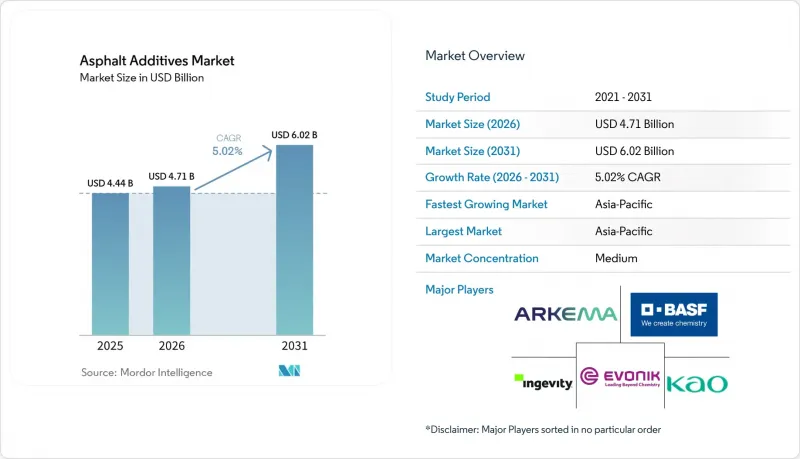
에 따르면 아스팔트 첨가제 시장 규모는 2025년에 44억 4,000만 달러로 평가되며, 2026년 47억 1,000만 달러에서 2031년까지 60억 2,000만 달러에 달할 것으로 예측되고 있으며, 예측 기간(2026-2031년)에 CAGR은 5.02%에 달할 전망입니다.
세계 아스팔트 첨가제 시장의 동향 및 인사이트
인프라 현대화 및 포장 도로 개보수
각 포장 프로젝트에는 현지의 교통 상황과 기후 조건에 적합한 결합제 시스템이 필요하므로 도로 건설 투자는 아스팔트 첨가제 시장에 있으며, 직접적인 수요 지표가 됩니다. 인도는 2026-27 회계연도에 도로운송·고속도로부에 344억 달러를 배정했습니다. 이는 전 회계연도 대비 7.9% 증가한 것으로, 고지대, 동결-해동, 습한 노반과 같은 과제가 있는 지역의 도로 정비 사업을 지원하기 위한 것입니다. 중국은 2026 회계연도에 총액 2,950억 위안(422억 달러)에 달하는 대규모 인프라 프로젝트를 승인했으며, 가혹한 조건으로 인해 폴리머 첨가량을 늘려야 하는 성에서 포장 공사를 계속하고 있습니다. 도로망의 노후화에 따라 콜드믹스용 유화제, 속경화제, 재생제의 수요가 증가하고 있으며, 도로 당국의 지출에서 유지관리 예산의 중요성이 점점 더 커지고 있습니다. 이러한 구매는 대규모 신규 건설 계약보다 조달 주기가 짧아, 건설 일정이 변경되더라도 수요를 유지하는 데 도움이 됩니다. 도로 관리 당국이 포장 유지 관리를 ‘미루어야 할 경비’가 아닌 ‘자산 관리상의 필요성’으로 인식하게 된다면, 아스팔트 첨가제 시장은 그 혜택을 누리게 될 것입니다.
성능 기준에 따른 바인더 사양과 높은 축중량
성능 등급에 기반한 바인더 사양으로 인해 화물 운송 노선이나 이용 빈도가 높은 고속도로에서 폴리머 첨가제에 대한 요구 사항이 높아지고 있습니다. 성능 등급(PG) 76-22 또는 PG 82-22 바인더의 경우, 일반적으로 바인더 질량의 5-7%에 해당하는 스티렌-부타디엔-스티렌(SBS)이 사용되며, 이와 호환성이 좋은 가공 안정제 및 분산제가 필요합니다. 2025년 연구에 따르면 SBS 개질 바인더는 통제된 차륜 자국 시험에서 인장 강도비와 탄성 계수를 30-35% 향상시키는 동시에, 차륜 자국의 깊이를 42% 감소시켰습니다. 이러한 결과는 내구 연수와 유지 관리 성과를 우선시하는 사양을 지원합니다. 고속도로 관리 기관이 더 고성능 등급을 채택하면, 개질되지 않은 바인더 시스템으로는 필요한 포장 설계 기준을 충족할 수 없게 되므로 아스팔트 첨가제 시장이 혜택을 받게 됩니다. 파키스탄, 동남아시아 및 기타 아세안(ASEAN) 국가들의 도로 시스템에 이 기술이 도입되면, 단순히 아스팔트 생산량을 늘릴 뿐만 아니라 첨가제 사용량도 증가시킬 것입니다.
휘발성 폴리머, 역청 및 바이오 원료의 비용
스티렌-부타디엔-스티렌(SBS) 폴리머, 베이스 비투멘 및 방향족 익스텐더 오일은 폴리머계 개질제 및 재생제의 비용 대부분을 차지합니다. SBS 가격은 부타디엔 원료 및 나프타의 크래킹 마진과 연동되므로, 석유화학제품의 설비 가동률에 영향을 받기 쉬운 경향이 있습니다. 부타디엔 비용이 급등하면 공급업체의 이익률이 하락하고, 공공 계약 가격이 매년 책정되는 경우 사양 업그레이드가 지연될 가능성이 있습니다. 바이오 유래 원료의 경우, 타르 오일은 크라프트 펄프 생산량에 의존하고, 식물성 오일은 기상 조건 및 바이오 연료 정책의 영향을 받으며, 리그닌의 공급량은 제지 생산량에 좌우되므로 고유한 공급 위험에 직면해 있습니다. 친환경 조달로 인해 바이오 유래 재생제에 대한 수요가 증가하는 가운데, 이러한 동향이 공급을 제약할 가능성이 있습니다. 중소규모의 특수 배합 제조업체가 통합형 화학 제조업체만큼 효과적으로 원료 가격 변동에 대응하지 못할 경우, 아스팔트 첨가제 시장에서는 추가적인 업계 재편이 진행될 가능성이 있습니다.
부문 분석
2025년, 아스팔트 첨가제 시장에서 폴리머계 개질제의 점유율은 41.56%를 차지했습니다. 이는 성능 등급별 바인더에서 스티렌-부타디엔-스티렌(SBS) 블록 공중합체 및 스티렌-부타디엔 고무(SBR)의 광범위한 사용에 힘입은 결과입니다. 요구 사항이 까다로운 용도의 경우, SBS 함유량은 일반적으로 바인더 질량의 4%에서 7% 범위 내에 있습니다. 아시아, 북미, 중동의 고속도로 시스템에서는 교통량, 기온, 설계 수명 요건이 미개질 바인더의 성능을 초과하는 경우 이러한 개질제가 사용됩니다. 일단 행정 기관이 성능 등급을 채택하면, 개질제를 제거하는 것은 포장 설계 기준을 훼손할 우려가 있습니다. 안티스트립제 및 접착 촉진제는 골재와 바인더의 분리가 일반적인 파손 양상인 열대 지역이나 강우량이 많은 지역에서 유사한 역할을 합니다. 유화제는 상온 보수 공법을 통해 가열식 혼합 플랜트가 필요 없는 콜드 믹스 및 유지 관리 작업을 지원합니다. 아스팔트 첨가제 시장은 이러한 확립된 제품군이 일반 도로 및 유지 관리 사양을 충족하고 있으므로 계속해서 이들에 의존하고 있습니다.
재생제 및 재활용제는 2031년까지 연평균 성장률(CAGR) 5.45%로 성장할 것으로 예측되며, 이는 제품 부문 내에서 가장 높은 성장률입니다. 이러한 제품의 사용량은 재생 아스팔트 포장(RAP)의 함량이 증가함에 따라 늘어납니다. 이는 노후화된 바인더가 미사용 재료와 동등한 성능을 발휘하기 위해서는 사전에 복원 처리가 필요하기 때문입니다. 2024년 조사에 따르면 RAP를 45% 함유한 혼합물에서 회춘제 투여량을 최적화함으로써 저온 균열 저항성과 중온 피로 수명이 미사용 바인더와 동등한 수준까지 회복되는 것으로 밝혀졌습니다. 유럽의 재활용 재료 함유율에 관한 요건과 중국의 유지 관리 공사 확대가 모두 이러한 제품에 대한 수요를 지원하고 있습니다. 피셔-트로프쉬 왁스, 반응성 개질제, 특수 안정제 등의 화학 개질제는 특정 성능 요건을 충족합니다. 그 밖의 제품으로는 저소음 다공성 포장용 첨가제, 동결 방지 표면 처리제, 오염에 노출되는 공항 포장용 제품 등이 포함됩니다. 이러한 용도는 사용량이 적고 특정 성능 요건이 요구되므로 부가가치가 높은 편입니다.
지역별 분석
아시아태평양은 2025년에 아스팔트 첨가제 시장 점유율의 38.78%를 차지할 것으로 예상되며, 2031년까지 연평균 성장률(CAGR) 5.94%로 성장할 것으로 전망됩니다. 중국에서는 고속도로망이 16만 km를 넘어섰고, 더 많은 포장 구간이 첫 번째 주요 보수 주기를 맞이함에 따라 건설 주도형 수요에서 유지 관리 주도형 수요로 전환되고 있습니다. 이러한 변화에 따라 유지관리 프로그램에서는 새로운 노반 전용 자재를 지정하기보다는 기존 포장의 성능을 회복시키는 것이 요구되므로, 노면 재생제, 유화제 및 신속 보수용 첨가제의 사용이 증가하고 있습니다. 인도는 여전히 신규 도로 건설에 중점을 두고 있으며, 인도의 국가 인프라 계획에는 3,906건의 도로 및 교량 프로젝트가 포함되어 있고, 2026 회계연도(FY26)의 인프라 자본 지출은 1213억 달러로 추정됩니다. 이러한 대조적인 수요 동향으로 인해 공급업체는 신규 노선을 위한 고투여량 폴리머 개질제 패키지와 기존 도로망을 위한 실용적인 보수 시스템을 모두 제공해야 할 필요가 있습니다. 일본과 한국에서는 예방적 유지보수 프로그램을 통해 수요를 지원하고 있으며, 도로 관리 기관은 향후 대규모 개보수가 필요해지는 것을 방지하기 위해 내구성이 높은 처리를 요구하고 있습니다. 하리마 화학 그룹이 공공사업연구소(PWRI) 및 니혼대학과 공동으로 추진 중인 2025년 바이오매스 유래 재활용 첨가제 프로젝트는 저탄소 포장 재생 기술 및 바인더의 반복적인 보수에 중점을 두는 일본의 입장을 반영하고 있습니다. 베트남, 태국, 인도네시아에서도 습도가 높은 환경에서의 포장 공사를 위해 내습성 개질제나 박리 방지제가 요구되고 있으며, 골재와 바인더의 접착성은 이 지역에서 제품의 필수 요건이 되고 있습니다.
북미 및 유럽은 성능 기준에 기반한 사양과 배출량 감축으로 이어지는 조달 기준 덕분에 고부가가치 수요가 높은 지역이 되었습니다. 미국에서는 연방도로청(FHWA)의 기술 지침을 통해 웜믹스(warm mix)의 채택이 지원되고 있으며, 이는 각 주의 교통 사양에도 영향을 미쳐 저온 포장 공법에 대한 일관된 평가를 촉진하고 있습니다. 캐나다에서는 저온 균열 저항성, 동결 방지 성능 및 동결-해동 내구성이 요구되며, 계절에 따른 큰 기온 변화에 적합한 지역 특화 첨가제 패키지가 선호되고 있습니다. 유럽에서는 각국 고유의 웜믹스 요건으로의 전환이 진행되고 있으며, 이는 승인된 배합, 입증된 성능, 그리고 공공 조달 조건을 충족할 수 있는 능력을 갖춘 공급업체에게 중요한 의미를 지닙니다. 독일에서는 2026년 12월까지 저온 생산으로의 전환이 추진되고 있으며, 이탈리아에서는 주거 지역 주변에서 웜믹스 사용이 의무화되어 있으며, 이러한 요건을 준수하는 것이 계약상의 필수 조건이 되고 있습니다. 프랑스, 노르웨이, 영국에서도 조달 인센티브, 건강 요건, 자발적인 노력을 결합함으로써 웜믹스의 이용이 확대되고 있습니다. 이 지역에서는 승인 및 시험 결과가 공급업체의 프로젝트 참여 자격을 좌우하므로 아스팔트 첨가제 시장에서는 원자재의 확보 가능성과 마찬가지로 제품의 검증도 중요하게 여겨지고 있습니다.
남미, 중동 및 아프리카는 중요한 수요원이 되고 있지만, 각 지역의 수요 패턴은 서로 다릅니다. 브라질의 도로망은 200만 km에 달하며, 양도 방식에 따른 개보수 및 도시 고속도로 개선을 통해 교통량이 많은 노선의 포장 수명을 연장하는 제품에 대한 지역적 수요가 지원되고 있습니다. 비투멘의 가격 변동과 지자체 예산 제약으로 인해 2차 도로에서의 고사양 첨가제 사용은 제한되고 있으며, 주요 간선 도로와 지역 포장 공사 간에 뚜렷한 차이가 발생하고 있습니다. 아르헨티나에서는 재정적 제약으로 인해 주요 농산물 수출 회랑 이외의 지역에서는 사양 수준이 낮습니다. 반면, 주요 회랑에서는 차축 하중이 크기 때문에 폴리머 개질재 채택에 대한 비용 대비 효과가 높습니다. 사우디아라비아의 ‘비전 2030’ 프로그램 및 물류 회랑에서는 특히 폭염으로 인해 노면에 더 큰 부하가 가해지는 지역에서 고온 내성 및 차선 파손 내성이 뛰어난 폴리머 개질 바인더의 사용이 장려되고 있습니다. Sasobit 유형의 웜 믹스용 첨가제는 기존 생산 조건 관리가 어려워지는 무더운 여름 포장 기간 중도 작업성을 향상시킬 수 있습니다. 남아프리카는 특수 첨가제의 배합 및 유통에 있으며, 지역 거점으로서의 역할을 수행하고 있는 반면, 이집트, 에티오피아 및 걸프 국가들에서는 주요 도로 회랑에 성능 사양 및 유지 관리 기준이 채택됨에 따라 장기적인 비즈니스 기회가 기대되고 있습니다.
기타 혜택:
- 엑셀 형식의 시장 예측(ME) 시트
- 3개월간의 애널리스트 지원
자주 묻는 질문
목차
제1장 서론
- 조사 전제조건과 시장 정의
- 조사 범위
제2장 조사 방법
제3장 개요
제4장 시장 구도
- 시장 개요
- 시장 성장 촉진요인
- 시장 성장 억제요인
- 밸류체인 분석
- Porter's Five Forces 분석
제5장 시장 규모와 성장 예측
- 제품 유형별
- 기술별
- 용도별
- 지역별
- 아시아태평양
- 중국
- 인도
- 일본
- 한국
- 기타 아시아태평양 국가
- 북미
- 미국
- 캐나다
- 멕시코
- 유럽
- 독일
- 영국
- 프랑스
- 이탈리아
- 기타 유럽 국가
- 남미
- 브라질
- 아르헨티나
- 기타 남미 국가
- 중동 및 아프리카
- 사우디아라비아
- 남아프리카공화국
- 기타 중동 및 아프리카 국가
- 아시아태평양
제6장 경쟁 구도
- 시장 집중도
- 전략적 동향
- 시장 점유율·순위 분석
- 기업 개요
- Arkema
- BASF
- Cargill
- Dow
- Dynasol Group
- Evonik Industries AG
- Honeywell International Inc.
- Ingevity Corporation
- Iterchimica S.p.A.
- Kao Corporation
- LCY Chemical Corp.
- LUCOBIT Aktiengesellschaft
- McAsphalt Industries Limited
- Nouryon
- Sripath Technologies, LLC
제7장 시장 기회와 향후 전망
KSA 26.10.28According to Mordor Intelligence, the asphalt additives market size was valued at USD 4.44 billion in 2025 and is estimated to grow from USD 4.71 billion in 2026 to reach USD 6.02 billion by 2031, at a CAGR of 5.02% during the forecast period (2026-2031).
Global Asphalt Additives Market Trends and Insights
Infrastructure Modernization and Pavement Rehabilitation
Road capital expenditure is a direct demand signal for the asphalt additives market, as each paving project requires binder systems suited to local traffic and climate conditions. India allocated USD 34.4 billion to the Ministry of Road Transport and Highways for 2026-27, a 7.9% increase over the preceding fiscal year, supporting road programs in areas with challenging high-altitude, freeze-thaw, and wet subgrade conditions. China approved major infrastructure projects worth CNY 295 billion (USD 42.2 billion) for 2026, sustaining pavement work in provinces where harsh conditions require higher polymer dosages. Maintenance budgets are becoming increasingly important in road authority spending, as aging networks require cold-mix emulsifiers, rapid-setting agents, and rejuvenators. These purchases follow shorter procurement cycles than large new-build contracts and can help sustain demand when construction schedules change. The asphalt additives market benefits when authorities treat pavement upkeep as an asset-management need rather than a deferred expense.
Performance-Based Binder Specifications and Heavy Axle Loads
Performance-graded binder specifications increase polymer additive requirements on freight corridors and heavily used highways. A Performance Grade (PG) 76-22 or PG 82-22 binder typically uses a Styrene-Butadiene-Styrene (SBS) content of 5-7% of the binder mass and requires compatible processing stabilizers and dispersants. A 2025 study reported that SBS-modified binders improved tensile strength ratio and resilient modulus by 30-35%, while rut depth declined by 42% in controlled wheel-tracking tests. These results support specifications that prioritize service life and maintenance outcomes. The asphalt additives market benefits when highway agencies adopt higher-performance grades, as unmodified binder systems no longer meet the required pavement design standards. Adoption in Pakistan, Southeast Asia, and other ASEAN road systems can raise additive intensity rather than merely add asphalt output.
Volatile Polymer, Bitumen, and Bio-Feedstock Costs
Styrene-Butadiene-Styrene (SBS) polymer, base bitumen, and aromatic extender oils account for a large share of the cost of polymeric modifiers and rejuvenating agents. SBS pricing moves with butadiene feedstock and naphtha cracking margins, making it sensitive to petrochemical capacity utilization. High butadiene costs can reduce supplier margins and delay specification upgrades where public contract prices are set annually. Bio-based inputs face separate supply risks because tall oil depends on kraft pulp output, vegetable oil responds to weather and biofuel policy, and lignin availability follows paper production. These dynamics can constrain supply as environmental procurement increases demand for bio-based rejuvenators. The asphalt additives market may see greater consolidation if smaller specialty formulators cannot manage feedstock volatility as effectively as integrated chemical suppliers.
Other drivers and restraints analyzed in the detailed report include:
- Reclaimed Asphalt Pavement Adoption and Binder Rejuvenation
- Warm-Mix Asphalt, Lower-Carbon Construction, and Circular Formulations
- High Initial Cost, Limited Contractor Capability, and Municipal Testing Gaps
For complete list of drivers and restraints, kindly check the Table Of Contents.
Segment Analysis
Polymeric modifiers accounted for 41.56% of the asphalt additives market share in 2025, supported by the broad use of Styrene-Butadiene-Styrene (SBS) block copolymers and Styrene-Butadiene Rubber (SBR) in performance-graded binders. SBS content commonly ranges from 4% to 7% of binder mass in demanding applications. Highway systems in Asia, North America, and the Middle East use these modifiers where traffic, temperature, and design-life requirements exceed the capability of unmodified binders. Once an agency adopts a performance grade, removing the modifier can compromise the pavement design basis. Anti-strip and adhesion promoters serve a related role in tropical and high-rainfall locations where aggregate-binder separation is a common failure mode. Emulsifiers support cold-mix and maintenance work, where ambient-temperature repair methods eliminate the need for heated mixing plants. The asphalt additives market continues to rely on these established product families because they meet routine highway and maintenance specifications.
Rejuvenators and recycling agents are projected to grow at a 5.45% CAGR through 2031, the highest rate within the product segment. Their use increases with reclaimed asphalt pavement (RAP) content because the aged binder requires restoration before it can perform comparably to virgin material. A 2024 review found that optimized rejuvenator dosing in mixtures containing 45% RAP restored low-temperature cracking resistance and mid-temperature fatigue life to levels comparable with virgin binder. European recycled-content requirements and China's expanding maintenance work both support demand for these products. Chemical modifiers, including Fischer-Tropsch waxes, reactive modifiers, and specialty stabilizers, address specific performance needs. Other products include additives for low-noise porous pavements, anti-icing surface treatments, and airport surfaces exposed to contamination. These applications represent smaller quantities but carry higher value due to their specific performance requirements.
Complete Report Scope:
- By Product Type
- Polymeric Modifiers
- Anti-Strip and Adhesion Promoters
- Emulsifiers
- Chemical Modifiers
- Rejuvenators and Recycling Agents
- Others
- By Technology
- Hot-Mix Asphalt
- Warm-Mix Asphalt
- Cold-Mix Asphalt
- Others
- By Application
- Road Construction and Paving
- Airport Runways and Airfield Pavements
- Parking Lots
- Roofing
- Industrial
- Others
- By Geography
- Asia-Pacific
- China
- India
- Japan
- South Korea
- Rest of Asia-Pacific
- North America
- United States
- Canada
- Mexico
- Europe
- Germany
- United Kingdom
- France
- Italy
- Rest of Europe
- South America
- Brazil
- Argentina
- Rest of South America
- Middle East and Africa
- Saudi Arabia
- South Africa
- Rest of Middle East and Africa
- Asia-Pacific
Geography Analysis
Asia-Pacific held 38.78% of the asphalt additives market share in 2025 and is projected to grow at a 5.94% CAGR through 2031. China is shifting from construction-led demand toward maintenance-led demand as its expressway network exceeds 160,000 km, bringing more pavement sections into their first major rehabilitation cycle. This transition is increasing the use of rejuvenators, emulsifiers, and rapid-repair additives, as maintenance programs must restore performance in existing pavements rather than specify materials only for new roadbeds. India remains more focused on new road construction, with its National Infrastructure Pipeline covering 3,906 road and bridge projects and Fiscal Year 2026 (FY26) infrastructure capital expenditure estimated at USD 121.3 billion. These contrasting demand profiles require suppliers to offer both high-dosage polymer modifier packages for new corridors and practical repair systems for established networks. Japan and South Korea support demand through preventive maintenance programs, in which road agencies seek durable treatments to avoid the need for more extensive rehabilitation later. Harima Chemical Group's 2025 biomass-derived recycling additive project with the Public Works Research Institute (PWRI) and Nihon University reflects Japan's focus on lower-carbon pavement renewal chemistry and repeated binder restoration. Vietnam, Thailand, and Indonesia also require moisture-resistant modifiers and anti-strip agents for paving in humid conditions, making aggregate-binder adhesion a regional product requirement.
North America and Europe are high-value demand areas due to performance-grade specifications and procurement criteria tied to lower emissions. The United States supports warm-mix adoption through Federal Highway Administration technical guidance, which has influenced state transportation specifications and encourages consistent evaluation of lower-temperature paving methods. Canada requires low-temperature cracking resistance, anti-icing performance, and freeze-thaw durability, supporting specialized regional additive packages suited to long seasonal temperature changes. Europe is shifting toward country-specific warm-mix requirements, which is significant for suppliers with approved formulations, verified performance, and the ability to meet public procurement conditions. Germany's transition to reduced-temperature production by December 2026 and Italy's warm-mix rule near residential areas are making compliance a contractual requirement. France, Norway, and the United Kingdom have also expanded warm-mix use through combinations of procurement incentives, health requirements, and voluntary commitments. In these regions, the asphalt additives market rewards product validation as much as basic material availability, as approval and test evidence can determine whether a supplier is eligible for a project.
South America, the Middle East, and Africa contribute meaningful demand but have distinct demand patterns. Brazil's road network spans 2 million km, and concession-funded rehabilitation and urban expressway upgrades support regional demand for products that extend pavement life on heavily used routes. Bitumen price volatility and constrained municipal budgets limit the use of higher-specification additives on secondary routes, creating a clear difference between major corridors and local paving work. Argentina's fiscal constraints reduce specification intensity outside major agricultural export corridors, where heavy axle loads provide a stronger cost case for polymeric modification. Saudi Arabia's Vision 2030 programs and logistics corridors support the use of high-temperature, rutting-resistant, polymer-modified binders, particularly where severe heat places additional stress on road surfaces. Sasobit-type warm-mix additives can also improve workability during hot summer paving periods, when traditional production conditions become more difficult to manage. South Africa serves as a regional center for specialty additive formulation and distribution, while Egypt, Ethiopia, and Gulf countries represent longer-term opportunities as primary road corridors adopt performance specifications and maintenance standards.
- Arkema
- BASF
- Cargill
- Dow
- Dynasol Group
- Evonik Industries AG
- Honeywell International Inc.
- Ingevity Corporation
- Iterchimica S.p.A.
- Kao Corporation
- LCY Chemical Corp.
- LUCOBIT Aktiengesellschaft
- McAsphalt Industries Limited
- Nouryon
- Sripath Technologies, LLC
Additional Benefits:
- The market estimate (ME) sheet in Excel format
- 3 months of analyst support
TABLE OF CONTENTS
1 Introduction
- 1.1 Study Assumptions and Market Definition
- 1.2 Scope of the Study
2 Research Methodology
3 Executive Summary
4 Market Landscape
- 4.1 Market Overview
- 4.2 Market Drivers
- 4.2.1 Infrastructure Modernization and Pavement Rehabilitation
- 4.2.2 Performance-Based Binder Specifications and Heavy Axle Loads
- 4.2.3 Reclaimed Asphalt Pavement Adoption and Binder Rejuvenation
- 4.2.4 Warm-Mix Asphalt and Lower-Carbon Construction Requirements
- 4.2.5 Specification-Ready Circular Formulations Using Recycled Plastics, Tires, and Bio-Based Feedstocks
- 4.3 Market Restraints
- 4.3.1 Volatile Polymer, Bitumen, and Bio-Feedstock Costs
- 4.3.2 High Initial Cost and Limited Contractor Technical Capability
- 4.3.3 Municipal Specification Inertia and Inconsistent Testing Infrastructure
- 4.4 Value Chain Analysis
- 4.5 Porter's Five Forces Analysis
- 4.5.1 Bargaining Power of Suppliers
- 4.5.2 Bargaining Power of Buyers
- 4.5.3 Threat of New Entrants
- 4.5.4 Threat of Substitutes
- 4.5.5 Competitive Rivalry
5 Market Size and Growth Forecasts (Value)
- 5.1 By Product Type
- 5.1.1 Polymeric Modifiers
- 5.1.2 Anti-Strip and Adhesion Promoters
- 5.1.3 Emulsifiers
- 5.1.4 Chemical Modifiers
- 5.1.5 Rejuvenators and Recycling Agents
- 5.1.6 Others
- 5.2 By Technology
- 5.2.1 Hot-Mix Asphalt
- 5.2.2 Warm-Mix Asphalt
- 5.2.3 Cold-Mix Asphalt
- 5.2.4 Others
- 5.3 By Application
- 5.3.1 Road Construction and Paving
- 5.3.2 Airport Runways and Airfield Pavements
- 5.3.3 Parking Lots
- 5.3.4 Roofing
- 5.3.5 Industrial
- 5.3.6 Others
- 5.4 By Geography
- 5.4.1 Asia-Pacific
- 5.4.1.1 China
- 5.4.1.2 India
- 5.4.1.3 Japan
- 5.4.1.4 South Korea
- 5.4.1.5 Rest of Asia-Pacific
- 5.4.2 North America
- 5.4.2.1 United States
- 5.4.2.2 Canada
- 5.4.2.3 Mexico
- 5.4.3 Europe
- 5.4.3.1 Germany
- 5.4.3.2 United Kingdom
- 5.4.3.3 France
- 5.4.3.4 Italy
- 5.4.3.5 Rest of Europe
- 5.4.4 South America
- 5.4.4.1 Brazil
- 5.4.4.2 Argentina
- 5.4.4.3 Rest of South America
- 5.4.5 Middle East and Africa
- 5.4.5.1 Saudi Arabia
- 5.4.5.2 South Africa
- 5.4.5.3 Rest of Middle East and Africa
- 5.4.1 Asia-Pacific
6 Competitive Landscape
- 6.1 Market Concentration
- 6.2 Strategic Moves
- 6.3 Market Share (%)/Ranking Analysis
- 6.4 Company Profiles (includes Global Overview, Market Overview, Core Segments, Financials as available, Strategic Information, Products and Services, and Recent Developments)
- 6.4.1 Arkema
- 6.4.2 BASF
- 6.4.3 Cargill
- 6.4.4 Dow
- 6.4.5 Dynasol Group
- 6.4.6 Evonik Industries AG
- 6.4.7 Honeywell International Inc.
- 6.4.8 Ingevity Corporation
- 6.4.9 Iterchimica S.p.A.
- 6.4.10 Kao Corporation
- 6.4.11 LCY Chemical Corp.
- 6.4.12 LUCOBIT Aktiengesellschaft
- 6.4.13 McAsphalt Industries Limited
- 6.4.14 Nouryon
- 6.4.15 Sripath Technologies, LLC
7 Market Opportunities and Future Outlook
- 7.1 White-Space and Unmet-Need Assessment


