

|
시장보고서
상품코드
2155257
네트워크 API 집약 플랫폼 : 시장 점유율 분석, 업계 동향과 통계, 성장 예측(2026-2031년)Network API Aggregation Platforms - Market Share Analysis, Industry Trends & Statistics, Growth Forecasts (2026 - 2031) |
||||||
 Mordor Intelligence
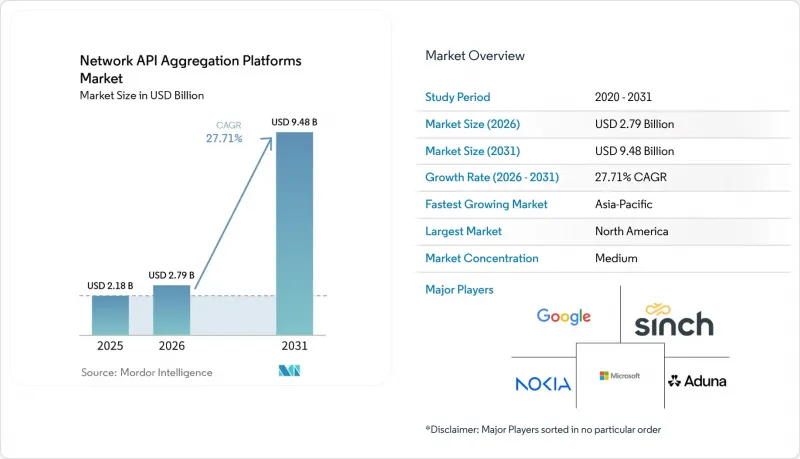
에 따르면 네트워크 API 집약 플랫폼 시장 규모는 2025년 21억 8,000만 달러, 2026년 27억 달러에서 2031년까지 94억 8,000만 달러로 확대될 것으로 예측되고 있으며, 2026-2031년까지 연평균 성장률(CAGR)은 27.71%에 달할 전망입니다.
전 세계 네트워크 API 통합 플랫폼 시장의 동향 및 인사이트
통합된 멀티 오퍼레이터 네트워크 액세스에 대한 수요 증가
기존에는 기업 개발자들이 각 이동통신사와 개별적으로 제휴 계약을 체결해야 했으므로 네트워크 인텔리전스의 활용 사례는 대규모 직접 계약처로 한정되어 있었습니다. 네트워크 API 통합 플랫폼 시장은 여러 통신사가 지원하는 단일 표준화된 엔드포인트를 통해 이러한 장벽을 해소합니다. 이러한 접근 방식을 통해 초기 API 통합에 소요되는 시간을 수개월에서 수시간으로 단축할 수 있습니다. Aduna는 2026년 3월, 미국, 독일, 스페인, 캐나다, 프랑스, 네덜란드의 40개 통신사업자로 확대되었으며, 호주, 브라질, 인도, 영국에서도 적극적으로 사업을 운영하고 있습니다. Google Cloud 마켓플레이스나 AWS 마켓플레이스를 활용함으로써, 기업은 통신 예산이 아닌 클라우드 인프라에 대한 투자를 통해 캐리어 인텔리전스를 확보할 수 있게 됩니다. 제조, 운송, 물류 업계에서는 네트워크 API 도입 준비도 평가가 100점 만점에 70점 이상을 기록하고 있으며, 통신 부문 이외의 분야에서도 수요가 있음을 보여주고 있습니다.
GSMA Open Gateway 및 CAMARA 표준화의 확대
CAMARA의 2025년 가을 메타 릴리스에는 10개의 안정화 API, 23개의 신규 API, 그리고 2025년 봄에 출시된 API 27건에 대한 업데이트가 포함되었습니다. 개발자가 최신 일관된 표준 규격 포트폴리오를 활용할 수 있게 됨에 따라 네트워크 API 통합 플랫폼 시장은 혜택을 받게 될 것입니다. 2026년 1분기까지 GSMA Open Gateway 인증 프로그램은 CAMARA의 태그가 지정된 릴리스 포트폴리오에서 33개의 인증된 API를 포함하게 되었으며, 40개가 추가로 개발 중입니다. 개방형 사양 덕분에 경쟁의 초점은 독자적인 인터페이스에서 네트워크 품질, 지역적 커버리지 및 서비스 수준 성능으로 이동하고 있습니다. 이러한 구조는 네트워크 API 통합 플랫폼 시장의 통합 사업자가 호환성이 더 높은 공급원을 연결할 수 있도록 지원합니다. TM Forum의 ODA TMF 93x Operate API, ETSI의 네트워크 노출 기능(NEF) 표준, 그리고 CAMARA의 거버넌스를 통해 API 정의는 공개된 기술 프로세스 내에서 유지되고 있습니다.
통신사업자의 API 도입 현황과 지역적 커버리지의 불균형
네트워크 API 집계 플랫폼 시장은 상용 API 제공 현황에 편차가 있다는 점으로 인해 여전히 제약을 받고 있습니다. GSMA Open Gateway의 보고서에 따르면 2026년 1분기 시점에 85개 네트워크에 걸쳐 280개의 상용 API 인스턴스가 배포되어 있었습니다. 아프리카, 동남아시아, 남미의 많은 통신사업자는 여전히 상용화 전 단계 또는 계획 단계에 머물러 있습니다. 가입자가 서비스 제공 범위 밖의 통신사업자 네트워크로 로밍할 경우, 전 세계적인 사기 방지 워크플로의 연속성이 깨져 SMS를 통한 인증으로 되돌아갈 수밖에 없습니다. 이로 인해 국경을 넘어 사업을 운영하는 기업에게 통합 플랫폼의 가치가 떨어지게 됩니다. 아프리카에는 54개국의 규제 체계가 존재하므로 보다 광범위한 확장을 위해서는 국가별 규정 준수 대응이 필요합니다.
부문 분석
2025년에는 도매 재판매업체에 의한 집약이 네트워크 API 집약 플랫폼 시장의 31.09%를 차지할 것으로 예상됩니다. 이 모델은 여러 통신사업자의 공급망에 걸쳐 단일 통합 엔드포인트를 제공합니다. CAMARA 준수 API 표준화는 통신사업자 간 인터페이스의 이질성을 줄임으로써 이 모델을 지원하고 있습니다. Aduna는 AT&T, 도이치 통신, 오렌지, 텔레포니카, 보다폰, 바티 에어텔, 릴라이언스 지오 등의 통신사업자로부터 공급되는 서비스를 통합하고 있습니다. ‘마켓플레이스 통합’ 모델에서는 개발자를 위해 하이퍼스케일러의 스토어프론트에 API를 배치합니다. 노키아는 2025년 7월 Google Cloud Marketplace에 ‘주문형 품질 보증(QoS)’, ‘번호 검증’, 그리고 ‘단말기 위치 정보 검증’을 게재할 예정입니다. Vonage는 2025년 12월에 AWS 마켓플레이스를 통해 자사의 네트워크 API 포트폴리오 제공을 시작할 예정입니다. ‘다이렉트 오퍼레이터’ 및 ‘멀티테넌트 애그리게이션’은 프라이빗 엔드포인트나 전용 서비스 수준 계약(SLA)이 필요한 고객을 지원합니다. 이러한 요구 사항은 공유 플랫폼에서의 데이터 상주성이 허용되지 않는 규제 대상 부문에서 특히 중요합니다.
‘페더레이션 및 익스체인지 애그리게이션’은 2026-2031년까지 연평균 성장률(CAGR) 28.87%로 확대될 것으로 예측됩니다. 네트워크 API 집계 플랫폼 시장의 이 부문은 집계자 간의 교환 및 통신사업자의 경계를 넘어 트래픽을 이동시키는 것을 가능하게 합니다. Aduna, Bridge Alliance의 BAEx 익스체인지, 그리고 지역 플랫폼은 양자 간 협력을 중복하지 않으면서도 커버리지를 확대할 수 있습니다. Syniverse는 2025년 6월 Aduna와 제휴하여 Aduna의 통합 플랫폼을 통해 기업 고객에게 SIM 스왑, 번호 검증 및 단말기 위치 정보 API를 제공할 전망입니다. Syniverse는 금융 서비스, 여행, 소매, 미디어 등 다양한 분야의 Global 2000 기업에 연간 1조 건 이상의 메시지를 전달하고 있습니다. 연방을 통해 각 플랫폼이 통신사업자와 개별적으로 연결을 구축해야 할 필요성이 줄어듭니다. 또한 플랫폼 경계를 넘어 결제 및 계측을 표준화할 수도 있습니다. TM Forum의 ODA TMF 93x Operate API는 연방 트랜잭션을 위한 거버넌스 기준을 제공합니다.
2025년에는 퍼블릭 클라우드가 시장의 38.11%를 차지할 것으로 예상됩니다. 개발자들은 종량제나 트랜잭션 단위의 API 과금을 지원하는 유연한 인프라를 선호합니다. Vonage, Sinch, Infobip은 서비스 출시 시점부터 Aduna의 개발자 플랫폼 파트너였으며, 클라우드 네이티브 제공 모델을 운영하고 있습니다. 프라이빗 클라우드 배포는 특히 가입자 수준 데이터에 전송 제한이 부과된 시장에서 데이터 상주 요건을 충족시킵니다. 온프레미스 및 통신사 호스팅 모델은 가입자 데이터에 대한 관리 권한을 제3자 플랫폼에 양도하고 싶지 않은 Tier 1 통신사에게 여전히 중요한 선택지로 남아 있습니다. 또한 국가 안보 요건으로 인해 국내에서 처리가 요구되는 경우도 있습니다. 도입 결정은 개발자에 대한 폭넓은 접근성과 통신사업자의 관리 권한 간의 균형을 반영한 것입니다. 이러한 균형으로 인해 동일한 플랫폼 포트폴리오 내에서 여러 가지 도입 접근 방식이 필요하게 되었습니다.
네트워크 API 통합 플랫폼 시장에서 하이브리드 클라우드는 2026-2031년까지 연평균 성장률(CAGR) 29.66%로 확대될 것으로 예측됩니다. 하이브리드 모델에서는 통신사업자가 관리하는 환경이나 주권 환경에서 네트워크 노출 기능(NEF)의 통합 및 동의 관리를 유지하면서, 개발자용 게이트웨이와 소프트웨어 개발 키트(SDK)를 퍼블릭 클라우드 환경에 배치합니다. 이러한 구성을 통해 네트워크 API 통합 플랫폼 시장은 기밀 데이터에 대한 로컬 관리를 유지하면서 개발자의 액세스를 지원할 수 있게 됩니다. Heksagon의 ‘Network API Operator Platform’은 단일 기술 계층 내에서 OAuth2 흐름, GDPR을 준수하는 동의 거버넌스, 그리고 테넌트 수준의 접근 제어를 통합하고 있습니다. 이러한 접근 방식은 공급자가 규정 준수 요건을 제품 계층에 어떻게 통합하고 있는지를 보여줍니다. 하이브리드 배포를 통해 통신사업자의 관리와 개발자를 위한 유연한 서비스 제공 사이의 격차를 좁힐 수 있습니다. 다만, 국가별 개인정보 보호 요건을 준수할 필요가 없어지는 것은 아닙니다. 오히려 서로 다른 환경에 걸쳐 이러한 요건을 관리하기 위한 프레임워크를 제공하는 것입니다.
지역별 분석
2025년, 북미는 네트워크 API 통합 플랫폼 시장 점유율의 28.98%를 차지했습니다. AT&T, T-Mobile, Verizon의 상용 배포가 이 지역의 선도적 지위를 지원했습니다. 2026년 2월, Aduna는 미국의 주요 통신사 3곳 모두와 계약을 체결하여 3억 건 이상의 연결을 지원했습니다. 이러한 계약을 통해 미국의 주요 통신사 전체에서 CAMARA를 준수하는 포괄적인 번호 검증 및 SIM 스왑 처리가 가능해집니다. 또한 해당 지역에는 통신사가 집중되어 있으며, 광범위한 커버리지를 실현하는 데 필요한 양자 간 협력의 수를 줄일 수도 있습니다.
아시아태평양은 2026-2031년까지 연평균 성장률(CAGR) 29.87%로 성장할 것으로 예측됩니다. 인도의 핀테크 수요, 일본의 대규모 통신사업자 생태계, 그리고 중국의 대규모 앱 경제가 이 지역에서의 도입을 지원하고 있습니다. 9,100만 명 이상의 가입자에게 서비스를 제공하는 NTT 도코모는 2026년 1월 29일자로 Aduna와 제휴 계약을 체결했습니다. 이 계약을 통해 Aduna의 글로벌 플랫폼을 통해 도코모의 번호 인증 및 SIM 스왑 API 제공이 가능해집니다. 차이나모바일(China Mobile)은 CAMARA의 번호 인증을 통해 인증 절차의 번거로움이 줄어들었고, 앱내 광고의 전환율이 2배로 증가했다고 보고했습니다.
중동 및 아프리카는 네트워크 API 통합 플랫폼 시장에서 독특한 상업적 조건을 보이고 있습니다. 사우디아라비아와 아랍에미리트는 ‘Open Gateway’ 준수 및 5G 독립형(SA) 프로그램을 통해 진전을 이루고 있습니다. NetAPI Telecom은 동·서·남아프리카를 아우르는 채널 파트너로서 GSMA Open Gateway에 가입했습니다. 그러나 아프리카 54개국의 규제 체계는 여전히 광범위한 상용화를 위한 큰 제약 요인으로 작용하고 있습니다. 남미는 여전히 발전의 초기 단계에 있지만, Aduna의 브라질 진출 계획은 이 지역 최대 핀테크 시장에서 나타나는 수요를 반영하고 있습니다.
기타 혜택:
- 엑셀 형식의 시장 예측(ME) 시트
- 3개월간의 애널리스트 지원
자주 묻는 질문
목차
제1장 서론
- 조사 전제조건과 시장 정의
- 조사 범위
제2장 조사 방법
제3장 개요
제4장 시장 구도
- 시장 개요
- 시장 성장 촉진요인
- 시장 성장 억제요인
- 업계 밸류체인 분석
- 규제 상황
- 기술 전망
- 거시경제 요인이 시장에 미치는 영향
- Porter's Five Forces 분석
제5장 시장 규모와 성장 예측
- 플랫폼 모델별
- 배포 모델별
- 최종사용자별
- 용도별
- 지역별
- 북미
- 미국
- 캐나다
- 멕시코
- 남미
- 브라질
- 아르헨티나
- 기타 남미 국가
- 유럽
- 영국
- 독일
- 프랑스
- 스페인
- 기타 유럽 국가
- 아시아태평양
- 중국
- 일본
- 인도
- 한국
- 기타 아시아태평양 국가
- 중동
- 사우디아라비아
- 아랍에미리트
- 기타 중동 국가
- 아프리카
- 남아프리카공화국
- 나이지리아
- 기타 아프리카 국가
- 북미
제6장 경쟁 구도
- 시장 집중도
- 전략적 동향
- 시장 점유율 분석
- 기업 개요
- Aduna AB
- Telefonaktiebolaget LM Ericsson
- Nokia Corporation
- Vonage Holdings Corp.
- Infobip Ltd.
- Bridge Alliance Cooperatief U.A.
- Sinch AB
- Google LLC
- Microsoft Corporation
- Proximus Global SA
- Telesign Corporation
- Route Mobile Limited
- Syniverse Technologies, LLC
- Comviva Technologies Limited
- Axonect
- Glide Identity, Inc.
- Sekura.id Ltd.
- NetAPI Telecom
- Heksagon
- Shabodi
제7장 시장 기회와 향후 전망
KSA 26.10.28According to Mordor Intelligence, the network API aggregation platforms market size is projected to expand from USD 2.18 billion in 2025 and USD 2.7 billion in 2026 to USD 9.48 billion by 2031, registering a CAGR of 27.71% between 2026 to 2031.
Global Network API Aggregation Platforms Market Trends and Insights
Rising Demand for Unified Multi-Operator Network Access
Enterprise developers historically needed separate integration agreements with each mobile operator, which limited network-intelligence use cases to large direct accounts. The network API aggregation platforms market addresses this barrier through one normalized endpoint supported by multiple operators. This approach can reduce the time to a first API integration from months to hours. Aduna expanded to 40 mobile operators across the United States, Germany, Spain, Canada, France, and the Netherlands in March 2026, while Australia, Brazil, India, and the United Kingdom were in its active pipeline. Google Cloud Marketplace and AWS Marketplace allow enterprises to acquire carrier intelligence through cloud infrastructure spending instead of telecom budgets. Manufacturing, transport, and logistics each scored above 70 out of 100 for network API adoption readiness, indicating demand beyond communications teams.
Expansion of GSMA Open Gateway and CAMARA Standardization
CAMARA's Fall 2025 meta-release included 10 stable APIs, 23 new APIs, and 27 updates to Spring 2025 APIs. The network API aggregation platforms market benefits when developers can work with a current and consistent portfolio of standards. By the first quarter of 2026, the GSMA Open Gateway Certification program covered 33 certified APIs from CAMARA's tagged release portfolio, with 40 more in development. Open specifications shift competition toward network quality, geographic reach, and service-level performance instead of proprietary interfaces. This arrangement supports aggregators in the network API aggregation platforms market by enabling them to connect more interchangeable supply. The TM Forum ODA TMF 93x Operate APIs, ETSI's Network Exposure Function standard, and CAMARA governance keep API definitions in public technical processes.
Uneven Operator API Readiness and Geographic Coverage
The network API aggregation platforms market remains constrained by unequal commercial API availability. The GSMA Open Gateway reported 280 commercially launched API instances across 85 networks in the first quarter of 2026. Many operators in Africa, Southeast Asia, and South America remained in pre-commercial or planning phases. A global fraud workflow can lose continuity when a subscriber roams onto an operator with no coverage, necessitating a return to SMS verification. This weakens the value of a unified platform for enterprises with cross-border operations. Africa faces 54 national regulatory frameworks, requiring country-level compliance work before a wider rollout can scale.
Other drivers and restraints analyzed in the detailed report include:
- 5G Standalone and Edge Capability Monetization
- Real-Time Fraud Prevention and Passwordless Authentication Demand
- Consent, Privacy, and Data-Sovereignty Friction
For complete list of drivers and restraints, kindly check the Table Of Contents.
Segment Analysis
Wholesale Reseller Aggregation is expected to account for 31.09% of the network API aggregation platforms market in 2025. This model provides a single integration endpoint across multiple operator supply chains. CAMARA-compliant API normalization supports this model by reducing variations among operator interfaces. Aduna aggregates supply from operators, including AT&T, Deutsche Telekom, Orange, Telefonica, Vodafone, Bharti Airtel, and Reliance Jio. The Marketplace Aggregation model places APIs in hyperscaler storefronts for developers. Nokia is expected to list Quality of Service on Demand, Number Verification, and Device Location Verification on Google Cloud Marketplace in July 2025. Vonage is expected to make its network API portfolio available through AWS Marketplace in December 2025. Direct Operator and Multi-Tenant Aggregation serve clients that require private endpoints and dedicated service-level agreements. These requirements are particularly relevant in regulated sectors where shared-platform data residency is unacceptable.
Federation and Exchange Aggregation is projected to expand at a CAGR of 28.87% from 2026 to 2031. This segment of the network API aggregation platforms market enables traffic to move across inter-aggregator exchanges and operator boundaries. Aduna, Bridge Alliance's BAEx exchange, and regional platforms can extend coverage without duplicating bilateral integrations. Syniverse is expected to partner with Aduna in June 2025 to provide SIM Swap, Number Verification, and Device Location APIs to its enterprise clients through Aduna's unified platform. Syniverse delivers more than 1 trillion messages annually to Global 2000 enterprises across financial services, travel, retail, and media. Federation reduces the need for each platform to establish every operator connection independently. It can also standardize settlement and metering across platform boundaries. TM Forum's ODA TMF 93x Operate APIs provide a governance reference for federation transactions.
Public Cloud is expected to account for 38.11% of the market in 2025. Developers favor elastic infrastructure that supports consumption-based pricing and transaction-level API billing. Vonage, Sinch, and Infobip are Aduna's developer-platform partners at launch and operate cloud-native delivery models. Private Cloud deployments address data-residency requirements, particularly in markets where subscriber-level data is subject to transfer restrictions. On-Premises and Operator-Hosted models remain relevant for Tier-1 operators that do not want to transfer custody of subscriber data to a third-party platform. National security requirements may also require in-country processing. Deployment decisions reflect the balance between broad developer access and operator control. This balance has created a need for multiple deployment approaches within the same platform portfolio.
Hybrid Cloud is projected to expand at a CAGR of 29.66% from 2026 to 2031 in the network API aggregation platforms market. Hybrid models retain operator-side Network Exposure Function integrations and consent management in operator-hosted or sovereign environments while placing developer-facing gateways and software development kits in public cloud environments. This arrangement enables the network API aggregation platforms market to support developer access while maintaining local controls over sensitive data. Heksagon's Network API Operator Platform includes OAuth2 flows, GDPR-aligned consent governance, and tenant-level access controls within a single technical layer. This approach demonstrates how providers are incorporating compliance requirements into the product layer. Hybrid deployment can narrow the gap between operator control and flexible developer delivery. However, it does not eliminate the need to comply with country-specific privacy requirements. Instead, it provides a framework for managing these requirements across different environments.
Complete Report Scope:
- By Platform Model
- Wholesale Reseller Aggregation
- Marketplace Aggregation
- Federation and Exchange Aggregation
- Direct Operator and Multi-Tenant Aggregation
- By Deployment Model
- Public Cloud
- Private Cloud
- Hybrid Cloud
- On-Premises and Operator-Hosted
- By End User
- Mobile Network Operators and Communication Service Providers
- Enterprises
- Communications Platform as a Service Providers
- Hyperscalers and Cloud Marketplaces
- Other End Users
- By Application
- Fraud Detection and Prevention
- Authentication and Account Security
- Customer Experience and Personalization
- Industrial Internet of Things and Connected Devices
- Mobility, Logistics, and Autonomous Systems
- Other Applications
- By Geography
- North America
- United States
- Canada
- Mexico
- South America
- Brazil
- Argentina
- Rest of South America
- Europe
- United Kingdom
- Germany
- France
- Spain
- Rest of Europe
- Asia-Pacific
- China
- Japan
- India
- South Korea
- Rest of Asia-Pacific
- Middle East
- Saudi Arabia
- United Arab Emirates
- Rest of Middle East
- Africa
- South Africa
- Nigeria
- Rest of Africa
- North America
Geography Analysis
North America accounted for 28.98% of the network API aggregation platforms market share in 2025. Commercial rollouts by AT&T, T-Mobile, and Verizon supported the region's leading position. In February 2026, Aduna secured agreements with all three major United States carriers, covering more than 300 million connections. These agreements provide comprehensive CAMARA-compliant Number Verification and SIM Swap coverage across the major United States carriers. The region's concentrated carrier base also reduces the number of bilateral integrations required to achieve broad coverage.
Asia-Pacific is projected to grow at a CAGR of 29.87% from 2026 to 2031. Fintech demand in India, Japan's large operator ecosystem, and China's high-volume app economy are supporting regional adoption. NTT DOCOMO, which serves more than 91 million subscribers, entered into a partnership with Aduna effective January 29, 2026. The agreement enables Aduna's global platform to distribute DOCOMO's Number Verification and SIM Swap APIs. China Mobile reported that CAMARA Number Verification doubled in-app advertising conversion rates by reducing verification friction.
The Middle East and Africa present distinct commercial conditions for the network API aggregation platforms market. Saudi Arabia and the United Arab Emirates are advancing through Open Gateway alignment and 5G Standalone programs. NetAPI Telecom joined the GSMA Open Gateway as a channel partner serving East, West, and Southern Africa. However, Africa's 54 national regulatory frameworks remain a significant constraint on broader commercial deployment. South America remains at an earlier stage of development, although Aduna's planned expansion into Brazil reflects demand in the region's largest fintech market.
- Aduna AB
- Telefonaktiebolaget LM Ericsson
- Nokia Corporation
- Vonage Holdings Corp.
- Infobip Ltd.
- Bridge Alliance Cooperatief U.A.
- Sinch AB
- Google LLC
- Microsoft Corporation
- Proximus Global SA
- Telesign Corporation
- Route Mobile Limited
- Syniverse Technologies, LLC
- Comviva Technologies Limited
- Axonect
- Glide Identity, Inc.
- Sekura.id Ltd.
- NetAPI Telecom
- Heksagon
- Shabodi
Additional Benefits:
- The market estimate (ME) sheet in Excel format
- 3 months of analyst support
TABLE OF CONTENTS
1 INTRODUCTION
- 1.1 Study Assumptions and Market Definition
- 1.2 Scope of the Study
2 RESEARCH METHODOLOGY
3 EXECUTIVE SUMMARY
4 MARKET LANDSCAPE
- 4.1 Market Overview
- 4.2 Market Drivers
- 4.2.1 Rising Demand for Unified Multi-Operator Network Access
- 4.2.2 Expansion of GSMA Open Gateway and CAMARA Standardization
- 4.2.3 5G Standalone and Edge Capability Monetization
- 4.2.4 Real-Time Fraud Prevention and Passwordless Authentication Demand
- 4.2.5 Hyperscaler Marketplace Distribution of Network Capabilities
- 4.2.6 Agentic AI Consumption of Network APIs
- 4.3 Market Restraints
- 4.3.1 Uneven Operator API Readiness and Geographic Coverage
- 4.3.2 Consent, Privacy, and Data-Sovereignty Friction
- 4.3.3 Unclear Value Capture Across Operators, Aggregators, and Developers
- 4.3.4 Fragmented API Versions, SLAs, and Operational Processes
- 4.4 Industry Value Chain Analysis
- 4.5 Regulatory Landscape
- 4.5.1 Privacy, Consent, and Data Protection
- 4.5.2 Communications and Electronic Identification Rules
- 4.5.3 Cross-Border Data Transfer and Data Localization
- 4.5.4 Competition, Interoperability, and Open Standards
- 4.6 Technological Outlook
- 4.6.1 CAMARA Service APIs and GSMA Open Gateway
- 4.6.2 TM Forum Operate APIs
- 4.6.3 5G Core Network Exposure Function and Service Exposure
- 4.6.4 API Gateway, Federation, Routing, and Normalization
- 4.6.5 Developer Portals, SDKs, Sandboxes, and Observability
- 4.6.6 AI Agents, Model Context Protocol, and Intent-Based Consumption
- 4.7 Impact of Macroeconomic Factors on the Market
- 4.8 Porter's Five Forces Analysis
- 4.8.1 Bargaining Power of Network Operators
- 4.8.2 Bargaining Power of Developers and Enterprise Buyers
- 4.8.3 Threat of New Entrants
- 4.8.4 Threat of Substitutes
- 4.8.5 Competitive Rivalry
5 MARKET SIZE AND GROWTH FORECASTS (VALUE)
- 5.1 By Platform Model
- 5.1.1 Wholesale Reseller Aggregation
- 5.1.2 Marketplace Aggregation
- 5.1.3 Federation and Exchange Aggregation
- 5.1.4 Direct Operator and Multi-Tenant Aggregation
- 5.2 By Deployment Model
- 5.2.1 Public Cloud
- 5.2.2 Private Cloud
- 5.2.3 Hybrid Cloud
- 5.2.4 On-Premises and Operator-Hosted
- 5.3 By End User
- 5.3.1 Mobile Network Operators and Communication Service Providers
- 5.3.2 Enterprises
- 5.3.3 Communications Platform as a Service Providers
- 5.3.4 Hyperscalers and Cloud Marketplaces
- 5.3.5 Other End Users
- 5.4 By Application
- 5.4.1 Fraud Detection and Prevention
- 5.4.2 Authentication and Account Security
- 5.4.3 Customer Experience and Personalization
- 5.4.4 Industrial Internet of Things and Connected Devices
- 5.4.5 Mobility, Logistics, and Autonomous Systems
- 5.4.6 Other Applications
- 5.5 By Geography
- 5.5.1 North America
- 5.5.1.1 United States
- 5.5.1.2 Canada
- 5.5.1.3 Mexico
- 5.5.2 South America
- 5.5.2.1 Brazil
- 5.5.2.2 Argentina
- 5.5.2.3 Rest of South America
- 5.5.3 Europe
- 5.5.3.1 United Kingdom
- 5.5.3.2 Germany
- 5.5.3.3 France
- 5.5.3.4 Spain
- 5.5.3.5 Rest of Europe
- 5.5.4 Asia-Pacific
- 5.5.4.1 China
- 5.5.4.2 Japan
- 5.5.4.3 India
- 5.5.4.4 South Korea
- 5.5.4.5 Rest of Asia-Pacific
- 5.5.5 Middle East
- 5.5.5.1 Saudi Arabia
- 5.5.5.2 United Arab Emirates
- 5.5.5.3 Rest of Middle East
- 5.5.6 Africa
- 5.5.6.1 South Africa
- 5.5.6.2 Nigeria
- 5.5.6.3 Rest of Africa
- 5.5.1 North America
6 COMPETITIVE LANDSCAPE
- 6.1 Market Concentration
- 6.2 Strategic Moves
- 6.3 Market Share Analysis
- 6.4 Company Profiles (includes Global Level Overview, Market Level Overview, Core Segments, Financials as available, Strategic Information, Market Rank/Share, Products and Services, Recent Developments)
- 6.4.1 Aduna AB
- 6.4.2 Telefonaktiebolaget LM Ericsson
- 6.4.3 Nokia Corporation
- 6.4.4 Vonage Holdings Corp.
- 6.4.5 Infobip Ltd.
- 6.4.6 Bridge Alliance Cooperatief U.A.
- 6.4.7 Sinch AB
- 6.4.8 Google LLC
- 6.4.9 Microsoft Corporation
- 6.4.10 Proximus Global SA
- 6.4.11 Telesign Corporation
- 6.4.12 Route Mobile Limited
- 6.4.13 Syniverse Technologies, LLC
- 6.4.14 Comviva Technologies Limited
- 6.4.15 Axonect
- 6.4.16 Glide Identity, Inc.
- 6.4.17 Sekura.id Ltd.
- 6.4.18 NetAPI Telecom
- 6.4.19 Heksagon
- 6.4.20 Shabodi
7 MARKET OPPORTUNITIES AND FUTURE OUTLOOK
- 7.1 White-Space and Unmet-Need Assessment


