

|
시장보고서
상품코드
2155271
머신 비전 소프트웨어 : 시장 점유율 분석, 업계 동향과 통계, 성장 예측(2026-2031년)Machine Vision Software - Market Share Analysis, Industry Trends & Statistics, Growth Forecasts (2026 - 2031) |
||||||
 Mordor Intelligence
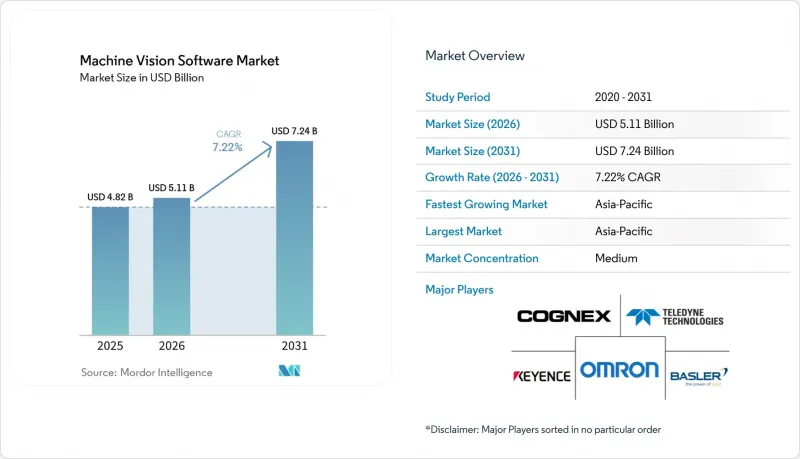
에 따르면 머신 비전 소프트웨어 시장 규모는 2025년에 48억 2,000만 달러로 평가되며, 2026년 51억 1,000만 달러에서 2031년까지 72억 4,000만 달러에 달할 것으로 예측되고 있으며, 예측 기간(2026-2031년)에 CAGR은 7.22%에 달할 전망입니다.
전 세계 머신 비전 소프트웨어 시장의 동향 및 인사이트
무결점 제조 및 자동 검사
표본 검사에서 포괄적인 인라인 검사로의 전환은 머신 비전 소프트웨어 시장의 수요를 견인하는 핵심 요인으로 계속 작용하고 있습니다. OEM 계약에서는 수작업 검사로는 일관되게 달성할 수 없는 극히 낮은 결함 허용치가 설정되는 사례가 늘고 있습니다. 딥러닝 모델은 통제된 환경에서 매우 높은 검출 정확도를 달성했으나, 최근 조사에 따르면 보고된 구현 사례의 상당수는 여전히 프로토타입 또는 파일럿 단계에 머물러 있습니다. 이는 여러 공장에 걸친 도입을 지원할 수 있는 공급업체에게 큰 사업 확장 기회가 됩니다. 자동차 및 의료기기의 품질 요구 사항 역시 재현 가능하고 검증 가능한 기록을 제공하는 검사 시스템을 선호하는 경향이 있습니다. 검사 결과가 단순한 독립적인 품질 기록에 그치지 않고, 제조 실행 시스템을 통해 시정 조치를 촉발할 경우 소프트웨어의 가치는 더욱 높아집니다.
비전 워크플로우에서의 AI 및 딥러닝 도입
딥러닝은 머신 비전 소프트웨어 시장을 혁신하고 있습니다. 기존 공급업체들은 신경망 기능을 추가해야 할 필요에 직면한 반면, AI 네이티브 공급업체들이 기존 검사 애플리케이션 시장에 진입하고 있기 때문입니다. 도입이 가장 활발한 분야는 엄격한 공차와 제품 편차로 인해 고정된 검사 규칙의 유효성이 제한되는 자동차, 전자, 물류 분야입니다. 2026년 3월에 발표된 코그넥스(Cognex)의 조사에 따르면 응답자의 57%가 이미 머신 비전 업무에 AI를 활용하고 있으며, 30%는 가까운 시일 내에 도입할 계획인 것으로 나타났습니다. MVTec은 2026년 5월, AI 및 규칙 기반 성능 향상, 다중 모달 시각적 프롬프트, 훈련 이미지 요구 사항을 줄여주는 툴을 갖춘 ‘HALCON 26.05’를 출시했습니다. 비전문가도 모델을 구축하고 유지 관리할 수 있는 이 플랫폼은 비전과 AI 통합을 담당할 인력 부족이라는 과제를 해결할 수 있습니다. 이러한 사용 편의성을 중시하는 노력을 통해 기존에는 전문 엔지니어링 팀이 필요했던 애플리케이션의 범위를 넘어 도입 범위를 확대할 수 있게 됩니다.
통합 비전 셀의 높은 총 소유 비용
통합 비전 셀의 총 소유 비용은 머신 비전 소프트웨어 시장, 특히 중규모 제조업체에게 큰 제약 요인으로 작용하고 있습니다. 여러 라인에 도입하기 위한 통합 서비스 비용은 AI 모델 훈련, 운영자 교육 및 후속 재교육 비용을 포함하지 않더라도 1만 5,000달러에서 4만 5,000달러에 달할 수 있습니다. 인용된 벤치마크에 따르면 첫해 도입 비용 중 하드웨어 감가상각비와 통합 작업비가 52%를 차지했습니다. 이후 비용은 소프트웨어, 지원 및 지속적인 운영비로 전환되지만, 이는 장비의 일회성 구매를 중심으로 한 조달 계획과 상충될 수 있습니다. 코그넥스는 2026년 5월 ‘OneVision’을 일반에 공개했으며, 도입 규모 확대에 따라 최대 50%의 비용 절감을 실현했다고 보고했습니다. 모델 관리의 일원화를 통해 일부 비용 문제는 해결할 수 있지만, 구매자는 장기적인 구독 및 플랫폼에 대한 의존도에 대해서도 평가해야 합니다.
부문 분석
2025년, 비전 검사 및 품질 보증 소프트웨어는 머신 비전 소프트웨어 시장 점유율의 33.21%를 차지했습니다. 이러한 확고한 입지는 자동차, 소비자 가전, 식품 포장 라인에서의 결함 탐지에 대한 장기적인 활용을 반영합니다. AI 및 딥러닝 비전 소프트웨어 시장 규모는 2031년까지 연평균 성장률(CAGR) 8.63%로 확대될 것으로 예측됩니다. 이러한 성장은 제품의 외관상 편차, 새로운 결함 패턴, 혹은 복잡한 표면 형상이 존재할 때 규칙 기반 툴이 직면하는 과제와 관련이 있습니다. 항공우주, 특수 화학, 의료기기 분야의 소량 다품종 제조업체들은 방대한 실제 결함 이미지 라이브러리가 아닌, 합성 결함 데이터를 활용하여 모델을 학습시키는 사례가 증가하고 있습니다.
비전 개발 및 프로그래밍 소프트웨어는 맞춤형 애플리케이션을 구축하는 통합 업체나 사내 엔지니어링 팀에게 여전히 중요한 역할을 하고 있습니다. 또한 이미지 처리 및 분석 소프트웨어는 특수한 측정이나 분류가 필요한 애플리케이션의 핵심 인프라로 자리 잡고 있습니다. HALCON 26.05에서는 AI 및 규칙 기반 기법의 처리 속도 향상, 멀티모달 언어 모델 지원, 그리고 물체 탐지 기능 강화가 추가되었습니다. 보정, 구성 및 시스템 관리 툴은 비전 시스템 도입 대수가 증가함에 따라 확대되는 추세입니다. 공급업체들은 이러한 기능을 개별 라이선스로 판매하는 대신, 구독 서비스에 포함시키는 사례가 늘고 있습니다. 이러한 접근 방식을 통해 고객 1인당 소프트웨어 수익을 향상시키는 동시에, 하드웨어 중심의 구매 결정 과정에서 비용 가시성을 낮출 수 있습니다.
2025년에는 온프레미스 및 엣지 소프트웨어가 매출의 72.34%를 차지했습니다. 이러한 상황은 분당 200대 이상으로 가동되는 생산 라인에서 10밀리초 이내에 추론 결과를 받아야 하는 요구를 반영하고 있습니다. 클라우드 기반 소프트웨어는 2031년까지 연평균 성장률(CAGR) 7.89%로 확대될 것으로 예측됩니다. 머신 비전 소프트웨어 시장에서는 주로 모델의 중앙 집중식 훈련, 버전 관리, 거점 간 거버넌스 및 집계 분석을 위해 클라우드 시스템이 활용되고 있습니다. 검사 판정이 불량품 제거 장치를 제어하는 경우, 클라우드를 이용한다고 해서 로컬 실행 요건이 사라지는 것은 아닙니다. 따라서 생산 라인에서의 신속한 판정과 모델 관리의 연동을 모두 필요로 하는 제조업체에게 하이브리드 아키텍처가 중요해집니다.
코그넥스는 2026년 5월, 클라우드-투-엣지 환경으로서 ‘OneVision’을 발표했습니다. 이 솔루션은 중앙 집중식 훈련과 거버넌스를 지원하는 동시에, 생산 중에는 클라우드 연결이 없어도 로컬에서 검사를 계속할 수 있도록 합니다. 이 아키텍처를 통해 일상적인 검사를 엣지 측에서 수행함으로써 지연, 대역폭 및 공장 현장에 대한 노출을 억제할 수 있습니다. 하이브리드 배포는 100개 이상의 검사 지점을 운영하는 기업에 특히 효과적입니다. 이러한 환경에서는 엣지 디바이스가 대부분의 이미지 프레임을 로컬에서 필터링하고, 클라우드 툴이 플래그가 지정된 사례나 재훈련을 관리합니다. 따라서 머신 비전 소프트웨어 시장은 단순히 온프레미스 시스템에서 클라우드로의 전환이 아니라, 로컬 실행과 중앙 집중식 거버넌스를 결합한 모델로 발전하고 있습니다.
지역별 분석
아시아태평양은 2025년 매출의 34.88%를 차지할 것으로 예상되며, 2031년까지 연평균 성장률(CAGR) 8.71%로 성장할 것으로 전망됩니다. 이 지역의 머신 비전 소프트웨어 시장은 대규모 제조 기반에 더해 배터리 공장, 반도체 제조, 전자기기 조립 분야에 대한 광범위한 투자가 결합되어 있습니다. 중국은 배터리 기가팩토리 및 반도체 생산 능력 확충을 통해 지속적인 조달 수요를 주도하고 있습니다. 일본에서는 키엔스가 반도체 백엔드 검사 분야에서 라이선싱을 시스템 계약에 포함시키고 있으며, 독자적인 시장 구조를 형성하고 있습니다. 인도에서는 전 세계 OEM 기업이 인도내 생산을 확대하는 가운데, ‘생산 연계 인센티브(PLI)’ 프로그램을 통해 전자기기 제조 능력을 확충하고 있습니다.
북미는 2025년에 2위 규모를 자랑하는 지역이었습니다. 머신 비전 소프트웨어 시장은 자동차 조립, 항공우주, 의료기기 생산 및 첨단 반도체 제조에 의해 지원되고 있습니다. 이 지역에서는 AI 네이티브 개발 플랫폼, 클라우드에서 엣지에 이르는 모델 관리, 그리고 의약품 추적 가능성이 더욱 중시되고 있습니다. 이러한 용도는 하드웨어 중심의 도입에 비해 더 높은 소프트웨어 라이선스 가치와 더 많은 지속적인 구독 수익을 창출할 가능성이 있습니다. 북미의 각 OEM 기업이 자동차 생산을 니어쇼어화하고, 전체 제조 네트워크에 걸쳐 공통된 품질 기준을 적용함에 따라 멕시코는 중요한 조달 거점으로 부상하고 있습니다.
유럽은 독일에 밀집해 있는 자동차 OEM 및 1차 공급업체 기반이 특징입니다. 2026년에 가동을 시작하는 BMW의 우드러프 공장에 설치된 6세대 배터리 생산 라인에서는 용접 비드에 대한 AI 지원 인라인 검사와 최종 공정에서의 배터리 100% 검사가 도입되었습니다. 영국, 프랑스, 이탈리아, 스페인에서는 자동차, 항공우주, 식품 포장, 의약품 제조 분야의 수요가 시장을 지탱하고 있습니다. 유럽의 구매자들은 사이버 보안, 감사 추적, 그리고 연결형 검사 시스템의 온프레미스 도입 옵션을 점점 더 중요하게 여기고 있습니다. 중동 및 남미는 여전히 소규모 시장이지만, 사우디아라비아와 UAE의 그린필드 투자, 그리고 브라질의 자동차 및 식품 가공 분야 수요가 새로운 도입을 촉진하고 있습니다.
기타 혜택:
- 엑셀 형식의 시장 예측(ME) 시트
- 3개월간의 애널리스트 지원
자주 묻는 질문
목차
제1장 서론
- 조사 전제조건과 시장 정의
- 조사 범위
제2장 조사 방법
제3장 개요
제4장 시장 구도
- 시장 개요
- 시장 성장 촉진요인
- 시장 성장 억제요인
- 거시경제 요인이 시장에 미치는 영향
- 업계 밸류체인 분석
- 규제 상황
- 기술 전망
- Porter's Five Forces 분석
제5장 시장 규모와 성장 예측
- 소프트웨어 유형별
- 배포 모델별
- 용도별
- 산업 분야별
- 지역별
- 북미
- 미국
- 캐나다
- 멕시코
- 남미
- 브라질
- 아르헨티나
- 칠레
- 기타 남미 국가
- 유럽
- 독일
- 영국
- 프랑스
- 이탈리아
- 스페인
- 기타 유럽 국가
- 아시아태평양
- 중국
- 일본
- 인도
- 한국
- 호주
- 기타 아시아태평양 국가
- 중동
- 아랍에미리트
- 사우디아라비아
- 카타르
- 기타 중동 국가
- 아프리카
- 남아프리카공화국
- 이집트
- 나이지리아
- 기타 아프리카 국가
- 북미
제6장 경쟁 구도
- 시장 집중도
- 전략적 동향
- 시장 점유율 분석
- 기업 개요
- Cognex Corporation
- Keyence Corporation
- Teledyne Technologies Incorporated
- Omron Corporation
- Basler AG
- Zebra Technologies Corporation
- SICK AG
- MVTec Software GmbH
- National Instruments Corporation
- Datalogic S.p.A.
- Atlas Copco AB
- TKH Group N.V.
- Stemmer Imaging AG
- Vitronic GmbH
- ISRA VISION AG
- Landing AI, Inc.
- NVIDIA Corporation
- Siemens AG
제7장 시장 기회와 향후 전망
KSA 26.10.28According to Mordor Intelligence, the machine vision software market size was valued at USD 4.82 billion in 2025 and estimated to grow from USD 5.11 billion in 2026 to reach USD 7.24 billion by 2031, at a CAGR of 7.22% during the forecast period (2026-2031).
Global Machine Vision Software Market Trends and Insights
Zero-Defect Manufacturing and Automated Inspection
The shift from sample checks to comprehensive inline inspection remains a central driver of demand in the machine vision software market. OEM contracts increasingly set extremely low defect limits that manual inspection cannot consistently meet. Deep learning models achieved very high detection accuracy in controlled settings, although most documented implementations remained at the prototype or pilot stage in a recent review. This presents a substantial rollout opportunity for suppliers capable of supporting deployment across several plants. Automotive and medical device quality requirements also favor inspection systems that provide repeatable and verifiable records. The value of the software increases when inspection results trigger corrective action through manufacturing execution systems rather than remaining a standalone quality record.
AI and Deep-Learning Adoption in Vision Workflows
Deep learning is changing the machine vision software market, as legacy suppliers must add neural network capabilities while AI-native suppliers enter established inspection applications. Adoption is strongest in automotive, electronics, and logistics, where tight tolerances and product variation limit the effectiveness of fixed inspection rules. A Cognex survey published in March 2026 found that 57% of respondents already used AI in machine vision operations and 30% planned near-term deployment. MVTec released HALCON 26.05 in May 2026 with improved AI and rule-based performance, multimodal visual prompting, and tools to reduce training image requirements. Platforms that allow non-specialists to build and maintain models can address the limited supply of vision-AI integration talent. This emphasis on usability can expand adoption beyond applications that have historically required specialist engineering teams.
High Total Cost of Ownership for Integrated Vision Cells
The total cost of an integrated vision cell is a material restraint for the machine vision software market, particularly for mid-sized manufacturers. Integration services for multi-line deployments can cost USD 15,000 to USD 45,000 before AI model training, operator training, and later retraining costs are included. Hardware amortization and integration labor represented 52% of the first-year deployment cost in the cited benchmark. Costs later shift toward software, support, and recurring operating expenses, which can conflict with procurement plans centered on a one-time equipment purchase. Cognex made OneVision generally available in May 2026 and reported cost reductions of up to 50% for scaling deployments. Centralized model management can address some cost issues, but it also requires buyers to assess long-term subscription and platform dependencies.
Other drivers and restraints analyzed in the detailed report include:
- Vision-Guided Robotics and Smart-Factory Deployment
- Labor Scarcity and Rising Inspection Costs
- Legacy-System Integration and Commissioning Complexity
For complete list of drivers and restraints, kindly check the Table Of Contents.
Segment Analysis
Vision Inspection and Quality Assurance Software accounted for 33.21% of the machine vision software market share in 2025. Its established position reflects long-term use in defect detection across automotive, consumer electronics, and food packaging lines. The machine vision software market size for AI and Deep Learning Vision Software is projected to grow at a CAGR of 8.63% through 2031. This growth is linked to the difficulty that rule-based tools face when products have cosmetic variation, new defect patterns, or complex surfaces. Low-volume, high-mix producers in aerospace, specialty chemicals, and medical devices can increasingly train models on synthetic defect data rather than on extensive libraries of real defect images.
Vision Development and Programming Software remains important for integrators and internal engineering teams that build customized applications. Image Processing and Analysis Software also remains core infrastructure for applications requiring specialized measurement or classification. HALCON 26.05 added speed improvements for AI and rule-based methods, support for multimodal language models, and improved object detection generation. Calibration, configuration, and system-management tools tend to grow with the installed base of vision systems. Suppliers increasingly bundle these functions into subscriptions instead of selling separate licenses. This approach can raise software revenue per customer while making costs less visible in hardware-led purchasing decisions.
On-Premises and Edge Software held 72.34% of revenue in 2025. This position reflects the need for production lines running at 200 or more units per minute to receive inference results in under 10 ms. Cloud-Based Software is projected to advance at a CAGR of 7.89% through 2031. The machine vision software market uses cloud systems mainly for centralized model training, version control, cross-site governance, and aggregated analytics. Cloud use does not eliminate the requirement for local execution when an inspection decision controls rejection equipment. This makes hybrid architectures relevant for manufacturers that require both rapid line decisions and coordinated model management.
Cognex introduced OneVision as a cloud-to-edge environment in May 2026. It supports centralized training and governance while allowing local inspection to continue without cloud connectivity during production. The architecture can limit latency, bandwidth, and factory-floor exposure by keeping routine inspection at the edge. Hybrid deployment is particularly relevant for enterprises operating more than 100 inspection points. In those settings, edge devices can filter most image frames locally while cloud tools manage flagged cases and retraining. The machine vision software market is therefore developing as a combined local execution and centralized governance model rather than a simple shift from on-premises systems to the cloud.
Complete Report Scope:
- By Software Type
- Vision Development and Programming Software
- Image Processing and Analysis Software
- AI / Deep Learning Vision Software
- Vision Inspection and Quality Assurance Software
- Other Software Types
- By Deployment Model
- On-Premises / Edge Software
- Cloud-Based Software
- Hybrid Software
- By Application
- Quality Inspection and Defect Detection
- Measurement and Metrology
- Robot Guidance and Bin Picking
- Identification, OCR, and Traceability
- Assembly Verification
- Process Monitoring
- By Industry Vertical
- Automotive and Mobility
- Electronics and Semiconductors
- Industrial Machinery and Equipment
- EV and Battery Manufacturing
- Pharmaceuticals and Medical Devices
- Food, Beverage, and Packaging
- Aerospace and Defense
- Other Industry Verticals
- By Geography
- North America
- United States
- Canada
- Mexico
- South America
- Brazil
- Argentina
- Chile
- Rest of South America
- Europe
- Germany
- United Kingdom
- France
- Italy
- Spain
- Rest of Europe
- Asia-Pacific
- China
- Japan
- India
- South Korea
- Australia
- Rest of Asia-Pacific
- Middle East
- United Arab Emirates
- Saudi Arabia
- Qatar
- Rest of Middle East
- Africa
- South Africa
- Egypt
- Nigeria
- Rest of Africa
- North America
Geography Analysis
Asia-Pacific accounted for 34.88% of revenue in 2025 and is projected to grow at a CAGR of 8.71% through 2031. The machine vision software market in the region combines a large manufacturing base with extensive investment in battery plants, semiconductor fabrication, and electronics assembly. China is driving sustained procurement demand through additions in battery gigafactory and semiconductor capacity. Japan has a distinct market structure because Keyence integrates software licensing into system contracts in semiconductor backend inspection. India is building electronics manufacturing capacity through Production Linked Incentive programs as global OEMs add production in the country.
North America was the second-largest region in 2025. The machine vision software market is supported by automotive assembly, aerospace, medical device production, and advanced semiconductor fabrication. The region places greater emphasis on AI-native development platforms, cloud-to-edge model management, and pharmaceutical traceability. These applications can produce higher software license values and more recurring subscription revenue than hardware-centered deployments. Mexico is becoming an important procurement location as North American OEMs near-shore vehicle production and apply common quality standards across their manufacturing networks.
Europe is shaped by Germany's dense automotive OEM and Tier-1 supplier base. BMW's Gen6 battery production line at Plant Woodruff, commissioned in 2026, uses AI-assisted inline inspection for weld seams and 100% end-of-line battery inspection. The United Kingdom, France, Italy, and Spain support demand from automotive, aerospace, food packaging, and pharmaceutical production. European buyers increasingly assess cybersecurity, audit trails, and on-premises options for connected inspection systems. Middle East and South America remain smaller markets, although greenfield investment in Saudi Arabia and the UAE and automotive and food processing demand in Brazil support new deployments.
- Cognex Corporation
- Keyence Corporation
- Teledyne Technologies Incorporated
- Omron Corporation
- Basler AG
- Zebra Technologies Corporation
- SICK AG
- MVTec Software GmbH
- National Instruments Corporation
- Datalogic S.p.A.
- Atlas Copco AB
- TKH Group N.V.
- Stemmer Imaging AG
- Vitronic GmbH
- ISRA VISION AG
- Landing AI, Inc.
- NVIDIA Corporation
- Siemens AG
Additional Benefits:
- The market estimate (ME) sheet in Excel format
- 3 months of analyst support
TABLE OF CONTENTS
1 INTRODUCTION
- 1.1 Study Assumptions and Market Definition
- 1.2 Scope of the Study
2 RESEARCH METHODOLOGY
3 EXECUTIVE SUMMARY
4 MARKET LANDSCAPE
- 4.1 Market Overview
- 4.2 Market Drivers
- 4.2.1 Zero-Defect Manufacturing and Automated Inspection
- 4.2.2 AI and Deep-Learning Adoption in Vision Workflows
- 4.2.3 Vision-Guided Robotics and Smart-Factory Deployment
- 4.2.4 Labor Scarcity and Rising Inspection Costs
- 4.2.5 Traceability Requirements in Food, Pharmaceutical, and Electronics Production
- 4.2.6 Reusable Vision Models and Synthetic Defect Data for Low-Volume Production
- 4.3 Market Restraints
- 4.3.1 High Total Cost of Ownership for Integrated Vision Cells
- 4.3.2 Legacy-System Integration and Commissioning Complexity
- 4.3.3 Shortage of Vision-AI Integration Specialists
- 4.3.4 Cybersecurity and Data-Governance Exposure in Connected Vision Systems
- 4.4 Impact of Macroeconomic Factors on the Market
- 4.5 Industry Value Chain Analysis
- 4.6 Regulatory Landscape
- 4.7 Technological Outlook
- 4.8 Porter's Five Forces Analysis
- 4.8.1 Threat of New Entrants
- 4.8.2 Bargaining Power of Suppliers
- 4.8.3 Bargaining Power of Buyers
- 4.8.4 Threat of Substitutes
- 4.8.5 Competitive Rivalry
5 MARKET SIZE AND GROWTH FORECASTS (VALUE)
- 5.1 By Software Type
- 5.1.1 Vision Development and Programming Software
- 5.1.2 Image Processing and Analysis Software
- 5.1.3 AI / Deep Learning Vision Software
- 5.1.4 Vision Inspection and Quality Assurance Software
- 5.1.5 Other Software Types
- 5.2 By Deployment Model
- 5.2.1 On-Premises / Edge Software
- 5.2.2 Cloud-Based Software
- 5.2.3 Hybrid Software
- 5.3 By Application
- 5.3.1 Quality Inspection and Defect Detection
- 5.3.2 Measurement and Metrology
- 5.3.3 Robot Guidance and Bin Picking
- 5.3.4 Identification, OCR, and Traceability
- 5.3.5 Assembly Verification
- 5.3.6 Process Monitoring
- 5.4 By Industry Vertical
- 5.4.1 Automotive and Mobility
- 5.4.2 Electronics and Semiconductors
- 5.4.3 Industrial Machinery and Equipment
- 5.4.4 EV and Battery Manufacturing
- 5.4.5 Pharmaceuticals and Medical Devices
- 5.4.6 Food, Beverage, and Packaging
- 5.4.7 Aerospace and Defense
- 5.4.8 Other Industry Verticals
- 5.5 By Geography
- 5.5.1 North America
- 5.5.1.1 United States
- 5.5.1.2 Canada
- 5.5.1.3 Mexico
- 5.5.2 South America
- 5.5.2.1 Brazil
- 5.5.2.2 Argentina
- 5.5.2.3 Chile
- 5.5.2.4 Rest of South America
- 5.5.3 Europe
- 5.5.3.1 Germany
- 5.5.3.2 United Kingdom
- 5.5.3.3 France
- 5.5.3.4 Italy
- 5.5.3.5 Spain
- 5.5.3.6 Rest of Europe
- 5.5.4 Asia-Pacific
- 5.5.4.1 China
- 5.5.4.2 Japan
- 5.5.4.3 India
- 5.5.4.4 South Korea
- 5.5.4.5 Australia
- 5.5.4.6 Rest of Asia-Pacific
- 5.5.5 Middle East
- 5.5.5.1 United Arab Emirates
- 5.5.5.2 Saudi Arabia
- 5.5.5.3 Qatar
- 5.5.5.4 Rest of Middle East
- 5.5.6 Africa
- 5.5.6.1 South Africa
- 5.5.6.2 Egypt
- 5.5.6.3 Nigeria
- 5.5.6.4 Rest of Africa
- 5.5.1 North America
6 COMPETITIVE LANDSCAPE
- 6.1 Market Concentration
- 6.2 Strategic Moves
- 6.3 Market Share Analysis
- 6.4 Company Profiles (includes Global Level Overview, Market Level Overview, Core Segments, Financials as available, Strategic Information, Market Rank/Share, Products and Services, Recent Developments)
- 6.4.1 Cognex Corporation
- 6.4.2 Keyence Corporation
- 6.4.3 Teledyne Technologies Incorporated
- 6.4.4 Omron Corporation
- 6.4.5 Basler AG
- 6.4.6 Zebra Technologies Corporation
- 6.4.7 SICK AG
- 6.4.8 MVTec Software GmbH
- 6.4.9 National Instruments Corporation
- 6.4.10 Datalogic S.p.A.
- 6.4.11 Atlas Copco AB
- 6.4.12 TKH Group N.V.
- 6.4.13 Stemmer Imaging AG
- 6.4.14 Vitronic GmbH
- 6.4.15 ISRA VISION AG
- 6.4.16 Landing AI, Inc.
- 6.4.17 NVIDIA Corporation
- 6.4.18 Siemens AG
7 MARKET OPPORTUNITIES AND FUTURE OUTLOOK
- 7.1 White-Space and Unmet-Need Assessment


