

|
시장보고서
상품코드
2155301
용접 검사 영상 시스템 : 시장 점유율 분석, 업계 동향과 통계, 성장 예측(2026-2031년)Weld Inspection Imaging Systems - Market Share Analysis, Industry Trends & Statistics, Growth Forecasts (2026 - 2031) |
||||||
 Mordor Intelligence
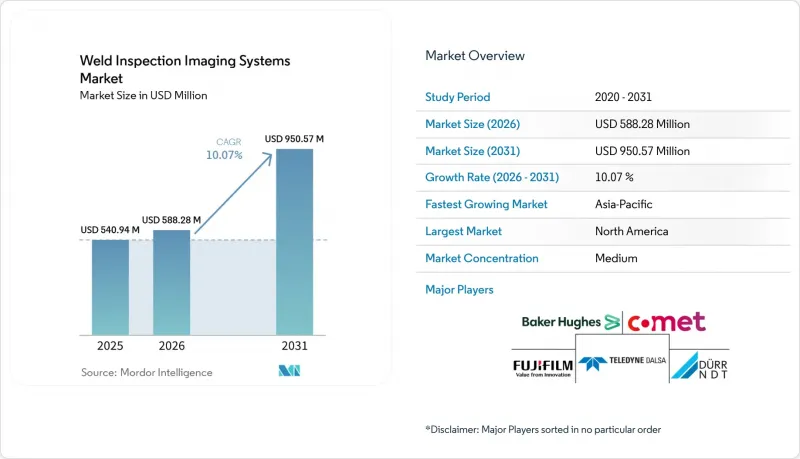
에 따르면 용접 검사용 영상 시스템 시장 규모는 2025년에 5억 4,094만 달러로 평가되며, 2026년 5억 8,828만 달러에서 2031년까지 9억 5,057만 달러에 달할 것으로 예측되고 있으며, 예측 기간(2026-2031년)에 CAGR은 10.07%에 달할 전망입니다.
전 세계 용접 검사용 영상 시스템 시장 동향 및 인사이트
필름에서 컴퓨터 단층촬영(CR)으로의 디지털 전환
용접 검사용 영상 시스템 시장은 운영 비용, 문서 관리 및 고객의 품질 요구 사항 측면에서 현재 디지털 공정이 유리해짐에 따라 필름 방사선 촬영에서 점차 전환되고 있습니다. X선 필름의 주요 원료인 은의 가격은 2025년에 사상 최고치를 기록했으며, 2026년에도 상승세를 이어가며 여전히 빈번한 필름 구매에 의존하는 검사 프로그램에 재료비 부담을 가중시키고 있습니다. 이러한 변화는 특히 반복적인 작업을 수행하고 소모품의 안정적인 공급이 필요한 조직의 경우, 필름의 장기적인 경제성을 약화시키고 있습니다. 여러 공급업체가 디지털 제품에 대한 개발 투자를 우선시하고 있으며, 이로 인해 기존의 필름 워크플로우를 유지하거나 업그레이드하려는 동기가 줄어들고 있습니다. 디지털 이미지에는 메타데이터가 내장되어 있으며, 자산 관리 시스템에 저장할 수 있으므로, 권한이 있는 팀은 검사 기록을 쉽게 검색, 공유, 확인하고, 향후 검사 결과와 비교할 수 있습니다. 작업자가 원격 확인, 문서 관리, 예측 유지보수 워크플로우 및 신속한 품질 판단을 지원할 수 있는 접근성이 뛰어난 검사 기록이 필요한 경우, 용접 검사용 이미지 시스템 시장은 그 혜택을 누리게 됩니다.
용접 무결성 및 추적성 요건의 강화
용접 검사 영상 시스템 시장은 규제 대상 산업 프로그램 전반에 걸친 추적 가능한 용접 기록에 대한 요구 사항 강화와 점점 더 복잡해지는 공급 체계의 혜택을 받고 있습니다. 파이프라인, 공정 배관, 항공우주 및 기타 중대한 영향을 수반하는 용도에서는 부품, 절차, 작업자, 승인 결정과 연계된 명확한 검사 증거가 필요합니다. 디지털 방사선 사진 기록은 물리적 필름보다 보관, 확인, 전송, 검색이 용이하며, 이는 여러 조직이 제조 및 최종 검수 책임을 분담하는 경우에 중요합니다. 규제 대상 사업자가 검사 문서를 관리하기 위해 디지털 포털이나 공식 기록 시스템을 활용함에 따라 전자적 제출의 중요성이 높아지고 있습니다. 주요 항공우주 계약업체들은 DICONDE의 기록 요건을 하청 제조업체까지 확대하고 있으므로 개별 공급업체가 기술 업그레이드를 계획하고 있지 않더라도 장비 교체가 필요할 수 있습니다. 추적성 요구 사항이 원청업체에 국한되지 않고 공급망 전체로 확산되고 있으므로, 용접 검사 영상 시스템 시장은 이러한 하류로의 파급 효과로부터 혜택을 볼 수 있습니다.
CT 시스템의 고액 설비 투자 및 시설 정비 비용
산업용 컴퓨터 단층촬영(CT)은 용접 검사 영상 시스템 시장에서 여전히 가장 고가의 장비 범주에 속하지만, 그 도입은 스캐너 구매 가격을 초과하는 비용으로 인해 제한받고 있습니다. 완전한 설치를 위해서는 전용으로 설계된 차폐 인클로저, 대용량 전원 공급, 진동 방지 대책, 공조 관리, 안전한 자재 취급, 그리고 전문적인 운영 절차가 필요할 수 있습니다. 이러한 요건들이 합쳐지면 총 설치 비용이 2배로 늘어날 수도 있으며, 단일 프로젝트 계약만을 담당하는 중규모 제조업체나 독립 검사 회사에게는 구매를 정당화하기 어렵습니다. 인프라 접근성, 전문적인 엔지니어링 지원 또는 장기 자금 조달 기회가 제한된 지역에서는 이러한 재정적 부담이 특히 큰 과제가 됩니다. 이러한 상황은 성숙한 비파괴 검사 거점에 비해 동남아시아, 남미, 아프리카의 일부 지역에서 더욱 두드러지게 나타납니다. 그 결과, 용접 검사용 영상 시스템 시장에서는 비용을 여러 프로그램에 분산할 수 있는 대형 제조업체, 대기업, 전문 서비스 제공업체들 사이에서 고가의 컴퓨터 단층촬영(CT) 장비 도입이 집중되는 현상이 지속되고 있습니다.
부문 분석
2025년, 용접 검사용 영상 시스템 시장 점유율 중 하드웨어 장비가 47.85%를 차지했습니다. 이는 평판 검출기 어레이, X선관, CT 갠트리 및 관련 영상 인프라의 높은 가치를 반영한 것입니다. 모든 디지털 워크플로는 검사 현장에서의 신뢰할 수 있는 영상 획득에 의존하므로 물리적 장비는 여전히 필수적입니다. 또한 하드웨어 구매에는 기본 장비의 주문 범위를 초과할 수 있는 인증, 설치 및 통합 작업도 수반됩니다. 서비스는 현장 교정, X선관 교체, 방사선원 관리 및 검사 기관과의 계약을 통해 중요한 부가 가치를 창출하고 있습니다. 이러한 활동은 시스템 설치 후에도 지속되어, 고객이 요구되는 검사 절차에 따라 성능을 유지할 수 있도록 지원합니다.
소프트웨어 분야는 AI를 활용한 결함 인식, 클라우드 기반 이미지 관리, 그리고 DICONDE 준수 아카이브가 기업의 검사 프로그램에서 점점 더 중심적인 역할을 수행함에 따라 2031년까지 연평균 성장률(CAGR) 13.85%를 기록할 것으로 예측되며, 이는 각 제품군 중 가장 높은 성장률입니다. 자동화 툴은 작업자가 디지털 이미지에서 이상 징후를 식별하고 그 특성을 파악할 수 있도록 지원함으로써, 일상적인 수작업 검토를 줄일 수 있습니다. 클라우드 시스템을 통해 승인된 기록을 시설 간에 공유할 수 있게 되며, 관리형 아카이브 기능은 고객, 감사인 및 공급업체의 접근을 지원합니다. ECNDT 2026에서 발표된 연구에서는 단층촬영 데이터에서 균열의 형태, 방향 및 연결성을 추출하고, 그 결과를 구조 모델과 연관시키는 컴퓨터 단층촬영(CT) 및 AI 프레임워크에 대해 설명했습니다. 용접 검사용 영상 시스템 시장은 소프트웨어 공급업체에게 지속적인 관계 구축의 길을 제공합니다. 이는 도입된 하드웨어의 수명 주기 동안 영상 관리 및 분석이 계속해서 중요하기 때문입니다.
2025년, 용접 검사용 영상 시스템 시장 규모의 45.10%를 직접 방사선 촬영이 차지했습니다. 이는 사용자가 화면상의 즉각적인 확인, 광범위한 절차와의 호환성, 그리고 필름 기반 방식보다 신속한 의사결정을 중시했기 때문입니다. 이 기술은 필름 현상을 기다릴 필요 없이 생산, 유지보수 또는 현장 작업 중에 이미지를 확인해야 하는 검사 팀에 도움이 됩니다. 또한 디지털 검사 절차에서 확립된 활용 실적도 광범위한 산업 환경에서의 도입을 지원하고 있습니다. 컴퓨터 방사선 촬영은 이미징 플레이트의 재사용이 가능하고, 기존 워크플로가 작업자에게 익숙하므로 검사 서비스 사업자들 사이에서 여전히 중요한 도입 기반을 유지하고 있습니다. 필름 방사선 촬영은 고객이 지정한 기존 프로세스나 아카이브의 연속성이 요구되는 제한적인 용도에서 여전히 역할을 하고 있지만, 필름 비용 상승에 따라 도입 기반은 감소하는 추세에 있습니다.
컴퓨터 단층촬영(CT)은 2D 방사선 촬영으로는 얻을 수 없는 상세한 정보가 필요한 내부 형상 및 검사가 어려운 재료의 조합을 검사할 수 있으므로 2031년까지 연평균 성장률(CAGR) 12.18%로 시장이 확대될 것으로 예측됩니다. 이 기법은 전기자동차(EV)의 파워트레인 및 배터리 제조에 사용되는 부품을 포함하여, 구리, 알루미늄, 강철이 밀접하게 결합된 어셈블리에서 점점 더 중요해지고 있습니다. 광자 계수형 검출기 플랫폼과 AI를 활용한 재구성 기술을 통해 이러한 다중 재료 부품에서 발생하는 아티팩트 문제가 완화되고 있습니다. Varex Imaging사는 2026년 TrueSpectrum을 발표했습니다. 이는 듀얼 에너지 광자 계수 방식을 채택한 것으로, 회사에 따르면 교정용 재료나 별도의 처리 공정을 필요로 하지 않고 빔 경화 아티팩트를 제거할 수 있다고 합니다. 스캔 속도의 향상과 재구성 이미지의 선명도 제고를 통해 내부 용접 검증이 필요한 생산 용도에서 CT의 적용성이 향상되고 있습니다. 그 결과, 용접 검사용 이미징 시스템 시장에서 CT는 전문적인 분석 용도에서 부가가치가 더 높은 제조 사용 사례로 전환되고 있습니다.
지역별 분석
북미는 2025년에 매출 점유율의 35.75%를 차지했습니다. 이는 지속적인 비파괴 검사 프로그램이 필요한 파이프라인 사업자, 항공우주 장비 제조업체, 유지보수 서비스 제공업체 및 정유소 자산이 밀집해 있는 것이 배경입니다. 인건비 급등으로 인해 자동화 및 AI를 활용한 결함 검사의 가치가 높아지고 있는 한편, 파이프라인의 안전 요건과 정유소의 턴어라운드(정기 점검)가 지속적인 영상 진단에 대한 지출을 지원하고 있습니다. 캐나다에서는 오일샌드 및 미드스트림 인프라를 통해 수요가 확대되고 있으며, 멕시코에서는 석유화학 및 자동차 관련 시설을 통해 수요가 확대되고 있습니다. 또한 이 지역에는 성숙한 검사 서비스 네트워크가 구축되어 있으며, 통합형 디지털 장비에 투자할 수 있는 고객들이 존재합니다. 이러한 요인들로 인해 북미는 용접 검사 영상 시스템 시장에서 주요 개발 기반으로 자리매김하고 있습니다.
아시아태평양은 중국의 배터리 생산 확대, 석유화학 프로젝트 및 중공업 건설에 힘입어 2031년까지 연평균 성장률(CAGR) 13.90%로 성장할 것으로 예측됩니다. 중국내 기가팩토리 건설 확대는 탭 용접부 및 부스바 연결부에 대한 인라인 CT 검사 수요를 창출하고 있으며, ECNDT 2026의 조사에 따르면 고속 시스템에서는 하루에 수천 회의 전체 셀 스캔이 가능한 것으로 나타났습니다. 또한 신규 산업 시설에서는 건설 및 시운전 단계에서 용접 검증을 위한 현장 이미징도 필요합니다. 따라서 이 지역의 용접 검사용 이미징 시스템 시장에는 배터리 제조, 정유소, 중공업 등 다양한 분야에 걸친 수요가 존재합니다.
2025년, 유럽은 기술적으로 첨단인 위치를 유지하고 있으며, 독일의 자동차·항공우주 산업, 프랑스의 원자력발전소 군, 그리고 영국의 해상 에너지 및 원자력발전소 해체 작업이 상세한 용접 검사를 지원하고 있습니다. 이탈리아의 항공우주 복합재 클러스터에서는 복잡한 형상의 검사에 컴퓨터 단층촬영(CT)이 활용되고 있으며, 중동에서는 사우디아라비아와 아랍에미리트(UAE)의 정유소 개보수 및 LNG 인프라 구축이 수요를 견인하고 있습니다. 이러한 활동에는 관리된 시설용 고정식 시스템과 현장 작업용 휴대용 장비 모두가 필요합니다. 이로 인해 성숙한 산업 경제권 및 에너지 투자 분야에서 용접 검사용 이미징 시스템 시장의 중요성이 유지되고 있습니다.
기타 혜택:
- 엑셀 형식의 시장 예측(ME) 시트
- 3개월간의 애널리스트 지원
자주 묻는 질문
목차
제1장 서론
- 조사 전제조건과 시장 정의
- 조사 범위
제2장 조사 방법
제3장 개요
제4장 시장 구도
- 시장 개요
- 시장 성장 촉진요인
- 시장 성장 억제요인
- 업계 밸류체인 분석
- 거시경제 요인이 시장에 미치는 영향
- 규제 상황
- 기술 전망
- Porter's Five Forces 분석
제5장 시장 규모와 성장 예측
- 제공별
- 기술별
- 폼팩터별
- 최종사용자 산업별
- 지역별
- 북미
- 미국
- 캐나다
- 멕시코
- 남미
- 브라질
- 아르헨티나
- 기타 남미 국가
- 유럽
- 독일
- 영국
- 프랑스
- 이탈리아
- 스페인
- 기타 유럽 국가
- 아시아태평양
- 중국
- 일본
- 인도
- 한국
- ASEAN
- 기타 아시아태평양 국가
- 중동
- 사우디아라비아
- 아랍에미리트
- 튀르키예
- 기타 중동 국가
- 아프리카
- 남아프리카공화국
- 나이지리아
- 기타 아프리카 국가
- 북미
제6장 경쟁 구도
- 시장 집중도
- 전략적 동향
- 시장 점유율 분석
- 기업 개요
- Baker Hughes Company
- Comet Technologies AG
- Nikon Metrology NV
- FUJIFILM Holdings Corporation
- DURR NDT GmbH & Co. KG
- Varex Imaging Corporation
- Teledyne DALSA, Inc.
- Hamamatsu Photonics K.K.
- Shimadzu Corporation
- Rigaku Corporation
- North Star Imaging, Inc.
- Vidisco Ltd.
- Bosello High Technology S.r.l.
- DIONDO GmbH
- Pexraytech Oy
- Industrial Control X-Ray, Inc.
- 3DX-Ray Ltd
- VJ Technologies, Inc.
- RX Solutions SAS
- SERVO-ROBOT Inc.
- Xiris Automation Inc.
- SmartRay GmbH
- VITRONIC Dr.-Ing. Stein Bildverarbeitungssysteme GmbH
- Precitec GmbH & Co. KG
- Carestream Health, Inc.
제7장 시장 기회와 향후 전망
KSA 26.10.28According to Mordor Intelligence, the weld inspection imaging systems market size was valued at USD 540.94 million in 2025 and is estimated to grow from USD 588.28 million in 2026 to reach USD 950.57 million by 2031, at a CAGR of 10.07% during the forecast period (2026-2031).
Global Weld Inspection Imaging Systems Market Trends and Insights
Digital Migration From Film to Direct and Computed Radiography
The weld inspection imaging systems market is moving away from film radiography because operating costs, document handling, and customer quality requirements now favor digital processes. Silver, a core input for X-ray film, reached historic highs in 2025 and continued rising in 2026, adding a material cost pressure to inspection programs that still rely on frequent film purchases. This change weakens the long-term economics of film, especially for organizations that perform repeat work and need a predictable supply of consumables. Several suppliers are directing development investment toward digital products, which reduces the incentive to maintain and upgrade traditional film workflows. Digital images carry embedded metadata and can be retained in asset management systems, giving authorized teams a record that is easier to locate, share, review, and compare with later inspections. The weld inspection imaging systems market benefits when operators need accessible inspection records that can support remote review, documentation control, predictive maintenance workflows, and faster quality decisions.
Tightening Weld Integrity and Traceability Requirements
The weld inspection imaging systems market benefits from stronger requirements for traceable weld records across regulated industrial programs and increasingly complex supply arrangements. Pipeline, process piping, aerospace, and other high-consequence applications need clear inspection evidence that can be associated with a component, procedure, operator, and approval decision. Digital radiographic records can be stored, reviewed, transferred, and searched more readily than physical film, which is important when several organizations share responsibility for fabrication and final acceptance. Electronic submission is becoming more relevant as regulated operators use digital portals and formal record systems to manage inspection documentation. Large aerospace contractors are extending DICONDE record requirements to lower-tier fabricators, so equipment replacement may be required even when an individual supplier has not planned a technology upgrade. The weld inspection imaging systems market can gain from this downstream effect because traceability needs spread through the supply chain rather than remaining limited to the prime contractor.
High Capital and Facility Preparation Costs for CT Systems
Industrial computed tomography remains the highest-value equipment category in the weld inspection imaging systems market, but its adoption is limited by costs that extend beyond the scanner purchase price. A complete installation may require a purpose-built shielded enclosure, high-capacity electrical supply, vibration isolation, climate control, safe material handling, and specialized operating procedures. Together, these requirements can double the total installed cost, which makes a purchase difficult to justify for mid-sized fabricators or independent inspection firms serving only one project contract. The financial commitment is especially challenging where access to infrastructure, specialist engineering support, or long-term financing is more limited. These conditions are more pronounced in parts of Southeast Asia, South America, and Africa than in mature nondestructive testing centers. The weld inspection imaging systems market consequently retains a concentration of high-value computed tomography installations among large manufacturers, conglomerates, and specialist service providers that can spread the cost across multiple programs.
Other drivers and restraints analyzed in the detailed report include:
- Industrial Automation and 100% Inline Inspection Adoption
- Aerospace, Energy, and Advanced Manufacturing NDT Intensity
- Radiation Safety, Licensing, and Exposure-Control Burden
For complete list of drivers and restraints, kindly check the Table Of Contents.
Segment Analysis
Hardware equipment held 47.85% of the weld inspection imaging systems market share in 2025, reflecting the high value of flat-panel detector arrays, X-ray tubes, computed tomography gantries, and related imaging infrastructure. Physical equipment remains essential because every digital workflow depends on reliable image capture at the inspection point. Hardware purchases also involve qualification, installation, and integration work that can extend beyond the base equipment order. Services form a significant secondary source of revenue through field calibration, tube replacement, radiation source management, and inspection bureau contracts. These activities continue after a system is installed and help customers maintain performance against the required inspection procedures.
Software is projected to record a 13.85% CAGR through 2031, the fastest rate among offerings, as AI-enabled defect recognition, cloud-based image management, and DICONDE-compliant archiving become more central to enterprise inspection programs. Automated tools can reduce routine manual review by helping operators identify and characterize indications from digital images. Cloud systems allow approved records to be shared across facilities, while controlled archiving supports customer, auditor, and supplier access. Research presented at ECNDT 2026 described computed tomography and AI frameworks that extracted crack geometry, orientation, and connectivity from tomographic data and linked findings with structural models. The weld inspection imaging systems market gives software providers a route to recurring relationships because image management and analysis remain relevant through the operating life of installed hardware.
Direct radiography commanded 45.10% of the weld inspection imaging systems market size in 2025, as users valued immediate on-screen review, broad procedural compatibility, and faster decisions than film-based methods can provide. The technology serves inspection teams that need to check images during production, maintenance, or field work without waiting for film processing. Its established use in digital inspection procedures also supports adoption across a broad set of industrial settings. Computed radiography retains a significant installed base among inspection service bureaus because imaging plates can be reused, and existing workflows remain familiar to operators. Film radiography still has a role in narrow applications with client-mandated legacy processes or archive continuity needs, although the installed base is declining as film costs rise.
Computed tomography is projected to advance at a 12.18% CAGR through 2031 because it can examine internal geometry and difficult material combinations that need more information than two-dimensional radiography provides. The approach is increasingly relevant for assemblies that contain copper, aluminum, and steel close together, including components used in EV powertrains and battery production. Photon-counting detector platforms and AI-driven reconstruction are reducing artifact burden in these multi-material parts. Varex Imaging presented TrueSpectrum in 2026 as a dual-energy photon-counting approach that it said can eliminate beam-hardening artifacts without calibration materials or separate processing steps. Faster scanning and clearer reconstructions improve the fit of computed tomography for production applications that require internal weld verification. The weld inspection imaging systems market is consequently seeing computed tomography move from specialized analysis toward higher-value manufacturing use cases.
Complete Report Scope:
- By Offering
- Hardware Equipment
- Software
- Services
- By Technology
- Direct Radiography
- Computed Radiography
- Film Radiography
- Computed Tomography
- By Form Factor
- Fixed and Stationary Systems
- Portable and Handheld Systems
- Offline Laboratory Systems
- By End-User Industry
- Oil and Gas
- Chemicals and Petrochemicals
- Aerospace and Defense
- Automotive and Transportation
- Energy and Power Generation
- Manufacturing and Heavy Engineering
- Construction and Infrastructure
- Electronics and Semiconductors
- Marine and Shipbuilding
- Other End-User Industries
- By Geography
- North America
- United States
- Canada
- Mexico
- South America
- Brazil
- Argentina
- Rest of South America
- Europe
- Germany
- United Kingdom
- France
- Italy
- Spain
- Rest of Europe
- Asia-Pacific
- China
- Japan
- India
- South Korea
- ASEAN
- Rest of Asia-Pacific
- Middle East
- Saudi Arabia
- United Arab Emirates
- Turkey
- Rest of the Middle East
- Africa
- South Africa
- Nigeria
- Rest of Africa
- North America
Geography Analysis
North America held 35.75% revenue share in 2025, supported by a dense base of pipeline operators, aerospace original equipment manufacturers, maintenance providers, and refinery assets that require continuing nondestructive testing programs. High labor costs increase the value of automation and AI-supported defect review, while pipeline safety requirements and refinery turnarounds support recurring imaging expenditure. Canada adds demand through oil sands and midstream infrastructure, while Mexico adds demand through petrochemical and automotive facilities. The region also has mature inspection service networks and customers that can invest in integrated digital equipment. These factors keep North America a major installed base for the weld inspection imaging systems market.
Asia-Pacific is projected to advance at a 13.90% CAGR through 2031, supported by China's battery manufacturing expansion, petrochemical projects, and heavy industrial construction. China's gigafactory build-out is creating demand for inline computed tomography inspection of tab welds and busbar connections, while ECNDT 2026 research showed that high-speed systems can support thousands of full-cell scans per day. New industrial facilities also need field imaging for weld verification during construction and commissioning. The regional weld inspection imaging systems market therefore has demand across battery manufacturing, refineries, and heavy industry.
Europe retained a technically advanced position in 2025, with Germany's automotive and aerospace base, France's nuclear fleet, and the United Kingdom's offshore energy and nuclear decommissioning work supporting detailed weld inspection. Italy's aerospace composite cluster is using computed tomography for complex geometries, while the Middle East draws demand from refinery upgrades and LNG infrastructure in Saudi Arabia and the United Arab Emirates. These activities require both fixed systems for controlled facilities and portable equipment for field programs. They keep the weld inspection imaging systems market relevant across mature industrial economies and energy investment areas.
- Baker Hughes Company
- Comet Technologies AG
- Nikon Metrology NV
- FUJIFILM Holdings Corporation
- DURR NDT GmbH & Co. KG
- Varex Imaging Corporation
- Teledyne DALSA, Inc.
- Hamamatsu Photonics K.K.
- Shimadzu Corporation
- Rigaku Corporation
- North Star Imaging, Inc.
- Vidisco Ltd.
- Bosello High Technology S.r.l.
- DIONDO GmbH
- Pexraytech Oy
- Industrial Control X-Ray, Inc.
- 3DX-Ray Ltd
- VJ Technologies, Inc.
- RX Solutions SAS
- SERVO-ROBOT Inc.
- Xiris Automation Inc.
- SmartRay GmbH
- VITRONIC Dr.-Ing. Stein Bildverarbeitungssysteme GmbH
- Precitec GmbH & Co. KG
- Carestream Health, Inc.
Additional Benefits:
- The market estimate (ME) sheet in Excel format
- 3 months of analyst support
TABLE OF CONTENTS
1 INTRODUCTION
- 1.1 Study Assumptions and Market Definition
- 1.2 Scope of the Study
2 RESEARCH METHODOLOGY
3 EXECUTIVE SUMMARY
4 MARKET LANDSCAPE
- 4.1 Market Overview
- 4.2 Market Drivers
- 4.2.1 Digital Migration from Film to Direct and Computed Radiography
- 4.2.2 Tightening Weld Integrity and Traceability Requirements
- 4.2.3 Industrial Automation and 100% Inline Inspection Adoption
- 4.2.4 Aerospace, Energy, and Advanced Manufacturing NDT Intensity
- 4.2.5 Portable Digital Radiography Acceptance for Field Pipeline Inspection
- 4.2.6 Battery and Semiconductor Weld-Quality Verification
- 4.3 Market Restraints
- 4.3.1 High Capital and Facility Preparation Costs for CT Systems
- 4.3.2 Radiation Safety, Licensing, and Exposure-Control Burden
- 4.3.3 Shortage of Certified Radiographic Testing Personnel
- 4.3.4 Isotope Supply Exposure and Digital-System Cybersecurity Risk
- 4.4 Industry Value Chain Analysis
- 4.5 Impact of Macroeconomic Factors on the Market
- 4.6 Regulatory Landscape
- 4.7 Technological Outlook
- 4.8 Porter's Five Forces Analysis
- 4.8.1 Bargaining Power of Suppliers
- 4.8.2 Bargaining Power of Buyers
- 4.8.3 Threat of New Entrants
- 4.8.4 Threat of Substitutes
- 4.8.5 Intensity of Competitive Rivalry
5 MARKET SIZE AND GROWTH FORECASTS (VALUE)
- 5.1 By Offering
- 5.1.1 Hardware Equipment
- 5.1.2 Software
- 5.1.3 Services
- 5.2 By Technology
- 5.2.1 Direct Radiography
- 5.2.2 Computed Radiography
- 5.2.3 Film Radiography
- 5.2.4 Computed Tomography
- 5.3 By Form Factor
- 5.3.1 Fixed and Stationary Systems
- 5.3.2 Portable and Handheld Systems
- 5.3.3 Offline Laboratory Systems
- 5.4 By End-User Industry
- 5.4.1 Oil and Gas
- 5.4.2 Chemicals and Petrochemicals
- 5.4.3 Aerospace and Defense
- 5.4.4 Automotive and Transportation
- 5.4.5 Energy and Power Generation
- 5.4.6 Manufacturing and Heavy Engineering
- 5.4.7 Construction and Infrastructure
- 5.4.8 Electronics and Semiconductors
- 5.4.9 Marine and Shipbuilding
- 5.4.10 Other End-User Industries
- 5.5 By Geography
- 5.5.1 North America
- 5.5.1.1 United States
- 5.5.1.2 Canada
- 5.5.1.3 Mexico
- 5.5.2 South America
- 5.5.2.1 Brazil
- 5.5.2.2 Argentina
- 5.5.2.3 Rest of South America
- 5.5.3 Europe
- 5.5.3.1 Germany
- 5.5.3.2 United Kingdom
- 5.5.3.3 France
- 5.5.3.4 Italy
- 5.5.3.5 Spain
- 5.5.3.6 Rest of Europe
- 5.5.4 Asia-Pacific
- 5.5.4.1 China
- 5.5.4.2 Japan
- 5.5.4.3 India
- 5.5.4.4 South Korea
- 5.5.4.5 ASEAN
- 5.5.4.6 Rest of Asia-Pacific
- 5.5.5 Middle East
- 5.5.5.1 Saudi Arabia
- 5.5.5.2 United Arab Emirates
- 5.5.5.3 Turkey
- 5.5.5.4 Rest of the Middle East
- 5.5.6 Africa
- 5.5.6.1 South Africa
- 5.5.6.2 Nigeria
- 5.5.6.3 Rest of Africa
- 5.5.1 North America
6 COMPETITIVE LANDSCAPE
- 6.1 Market Concentration
- 6.2 Strategic Moves
- 6.3 Market Share Analysis
- 6.4 Company Profiles (includes Global Level Overview, Market Level Overview, Core Segments, Financials as available, Strategic Information, Market Rank/Share, Products and Services, Recent Developments)
- 6.4.1 Baker Hughes Company
- 6.4.2 Comet Technologies AG
- 6.4.3 Nikon Metrology NV
- 6.4.4 FUJIFILM Holdings Corporation
- 6.4.5 DURR NDT GmbH & Co. KG
- 6.4.6 Varex Imaging Corporation
- 6.4.7 Teledyne DALSA, Inc.
- 6.4.8 Hamamatsu Photonics K.K.
- 6.4.9 Shimadzu Corporation
- 6.4.10 Rigaku Corporation
- 6.4.11 North Star Imaging, Inc.
- 6.4.12 Vidisco Ltd.
- 6.4.13 Bosello High Technology S.r.l.
- 6.4.14 DIONDO GmbH
- 6.4.15 Pexraytech Oy
- 6.4.16 Industrial Control X-Ray, Inc.
- 6.4.17 3DX-Ray Ltd
- 6.4.18 VJ Technologies, Inc.
- 6.4.19 RX Solutions SAS
- 6.4.20 SERVO-ROBOT Inc.
- 6.4.21 Xiris Automation Inc.
- 6.4.22 SmartRay GmbH
- 6.4.23 VITRONIC Dr.-Ing. Stein Bildverarbeitungssysteme GmbH
- 6.4.24 Precitec GmbH & Co. KG
- 6.4.25 Carestream Health, Inc.
7 MARKET OPPORTUNITIES AND FUTURE OUTLOOK
- 7.1 White-Space and Unmet-Need Assessment


