

|
시장보고서
상품코드
2155303
PCB X선 검사 시스템 : 시장 점유율 분석, 업계 동향과 통계, 성장 예측(2026-2031년)PCB X-Ray Inspection Systems - Market Share Analysis, Industry Trends & Statistics, Growth Forecasts (2026 - 2031) |
||||||
 Mordor Intelligence
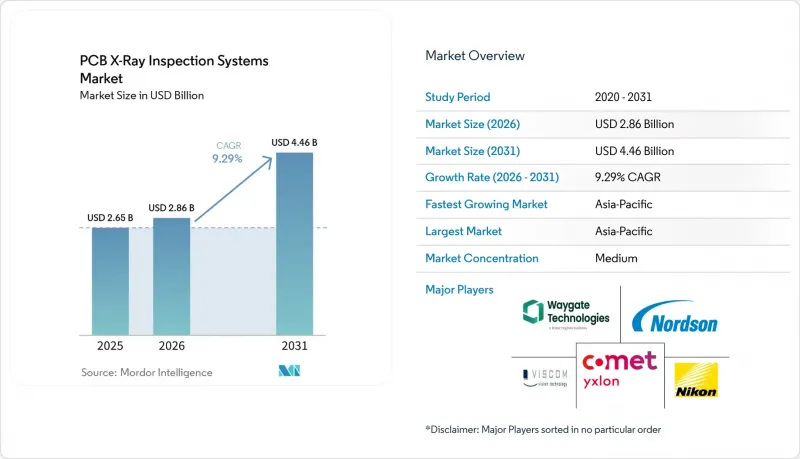
에 따르면 PCB용 X선 검사 시스템 시장 규모는 2025년에 26억 5,000만 달러, 2026년에 28억 6,000만 달러에 달하며, 2031년까지 44억 6,000만 달러에 달할 것으로 예측되고 있으며, 2026-2031년까지 연평균 성장률(CAGR)은 9.29%에 달할 전망입니다.
전 세계 PCB X선 검사 시스템 시장의 동향 및 인사이트
소형화의 진전과 부품 밀도의 향상
PCB 레이아웃의 소형화에 따라 내부 품질 검사를 위한 PCB X선 검사 시스템의 활용이 증가하고 있습니다. 이러한 PCB X선 검사 시스템에 대한 수요는 조립 설계에서 중요한 접합부가 패키지 아래에 가려지는 경우에 더욱 높아집니다. 볼 그리드 어레이(BGA), 쿼드 플랫 노 리드(QFN), 랜드 그리드 어레이(LGA) 등의 패키지에서는 솔더 접합부가 부품 본체 아래에 숨겨져 있습니다. 따라서 광학 장비로는 접합부를 확인할 수 없는 경우, 비파괴 검사인 X선 검사가 필요합니다. 패키지의 피치가 0.3mm 이하로 전환됨에 따라 수요는 더욱 증가하고 있습니다. 또한 파워 모듈 구매자들 사이에서는 합격·불합격 결과뿐만 아니라 측정된 보이드율의 제시를 요구하는 목소리도 높아지고 있습니다. 이에 따라 보이드 부피를 보고할 수 있고, 공급업체의 보다 상세한 요구 사항을 충족할 수 있는 3D CT 시스템에 대한 수요가 증가하고 있습니다.
자동차용 전자기기 및 전기자동차의 성장
자동차용 전자기기 분야에서는 자동 X선 검사 용도가 일상적인 조립 검사에서 안전 관련 검증으로 전환되고 있습니다. 이에 따라 PCB X선 검사 시스템 시장은 공급업체의 품질 기록 관리와 생산 라인 관리라는 두 가지 역할을 모두 담당하고 있습니다. ADAS 센서 모듈, 배터리 관리용 PCB, SiC 인버터 모듈에는 높은 처리량을 유지하면서도 일관된 납땜 품질이 요구됩니다. 오므론은 전기자동차의 구동계에 사용되는 파워 모듈, eAxle 어셈블리, 그리고 인버터용 자동 X선 검사 시스템 ‘VT-X850 3D CT’를 출시했습니다. IATF 16949:2016에서는 자동차 접합 공정에 대해 문서화된 통계적 공정 관리가 요구되며, 검사 데이터는 이러한 문서화를 지원할 수 있습니다. 유럽의 자동차 제조사는 이러한 관리 요건을 지정할 수 있지만, 많은 2차 공급업체는 동남아시아에서 사업을 운영하고 있습니다. 이로 인해 아세안(ASEAN) 생산 클러스터에 위치한 전자 부품 공장에는 추가적인 수요가 발생하고 있습니다.
높은 초기 투자 비용과 긴 회수 기간
모든 기능을 갖춘 3D CT 시스템의 가격은 30만 달러에서 100만 달러에 달합니다. 이러한 지출로 인해 회수 기간이 중규모 제조사나 하청업체의 계획 기간을 초과할 가능성이 있습니다. 제조업체는 고성능 시스템을 공유할지, 아니면 성능이 낮은 장비를 여러 대 도입할지 선택해야 하는 상황에 직면할 수 있습니다. Lumafield사의 보고서에 따르면 결함 누락이나 재작업 비용이 발생하고 있음에도 불구하고 검사 비용에 대한 우려가 여전히 수작업 공정을 유지하는 주요 이유로 꼽히고 있습니다. 대형 OEM 및 EMS 공급업체는 첨단 시스템을 도입할 수 있지만, 많은 소규모 시설에서는 도입률이 여전히 낮은 실정입니다. 모듈식, 구독형 및 초기 투자 비용이 적은 시스템은 완전한 CT 기능이 없어도 이러한 격차를 해소할 가능성이 있습니다.
부문 분석
인라인 자동 X선 검사는 2025년 매출의 52.84%를 차지하며, 대량 생산되는 소비자용 전자제품 및 자동차 조립 공정에서 그 역할을 반영하고 있습니다. 이러한 시스템은 연속 생산 일정을 운영하는 공장에 대해 컨베이어 속도에 맞춰 결함 정보를 제공합니다. 오프라인 자동 X선 검사는 2031년까지 연평균 성장률(CAGR) 12.46%로 확대될 것으로 예측됩니다. 항공우주, 의료, 방위 분야 고객에게 서비스를 제공하는 수탁제조업체들은 라인 처리량보다 유연성이나 고해상도가 중요시되는 경우 오프라인 시스템을 채택하고 있습니다. 수동식 및 벤치탑형 장비는 시제품 평가, 고장 분석, 연구개발 및 수탁 가공 업무에서 여전히 중요한 역할을 수행하고 있습니다. Lumafield사는 2026년 7월, 최대 760mm/s의 속도로 2D 및 2.5D 검사가 가능한 인라인 어레이 X선 시스템 ‘Mars’를 출시했습니다.
인라인 장비 분야의 PCB X선 검사 시스템 시장 규모는 고처리량 생산 라인과의 통합에 대한 수요를 반영하고 있습니다. PCB X선 검사 시스템 시장에는 생산 라인 외부에서 유연한 검사가 필요한 다품종 생산 프로그램을 위한 오프라인 시스템도 포함됩니다. 동적 평면 CT 촬영 기술 덕분에 인라인 속도와 오프라인 해상도 사이에서 기존에 존재하던 상충 관계가 점차 줄어들고 있습니다. 이를 통해 이전에는 배치 샘플링에 의존하던 용도에서도 인라인 CT를 활용할 수 있게 될 가능성이 있습니다. 듀얼 모드 기능을 제공하는 공급업체는 시스템의 타협점을 최소화하면서 두 가지 생산 요구 사항을 모두 충족할 수 있습니다. 이러한 기능이 더 광범위한 제품 포트폴리오에서 이용 가능해짐에 따라 순수한 오프라인 전문 제조업체들은 압박에 직면할 가능성이 있습니다.
2D X선 검사는 표준 PCB 솔더 접합부 검사에서 여전히 비용 대비 효율이 높기 때문에 2025년 매출의 57.36%를 차지했습니다. PCB X선 검사 시스템 시장에서 2D 시스템이 차지하는 점유율은 CT 처리가 필요 없이 많은 평면 결함을 감지할 수 있는 능력을 반영합니다. 3D 컴퓨터 단층촬영(CT) 검사는 2031년까지 연평균 성장률(CAGR) 11.74%로 성장할 것으로 예측됩니다. 자동차용 파워 일렉트로닉스 분야에서는 보이드 측정 데이터가 필요한 반면, 반도체 제조업체에서는 적층 다이의 상호 연결 검사가 요구되고 있습니다. Rayence사는 2026년 3월, AI 칩 및 HBM의 인라인 검사 및 3D CT에 대응하기 위해 ‘Flash 시리즈’ 검출기 플랫폼을 확충했습니다. 이 플랫폼은 49.5μm의 픽셀 크기와 최대 70프레임/초의 프레임 속도를 실현하고 있습니다.
2.5D X선 검사는 평면 이미징과 풀 CT의 중간적인 대안으로 여전히 자리 잡고 있습니다. 이는 BGA의 보이드 매핑이나 스루 실리콘 비아(TSV) 분석에 적합하며, 비스듬한 각도에서 촬영한 이미지를 통해 깊이 정보를 얻을 수 있습니다. PCB X선 검사 시스템 시장에서는 공급업체 간의 성능 격차가 확대되고 있습니다. Comet Yxlon사는 2026년, 첨단 반도체 패키지 검사를 위해 160 kV 나노포커스 튜브를 탑재하여 FF35 CT를 강화했습니다. 마이크로 포커스 및 나노 포커스 광원 기술을 보유한 공급업체는 첨단 패키징 분야에서 차별화를 꾀할 수 있습니다. 반면, 주로 처리량이나 시스템 가격에 중점을 두고 있는 벤더는 3D CT가 입찰의 표준 요건이 되는 분야에서 더 큰 압박에 직면할 가능성이 있습니다.
지역별 분석
아시아태평양은 2025년 자동 X선 검사 시장 매출의 48.63%를 차지하며, 2031년까지 연평균 성장률(CAGR) 12.12%를 기록할 것으로 예측됩니다. 이 지역의 PCB X선 검사 시스템 시장은 대규모 전자기기 생산 거점과 지속적인 설비 갱신이 맞물려 형성되고 있습니다. 중국, 한국, 일본은 반도체 패키징 및 자동차용 전자기기 분야의 수요를 지원하고 있습니다. 베트남, 태국, 말레이시아는 중국의 연안 제조 지역에서 생산이 이전됨에 따라 투자 단계에 접어들고 있습니다. 지역 공급업체들은 현지 애플리케이션 지원 및 가격 정책을 통해 경쟁력을 발휘할 수 있습니다. 페낭에 본사를 둔 ViTrox는 이러한 환경에서 현지 거점을 갖춘 공급업체의 존재를 상징합니다.
북미 PCB X선 검사 시스템 시장의 수요는 AI 가속기, 고성능 컴퓨팅용 프로세서, 메모리 패키징 및 배터리 셀 제조와의 연계성을 강화하고 있습니다. 이러한 용도에서는 인라인 CT 검사나 특수한 반도체 검사가 필요할 수 있습니다. Nordson Test and Inspection사는 2026년 8월 피닉스에 ‘센터 오브 엑설런스(Center of Excellence)’를 개설하여 자사의 검사 플랫폼에 대한 시연 및 교육을 제공하고 있습니다. Viscom사는 2026년 상반기 수주액이 5,571만 5,000유로(2026년 상반기 보고 평균 환율 기준 6,130만 달러에 해당)였다고 보고하며, 북미를 수요가 견고한 지역으로 꼽았습니다. 유럽 시장은 독일, 프랑스, 이탈리아의 자동차 제조사 및 1차 공급업체에 의해 지탱되고 있습니다. ZEISS는 2025년 7월, 대형 자동차용 알루미늄 주조품의 자동 2D 검사를 위한 ‘OMNIA GC 220-180’을 출시했습니다.
남미, 중동 및 아프리카는 여전히 PCB X선 검사 시스템 시장이 초기 단계에 있습니다. 이 지역들의 PCB X선 검사 시스템 시장은 자동차, 산업화, 유지보수 각 분야의 고유한 요구 사항에 의해 지원되고 있습니다. 브라질은 자동차용 전자기기 및 수출 지향적 공급업체가 존재하므로 해당 지역에서 가장 뚜렷한 비즈니스 기회를 가지고 있습니다. 아랍에미리트(UAE)와 사우디아라비아는 산업화 프로그램을 통해 전자제품 생산 능력을 확충하고 있습니다. 아프리카의 제조 거점은 여전히 제한적이기 때문에 단기적인 수요는 광업, 석유 및 가스 및 통신용 전자기기 유지보수를 위한 수입 장비에 집중되어 있습니다. 인도의 경우, 국내 전자제품 생산이 확대됨에 따라 주목을 받고 있습니다. Koh Young사는 2026년에 노이다에 지사를 개설했으나, 이 회사가 공개한 활동 내용은 상용 자동 X선 검사 시스템이 아닌 광학 검사 솔루션에 관한 것이었습니다.
기타 혜택:
- 엑셀 형식의 시장 예측(ME) 시트
- 3개월간의 애널리스트 지원
자주 묻는 질문
목차
제1장 서론
- 조사 전제조건과 시장 정의
- 조사 범위
제2장 조사 방법
제3장 개요
제4장 시장 구도
- 시장 개요
- 시장 성장 촉진요인
- 시장 성장 억제요인
- 거시경제 요인이 시장에 미치는 영향
- 업계 밸류체인 분석
- 규제 상황
- 기술 전망
- Porter's Five Forces 분석
제5장 시장 규모와 성장 예측
- 검사 모드별
- 이미징 디멘션별
- 검사 용도별
- 최종사용자 산업별
- 지역별
- 북미
- 미국
- 캐나다
- 멕시코
- 남미
- 브라질
- 아르헨티나
- 기타 남미 국가
- 유럽
- 독일
- 영국
- 프랑스
- 이탈리아
- 스페인
- 기타 유럽 국가
- 아시아태평양
- 중국
- 일본
- 인도
- 한국
- ASEAN
- 기타 아시아태평양 국가
- 중동 및 아프리카
- 중동
- 사우디아라비아
- 아랍에미리트
- 튀르키예
- 기타 중동 국가
- 아프리카
- 남아프리카공화국
- 나이지리아
- 기타 아프리카 국가
- 중동
- 북미
제6장 경쟁 구도
- 시장 집중도
- 전략적 동향
- 시장 점유율 분석
- 기업 개요
- Viscom SE
- Nordson Corporation
- Comet Yxlon GmbH
- Nikon Metrology, Inc.
- Waygate Technologies GmbH
- Unicomp Technology Co., Ltd.
- Saki Corporation
- Test Research, Inc.
- Koh Young Technology Inc.
- Omron Corporation
- ViTrox Corporation Berhad
- Mirtec Co., Ltd.
- Pemtron Corporation
- Goepel electronic GmbH
- Scienscope International, Inc.
- SEC Co., Ltd.
- VJ Technologies, Inc.
- North Star Imaging, Inc.
- Visiconsult X-ray Systems and Solutions GmbH
- Creative Electron, Inc.
- Glenbrook Technologies, Inc.
- Matsusada Precision Inc.
- Machvision, Inc.
제7장 시장 기회와 향후 전망
KSA 26.10.28According to Mordor Intelligence, the PCB x-ray inspection systems market size was USD 2.65 billion in 2025, and USD 2.86 billion in 2026, and is forecast to reach USD 4.46 billion by 2031, registering a CAGR of 9.29% between 2026 and 2031.
Global PCB X-Ray Inspection Systems Market Trends and Insights
Rising Miniaturization and Higher Component Densities
Smaller PCB layouts are increasing the use of PCB X-ray inspection systems market systems for internal quality checks. This PCB X-ray inspection systems market demand rises when assembly designs leave critical joints concealed beneath packages. Ball-grid array, quad-flat no-lead, and land-grid array packages conceal their solder connections beneath the component body. This makes non-destructive X-ray inspection necessary where optical equipment cannot view the joint. Demand becomes more acute as package pitches move toward 0.3 mm and below. Buyers of power modules are also asking for measured void percentages rather than pass or fail results. This favors 3D CT systems that can report void volume and support more detailed supplier requirements.
Growth in Automotive Electronics and Electric Vehicles
Automotive electronics is shifting automated X-ray inspection from a routine assembly check toward safety-related verification. The PCB X-ray inspection systems market therefore serves both supplier quality records and production-line controls. ADAS sensor modules, battery-management PCBs, and SiC inverter modules require consistent solder quality at high throughput. OMRON introduced the VT-X850 3D CT automated X-ray inspection system for power modules, e-axle assemblies, and inverters used in electric vehicle drivetrains. IATF 16949:2016 requires documented statistical process control for automotive joining processes, and inspection data can support that documentation. European vehicle makers can specify these controls, while many tier-2 suppliers operate in Southeast Asia. This places additional demand on electronics factories in ASEAN production clusters.
High Initial Capital Investment and Long Payback Periods
Full-featured 3D CT systems cost from USD 300,000 to USD 1 million. These outlays can place the payback period beyond the planning horizon of mid-sized manufacturers and subcontractors. A manufacturer may need to choose between a shared high-capability system and several lower-capability units. Lumafield reported that inspection-cost concerns remained a leading reason for retaining manual programs, despite defect escapes and rework costs. Large OEMs and EMS providers can deploy advanced systems, while many smaller facilities remain underpenetrated. Modular, subscription-based, and lower-capital systems may address this gap without requiring full CT capability.
Other drivers and restraints analyzed in the detailed report include:
- AI-Enabled Defect Classification and Reduced False Calls
- Expansion of Industry 4.0 and Connected Manufacturing Lines
- Shortage of Skilled AXI and CT Programming Personnel
For complete list of drivers and restraints, kindly check the Table Of Contents.
Segment Analysis
Inline automated X-ray inspection held 52.84% of 2025 revenue, reflecting its role in high-volume consumer electronics and automotive assembly. These systems provide defect feedback at conveyor speed for factories operating continuous production schedules. Offline automated X-ray inspection is projected to expand at a CAGR of 12.46% through 2031. Contract manufacturers serving aerospace, medical, and defense customers use offline systems when flexibility and high resolution are more important than line throughput. Manual and benchtop equipment remains relevant for prototype evaluation, failure analysis, research and development, and job-shop work. Lumafield launched the Mars in-line arrayed X-ray system in July 2026 with 2D and 2.5D inspection at speeds of up to 760 mm/s.
The PCB X-ray inspection systems market size for inline equipment reflects demand for integration into high-throughput production lines. The PCB X-ray inspection systems market also includes offline systems for high-mix programs that require flexible inspection outside those lines. Dynamic planar CT acquisition is narrowing the historic trade-off between inline speed and offline resolution. This could enable inline CT use in applications that previously relied on batch sampling. Suppliers that offer dual-mode capability can serve both production needs with fewer system compromises. Pure offline specialists may face pressure as these capabilities become available in broader product portfolios.
2D X-ray inspection accounted for 57.36% of 2025 revenue because it remains cost-effective for standard PCB solder-joint checks. The PCB X-ray inspection systems market share held by 2D systems reflects their ability to resolve many planar defects without CT processing. 3D computed tomography inspection is projected to grow at a CAGR of 11.74% through 2031. Automotive power electronics needs measured void information, while semiconductor producers need to inspect stacked die interconnects. Rayence expanded its Flash Series detector platform in March 2026 to support inline inspection and 3D CT on AI chips and HBM. The platform offered a 49.5 µm pixel size and up to 70 frames per second.
2.5D X-ray inspection remains a middle option between planar imaging and full CT. It suits BGA void mapping and through-silicon-via analysis, where angled images add depth information. The PCB X-ray inspection systems market is moving toward greater capability differences among suppliers. Comet Yxlon enhanced its FF35 CT in 2026 with a 160 kV nanofocus tube for advanced semiconductor-package inspection. Suppliers with microfocus and nanofocus source technology can differentiate in advanced packaging work. Vendors focused chiefly on throughput and system price may face more pressure where 3D CT becomes a standard tender requirement.
Complete Report Scope:
- By Inspection Mode
- Inline Automated X-Ray Inspection
- Offline Automated X-Ray Inspection
- Manual and Benchtop X-Ray Inspection
- By Imaging Dimension
- 2D X-Ray Inspection
- 2.5D X-Ray Inspection
- 3D Computed Tomography Inspection
- By Inspection Application
- Solder Joint and Interconnect Inspection
- Through-Hole, Via, and Internal Structure Inspection
- Semiconductor Package and Die Inspection
- Component Presence, Placement, and Verification
- Structural Defect and Foreign-Material Detection
- By End-User Industry
- Consumer Electronics
- Automotive Electronics
- Industrial and Energy Electronics
- Aerospace and Defense Electronics
- Medical Electronics
- Telecommunications and Networking Equipment
- Electronics Manufacturing Services Providers
- Other End-User Industries
- By Geography
- North America
- United States
- Canada
- Mexico
- South America
- Brazil
- Argentina
- Rest of South America
- Europe
- Germany
- United Kingdom
- France
- Italy
- Spain
- Rest of Europe
- Asia-Pacific
- China
- Japan
- India
- South Korea
- ASEAN
- Rest of Asia-Pacific
- Middle East and Africa
- Middle East
- Saudi Arabia
- United Arab Emirates
- Turkey
- Rest of the Middle East
- Africa
- South Africa
- Nigeria
- Rest of Africa
- Middle East
- North America
Geography Analysis
Asia-Pacific accounted for 48.63% of automated X-ray inspection revenue in 2025 and is projected to record a CAGR of 12.12% through 2031. The PCB X-ray inspection systems market in the region combines a large electronics production base with ongoing equipment upgrades. China, South Korea, and Japan support demand from semiconductor packaging and automotive electronics. Vietnam, Thailand, and Malaysia are entering a period of investment as production shifts from China's coastal manufacturing areas. Regional vendors can compete through local application support and pricing. ViTrox, headquartered in Penang, illustrates the presence of locally based suppliers in this environment.
North American demand in the PCB X-ray inspection systems market is increasingly tied to AI accelerators, high-performance computing processors, memory packaging, and battery-cell manufacturing. These applications can require inline CT inspection and specialized semiconductor inspection. Nordson Test and Inspection opened a Center of Excellence in Phoenix in August 2026 to provide demonstrations and training for its inspection platforms. Viscom reported EUR 55.715 million in H1 2026 order intake, equivalent to USD 61.3 million at the reported average H1 2026 exchange rate, and identified North America as a strong demand region. Europe is supported by vehicle makers and tier-1 suppliers in Germany, France, and Italy. ZEISS launched the OMNIA GC 220-180 in July 2025 for automated 2D inspection of large automotive aluminum castings.
South America, the Middle East, and Africa remain earlier-stage PCB X-ray inspection systems markets. The PCB X-ray inspection systems market in these areas is supported by distinct automotive, industrialization, and maintenance requirements. Brazil has the region's clearest opportunity because of automotive electronics and export-focused suppliers. The United Arab Emirates and Saudi Arabia are building electronics capacity through industrialization programs. Africa's manufacturing base remains limited, so near-term use is focused on imported equipment for mining, oil and gas, and telecommunications electronics maintenance. India is gaining attention as local electronics output expands. Koh Young opened a branch office in Noida during 2026, but its cited activity concerned optical inspection solutions rather than commercial automated X-ray inspection systems.
- Viscom SE
- Nordson Corporation
- Comet Yxlon GmbH
- Nikon Metrology, Inc.
- Waygate Technologies GmbH
- Unicomp Technology Co., Ltd.
- Saki Corporation
- Test Research, Inc.
- Koh Young Technology Inc.
- Omron Corporation
- ViTrox Corporation Berhad
- Mirtec Co., Ltd.
- Pemtron Corporation
- Goepel electronic GmbH
- Scienscope International, Inc.
- SEC Co., Ltd.
- VJ Technologies, Inc.
- North Star Imaging, Inc.
- Visiconsult X-ray Systems and Solutions GmbH
- Creative Electron, Inc.
- Glenbrook Technologies, Inc.
- Matsusada Precision Inc.
- Machvision, Inc.
Additional Benefits:
- The market estimate (ME) sheet in Excel format
- 3 months of analyst support
TABLE OF CONTENTS
1 INTRODUCTION
- 1.1 Study Assumptions and Market Definition
- 1.2 Scope of the Study
2 RESEARCH METHODOLOGY
3 EXECUTIVE SUMMARY
4 MARKET LANDSCAPE
- 4.1 Market Overview
- 4.2 Market Drivers
- 4.2.1 Rising Miniaturization and Higher Component Densities
- 4.2.2 Growth in Automotive Electronics and Electric Vehicles
- 4.2.3 Expansion of Industry 4.0 and Connected Manufacturing Lines
- 4.2.4 AI-Enabled Defect Classification and Reduced False Calls
- 4.2.5 Proliferation of Advanced Packaging and Chiplet Architectures
- 4.2.6 Expansion of High-Reliability Electronics Manufacturing in Asia-Pacific
- 4.3 Market Restraints
- 4.3.1 High Initial Capital Investment and Long Payback Periods
- 4.3.2 Shortage of Skilled AXI and CT Programming Personnel
- 4.3.3 Integration Complexity Across Legacy SMT Lines
- 4.3.4 Radiation Safety, Calibration, and Compliance Costs
- 4.4 Impact of Macroeconomic Factors on the Market
- 4.5 Industry Value-Chain Analysis
- 4.6 Regulatory Landscape
- 4.7 Technological Outlook
- 4.7.1 2D Digital X-Ray Imaging
- 4.7.2 2.5D Oblique Imaging
- 4.7.3 3D Computed Tomography
- 4.7.4 High-Resolution Microfocus and Nano-Focus Sources
- 4.7.5 Flat-Panel Detector and Photon-Counting Developments
- 4.7.6 AI-Based Defect Recognition and Closed-Loop Process Control
- 4.7.7 Digital Twins, Traceability, and Manufacturing Execution System Integration
- 4.8 Porter's Five Forces Analysis
- 4.8.1 Bargaining Power of Suppliers
- 4.8.2 Bargaining Power of Buyers
- 4.8.3 Threat of New Entrants
- 4.8.4 Threat of Substitutes
- 4.8.5 Intensity of Competitive Rivalry
5 MARKET SIZE AND GROWTH FORECASTS (VALUE)
- 5.1 By Inspection Mode
- 5.1.1 Inline Automated X-Ray Inspection
- 5.1.2 Offline Automated X-Ray Inspection
- 5.1.3 Manual and Benchtop X-Ray Inspection
- 5.2 By Imaging Dimension
- 5.2.1 2D X-Ray Inspection
- 5.2.2 2.5D X-Ray Inspection
- 5.2.3 3D Computed Tomography Inspection
- 5.3 By Inspection Application
- 5.3.1 Solder Joint and Interconnect Inspection
- 5.3.2 Through-Hole, Via, and Internal Structure Inspection
- 5.3.3 Semiconductor Package and Die Inspection
- 5.3.4 Component Presence, Placement, and Verification
- 5.3.5 Structural Defect and Foreign-Material Detection
- 5.4 By End-User Industry
- 5.4.1 Consumer Electronics
- 5.4.2 Automotive Electronics
- 5.4.3 Industrial and Energy Electronics
- 5.4.4 Aerospace and Defense Electronics
- 5.4.5 Medical Electronics
- 5.4.6 Telecommunications and Networking Equipment
- 5.4.7 Electronics Manufacturing Services Providers
- 5.4.8 Other End-User Industries
- 5.5 By Geography
- 5.5.1 North America
- 5.5.1.1 United States
- 5.5.1.2 Canada
- 5.5.1.3 Mexico
- 5.5.2 South America
- 5.5.2.1 Brazil
- 5.5.2.2 Argentina
- 5.5.2.3 Rest of South America
- 5.5.3 Europe
- 5.5.3.1 Germany
- 5.5.3.2 United Kingdom
- 5.5.3.3 France
- 5.5.3.4 Italy
- 5.5.3.5 Spain
- 5.5.3.6 Rest of Europe
- 5.5.4 Asia-Pacific
- 5.5.4.1 China
- 5.5.4.2 Japan
- 5.5.4.3 India
- 5.5.4.4 South Korea
- 5.5.4.5 ASEAN
- 5.5.4.6 Rest of Asia-Pacific
- 5.5.5 Middle East and Africa
- 5.5.5.1 Middle East
- 5.5.5.1.1 Saudi Arabia
- 5.5.5.1.2 United Arab Emirates
- 5.5.5.1.3 Turkey
- 5.5.5.1.4 Rest of the Middle East
- 5.5.5.2 Africa
- 5.5.5.2.1 South Africa
- 5.5.5.2.2 Nigeria
- 5.5.5.2.3 Rest of Africa
- 5.5.5.1 Middle East
- 5.5.1 North America
6 COMPETITIVE LANDSCAPE
- 6.1 Market Concentration
- 6.2 Strategic Moves
- 6.3 Market Share Analysis
- 6.4 Company Profiles (includes Global Level Overview, Market Level Overview, Core Segments, Financials as available, Strategic Information, Market Rank/Share, Products and Services, Recent Developments)
- 6.4.1 Viscom SE
- 6.4.2 Nordson Corporation
- 6.4.3 Comet Yxlon GmbH
- 6.4.4 Nikon Metrology, Inc.
- 6.4.5 Waygate Technologies GmbH
- 6.4.6 Unicomp Technology Co., Ltd.
- 6.4.7 Saki Corporation
- 6.4.8 Test Research, Inc.
- 6.4.9 Koh Young Technology Inc.
- 6.4.10 Omron Corporation
- 6.4.11 ViTrox Corporation Berhad
- 6.4.12 Mirtec Co., Ltd.
- 6.4.13 Pemtron Corporation
- 6.4.14 Goepel electronic GmbH
- 6.4.15 Scienscope International, Inc.
- 6.4.16 SEC Co., Ltd.
- 6.4.17 VJ Technologies, Inc.
- 6.4.18 North Star Imaging, Inc.
- 6.4.19 Visiconsult X-ray Systems and Solutions GmbH
- 6.4.20 Creative Electron, Inc.
- 6.4.21 Glenbrook Technologies, Inc.
- 6.4.22 Matsusada Precision Inc.
- 6.4.23 Machvision, Inc.
7 MARKET OPPORTUNITIES AND FUTURE OUTLOOK
- 7.1 White-Space and Unmet-Need Assessment
- 7.1.1 Low-CapEx AXI for Mid-Sized Electronics Manufacturers
- 7.1.2 Explainable AI for High-Mix, Low-Volume Production
- 7.1.3 Radiation-Limited Inspection of Sensitive Devices
- 7.1.4 Closed-Loop Void Data for Process Optimization
- 7.1.5 Local Service Coverage in Emerging Electronics Clusters


