

|
시장보고서
상품코드
2155554
핑크 수소 : 시장 점유율 분석, 업계 동향과 통계, 성장 예측(2026-2031년)Pink Hydrogen - Market Share Analysis, Industry Trends & Statistics, Growth Forecasts (2026 - 2031) |
||||||
 Mordor Intelligence
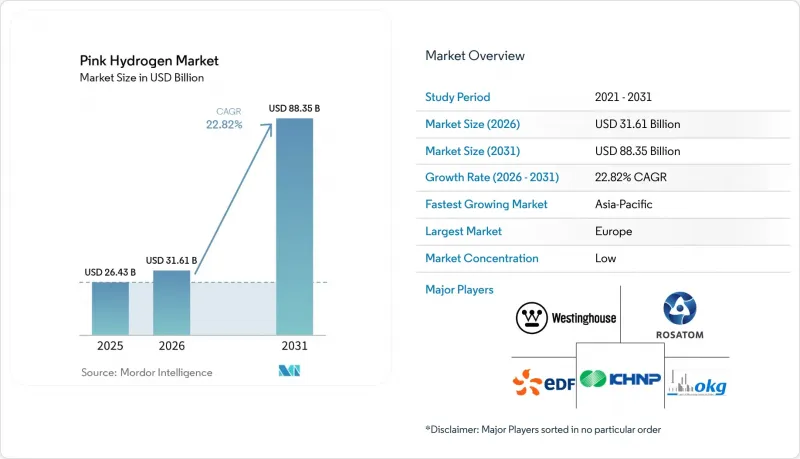
에 의하면, 핑크 수소 시장 규모는 2025년에 264억 3,000만 달러로 평가되었고, 2026년 316억 1,000만 달러에서 2031년까지 883억 5,000만 달러에 이를 것으로 예측되며, 예측 기간(2026년-2031년) CAGR은 22.82%를 기록할 전망입니다.
세계 핑크 수소 시장 동향 및 인사이트
연속 전해를 위한 원자력 발전의 활용 가능성
원자력 발전을 통해 전해조는 90% 이상의 가동률로 운전이 가능해져 안정적인 수소 생산을 뒷받침합니다. 이러한 운전 패턴을 통해 간헐적인 전력 공급으로는 대응할 수 없는 대규모 생산량에 설비 비용을 분산시킬 수 있습니다. 미국 멕시코만 연안 지역의 평가에 따르면, 섹션 45V 세액 공제 제도 하에서 수소 가격이 2.50달러/kg, 전력 가격이 32.86달러/MWh에서 60달러/MWh 범위라면 원자력 통합형 수소가 경쟁력을 가질 수 있는 것으로 밝혀졌습니다. 원자로의 열은 고체 산화물 전해에도 활용할 수 있어, 전력 입력에만 의존하는 시스템에 비해 전력 사용량을 절감할 수 있습니다. EDF의 보고서에 따르면, 열 결합을 통해 양성자 교환막(PEM)이나 알칼리계 전해법에 비해 수소 수율을 20%에서 30%까지 향상시킬 수 있다고 합니다. 이러한 운전 특성 덕분에 핑크 수소 시장은 대규모 저장 버퍼에 의존하지 않고도 정유시설 규모의 운영에서 지속적인 생산을 실현할 수 있는 길이 열립니다.
정부의 청정 수소 자금 지원 및 넷제로 정책
미국은 2025년 1월, 섹션 45V에 근거한 청정 수소 생산 세액 공제에 관한 규정을 확정했습니다. 이 프로그램에서는 최소 탄소 강도 기준을 충족하는 수소에 대해 최대 3달러/kg의 인센티브가 제공됩니다. 이 규정에는 적격 상업용 원자로, 재가동 원자로 및 출력 증강을 받는 원자로에 대한 적격성 요건이 포함되어 있습니다. 유럽연합 집행위원회는 2026년 3월 소형 모듈형 원자로(SMR) 전략을 발표하고, 새로운 원자로 건설 예정지 근처에 수소, 암모니아, 합성 연료 생산 거점을 집적시키는 ‘SMR 밸리’를 제안했습니다. 영국은 2025년 2월, 첨단 원자로 프로젝트의 계획, 규제 및 연료 공급 과정을 지원하기 위해 ‘첨단 원자력 프레임워크’를 출범시켰습니다. 이러한 조치들은 종합적으로 원자로 및 전해조 개발의 불확실성을 줄임으로써 핑크 수소 시장의 투자 환경을 개선할 것입니다.
원자력 및 전해 장치에 대한 높은 자본 요건
핑크 수소 프로젝트에서는 수익이 발생하기 전에 원자로 용량, 전해 장치, 저장 시설 및 연결 인프라에 대한 투자가 필요합니다. 유럽 내 양성자 교환막(PEM) 설비의 설치 비용은 1kW당 2,000-2,550달러입니다. 2026년 조사에 따르면, PEM 시스템의 플랜트 부대 설비(BOP) 자본 비용은 1MW의 경우 1kW당 848달러였던 것이 1GW에서는 1kW당 87달러까지 낮아져, 규모 확대가 비용 절감에 기여하는 바를 보여주고 있습니다. 대형 반응로는 1기당 60억 달러 이상이 소요될 수 있어, 해당 지역에서 진행되는 프로젝트에 추가적인 설비 투자 부담을 안겨줍니다. 따라서 핑크 수소 시장 전체에서 투자를 회수하기 위해서는 장기 공급 계약이 중요합니다. 국제전기표준회의(IEC)의 전해조 규격 및 미국 원자력규제위원회(NRC)의 요건을 준수하기 위해서는 추가적인 준비 작업과 초기 비용이 필요합니다.
부문 분석
2025년, PEM 전해법은 핑크 수소 시장 점유율의 49.34%를 차지했습니다. 이러한 위상은 운영 신뢰성, 확립된 부품 공급망, 그리고 기존 원자력 발전 출력 프로파일과의 호환성을 반영합니다. PEM 시스템은 원자력 발전소가 계통 수요에 따라 출력을 조정할 때 변동하는 전력 부하에 대응할 수 있으므로, 전용 열 통합 없이 상업적 확장을 목표로 하는 사업자에게 실용적인 기술이 되고 있습니다. 2025년 2월, 한국수력원자력(KHNP)은 Nel ASA와 제휴하여 알칼리 기술과 원자력 발전을 결합했습니다. 이번 제휴는 2024년 4월에 시작된 KHNP의 국가 실증 프로그램에 이은 것입니다. 알칼리 시스템은 대규모 설비의 경우 초기 투자 비용을 절감할 수 있는 대안으로서 여전히 중요한 위치를 차지하고 있습니다. 따라서 핑크 수소 시장에는 조기 도입을 위한 여러 공정 옵션이 존재합니다.
고체 산화물 전해는 2031년까지 연평균 성장률(CAGR) 23.56%를 나타낼 것으로 예측됩니다. 이 공정은 원자로 열교환기에서 얻어지는 고온 증기를 활용하여 수소 생산에 필요한 전력 투입량을 줄일 수 있습니다. EDF의 추산에 따르면, 원자로 열을 통합함으로써 저온 시스템에 비해 수소 수율을 20%에서 30%까지 향상시킬 수 있는 것으로 나타났습니다. 2026년 연구에서는 고온 원자로 증기를 공급원으로 하는 중온 고체 산화물 전해가 평가되었습니다. 한국수력원자력(KHNP)은 2026년 7월에 개최된 K-SOC 심포지엄에서 공정 열용량 및 잠재적 실증 부지에 관한 예비 연구 결과를 발표했습니다. 이 공정은 상용 프로젝트에서 양성자 교환막(PEM)만큼 확립되어 있지는 않습니다. 그러나 그 에너지 특성은 안정적인 열을 공급할 수 있는 원자력 시스템에 적합합니다. 이를 통해 핑크 수소 시장에는 시스템 효율 향상에 초점을 맞춘 기술적 선택지가 생겨났으며, 공정 선정이 원자로 구성이나 프로젝트 일정에 좌우되는 이유도 설명됩니다.
지역별 분석
2025년, 유럽은 핑크 수소 시장 점유율의 58.38%를 차지했습니다. 이 지역에서 프랑스는 중심적인 역할을 수행하고 있으며, 56기의 원자로 군이 막대한 원자력 발전 용량을 제공합니다. 2026년부터 2035년까지의 프랑스 제3차 다년도 에너지 계획(PPE3)에서는 연간 380-420 TWh의 원자력 발전 목표가 설정되어 있습니다. 2026년 7월, EDF는 H4 마르세유-포스사와 최초의 원자력 발전 할당 계약을 체결했습니다. 이 계약에 따라 2032년부터 10년 동안 150 MW의 원자력 발전 용량이 할당되며, 이는 16억 유로(18억 5,000만 달러) 규모의 전기식 지속 가능한 항공 연료(e-SAF) 시설에 전력을 공급하는 데 사용될 예정입니다. 또한 EDF는 헤이샴 인근의 ‘베이 수소 허브’에서 고체 산화물 전해법의 도입 가능성을 평가했습니다. 프랑스와 폴란드는 원자력 유래 수소에 대한 저탄소 인증을 지지하고 있지만, 유럽집행위원회는 공식 분류를 2028년 7월까지 연기했습니다. 스웨덴과 핀란드 역시 분류 문제가 해결된다면, 인증 생산을 뒷받침할 수 있는 원자력 발전 용량을 보유하고 있습니다.
아시아태평양은 2031년까지 연평균 성장률(CAGR) 24.18%를 나타낼 것으로 예측됩니다. 한국의 프로그램에는 한국수력원자력(KHNP)이 주관하는 국가 원자력 수소 연구 프로젝트가 포함되어 있으며, 이는 2024년 4월부터 8개 산업 파트너와 공동으로 운영되고 있습니다. 시범 시설은 2027년 완공을 목표로 하고 있습니다. KHNP가 2026년 7월에 개최한 K-SOC 협의회에서는 산업계, 학계, 국립연구소 간의 연구 협력이 도모되었습니다. 일본은 오기시마의 가와사키 LH2 터미널에서 액체 수소 인프라 구축을 추진하고 있습니다. 이 프로젝트에는 5만 입방미터 규모의 저장 탱크가 포함되어 있으며, 2026년 1월의 수송 계약과 연계되어 있습니다. 일본원자력연구개발기구는 2025년 3월, 고온 공학 시험로 내 수소 제조 시설에 대해 규제 심사를 신청했습니다. 인도는 2026년 6월, 칼파캄에서 구리·염소 열화학 사이클을 이용한 수소 제조 시설을 개소하여, 해당 지역의 생산 거점에 비전해 방식의 제조 경로를 추가했습니다.
기타 혜택:
- 엑셀 형식 시장 예측(ME) 시트
- 3개월간의 애널리스트 지원
자주 묻는 질문
목차
제1장 서론
- 조사의 전제조건과 시장의 정의
- 조사 범위
제2장 조사 방법
제3장 주요 요약
제4장 시장 구도
- 시장 개요
- 시장 성장 촉진요인
- 시장 성장 억제요인
- 밸류체인 분석
- Porter의 Five Forces 분석
제5장 시장 규모와 성장 예측
- 프로세스별
- 폼별
- 최종사용자 산업별
- 지역별
- 아시아태평양
- 중국
- 인도
- 일본
- 한국
- 기타 아시아태평양 국가
- 북미
- 미국
- 캐나다
- 멕시코
- 유럽
- 독일
- 영국
- 프랑스
- 이탈리아
- 기타 유럽 국가
- 남미
- 브라질
- 아르헨티나
- 기타 남미 국가
- 중동 및 아프리카
- 사우디아라비아
- 남아프리카공화국
- 기타 중동 및 아프리카 국가
- 아시아태평양
제6장 경쟁 구도
- 시장 집중도
- 전략적 동향
- 시장 점유율·순위 분석
- 기업 개요
- EDF
- Korea Hydro & Nuclear Power(KHNP)
- NuScale Power Corporation
- OKG Aktiebolag
- Rolls-Royce SMR Limited
- Rosatom State Atomic Energy Corporation
- Westinghouse Electric Company LLC
제7장 시장 기회와 향후 전망
LSH 26.10.29According to Mordor Intelligence, the pink hydrogen market size was valued at USD 26.43 billion in 2025 and is estimated to grow from USD 31.61 billion in 2026 to reach USD 88.35 billion by 2031, at a CAGR of 22.82% during the forecast period (2026-2031).
Global Pink Hydrogen Market Trends and Insights
Nuclear Power Availability for Continuous Electrolysis
Nuclear power enables electrolyzers to operate at utilization rates above 90%, supporting steady hydrogen output. This operating pattern spreads equipment costs across a larger production output than intermittent power sources can support. A U.S. Gulf Coast assessment found that nuclear-integrated hydrogen can become competitive under Section 45V credits at a hydrogen price of USD 2.50/kg and electricity prices ranging from USD 32.86/MWh to USD 60/MWh. Reactor heat can also support solid oxide electrolysis, reducing electricity use compared with systems that rely solely on electrical input. EDF reports that thermal coupling can improve hydrogen yield by 20% to 30% compared with Proton Exchange Membrane (PEM) and alkaline alternatives. These operating characteristics provide the pink hydrogen market with a path to continuous output for refinery-scale operations without relying on large storage buffers.
Government Clean-Hydrogen Funding and Net-Zero Policies
The United States finalized rules for the Section 45V clean hydrogen production credit in January 2025. The program provides an incentive of up to USD 3.00/kg for hydrogen that meets the lowest carbon-intensity threshold. The rules include eligibility pathways for qualifying merchant reactors, restarted reactors, and reactors receiving power uprates. The European Commission introduced its Small Modular Reactor (SMR) strategy in March 2026 and proposed SMR Valleys that can cluster hydrogen, ammonia, and synthetic fuel production near new reactor sites. The United Kingdom launched its Advanced Nuclear Framework in February 2025 to support planning, regulation, and fuel supply processes for advanced reactor projects. Together, these measures improve investment conditions for the pink hydrogen market by reducing uncertainty across reactor and electrolyzer development.
High Nuclear and Electrolysis Capital Requirements
Pink hydrogen projects require investment in reactor capacity, electrolyzers, storage, and connecting infrastructure before revenue begins. Proton Exchange Membrane (PEM) installations in Europe cost USD 2,000/kW to USD 2,550/kW. A 2026 study found that balance-of-plant capital for PEM systems fell from USD 848/kW at 1 MW to USD 87/kW at 1 GW, demonstrating the role of scale in lowering costs. Large reactors can cost more than USD 6 billion per unit, adding another layer of capital expenditure to co-located projects. Long-term offtake contracts are therefore important for recovering investment across the pink hydrogen market. Compliance with International Electrotechnical Commission (IEC) electrolyzer standards and Nuclear Regulatory Commission requirements adds preparation work and upfront expense.
Other drivers and restraints analyzed in the detailed report include:
- Decarbonization of Refining and Chemical Hydrogen Demand
- Hydrogen Demand from Steel, Heavy Transport, and Energy Storage
- Limited Nuclear Fleet and Project-Siting Availability
For complete list of drivers and restraints, kindly check the Table Of Contents.
Segment Analysis
PEM electrolysis accounted for 49.34% of the pink hydrogen market share in 2025. This position reflects operating reliability, established component supply chains, and compatibility with existing nuclear output profiles. PEM systems can manage varying electrical loads when nuclear stations follow grid demand, making the technology practical for operators seeking commercial deployment without specialized heat integration. In February 2025, Korea Hydro & Nuclear Power Co., Ltd. (KHNP) partnered with Nel ASA to combine alkaline technology with nuclear power. This collaboration followed KHNP's national demonstration program, which began in April 2024. Alkaline systems remain relevant as a lower-capital option for large installations. The pink hydrogen market, therefore, has more than one process route available for early deployment.
Solid oxide electrolysis is projected to grow at a CAGR of 23.56% through 2031. This process uses high-temperature steam from reactor heat exchangers and can reduce the electrical input required for hydrogen production. EDF estimates that reactor heat integration can raise hydrogen yield by 20% to 30% compared with low-temperature systems. A 2026 study evaluated intermediate-temperature solid oxide electrolysis supplied with high-temperature reactor steam. KHNP presented preliminary work on process-heat capacity and potential demonstration sites at its July 2026 K-SOC symposium. The process remains less established than Proton Exchange Membrane (PEM) for commercial projects. However, its energy profile is suited to nuclear systems that can supply steady heat. This gives the pink hydrogen market a technology option focused on higher system efficiency and explains why process selection will depend on reactor configuration and project timeline.
Complete Report Scope:
- By Process
- PEM Electrolysis
- Alkaline Electrolysis
- Solid Oxide Electrolysis
- By Form
- Gaseous Hydrogen
- Liquid Hydrogen
- By End-User Industry
- Refinery
- Ammonia Production
- Methanol Production
- Steel Production
- Transport
- Cement Industry
- Others
- By Geography
- Asia-Pacific
- China
- India
- Japan
- South Korea
- Rest of Asia-Pacific
- North America
- United States
- Canada
- Mexico
- Europe
- Germany
- United Kingdom
- France
- Italy
- Rest of Europe
- South America
- Brazil
- Argentina
- Rest of South America
- Middle East and Africa
- Saudi Arabia
- South Africa
- Rest of Middle East and Africa
- Asia-Pacific
Geography Analysis
Europe accounted for 58.38% of the pink hydrogen market share in 2025. France plays a central role in the region, with its 56-reactor fleet providing substantial nuclear generation capacity. France's Multi-Year Energy Plan 3 (PPE3) for 2026 to 2035 sets a nuclear production target of 380-420 TWh annually. In July 2026, EDF signed its first Nuclear Production Allocation Contract with H4 Marseille Fos. The agreement allocates 150 MW of nuclear capacity for 10 years, starting in 2032, to power a EUR 1.6 billion (USD 1.85 billion) electro-Sustainable Aviation Fuel (e-SAF) facility. EDF is also assessing solid oxide electrolysis at its Bay Hydrogen Hub near Heysham. France and Poland support low-carbon recognition for nuclear hydrogen, while the European Commission has deferred formal classification until July 2028. Sweden and Finland also have nuclear capacity that could support certified production if the classification is resolved.
Asia-Pacific is expected to grow at a CAGR of 24.18% through 2031. South Korea's program includes KHNP's national nuclear hydrogen research project, which has operated since April 2024 with 8 industrial partners. The pilot facility is targeted for completion in 2027. KHNP's July 2026 K-SOC council linked research among industry, academia, and national laboratories. Japan is developing liquid hydrogen infrastructure at the Kawasaki LH2 Terminal in Ogishima. The project includes a 50,000-cubic-meter storage tank and is paired with the January 2026 carrier contract. The Japan Atomic Energy Agency filed a regulatory review application in March 2025 for a hydrogen facility at the High Temperature Engineering Test Reactor. India inaugurated a copper-chlorine thermochemical cycle hydrogen facility at Kalpakkam in June 2026, adding a non-electrolytic route to the regional production base.
- EDF
- Korea Hydro & Nuclear Power (KHNP)
- NuScale Power Corporation
- OKG Aktiebolag
- Rolls-Royce SMR Limited
- Rosatom State Atomic Energy Corporation
- Westinghouse Electric Company LLC
Additional Benefits:
- The market estimate (ME) sheet in Excel format
- 3 months of analyst support
TABLE OF CONTENTS
1 Introduction
- 1.1 Study Assumptions and Market Definition
- 1.2 Scope of the Study
2 Research Methodology
3 Executive Summary
4 Market Landscape
- 4.1 Market Overview
- 4.2 Market Drivers
- 4.2.1 Nuclear Power Availability for Continuous Electrolysis
- 4.2.2 Government Clean-Hydrogen Funding and Net-Zero Policies
- 4.2.3 Decarbonization of Refining and Chemical Hydrogen Demand
- 4.2.4 Hydrogen Demand from Steel, Heavy Transport and Energy Storage
- 4.2.5 Monetization of Nuclear Power Surplus and Curtailment Periods
- 4.3 Market Restraints
- 4.3.1 High Nuclear and Electrolyzer Capital Requirements
- 4.3.2 Limited Nuclear Fleet and Project-Siting Availability
- 4.3.3 Nuclear-Hydrogen Licensing Interface and Safety Case Complexity
- 4.4 Value Chain Analysis
- 4.5 Porter's Five Forces Analysis
- 4.5.1 Threat of New Entrants
- 4.5.2 Bargaining Power of Suppliers
- 4.5.3 Bargaining Power of Buyers
- 4.5.4 Threat of Substitutes
- 4.5.5 Competitive Rivalry
5 Market Size and Growth Forecasts (Value)
- 5.1 By Process
- 5.1.1 PEM Electrolysis
- 5.1.2 Alkaline Electrolysis
- 5.1.3 Solid Oxide Electrolysis
- 5.2 By Form
- 5.2.1 Gaseous Hydrogen
- 5.2.2 Liquid Hydrogen
- 5.3 By End-User Industry
- 5.3.1 Refinery
- 5.3.2 Ammonia Production
- 5.3.3 Methanol Production
- 5.3.4 Steel Production
- 5.3.5 Transport
- 5.3.6 Cement Industry
- 5.3.7 Others
- 5.4 By Geography
- 5.4.1 Asia-Pacific
- 5.4.1.1 China
- 5.4.1.2 India
- 5.4.1.3 Japan
- 5.4.1.4 South Korea
- 5.4.1.5 Rest of Asia-Pacific
- 5.4.2 North America
- 5.4.2.1 United States
- 5.4.2.2 Canada
- 5.4.2.3 Mexico
- 5.4.3 Europe
- 5.4.3.1 Germany
- 5.4.3.2 United Kingdom
- 5.4.3.3 France
- 5.4.3.4 Italy
- 5.4.3.5 Rest of Europe
- 5.4.4 South America
- 5.4.4.1 Brazil
- 5.4.4.2 Argentina
- 5.4.4.3 Rest of South America
- 5.4.5 Middle East and Africa
- 5.4.5.1 Saudi Arabia
- 5.4.5.2 South Africa
- 5.4.5.3 Rest of Middle East and Africa
- 5.4.1 Asia-Pacific
6 Competitive Landscape
- 6.1 Market Concentration
- 6.2 Strategic Moves
- 6.3 Market Share (%)/Ranking Analysis
- 6.4 Company Profiles (includes Global Overview, Market Overview, Core Segments, Financials as available, Strategic Information, Products and Services, and Recent Developments)
- 6.4.1 EDF
- 6.4.2 Korea Hydro & Nuclear Power (KHNP)
- 6.4.3 NuScale Power Corporation
- 6.4.4 OKG Aktiebolag
- 6.4.5 Rolls-Royce SMR Limited
- 6.4.6 Rosatom State Atomic Energy Corporation
- 6.4.7 Westinghouse Electric Company LLC
7 Market Opportunities and Future Outlook
- 7.1 White-Space and Unmet-Need Assessment


