

|
시장보고서
상품코드
2155567
헬스케어 핀테크 : 시장 점유율 분석, 업계 동향과 통계, 성장 예측(2026-2031년)Healthcare Fintech - Market Share Analysis, Industry Trends & Statistics, Growth Forecasts (2026 - 2031) |
||||||
 Mordor Intelligence
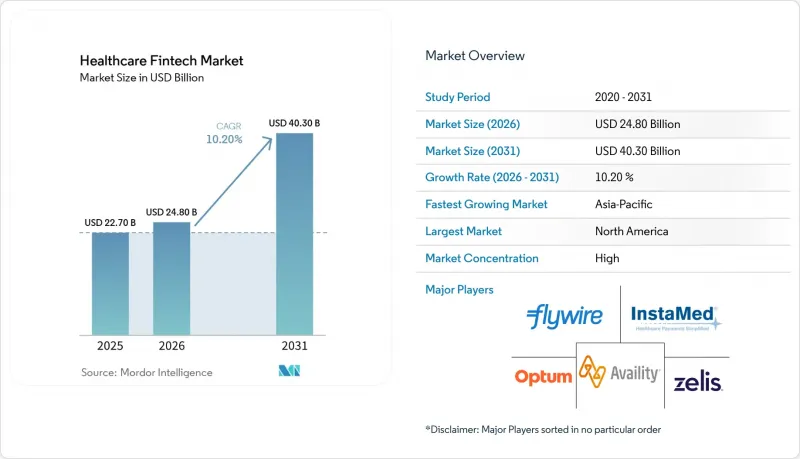
에 의하면, 헬스케어 핀테크 시장 규모는 2025년 227억 달러에서 2026년에는 248억 달러로 확대되어 2031년까지 403억 달러에 이를 것으로 예상되고 있어 2026-2031년 CAGR 10.2%를 기록할 전망입니다.
세계 헬스케어 핀테크 시장 동향 및 인사이트
의료비 급등과 환자의 경제적 부담 증가
환자의 경제적 부담은 의료비 분담으로 인해, 많은 경우 의료가 필요한 바로 그 시점에 지불 책임이 가구에 직접 전가되기 때문에 헬스케어 핀테크 시장에 있어 지속적인 수요원이 되고 있습니다. 2025년, 고용주가 제공하는 보험 플랜 가입자 중 1인 가구의 평균 본인 부담금은 1,886달러에 달했으며, 피보험자의 34%가 2,000달러를 초과하는 본인 부담금을 부담하고 있었습니다. 고액 본인부담형 보험 플랜에 가입한 사람은 그러한 플랜에 가입하지 않은 사람보다 권장되는 의료 서비스를 받을 확률이 4.7% 낮았기 때문에 자금 조달 도구는 환자가 필요한 치료를 진행하는 데 중요한 역할을 하고 있습니다. 2025년 7월, 연방 법원이 의료비 채무에 대한 신용 정보 보고 규정을 무효화함에 따라, 환자의 신용 위험은 계속해서 정책적 불확실성에 노출되어 있습니다. 환자의 미납 잔액이 클수록 의료 제공업체는 더 신속한 회수를 필요로 합니다. 특히, 지불 지연이 후속 연락, 자금 계획, 직원의 업무 부담에 영향을 미치는 경우에는 더욱 그렇습니다. 소비자 대출, 할부 계획, 명확한 디지털 청구서는 환자의 의료 접근을 지원하는 동시에, 의료 제공업체에게 환자 본인 부담금 잔액을 관리하기 위한 보다 체계적인 프로세스를 제공합니다.
의료 결제 및 금융 거래의 디지털화
디지털 결제 도구를 통해 수익 사이클 업무는 사후 청구에서 조기 확인, 자동화된 의사 결정, 그리고 의료 기관의 전반적인 업무에 걸친 신속한 입금 처리로 전환되고 있습니다. 의료 기관의 약 80%가 수익 주기에서 생성형 AI 도구의 검토, 시범 도입 또는 구현을 진행 중이며, 27%는 이미 대규모로 활용하고 있습니다. 이러한 도입을 통해 의료 기관은 별도의 팀 간에 정보를 주고받는 대신, 지급, 송금, 코딩 및 청구 거절 관리를 동일한 업무 프로세스 내에서 연계해야 할 더 강력한 근거를 얻게 됩니다. 자동화된 워크플로우를 통해 청구가 처리 속도가 느린 수동 심사 대기열에 들어가기 전에 불완전한 정보를 식별할 수 있습니다. 수동 심사 대기열에서는 지연이 발생하여 직원과 환자 모두에게 추가적인 부담이 될 수 있습니다. 실시간 결제 인프라와 애플리케이션 프로그래밍 인터페이스(API)를 활용함으로써 심사, 송금, 분개 및 재무 후속 조치에 필요한 정보를 이용할 수 있게 되는 시간을 단축할 수 있습니다. 이러한 기능이 고립된 기술적 시범 프로젝트가 아닌, 기존의 수익 주기 프로세스와 연계된 일상적인 운영 도구가 됨으로써 헬스케어 핀테크 시장은 혜택을 누리게 될 것입니다.
의료 및 금융 데이터의 개인정보 보호, 보안, 사이버 보안 관련 위험
사이버 보안은 중대한 제약 요인이 됩니다. 의료 금융 플랫폼은 여러 연계 기관에 걸쳐 환자, 지불, 청구 및 신원 관련 기밀 데이터를 다루기 때문입니다. 체인지 헬스케어(Change Healthcare)의 정보 유출 사건은 1억 9,270만 명에게 영향을 미쳤으며, 결제 인프라 제공업체의 장애가 의료 제공업체 네트워크 전체의 청구 및 청구 처리를 중단시킬 수 있음을 보여주었습니다. 벤더는 의료 개인정보 보호 의무 및 결제 카드 보안 요건을 충족하는 동시에, 조달, 도입 및 지속적인 운영 과정에서 신뢰할 수 있는 관리 체계를 입증해야 합니다. 이러한 요건으로 인해 기업 고객을 확보하는 데 필요한 비용과 시간이 증가합니다. 구매자는 기밀 정보가 처리의 모든 단계에서 지속적으로 보호되고 있다는 증거를 요구하기 때문입니다. 또한 보안 대책, 사업 연속성 계획, 감사 대응 체계 및 중대한 사고에 대한 대응 절차를 문서화할 수 있는 신뢰도가 입증된 공급업체의 가치도 높아집니다. 따라서 헬스케어 핀테크 시장에서는 제품 설계, 공급업체 감독, 운영 프로세스 및 고객에 대한 보증 자료에 통합된 보안 기능이 중시됩니다.
부문 분석
2025년, 의료 핀테크 시장에서 의료 소비자 대상 대출은 29.1%의 점유율을 차지하며 최대 기능 카테고리가 되었을 뿐만 아니라, 환자의 직접 지불 책임 규모를 여실히 보여주고 있습니다. 이 카테고리는 치료 결정에 따라 즉각적인 지불이 필요할 수 있는 병원 시스템, 전문 진료소, 외래 진료 현장에서 환자 대상 신용 상품이 널리 이용되고 있음을 반영합니다. CareCredit, PatientFi, PayZen 및 AccessOne은 진료 현장의 할부 계약부터 장기 의료 대출에 이르기까지 차용인의 다양한 요구를 충족시키며, 각기 다른 접근 방식으로 다양한 경제적 상황에 대응하고 있습니다. 환자의 지불, 지불의 원활화, 그리고 소비자 주도형 계좌 관리는 기능 구성의 다른 중요한 요소로서, 환자와 의료 제공업체의 재무 업무를 연결해 줍니다. 고용주와 계좌 보유자가 해당 의료비를 관리하고, 의료 서비스를 받기 전에 자금을 확보하기 위해 이러한 계좌를 이용함에 따라, 건강 저축 계좌(HSA)의 관리는 계속해서 확대되고 있습니다. HealthEquity의 보고서에 따르면, 2026년 7월 기준 건강 저축 계좌 수는 전년 대비 8% 증가한 1,070만 건, 총 자산 규모는 380억 달러에 달했습니다.
의료 분야의 B2B 결제 및 의료 기관의 미지급금 관리는 2031년까지 연평균 성장률(CAGR) 14.4%를 나타낼 것으로 예측되며, 이는 기능 카테고리 중 가장 높은 성장률입니다. 이 기능 분야의 의료 핀테크 시장 규모는 청구 정보, 송금 내역, 지급 계상 및 내부 회계 기록을 보다 신속하게 일치시켜야 할 필요성에 의해 뒷받침되고 있습니다. 결제 및 송금 경로가 분리되어 있기 때문에 의료 기관의 경리 팀은 특히 배치에 다수의 청구 및 지급 기록이 포함된 경우, 자동화가 가능한 일상적인 대조 작업을 수행할 수밖에 없습니다. 스트레이트 스루 프로세싱(STP), 실시간 결제 수단, AI를 활용한 송금 대조는 직원이 관련 정보를 더 신속하게 파악할 수 있도록 지원함으로써 이러한 업무 부담을 경감시킵니다. MediStreams는 지급자 데이터 피드를 직접 가져오고 지능형 분류를 위한 API 연결을 확대한 후, 2025년에 사상 최고의 실적을 기록했다고 보고했습니다. 청구, 수급 자격 및 송금 경로는 지급의 정확성과 속도에 영향을 미치는 지급 거절 방지 및 사전 승인 워크플로우를 뒷받침하기 때문에 여전히 핵심 요소입니다. 대규모 플랫폼과 신규 진입 공급업체들은 이러한 기능을 보다 광범위한 수익 주기 솔루션에 통합하여 헬스케어 핀테크 시장의 확장을 뒷받침하고 있습니다.
지역별 분석
2025년, 북미는 헬스케어 핀테크 시장 점유율의 78.9%를 차지했습니다. 이는 미국의 다중 지불자 보험 구조, 환자의 높은 본인 부담률, 그리고 전자의무기록(EMR)의 광범위한 활용에 힘입은 결과입니다. 이 지역의 행정적 부담은 수익 주기 관리, 원활한 지급, 급여 계좌 및 환자 대출에 대한 수요를 창출하고 있습니다. 캐나다의 단일 지불자 제도는 환자 대출에 대한 잠재적 수요를 제한하고 있지만, 그럼에도 불구하고 의료 제공업체에 대한 자동 지급 및 고용주 급여 계좌는 여전히 지원되고 있습니다. 멕시코는 다양한 지불자 및 의료 제공업체 환경을 통해 지역적 수요를 더욱 높이고 있습니다. Optum이나 Waystar와 같은 미국 플랫폼은 시스템 규모로 운영되는 반면, PayZen이나 PatientFi는 환자의 재정적 필요에 더 직접적으로 초점을 맞추었습니다. 2025년 고용주 플랜의 평균 본인 부담금이 1,886달러라는 사실은 이러한 서비스를 뒷받침하는 환자의 경제적 부담이 얼마나 큰지를 보여줍니다.
유럽은 각국의 의료 자금 조달 시스템에 따라 지불 수요가 다르기 때문에 헬스케어 핀테크 시장에서 규모는 작지만 독자적인 역할을 수행하고 있습니다. 영국의 NHS를 중심으로 한 모델에서는 소비자 대상 자금 조달보다는 관리 효율성이나 인력과 관련된 지불 도구가 중시되고 있습니다. 독일의 공적 보험과 민간 보험이 혼재된 체계는 금융 워크플로우 전반에 걸쳐 보다 다양한 수요를 창출하고 있습니다. ‘유럽 헬스 데이터 스페이스(European Health Data Space)’는 디지털 헬스 분야의 상호 운용성과 가치 기반 상환 모델을 지원하고 있습니다. 남미는 여전히 초기 단계에 있지만, 파편화된 민간 보험 체계가 청구 검증 및 지급 중개에 대한 수요를 창출하고 있습니다. Osigu사는 라틴아메리카에 주력하고 있으며, 130개 이상의 병원을 연결하여 연간 1,200만 건의 거래를 처리하고 있습니다.
아시아태평양은 2031년까지 연평균 성장률(CAGR) 14.7%를 나타낼 것으로 예측되며, 이는 헬스케어 핀테크 시장에서 지역별 가장 높은 성장률입니다. 이 지역 전체의 헬스케어 핀테크 시장 규모 확대는 디지털 헬스 인프라 확충과 확립된 디지털 결제 생태계에 의해 뒷받침되고 있습니다. 인도의 ‘아유슈만 바라트 디지털 미션(Ayushman Bharat Digital Mission)’은 2026년 7월 고유 헬스 ID 수가 9억 건을 돌파하며, 인증된 의료 거래를 위한 대규모 디지털 기반을 구축했습니다. 인도의 결제 인프라는 확립된 실시간 결제 시스템을 통해 환자로부터의 수납 및 의료 제공업체에 대한 지급을 처리할 수 있습니다. 중국에는 헬스케어 결제 서비스를 뒷받침할 수 있는 성숙한 ‘알리페이’ 및 ‘위챗 페이’ 결제 네트워크가 있습니다. 사우디아라비아와 아랍에미리트(UAE)는 디지털 헬스케어 역량을 구축 중이지만, 단기적인 대상 시장 규모는 북미 및 아시아태평양보다 작습니다. 개인정보 보호, 결제, 금융 관련 규제로 인해 해당 지역 전반에 걸쳐 시장 진입 요건이 엄격해지고 있으며, 규정 준수를 입증할 수 있는 공급업체가 유리한 입지를 점하고 있습니다.
기타 혜택:
- 엑셀 형식 시장 예측(ME) 시트
- 3개월간의 애널리스트 지원
자주 묻는 질문
목차
제1장 서론
- 조사의 전제조건과 시장의 정의
- 조사 범위
제2장 조사 방법
제3장 주요 요약
제4장 시장 구도
- 시장 개요
- 시장 성장 촉진요인
- 시장 성장 억제요인
- 밸류체인 분석
- 규제 상황
- 기술 전망
- Porter의 Five Forces 분석
제5장 시장 규모와 성장 예측
- 기능별
- 경제적 구매자 별
- 채널별
- 지역별
- 북미
- 미국
- 캐나다
- 멕시코
- 남미
- 브라질
- 아르헨티나
- 기타 남미 국가
- 유럽
- 영국
- 독일
- 프랑스
- 이탈리아
- 스페인
- 기타 유럽 국가
- 아시아태평양
- 중국
- 일본
- 인도
- 한국
- 호주
- 인도네시아
- 태국
- 말레이시아
- 싱가포르
- 베트남
- 기타 아시아태평양 국가
- 중동 및 아프리카
- 사우디아라비아
- 아랍에미리트(UAE)
- 튀르키예
- 남아프리카공화국
- 이집트
- 기타 중동 및 아프리카 국가
- 북미
제6장 경쟁 구도
- 시장 집중도
- 전략적 동향
- 시장 점유율 분석(상위 5-6사)
- 기업 개요
- Optum
- Zelis
- Availity
- Flywire
- InstaMed
- Rectangle Health
- Waystar
- Experian Health
- R1 RCM
- athenahealth
- FinThrive
- Cedar
- Phreesia
- RevSpring
- HealthEquity
- CareCredit
- PayZen
- AccessOne
- CarePayment
- PatientFi
제7장 시장 기회와 향후 전망
LSH 26.10.29According to Mordor Intelligence, the healthcare fintech market size is expected to increase from USD 22.7 billion in 2025 to USD 24.8 billion in 2026 and reach USD 40.3 billion by 2031, growing at a CAGR of 10.2% over 2026-2031.
Global Healthcare Fintech Market Trends and Insights
Rising Healthcare Costs And Growing Patient Financial Responsibility
Patient financial exposure remains a durable source of demand for the healthcare fintech market because cost sharing places more payment responsibility directly on households, often at the point when care is needed. The average single-coverage deductible for employer-plan participants reached USD 1,886 in 2025, and 34% of covered workers had deductibles above USD 2,000. High-deductible plan enrollees were 4.7 percentage points less likely to receive recommended care than people without such plans, which gives financing tools a role in helping patients proceed with needed treatment. A federal court vacated the medical-debt credit-reporting rule in July 2025, leaving patient credit exposure subject to continued policy uncertainty. Providers need faster collections when patients carry larger balances, especially when delayed payments affect follow-up outreach, cash planning, and staff workload. Consumer financing, payment plans, and clear digital billing can support patient access while giving providers a more organized process for managing self-pay balances.
Digitalization Of Healthcare Payment And Financial Transactions
Digital payment tools are moving revenue-cycle work from follow-up billing toward earlier checks, automated decisions, and faster payment posting across provider operations. Around 80% of health systems were exploring, piloting, or implementing generative AI tools in the revenue cycle, and 27% were already using them at scale. This adoption gives providers stronger reasons to connect payment, remittance, coding, and denial management within the same operating process, instead of passing information between separate teams. Automated workflows can identify incomplete information before claims move into slower manual review queues, where delays can create further work for both staff and patients. Real-time payment rails and application programming interfaces can reduce the time between adjudication, remittance, posting, and the availability of information for financial follow-up. The healthcare fintech market benefits when these capabilities become routine operating tools that are connected to existing revenue-cycle processes rather than isolated technology pilots.
Healthcare And Financial Data Privacy, Security, And Cybersecurity Risks
Cybersecurity is a material constraint because healthcare financial platforms handle sensitive patient, payment, claims, and identity data across several connected organizations. The Change Healthcare breach affected 192.7 million people and showed how disruption at a payment infrastructure provider can interrupt claims and billing across provider networks. Vendors must meet healthcare privacy duties and payment-card security requirements while demonstrating reliable controls during procurement, implementation, and ongoing operations. These requirements increase the cost and time needed to win enterprise customers because buyers need evidence that sensitive information remains protected through every processing stage. They also increase the value of established vendors that can document security practices, continuity planning, audit readiness, and response procedures for a significant incident. The healthcare fintech market, therefore, favors security capabilities that are built into product design, vendor oversight, operational processes, and customer assurance materials.
Other drivers and restraints analyzed in the detailed report include:
- Increasing Complexity Of Healthcare Revenue, Claims, And Reimbursement Workflows
- Growing Adoption Of Healthcare-Specific Embedded Payments And Financing Solutions
- Complex Integration With Legacy Healthcare And Financial Systems
For complete list of drivers and restraints, kindly check the Table Of Contents.
Segment Analysis
Healthcare consumer financing held 29.1% of the healthcare fintech market share in 2025, making it the largest function category and showing the scale of direct patient payment responsibility. The category reflects broad use of patient credit products in hospital systems, specialty practices, and ambulatory settings, where treatment decisions may create an immediate payment need. CareCredit, PatientFi, PayZen, and AccessOne have served different borrower needs, from point-of-care installment arrangements to longer-duration medical loans, with each approach addressing a distinct affordability situation. Patient payments, payment facilitation, and consumer-directed account administration represent other important parts of the function mix and connect patients with providers' financial operations. Health savings account administration has continued to expand as employers and account holders use these accounts to manage eligible medical expenses and set aside funds before care occurs. HealthEquity reported 10.7 million health savings accounts in July 2026, up 8% year over year, with USD 38 billion in assets.
Healthcare B2B payments and provider AP are forecast to grow at a 14.4% CAGR through 2031, the highest rate among function categories. The healthcare fintech market size for this function is supported by the need to align claims information, remittance details, payment posting, and internal accounting records more quickly. Separate payment and remittance rails have left provider accounting teams with routine reconciliation work that can be automated, particularly when batches contain many claims or payment records. Straight-through processing, real-time payment methods, and AI-supported remittance matching address this workload by helping staff identify relevant information sooner. MediStreams reported a record 2025 after expanding application programming interface connectivity for direct ingestion and intelligent categorization of payer data feeds. Claims, eligibility, and remittance rails remain foundational because they support denial prevention and prior authorization workflows that affect payment accuracy and speed. Larger platforms and newer suppliers are building these capabilities into broader revenue-cycle offerings, supporting the expansion of the healthcare fintech market.
Complete Report Scope:
- By Function
- Consumer-Directed Health Account Administration
- Healthcare Consumer Financing
- Patient Payments and Healthcare Payment Facilitation
- Claims, Eligibility and Remittance Rails
- Healthcare B2B Payments and Provider AP
- By Economic Buyer
- Healthcare Providers
- Healthcare Payers
- Employers and Plan Sponsors
- Patients and Individual Consumers
- By Channel
- Direct Enterprise
- Bank/Issuer Partner
- TPA/Broker/Benefits Consultant
- Embedded/API/OEM
- By Geography
- North America
- United States
- Canada
- Mexico
- South America
- Brazil
- Argentina
- Rest of South America
- Europe
- United Kingdom
- Germany
- France
- Italy
- Spain
- Rest of Europe
- Asia-Pacific
- China
- Japan
- India
- South Korea
- Australia
- Indonesia
- Thailand
- Malaysia
- Singapore
- Vietnam
- Rest of Asia-Pacific
- Middle East and Africa
- Saudi Arabia
- United Arab Emirates
- Turkey
- South Africa
- Egypt
- Rest of Middle East and Africa
- North America
Geography Analysis
North America held 78.9% of the healthcare fintech market share in 2025, supported by the United States' multi-payer insurance structure, high patient cost sharing, and extensive use of electronic health records. The region's administrative burden creates demand for revenue-cycle management, payment facilitation, benefit accounts, and patient financing. Canada's single-payer structure limits the addressable need for patient financing but still supports provider payment automation and employer benefit accounts. Mexico adds regional demand through its varied payer and provider environment. United States platforms such as Optum and Waystar operate at system scale, while PayZen and PatientFi focus more directly on patient financial needs. The USD 1,886 average employer-plan deductible in 2025 illustrates the patient exposure that supports these services.
Europe has a smaller but distinct role in the healthcare fintech market, as payment needs vary across national healthcare funding systems. The United Kingdom's NHS-centered model emphasizes administrative efficiency and workforce-related payment tools more than consumer financing. Germany's mixed statutory and private insurance framework creates more varied demand across financial workflows. The European Health Data Space supports interoperability and value-based reimbursement models for digital health. South America remains at an earlier stage, but fragmented private insurance arrangements create demand for claims validation and payment intermediation. Osigu has focused on Latin America, connecting more than 130 hospitals and processing 12 million transactions annually.
Asia-Pacific is forecast to grow at a 14.7% CAGR through 2031, the fastest regional rate in the healthcare fintech market. Growth in the healthcare fintech market size across the region is supported by expanding digital health infrastructure and established digital payment ecosystems. India's Ayushman Bharat Digital Mission crossed 900 million unique health IDs in July 2026, creating a large digital foundation for authenticated healthcare interactions. India's payment infrastructure can support patient collections and provider disbursements through established real-time rails. China has mature Alipay and WeChat Pay payment networks that can support healthcare payment services. Saudi Arabia and the United Arab Emirates are developing digital healthcare capabilities, although their near-term addressable scale remains below that of North America and Asia-Pacific. Privacy, payment, and financial regulations raise entry requirements across the region and support suppliers that can demonstrate compliance.
- Optum
- Zelis
- Availity
- Flywire
- InstaMed
- Rectangle Health
- Waystar
- Experian Health
- R1 RCM
- athenahealth
- FinThrive
- Cedar
- Phreesia
- RevSpring
- HealthEquity
- CareCredit
- PayZen
- AccessOne
- CarePayment
- PatientFi
Additional Benefits:
- The market estimate (ME) sheet in Excel format
- 3 months of analyst support
TABLE OF CONTENTS
1 INTRODUCTION
- 1.1 Study Assumptions and Market Definition
- 1.2 Scope of the Study
2 RESEARCH METHODOLOGY
3 EXECUTIVE SUMMARY
4 MARKET LANDSCAPE
- 4.1 Market Overview
- 4.2 Market Drivers
- 4.2.1 Rising Healthcare Costs and Growing Patient Financial Responsibility
- 4.2.2 Digitalization of Healthcare Payment and Financial Transactions
- 4.2.3 Increasing Complexity of Healthcare Revenue, Claims, and Reimbursement Workflows
- 4.2.4 Growing Demand for Integrated Financial Experiences Across the Care Journey
- 4.2.5 Expansion of Digital and Remote Healthcare Delivery Models
- 4.2.6 Growing Adoption of Healthcare-Specific Embedded Payments and Financing Solutions
- 4.3 Market Restraints
- 4.3.1 Healthcare and Financial Data Privacy, Security, and Cybersecurity Risks
- 4.3.2 Complex Integration with Legacy Healthcare and Financial Systems
- 4.3.3 Fragmented Payer, Provider, and Reimbursement Ecosystems
- 4.3.4 Complex Regulatory Requirements Across Healthcare and Financial Services
- 4.4 Value Chain Analysis
- 4.4.1 Financial Infrastructure and Payment Network Providers
- 4.4.2 Healthcare FinTech Platform and Solution Providers
- 4.4.3 Healthcare Technology and Integration Platforms
- 4.4.4 Healthcare Ecosystem End Users and Transaction Participants
- 4.5 Regulatory Landscape
- 4.5.1 Healthcare Data Privacy, Security, and Patient Information Protection Requirements
- 4.5.2 Payment Processing and Financial Transaction Security Requirements
- 4.5.3 Consumer Protection and Healthcare Financing Regulations
- 4.5.4 Financial Crime, Identity Verification, and Compliance Requirements
- 4.6 Technological Outlook
- 4.6.1 Application Programming Interfaces, Embedded Finance, and Healthcare System Integration
- 4.6.2 Artificial Intelligence and Machine Learning for Financial Automation
- 4.6.3 Cloud-Based and API-Driven Financial Infrastructure
- 4.6.4 Real-Time Payments, Digital Wallets, and Advanced Payment Authentication
- 4.7 Porter's Five Forces Analysis
- 4.7.1 Threat of New Entrants
- 4.7.2 Bargaining Power of Suppliers
- 4.7.3 Bargaining Power of Buyers
- 4.7.4 Threat of Substitutes
- 4.7.5 Competitive Rivalry
5 MARKET SIZE AND GROWTH FORECASTS
- 5.1 By Function
- 5.1.1 Consumer-Directed Health Account Administration
- 5.1.2 Healthcare Consumer Financing
- 5.1.3 Patient Payments and Healthcare Payment Facilitation
- 5.1.4 Claims, Eligibility and Remittance Rails
- 5.1.5 Healthcare B2B Payments and Provider AP
- 5.2 By Economic Buyer
- 5.2.1 Healthcare Providers
- 5.2.2 Healthcare Payers
- 5.2.3 Employers and Plan Sponsors
- 5.2.4 Patients and Individual Consumers
- 5.3 By Channel
- 5.3.1 Direct Enterprise
- 5.3.2 Bank/Issuer Partner
- 5.3.3 TPA/Broker/Benefits Consultant
- 5.3.4 Embedded/API/OEM
- 5.4 By Geography
- 5.4.1 North America
- 5.4.1.1 United States
- 5.4.1.2 Canada
- 5.4.1.3 Mexico
- 5.4.2 South America
- 5.4.2.1 Brazil
- 5.4.2.2 Argentina
- 5.4.2.3 Rest of South America
- 5.4.3 Europe
- 5.4.3.1 United Kingdom
- 5.4.3.2 Germany
- 5.4.3.3 France
- 5.4.3.4 Italy
- 5.4.3.5 Spain
- 5.4.3.6 Rest of Europe
- 5.4.4 Asia-Pacific
- 5.4.4.1 China
- 5.4.4.2 Japan
- 5.4.4.3 India
- 5.4.4.4 South Korea
- 5.4.4.5 Australia
- 5.4.4.6 Indonesia
- 5.4.4.7 Thailand
- 5.4.4.8 Malaysia
- 5.4.4.9 Singapore
- 5.4.4.10 Vietnam
- 5.4.4.11 Rest of Asia-Pacific
- 5.4.5 Middle East and Africa
- 5.4.5.1 Saudi Arabia
- 5.4.5.2 United Arab Emirates
- 5.4.5.3 Turkey
- 5.4.5.4 South Africa
- 5.4.5.5 Egypt
- 5.4.5.6 Rest of Middle East and Africa
- 5.4.1 North America
6 COMPETITIVE LANDSCAPE
- 6.1 Market Concentration
- 6.2 Strategic Moves
- 6.3 Market Share Analysis (Top 5-6 players)
- 6.4 Company Profiles (includes Global Level Overview, Market Level Overview, Core Segments, Financials as available, Strategic Information, Market Rank/Share, Products and Services, Recent Developments)
- 6.4.1 Optum
- 6.4.2 Zelis
- 6.4.3 Availity
- 6.4.4 Flywire
- 6.4.5 InstaMed
- 6.4.6 Rectangle Health
- 6.4.7 Waystar
- 6.4.8 Experian Health
- 6.4.9 R1 RCM
- 6.4.10 athenahealth
- 6.4.11 FinThrive
- 6.4.12 Cedar
- 6.4.13 Phreesia
- 6.4.14 RevSpring
- 6.4.15 HealthEquity
- 6.4.16 CareCredit
- 6.4.17 PayZen
- 6.4.18 AccessOne
- 6.4.19 CarePayment
- 6.4.20 PatientFi
7 MARKET OPPORTUNITIES AND FUTURE OUTLOOK
- 7.1 White-Space and Unmet-Need Assessment
- 7.1.1 Affordable Financing for Underinsured and High-Deductible Patients
- 7.1.2 Transparent and Predictable Financing Without Deferred-Interest Risk
- 7.1.3 Interoperable Embedded Financing Across Healthcare Billing and Patient Workflows


