

|
시장보고서
상품코드
2155597
베이스밴드 유닛 : 시장 점유율 분석, 업계 동향과 통계, 성장 예측(2026-2031년)Baseband Unit - Market Share Analysis, Industry Trends & Statistics, Growth Forecasts (2026 - 2031) |
||||||
 Mordor Intelligence
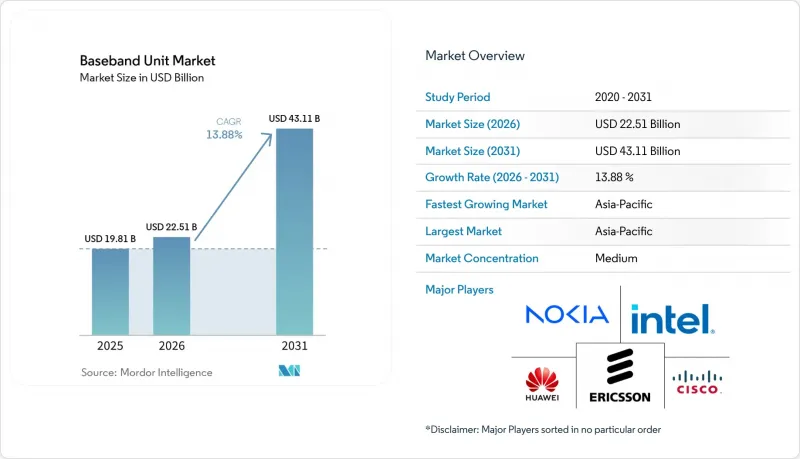
에 따르면 베이스밴드 유닛 시장 규모는 2025년 198억 1,000만 달러에서 2026년에는 225억 1,000만 달러로 확대되어, 2026년부터 2031년까지 CAGR 13.88%를 기록하며 2031년에는 431억 1,000만 달러에 달할 것으로 예측됩니다.
세계 베이스밴드 유닛 시장의 동향 및 인사이트
세계 5G 독립형(SA) 네트워크의 확대
스탠드얼론형 5G의 전개는 독립된 5G 네트워크를 위해 설계된 5G 코어 및 베이스밴드 기능을 필요로 하기 때문에 베이스밴드 유닛 시장의 주요 성장 동력이 되고 있습니다. 세계 모바일 공급자 협회(GSA) 보고서에 따르면, 2026년 1분기까지 95개 통신 사업자가 상용 5G 독립형 서비스를 시작할 예정이며, 이는 2025년 1분기 대비 42% 증가한 수치입니다. SA(Standalone) 네트워크는 네트워크 슬라이싱, 저지연 서비스, 그리고 기존 네트워크 구성으로는 제공하기 어려운 차별화된 기업용 서비스를 지원합니다. 기존 베이스밴드 장비 및 코어 네트워크의 통합이 새로운 아키텍처에 대응해야 하므로, 이러한 전환에는 단순히 무선 장비의 업그레이드 이상의 조치가 필요한 경우가 많습니다. 또한 통신 사업자들은 독립형 기능을 도입하는 동시에 기존 서비스 성능을 유지해야 하므로, 이는 단계적인 장비 조달을 촉진하고 있습니다. 기존 커버리지 네트워크가 산업용 및 기업 고객을 위한 서비스 플랫폼으로 활용되기 시작하면, 베이스밴드 유닛 시장은 그 혜택을 누리게 될 것입니다.
네트워크 용량 및 저지연에 대한 수요 증가
트래픽 양의 증가에 따라 무선 액세스 계층의 처리 능력 증강이 필요해졌으며, 이것이 베이스밴드 유닛 시장의 수요를 뒷받침하고 있습니다. 에릭슨(Ericsson)의 보고서에 따르면, 2025년 말 시점에서 5G는 전 세계 모바일 데이터 트래픽의 48%를 차지하고 있으며, 2031년까지 그 점유율은 85%에 달할 것으로 예측됩니다. 또한 이 보고서는 AI 워크로드, 비디오 감시, 산업용 인터넷 연결 센서와 관련하여 일부 제공업체에서 업링크 트래픽의 증가세가 가속화되고 있음을 지적하고 있습니다. 이러한 애플리케이션은 특히 다수의 기기가 동시에 데이터를 전송할 경우, 기존의 소비자용 광대역 트래픽보다 더 많은 스케줄링 및 처리 리소스를 필요로 합니다. 2026년 7월, NTT 도코모는 에릭슨의 ‘RAN 프로세서 6672’를 일본 최초로 상용 도입을 완료했습니다. 이를 통해 이전 세대에 비해 최대 4배의 용량 효율과 50% 이상의 에너지 소비 감축을 실현했습니다. 이 도입 사례는 용량 업그레이드가 사소한 소프트웨어 변경이 아닌, 새로운 세대의 장비를 기반으로 하는 경향이 강해지고 있는 이유를 보여줍니다.
높은 전력 소비 및 열 관리 요구 사항
전력 소비와 열 관리는 특히 고밀도 중앙 집중형 RAN 도입 시, 베이스밴드 유닛(BBU) 시장의 성장을 제약하는 요인이 될 수 있습니다. 화웨이는 중앙 집중형 RAN 모드에서 5G BBU의 최대 전력 소비량을 2,000W로 보고하고 있습니다. 국제전기통신연합(ITU)은 중앙 집중형 RAN 모드에서 사용되는 5G BBU 시스템에 대한 액체 냉각 요건을 규정하고 있습니다. ETSI 또한 이 구성의 5G BBU 설치를 위해 설계된 액체 냉각 및 고에너지 효율 솔루션에 대한 요건과 사용 사례를 규정하고 있습니다. 따뜻한 기후나 고밀도 실내 클러스터에서는 냉각 비용, 사이트 인프라 요구 사항, 장비 설치 및 운영상의 복잡성이 증가할 가능성이 있습니다. 벤더는 각 사이트의 물리적 및 전력적 제약 조건 내에서 도입 가능한, 저전력 소비 및 냉각 설계를 갖춘 용량 향상을 실현해야 합니다.
부문 분석
하드웨어는 2025년에 베이스밴드 유닛 시장의 48.76%를 차지했습니다. 이는 커버리지 확대 단계에서의 물리적 구축, 특히 아시아태평양 및 북미의 매크로 사이트 구축에 수반되는 자본 집약성을 반영한 것입니다. 소프트웨어는 AI 네이티브 및 클라우드 네이티브 RAN 플랫폼이 제품 개발 단계에서 상용 네트워크 구축 단계로 넘어감에 따라, 2026년부터 2031년까지 연평균 성장률(CAGR) 14.77%로 성장할 것으로 예측됩니다. 노키아는 2026년 7월, AI 가속 기능을 갖춘 AirScale 플러그인 카드, GPU 기반 AI-RAN 노드, 그리고 4G, 5G, 향후 6G 워크로드를 지원하는 anyRAN 소프트웨어 기반으로 구성된 AI 네이티브 RAN 플랫폼을 출시할 예정입니다. 이러한 설계는 일회성 장비 판매에서 여러 네트워크 업그레이드 주기에 걸쳐 지속가능한 소프트웨어 계약으로의 전환을 지원합니다. 또한 기업에서는 설치, 통합, 수명주기 관리, 운영 지원이 필요한 경우가 많기 때문에 서비스 역시 중요한 수익원이 되고 있습니다.
베이스밴드 유닛 시장에서 가상화 기능의 도입이 확대됨에 따라, 예측 기간 동안 하드웨어와 소프트웨어 간의 수익 격차는 축소될 것으로 전망됩니다. 에릭슨의 ‘AI in RAN’ 소프트웨어는 베이스밴드 및 무선 장비 내에 AI 모델을 통합하여 실시간 최적화와 에너지 관리를 실현합니다. 삼성은 인텔 제온 6 하드웨어를 사용하여 미국의 Tier 1 통신 사업자의 실제 운영 네트워크에서 상용 vRAN 통화를 성공적으로 수행함으로써, 상용 서버가 베이스밴드의 연산 워크로드를 지원할 수 있음을 입증했습니다. 따라서 소프트웨어 라이선싱은 특정 사이트에 도입된 전용 섀시와 독립적으로 가치를 창출할 수 있습니다. 또한, 다중 벤더 도입에는 통합 및 라이프사이클 지원이 필요하며, 네트워크 구성이 복잡해질수록 서비스의 역할은 점점 더 중요해질 것입니다.
매시브 MIMO는 고밀도 도시 지역 및 6 GHz 미만 주파수 대역에서의 스펙트럼 효율성 향상 수요에 힘입어, 2025년에는 구성별 베이스밴드 유닛 시장의 49.11%를 차지할 것으로 예측됩니다. 통신 사업자들이 기존의 32T32R 및 64T64R 구성을 뛰어넘는 안테나 수를 늘려감에 따라, 매시브 MIMO는 2026년부터 2031년까지 연평균 성장률(CAGR) 15.01%로 성장할 것으로 예측됩니다. 이러한 시스템을 통해 추가 주파수 대역을 구매하지 않고도 더 높은 처리량 밀도를 실현할 수 있습니다. 에릭슨은 2025년 12월 NTT 도코모를 대상으로 ‘AIR 3255 4.5 GHz 매시브 MIMO 무선기’의 상용화를 시작할 전망이며, 이는 새로운 구성의 상용 도입을 의미합니다. 안테나 수의 증가에 따른 전환에는 더 큰 기저대역 처리 능력이 필요하며, 이는 행렬 연산을 많이 사용하는 워크로드를 위해 설계된 프로세서에 대한 수요를 뒷받침하게 될 것입니다.
비매시브 MIMO 구성은 최대 스펙트럼 효율보다 사이트 비용 절감이 중시되는 지방이나 교외 지역에서의 구축에서 계속해서 중요한 역할을 할 것입니다. 전송상의 제약으로 인해 첨단 안테나 시스템이 설계된 대로 성능을 발휘하지 못할 가능성이 있으므로, 통신 사업자는 프론트홀 및 미드홀 용량을 평가해야 합니다. NTT 도코모의 RAN 프로세서 6672는 3.5 GHz, 3.7 GHz, 4.5 GHz 대역에 걸친 280 MHz의 주파수 대역을 통합하여 매시브 MIMO 유닛을 지원합니다. 이 시스템은 베이스밴드 플랫폼이 단순한 신호 라우팅 장치로서가 아니라, 스펙트럼 집약 및 제어 계층으로서 기능함을 입증하고 있습니다. 또한, 무선 주파수 체인의 수가 증가하면 전력 소비 및 열 관리 요구 사항도 높아지므로, 전송 용량, 전력 공급 능력, 그리고 냉각 비용을 종합적으로 평가해야 합니다.
지역별 분석
아시아태평양은 2025년에 베이스밴드 유닛 시장의 30.12% 점유율을 차지했으며, 예측 기간(2026년부터 2031년까지) 동안 연평균 성장률(CAGR) 15.87%로 확대될 것으로 전망됩니다. 2025년 말까지 중국에서 350만 개 이상의 5G 기지국이 구축될 전망이며, 이것이 해당 지역의 시장 규모를 뒷받침할 것으로 예상됩니다. 초기 커버리지 확대 단계를 거친 후, 이 지역에서는 앞으로도 네트워크 밀도 향상 및 상용화 전 5G-Advanced(5G 어드밴스드)를 위한 활동을 위해 자본 설비가 지속적으로 필요할 것입니다. 인도는 2024년 및 2025년 주파수 경매를 거쳐 5G의 급속한 확대기에 접어들 것으로 예상됩니다. 한국은 계속해서 기술 도입의 주요 시장이며, ‘Hyper AI Network Infrastructure’ 프로젝트를 통해 산업 환경에서 AI-RAN 및 독립형 5G 시험이 진행되고 있습니다. NTT 도코모, 소프트뱅크, KDDI는 2026년에 잇달아 에릭슨과 RAN 계약을 체결할 것으로 예상되며, 이는 일본에서 벤더 재편의 시기가 도래했음을 시사합니다.
북미와 유럽은 수요 추세가 다르긴 하지만, 서로를 보완하는 관계에 있습니다. 미국에서는 3개 Tier 1 통신 사업자에 의한 전국 규모의 독립형 5G 구축이 완료될 전망이며, 단기적인 투자는 초기 커버리지 확대에서 용량 증강 및 AI 대응을 위한 업그레이드로 전환될 것입니다. 캐나다와 멕시코는 아직 용량 증강 초기 단계에 있으며, 중파대 5G 주파수 대역의 프레임워크 구축을 추진하고 있습니다. 유럽에서는 에릭슨과 노키아가 보다폰 쓰리 및 버진 미디어 O2와 공동으로 진행하는 2026년 계획을 포함한 다년간의 프레임워크 계약을 통해 독립형 5G에 대한 투자가 진행되고 있습니다.
남미는 여전히 ‘용량 우선’의 전개 단계에 있으며, 브라질과 아르헨티나가 이 지역의 전개를 주도하고 있습니다. 이 지역에서는 주파수 대역 확보 및 네트워크 현대화를 위한 예산이 마련됨에 따라 장기적인 기회가 기대됩니다.
중동 및 아프리카에서는 수요 상황이 대조적입니다. 걸프협력회의(GCC) 회원국들은 독립형 5G를 조기에 도입한 국가들로, 프리미엄 주파수 대역 할당 및 스마트 시티 프로그램에는 대용량 네트워크 인프라가 요구되고 있습니다. 사우디아라비아의 디지털 인프라 구축 노력과 UAE의 스마트 시티 연결성 프로그램은 향후 수년까지 장비 수요를 뒷받침할 것으로 예상됩니다. 아프리카는 여전히 발전의 초기 단계에 있으며, 남아프리카공화국과 나이지리아가 도입을 주도하고 있는 반면, 이 지역의 대부분은 계속해서 4G 인프라 구축에 주력하고 있습니다. 주파수 경매와 광섬유 백홀 계획이 성숙해짐에 따라, 선택적인 5G 투자가 증가할 것으로 예상됩니다. 걸프 지역은 더 큰 규모의 지역 시장에 비해 규모는 작지만, 사이트당 수요 밀도가 높기 때문에 이 지역의 베이스밴드 유닛 시장 규모를 지탱하고 있습니다. 이러한 환경은 성능, 에너지 효율 및 서비스 요구 사항을 충족할 수 있는 공급업체에게 고부가가치 부문을 창출하고 있습니다.
기타 혜택:
- 엑셀 형식의 시장 예측(ME) 시트
- 3개월간의 애널리스트 지원
자주 묻는 질문
목차
제1장 소개
- 조사 가정과 시장 정의
- 조사 범위
제2장 조사 방법
제3장 주요 요약
제4장 시장 구도
- 시장 개요
- 시장 성장 촉진요인
- 시장 성장 억제요인
- 거시경제 요인이 시장에 미치는 영향
- 업계 밸류체인 분석
- 규제 상황
- 기술 전망
- Porter's Five Forces 분석
제5장 시장 규모와 성장 예측
- 구성요소별
- MIMO 구성별
- 전개별
- 네트워크 아키텍처별
- 최종사용자별
- 지역별
- 북미
- 미국
- 캐나다
- 멕시코
- 남미
- 브라질
- 아르헨티나
- 기타 남미 국가
- 유럽
- 영국
- 독일
- 프랑스
- 이탈리아
- 스페인
- 기타 유럽 국가
- 아시아태평양
- 중국
- 인도
- 일본
- 한국
- 기타 아시아태평양 국가
- 중동
- 사우디아라비아
- 아랍에미리트
- 기타 중동 국가
- 아프리카
- 남아프리카공화국
- 나이지리아
- 기타 아프리카 국가
- 북미
제6장 경쟁 구도
- 시장 집중도
- 전략적 동향
- 시장 점유율 분석
- 기업 개요
- Huawei Technologies Co., Ltd.
- Ericsson AB
- Nokia Corporation
- Samsung Electronics Co., Ltd.
- ZTE Corporation
- Qualcomm Technologies, Inc.
- Intel Corporation
- Fujitsu Limited
- NEC Corporation
- Cisco Systems, Inc.
- Mavenir Systems, Inc.
- Radisys Corporation
- Parallel Wireless, Inc.
- CommScope Holding Company, Inc.
- Airspan Networks Inc.
- JMA Wireless
- Sercomm Corporation
- Rakuten Symphony
- Viettel High-Tech Industries Corporation
- CICT Mobile Communications Equipment Co., Ltd.
- Marvell Technology, Inc.
- Broadcom Inc.
제7장 시장 기회와 향후 전망
KSM 26.10.30According to Mordor Intelligence, the baseband unit market size is expected to grow from USD 19.81 billion in 2025 to USD 22.51 billion in 2026 and is forecast to reach USD 43.11 billion by 2031 at 13.88% CAGR over 2026-2031.
Global Baseband Unit Market Trends and Insights
Global 5G Standalone Network Expansion
Standalone 5G deployment is a central driver for the Baseband Unit Market because it requires a 5G core and baseband functions designed for an independent 5G network. The Global Mobile Suppliers Association reported that 95 operators had launched commercial 5G standalone services by Q1 2026, a 42% increase from Q1 2025. Standalone networks support network slicing, lower-latency services, and differentiated enterprise offerings that are difficult to deliver through legacy network arrangements. The transition often requires more than a radio upgrade because the installed baseband equipment and core integration must support the new architecture. Operators also need to maintain existing service performance while introducing standalone capabilities, which encourages phased equipment procurement. The Baseband Unit Market benefits when established coverage networks are adapted into service platforms for industrial and enterprise customers.
Rising Demand for Network Capacity and Lower Latency
Rising traffic volumes require more processing capacity at the radio access layer, supporting demand in the Baseband Unit Market. Ericsson reported that 5G accounted for 48% of global mobile data traffic at the end of 2025 and projected that share would reach 85% by 2031. The report also identified faster uplink traffic growth for some providers, linked to AI workloads, video surveillance, and industrial internet-connected sensors. These applications require more scheduling and processing resources than conventional consumer broadband traffic does, especially when many devices transmit data simultaneously. In July 2026, NTT DOCOMO completed Japan's first commercial deployment of Ericsson's RAN Processor 6672, delivering up to 4 times higher capacity efficiency and more than 50% lower energy consumption than the earlier generation. The deployment shows why capacity upgrades are increasingly based on new equipment generations instead of minor software changes.
High Power Consumption and Thermal Management Requirements
Power consumption and thermal management can restrain the Baseband Unit Market, especially in dense centralized-RAN deployments. Huawei documented a maximum 5G BBU power consumption of 2,000 W in centralized-RAN mode. The International Telecommunication Union identifies the liquid-cooling requirements for 5G BBU systems used in centralized RAN mode. ETSI also set requirements and use cases for liquid cooling and high-energy-efficiency solutions designed for 5G BBU installations in this configuration. Warm climates and high-density indoor clusters can increase cooling costs, site infrastructure requirements, equipment installation, and operating complexity. Vendors must combine capacity improvements with lower energy consumption and cooling designs that can be deployed within each site's physical and power limits.
Other drivers and restraints analyzed in the detailed report include:
- Growth of Private 5G and Industrial Networks
- Open RAN and Virtualized RAN Adoption
- Semiconductor Supply Concentration and Component Lead-Time Risk
For complete list of drivers and restraints, kindly check the Table Of Contents.
Segment Analysis
Hardware is projected to account for 48.76% of the Baseband Unit Market in 2025, reflecting the capital intensity of physical deployments during the coverage expansion phase, particularly for macro-site buildouts in Asia-Pacific and North America. Software is projected to grow at a 14.77% CAGR from 2026 to 2031 as AI-native and cloud-native RAN platforms progress from product development to commercial network deployment. Nokia is expected to launch an AI-native RAN platform in July 2026, comprising an AI-accelerated AirScale plug-in card, a GPU-powered AI-RAN node, and an anyRAN software foundation that supports 4G, 5G, and future 6G workloads. This design supports a transition from one-time equipment sales to software agreements that can remain in place across multiple network upgrade cycles. Services also represent a significant revenue stream, as enterprises often require installation, integration, lifecycle management, and operational support.
The revenue gap between hardware and software is expected to narrow during the forecast period as the Baseband Unit Market increases its adoption of virtualized functions. Ericsson's AI in RAN software embeds AI models within baseband and radio equipment to enable real-time optimization and energy management. Samsung completed a commercial vRAN call on a Tier-1 US operator's live network using Intel Xeon 6 hardware, demonstrating that commercial servers can support baseband compute workloads. Software licensing can therefore generate value independently of the proprietary chassis deployed at a specific site. Multi-vendor deployments also require integration and lifecycle support, increasing the role of services as network configurations become more complex.
Massive MIMO is projected to account for 49.11% of the Baseband Unit Market by configuration in 2025, supported by demand for greater spectral efficiency in dense urban areas and sub-6 GHz spectrum bands. Massive MIMO is projected to grow at a 15.01% CAGR from 2026 to 2031 as operators increase antenna counts beyond conventional 32T32R and 64T64R configurations. These systems enable higher throughput density without requiring additional spectrum purchases. Ericsson is expected to begin commercial deployment of its AIR 3255 4.5 GHz Massive MIMO radio for NTT DOCOMO in December 2025, demonstrating the commercial adoption of newer configurations. The shift toward higher antenna counts requires greater baseband processing capacity and supports demand for processors designed for matrix-intensive workloads.
Non-Massive MIMO configurations will retain relevance in rural and suburban deployments, where lower site costs are more important than maximum spectral efficiency. Operators must evaluate fronthaul and midhaul capacity, as transport constraints can prevent advanced antenna systems from achieving their designed performance. NTT DOCOMO's RAN Processor 6672 aggregates 280 MHz of spectrum across the 3.5 GHz, 3.7 GHz, and 4.5 GHz bands and supports Massive MIMO units. The system demonstrates how the baseband platform serves as a spectrum aggregation and control layer rather than solely as a signal router. Higher radio-frequency chain counts also increase energy consumption and thermal requirements, necessitating a collective assessment of transport capacity, power availability, and cooling costs.
Complete Report Scope:
- By Component
- Hardware
- Software
- Services
- By MIMO Configuration
- Non-Massive MIMO
- Massive MIMO
- Massive Antenna Element
- By Deployment
- Indoor
- Outdoor
- Other Deployments
- By Network Architecture
- Standalone
- Non-Standalone
- Other Network Architectures
- By End User
- Telecom Operators
- Enterprises and Private Networks
- Government and Defense
- Managed Service Providers
- By Geography
- North America
- United States
- Canada
- Mexico
- South America
- Brazil
- Argentina
- Rest of South America
- Europe
- United Kingdom
- Germany
- France
- Italy
- Spain
- Rest of Europe
- Asia-Pacific
- China
- India
- Japan
- South Korea
- Rest of Asia-Pacific
- Middle East
- Saudi Arabia
- United Arab Emirates
- Rest of Middle East
- Africa
- South Africa
- Nigeria
- Rest of Africa
- North America
Geography Analysis
Asia-Pacific is projected to hold a 30.12% share of the Baseband Unit Market in 2025 and expand at a CAGR of 15.87% during the forecast period (2026 to 2031). China's deployment of more than 3.5 million 5G base stations by the end of 2025 is expected to support the region's volume position. Following the initial coverage phase, the region will continue to require capital equipment for network densification and pre-commercial 5G-Advanced activities. India is expected to enter a period of rapid 5G expansion following spectrum auctions in 2024 and 2025. South Korea remains a key market for technology adoption, with its Hyper AI Network Infrastructure project testing AI-RAN and standalone 5G in industrial environments. NTT DOCOMO, SoftBank, and KDDI are expected to establish successive Ericsson RAN agreements in 2026, indicating a period of vendor consolidation in Japan.
North America and Europe have distinct yet complementary demand profiles. The United States is expected to complete nationwide standalone 5G deployments across its three Tier-1 operators, shifting near-term spending from initial coverage toward capacity densification and AI-ready upgrades. Canada and Mexico remain at earlier stages of densification and continue to develop mid-band 5G spectrum frameworks. Europe is advancing standalone 5G investment through multi-year framework agreements, including planned 2026 work involving Ericsson and Nokia with VodafoneThree and Virgin Media O2.
South America remains in a capacity-first deployment phase, with Brazil and Argentina leading regional rollouts. The region presents a longer-term opportunity as spectrum availability and network modernization budgets develop.
The Middle East and Africa have contrasting demand conditions. Gulf Cooperation Council (GCC) countries are early adopters of standalone 5G, as premium spectrum allocations and smart-city programs require high-capacity network infrastructure. Saudi Arabia's digital infrastructure commitments and the UAE's smart-city connectivity programs are expected to support multi-year equipment demand. Africa remains at an earlier stage of development, with South Africa and Nigeria leading deployments while much of the region continues to focus on 4G consolidation. Selective 5G investment is expected to increase as spectrum auctions and fiber backhaul programs mature. Although the Gulf is more compact than larger regional markets, high per-site demand intensity supports the Baseband Unit Market size in the region. This environment creates a high-value segment for suppliers capable of meeting performance, energy-efficiency, and service requirements.
- Huawei Technologies Co., Ltd.
- Ericsson AB
- Nokia Corporation
- Samsung Electronics Co., Ltd.
- ZTE Corporation
- Qualcomm Technologies, Inc.
- Intel Corporation
- Fujitsu Limited
- NEC Corporation
- Cisco Systems, Inc.
- Mavenir Systems, Inc.
- Radisys Corporation
- Parallel Wireless, Inc.
- CommScope Holding Company, Inc.
- Airspan Networks Inc.
- JMA Wireless
- Sercomm Corporation
- Rakuten Symphony
- Viettel High-Tech Industries Corporation
- CICT Mobile Communications Equipment Co., Ltd.
- Marvell Technology, Inc.
- Broadcom Inc.
Additional Benefits:
- The market estimate (ME) sheet in Excel format
- 3 months of analyst support
TABLE OF CONTENTS
1 INTRODUCTION
- 1.1 Study Assumptions and Market Definition
- 1.2 Scope of the Study
2 RESEARCH METHODOLOGY
3 EXECUTIVE SUMMARY
4 MARKET LANDSCAPE
- 4.1 Market Overview
- 4.2 Market Drivers
- 4.2.1 Global 5G Standalone Network Expansion
- 4.2.2 Rising Demand for Network Capacity and Lower Latency
- 4.2.3 Growth of Private 5G and Industrial Networks
- 4.2.4 Open RAN and Virtualized RAN Adoption
- 4.2.5 AI-Enabled Radio Resource Optimization
- 4.2.6 Edge Computing and Cloud-Native RAN Deployment
- 4.3 Market Restraints
- 4.3.1 High Power Consumption and Thermal Management Requirements
- 4.3.2 Semiconductor Supply Concentration and Component Lead-Time Risk
- 4.3.3 Brownfield Integration Complexity
- 4.3.4 Geopolitical Vendor Restrictions and Supply-Chain Fragmentation
- 4.4 Impact of Macroeconomic Factors on the Market
- 4.5 Industry Value Chain Analysis
- 4.6 Regulatory Landscape
- 4.7 Technological Outlook
- 4.8 Porter's Five Forces Analysis
- 4.8.1 Bargaining Power of Suppliers
- 4.8.2 Bargaining Power of Buyers
- 4.8.3 Threat of New Entrants
- 4.8.4 Threat of Substitutes
- 4.8.5 Competitive Rivalry
5 MARKET SIZE AND GROWTH FORECASTS (VALUE)
- 5.1 By Component
- 5.1.1 Hardware
- 5.1.2 Software
- 5.1.3 Services
- 5.2 By MIMO Configuration
- 5.2.1 Non-Massive MIMO
- 5.2.2 Massive MIMO
- 5.2.3 Massive Antenna Element
- 5.3 By Deployment
- 5.3.1 Indoor
- 5.3.2 Outdoor
- 5.3.3 Other Deployments
- 5.4 By Network Architecture
- 5.4.1 Standalone
- 5.4.2 Non-Standalone
- 5.4.3 Other Network Architectures
- 5.5 By End User
- 5.5.1 Telecom Operators
- 5.5.2 Enterprises and Private Networks
- 5.5.3 Government and Defense
- 5.5.4 Managed Service Providers
- 5.6 By Geography
- 5.6.1 North America
- 5.6.1.1 United States
- 5.6.1.2 Canada
- 5.6.1.3 Mexico
- 5.6.2 South America
- 5.6.2.1 Brazil
- 5.6.2.2 Argentina
- 5.6.2.3 Rest of South America
- 5.6.3 Europe
- 5.6.3.1 United Kingdom
- 5.6.3.2 Germany
- 5.6.3.3 France
- 5.6.3.4 Italy
- 5.6.3.5 Spain
- 5.6.3.6 Rest of Europe
- 5.6.4 Asia-Pacific
- 5.6.4.1 China
- 5.6.4.2 India
- 5.6.4.3 Japan
- 5.6.4.4 South Korea
- 5.6.4.5 Rest of Asia-Pacific
- 5.6.5 Middle East
- 5.6.5.1 Saudi Arabia
- 5.6.5.2 United Arab Emirates
- 5.6.5.3 Rest of Middle East
- 5.6.6 Africa
- 5.6.6.1 South Africa
- 5.6.6.2 Nigeria
- 5.6.6.3 Rest of Africa
- 5.6.1 North America
6 COMPETITIVE LANDSCAPE
- 6.1 Market Concentration
- 6.2 Strategic Moves
- 6.3 Market Share Analysis
- 6.4 Company Profiles (includes Global Level Overview, Market Level Overview, Core Segments, Financials as available, Strategic Information, Market Rank/Share, Products and Services, Recent Developments)
- 6.4.1 Huawei Technologies Co., Ltd.
- 6.4.2 Ericsson AB
- 6.4.3 Nokia Corporation
- 6.4.4 Samsung Electronics Co., Ltd.
- 6.4.5 ZTE Corporation
- 6.4.6 Qualcomm Technologies, Inc.
- 6.4.7 Intel Corporation
- 6.4.8 Fujitsu Limited
- 6.4.9 NEC Corporation
- 6.4.10 Cisco Systems, Inc.
- 6.4.11 Mavenir Systems, Inc.
- 6.4.12 Radisys Corporation
- 6.4.13 Parallel Wireless, Inc.
- 6.4.14 CommScope Holding Company, Inc.
- 6.4.15 Airspan Networks Inc.
- 6.4.16 JMA Wireless
- 6.4.17 Sercomm Corporation
- 6.4.18 Rakuten Symphony
- 6.4.19 Viettel High-Tech Industries Corporation
- 6.4.20 CICT Mobile Communications Equipment Co., Ltd.
- 6.4.21 Marvell Technology, Inc.
- 6.4.22 Broadcom Inc.
7 MARKET OPPORTUNITIES AND FUTURE OUTLOOK
- 7.1 White-Space and Unmet-Need Assessment


