

|
시장보고서
상품코드
2155602
북미의 베이스밴드 유닛 : 시장 점유율 분석, 업계 동향과 통계, 성장 예측(2026-2031년)North America Baseband Unit - Market Share Analysis, Industry Trends & Statistics, Growth Forecasts (2026 - 2031) |
||||||
 Mordor Intelligence
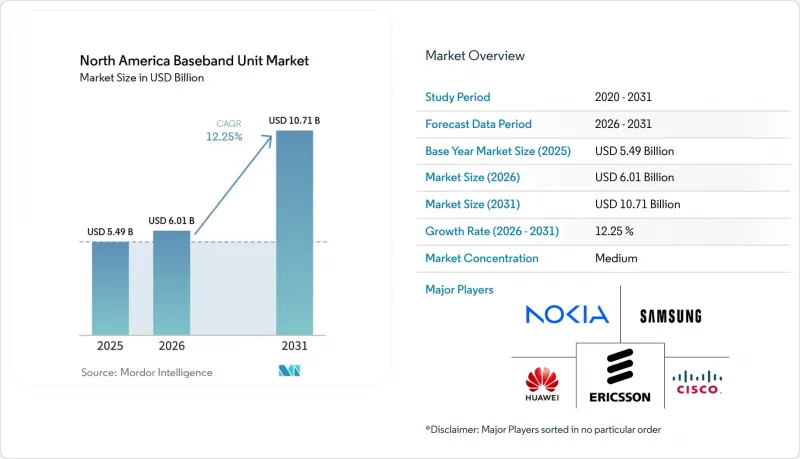
에 따르면 북미의 베이스밴드 유닛 시장 규모는 2025년에 54억 9,000만 달러로 평가되며, 2026년 60억 1,000만 달러에서 확대되어 2031년까지 107억 1,000만 달러에 달할 것으로 추정됩니다.
2026년부터 2031년까지의 예측 기간 동안 연평균 성장률(CAGR)은 12.25%가 될 것으로 전망됩니다.
북미 베이스밴드 유닛 시장의 동향 및 인사이트
5G 독립형(SA) 네트워크의 확대
독립형 5G의 확산은 북미 베이스밴드 유닛 시장의 수요를 견인하는 핵심 요인입니다. 이러한 네트워크에는 소프트웨어를 통해 업데이트가 가능하며, 비독립형 구성에서는 사용할 수 없는 기능을 지원할 수 있는 베이스밴드 시스템이 필요합니다. AT&T는 독립형 5G의 전국적인 상용화를 시작했으며, 가입자들을 개방적이고 가상화된 인프라 기반의 아키텍처로 전환하고 있습니다. 이 아키텍처를 통해 통신 사업자는 별도의 물리적 네트워크를 구축하지 않고도 지연에 민감한 비즈니스 용도를 위한 네트워크 슬라이싱을 제공할 수 있게 됩니다. 연방통신위원회(FCC)는 2026년 7월, 2027년 7월까지 160 MHz의 상위 C-밴드 주파수 대역을 경매에 부치는 규정을 채택했습니다. 이를 통해 면허 취득자가 새로운 용량을 준비하는 과정에서 향후 장비 업데이트 주기가 지원될 것입니다. VTel Wireless는 2026년 3월, 버몬트주 내 독립형 5G 코어 및 RAN 구축을 위해 에릭슨을 선정했습니다. 이는 이러한 전환이 지역 및 지방 통신 사업자로도 확대되고 있음을 보여줍니다.
네트워크 용량 및 저지연에 대한 수요 증가
5G 네트워크상의 트래픽 증가에 따라, 더 높은 처리 능력을 갖춘 베이스밴드 유닛에 대한 필요성이 높아지고 있습니다. 증강 현실(AR), 산업용 IoT, 고정 무선 액세스에는 지속적인 처리량과 낮은 지연 시간이 요구됩니다. 노키아는 2025년 4월, 미국 T-Mobile과의 계약을 연장하고, ReefShark 시스템 온 칩(SoC) 기술을 채택한 ‘Levante Ultra-Performance’ 베이스밴드 제품을 포함한 AirScale RAN 장비를 공급하게 되었습니다. 또한, 베이스밴드 플랫폼은 무선 처리 외에도 네트워크 에지에서 컴퓨팅 워크로드를 처리할 수 있도록 설계되었습니다. 에릭슨은 2026년, T-Mobile 미국이 AI 네이티브 스케줄러의 현장 시험을 실시하고 있으며, AT&T가 Cloud RAN 인프라에 AI 네이티브 소프트웨어를 도입하고 있다고 보고했습니다. 용량 확대에 따라 네트워크 데이터량도 증가함에 따라, 추가적인 자동 최적화의 필요성이 더욱 커지고 있습니다.
높은 전력 소비 및 열 관리 요구 사항
5G 베이스밴드 유닛의 전력 소비량은 2,000와트인 반면, 동급 4G 유닛(HUAWEI.COM)의 전력 소비량은 500와트입니다. 사이트에 각각 1,000-1,400와트를 소비하는 64T64R 능동 안테나 유닛도 사용되고 있는 경우, 이 차이는 더욱 두드러집니다. 따라서 북미의 다양한 기후 조건에 놓인 전체 실외 네트워크에서 열 관리는 운영상의 중요한 과제가 되고 있습니다. 2025년에 발표된 조사에 따르면, 칩의 작동 온도가 10°C 상승하면 장비 고장률이 25% 증가하고, 비트 오류율이 15% 상승하며, 하드웨어 수명이 30% 이상 단축되는 것으로 밝혀졌습니다. USENIX NSDI 2025에서 발표된 조사에 따르면, 트래픽 예측과 전력 상태 최적화를 통해 가상화된 RAN 서버의 전력 소비를 40% 이상 절감할 수 있는 것으로 나타났습니다. 따라서 신뢰할 수 있는 전력 관리 도구를 통합한 공급업체는 무선 성능뿐만 아니라 운영 비용 측면에서도 경쟁력을 발휘할 수 있습니다.
부문 분석
2025년에는 하드웨어가 북미 베이스밴드 유닛 시장의 지역별 매출의 47.77%를 차지할 것으로 예측되며, 가장 큰 구성요소 카테고리가 될 전망입니다. 이 점유율은 통신 사업자와의 다년간 계약을 바탕으로 4G 장비가 5G 지원 베이스밴드 및 무선 시스템으로 교체되는 것을 반영합니다. 노키아와 T-Mobile USA 간의 2025년 계약에는 하드웨어, 소프트웨어, 유지보수 및 지원이 포함될 것으로 예상됩니다. ‘Levante’ 초고성능 베이스밴드 카드와 ‘Habrok’ Massive MIMO 무선 장비가 공급 범위의 중요한 부분을 차지할 것으로 전망됩니다. 가치 창출의 원천이 확대되고 있음에도 불구하고, 하드웨어는 북미 베이스밴드 유닛 시장의 현대화 과정에서 여전히 필수적입니다. 또한 하드웨어는 소프트웨어 및 서비스 판매를 위한 도입 기반을 제공하기도 합니다.
소프트웨어 시장은 2026년부터 2031년까지 연평균 성장률(CAGR) 14.11%로 확대될 것으로 예측됩니다. 각 공급업체들은 구독 라이선스를 통해 클라우드 네이티브 RAN 플랫폼 및 AI 기반 네트워크 관리 도구를 제공하는 사례가 증가하고 있습니다. 이러한 추세로 인해 베이스밴드 관련 지출의 일부가 장비 일괄 구매에서 지속적인 수익 모델로 전환되고 있습니다. 서비스는 여전히 구성요소 중 규모가 가장 작은 카테고리이지만, 통신 사업자들이 라이프사이클 지원을 요구함에 따라 매니지드 서비스 계약은 확대되고 있습니다. Open RAN 소프트웨어는 범용 x86 장비에서 구동되기 때문에 하드웨어 이익률에 추가적인 압박이 가해지고 있습니다. 그 결과, 북미의 베이스밴드 유닛 시장에서는 소프트웨어 통합, 에너지 관리 및 지속적인 지원이 더욱 중요시되고 있습니다.
2025년에는 매시브 MIMO가 북미 베이스밴드 유닛 시장 매출의 46.14%를 차지할 것으로 예측됩니다. 이 부문은 64송신·64수신 안테나 구성을 채택한 미드밴드 5G의 확산으로 혜택을 보고 있습니다. 이러한 시스템은 스펙트럼 효율을 향상시키고 고밀도 모바일 네트워크의 트래픽 요구 사항을 충족시킵니다. 매시브 MIMO 부문은 2026년부터 2031년까지 연평균 성장률(CAGR) 13.56%로 확대될 것으로 예측됩니다. 고차 어레이는 다중 사용자 빔포밍, 캐리어 애그리게이션 및 협업 멀티포인트 전송을 지원합니다. 이러한 기술의 도입으로 각 기저대역 장치에 요구되는 처리 능력이 증가합니다.
GPU를 통해 가속화된 분산형 유닛은 소프트웨어 정의 Massive MIMO가 범용 컴퓨팅 장치에서 어떻게 작동할 수 있는지를 보여줍니다. 이러한 시스템은 기존의 4층 구성에 비해 최대 3배의 스펙트럼 효율을 실현할 수 있습니다. 비 Massive MIMO는 미국 농촌 지역의 통신 커버리지, 캐나다 교외 네트워크, 그리고 멕시코의 초기 스몰 셀 도입에서 여전히 중요한 역할을 하고 있습니다. 이러한 용도에서는 사이트 비용 절감과 도입 간소화가 우선시됩니다. AmpliTech사는 2025년 12월에 개최될 O-RAN Global PlugFest에서 상용 등급의 64T64R CAT-B Massive MIMO 무선 장비의 검증을 완료할 전망입니다. 대규모 Massive MIMO 구축을 목표로 하는 벤더들에게 오픈 프론트홀 인증은 중요한 요건이 되고 있습니다.
기타 혜택:
- 엑셀 형식의 시장 예측(ME) 시트
- 3개월간의 애널리스트 지원
자주 묻는 질문
목차
제1장 소개
- 조사 가정과 시장 정의
- 조사 범위
제2장 조사 방법
제3장 주요 요약
제4장 시장 구도
- 시장 개요
- 시장 성장 촉진요인
- 시장 성장 억제요인
- 거시경제 요인이 시장에 미치는 영향
- 업계 밸류체인 분석
- 규제 상황
- 기술 전망
- Porter's Five Forces 분석
제5장 시장 규모와 성장 예측
- 구성요소별
- MIMO 구성별
- 전개별
- 네트워크 아키텍처별
- 최종사용자별
- 국가별
- 미국
- 캐나다
- 멕시코
제6장 경쟁 구도
- 시장 집중도
- 전략적 동향
- 시장 점유율 분석
- 기업 개요
- Huawei Technologies Co., Ltd.
- Ericsson AB
- Nokia Corporation
- Samsung Electronics Co., Ltd.
- ZTE Corporation
- Qualcomm Technologies, Inc.
- Intel Corporation
- Fujitsu Limited
- NEC Corporation
- Cisco Systems, Inc.
- Mavenir Systems, Inc.
- Radisys Corporation
- Parallel Wireless, Inc.
- CommScope Holding Company, Inc.
- Airspan Networks Inc.
- JMA Wireless
- Rakuten Symphony
- CICT Mobile Communications Equipment Co., Ltd.
- Marvell Technology, Inc.
- Broadcom Inc.
제7장 시장 기회와 향후 전망
KSM 26.10.30According to Mordor Intelligence, the North America baseband unit market size was valued at USD 5.49 billion in 2025 and is estimated to expand from USD 6.01 billion in 2026 to reach USD 10.71 billion by 2031, at a CAGR of 12.25% during the forecast period 2026-2031.
North America Baseband Unit Market Trends and Insights
5G Standalone Network Expansion
Standalone 5G deployment is a central driver of demand for the North America Baseband Unit Market. These networks need baseband systems that can be updated through software and support functions unavailable in non-standalone configurations. AT&T had entered nationwide commercial deployment of standalone 5G and was moving subscribers to an architecture based on open, virtualized infrastructure. This architecture allows operators to offer network slicing for latency-sensitive business uses without building separate physical networks. The Federal Communications Commission adopted rules in July 2026 to auction 160 MHz of Upper C-band spectrum by July 2027, supporting a later equipment cycle as licensees prepare for new capacity. VTel Wireless selected Ericsson in March 2026 for a Vermont standalone 5G core and RAN deployment, indicating that the shift is also reaching regional and rural carriers.
Rising Demand for Network Capacity and Lower Latency
Traffic on 5G networks is increasing the need for baseband units with higher processing capacity. Augmented reality, industrial IoT, and fixed wireless access require sustained throughput and lower latency. Nokia extended its agreement with T-Mobile US in April 2025 to supply AirScale RAN equipment, including the Levante Ultra-Performance baseband products that use ReefShark system-on-chip technology. Baseband platforms are also being designed to handle computing workloads at the network edge alongside radio processing. Ericsson reported in 2026 that T-Mobile US was conducting field trials of an AI-native scheduler and that AT&T was deploying AI-native software on Cloud RAN infrastructure. Greater capacity produces more network data, which strengthens the case for further automated optimization.
High Power Consumption and Thermal Management Requirements
A 5G baseband unit draws 2,000 watts, compared with 500 watts for a comparable 4G unit HUAWEI.COM. The difference becomes more significant when a site also uses 64T64R active antenna units that draw 1,000 to 1,400 watts each. Thermal control is therefore an operating concern across outdoor networks in varied North American climates. Research published in 2025 found that a 10°C rise in chip operating temperature increased equipment failure rates by 25%, increased bit error rates by 15%, and shortened hardware life by more than 30%. Research presented at USENIX NSDI 2025 showed that traffic prediction and power-state optimization can reduce the power consumption of virtualized RAN servers by more than 40%. Suppliers that integrate credible power management tools can therefore compete on operating cost as well as radio performance.
Other drivers and restraints analyzed in the detailed report include:
- Growth of Private 5G and Industrial Networks
- Open RAN and Virtualized RAN Adoption
- Semiconductor Supply Concentration and Component Lead-Time Risk
For complete list of drivers and restraints, kindly check the Table Of Contents.
Segment Analysis
Hardware is projected to account for 47.77% of the North America Baseband Unit Market's regional revenue in 2025, making it the largest component category. This share reflects the replacement of 4G equipment with 5G-capable baseband and radio systems under multiyear carrier agreements. Nokia's 2025 contract with T-Mobile US is expected to include hardware, software, maintenance, and support. Levante ultra-performance baseband cards and Habrok Massive MIMO radios are expected to form an important part of the delivery scope. Hardware remains essential to the modernization of the North America Baseband Unit Market, even as the sources of value broaden. It also provides the installed base for software and service sales.
Software is projected to expand at a 14.11% CAGR from 2026 to 2031. Providers increasingly deliver cloud-native RAN platforms and AI-based network management tools through subscription licenses. This trend shifts a portion of baseband spending from one-time equipment purchases to recurring revenue. Services remain the smallest component category; however, managed service contracts are expanding as operators seek lifecycle support. Open RAN software can run on general-purpose x86 equipment, placing additional pressure on hardware margins. Consequently, the North America Baseband Unit Market is placing greater emphasis on software integration, energy management, and ongoing support.
Massive MIMO is projected to account for 46.14% of the North America Baseband Unit Market by revenue in 2025. The segment benefits from mid-band 5G deployments that use 64-transmit, 64-receive antenna configurations. These systems improve spectral efficiency and support the traffic requirements of dense mobile networks. The Massive MIMO segment is projected to expand at a 13.56% CAGR from 2026 to 2031. Higher-order arrays support multi-user beamforming, carrier aggregation, and coordinated multipoint transmission. Their deployment increases the processing capacity required in each baseband unit.
GPU-accelerated distributed units demonstrate how software-defined Massive MIMO can operate on general-purpose computing equipment. These systems can deliver up to three times the spectral efficiency of conventional four-layer configurations. Non-Massive MIMO remains relevant for rural coverage in the United States, suburban networks in Canada, and initial small-cell deployments in Mexico. These applications prioritize lower site costs and simpler deployment. AmpliTech is expected to complete validation of a commercial-grade 64T64R CAT-B Massive MIMO radio at the O-RAN Global PlugFest in December 2025. Open fronthaul certification is becoming an important requirement for vendors pursuing larger Massive MIMO deployments.
Complete Report Scope:
- By Component
- Hardware
- Software
- Services
- By MIMO Configuration
- Non-Massive MIMO
- Massive MIMO
- Massive Antenna Element
- By Deployment
- Indoor
- Outdoor
- Other Deployment
- By Network Architecture
- Standalone
- Non-Standalone
- Other Network Architectures
- By End User
- Telecom Operators
- Enterprises and Private Networks
- Government and Defense
- Managed Service Providers
- By Country
- United States
- Canada
- Mexico
List of Companies Covered in this Report:
- Huawei Technologies Co., Ltd.
- Ericsson AB
- Nokia Corporation
- Samsung Electronics Co., Ltd.
- ZTE Corporation
- Qualcomm Technologies, Inc.
- Intel Corporation
- Fujitsu Limited
- NEC Corporation
- Cisco Systems, Inc.
- Mavenir Systems, Inc.
- Radisys Corporation
- Parallel Wireless, Inc.
- CommScope Holding Company, Inc.
- Airspan Networks Inc.
- JMA Wireless
- Rakuten Symphony
- CICT Mobile Communications Equipment Co., Ltd.
- Marvell Technology, Inc.
- Broadcom Inc.
Additional Benefits:
- The market estimate (ME) sheet in Excel format
- 3 months of analyst support
TABLE OF CONTENTS
1 INTRODUCTION
- 1.1 Study Assumptions and Market Definition
- 1.2 Scope of the Study
2 RESEARCH METHODOLOGY
3 EXECUTIVE SUMMARY
4 MARKET LANDSCAPE
- 4.1 Market Overview
- 4.2 Market Drivers
- 4.2.1 Global 5G Standalone Network Expansion
- 4.2.2 Rising Demand for Network Capacity and Lower Latency
- 4.2.3 Growth of Private 5G and Industrial Networks
- 4.2.4 Open RAN and Virtualized RAN Adoption
- 4.2.5 AI-Enabled Radio Resource Optimization
- 4.2.6 Edge Computing and Cloud-Native RAN Deployment
- 4.3 Market Restraints
- 4.3.1 High Power Consumption and Thermal Management Requirements
- 4.3.2 Semiconductor Supply Concentration and Component Lead-Time Risk
- 4.3.3 Brownfield Integration Complexity
- 4.3.4 Geopolitical Vendor Restrictions and Supply-Chain Fragmentation
- 4.4 Impact of Macroeconomic Factors on the Market
- 4.5 Industry Value Chain Analysis
- 4.6 Regulatory Landscape
- 4.7 Technological Outlook
- 4.8 Porter's Five Forces Analysis
- 4.8.1 Bargaining Power of Suppliers
- 4.8.2 Bargaining Power of Buyers
- 4.8.3 Threat of New Entrants
- 4.8.4 Threat of Substitutes
- 4.8.5 Competitive Rivalry
5 MARKET SIZE AND GROWTH FORECASTS (VALUE)
- 5.1 By Component
- 5.1.1 Hardware
- 5.1.2 Software
- 5.1.3 Services
- 5.2 By MIMO Configuration
- 5.2.1 Non-Massive MIMO
- 5.2.2 Massive MIMO
- 5.2.3 Massive Antenna Element
- 5.3 By Deployment
- 5.3.1 Indoor
- 5.3.2 Outdoor
- 5.3.3 Other Deployment
- 5.4 By Network Architecture
- 5.4.1 Standalone
- 5.4.2 Non-Standalone
- 5.4.3 Other Network Architectures
- 5.5 By End User
- 5.5.1 Telecom Operators
- 5.5.2 Enterprises and Private Networks
- 5.5.3 Government and Defense
- 5.5.4 Managed Service Providers
- 5.6 By Country
- 5.6.1 United States
- 5.6.2 Canada
- 5.6.3 Mexico
6 COMPETITIVE LANDSCAPE
- 6.1 Market Concentration
- 6.2 Strategic Moves
- 6.3 Market Share Analysis
- 6.4 Company Profiles (includes Global Level Overview, Market Level Overview, Core Segments, Financials as available, Strategic Information, Market Rank/Share, Products and Services, Recent Developments)
- 6.4.1 Huawei Technologies Co., Ltd.
- 6.4.2 Ericsson AB
- 6.4.3 Nokia Corporation
- 6.4.4 Samsung Electronics Co., Ltd.
- 6.4.5 ZTE Corporation
- 6.4.6 Qualcomm Technologies, Inc.
- 6.4.7 Intel Corporation
- 6.4.8 Fujitsu Limited
- 6.4.9 NEC Corporation
- 6.4.10 Cisco Systems, Inc.
- 6.4.11 Mavenir Systems, Inc.
- 6.4.12 Radisys Corporation
- 6.4.13 Parallel Wireless, Inc.
- 6.4.14 CommScope Holding Company, Inc.
- 6.4.15 Airspan Networks Inc.
- 6.4.16 JMA Wireless
- 6.4.17 Rakuten Symphony
- 6.4.18 CICT Mobile Communications Equipment Co., Ltd.
- 6.4.19 Marvell Technology, Inc.
- 6.4.20 Broadcom Inc.
7 MARKET OPPORTUNITIES AND FUTURE OUTLOOK
- 7.1 White-Space and Unmet-Need Assessment


