

|
시장보고서
상품코드
2155612
무매듭 조직 봉합 기기 : 시장 점유율 분석, 업계 동향과 통계, 성장 예측(2026-2031년)Knotless Tissue Control Devices - Market Share Analysis, Industry Trends & Statistics, Growth Forecasts (2026 - 2031) |
||||||
 Mordor Intelligence
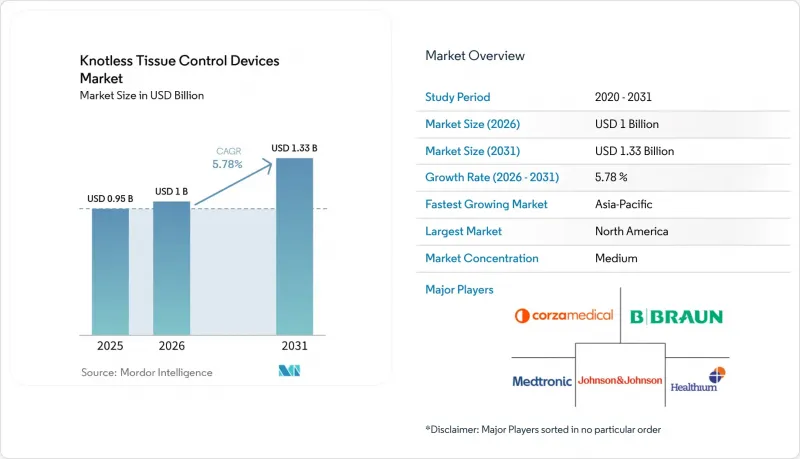
에 따르면 무매듭 조직 봉합 기기 시장 규모는 2025년 9억 5,000만 달러에서 2026년에는 10억 달러로 확대되고, 2026년부터 2031년까지 CAGR 5.78%를 기록하며 2031년에는 13억 3,000만 달러에 달할 것으로 예측됩니다.
세계 무매듭 조직 봉합 기기 시장 동향 및 인사이트
최소침습 및 로봇 보조 연조직 봉합술의 확대
로봇 수술은 단순히 수술 건수의 증가에 그치지 않고, 무매듭 봉합에 대한 수요 양상을 변화시키고 있습니다. 미국 내 22만 명 이상의 환자를 대상으로 한 후향적 연구에 따르면, 로봇 보조 자궁 적출술에서 무매듭 장치의 사용률은 7년 동안 2.9%에서 10.4%로 상승했습니다. 또한, 같은 관찰 기간 동안 복벽 탈장 수복술에서의 사용률은 12.2%에서 25.3%로 상승했습니다. 로봇 심장 수술에서는V-Loc 바브가 달린 봉합사를 사용함으로써 좌심방 폐쇄 시간이 31.3%(11분) 단축되었습니다. 이는 기존 봉합사를 사용했을 때의 16분과 비교한 것으로, 재수술이나 중대한 합병증의 증가는 관찰되지 않았습니다. 로봇 수술실에서는 팀 연수 시 디바이스 사용 절차가 표준화되는 경우가 많으며, 이로 인해 확립된 워크플로우 내에서 기존 봉합사가 선호되지 않을 가능성이 있습니다. 이러한 추세는 정형외과, 비뇨기과, 일반외과, 종양학 등 각 분야에서 로봇 수술 프로그램이 확대됨에 따라 ‘무매듭 조직 봉합 기기 시장’을 견인하는 요인이 되고 있습니다.
수술실 시간과 처리량에 대한 경제성
무매듭 장치가 수술실에서 채택되는 이유는 하루당 수술 건수를 늘릴 수 있는 시간 단축에 있습니다. 로봇 보조 자궁 적출술에서 무매듭 장치를 사용함으로써 조정 후 수술실 시간이 19.1분 단축되었습니다. 복벽 탈장 교정술에서도 조정된 수술 시간이 17.3분 단축되었습니다. 보고된 시간 단축에 따른 비용 절감 효과는 적용되는 수술실 비용에 따라 자궁 적출술 1건당 700-2,158달러, 탈장 복구술 1건당 640-1,955달러에 해당합니다. 외래 수술 센터의 한 수술실에서는 보통 하루에 4-6건의 수술을 처리합니다. 17-19분의 단축으로 인해 추가 사례를 처리할 여력이 생겨, 이러한 시설의 수익 창출에 더 직접적인 기여를 하게 됩니다. 이러한 운영 환경은 조달 결정이 환자 처리 능력과 밀접하게 연결되어 있는 ‘무매듭 조직 봉합 기기 시장’을 뒷받침하고 있습니다.
높은 가격 책정 및 도입 요건
프리미엄 가격 책정은 병원 도입을 목표로 하는 제조사들에게 여전히 접근성상의 과제로 남아 있습니다. 바브가 있는 무매듭 기기의 미국 정가는 12-24개가 들어 있는 1박스당 150-350달러로 알려져 있으나, 공동 구매 계약을 통해 실제 가격은 낮아질 가능성이 있습니다. 병원의 가치 분석 위원회는 도입이 가져다주는 임상적 및 재정적 이점을 기준으로 기기의 추가 도입을 검토합니다. 동료 심사를 거친 평가 보고서에 따르면, 바브가 있는 기기를 기존 봉합사와 비교했을 때, 인공 슬관절 전치환술 1건당 평균 48.8달러의 비용 절감 효과가 확인되었습니다. 그러나 이 절감액만으로는 병원 채널의 프리미엄급 조달 요건을 충족하지 못할 수도 있습니다. 2025년에는 인도와 한국에서 FDA 승인을 받은 신제품이 미국 시장에 진입하면서 기존 공급업체에 대한 가격 경쟁이 격화되었습니다.
부문 분석
2025년, 비흡수성 폴리머 소재의 기기는 무매듭 조직 봉합 기기 시장의 42.31% 점유율을 차지했습니다. 이러한 위상은 영구적 및 반영구적 조직 고정, 특히 장기간에 걸쳐 기계적 무결성을 유지해야 하는 정형외과 및 심혈관 외과 수술에서의 사용을 반영합니다. 이 소재는 생분해가 지속적인 지지라는 기능적 요구와 상충되는 임상 환경에 적합합니다. 단기 흡수성 제품은 부인과 및 일반 연조직 봉합술에서 핵심적인 위치를 차지하고 있습니다. 이 제품의 흡수 패턴은 2-6주의 상처 치유 기간과 일치합니다. 따라서 제품 선택은 예상되는 치유 과정과 수술 후 필요한 기계적 지지 수준에 따라 결정됩니다.
장기 흡수성 기기는 2026년부터 2031년까지 연평균 성장률(CAGR) 6.65%로 성장할 것으로 예측되며, 이 제품 분류 중 가장 높은 성장률을 보이고 있습니다. FDA는 2026년 5월, 복벽 근막, 무릎 신전 기전 근막, 심부 고관절 근막 및 복벽 탈장 폐쇄를 포함한 고장력 용도에 대해 ‘STRATAFIX Symmetric PDS Plus’를 승인했습니다. 이러한 적응증 확대로 인해 장기 흡수성 기기는 근막 폐쇄 분야에서 더욱 중요한 선택지가 될 것입니다. 고장력 부위에서의 채택이 지속된다면, 제품 구성에서 비흡수성 제품의 장기적인 비중이 낮아질 가능성이 있습니다. 따라서 장기 흡수성 기기를 포함한 ‘무매듭 조직 봉합 기기 시장’의 규모는 외과의들이 이러한 제품을 새로 승인된 적응증에 채택할지 여부에 따라 좌우될 것입니다.
2025년 시점에서, 단방향 바브가 있는 장치는 ‘무매듭 조직 봉합 기기 시장’의 58.24% 점유율을 차지했습니다. 이러한 주도적인 지위는 로봇 수술에서 채택되고 있는 방향성 있는 워크플로우에 기인합니다. 로봇 수술을 수행하는 외과의사는 일반적으로 정의된 기준점에서 한 방향으로 조직을 봉합합니다. 단방향 바브는 전방으로의 통과를 허용하고 후방으로의 움직임을 차단합니다. 이러한 설계는 제한된 로봇 수술 작업 공간 내에서 이루어지는 봉합 수술에 적합합니다. 또한, 이러한 구조 덕분에 봉합 작업 중 반복적인 결찰에 대한 의존도도 낮아집니다.
양방향형 기기는 상처의 중심에서 양쪽 끝을 향해 상처 봉합을 수행할 수 있습니다. 이러한 기기는 대칭적인 장력 분포가 중요한 개방 수술 환경의 긴 상처나 개복 수술 사례에서 여전히 유용합니다. 양방향형 제품은 대칭적인 상처 관리에 있어 이론적인 이점을 제공할 수 있지만, 로봇 수술의 보급으로 인해 단방향형 설계의 중요성은 더욱 높아지고 있습니다. 로봇 수술의 워크플로우로 인해 가장 빠르게 성장하고 있는 분야에서 양방향 폐쇄의 실용적 가치는 떨어지고 있습니다. B. Braun사의 Aesculap 사업부는 복강경 자궁 적출술에서 Symmcora와 Medtronic사의V-Loc을 비교하는 BARHYSTER 무작위 임상시험을 진행하고 있습니다. 이 조사를 통해 ‘매듭이 없는 조직 제어 장치 시장’에서 주류를 이루고 있는 단방향 구조에 경쟁사들의 관심이 집중되고 있습니다.
지역별 분석
2025년, 북미는 전 세계 무매듭 조직 봉합 기기 시장 점유율의 41.61%를 차지했습니다. 미국은 로봇 수술의 높은 보급률과 성숙한 외래 수술 센터 부문을 통해 이러한 위상을 뒷받침하고 있습니다. 클래스 II 봉합 기기에 대한 FDA 승인 절차에 따라 2025년 9월부터 2026년 5월까지 관련 승인 6건이 내려졌습니다. 이러한 움직임은 제품 주기의 모멘텀을 유지하는 것으로, 미국의 기존 공급업체뿐만 아니라 인도와 한국의 신규 진입 기업들도 포함되었습니다. 캐나다에서는 의료 기술 평가 일정에 따라 보다 신중한 도입 과정이 형성되고 있습니다. 멕시코에서는 민간 병원 기반이 확대됨에 따라 최소침습 수술법의 보급이 진행되고 있지만, 기기의 보급률은 여전히 초기 단계에 머물러 있습니다.
유럽에서는 규정 준수 요건이 제품 시장 진입 속도를 좌우하기 때문에 수요 환경이 독특합니다. EU MDR 2017/745에서는 연조직 고정 제품의 재인증 시 최신 임상 증거를 제출할 것을 요구하고 있습니다. 이 요건으로 인해 시간과 비용이 증가하므로, 자금력이 있는 공급업체에 유리하게 작용하여 소규모 신규 진입 기업의 시장 진입을 제한할 가능성이 있습니다. 영국의 국민보건서비스(NHS)는 2035년까지 연간 50만 건의 로봇 수술을 목표로 하고 있으며, 이로 인해 로봇 호환 봉합 제품에 대한 장기적인 수요 기반이 형성되고 있습니다. Serag-Wiessner, B. Braun, Resorba Medical 및 Advanced Medical Solutions는 이 지역에서 확고한 입지를 구축한 기업들입니다. 그 밖의 유럽 지역도 OECD 전반에서 나타나는 외래 수술로의 전환 추세를 따르고 있어, 이에 따라 수요는 병원 중심의 용도를 넘어 확대되고 있습니다.
아시아태평양은 2031년까지 연평균 성장률(CAGR) 7.65%로 성장할 것으로 예측되며, 이는 지역별 부문 중 가장 높은 성장률입니다. 중국, 일본, 인도, 한국, 호주가 이러한 성장을 뒷받침하는 주요 국가입니다. 스미스 앤 네퓨(Smith & Nephew)는 2026년 3월, 어깨, 팔꿈치, 고관절, 무릎, 발목의 연조직 복원을 위한 ‘Q-FIX 무매듭 앵커’의 일본 내 판매를 시작했습니다. 메릴 앤 서저리(Merrill & Surgery)는 2025년 9월 ‘PINION PDO 무매듭 봉합사’에 대해 FDA 승인을 획득했으며, 인도를 고부가가치 수출 시장에 접근할 수 있는 비용 경쟁력 있는 제조 거점으로 자리매김했습니다. 필테크(Fieldtech)사는 2025년 10월 바브가 부착된 외과용 봉합사에 대해 미국 승인을 획득하여 한국의 의료기기 수출 역량을 입증했습니다. 중국 및 인도의 병원 확장에 따라, 기존에는 일반 봉합사를 사용하던 환자층 사이에서 첨단 상처 봉합법에 대한 새로운 수요가 발생하고 있습니다. 중동 및 아프리카 및 남미는 수요의 중심지로 발전하고 있으며, GCC(걸프협력회의) 회원국의 사립 병원과 브라질 및 아르헨티나의 수술 건수가 이 지역의 주요 성장 동력이 되고 있습니다.
기타 혜택:
- 엑셀 형식의 시장 예측(ME) 시트
- 3개월간의 애널리스트 지원
자주 묻는 질문
목차
제1장 소개
- 조사 가정과 시장 정의
- 조사 범위
제2장 조사 방법
제3장 주요 요약
제4장 시장 구도
- 시장 개요
- 시장 성장 촉진요인
- 시장 성장 억제요인
- 공급망 분석
- 규제 상황
- 기술 전망
- Porter's Five Forces 분석
제5장 시장 규모와 성장 예측
- 제품 유형별
- 바브 아키텍처별
- 앵커 디자인별
- 용도별
- 최종사용자별
- 지역별
- 북미
- 미국
- 캐나다
- 멕시코
- 유럽
- 독일
- 영국
- 프랑스
- 이탈리아
- 스페인
- 기타 유럽 국가
- 아시아태평양
- 중국
- 일본
- 인도
- 호주
- 한국
- 기타 아시아태평양 국가
- 중동 및 아프리카
- GCC
- 남아프리카공화국
- 기타 중동 및 아프리카 국가
- 남미
- 브라질
- 아르헨티나
- 기타 남미 국가
- 북미
제6장 경쟁 구도
- 시장 집중도
- 시장 점유율 분석
- 기업 개요
- Advanced Medical Solutions Group plc
- B. Braun Melsungen AG
- CONMED Corporation
- Corza Medical
- DemeTECH Corporation
- Dolphin Sutures
- Genesis MedTech Group
- Healthium Medtech Limited
- Johnson & Johnson
- Medtronic plc
- Serag-Wiessner GmbH & Co. KG
- Shandong Weigao Group Medical Polymer Company Limited
- Smith+Nephew plc
- Stryker Corporation
- Teleflex Incorporated
- UNIFY Surgical
제7장 시장 기회와 향후 전망
KSMAccording to Mordor Intelligence, the knotless tissue control devices market size is expected to grow from USD 0.95 billion in 2025 to USD 1 billion in 2026 and is forecast to reach USD 1.33 billion by 2031 at 5.78% CAGR over 2026-2031.
Global Knotless Tissue Control Devices Market Trends and Insights
Expansion Of Minimally Invasive And Robotic Soft-Tissue Closure
Robotic surgery is reshaping demand for knotless closure beyond a simple increase in procedure volumes. A retrospective study of more than 220,000 U.S. patients found that use of knotless devices in robotic total hysterectomy rose from 2.9% to 10.4% over 7 years. Use in ventral hernia repair rose from 12.2% to 25.3% during the same observation period. In robotic cardiac surgery, V-Loc barbed sutures reduced left atrial closure time by 31.3%, or 11 minutes compared with 16 minutes for conventional sutures, without a rise in reoperation or major complications. Robotic suites often standardize device protocols during team training, which can make conventional sutures less favored within established workflows. This effect supports the Knotless Tissue Control Devices Market as robotic programs broaden across orthopedics, urology, general surgery, and oncology.
Operating-Room Time And Throughput Economics
The operating-room case for knotless devices rests on time savings that can improve daily capacity. In robotic total hysterectomy, knotless devices reduced adjusted operating-room time by 19.1 minutes. Ventral hernia repair recorded a 17.3-minute reduction in adjusted operating-room time. The reported savings equated to USD 700 to USD 2,158 per hysterectomy case and USD 640 to USD 1,955 per hernia repair case, depending on the operating-room cost applied. A single operating room in an ambulatory surgical center commonly manages 4 to 6 cases each day. Recovering 17 to 19 minutes can allow capacity for an additional case, making the revenue case more direct for these facilities. This operational setting strengthens the Knotless Tissue Control Devices Market, where procurement decisions are closely tied to patient throughput.
Premium Pricing And Access Requirements
Premium pricing remains an access issue for manufacturers pursuing hospital adoption. Barbed knotless devices were indicated at USD 150 to USD 350 per box of 12 to 24 units in U.S. list pricing, although group-purchasing contracts can reduce realized prices. Hospital value-analysis committees review device additions against the clinical and financial return they can demonstrate. A peer-reviewed evaluation reported average savings of USD 48.8 per total knee arthroplasty case for barbed versus traditional sutures. That saving may not always be sufficient for premium-tier procurement in the hospital channel. New FDA-cleared products from India and South Korea entered the U.S. market in 2025, adding price competition against established suppliers.
Other drivers and restraints analyzed in the detailed report include:
- Growth In Surgical Volumes And Outpatient Procedures
- Antibacterial Innovation And High-Tension Closure
- Clinical Consistency, Safety, And Adoption Complexity
For complete list of drivers and restraints, kindly check the Table Of Contents.
Segment Analysis
Non-absorbable polymer devices captured 42.31% of the Knotless Tissue Control Devices Market share in 2025. Their position reflects use in permanent and semi-permanent tissue fixation, especially in orthopedic and cardiovascular procedures where mechanical integrity must remain over time. The material is suited to clinical settings in which degradation would conflict with the functional need for continuing support. Short-term absorbable products form a middle tier for gynecological and general soft-tissue approximation. Their absorption pattern aligns with wound-healing periods of 2 to 6 weeks. Product selection is therefore tied to the anticipated healing profile and the level of mechanical support required after the procedure.
Long-term absorbable devices are forecast to grow at a 6.65% CAGR from 2026 to 2031, the fastest rate in this product classification. The FDA cleared STRATAFIX Symmetric PDS Plus in May 2026 for high-tension applications, including abdominal wall fascia, knee extensor mechanism fascia, deep hip fascia, and ventral hernia closure. The device extension makes long-term absorbable options more relevant for fascia closure. Continued adoption in high-tension anatomy could reduce the long-term weight of non-absorbable products in the mix. The Knotless Tissue Control Devices Market size for long-term absorbable devices is consequently linked to whether surgeons adopt these products in the newly cleared applications.
Unidirectional barbed devices held 58.24% of the Knotless Tissue Control Devices Market share in 2025. Their leading position follows the directional workflow used in robotic surgery. Robotic surgeons commonly close tissue from a defined reference point in one direction. Unidirectional barbs permit forward passage and resist backward movement. This design matches the closure performed through a confined robotic workspace. The architecture also reduces dependence on repeated knot tying during the closure run.
Bidirectional devices allow closure from the center of a wound toward both ends. They remain relevant for longer wounds and laparotomy cases in open-surgery settings, where symmetrical tension distribution can be valuable. Robotic growth reinforces unidirectional designs even though bidirectional products can offer theoretical benefits for symmetric wound management. The robotic workflow reduces the practical value of two-direction closure in the settings growing most quickly. B. Braun's Aesculap division is conducting the BARHYSTER randomized trial, which compares Symmcora with Medtronic's V-Loc in laparoscopic total hysterectomy. The study focuses competitive attention on the dominant unidirectional architecture in the Knotless Tissue Control Devices Market.
Complete Report Scope:
- By Product Type
- Short-Term Absorbable Devices
- Long-Term Absorbable Devices
- Non-Absorbable Polymer Devices
- By Barb Architecture
- Unidirectional Barbed Devices
- Bidirectional Barbed Devices
- By Anchor Design
- Loop-End Devices
- Fixation-Tab Devices
- End-Stopper Devices
- By Application
- General Surgery
- Gynecological and Obstetric Surgery
- Orthopedic and Soft-Tissue Surgery
- Cardiovascular Surgery
- Urological Surgery
- Cosmetic and Plastic Surgery
- Colorectal and Bariatric Surgery
- Other Applications
- By End User
- Hospitals
- Ambulatory Surgical Centers
- Trauma Centers
- Specialty Surgical Clinics
- Other End Users
- By Geography
- North America
- United States
- Canada
- Mexico
- Europe
- Germany
- United Kingdom
- France
- Italy
- Spain
- Rest of Europe
- Asia-Pacific
- China
- Japan
- India
- Australia
- South Korea
- Rest of Asia-Pacific
- Middle East and Africa
- GCC
- South Africa
- Rest of Middle East and Africa
- South America
- Brazil
- Argentina
- Rest of South America
- North America
Geography Analysis
North America held 41.61% of the global Knotless Tissue Control Devices Market share in 2025. The United States supports this position through high robotic-surgery penetration and a mature ambulatory surgical center sector. The FDA pathway for Class II suture devices supported 6 related clearances between September 2025 and May 2026. This activity sustained product-cycle momentum and included established U.S. suppliers as well as entrants from India and South Korea. Canada has a more deliberate adoption path shaped by health technology assessment timelines. Mexico's expanding private-hospital base supports wider use of minimally invasive techniques, although device penetration remains at an earlier stage.
Europe has a distinct demand environment because compliance requirements shape the pace of product entry. EU MDR 2017/745 requires updated clinical evidence for soft-tissue fixation products at recertification. This requirement adds time and cost that favor well-resourced suppliers and can restrict smaller entrants. The United Kingdom's National Health Service targets 500,000 robotic surgeries each year by 2035, creating a long-term demand base for robotic-compatible closure. Serag-Wiessner, B. Braun, Resorba Medical, and Advanced Medical Solutions are established regional participants. Rest of Europe also follows the wider OECD shift toward ambulatory surgery, which extends demand beyond hospital-centered applications.
Asia-Pacific is forecast to grow at a 7.65% CAGR through 2031, the highest rate among geographic segments. China, Japan, India, South Korea, and Australia are the key countries supporting this growth. Smith+Nephew began commercial sales of the Q-FIX Knotless Anchor in Japan in March 2026 for shoulder, elbow, hip, knee, and ankle soft-tissue repair. Meril Endo Surgery received FDA clearance for the PINION PDO Knotless Suture in September 2025, positioning India as a cost-competitive manufacturing source with access to high-value export markets. Feeltech received U.S. clearance for a barbed surgical suture in October 2025, reflecting South Korea's medical-device export capability. Hospital expansion in China and India is creating first-time demand for advanced closure across patient groups that historically used conventional sutures. The Middle East and Africa and South America are developing demand centers, with GCC private hospitals and procedure volumes in Brazil and Argentina providing the main regional support.
- Advanced Medical Solutions Group
- B. Braun
- Conmed
- Corza Medical
- DemeTECH
- Dolphin Sutures
- Genesis MedTech Group
- Healthium Medtech Limited
- Johnson & Johnson
- Medtronic
- Serag-Wiessner GmbH & Co. KG
- Shandong Weigao Group Medical Polymer Company Limited
- Smith+Nephew plc
- Stryker
- Teleflex
- UNIFY Surgical
Additional Benefits:
- The market estimate (ME) sheet in Excel format
- 3 months of analyst support
TABLE OF CONTENTS
1 Introduction
- 1.1 Study Assumptions and Market Definition
- 1.2 Scope of the Study
2 Research Methodology
3 Executive Summary
4 Market Landscape
- 4.1 Market Overview
- 4.2 Market Drivers
- 4.2.1 Expansion of Minimally Invasive and Robotic Soft-Tissue Closure
- 4.2.2 Operating-Room Time and Throughput Economics
- 4.2.3 Growth in Surgical Volumes and Outpatient Procedures
- 4.2.4 Antibacterial and Extended-Support Polymer Innovation
- 4.2.5 Knotless Closure Adoption in Deep and High-Tension Anatomy
- 4.2.6 Procedure-Specific Standardization in Robotic Surgery
- 4.3 Market Restraints
- 4.3.1 Clinical Heterogeneity Versus Conventional Sutures
- 4.3.2 Barbed-End Entanglement and Dehiscence Risk
- 4.3.3 Premium Pricing and Hospital Value-Analysis Scrutiny
- 4.3.4 Training, Labeling and Regulatory Complexity Across Indications
- 4.4 Supply-Chain Analysis
- 4.5 Regulatory Landscape
- 4.6 Technological Outlook
- 4.7 Porter's Five Forces Analysis
- 4.7.1 Threat of New Entrants
- 4.7.2 Bargaining Power of Suppliers
- 4.7.3 Bargaining Power of Buyers
- 4.7.4 Threat of Substitutes
- 4.7.5 Competitive Rivalry
5 Market Size & Growth Forecasts (Value, USD)
- 5.1 By Product Type
- 5.1.1 Short-Term Absorbable Devices
- 5.1.2 Long-Term Absorbable Devices
- 5.1.3 Non-Absorbable Polymer Devices
- 5.2 By Barb Architecture
- 5.2.1 Unidirectional Barbed Devices
- 5.2.2 Bidirectional Barbed Devices
- 5.3 By Anchor Design
- 5.3.1 Loop-End Devices
- 5.3.2 Fixation-Tab Devices
- 5.3.3 End-Stopper Devices
- 5.4 By Application
- 5.4.1 General Surgery
- 5.4.2 Gynecological and Obstetric Surgery
- 5.4.3 Orthopedic and Soft-Tissue Surgery
- 5.4.4 Cardiovascular Surgery
- 5.4.5 Urological Surgery
- 5.4.6 Cosmetic and Plastic Surgery
- 5.4.7 Colorectal and Bariatric Surgery
- 5.4.8 Other Applications
- 5.5 By End User
- 5.5.1 Hospitals
- 5.5.2 Ambulatory Surgical Centers
- 5.5.3 Trauma Centers
- 5.5.4 Specialty Surgical Clinics
- 5.5.5 Other End Users
- 5.6 By Geography
- 5.6.1 North America
- 5.6.1.1 United States
- 5.6.1.2 Canada
- 5.6.1.3 Mexico
- 5.6.2 Europe
- 5.6.2.1 Germany
- 5.6.2.2 United Kingdom
- 5.6.2.3 France
- 5.6.2.4 Italy
- 5.6.2.5 Spain
- 5.6.2.6 Rest of Europe
- 5.6.3 Asia-Pacific
- 5.6.3.1 China
- 5.6.3.2 Japan
- 5.6.3.3 India
- 5.6.3.4 Australia
- 5.6.3.5 South Korea
- 5.6.3.6 Rest of Asia-Pacific
- 5.6.4 Middle East and Africa
- 5.6.4.1 GCC
- 5.6.4.2 South Africa
- 5.6.4.3 Rest of Middle East and Africa
- 5.6.5 South America
- 5.6.5.1 Brazil
- 5.6.5.2 Argentina
- 5.6.5.3 Rest of South America
- 5.6.1 North America
6 Competitive Landscape
- 6.1 Market Concentration
- 6.2 Market Share Analysis
- 6.3 Company Profiles (includes Global Level Overview, Market Level Overview, Core Segments, Financials as available, Strategic Information, Market Rank/Share, Products and Services, Recent Developments)
- 6.3.1 Advanced Medical Solutions Group plc
- 6.3.2 B. Braun Melsungen AG
- 6.3.3 CONMED Corporation
- 6.3.4 Corza Medical
- 6.3.5 DemeTECH Corporation
- 6.3.6 Dolphin Sutures
- 6.3.7 Genesis MedTech Group
- 6.3.8 Healthium Medtech Limited
- 6.3.9 Johnson & Johnson
- 6.3.10 Medtronic plc
- 6.3.11 Serag-Wiessner GmbH & Co. KG
- 6.3.12 Shandong Weigao Group Medical Polymer Company Limited
- 6.3.13 Smith+Nephew plc
- 6.3.14 Stryker Corporation
- 6.3.15 Teleflex Incorporated
- 6.3.16 UNIFY Surgical
7 Market Opportunities and Future Outlook
- 7.1 White-Space and Unmet-Need Assessment


